|
시장보고서
상품코드
2100735
아시아태평양의 군용기 시장 : 점유율 분석, 업계 동향 및 통계, 성장 예측(2026-2031년)Asia-Pacific Military Aircraft - Market Share Analysis, Industry Trends & Statistics, Growth Forecasts (2026 - 2031) |
||||||
 Mordor Intelligence
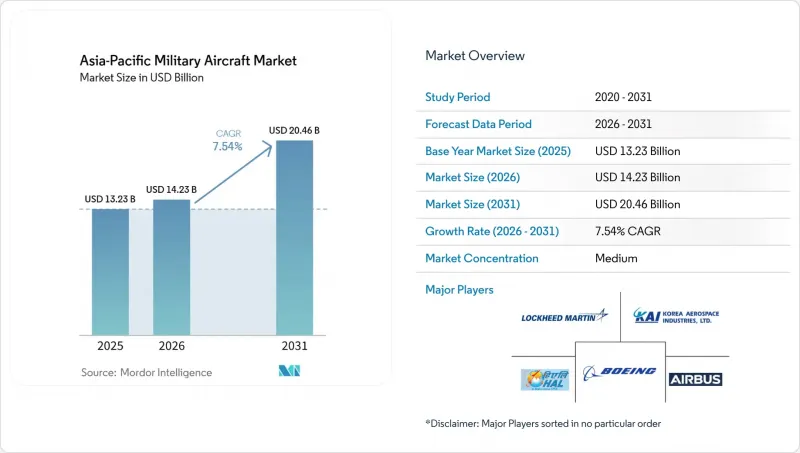
Mordor Intelligence에 의하면, 아시아태평양 군용기 시장 규모는 2025년 132억 3,000만 달러에서 2026년에는 142억 3,000만 달러로 확대되어 2026-2031년까지 CAGR 7.54%로 성장을 지속하여, 2031년에는 204억 6,000만 달러에 이를 것으로 예측됩니다.
본 보고서는 항공기 유형(고정익기 및 회전익기), 최종 사용자별(공군, 육군용 항공대, 해군/해병대 항공대, 통합·특수작전부대, 기타), 추진 방식(터보팬, 터보제트, 터보프로프, 터보샤프트, 전전기식/하이브리드 전기식), 지역(중국, 인도, 일본, 기타)별로 분류되어 있습니다. 시장 전망은 금액(달러) 기준으로 제시되어 있습니다.
아시아태평양 군용기 시장 동향과 인사이트
급속한 함대 현대화 프로그램이 조달 주기를 가속화
1980년대와 1990년대에 도입된 노후화된 전투기가 기체 비행 시간의 임계치에 도달하고 있어 조기 퇴역이 불가피할 뿐만 아니라, F-35, 라팔, KF-21 등의 항공기 긴급 조달을 촉진하고 있습니다. F-15J 각 기종을 예정보다 앞당겨 퇴역시키기로 한 도쿄의 결정은 전투 태세를 회복하기 위해 타이팽 기단을 대체할 블랙호크 조달을 가속화한 캔버라의 움직임과 유사합니다. 갱신 일정을 앞당김에 따라 평가 기간이 단축되어, 실적이 입증된 다목적 설계로 단기간 내 납품이 가능한 기종이 유리해지고 있습니다. 그 결과, 동시에 진행되는 프로젝트가 증가함에 따라 공급업체의 수익이 향상되고, 견고한 예비 부품 공급 체제가 유지되고 있습니다.
국산 전투기 개발 노력이 산업 기반을 재구축
인도의 AMCA나 한국의 KF-21과 같은 차세대 프로그램은 단가당 비용 효율성보다 국내 산업 정책을 우선시하고 있습니다. 각국 정부는 항공 프로젝트를 국가의 연구개발, 일자리 창출, 수출 확대를 위한 전략적 축으로 규정함으로써 예산 지원을 확보하고, 선거 주기의 압력으로부터 프로그램을 보호하고 있습니다. 유럽과 미국의 OEM 기업들은 시장 내 입지를 유지하기 위해 공동 개발에 참여하거나 현지에서 부가가치를 높이는 방식으로 대응하고 있습니다.
사이버·우주 부문으로의 예산 재분배가 항공 부문 지출을 제약
일본이 2024년에 항공기 조달 예산을 현 수준으로 유지하면서, 위성 군집 및 사이버 부대에 대한 자금을 대폭 증액하기로 결정한 것은 정보 우위 확립을 위한 전략적 전환을 의미합니다. 이러한 예산 재분배는 호주나 한국과 같은 국가들 역시 우주·사이버 역량에 대한 투자를 우선시하고 있다는 점에서 보다 광범위한 지역적 동향과 일치합니다. 이러한 전환은 현대 전쟁에서 정보 수집, 모니터링, 안전한 통신, 사이버 회복력의 중요성이 높아지고 있음을 여실히 보여줍니다. 그 결과, 기존 항공 프로그램, 특히 훈련기나 구형 기체 업그레이드와 관련된 프로그램은 단기적인 예산 제약에 직면해 있습니다. 이러한 제약으로 인해 조종사 훈련이 지연되거나 현대화 노력이 늦어질 가능성이 있어, 기존 플랫폼에 주력하는 항공우주 제조업체들에게 과제가 되고 있습니다.
부문 분석
2025년에는 다목적 전투기가 단일 임무용 제트기를 대체했고, 2031년까지 연평균 성장률(CAGR) 8.04%라는 빠른 속도로 시장이 확대된 결과, 고정익기 모델이 시장 점유율의 84.83%를 차지했습니다. 이러한 시장 규모 우위는 F-35, KF-21, 라팔기를 선호하는 일본, 한국, 호주로부터의 대규모 수주에 기인합니다. 한편, 전자전형 및 정보 수집 플랫폼은 수량은 적지만 계약 금액이 고액이기 때문에 공급업체의 이익률을 뒷받침하고 있습니다.
회전익기의 조달 동향은 이와는 다른 곡선을 그리고 있으며, 수 분 만에 수송 임무에서 전투 임무로 전환이 가능한 모듈식 설계가 재정적 제약이 있는 구매자들의 관심을 끌고 있습니다. 각국 정부가 수직 이착륙의 범용성을 우선시하며 속도 저하를 수용함에 따라, MH-60M, AW139, 다목적 해상 헬리콥터의 수주가 증가하고 있습니다. 리스 계약이나 시간 단위 과금 계약이 보급되면서, 이를 통해 설비 투자를 줄이는 동시에 애프터마켓 서비스 수요를 높이고 있습니다.
회전익기의 부활은 운용 비용 절감과 승무원 훈련 주기 단축이라는 이점을 누리고 있습니다. 그러나 이 부문은 절대액 기준으로는 다른 부문에 뒤처지고 있지만, 수색 및 구조 및 인도적 지원 임무에 대한 적응성 덕분에 국방 예산이 정체된 상황에서도 안정적인 자금 확보가 이루어지고 있습니다. 새롭게 등장한 하이브리드 전기식 실증기는 미래 효율성 측면에서 비약적인 진보를 시사하며, 제트기와의 성능 격차를 더욱 좁힐 가능성이 있습니다.
기타 혜택
- 엑셀 형식 시장 예측(ME) 시트
- 3개월간의 애널리스트 지원
자주 묻는 질문
목차
제1장 서론
제2장 조사 방법
제3장 주요 요약
제4장 주요 산업 동향
제5장 시장 구도
제6장 시장 규모와 성장 예측
제7장 경쟁 구도
제8장 시장 기회와 향후 전망
제9장 항공 산업 CEO가 직면하는 중요 전략적 과제
JHS 26.08.11According to Mordor Intelligence, the Asia-Pacific military aircraft market size is expected to grow from USD 13.23 billion in 2025 to USD 14.23 billion in 2026, and is forecast to reach USD 20.46 billion by 2031, at a 7.54% CAGR over 2026-2031.
This report is Segmented by Aircraft Type (Fixed-Wing Aircraft and Rotorcraft), End-User Service (Air Force, Army Aviation, Naval/Marine Corps Aviation, Joint/Special Operations, and More), Propulsion Type (Turbofan, Turbojet, Turboprop, Turboshaft, and Fully Electric/Hybrid-Electric), and Geography (China, India, Japan, and More). The Market Forecasts are Provided in Terms of Value (USD).
Asia-Pacific Military Aircraft Market Trends and Insights
Rapid Fleet-Modernization Programs Accelerate Procurement Cycles
Aging fighters from the 1980s and 1990s reach critical airframe-hour thresholds, compelling early retirements and driving urgent procurement of F-35, Rafale, and KF-21 aircraft. Tokyo's decision to phase out the F-15J variants ahead of schedule mirrors Canberra's accelerated Black Hawk buy, which replaced the Taipan fleet to restore readiness. Faster replacement timetables shorten evaluation windows, favoring proven multi-role designs with quick delivery slots. The resulting volume of concurrent projects lifts supplier revenues and sustains robust spares pipelines.
Indigenous Fighter Development Initiatives Reshape Industrial Base
New-generation programs such as India's AMCA and South Korea's KF-21 elevate domestic industrial policy above per-unit cost efficiencies. Governments frame aviation projects as strategic pillars for national R&D, job creation, and export growth, thereby securing budgetary support and insulating programs from the pressures of election cycles. Western OEMs answer with co-development roles and deeper local value-addition to retain market presence.
Budget Re-prioritization to Cyber and Space Domains Constrains Aviation Outlays
Japan's decision to substantially increase funding for satellite constellations and cyber units in 2024, while maintaining flat budgets for aircraft procurement, signifies a strategic shift toward achieving information dominance. This reallocation aligns with a broader regional trend, as countries like Australia and South Korea also prioritize investments in space and cyber capabilities. The shift underscores the growing significance of intelligence, surveillance, secure communications, and cyber resilience in contemporary warfare. Consequently, traditional aviation programs, particularly those involving trainer aircraft and upgrades to legacy fleets, are experiencing near-term budgetary constraints. These limitations may slow pilot training and delay modernization efforts, posing challenges for aerospace manufacturers focused on conventional platforms.
Other drivers and restraints analyzed in the detailed report include:
- Shift to Multi-Domain Operations Doctrine Drives Integrated Platform Requirements
- Growing Maritime Security Threats Accelerate Naval Aviation Procurement
- Protracted Certification Timelines for New-Generation Trainers Slow Fleet Renewal
For complete list of drivers and restraints, kindly check the Table Of Contents.
Segment Analysis
Fixed-wing models accounted for an 84.83% market share in 2025 as multirole fighters replaced single-mission jets at a brisk 8.04% CAGR through 2031. This market size advantage stems from large orders from Japan, South Korea, and Australia, which favor the F-35, KF-21, and Rafale fleets. Concurrently, electronic warfare variants and intelligence platforms expand in lower volumes, yet they carry high contract values, sustaining supplier margins.
Rotorcraft procurement follows a different curve, where modular designs that switch from lift to combat duty in minutes attract fiscally constrained buyers. Orders for the MH-60M, AW139, and multi-role maritime helicopters increase as governments accept lower speeds in exchange for vertical lift versatility. Leasing and power-by-the-hour contracts are gaining traction, reducing capital expenditures while increasing aftermarket service demand.
The rotorcraft renaissance benefits from lower operating costs and faster crew training cycles. However, the segment trails in absolute dollars, its adaptability to search-and-rescue and humanitarian missions secures steady funding even in flat defense budgets. Emerging hybrid-electric demonstrators hint at future efficiency breakthroughs that could further narrow the performance gap with jets.
Complete Report Scope:
- By Aircraft Type
- Fixed-Wing Aircraft
- Multi-role Aircraft
- Training Aircraft
- Transport Aircraft
- Others
- Rotorcraft
- Multi-Mission Helicopters
- Transport Helicopters
- Others
- Fixed-Wing Aircraft
- By End-User Service
- Air Force
- Army Aviation
- Naval/Marine Corps Aviation
- Joint/Special Operations
- Paramilitary and Coast Guard
- By Propulsion Type
- Turbofan
- Turbojet
- Turboprop
- Turboshaft
- Fully Electric/Hybrid-Electric
- By Geography
- China
- India
- Japan
- South Korea
- Indonesia
- Australia
- Rest of Asia-Pacific
List of Companies Covered in this Report:
- Airbus SE
- Aviation Industry Corporation of China
- Dassault Aviation SA
- Embraer S.A.
- Hindustan Aeronautics Limited
- Korea Aerospace Industries, Ltd.
- Leonardo S.p.A.
- Lockheed Martin Corporation
- Textron Inc.
- The Boeing Company
- Northrop Grumman Corporation
- Saab AB
- United Aircraft Corporation
- Mitsubishi Heavy Industries, Ltd.
- PT Dirgantara Indonesia (Persero)
- BAE Systems plc
- Kawasaki Heavy Industries, Ltd.
Additional Benefits:
- The market estimate (ME) sheet in Excel format
- 3 months of analyst support
TABLE OF CONTENTS
1 INTRODUCTION
- 1.1 Study Assumptions and Market Definition
- 1.2 Scope of the Study
2 RESEARCH METHODOLOGY
3 EXECUTIVE SUMMARY
4 KEY INDUSTRY TRENDS
- 4.1 Gross Domestic Product
- 4.2 Active Fleet Data
- 4.3 Defense Spending
5 MARKET LANDSCAPE
- 5.1 Market Overview
- 5.2 Market Drivers
- 5.2.1 Rapid fleet-modernization programs
- 5.2.2 Indigenous fighter development initiatives
- 5.2.3 Shift-to-multi-domain operations doctrine
- 5.2.4 Growing maritime security threats
- 5.2.5 Defense offset policies favoring local production
- 5.2.6 Hydrogen-electric propulsion R&D pilots
- 5.3 Market Restraints
- 5.3.1 Budget re-prioritization to cyber and space domains
- 5.3.2 Protracted certification timelines for new-gen trainers
- 5.3.3 Rotorcraft sustainment skill-gap in Tier-2 economies
- 5.3.4 Export-control choke-points on advanced engines
- 5.4 Value Chain Analysis
- 5.5 Regulatory Landscape
- 5.6 Technological Outlook
- 5.7 Porter's Five Forces Analysis
- 5.7.1 Threat of New Entrants
- 5.7.2 Bargaining Power of Suppliers
- 5.7.3 Bargaining Power of Buyers
- 5.7.4 Threat of Substitutes
- 5.7.5 Intensity of Competitive Rivalry
6 MARKET SIZE AND GROWTH FORECASTS (VALUE)
- 6.1 By Aircraft Type
- 6.1.1 Fixed-Wing Aircraft
- 6.1.1.1 Multi-role Aircraft
- 6.1.1.2 Training Aircraft
- 6.1.1.3 Transport Aircraft
- 6.1.1.4 Others
- 6.1.2 Rotorcraft
- 6.1.2.1 Multi-Mission Helicopters
- 6.1.2.2 Transport Helicopters
- 6.1.2.3 Others
- 6.1.1 Fixed-Wing Aircraft
- 6.2 By End-User Service
- 6.2.1 Air Force
- 6.2.2 Army Aviation
- 6.2.3 Naval/Marine Corps Aviation
- 6.2.4 Joint/Special Operations
- 6.2.5 Paramilitary and Coast Guard
- 6.3 By Propulsion Type
- 6.3.1 Turbofan
- 6.3.2 Turbojet
- 6.3.3 Turboprop
- 6.3.4 Turboshaft
- 6.3.5 Fully Electric/Hybrid-Electric
- 6.4 By Geography
- 6.4.1 China
- 6.4.2 India
- 6.4.3 Japan
- 6.4.4 South Korea
- 6.4.5 Indonesia
- 6.4.6 Australia
- 6.4.7 Rest of Asia-Pacific
7 COMPETITIVE LANDSCAPE
- 7.1 Market Concentration
- 7.2 Strategic Moves
- 7.3 Market Share Analysis
- 7.4 Company Profiles (includes Global level Overview, Market level overview, Core Segments, Financials as available, Strategic Information, Market Rank/Share for key companies, Products and Services, and Recent Developments)
- 7.4.1 Airbus SE
- 7.4.2 Aviation Industry Corporation of China
- 7.4.3 Dassault Aviation SA
- 7.4.4 Embraer S.A.
- 7.4.5 Hindustan Aeronautics Limited
- 7.4.6 Korea Aerospace Industries, Ltd.
- 7.4.7 Leonardo S.p.A.
- 7.4.8 Lockheed Martin Corporation
- 7.4.9 Textron Inc.
- 7.4.10 The Boeing Company
- 7.4.11 Northrop Grumman Corporation
- 7.4.12 Saab AB
- 7.4.13 United Aircraft Corporation
- 7.4.14 Mitsubishi Heavy Industries, Ltd.
- 7.4.15 PT Dirgantara Indonesia (Persero)
- 7.4.16 BAE Systems plc
- 7.4.17 Kawasaki Heavy Industries, Ltd.
8 MARKET OPPORTUNITIES AND FUTURE OUTLOOK
- 8.1 White-space and Unmet-Need Assessment