|
시장보고서
상품코드
2100733
북미의 군용 항공기 시장 : 점유율 분석, 업계 동향 및 통계, 성장 예측(2026-2031년)North America Military Aircraft - Market Share Analysis, Industry Trends & Statistics, Growth Forecasts (2026 - 2031) |
||||||
 Mordor Intelligence
Mordor Intelligence에 의하면, 북미 군용 항공기 시장 규모는 2025년 189억 9,000만 달러에서 2026년에는 199억 3,000만 달러로 확대되어 2026년부터 2031년까지 CAGR 4.80%로 성장을 지속하여, 2031년에는 251억 9,000만 달러에 이를 것으로 예측됩니다.
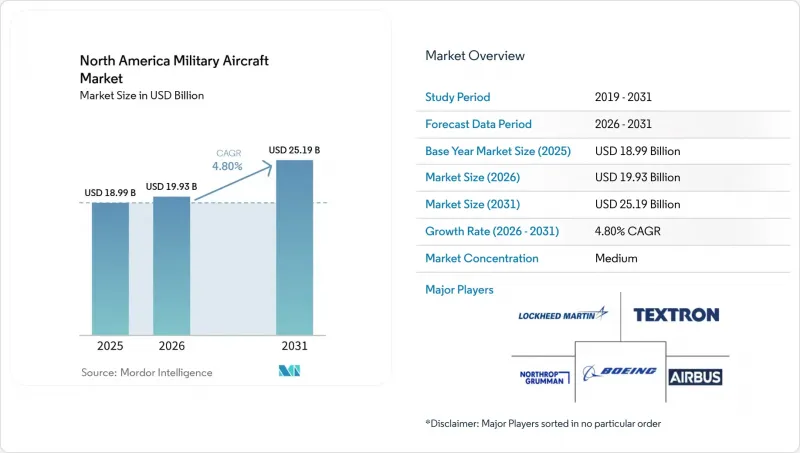
본 보고서는 항공기 유형(고정익기 및 회전익기), 최종 사용자 기관(공군, 육군용 항공대, 해군/해병대 항공대, 통합·특수작전부대 등), 추진 방식(터보팬, 터보제트, 터보프로프, 터보샤프트, 전전기식/하이브리드 전기식), 지역(미국, 캐나다, 멕시코)별로 분류되어 있습니다. 시장 전망은 금액(달러) 기준으로 제시되어 있습니다.
북미 군용 항공기 시장 동향과 인사이트
유지보수가 중심이 되는 F-35 프로그램이 애프터마켓 수요를 견인
F-35의 인도 대수는 2025년에 프로그램 사상 최고치를 기록했으며, 현재 도입 기단을 둘러싼 지역별 지출은 유지보수, 예비 부품 및 정비 거점의 역량으로 전환되고 있어, 이로 인해 주요 제조업체 및 Tier 2·3 공급업체의 수익 구성에 변화가 발생하고 있습니다. 미국 해군은 2025년 말부터 2030년대 초반까지 전 세계 공급망과 함대의 즉각 대응 태세를 포괄하는 물류 지원 계약 개정을 승인했습니다. 이는 북미 군용 항공기 시장에서 해당 플랫폼의 애프터마켓 수요가 높음을 보여주는 지표입니다. 캐나다의 F-35A 88대 도입은 국내 유지보수 업무에 대한 산업계의 참여를 정착시키고, 훈련 장비 및 부품 오버홀까지 확대되어 국경을 초월한 MRO(정비·수리·오버홀) 체제를 강화하고 있습니다. 2024 회계연도, 미국 공군의 임무 수행 가능률은 목표를 하회했습니다. 이에 따라 기술 데이터 접근성, 부품 확보 가능성, 정비 요원의 처리 능력에 대한 관심이 높아지면서, 항공기의 지상 대기 시간을 단축하고 출격 횟수를 향상시키기 위한 노력이 진행되고 있습니다. 유지관리 계약 규모 및 예비 부품 비축과 관련된 노력은 생산 확대가 지속되는 가운데에서도 애프터마켓의 성장이 이제 북미 군용 항공기 시장의 핵심 원동력이 되고 있음을 뒷받침하고 있습니다.
미국의 ‘국가방위전략’이 차세대 폭격기 및 급유기 예산을 뒷받침
전략적 억지력의 우선순위에 따라 KC-46 급유기와 B-21 폭격기는 미국 항공기 조달에서 계속해서 최우선 과제로 남아 있으며, 급유기 프로그램은 2025년에 100호기 인도를 기록하고, 이전의 손실 계상에도 불구하고 추가 물량을 확보하고 있습니다. 미국 공군은 2026년 초, B-21의 생산 능력을 확대하기 위해 45억 달러 규모의 계약을 체결했습니다. 이를 통해 2027년 실전 배치를 위한 일정이 앞당겨졌으며, 도장, 복합재료, 임무 시스템 각 공급업체에 대한 장기적인 전망이 확보되었습니다. 미래 플랫폼을 위한 적응형 추진 시스템 및 연비 효율 개선에 대한 지속적인 투자는 수명 주기 비용 관리를 지원하는 동시에, 차세대 임무에서 항속 거리와 적재량의 우위를 실현할 것입니다. 이를 종합해 볼 때, 이러한 노력은 장기 주기가 필요한 폭격기 및 급유기 부대에 걸친 북미 군용 항공기 시장 수요 전망을 뒷받침하는 동시에, 캐나다의 동맹국 간 상호 운용성 이점을 강화하게 될 것입니다.
공급망 내 티타늄 및 복합재료 부족이 생산 확대를 제약
2025년에 정점을 찍은 티타늄 및 첨단 복합재료공급 차질로 인해 리드타임이 장기화되고 비용이 상승하여 수송기, 전투기, 회전익기 각 생산 라인의 안정성에 영향을 미쳤습니다. KC-46 급유기의 경우, 2026년 초에 추가 손실이 발생했으나, 경영진은 이를 공급망 경색에 기인한 것으로 보고 있으며, 자재 공급이 어려운 상황에서 고정 가격 개발·생산 계약의 이익률 취약성을 여실히 드러냈습니다. 프로그램 관리자들은 부품 수를 줄이고 자재를 다각화하기 위해 디지털 제조 및 적층 가공 전략에 대한 의존도를 높였습니다. 여기에는 조달이 어려운 금속 대신 코발트-크롬 합금을 사용한 3D 프린팅 방식의 연료 노즐도 포함됩니다. 대형 주계약업체는 수직 통합을 활용해 위험을 완화할 수 있지만, 중소 공급업체들은 유동성 및 운전 자금 부족에 직면해 있어, 이로 인해 납기 지연이나 생산 확대 속도의 정체로 이어질 가능성이 있습니다. 이러한 압박은 북미 군용 항공기 시장의 매출 성장세를 둔화시키고 있으며, 투입 비용을 안정화하기 위한 공급업체 개발 및 다년 계약에 대한 관심을 높이고 있습니다.
부문 분석
2025년 기준, 고정익기 플랫폼은 북미 군용 항공기 시장 점유율의 88.21%를 차지하고 있으며, 2031년까지 연평균 성장률(CAGR) 5.67%를 나타낼 것으로 예측됩니다. 연말 F-35 인도 대수가 사상 최고치를 기록하고, B-21의 소량 생산이 진행됨에 따라 스텔스기 및 다목적기 편대의 주도적 지위가 더욱 공고해지고 있습니다. 또한, 구형 제트기의 수명 연장 프로그램이 시장을 뒷받침하고 있습니다. 이러한 프로그램은 재자본화 위험을 줄이면서 연결성과 생존성을 향상시킵니다. 수명 연장(SLM) 프로그램은 기체의 수명을 연장하고 정비 공장의 업무량을 유지합니다. 또한, C-130J를 중심으로 한 대규모 수송기 편대는 현역 부대와 예비역 부대를 불문하고 전구 내 기동성에 대한 수요를 확보하고 있습니다. 훈련기 조달을 통해 신규 조종사 및 교관 요원의 양성이 촉진되며, 주요 시설에서의 생산 지속성을 유지하는 데 도움이 되는 안정적인 수주가 이루어지고 있습니다.
회전익 항공기에 대한 투자는 보다 소규모의 기반에서 확대되고 있으며, 비행 시간당 사용 빈도가 높은 항공기의 보충을 담당하는 중량 수송, 공격, 특수 임무용 파생형에 중점을 두고 있습니다. 2025년 및 2026년의 ‘아파치’와 ‘치누크’ 수주는 생산 라인을 유지하고 블록 개량에 자금을 공급했습니다. 한편, 육군의 미래 수직 이착륙기 관련 노력은 틸트로터를 포지셔닝하여 장기적인 부대 설계 옵션을 형성하는 것입니다. 항속 거리, 적재량, 네트워크 통합을 향상시키는 현대화 로드맵은 프로그램의 정당성을 뒷받침할 뿐만 아니라, 수명 주기 전반에 걸친 업그레이드를 지원하며, 이는 북미 군용 항공기 시장의 유지보수 생태계로 파급되고 있습니다. 특수 작전, 의료 후송, 전투 수색 및 구조를 위한 임무 특화형 파생 기종은 최상위 사양을 유지하며, 분산형 작전 교리에서 회전익기의 역할을 강화하고 있습니다.
기타 혜택:
- 엑셀 형식 시장 예측(ME) 시트
- 3개월간의 애널리스트 지원
자주 묻는 질문
목차
제1장 서론
제2장 조사 방법
제3장 주요 요약
제4장 주요 업계 동향
제5장 시장 구도
제6장 시장 규모와 성장 예측
제7장 경쟁 구도
제8장 시장 기회와 향후 전망
JHSAccording to Mordor Intelligence, the North America military aircraft market size is expected to grow from USD 18.99 billion in 2025 to USD 19.93 billion in 2026 and is forecasted to reach USD 25.19 billion by 2031 at a 4.80% CAGR over 2026-2031.
This report is Segmented by Aircraft Type (Fixed-Wing Aircraft and Rotorcraft), End-User Service (Air Force, Army Aviation, Naval/Marine Corps Aviation, Joint/Special Operations, and More), Propulsion Type (Turbofan, Turbojet, Turboprop, Turboshaft, and Fully Electric/Hybrid-Electric), and Geography (United States, Canada, and Mexico). The Market Forecasts are Provided in Terms of Value (USD).
North America Military Aircraft Market Trends and Insights
Sustainment-Heavy F-35 Program Drives Aftermarket Demand
F-35 deliveries reached a program record in 2025, and the installed base is now pivoting regional spending toward sustainment, spares, and depot capacity, which is altering the revenue mix for primes and Tier 2 or 3 suppliers. The US Navy awarded a logistics support modification in late 2025 that covers global supply chains and fleet readiness through the early 2030s, a marker of the platform's aftermarket intensity in the North America military aircraft market. Canada's 88 F-35A acquisition embeds industrial participation in domestic sustainment work, extending to training devices and component overhaul, strengthening a cross-border MRO footprint. US Air Force mission-capable rates lagged service goals in FY2024, which heightened attention on technical data access, parts availability, and maintainer throughput to reduce aircraft-on-ground time and improve sortie generation. The scale of sustainment contracts and stockpiled spares initiatives underscores that aftermarket growth is now a central driver of the North America military aircraft market, even as production ramps continue.
The US National Defense Strategy Boosts Next-Gen Bomber and Tanker Budgets
Strategic deterrence priorities keep the KC-46 tanker and B-21 bomber at the forefront of US aircraft procurement, with the tanker program recording its 100th delivery in 2025 and securing additional lots despite earlier loss charges. The US Air Force signed a USD 4.5 billion agreement in early 2026 to expand B-21 production capacity, compressing schedules toward 2027 operational fielding and providing long-term visibility for suppliers in coatings, composites, and mission systems. Continued investment in adaptive propulsion and fuel-efficiency improvements for future platforms also supports lifecycle cost control while enabling range and payload advantages for next-generation missions. Taken together, these commitments underpin the demand outlook for the North America military aircraft market across long-cycle bomber and tanker fleets while reinforcing allied interoperability benefits for Canada.
Supply-Chain Titanium and Composite Shortages Constrain Ramp-Ups
Titanium and advanced composite supply disruptions that peaked during 2025 lengthened lead times and raised costs, affecting production stability for transport, fighter, and rotorcraft lines. The KC-46 tanker incurred an additional loss charge in early 2026, which management linked to supply chain pressures, highlighting the margin sensitivity of fixed-price development and production contracts under material stress. Program managers increased reliance on digital manufacturing and additive strategies to reduce part counts and diversify materials, including 3D-printed fuel nozzles that use cobalt-chrome alloys in place of harder-to-source metals. While large primes can deploy vertical integration to mitigate risk, smaller suppliers face liquidity and working capital strains that can delay deliveries and stall ramp rates. These pressures temper top-line momentum in the North America military aircraft market and focus attention on supplier development and multi-year agreements to stabilize input costs.
Other drivers and restraints analyzed in the detailed report include:
- Canada's Future Fighter Capability Project Procurement
- Shift Toward Optionally-Manned Combat Aircraft Loyal Wingmen
- Congressional CRs Delay Long-Lead Funding Releases
For complete list of drivers and restraints, kindly check the Table Of Contents.
Segment Analysis
Fixed-wing platforms accounted for 88.21% of the North America military aircraft market share in 2025 and are expected to grow at a CAGR of 5.67% through 2031, with year-end F-35 deliveries setting a record and low-rate B-21 production advancing, reinforcing the leadership of stealth and multi-role fleets. The market is further supported by life-extension programs for legacy jets that reduce recapitalization risk while adding connectivity and survivability upgrades. Service Life Modification programs extend fleet lives and sustain depot workload, and a large transport fleet centered on the C-130J secures intra-theater mobility demand across active and reserve components. Training aircraft procurement supports throughput for new pilots and instructor cadres, adding a steady tranche of orders that help maintain production continuity at key facilities.
Rotorcraft investment grows from a smaller base and is oriented toward heavy-lift, attack, and special-mission variants that backfill aircraft with high flight-hour intensity. Apache and Chinook orders in 2025 and 2026 sustained lines and funded block improvements, while Army future vertical-lift efforts position tiltrotors to shape long-term force design choices. Modernization paths that add range, payload, and network integration underpin program justification and support lifecycle upgrades that cascade into the sustainment ecosystem of the North America military aircraft market. Missionized derivatives for special operations, medical evacuation, and combat search and rescue retain premium configurations and reinforce rotorcraft's role in distributed operations doctrines.
Complete Report Scope:
- By Aircraft Type
- Fixed-Wing Aircraft
- Multi-role Aircraft
- Training Aircraft
- Transport Aircraft
- Other Aircraft
- Rotorcraft
- Multi-Mission Helicopter
- Transport Helicopter
- Other Helicopter
- Fixed-Wing Aircraft
- By End-User Service
- Air Force
- Army Aviation
- Naval/Marine Corps Aviation
- Joint/Special Operations
- Paramilitary and Coast Guard
- By Propulsion Type
- Turbofan
- Turbojet
- Turboprop
- Turboshaft
- Fully Electric/Hybrid-Electric
- By Geography
- United States
- Canada
- Mexico
List of Companies Covered in this Report:
- Lockheed Martin Corporation
- The Boeing Company
- Northrop Grumman Corporation
- Textron Inc.
- Leonardo S.p.A.
- Airbus SE
- Gulfstream Aerospace Corporation (General Dynamics Corporation)
- Bombardier Inc.
- Embraer S.A.
- Korea Aerospace Industries, Ltd.
- Turkish Aerospace Industries, Inc.
- Dassault Aviation S.A.
- Israel Aerospace Industries Ltd.
Additional Benefits:
- The market estimate (ME) sheet in Excel format
- 3 months of analyst support
TABLE OF CONTENTS
1 INTRODUCTION
- 1.1 Study Assumptions and Market Definition
- 1.2 Scope of the Study
2 RESEARCH METHODOLOGY
3 EXECUTIVE SUMMARY
4 KEY INDUSTRY TRENDS
- 4.1 Gross Domestic Product
- 4.2 Active Fleet Data
- 4.3 Defense Spending
5 MARKET LANDSCAPE
- 5.1 Market Overview
- 5.2 Market Drivers
- 5.2.1 Sustainment-heavy F-35 program drives aftermarket demand
- 5.2.2 The US National Defense Strategy boosts next-gen bomber and tanker budgets
- 5.2.3 Canada's Future Fighter Capability Project (FFCP) procurement
- 5.2.4 Shift toward optionally-manned combat aircraft (loyal wingmen)
- 5.2.5 Additive manufacturing of legacy parts cuts AOG time
- 5.2.6 Modular open-systems avionics mandate accelerates retrofit cycles
- 5.3 Market Restraints
- 5.3.1 Supply-chain titanium and composite shortages constrain ramp-ups
- 5.3.2 Congressional CRs delay long-lead funding releases
- 5.3.3 Skilled military aviation technician shortage
- 5.3.4 Noise and emissions caps near bases restrict flight-hour allocations
- 5.4 Value Chain Analysis
- 5.5 Regulatory Outlook
- 5.6 Technological Outlook
- 5.7 Porter's Five Forces Analysis
- 5.7.1 Bargaining Power of Suppliers
- 5.7.2 Bargaining Power of Buyers/Consumers
- 5.7.3 Threat of New Entrants
- 5.7.4 Threat of Substitute Products
- 5.7.5 Intensity of Competitive Rivalry
6 MARKET SIZE AND GROWTH FORECASTS (VALUE)
- 6.1 By Aircraft Type
- 6.1.1 Fixed-Wing Aircraft
- 6.1.1.1 Multi-role Aircraft
- 6.1.1.2 Training Aircraft
- 6.1.1.3 Transport Aircraft
- 6.1.1.4 Other Aircraft
- 6.1.2 Rotorcraft
- 6.1.2.1 Multi-Mission Helicopter
- 6.1.2.2 Transport Helicopter
- 6.1.2.3 Other Helicopter
- 6.1.1 Fixed-Wing Aircraft
- 6.2 By End-User Service
- 6.2.1 Air Force
- 6.2.2 Army Aviation
- 6.2.3 Naval/Marine Corps Aviation
- 6.2.4 Joint/Special Operations
- 6.2.5 Paramilitary and Coast Guard
- 6.3 By Propulsion Type
- 6.3.1 Turbofan
- 6.3.2 Turbojet
- 6.3.3 Turboprop
- 6.3.4 Turboshaft
- 6.3.5 Fully Electric/Hybrid-Electric
- 6.4 By Geography
- 6.4.1 United States
- 6.4.2 Canada
- 6.4.3 Mexico
7 COMPETITIVE LANDSCAPE
- 7.1 Market Concentration
- 7.2 Strategic Moves
- 7.3 Market Share Analysis
- 7.4 Company Profiles (includes Global level Overview, Market level overview, Core Segments, Financials as available, Strategic Information, Market Rank/Share for key companies, Products and Services, and Recent Developments)
- 7.4.1 Lockheed Martin Corporation
- 7.4.2 The Boeing Company
- 7.4.3 Northrop Grumman Corporation
- 7.4.4 Textron Inc.
- 7.4.5 Leonardo S.p.A.
- 7.4.6 Airbus SE
- 7.4.7 Gulfstream Aerospace Corporation (General Dynamics Corporation)
- 7.4.8 Bombardier Inc.
- 7.4.9 Embraer S.A.
- 7.4.10 Korea Aerospace Industries, Ltd.
- 7.4.11 Turkish Aerospace Industries, Inc.
- 7.4.12 Dassault Aviation S.A.
- 7.4.13 Israel Aerospace Industries Ltd.
8 MARKET OPPORTUNITIES AND FUTURE OUTLOOK
- 8.1 White-space and Unmet-Need Assessment