

|
시장보고서
상품코드
2100746
북미의 폴리에테르에테르케톤(PEEK) 시장 : 점유율 분석, 업계 동향 및 통계, 성장 예측(2026-2031년)North America Polyether Ether Ketone (PEEK) - Market Share Analysis, Industry Trends & Statistics, Growth Forecasts (2026 - 2031) |
||||||
 Mordor Intelligence
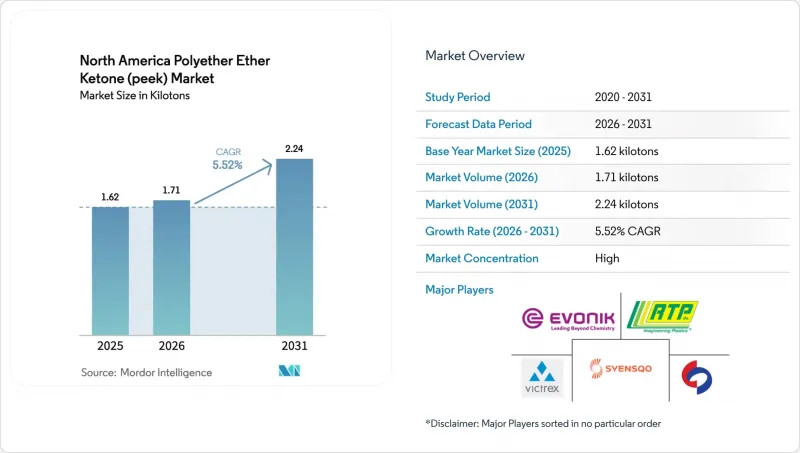
Mordor Intelligence에 의하면, 2026년 북미 폴리에테르에테르케톤(PEEK) 시장 규모는 1.71 킬로톤으로 추정되고 있어 2025년 1.62 킬로톤에서 확대해, 2031년에는 2.24 킬로톤에 이를 것으로 예측됩니다.
2026년부터 2031년까지의 연평균 성장률(CAGR)은 5.52%를 나타낼 전망입니다.
본 보고서는 최종 사용자 산업별(항공우주, 자동차, 전기 및 전자, 산업·기계, 기타 최종 사용자 산업), 보강재별(무충진, 유리 충전, 탄소 충전, 기타), 지역별(미국, 캐나다, 멕시코)로 분류되어 있습니다. 시장 전망은 수량(톤)과 금액(달러)으로 제시되어 있습니다.
북미 폴리에테르에테르케톤(PEEK) 시장 동향 및 인사이트
항공우주 부문에서의 경량화 및 FST 기준 준수
연방항공청(FAA)이 정한 화염·연기·독성 기준치는 경량화 목표와 부합하며, PEEK는 내장 패널, 연료 시스템 부품, 와이어 하네스의 금속 대체재로서 입지를 확고히 하고 있습니다. 이 수지의 밀도는 1.3g/cm³이며, 할로겐계 첨가제를 사용하지 않고도 알루미늄에 비해 40%의 경량화를 실현하므로 인증 절차가 간소화됩니다. 예비 부품의 주문형 프린팅을 통해 유지보수 주기가 단축되고 재고 관리 비용이 최소화됩니다. 또한, 지속 가능한 항공 연료의 도입으로 내화학성 튜브 및 밸브에 대한 수요가 더욱 증가하고 있습니다. 이러한 요인들이 복합적으로 작용하여 북미 항공우주 산업은 PEEK 시장의 주요 고객으로서의 입지를 더욱 공고히 하고 있습니다.
의료용 임플란트의 생체적합성에 대한 수요
뼈와 유사한 탄성 계수, 고유한 방사선 투과성, ISO 10993 세포 독성 기준 준수를 통해 척추 케이지, 두개골 플레이트, 외상 고정 장치에서 PEEK의 사용이 확대되고 있습니다. 2024년 FDA가 승인한 3D Systems의 적층 가공 방식 두개골 임플란트는 기계 가공된 블랭크에 비해 최대 85%의 재료 절감을 실현하는 동시에, 환자별로 최적화된 형태를 가능하게 했습니다. 병원 내 프린팅 센터가 확대됨에 따라 멸균이 가능하고 MRI 호환 소재에 대한 수요가 증가하고 있으며, 이는 PEEK 시장의 장기적인 소비량 증가를 뒷받침하고 있습니다.
제한된 가공업체 기반과 금형의 복잡성
PEEK의 사출 성형 및 압출 성형에는 니켈 기반 합금, 핫 러너 게이트, 180°C를 초과하는 금형 온도가 필요하기 때문에 이에 참여할 수 있는 업체는 북미의 소수 경험 많은 가공업체로 제한됩니다. 생산 능력의 제약으로 인해 수요가 급증할 경우 리드타임이 길어지는 한편, 항공우주 및 의료 분야의 품질 관리 인증이 추가적인 진입 장벽으로 작용하고 있습니다.
부문 분석
2025년, 항공우주 부문은 PEEK 시장 점유율의 55.34%를 차지했습니다. 이는 엄격한 규제 준수라는 장벽과, 재료의 높은 가격을 상쇄하는 경량화에 따른 경제성이 배경에 있습니다. 민간 항공기 제조업체들은 부식을 방지하고 난연성 기준을 충족하기 위해 PEEK로 제작된 브래킷, 씰, 전선 절연체를 지정하고 있습니다. 의료기기, 석유 및 가스용 공구, 반도체 웨이퍼 핸들링 시스템은 연평균 성장률(CAGR) 5.90%로 확대되는 가장 빠르게 성장하는 ‘기타’ 부문을 구성하고 있습니다. 수요의 다양화는 항공우주 부문의 수주 주기 변동으로부터 PEEK 시장을 보호하는 데 일조하고 있습니다.
엔진의 전동화, 연료전지 개발, 혁신적인 드론 구조의 발전으로 인해 2031년까지 항공우주 부문 수요는 계속 확대될 전망입니다. 이와 동시에, 미국 내 척추 고정술 시술 건수 증가와 보험 보상 범위의 확대가 의료용 임플란트 소비를 뒷받침하고 있습니다. 이러한 용도 전반에 걸쳐 시장 규모는 대량 생산형 성형에서 소량 생산의 정밀 기계 가공으로 가치의 중심이 이동함에 따라 확대되고 있으며, 미션 크리티컬한 부품의 구현을 가능하게 하는 소재로서 PEEK의 입지를 공고히 하고 있습니다.
기타 혜택
- 엑셀 형식 시장 예측(ME) 시트
- 3개월간의 애널리스트 지원
자주 묻는 질문
목차
제1장 서론
제2장 조사 방법
제3장 주요 요약
제4장 시장 구도
제5장 시장 규모와 성장 예측
제6장 경쟁 구도
제7장 시장 기회와 향후 전망
제8장 CEO가 직면하는 중요 전략적 과제
JHS 26.08.11According to Mordor Intelligence, the North America polyether ether ketone market size in 2026 is estimated at 1.71 kilotons, growing from 2025 value of 1.62 kilotons with 2031 projections showing 2.24 kilotons, growing at 5.52% CAGR over 2026-2031.
This report is Segmented by End-User Industry (Aerospace, Automotive, Electrical and Electronics, Industrial and Machinery, and Other End-User Industries), Reinforcement (Unfilled, Glass-Filled, Carbon-Filled, and Other), and Geography (United States, Canada, and Mexico). The Market Forecasts are Provided in Terms of Volume (Tons) and Value (USD).
North America Polyether Ether Ketone (PEEK) Market Trends and Insights
Aerospace Lightweighting and FST Compliance
Federal Aviation Administration flame, smoke, and toxicity thresholds align with weight-reduction targets, positioning PEEK as a metal substitute for interior panels, fuel-system components, and wiring harnesses. The resin's 1.3 g/cm3 density yields 40% weight savings over aluminum without halogenated additives, simplifying certification workflows. On-demand printing of spare parts shortens maintenance cycles and minimizes inventory overhead, and sustainable aviation-fuel adoption further elevates demand for chemically resistant tubing and valves. These factors collectively reinforce North American aerospace as the anchor customer for the PEEK market.
Medical-Implant Biocompatibility Demand
A bone-like elastic modulus, inherent radiolucency, and ISO 10993 cytotoxicity compliance support growing use of PEEK in spinal cages, cranial plates, and trauma fixation devices. The 2024 FDA clearance of 3D Systems' additively manufactured cranial implant demonstrated up to 85% material savings versus machined blanks while enabling patient-specific geometries. As hospital-based printing centers proliferate, demand for sterilizable, MRI-compatible materials rises, reinforcing long-term consumption growth in the PEEK market.
Limited Processor Base and Tooling Complexity
Injection-molding and extrusion of PEEK demand nickel-based alloys, hot-runner gates, and mold temperatures above 180 °C, limiting participation to a handful of experienced North American processors. Capacity constraints inflate lead times during demand spikes, while aerospace and medical quality-management certification erects additional entry barriers.
Other drivers and restraints analyzed in the detailed report include:
- EV High-Temperature Component Adoption
- Additive-Manufacturing of On-Demand Spares
- Volatile Difluoro-Benzophenone Precursor Supply
For complete list of drivers and restraints, kindly check the Table Of Contents.
Segment Analysis
Aerospace accounted for 55.34% of PEEK market share in 2025, underpinned by high regulatory compliance hurdles and weight-reduction economics that offset material premiums. Commercial airframe builders specify PEEK brackets, seals, and wire insulation to eliminate corrosion and meet flame-retardant thresholds. Medical devices, oil and gas tooling, and semiconductor wafer-handling systems comprise the fastest-growing "other" category, advancing at a 5.90% CAGR. Demand diversification helps shield the PEEK market from aerospace order-cycle volatility.
Continued engine electrification, fuel-cell development, and novel drone architectures extend aerospace pull through 2031. In parallel, rising spinal fusion procedure volumes and broader insurance reimbursement in the United States propel medical implant consumption. Across these applications, the PEEK market size expands as value shifts from high-throughput molding to low-volume precision machining, reinforcing the material's position as an enabler of mission-critical components.
Complete Report Scope:
- By End-User Industry
- Aerospace
- Automotive
- Electrical and Electronics
- Industrial and Machinery
- Other End-User Industries
- By Reinforcement
- Unfilled
- Glass-filled
- Carbon-filled
- Other
- By Geography
- United States
- Canada
- Mexico
List of Companies Covered in this Report:
- Arkema
- Avient Corporation
- Celanese Corporation
- Drake Plastics
- Ensinger
- Ensinger
- Evonik Industries AG
- JiangSu JunHua HPP Co., Ltd.
- Jilin Joinature Polymer Co., Ltd.
- Oxford Performance Materials
- Pan Jin Zhongrun High Performance Polymer Co., Ltd.
- RTP Company
- SABIC
- Syensqo
- Victrex PLC
Additional Benefits:
- The market estimate (ME) sheet in Excel format
- 3 months of analyst support
TABLE OF CONTENTS
1 Introduction
- 1.1 Study Assumptions and Market Definition
- 1.2 Scope of the Study
2 Research Methodology
3 Executive Summary
4 Market Landscape
- 4.1 Market Overview
- 4.2 Market Drivers
- 4.2.1 Aerospace lightweighting and FST compliance
- 4.2.2 Medical-implant biocompatibility demand
- 4.2.3 EV high-temperature component adoption
- 4.2.4 Additive-manufacturing of on-demand spares
- 4.2.5 USMCA-led regional PEEK supply-chain reshoring
- 4.3 Market Restraints
- 4.3.1 High raw-material and processing cost
- 4.3.2 Limited processor base and tooling complexity
- 4.3.3 Volatile difluoro-benzophenone precursor supply
- 4.4 Value Chain Analysis
- 4.5 Porter's Five Forces
- 4.5.1 Threat of New Entrants
- 4.5.2 Bargaining Power of Suppliers
- 4.5.3 Bargaining Power of Buyers
- 4.5.4 Threat of Substitutes
- 4.5.5 Competitive Rivalry
- 4.6 Regulatory Landscape
- 4.6.1 United States
- 4.6.2 Canada
- 4.6.3 Mexico
- 4.7 End-use Sector Trends
- 4.7.1 Aerospace (Aerospace Component Production Revenue)
- 4.7.2 Automotive (Automobile Production)
- 4.7.3 Building and Construction (New Construction Floor Area)
- 4.7.4 Electrical and Electronics (Electrical and Electronics Production Revenue)
- 4.7.5 Packaging(Plastic Packaging Volume)
5 Market Size and Growth Forecasts (Value and Volume)
- 5.1 By End-User Industry
- 5.1.1 Aerospace
- 5.1.2 Automotive
- 5.1.3 Electrical and Electronics
- 5.1.4 Industrial and Machinery
- 5.1.5 Other End-User Industries
- 5.2 By Reinforcement
- 5.2.1 Unfilled
- 5.2.2 Glass-filled
- 5.2.3 Carbon-filled
- 5.2.4 Other
- 5.3 By Geography
- 5.3.1 United States
- 5.3.2 Canada
- 5.3.3 Mexico
6 Competitive Landscape
- 6.1 Market Concentration
- 6.2 Strategic Moves
- 6.3 Market Share (%)/Ranking Analysis
- 6.4 Company Profiles (includes Global level Overview, Market level overview, Core Segments, Financials as available, Strategic Information, Market Rank/Share for key companies, Products and Services, and Recent Developments)
- 6.4.1 Arkema
- 6.4.2 Avient Corporation
- 6.4.3 Celanese Corporation
- 6.4.4 Drake Plastics
- 6.4.5 Ensinger
- 6.4.6 Ensinger
- 6.4.7 Evonik Industries AG
- 6.4.8 JiangSu JunHua HPP Co., Ltd.
- 6.4.9 Jilin Joinature Polymer Co., Ltd.
- 6.4.10 Oxford Performance Materials
- 6.4.11 Pan Jin Zhongrun High Performance Polymer Co., Ltd.
- 6.4.12 RTP Company
- 6.4.13 SABIC
- 6.4.14 Syensqo
- 6.4.15 Victrex PLC
7 Market Opportunities and Future Outlook
- 7.1 White-Space and Unmet-Need Assessment


