

|
시장보고서
상품코드
2100756
VR, AR 및 MR(가상현실, 증강현실 및 혼합현실) 시장 : 점유율 분석, 업계 동향 및 통계, 성장 예측(2026-2031년)Virtual, Augmented and Mixed Reality (VR/AR) - Market Share Analysis, Industry Trends & Statistics, Growth Forecasts (2026 - 2031) |
||||||
 Mordor Intelligence
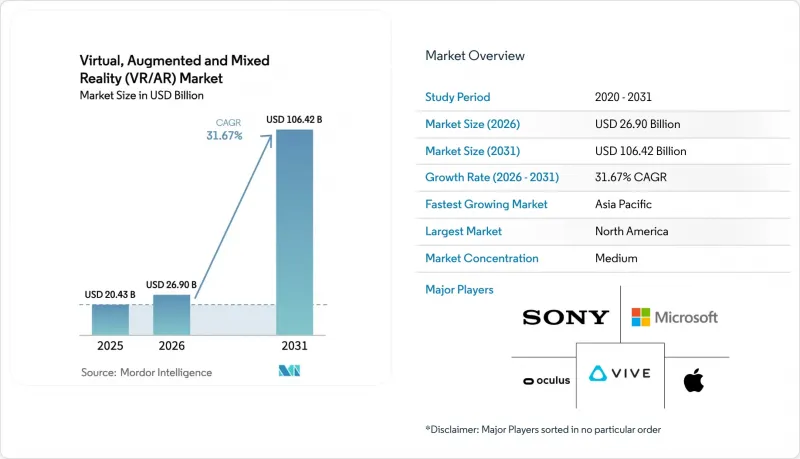
Mordor Intelligence에 의하면, VR, AR 및 MR(가상현실, 증강현실 및 혼합현실) 시장 규모는 2025년에 204억 3,000만 달러로 평가되었고 2026년 269억 달러에서 2031년까지 1,064억 2,000만 달러에 이를 것으로 예측되며, 예측 기간(2026-2031년) CAGR은 31.67%를 나타낼 전망입니다.
본 보고서는 리얼리티 유형(가상현실(VR), 증강현실(AR), 혼합현실(MR)), 구성 요소(하드웨어, 소프트웨어, 서비스), 기기 폼 팩터(소비자용 헤드셋, 기업/산업용 헤드셋, 기타), 최종 사용자(게임 및 e스포츠, 미디어 및 엔터테인먼트, 기타), 지역별로 분류되어 있습니다. 시장 전망은 금액(달러) 기준으로 제시되어 있습니다.
전 세계 VR, AR 및 MR(가상현실, 증강현실 및 혼합현실) 시장 동향과 인사이트
게임 및 e스포츠 부문에서의 폭발적인 확산
게임은 여전히 가상현실, 증강현실, 혼합현실 시장의 핵심 축을 이루고 있지만, e스포츠 및 소셜 네트워크화된 게임 세계로의 전환에 따라 사용자 기반과 세션 시간이 확대되고 있습니다. Meta는 2024년에 Quest 시리즈 헤드셋의 사상 최대 출하량을 기록했으며, 라이브 서비스 모델을 통해 컨텐츠 프랜차이즈가 확대되는 가운데 중가대 올인원 기기에 대한 수요가 입증되었습니다. VR 타이틀에 통합된 AI 기반 코칭 모듈은 프로팀의 성과를 두 자릿수 수준으로 향상시켰으며, 일반 소비자의 오락에서 고성능 훈련으로의 전환 경로를 명확히 보여주고 있습니다. 북미 시청자를 대상으로 한 크로스 플랫폼 확장을 목표로 수백만 달러 규모의 스튜디오에 자금을 조달한 사례에서도 알 수 있듯이, 투자자들의 관심은 여전히 높은 수준을 유지하고 있습니다. 프리미엄 토너먼트, 게임 내 상품 판매, 광고 지원형 관전 모드가 성숙해짐에 따라, 이 부문의 진화로 인해 사용자 1인당 평균 수익(ARPU)이 향상될 것으로 예측됩니다.
기업용 훈련 및 원격 지원 도입
VR, AR 및 MR(가상현실, 증강현실 및 혼합현실) 시장의 기업들은 측정 가능한 성과가 구체화됨에 따라, 단발성 시범 프로젝트에서 대규모 XR 도입으로 전환하고 있습니다. 의료 기관에서는 Osso VR 등의 벤더가 제공하는 시뮬레이터를 도입한 결과, 외과 수술 훈련 시간이 3분의 2로 단축되었다고 보고되고 있습니다. 지멘스(Siemens)를 비롯한 산업 부문의 선도 기업들은 안전 교육 모듈을 몰입형 형태로 전환한 결과, 인증 검사 합격률이 13% 향상된 것을 기록했으며, 한편 화학 제조업체인 BASF는 디지털 시뮬레이터를 활용하여 현장의 기술 격차 해소에 힘쓰고 있습니다. 원격 지도(텔레프로크터링) 도입을 통해 전문가 멘토가 원격지에서 시술을 지도할 수 있게 되어 출장 경비 절감과 전문가의 활동 범위 확대가 이루어지고 있는 점도 XR의 보급을 뒷받침하고 있습니다. 디지털 트윈을 도입한 경우, 1년 후 지식 회상률이 80%에 달하는 것으로 입증되는 등 학습 내용의 정착 기간이 길기 때문에 XR은 오류 허용도가 낮고 규정 준수 감사가 엄격한 규제 산업 분야에서 귀중한 자산으로서의 위상을 확립하고 있습니다.
건강 및 인체공학적 우려
헤드셋을 장시간 착용하는 것은 여전히 피로, 시각적 부담, 자세 문제를 유발하고 있으며, 업무 환경에서 장시간 세션을 진행하는 데 걸림돌이 되고 있습니다. 치과 교육 분야의 학술적 연구에서는 과도한 부담을 방지하기 위한 세션 시간 가이드라인이 필요하다는 점이 강조되고 있습니다. 반도체 제조업체들은 피로 징후가 나타날 때 작업 부하를 자동으로 조정하는 생체 인식 모니터링 기술에 대한 특허를 취득했으나, 표준화 기구에서는 아직 통일된 노출 한도치가 발표되지 않았습니다. 고성능 기기는 뛰어난 광학 성능을 갖추고 있지만, 무게가 600그램을 초과하는 경우도 있어 선명도와 편안함 사이에서 절충이 발생합니다. 법적 책임을 고려하여 기업들은 사용 시간을 단축하도록 의무화하고 있으며, 그 결과 몰입형 훈련을 통해 기대되는 생산성 향상이 상쇄되기도 합니다.
부문 분석
증강현실(AR)은 2025년 매출의 43.18%를 차지하며, 소매업에서의 착용 체험부터 조립 라인의 안내에 이르기까지 물리적 워크플로우에 컨텍스트 데이터를 중첩시키는 역할을 강화하고 있습니다. VR, AR 및 MR(가상현실, 증강현실 및 혼합현실) 시장에서는 유지보수, 내비게이션, 원격 검사 시나리오에서 신속한 투자 회수(ROI)가 기대되기 때문에 AR이 계속해서 지지를 받고 있습니다. AR 미러를 도입한 소매업체들은 반품률 감소와 전환율 향상을 보고하고 있습니다. 이와 동시에, 혼합 현실(MR)은 연평균 성장률(CAGR) 33.69%로 확대될 것으로 예측되며, 가장 빠르게 성장하는 모달리티로 자리매김하고 있습니다. 병원에서는 촉각적 시각 정보와 홀로그램 오버레이를 융합한 MR 수술 안내 시스템의 시험 운영이 진행되고 있으며, 이를 통해 시각화와 실제 동작 간의 격차를 좁히고 있습니다. 개발자들은 MR을 순수한 VR의 몰입감과 AR의 편의성을 연결하는 존재로 간주하며, 하드웨어 측면에서 큰 타협 없이 사용자층을 확대할 수 있는 중도적인 선택지라고 보고 있습니다.
복합 현실의 성장세는 더욱 경량화된 패스스루 카메라와 AI 코프로세서를 통해 정교해진 공간 매핑 알고리즘에 힘입고 있습니다. MR용 가상현실(VR), 증강현실(AR), 혼합현실(MR) 시장 규모는 2030년까지 4배로 확대될 것으로 예측되며, 이는 벤더들에게 연구개발비를 상각할 수 있을 정도의 판매 규모가 확보된다는 것을 의미합니다. 가상현실(VR)은 게임 부문에서 충성도 높은 사용자 기반을 유지하고 있지만, 경쟁 기기들이 하이브리드 기능을 내세우면서 판매 대수 증가세는 둔화되고 있습니다. 전반적으로 리얼리티 유형의 다양화는 획일적인 하드웨어에서 상황에 맞는 폼 팩터로의 전환을 시사하고 있습니다.
2025년 매출액 중 하드웨어가 56.05%를 차지하고 있으며, 이는 헤드셋, 센서, 광학 모듈의 높은 가격을 반영한 것입니다. 이러한 지배적인 지위에도 불구하고, 매니지드 서비스, 클라우드 렌더링, 분석은 구성 요소 중 가장 높은 연평균 성장률(CAGR)인 36.46%로 확대될 것으로 예측됩니다. 개념 증명(PoC) 단계를 넘어선 기업들은 기기군 관리, 컨텐츠 업데이트, 보안 패치 적용을 전문 공급업체에 위탁하고 있습니다. 성과 기반 가격 책정이 보편화됨에 따라, 서비스 계약에 할당되는 VR, AR 및 MR(가상현실, 증강현실 및 혼합현실) 시장 규모는 2028년까지 소프트웨어 라이선싱 규모를 넘어설 전망입니다.
소프트웨어 엔진은 여전히 중요하지만, 노코드 대시보드와 AI 지원형 크리에이터 툴의 배후에서 점차 추상화가 진행되고 있습니다. 범용 칩셋과 상품화된 광학 시스템이 결합되면서 하드웨어의 이익률은 압박받고 있으며, 이익의 원천은 이용 현황이나 훈련 효과를 모니터링하는 구독형 대시보드로 이동하고 있습니다. ArborXR 등의 벤더가 통합한 분석 플랫폼은 헤드셋 도입 현황과 직원의 생산성을 연결하는 세션 수준의 KPI를 대시보드에 제공하여, CFO의 심사를 엄격하게 하는 동시에 예산 갱신의 근거가 되고 있습니다.
지역별 분석
북미는 계속해서 VR, AR 및 MR(가상현실, 증강현실 및 혼합현실) 시장을 주도하고 있으며, 벤처 자금, 방위 계약, 소프트웨어 스튜디오의 긴밀한 생태계에 힘입어 2025년에는 전 세계 매출의 27.45%를 차지합니다. 공개 자료에 따르면, 메타(Meta)만 해도 연간 200억 달러에 가까운 금액을 XR에 투자하고 있어 공급망 기반을 공고히 하고 부품 제조업체를 유치하고 있습니다. 데이터 개인정보 보호 및 수출 규제에 관한 규정이 명확해짐에 따라 기업의 신뢰도가 높아지는 한편, 주요 대도시권에서 5G 미드밴드 커버리지 확대가 클라우드 렌더링을 통한 워크플로우를 뒷받침하고 있습니다.
아시아태평양은 가장 빠르게 성장하는 지역으로, 2031년까지 연평균 34.57%의 성장률이 예상됩니다. 정부의 이니셔티브이 국내 생태계 구축을 촉진하고 있습니다. 한국은 2026년까지 메타버스 부문에서 세계 상위 5위권 진입을 목표로 하고 있으며, 중국은 XR을 ‘미래 산업’ 중 하나로 지정하고 성(省) 차원의 보조금을 통해 연구개발(R&D)에 자금을 지원하고 있습니다. 일본과 대만에 본사를 둔 부품 공급망은 전 세계 OEM에 광학 부품, 센서, ASIC을 공급하며, 리드타임 단축과 공동 개발 프로그램 촉진에 기여하고 있습니다. 주요 통신사들이 독립형 5G 코어를 구축하는 가운데, 싱가포르, 인도, 호주에서는 VR, AR 및 MR(가상현실, 증강현실 및 혼합현실) 시장에 대한 신규 투자가 계속해서 몰리고 있습니다.
기타 혜택
- 엑셀 형식 시장 예측(ME) 시트
- 3개월간의 애널리스트 지원
자주 묻는 질문
목차
제1장 서론
제2장 조사 방법
제3장 주요 요약
제4장 시장 구도
제5장 시장 규모와 성장 예측
제6장 경쟁 구도
제7장 시장 기회와 향후 전망
JHS 26.08.11According to Mordor Intelligence, the virtual augmented and mixed reality market size was valued at USD 20.43 billion in 2025 and estimated to grow from USD 26.9 billion in 2026 to reach USD 106.42 billion by 2031, at a CAGR of 31.67% during the forecast period (2026-2031).
This report is Segmented by Reality Type (Virtual Reality (VR), Augmented Reality (AR), Mixed Reality (MR)), Component (Hardware, Software, Services), Device Form Factor (Consumer Headsets, Enterprise/Industrial Headsets, and More), End User (Gaming and E-Sports, Media and Entertainment, and More), and by Geography. The Market Forecasts are Provided in Terms of Value (USD).
Global Virtual, Augmented and Mixed Reality (VR/AR) Market Trends and Insights
Explosive Gaming and E-Sports Adoption
Gaming remains the anchor of the Virtual, Augmented and Mixed Reality market, yet the pivot toward e-sports and socially networked game worlds is broadening user bases and session lengths. Meta shipped record volumes of Quest-series headsets in 2024, validating demand for mid-priced all-in-one devices as content franchises scale on live-service models. AI-enabled coaching modules integrated into VR titles are delivering double-digit performance gains for professional teams, underlining a pathway from consumer leisure to high-performance training. Investor appetite is sustained, illustrated by multimillion-dollar studio financings aimed at cross-platform launches targeting North American audiences. The segment's evolution is expected to lift average revenue per user as premium tournaments, in-game merchandising and ad-supported spectator modes mature.
Enterprise Training and Remote-Assist Roll-outs
Corporations in the Virtual Augmented And Mixed Reality (VR/AR) Market migrating from isolated pilots to fleet-scale XR deployments as measurable returns crystallize. Medical institutions report a two-thirds reduction in surgical training time after adopting simulators from vendors such as Osso VR . Industrial leaders including Siemens have recorded 13% higher certification pass rates after converting safety modules to immersive formats, while chemical producer BASF leverages digital simulators to address skills gaps on shop floors. Adoption is reinforced by tele-proctoring, allowing expert mentors to guide remote procedures, cutting travel overheads and extending specialist reach. Longer session retention-documented at 80% one-year knowledge recall when digital twins are deployed-positions XR as an asset for regulated industries where error tolerance is low and compliance auditing is strict.
Health and Ergonomic Concerns
Extended headset wear still raises fatigue, vision strain and posture issues that discourage long sessions in professional settings. Academic trials in dental education underscore the need for session-length guidelines to guard against overexertion. Chip makers are patenting biometric monitoring to auto-throttle workloads when fatigue indicators arise, yet standard-setting bodies have not issued unified exposure limits. Premium devices offer superior optics but may weigh more than 600 grams, creating trade-offs between clarity and comfort. Liability considerations push enterprises to mandate shorter rotations, sometimes offsetting productivity gains promised by immersive training.
Other drivers and restraints analyzed in the detailed report include:
- 5G / Edge Networks Enabling Low-Latency XR Streaming
- Open-Source XR Dev-Kits Cutting Time-to-MVP
- High Device Price-Performance Gap
For complete list of drivers and restraints, kindly check the Table Of Contents.
Segment Analysis
Augmented Reality commanded 43.18% of 2025 revenue, reinforcing its role in overlaying contextual data onto physical workflows, from retail try-ons to assembly line guidance. The Virtual, Augmented and Mixed Reality market continues to favor AR for quick ROI in maintenance, navigation and remote inspection scenarios. Retailers deploying AR mirrors report reduced return rates and higher conversion. In parallel, Mixed Reality is forecast to expand at a 33.69% CAGR, qualifying as the fastest-growing modality. Hospitals are piloting MR surgical guidance that blends tactile view with holographic overlays, narrowing the gap between visualization and action. Developers see MR as bridging pure VR immersion and AR convenience, a middle path that broadens audience reach without deep hardware trade-offs.
Mixed Reality's momentum rests on lighter pass-through cameras and spatial-mapping algorithms refined by AI co-processors. The Virtual, Augmented and Mixed Reality market size for MR applications is projected to quadruple by 2030, providing vendors with volume to amortize R&D spending. Virtual Reality maintains a loyal gaming base but faces slower unit growth as competitive devices promote hybrid features. Overall, reality-type diversification signals a shift from one-size-fits-all hardware toward situational form factors
Hardware captured 56.05% of 2025 revenue, reflecting high ticket prices for headsets, sensors and optical modules. Despite this dominance, managed services, cloud rendering and analytics are predicted to rise at a 36.46% CAGR, the highest among components. Enterprises moving beyond proof-of-concepts are outsourcing device fleets, content updates and security patches to specialist providers. The Virtual, Augmented and Mixed Reality market size allocated to service contracts is set to overtake software licensing by 2028 as outcome-based pricing gains traction.
Software engines remain critical but are gradually abstracted behind no-code dashboards and AI-assisted creator tools. Hardware margins compress when generic chipsets meet commoditized optics, shifting profit pools to subscription dashboards that monitor utilization and training efficacy. Analytics platforms integrated by vendors such as ArborXR feed dashboards with session-level KPIs that link headset deployment to workforce productivity, sharpening CFO scrutiny and underpinning budget renewals.
Complete Report Scope:
- By Reality Type
- Virtual Reality (VR)
- Augmented Reality (AR)
- Mixed Reality (MR)
- By Component
- Hardware
- Software
- Services
- By Device Form Factor
- Consumer Headsets
- Enterprise/Industrial Headsets
- Smart Glasses
- Others
- By End-Use Industry
- Gaming and E-Sports
- Media and Entertainment
- Healthcare and Life-Sciences
- Retail and E-Commerce
- Manufacturing and Industrial
- Others
- By Geography
- North America
- United States
- Canada
- Mexico
- South America
- Brazil
- Argentina
- Rest of South America
- Europe
- Germany
- United Kingdom
- France
- Italy
- Spain
- Rest of Europe
- Asia-Pacific
- China
- India
- Japan
- South Korea
- Australia and New Zealand
- Rest of Asia-Pacific
- Middle East and Africa
- Middle East
- Saudi Arabia
- United Arab Emirates
- Turkey
- Rest of Middle East
- Africa
- South Africa
- Egypt
- Rest of Africa
- Middle East
- North America
Geography Analysis
North America continues to lead the Virtual Augmented And Mixed Reality Market, capturing 27.45% of global revenue in 2025, supported by venture financing, defense contracts and a dense ecosystem of software studios. Public filings reveal that Meta alone invests close to USD 20 billion annually in XR, anchoring supply chains and attracting component makers. Regulatory clarity on data privacy and export controls bolsters enterprise confidence, while 5G mid-band coverage in major metros underpins cloud-rendered workflows.
Asia-Pacific is the fastest-growing region, projected to compound at 34.57% through 2031. Government initiatives drive domestic ecosystem build-outs: South Korea targets a top-five global metaverse ranking by 2026, while China designates XR among "future industries" and funds R&D through provincial grants. Component supply chains headquartered in Japan and Taiwan deliver optics, sensors and ASICs to global OEMs, reducing lead times and fostering co-development programs. The Virtual, Augmented and Mixed Reality market continues to attract greenfield investment in Singapore, India and Australia as telecom incumbents deploy standalone 5G cores.
- Meta Platforms Inc. (Oculus)
- Sony Group Corp.
- HTC Corp. (Vive)
- Microsoft Corp.
- Apple Inc.
- Samsung Electronics Co. Ltd
- Lenovo Group Ltd
- Pico Interactive Inc.
- Qualcomm Technologies Inc.
- Magic Leap Inc.
- Vuzix Corp.
- RealWear Inc.
- DPVR (Lexiang Tech)
- Valve Corp.
- Unity Technologies Inc.
- Epic Games Inc. (Unreal Engine)
- Autodesk Inc.
- Dassault Systemes SE
- Ultraleap Ltd
- Niantic Inc.
Additional Benefits:
- The market estimate (ME) sheet in Excel format
- 3 months of analyst support
TABLE OF CONTENTS
1 INTRODUCTION
- 1.1 Study Assumptions and Market Definition
- 1.2 Scope of the Study
2 RESEARCH METHODOLOGY
3 EXECUTIVE SUMMARY
4 MARKET LANDSCAPE
- 4.1 Market Overview
- 4.2 Market Drivers
- 4.2.1 Explosive gaming and e-sports adoption
- 4.2.2 Enterprise training and remote-assist roll-outs
- 4.2.3 5G/edge networks enabling low-latency XR streaming
- 4.2.4 Open-source XR dev-kits cutting time-to-MVP
- 4.2.5 Industrial digital-twin maintenance workflows
- 4.2.6 Government metaverse RandD incentives (KR, CN)
- 4.3 Market Restraints
- 4.3.1 Health and ergonomic concerns
- 4.3.2 High device price-performance gap
- 4.3.3 Cyber-security and data-privacy exposure
- 4.3.4 Critical-material (rare-earth) supply-chain risk
- 4.4 Supply-Chain Analysis
- 4.5 Regulatory Landscape
- 4.6 Technological Outlook
- 4.7 Porter's Five Forces
- 4.7.1 Bargaining Power of Suppliers
- 4.7.2 Bargaining Power of Buyers
- 4.7.3 Threat of New Entrants
- 4.7.4 Threat of Substitutes
- 4.7.5 Competitive Rivalry
- 4.8 Assesment of Macroeconomic Factors on the market
5 MARKET SIZE AND GROWTH FORECASTS (VALUE)
- 5.1 By Reality Type
- 5.1.1 Virtual Reality (VR)
- 5.1.2 Augmented Reality (AR)
- 5.1.3 Mixed Reality (MR)
- 5.2 By Component
- 5.2.1 Hardware
- 5.2.2 Software
- 5.2.3 Services
- 5.3 By Device Form Factor
- 5.3.1 Consumer Headsets
- 5.3.2 Enterprise/Industrial Headsets
- 5.3.3 Smart Glasses
- 5.3.4 Others
- 5.4 By End-Use Industry
- 5.4.1 Gaming and E-Sports
- 5.4.2 Media and Entertainment
- 5.4.3 Healthcare and Life-Sciences
- 5.4.4 Retail and E-Commerce
- 5.4.5 Manufacturing and Industrial
- 5.4.6 Others
- 5.5 By Geography
- 5.5.1 North America
- 5.5.1.1 United States
- 5.5.1.2 Canada
- 5.5.1.3 Mexico
- 5.5.2 South America
- 5.5.2.1 Brazil
- 5.5.2.2 Argentina
- 5.5.2.3 Rest of South America
- 5.5.3 Europe
- 5.5.3.1 Germany
- 5.5.3.2 United Kingdom
- 5.5.3.3 France
- 5.5.3.4 Italy
- 5.5.3.5 Spain
- 5.5.3.6 Rest of Europe
- 5.5.4 Asia-Pacific
- 5.5.4.1 China
- 5.5.4.2 India
- 5.5.4.3 Japan
- 5.5.4.4 South Korea
- 5.5.4.5 Australia and New Zealand
- 5.5.4.6 Rest of Asia-Pacific
- 5.5.5 Middle East and Africa
- 5.5.5.1 Middle East
- 5.5.5.1.1 Saudi Arabia
- 5.5.5.1.2 United Arab Emirates
- 5.5.5.1.3 Turkey
- 5.5.5.1.4 Rest of Middle East
- 5.5.5.2 Africa
- 5.5.5.2.1 South Africa
- 5.5.5.2.2 Egypt
- 5.5.5.2.3 Rest of Africa
- 5.5.5.1 Middle East
- 5.5.1 North America
6 COMPETITIVE LANDSCAPE
- 6.1 Market Concentration
- 6.2 Strategic Moves
- 6.3 Market Share Analysis
- 6.4 Company Profiles (includes Global level Overview, Market level overview, Core Segments, Financials as available, Strategic Information, Market Rank/Share for key companies, Products and Services, and Recent Developments)
- 6.4.1 Meta Platforms Inc. (Oculus)
- 6.4.2 Sony Group Corp.
- 6.4.3 HTC Corp. (Vive)
- 6.4.4 Microsoft Corp.
- 6.4.5 Apple Inc.
- 6.4.6 Samsung Electronics Co. Ltd
- 6.4.7 Lenovo Group Ltd
- 6.4.8 Pico Interactive Inc.
- 6.4.9 Qualcomm Technologies Inc.
- 6.4.10 Magic Leap Inc.
- 6.4.11 Vuzix Corp.
- 6.4.12 RealWear Inc.
- 6.4.13 DPVR (Lexiang Tech)
- 6.4.14 Valve Corp.
- 6.4.15 Unity Technologies Inc.
- 6.4.16 Epic Games Inc. (Unreal Engine)
- 6.4.17 Autodesk Inc.
- 6.4.18 Dassault Systemes SE
- 6.4.19 Ultraleap Ltd
- 6.4.20 Niantic Inc.
7 MARKET OPPORTUNITIES AND FUTURE OUTLOOK
- 7.1 White-space and Unmet-need Assessment


