

|
시장보고서
상품코드
2116570
가상 진료 시장 : 점유율 분석, 업계 동향과 통계, 성장 예측(2026-2031년)Global Virtual Care - Market Share Analysis, Industry Trends & Statistics, Growth Forecasts (2026 - 2031) |
||||||
 Mordor Intelligence
Mordor Intelligence에 의하면, 가상 진료 시장 규모는 2025년에 161억 9,000만 달러로 평가되었고 2026년 203억 3,000만 달러에서 2031년까지 635억 3,000만 달러에 이를 것으로 예측되며, 예측 기간(2026-2031년) CAGR은 25.58%를 나타낼 전망입니다.
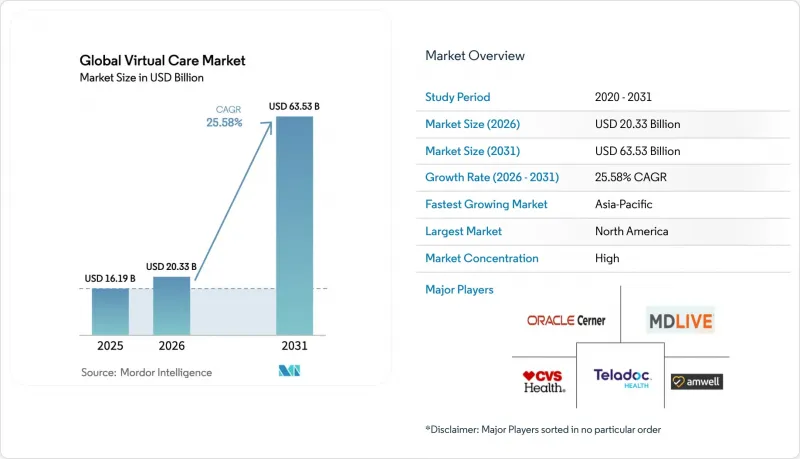
본 보고서는 구성 요소(하드웨어, 소프트웨어, 서비스), 제공 형태(화상 진료, 음성 진료 등), 용도(1차 진료, 전문 진료 등), 최종 사용자(병원 및 진료소, 개인 개업의 등), 지역(북미, 유럽, 아시아태평양, 남미, 중동 및 아프리카)별로 분류되어 있습니다. 시장 전망은 금액(달러) 기준으로 제시되어 있습니다.
세계 가상 진료 시장 동향 및 인사이트
팬데믹 이후, 보상 평등법 확대
영구적인 지불 평등에 관한 법령을 제정한 미국 주들은 2019년 이후 2배인 33개 주로 증가했습니다. 또한, ‘2024년 원격의료 현대화법’에 따라 메디케어 면제 조치가 2026년까지 연장되고, 지리적 제한이 철폐됨과 동시에 제공업체의 자격 요건이 확대되었습니다. CMS(미국 의료보험 및 의료서비스 센터)의 2025년 의사 보수 일정표에는 종합적인 ‘고급 1차 의료 관리 서비스’가 추가되어, 가상 진료 제공업체에게 예측 가능한 수익원이 창출되었습니다. 민간 보험사들도 이에 발맞추어 2025년에 제출된 대규모 단체 계약의 87%에 지급 격차 시정 조항이 포함되었습니다. 이러한 구조를 통해 원격의료는 응급 상황의 대체 수단이 아닌 표준적인 혜택으로 자리 잡아가고 있습니다. 지불자의 신뢰가 높아짐에 따라 벤처 투자자들은 플랫폼의 확장성에 새로운 자본을 투입하고 있으며, 병원 시스템은 입원 및 외래 진료의 모든 단계에 원격의료 경로를 통합하고 있습니다.
고령화가 진행되고 재택 만성기 돌봄 모델이 추진됨
2030년까지 전 세계 65세 이상 인구는 10억 명을 넘어설 전망이며, 만성 질환 유병률도 계속 증가하고 있습니다. 원격 환자 모니터링 프로그램에서는 당뇨병 환자의 공복 혈당 수치가 1.68%, HbA1c가 0.45% 감소한 것이 확인되어 그 임상적 유효성이 입증되었습니다. ‘재택 병원’ 시범 사업에서는 의료비가 30% 절감되고 재입원이 최대 83% 감소하여, 이에 따라 지불자 측의 가치 기반 가상 번들(virtual bundle)에 대한 관심이 높아지고 있습니다. 맥킨지는 미국 의료 서비스 중 2,650억 달러 상당이 재택으로 전환될 수 있을 것으로 예측하고 있으며, 이에 따라 시설 계획 및 임상의의 업무 흐름 재검토가 진행될 것으로 전망됩니다. 인구통계학적 압박이 커지는 가운데, 의료 시스템은 재택 중심의 가상 경로를 의료 종사자의 지속가능성을 위해 필수적인 요소로 자리매김하고 있습니다.
규제 변화에 따른 데이터 개인정보 보호 소송 위험
미국 보건복지부(HHS)는 2025년에 예정된 HIPAA 규정 개정안에서 암호화, 다단계 인증 및 공식적인 자산 관리를 의무화할 계획이며, 이로 인해 규정 준수를 위한 막대한 비용이 부과될 것입니다. 연방거래위원회(FTC)는 소비자 건강 데이터 유출에 대한 단속을 강화하고 있어, 가상 플랫폼의 소송 위험이 높아지고 있습니다. 캘리포니아주의 CPRA나 버지니아주의 CDPA 등 주마다 다른 개인정보 보호법이 추가 요건을 더하고 있어, 여러 주에 걸친 사업 확장을 복잡하게 만들고 있습니다. 유럽의 사업자들은 GDPR(EU 개인정보보호규정) 준수와 국경을 넘는 데이터 전송 제한에 직면해 있습니다. 이러한 중복된 규제 체계는 제품 개발 주기를 지연시키고, 공급업체 실사에 소요되는 기간을 연장시키며, 소규모 신규 진출기업들을 제휴나 인수합병으로 내몰고 있습니다.
부문 분석
2025년에는 진단, 분류, 그리고 장기적인 모니터링에서 다학제적 임상 팀이 여전히 필수적이었기 때문에 서비스 부문이 가상 진료 시장 점유율의 53.84%를 차지했습니다. 이 부문의 견고한 성장세는 진료 연계와 가치 기반 성과를 중시하는 종합적인 상환 코드에 의해 더욱 강화되고 있습니다. 한편, 소프트웨어 분야는 증상 확인, 위험도 계층화 및 기록 작성을 자동화하는 확장 가능한 AI 알고리즘에 힘입어 2031년까지 연평균 성장률(CAGR) 27.11%로 성장하고 있습니다. 이 두 가지 성장 궤적을 통해 플랫폼은 노동 집약적인 서비스 라인 위에 고수익률의 SaaS 요금을 더할 수 있게 되어, 예측 가능한 구독 수익과 진료 횟수 기반 과금을 결합할 수 있습니다. 하드웨어의 성장은 다소 뒤처지고 있습니다. 이는 기기의 표준화 및 환자 사용 편의성과 관련된 과제가 신속한 업데이트 주기를 제한하고 있기 때문이지만, 그럼에도 불구하고 연결형 센서의 도입은 만성 질환 관리 과정에서 지속적인 데이터 수집을 뒷받침하고 있습니다.
소프트웨어의 성장세는 한 명의 간호사가 여러 병상을 모니터링할 수 있는 ‘가상 간병인(Virtual Sitter)’ 대시보드에 대한 병원 측 수요에서도 기인합니다. 이를 통해 낙상 사고가 감소함과 동시에 시설당 연간 120만 달러의 비용 절감이 실현되고 있습니다. EHR에 통합된 보험사 인증 API는 전화 응대 시간을 몇 분 단축하고, 급여 거절률을 낮춥니다. 예측 분석이 성숙해짐에 따라 소프트웨어 모듈은 자동화된 치료 계획 제안을 점점 더 많이 제공하게 되어, 임상 직원이 더 시급한 업무에 전념할 수 있게 됩니다. 기업 고객들이 다년 라이선스 계약을 체결함에 따라 소프트웨어 수익 전망이 개선되어, 가상 진료 시장에서 지속적인 수익원을 중시하는 기관 투자자들을 유치하고 있습니다.
2025년 매출의 60.25%를 화상 진료가 차지하며, 이는 임상의에게 급성기 평가에 필수적인 실시간 시각적 정보를 제공합니다. 18개 관할 구역에서 음성만 사용하는 진료에 대한 보험 적용이 법제화되어 대역폭에 제한이 있는 환자에 대한 지속적인 치료가 보장되고 있지만, 대부분의 민간 계약에서는 화상 진료에 비해 보수가 여전히 낮은 수준입니다. VR/AR을 활용한 의료는 아직 초기 단계이지만, 통증 완화, 노출 요법 및 신체 재활에 대한 적용에 관한 증거가 축적됨에 따라 연평균 성장률(CAGR) 27.68%로 확대되고 있습니다. 텍사스주에서 진행된 홀로그래피를 활용한 시범 사업에서는 표준 화상 진료에 비해 환자의 참여도가 높았다는 보고가 있어, 향후 경쟁상의 차별화 요소가 될 가능성을 시사하고 있습니다. 비동기(스토어 앤 포워드) 방식은 고해상도 이미지가 동기식 대화를 대체하는 피부과 및 안과 진료를 지원하고 있습니다.
광대역 환경이 갖춰지지 않은 지방에서는 위성 백홀을 통해 영상 품질이 안정적이지만, 지연으로 인해 신경 재활 세션이 방해받을 수 있어 음성과 텍스트를 결합한 하이브리드 워크플로우에 대한 수요가 지속되고 있습니다. 플랫폼 로드맵에서는 일반용 헤드셋을 활용한 혼합 현실(MR) 툴킷의 통합이 진행되고 있지만, 보험 환급 정책은 여전히 기술적 능력을 따라가지 못하고 있습니다. 따라서 의료 제공업체들은 단계적 도입 방식을 채택하고 있으며, 초기에는 진료소 내 행동 치료에 VR을 도입하고, 보험 환급 코드가 확정됨에 따라 재택용 키트로 확대되고 있습니다. ‘무한 현실(Unlimited Reality)’ 기술의 융합으로 치료 범위는 확대될 전망이지만, 몰입형 제공 방식이 화상 기반 가상 진료 시장의 압도적인 점유율을 잠식하기 위해서는 비용과 접근성의 개선이 필수적입니다.
지역별 분석
북미는 성숙한 보험 환급 제도와 조기 기술 도입에 힘입어 2025년에는 매출의 41.67%를 차지하며 가상 진료 시장을 주도했습니다. 2025년 미국 구제법에 따라 메디케어의 원격의료 적용 범위가 2025년 3월까지 연장되었으나, 영구적인 법제화는 아직 미정이어서 규제 측면의 불확실성이 발생하고 있습니다. 주 간 처우 균등화 움직임은 계속되고 있지만, DEA(마약단속국)의 규제 약물에 관한 새로운 규정이 규정 준수 측면에서 새로운 부담을 초래하고 있습니다. 스타링크를 활용한 지방 광대역 시범 사업을 통해 접근 격차 해소가 진행되어, 참여 클리닉의 진료 건수는 12% 증가했습니다. 의료 인력의 만성적인 부족이 주를 아우르는 네트워크 구축을 뒷받침하고 있지만, 면허의 완전한 상호 인정 제도는 여전히 확립되지 않았습니다.
아시아태평양은 중국, 인도, 인도네시아의 정부 자금과 대규모 플랫폼 확장에 힘입어 2031년까지 연평균 성장률(CAGR) 29.44%를 달성할 것으로 예측됩니다. 인도의 ‘E-Sanjeevni’ 네트워크는 이미 1억 3,000만 건의 진료를 중개하며 허브 앤 스포크(hub-and-spoke)형 가상 모델의 확장성을 보여주고 있습니다. 벤처 자금 조달은 계속해서 견조한 추세를 보이고 있으며, 현지 경제적 수용 범위에 맞춘 AI 분석 및 원격 진단이 주요 대상입니다. 인프라 격차는 여전히 존재하며, 농촌 지역에서는 모바일 우선 전략과 비동기 메시징에 의존하고 있습니다. 시장별 정책의 불균일성으로 인해 국가별 시장 진출 전략이 요구되지만, 지역 전체의 성장 모멘텀 덕분에 이 지역은 가상 의료 시장에서 가장 빠르게 성장하는 거점이 되었습니다.
유럽에서는 40개국이 원격의료 체계를 공식적으로 마련한 것을 배경으로, 꾸준한 보급이 진행되고 있습니다. EU의 국경 간 의료 이니셔티브는 의료비 상환의 조화를 목표로 하고 있지만, 데이터 개인정보 보호 지침으로 인해 규정 준수 측면에서 복잡성이 발생하고 있습니다. 정신건강 대기 목록이 길어지는 가운데, 원격 정신과 의료 솔루션이 급속히 보급되고 있습니다. 영국에서는 위성 통신을 활용한 시범 도입을 통해 외딴 지역의 일반 진료소와의 연결이 확대되고 있는 반면, 북유럽 국가들에서는 전자 건강 카드와 연동된 전국적인 원격 모니터링 등록 제도를 선도적으로 도입하고 있습니다. 팬데믹 이후 기업 가치가 정상화됨에 따라 업계 재편이 가속화되고 있으며, 인수 측은 이익률 압박에 대응하기 위해 AI를 활용한 트리아지 기능을 우선적으로 요구하고 있습니다.
기타 혜택:
- 엑셀 형식 시장 예측(ME) 시트
- 3개월간의 애널리스트 지원
자주 묻는 질문
목차
제1장 서론
제2장 조사 방법
제3장 주요 요약
제4장 시장 구도
제5장 시장 규모와 성장 예측
제6장 경쟁 구도
제7장 시장 기회와 향후 전망
JHS 26.08.28According to Mordor Intelligence, the virtual care market size was valued at USD 16.19 billion in 2025 and estimated to grow from USD 20.33 billion in 2026 to reach USD 63.53 billion by 2031, at a CAGR of 25.58% during the forecast period (2026-2031).
This report is Segmented by Component (Hardware, Software, Services), Delivery Mode (Video Consultation, Audio Consultation, and More), Application (Primary Care, Specialty Consultation, and More), End User (Hospitals & Clinics, Physician Practices, and More), and Geography (North America, Europe, Asia-Pacific, South America, Middle East and Africa). The Market Forecasts are Provided in Terms of Value (USD).
Global Virtual Care Market Trends and Insights
Reimbursement Parity Laws Expanding Post-Pandemic
Permanent payment parity statutes have doubled to 33 U.S. states since 2019, and the Telehealth Modernization Act of 2024 extends Medicare waivers through 2026, eliminating geographic restrictions and broadening provider eligibility. CMS's 2025 Physician Fee Schedule adds bundled Advanced Primary Care Management Services, creating predictable revenue streams for virtual providers. Commercial insurers follow suit, with parity clauses included in 87% of large-group contracts filed in 2025. These mechanisms institutionalize virtual care as a standard benefit rather than an emergency workaround. As payer confidence grows, venture investors channel fresh capital into platform scalability, and hospital systems embed virtual pathways across inpatient and ambulatory settings.
Aging Population Driving Home-Based Chronic-Care Models
By 2030, the global population aged 65 and above will surpass 1 billion, while chronic disease prevalence continues to climb. Remote patient monitoring programs record 1.68% fasting-glucose reductions and 0.45% HbA1c drops among diabetics, validating clinical effectiveness. Hospital-at-home pilots deliver 30% lower care costs and up to 83% fewer readmissions, stimulating payer interest in value-based virtual bundles. McKinsey projects USD 265 billion of U.S. health services can shift to the home, realigning facilities planning and clinician workflows. As demographic pressures intensify, health systems treat home-centric virtual pathways as essential to workforce sustainability.
Data-Privacy Litigation Risk Under Evolving Regulations
HHS plans to mandate encryption, multifactor authentication, and formal asset management in proposed HIPAA rule revisions slated for 2025, imposing steep compliance spending. The FTC expands enforcement on consumer health-data breaches, heightening litigation exposure for virtual platforms. Divergent state privacy acts, notably California's CPRA and Virginia's CDPA, layer additional requirements, complicating multistate rollouts. European operators contend with GDPR harmonization and cross-border data-transfer restrictions. These overlapping regimes slow product cycles and increase vendor-due-diligence timelines, nudging smaller entrants toward partnership or acquisition.
Other drivers and restraints analyzed in the detailed report include:
- Clinician Shortages in Rural Regions
- Venture Funding Into AI-Powered Virtual Triage
- Unequal Broadband Penetration in Emerging Economies
For complete list of drivers and restraints, kindly check the Table Of Contents.
Segment Analysis
Services captured 53.84% of virtual care market share in 2025 as multidisciplinary clinical teams remained vital for diagnosis, triage, and longitudinal monitoring. The segment's resilience is reinforced by bundled reimbursement codes that prize care coordination and value-based outcomes. Software, however, advances at a 27.11% CAGR through 2031, propelled by scalable AI algorithms that automate symptom checking, risk stratification, and documentation. This dual trajectory enables platforms to layer high-margin SaaS fees atop labor-intensive service lines, blending predictable subscription revenue with encounter-based billing. Hardware lags in growth because device standardization and patient usability hurdles limit rapid refresh cycles, yet connected-sensor adoption still supports continuous data capture for chronic-care pathways.
Software's momentum also emanates from hospital demand for virtual sitter dashboards that allow a single nurse to oversee multiple beds, reducing fall incidents and saving USD 1.2 million per facility annually. Payer credentialing APIs, integrated within EHRs, shave minutes off call times and tighten denial rates. As predictive analytics mature, software modules increasingly deliver automated plan-of-care recommendations, shifting clinical staff to higher-acuity tasks. With enterprise buyers negotiating multi-year licenses, software revenue visibility improves, drawing institutional investors who value recurring income streams inside the virtual care market.
Video consultation accounted for 60.25% of 2025 revenue, offering clinicians real-time visual cues essential for acute assessments. States have codified coverage for audio-only visits in 18 jurisdictions, ensuring continuity for bandwidth-limited patients, yet reimbursement remains lower than video in most commercial contracts. VR/AR-enabled care, though nascent, accelerates at a 27.68% CAGR as evidence mounts for pain distraction, exposure therapy, and physical-rehab applications. Holographic pilots in Texas reported higher patient-engagement scores relative to standard video, hinting at future competitive differentiation. Asynchronous (store-and-forward) modalities support dermatology and ophthalmology where high-resolution imaging replaces synchronous dialog.
In rural broadband deserts, satellite backhaul stabilizes video quality, but latency occasionally disrupts neuro-rehab sessions, sustaining demand for hybrid audio-plus-text workflows. Platform roadmaps increasingly integrate mixed-reality toolkits using consumer headsets, yet reimbursement policy still lags technological capability. Providers therefore adopt phased rollouts, initially deploying VR for in-clinic behavioral health before expanding to at-home kits as payer codes solidify. The convergence of unlimited-reality technologies is poised to widen therapeutic scope, though cost and accessibility must improve before immersive delivery modes erode video's commanding virtual care market share.
Complete Report Scope:
- By Component (Value)
- Hardware
- Software
- Services
- By Delivery Mode (Value)
- Video Consultation
- Audio Consultation
- Messaging
- Asynchronous (Store-and-Forward)
- VR / AR-Enabled Care
- Others
- By Application (Value)
- Primary Care
- Specialty Consultation
- Chronic Disease Management
- Mental Health Services
- Post-Acute & Rehabilitation
- Wellness & Preventive Care
- By End User (Value)
- Hospitals & Clinics
- Physician Practices
- Home-Care Settings
- Employers & Payers
- Government & Defense Facilities
- Patients
- By Geography (Value)
- North America
- United States
- Canada
- Mexico
- Europe
- Germany
- United Kingdom
- France
- Italy
- Spain
- Rest of Europe
- Asia-Pacific
- China
- India
- Japan
- South Korea
- Australia
- Rest of Asia-Pacific
- South America
- Brazil
- Argentina
- Rest of South America
- Middle East and Africa
- GCC
- South Africa
- Rest of Middle East and Africa
- North America
Geography Analysis
North America led the virtual care market with 41.67% revenue in 2025, buoyed by mature reimbursement and early technology adoption. The American Relief Act of 2025 extends Medicare telehealth coverage through March 2025, but permanent legislation remains pending, injecting regulatory uncertainty. State parity momentum persists, yet upcoming DEA controlled-substance rules create new compliance layers. Rural broadband pilots featuring Starlink have begun closing access gaps, lifting encounter volumes 12% in participating clinics. Persistent clinician shortages drive cross-state networks, although full licensure reciprocity is still incomplete.
Asia-Pacific is projected to achieve a 29.44% CAGR to 2031, propelled by government funding and large-scale platform rollouts in China, India, and Indonesia. India's E-Sanjeevni network has already facilitated 130 million consultations, illustrating the scalability of hub-and-spoke virtual models. Venture funding remains robust, targeting AI analytics and remote diagnostics attuned to local affordability thresholds. Infrastructure disparities persist, with rural regions dependent on mobile-first strategies and asynchronous messaging. Policy heterogeneity across markets demands country-specific go-to-market tactics, yet collective momentum positions the region as the fastest-growing node in the virtual care market.
Europe records steady adoption, underpinned by 40 nations formalizing telemedicine frameworks. EU cross-border health initiatives aim to harmonize reimbursement, but data privacy directives present compliance complexity. Telepsychiatry solutions proliferate as mental-health waitlists lengthen. Satellite-enabled trials in the UK extend connectivity to remote GP practices, while Nordic countries pioneer national tele-monitoring registries that integrate with electronic health cards. Consolidation accelerates as valuations normalize post-pandemic, with acquirers prioritizing AI-enhanced triage capabilities to counter margin compression.
- Teladoc Health Inc
- Amwell
- MDLive (Evernorth)
- Doctor On Demand / Included Health
- Babylon Health
- Practo Technologies
- Ping An Good Doctor
- Doctor Anywhere
- 98point6
- Livongo Health
- Omada Health
- Hims & Hers Health
- Koninklijke Philips
- GE Healthcare
- Siemens Healthineers
- Medtronic
- Cisco Systems
- Google Cloud Healthcare
- Microsoft
- CVS Health
Additional Benefits:
- The market estimate (ME) sheet in Excel format
- 3 months of analyst support
TABLE OF CONTENTS
1 Introduction
- 1.1 Study Assumptions & Market Definition
- 1.2 Scope of the Study
2 Research Methodology
3 Executive Summary
4 Market Landscape
- 4.1 Market Overview
- 4.2 Market Drivers
- 4.2.1 Reimbursement parity laws expanding post-pandemic
- 4.2.2 Aging population driving home-based chronic-care models
- 4.2.3 Clinician shortages in rural regions
- 4.2.4 Venture funding into AI-powered virtual triage
- 4.2.5 Employer demand for integrated virtual primary care
- 4.2.6 Satellite-enabled connectivity in low-bandwidth areas
- 4.3 Market Restraints
- 4.3.1 Data-privacy litigation risk under evolving regulations
- 4.3.2 Unequal broadband penetration in emerging economies
- 4.3.3 Physician licensure barriers across state borders
- 4.3.4 Cyber-security fatigue among health systems
- 4.4 Value / Supply-Chain Analysis
- 4.5 Regulatory Landscape
- 4.6 Technological Outlook
- 4.7 Porter's Five Forces
- 4.7.1 Threat of New Entrants
- 4.7.2 Bargaining Power of Suppliers
- 4.7.3 Bargaining Power of Buyers
- 4.7.4 Threat of Substitutes
- 4.7.5 Competitive Rivalry
5 Market Size & Growth Forecasts
- 5.1 By Component (Value)
- 5.1.1 Hardware
- 5.1.2 Software
- 5.1.3 Services
- 5.2 By Delivery Mode (Value)
- 5.2.1 Video Consultation
- 5.2.2 Audio Consultation
- 5.2.3 Messaging
- 5.2.4 Asynchronous (Store-and-Forward)
- 5.2.5 VR / AR-Enabled Care
- 5.2.6 Others
- 5.3 By Application (Value)
- 5.3.1 Primary Care
- 5.3.2 Specialty Consultation
- 5.3.3 Chronic Disease Management
- 5.3.4 Mental Health Services
- 5.3.5 Post-Acute & Rehabilitation
- 5.3.6 Wellness & Preventive Care
- 5.4 By End User (Value)
- 5.4.1 Hospitals & Clinics
- 5.4.2 Physician Practices
- 5.4.3 Home-Care Settings
- 5.4.4 Employers & Payers
- 5.4.5 Government & Defense Facilities
- 5.4.6 Patients
- 5.5 By Geography (Value)
- 5.5.1 North America
- 5.5.1.1 United States
- 5.5.1.2 Canada
- 5.5.1.3 Mexico
- 5.5.2 Europe
- 5.5.2.1 Germany
- 5.5.2.2 United Kingdom
- 5.5.2.3 France
- 5.5.2.4 Italy
- 5.5.2.5 Spain
- 5.5.2.6 Rest of Europe
- 5.5.3 Asia-Pacific
- 5.5.3.1 China
- 5.5.3.2 India
- 5.5.3.3 Japan
- 5.5.3.4 South Korea
- 5.5.3.5 Australia
- 5.5.3.6 Rest of Asia-Pacific
- 5.5.4 South America
- 5.5.4.1 Brazil
- 5.5.4.2 Argentina
- 5.5.4.3 Rest of South America
- 5.5.5 Middle East and Africa
- 5.5.5.1 GCC
- 5.5.5.2 South Africa
- 5.5.5.3 Rest of Middle East and Africa
- 5.5.1 North America
6 Competitive Landscape
- 6.1 Market Concentration
- 6.2 Market Share Analysis
- 6.3 Company Profiles (includes Global level Overview, Market level overview, Core Segments, Financials as available, Strategic Information, Market Rank/Share for key companies, Products & Services, and Recent Developments)
- 6.3.1 Teladoc Health Inc
- 6.3.2 Amwell
- 6.3.3 MDLive (Evernorth)
- 6.3.4 Doctor On Demand / Included Health
- 6.3.5 Babylon Health
- 6.3.6 Practo Technologies
- 6.3.7 Ping An Good Doctor
- 6.3.8 Doctor Anywhere
- 6.3.9 98point6
- 6.3.10 Livongo Health
- 6.3.11 Omada Health
- 6.3.12 Hims & Hers Health
- 6.3.13 Philips Healthcare
- 6.3.14 GE Healthcare
- 6.3.15 Siemens Healthineers
- 6.3.16 Medtronic
- 6.3.17 Cisco Systems
- 6.3.18 Google Cloud Healthcare
- 6.3.19 Microsoft
- 6.3.20 CVS Health
7 Market Opportunities & Future Outlook
- 7.1 White-space & Unmet-Need Assessment


