|
시장보고서
상품코드
2113243
남미의 면화 시장 : 시장 점유율 분석, 업계 동향과 통계, 성장 예측(2026-2031년)South America Cotton - Market Share Analysis, Industry Trends & Statistics, Growth Forecasts (2026 - 2031) |
||||||
 Mordor Intelligence
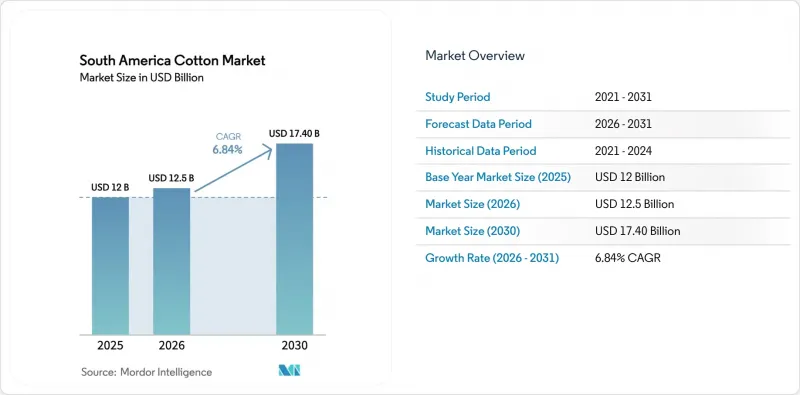
Mordor Intelligence에 따르면 남미의 면화 시장 규모는 2025년 120억 달러에서 2026년에는 125억 달러로 확대하며, 2031년까지 174억 달러에 달할 것으로 예측되고 있으며, 2026-2031년까지 CAGR은 6.84%에 달할 전망입니다.
이 보고서는 지역별(아르헨티나, 브라질, 콜롬비아, 페루 등)로 세분화되어 있습니다. 이 보고서에는 생산 분석(수량), 소비 분석(금액 및 수량), 수입 분석(금액 및 수량), 수출 분석(금액 및 수량), 도매 가격 동향 분석 및 예측, 주요 기업 리스트 등이 포함되어 있습니다. 시장 예측은 금액(달러) 및 수량(미터톤)으로 제시되어 있습니다.
남미 면화 시장의 동향 및 인사이트
확대되는 섬유 제조 및 수출 수요
브라질은 2024년에 270만 메트릭톤의 린트를 수출하여 미국을 제치고, 남미 면화 시장을 추적 가능한 섬유의 주요 공급원으로 자리매김했습니다. 브라질의 국내 방적 능력은 2024-2025년에 12% 증가하여 120만 메트릭톤에 달했으며, 이는 농가의 생산량을 더 많이 흡수하고 현지 가격을 안정시키는 결과를 가져왔습니다. 아르헨티나에서 칠레 및 우루과이로의 원사 수출은 비센틴(Vicentin)사가 사업 재편을 단행했음에도 불구하고 2025년에 9% 증가하여 메르코수르 특혜 조치의 매력을 보여주었습니다. 파라과이는 파라과이-파라나 수로를 활용하여 운임을 최대 20% 절감하고, 아시아의 방적 공장과 새로운 인수 계약을 체결하고 있습니다. 북미 브랜드들의 니어쇼어링으로 인해 2028년까지 지역내 면화 수요가 18만 미터톤 증가할 것으로 예측되며, 이는 남미 면화 시장의 성장 궤도를 더욱 공고히 할 것입니다.
면화 수확 및 탈면 작업의 기술적 기계화
2024년 이후, 마토그로소주와 바이아주에서는 차량 탑재형 모듈 피커의 도입으로 수확에 필요한 노동력이 60% 감소했습니다. 롤러식 면화 탈피 복합 시설의 처리 능력은 2022년 시간당 80 베일에서 120 베일로 향상되어, 고급 계약에 따른 신속한 출하와 더욱 신선한 섬유 품질을 실현할 수 있게 되었습니다. 2020년 대비 20%의 수확량 증가는 위성 유도 방식의 가변 시비 및 관개를 최적화하는 수분 센서 덕분입니다. 아르헨티나와 파라과이는 브라질보다 최대 2시즌 뒤처져 있지만, 리스 모델과 다자간 융자를 통해 기술 보급이 가속화되고 있습니다. 기계화를 통해 추적성이 향상되어, 지속가능성을 중시하는 구매자들에게 남미 면화 시장의 매력은 여전히 유지되고 있습니다.
세라두 지역의 기후로 인한 수분 스트레스
2024-2025년에 걸친 라니냐 현상으로 인해 강수량이 200mm 부족했던 바이아주 서부와 피아우이주 남부에서는 2기작 수확량이 최대 12% 감소했습니다. 세라두 지역은 브라질 면화 생산량의 68%를 공급하고 있으므로 지난 10년간 강수량 변동률이 22%에서 31%로 상승한 것은 재배 결정에 어려움을 주고 있습니다. 생산자들은 센터 피벗식 관개에 4억 2,000만 달러를 투자했으나, 디젤 가격이 24% 상승함에 따라 헥타르당 최대 52달러의 이익이 압박받고 있습니다. 기후 모델에 따르면 2035년까지 강수량이 10-15% 감소할 것으로 예측되어, 면화 생산이 동부의 토칸틴스주와 마라냥주로 이동할 가능성이 있습니다.
기타 혜택:
- 엑셀 형식의 시장 예측(ME) 시트
- 3개월간 애널리스트 지원
자주 묻는 질문
목차
제1장 서론
제2장 조사 방법
제3장 개요
제4장 시장 구도
제5장 시장 규모와 성장 예측
제6장 최종 용도 및 산업
제7장 경쟁 구도
제8장 시장 기회와 향후 전망
KSA 26.08.25According to Mordor Intelligence, the South America cotton market size is anticipated to grow from USD 12 billion in 2025 to USD 12.5 billion in 2026 and is forecasted to reach USD 17.4 billion by 2031, at a CAGR of 6.84% (2026-2031).
This report is Segmented by Geography (Argentina, Brazil, Colombia, Peru, and More). The Report Includes Production Analysis (Volume), Consumption Analysis (Value and Volume), Import Analysis (Value and Volume), Export Analysis (Value and Volume), Wholesale Price Trend Analysis and Forecast, List of Key Players, and More. The Market Forecasts are Provided in Terms of Value (USD) and Volume (Metric Tons).
South America Cotton Market Trends and Insights
Expanding Textile Manufacturing and Export Demand
Brazil shipped 2.7 million metric tons of lint in 2024, surpassing the United States and positioning the South America cotton market as a leading source of traceable fiber . Domestic spinning capacity in Brazil rose 12% between 2024 and 2025 to 1.2 million metric tons, absorbing more farm output and stabilizing local prices. Argentina's yarn exports to Chile and Uruguay climbed 9% in 2025, even as Vicentin restructured operations, showing the pull of Mercosur preferences. Paraguay leverages the Paraguay-Parana waterway to cut freight costs by up to 20%, securing new offtake contracts from Asian mills. Near-shoring by North American brands is forecast to add 180,000 metric tons of regional lint demand by 2028, reinforcing the growth path of the South America cotton market
Technological Mechanization in Ginning and Harvesting
Adoption of on-board module pickers lowered harvest labor needs by 60% in Mato Grosso and Bahia since 2024 . Roller-gin complexes now process 120 bales per hour, up from 80 bales in 2022, enabling quicker shipment and fresher fiber quality for high-end contracts. Yield gains of 20% against 2020 levels stem from satellite-guided variable-rate fertilization and moisture sensors that optimize irrigation. Argentina and Paraguay lag Brazil by up to two seasons, but leasing models and multilateral loans accelerate technology diffusion. Mechanization increases traceability, keeping the South America cotton market attractive to sustainability-driven buyers.
Climate-Linked Water Stress in the Cerrado
La Nina conditions in 2024-2025 cut second-crop yields by up to 12% in western Bahia and southern Piaui, where rainfall deficits reached 200 millimeters. The Cerrado supplies 68% of Brazilian lint, so rising rainfall variability from 22% to 31% over the past decade complicates sowing decisions. Growers invested USD 420 million in center-pivot irrigation, yet diesel price gains of 24% erode margins by as much as USD 52 per hectare. Climate models project a 10-15% precipitation decline by 2035, potentially shifting cotton east into Tocantins and Maranhao.
Other drivers and restraints analyzed in the detailed report include:
- Government Credit Lines for Medium-Scale Cotton Farms
- Near-Shoring of Apparel Supply Chains into Mercosur
- Rising Resistance to Glyphosate-Tolerant Bacillus thuringiensis (Bt) Varieties
For complete list of drivers and restraints, kindly check the Table Of Contents.
Complete Report Scope:
- By Geography
- Argentina
- Production Analysis (Area Harvested, Yield, and Production Volume)
- Consumption Analysis (Consumption Value and Volume)
- Import Market Analysis (Import Value, Volume, and Key Supplying Markets)
- Export Market Analysis (Export Value, Volume, and Key Destination Markets)
- Wholesale Price Trend Analysis and Forecast
- Regulatory Framework
- List of Key Players
- Logistics and Infrastructure
- Seasonality Analysis
- Brazil
- Production Analysis (Area Harvested, Yield, and Production Volume)
- Consumption Analysis (Consumption Value and Volume)
- Import Market Analysis (Import Value, Volume, and Key Supplying Markets)
- Export Market Analysis (Export Value, Volume, and Key Destination Markets)
- Wholesale Price Trend Analysis and Forecast
- Regulatory Framework
- List of Key Players
- Logistics and Infrastructure
- Seasonality Analysis
- Chile
- Production Analysis (Area Harvested, Yield, and Production Volume)
- Consumption Analysis (Consumption Value and Volume)
- Import Market Analysis (Import Value, Volume, and Key Supplying Markets)
- Export Market Analysis (Export Value, Volume, and Key Destination Markets)
- Wholesale Price Trend Analysis and Forecast
- Regulatory Framework
- List of Key Players
- Logistics and Infrastructure
- Seasonality Analysis
- Colombia
- Production Analysis (Area Harvested, Yield, and Production Volume)
- Consumption Analysis (Consumption Value and Volume)
- Import Market Analysis (Import Value, Volume, and Key Supplying Markets)
- Export Market Analysis (Export Value, Volume, and Key Destination Markets)
- Wholesale Price Trend Analysis and Forecast
- Regulatory Framework
- List of Key Players
- Logistics and Infrastructure
- Seasonality Analysis
- Peru
- Production Analysis (Area Harvested, Yield, and Production Volume)
- Consumption Analysis (Consumption Value and Volume)
- Import Market Analysis (Import Value, Volume, and Key Supplying Markets)
- Export Market Analysis (Export Value, Volume, and Key Destination Markets)
- Wholesale Price Trend Analysis and Forecast
- Regulatory Framework
- List of Key Players
- Logistics and Infrastructure
- Seasonality Analysis
- Argentina
Additional Benefits:
- The market estimate (ME) sheet in Excel format
- 3 months of analyst support
TABLE OF CONTENTS
1 Introduction
- 1.1 Study Assumptions and Market Definition
- 1.2 Scope of the Study
2 Research Methodology
3 Executive Summary
4 Market Landscape
- 4.1 Market Overview
- 4.2 Market Drivers
- 4.2.1 Expanding textile manufacturing and export demand
- 4.2.2 Technological mechanization in ginning and harvesting
- 4.2.3 Government credit lines for medium-scale cotton farms
- 4.2.4 Near-shoring of apparel supply chains into Mercosur
- 4.2.5 Crop-insurance penetration among smallholders
- 4.2.6 Carbon-credit premiums for regenerative cotton
- 4.3 Market Restraints
- 4.3.1 Climate-linked water stress in the Cerrado
- 4.3.2 Rising resistance to glyphosate-tolerant Bacillus thuringiensis (Bt) varieties
- 4.3.3 Logistics bottlenecks at Northern Arc ports
- 4.3.4 Tight on-farm labor pool post-pandemic
- 4.4 Opportunities
- 4.5 Challenges
- 4.6 Value Chain Analysis
- 4.7 Technologies and usage of AI in the Industry
- 4.8 Input Market Analysis
- 4.8.1 Seeds
- 4.8.2 Fertilizers
- 4.8.3 Crop Protection Chemicals
- 4.9 Distribution Channel Analysis
- 4.10 Market Sentiment Analysis
- 4.11 PESTLE Analysis
5 Market Size and Growth Forecasts (Value and Volume)
- 5.1 By Geography
- 5.1.1 Argentina
- 5.1.1.1 Production Analysis (Area Harvested, Yield, and Production Volume)
- 5.1.1.2 Consumption Analysis (Consumption Value and Volume)
- 5.1.1.3 Import Market Analysis (Import Value, Volume, and Key Supplying Markets)
- 5.1.1.4 Export Market Analysis (Export Value, Volume, and Key Destination Markets)
- 5.1.1.5 Wholesale Price Trend Analysis and Forecast
- 5.1.1.6 Regulatory Framework
- 5.1.1.7 List of Key Players
- 5.1.1.8 Logistics and Infrastructure
- 5.1.1.9 Seasonality Analysis
- 5.1.2 Brazil
- 5.1.2.1 Production Analysis (Area Harvested, Yield, and Production Volume)
- 5.1.2.2 Consumption Analysis (Consumption Value and Volume)
- 5.1.2.3 Import Market Analysis (Import Value, Volume, and Key Supplying Markets)
- 5.1.2.4 Export Market Analysis (Export Value, Volume, and Key Destination Markets)
- 5.1.2.5 Wholesale Price Trend Analysis and Forecast
- 5.1.2.6 Regulatory Framework
- 5.1.2.7 List of Key Players
- 5.1.2.8 Logistics and Infrastructure
- 5.1.2.9 Seasonality Analysis
- 5.1.3 Chile
- 5.1.3.1 Production Analysis (Area Harvested, Yield, and Production Volume)
- 5.1.3.2 Consumption Analysis (Consumption Value and Volume)
- 5.1.3.3 Import Market Analysis (Import Value, Volume, and Key Supplying Markets)
- 5.1.3.4 Export Market Analysis (Export Value, Volume, and Key Destination Markets)
- 5.1.3.5 Wholesale Price Trend Analysis and Forecast
- 5.1.3.6 Regulatory Framework
- 5.1.3.7 List of Key Players
- 5.1.3.8 Logistics and Infrastructure
- 5.1.3.9 Seasonality Analysis
- 5.1.4 Colombia
- 5.1.4.1 Production Analysis (Area Harvested, Yield, and Production Volume)
- 5.1.4.2 Consumption Analysis (Consumption Value and Volume)
- 5.1.4.3 Import Market Analysis (Import Value, Volume, and Key Supplying Markets)
- 5.1.4.4 Export Market Analysis (Export Value, Volume, and Key Destination Markets)
- 5.1.4.5 Wholesale Price Trend Analysis and Forecast
- 5.1.4.6 Regulatory Framework
- 5.1.4.7 List of Key Players
- 5.1.4.8 Logistics and Infrastructure
- 5.1.4.9 Seasonality Analysis
- 5.1.5 Peru
- 5.1.5.1 Production Analysis (Area Harvested, Yield, and Production Volume)
- 5.1.5.2 Consumption Analysis (Consumption Value and Volume)
- 5.1.5.3 Import Market Analysis (Import Value, Volume, and Key Supplying Markets)
- 5.1.5.4 Export Market Analysis (Export Value, Volume, and Key Destination Markets)
- 5.1.5.5 Wholesale Price Trend Analysis and Forecast
- 5.1.5.6 Regulatory Framework
- 5.1.5.7 List of Key Players
- 5.1.5.8 Logistics and Infrastructure
- 5.1.5.9 Seasonality Analysis
- 5.1.1 Argentina
6 End Use Applications and Industries
- 6.1 Primary Applications and Emerging Applications
- 6.2 Consumption Breakdown by Industries
7 Competitive Landscape
- 7.1 Overview of the Competition
- 7.2 Recent Developments
- 7.3 Market Concentration Analysis