

|
시장보고서
상품코드
2120804
면 : 시장 점유율 분석, 업계 동향과 통계, 성장 예측(2026-2031년)Cotton - Market Share Analysis, Industry Trends & Statistics, Growth Forecasts (2026 - 2031) |
||||||
 Mordor Intelligence
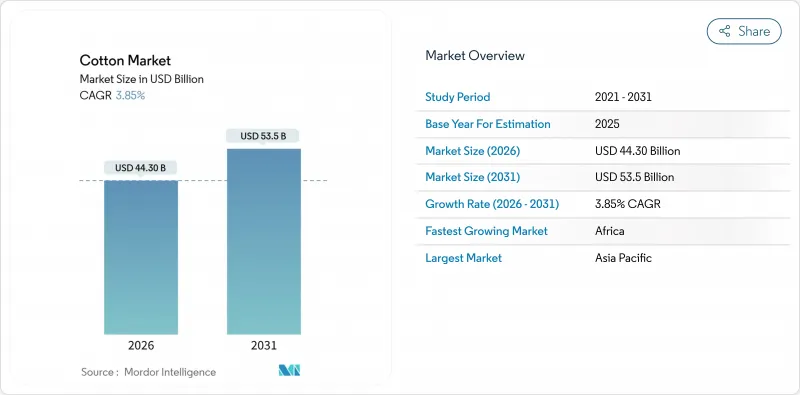
Mordor Intelligence에 의하면, 면화 시장 규모는 2026년에 443억 달러 2031년까지 535억 달러에 이를 것으로 예측되며, 예측 기간에는 CAGR 3.85%를 기록할 전망입니다.
본 보고서는 지역별(북미, 유럽, 아시아태평양, 남미 등)로 분류되어 있습니다. 본 보고서에는 생산 분석(수량), 소비 분석(금액 및 수량), 수입 분석(금액 및 수량), 수출 분석(금액 및 수량), 도매 가격 동향 분석, 주요 기업 목록 등이 포함되어 있습니다. 시장 전망은 금액(달러) 및 수량(메트릭 톤) 단위로 제시되어 있습니다.
세계 면화 시장 동향 및 인사이트
생명공학을 통한 수확량 증대
현재 유전자 변형 면화는 전 세계 재배 면적의 78.4%를 차지하고 있으며, 기존 품종에 비해 평균 수확량을 15%-25% 끌어올리고 있습니다. 인도의 면화 수확량은 2002년 460 kg/ha에서 2024년에는 510 kg/ha로 증가했습니다. 한편, 미국의 농가들은 해충 저항성과 제초제 저항성 형질을 조합하여 사용함으로써 950 kg/ha에 가까운 수준을 유지하고 있습니다. 텍사스 A&M 대학의 유전자 편집 프로그램에서는 2025년 포장 시험에서 관개 용수가 40% 감소한 상황에서도 관개 재배 시 수확량의 90%를 유지할 수 있는 가뭄 내성 계통이 개발되었습니다. 미국 농무부(USDA)는 특정 유전자 편집 작물의 승인을 신속하게 추진하고 있지만, 유럽연합(EU) 규제 당국은 여전히 이를 유전자 변형 생물로 취급하고 있어, 그 결과 해당 지역에서의 도입이 지연되고 있습니다. 헥타르당 50-80달러에 달하는 라이선스 비용이 사하라 이남 아프리카의 소규모 농가에서의 도입을 여전히 제한하고 있어, 보조금 조정이 필요하다는 점이 부각되고 있습니다.
재생형 농업의 프리미엄
브랜드의 노력이 조달 관행을 변화시키고 있습니다. H&M(Hennes & Mauritz AB)은 2030년까지 모든 면화를 재활용 면이나 지속 가능한 조달원에서 확보하겠다고 약속했으며, 그중 20.0%는 재생 농업 기준을 충족하는 것으로 간주됩니다. 리바이스 스트라우스 앤 컴퍼니는 2025년에 인도와 파키스탄 전역에서 10,000헥타르를 재생 농업 프로토콜에 임베디드하고, 10%-15%의 프리미엄을 지급하여 연간 0.5메트ルトン/헥타르당 토양 탄소 증가를 실현했습니다. 미국 코튼 트러스트 프로토콜(United States Cotton Trust Protocol)은 2,500개 농장을 디지털 대시보드에 연동하여, 각 브랜드가 검증된 토양, 물, 탄소 관련 지표를 조회할 수 있도록 했습니다. 헥타르당 30-100달러의 인증 비용은 여전히 장벽으로 남아 있지만, 협동조합을 통한 집약화로 생산자 1인당 비용 절감이 진행되고 있습니다.
물 부족 관련 규제
캘리포니아주의 ‘지속 가능한 지하수 관리법’은 2025년 전면 시행 이후 15,000헥타르의 농지가 이용 불가능해졌습니다. 파키스탄의 인더스강 유역 관리청은 2024년 칼리프(우기) 시즌에 펀자브주 및 신드주의 용수로 유량을 25% 감축하여 경작 면적을 8% 축소했습니다. 우즈베키스탄에서는 아랄해의 건조화를 배경으로 2024년 경작 면적이 98만 헥타르까지 감소했습니다. 인도의 마하라슈트라 주는 2024년부터 점적 관개 시스템 사용을 의무화하여, 소규모 농가에게 헥타르당 480달러(40,000루피)의 설비 투자 부담이 증가했습니다. 현재 각 브랜드는 ISO 14046에 기반한 물 발자국 감사를 요구하고 있어, 규정 준수 비용을 상승시키고 있습니다.
지역별 분석
2025년, 아시아태평양은 면화 시장 규모의 60.4%를 차지했으며, 중국의 생산량 600만 메트릭톤과 인도의 수확량 580만 메트릭톤이 이를 뒷받침했습니다. 중국의 1억 1,000만 스핀들 규모의 생산 네트워크는 2024년에 국내산 린트 외에도 주로 미국, 브라질, 호주에서 수입한 260만 메트릭톤을 소비했습니다. 인도는 2024년, 최저 지지 가격(MSP)에 따른 가격 안정화 조치 하에 방글라데시, 베트남, 중국으로 120만 메트릭톤을 수출했습니다. 호주는 풍성한 강우에 힘입어 2024년에 회복세를 보였으며, 생산량의 95.0%를 수출했습니다. 동남아시아의 방적 공장은 유럽연합(EU)의 산림 파괴 규제(EUDR) 준수 요건에 따라 구매를 가속화함으로써 해당 지역의 전략적 우위를 강화했습니다. 그러나 아시아태평양에서는 마하라슈트라주, 구자라트주, 신장 위구르 자치구에서 수자원 배분에 대한 압박이 커지고 있어, 이것이 확장의 걸림돌이 될 가능성이 있습니다.
아프리카는 2031년까지 연평균 성장률(CAGR) 4.0%로 가장 높은 성장세를 보이고 있으며, 베냉, 부르키나파소, 말리에서는 종자 배포, 비료 보조금, 운송 통로 정비를 통해 2023년부터 2025년까지 재배 면적을 12% 확대될 전망입니다. 베냉은 2024-25년 시즌에 72만 메트르톤을 수확하여 생산량의 90%를 코토누 항구를 통해 수출했습니다. 이집트는 연간 평균 18만 메트르톤의 초장섬유 면화를 유지하고 있으며, 40%-50%의 프리미엄 가격을 받고 있지만, 나일 델타 지역에서는 수익성이 높은 채소와의 경쟁에 직면해 있습니다. 남아프리카공화국에서는 2024년에 Bt 기술이 전면 도입되어 생산량이 1만 8,000메트르톤으로 안정되었으나, 인접 국가들의 인프라 구축 지연으로 인해 진전이 저해되고 있으며, 면화 탈피 공정의 지연으로 인해 납품 시 가격이 5%-8% 하락하고 있습니다.
북미와 남미의 상황은 다릅니다. 미국에서는 2024-25년에 300만 메트르톤을 수확했으나, 텍사스주의 가뭄 영향으로 6% 감소했습니다. 경작 면적의 85%는 최신 농업법에 근거한 농작물 보험에 의한 보호 조치의 대상입니다. 브라질의 세라두 지역에서는 경작 면적이 두 배로 늘어 280만 메트ルトン에 달했습니다. 또한, 2기작 도입으로 인해 중국 수입 구성에서 점유율을 확대되고 있습니다. 아르헨티나에서는 국제 수요 증가와 특정 수출 규제 철폐 등 경제 정책의 안정화로 인해 면화 생산의 수익성이 향상됨에 따라, 2024년 재배 면적이 62만 2,000헥타르로 확대되었습니다. 유럽 및 중동에서는 튀르키예가 2024년에 25만 메트르톤을 공급했으며, 그 대부분은 국내 가공용으로 사용되었습니다. 유럽연합(EU)의 산림 파괴 규제로 인해 FOB 가격의 2%-3%에 해당하는 규정 준수 비용이 절감되어, 추적 시스템이 잘 갖춰진 수출업체에게는 유리한 상황이 되었습니다.
기타 혜택:
- 엑셀 형식 시장 예측(ME) 시트
- 3개월간의 애널리스트 지원
자주 묻는 질문
목차
제1장 서론
제2장 조사 방법
제3장 주요 요약
제4장 시장 역학
제5장 시장 규모와 성장 예측
제6장 최종 용도 및 산업
제7장 경쟁 구도
제8장 시장 기회와 향후 전망
LSH 26.09.08According to Mordor Intelligence, the cotton market size is USD 44.3 billion in 2026 and is projected to reach USD 53.5 billion by 2031, advancing at a 3.85% CAGR over the forecast period.
This report is Segmented by Geography (North America, Europe, Asia-Pacific, South America, and More). The Report Includes Production Analysis (Volume), Consumption Analysis (Value and Volume), Import Analysis (Value and Volume), Export Analysis (Value and Volume), Wholesale Price Trend Analysis, List of Key Players, and More. The Market Forecasts are Provided in Terms of Value (USD) and Volume (Metric Tons).
Global Cotton Market Trends and Insights
Biotech-Enabled Yield Gains
Genetically modified cotton now covers 78.4% of global acreage, pushing average yields up by 15%-25% compared with conventional cultivars. Indian lint yields increased from 460 kg/ha in 2002 to 510 kg/ha in 2024, while United States farmers maintained levels close to 950 kg/ha by stacking insect- and herbicide-tolerance traits. Gene-editing programs at Texas A&M University delivered drought-tolerant lines that preserved 90% of irrigated yield under 40% water cuts during 2025 field trials. The United States Department of Agriculture (USDA) has fast-tracked the approval of certain gene-edited crops, while the European Union's oversight continues to treat them as genetically modified organisms, thereby delaying regional rollouts. Licensing fees of USD 50-80/ha still limit adoption among sub-Saharan smallholders, underscoring the need for subsidy alignment.
Regenerative Farming Premiums
Brand commitments are reshaping procurement habits. H&M Hennes & Mauritz AB has committed to ensuring that all cotton will be either recycled or sustainably sourced by 2030, with 20.0% meeting regenerative criteria. Levi Strauss and Company enrolled 10,000 ha under regenerative protocols across India and Pakistan in 2025, paying a 10%-15% premium and delivering soil-carbon gains of 0.5 metric tons/ha annually. The United States Cotton Trust Protocol linked 2,500 farms to a digital dashboard that brands query for verified soil, water, and carbon metrics. Certification outlays of USD 30-USD 100/ha remain a hurdle, but cooperative aggregation is helping to ease the cost per grower.
Water-Scarcity Regulations
California's Sustainable Groundwater Management Act displaced 15,000 ha of land after full enforcement in 2025. Pakistan's Indus River System Authority lowered Punjab and Sindh canal flows by 25% in the 2024 kharif season, trimming the area by 8%. Uzbekistan's acreage slid to 980,000 ha in 2024 amid the Aral Sea's collapse. The state of Maharashtra in India mandated the use of drip systems from 2024, adding USD 480/ha (INR 40,000/ha) in capital outlays for smallholders. Brands now request ISO 14046 water-footprint audits, pushing compliance costs higher.
Other drivers and restraints analyzed in the detailed report include:
- Surge in Organic-Cotton Demand
- Government Minimum-Support-Price Programs
- Volatile Trade-Policy Shifts
For complete list of drivers and restraints, kindly check the Table Of Contents.
Complete Report Scope:
- By Geography
- North America
- United States
- Production Analysis (Area Harvested, Yield, and Production Volume)
- Consumption Analysis (Consumption Value and Volume)
- Import Market Analysis (Import Value, Volume, and Key Supplying Markets)
- Export Market Analysis (Export Value, Volume, and Key Destination Markets)
- Wholesale Price Trend Analysis and Forecast
- Regulatory Framework
- List of Key Players
- Logistics and Infrastructure
- Seasonality Analysis
- Canada
- Production Analysis (Area Harvested, Yield, and Production Volume)
- Consumption Analysis (Consumption Value and Volume)
- Import Market Analysis (Import Value, Volume, and Key Supplying Markets)
- Export Market Analysis (Export Value, Volume, and Key Destination Markets)
- Wholesale Price Trend Analysis and Forecast
- Regulatory Framework
- List of Key Players
- Logistics and Infrastructure
- Seasonality Analysis
- United States
- South America
- Brazil
- Production Analysis (Area Harvested, Yield, and Production Volume)
- Consumption Analysis (Consumption Value and Volume)
- Import Market Analysis (Import Value, Volume, and Key Supplying Markets)
- Export Market Analysis (Export Value, Volume, and Key Destination Markets)
- Wholesale Price Trend Analysis and Forecast
- Regulatory Framework
- List of Key Players
- Logistics and Infrastructure
- Seasonality Analysis
- Argentina
- Production Analysis (Area Harvested, Yield, and Production Volume)
- Consumption Analysis (Consumption Value and Volume)
- Import Market Analysis (Import Value, Volume, and Key Supplying Markets)
- Export Market Analysis (Export Value, Volume, and Key Destination Markets)
- Wholesale Price Trend Analysis and Forecast
- Regulatory Framework
- List of Key Players
- Logistics and Infrastructure
- Seasonality Analysis
- Brazil
- Europe
- Russia
- Production Analysis (Area Harvested, Yield, and Production Volume)
- Consumption Analysis (Consumption Value and Volume)
- Import Market Analysis (Import Value, Volume, and Key Supplying Markets)
- Export Market Analysis (Export Value, Volume, and Key Destination Markets)
- Wholesale Price Trend Analysis and Forecast
- Regulatory Framework
- List of Key Players
- Logistics and Infrastructure
- Seasonality Analysis
- Germany
- Production Analysis (Area Harvested, Yield, and Production Volume)
- Consumption Analysis (Consumption Value and Volume)
- Import Market Analysis (Import Value, Volume, and Key Supplying Markets)
- Export Market Analysis (Export Value, Volume, and Key Destination Markets)
- Wholesale Price Trend Analysis and Forecast
- Regulatory Framework
- List of Key Players
- Logistics and Infrastructure
- Seasonality Analysis
- Russia
- Asia-Pacific
- China
- Production Analysis (Area Harvested, Yield, and Production Volume)
- Consumption Analysis (Consumption Value and Volume)
- Import Market Analysis (Import Value, Volume, and Key Supplying Markets)
- Export Market Analysis (Export Value, Volume, and Key Destination Markets)
- Wholesale Price Trend Analysis and Forecast
- Regulatory Framework
- List of Key Players
- Logistics and Infrastructure
- Seasonality Analysis
- India
- Production Analysis (Area Harvested, Yield, and Production Volume)
- Consumption Analysis (Consumption Value and Volume)
- Import Market Analysis (Import Value, Volume, and Key Supplying Markets)
- Export Market Analysis (Export Value, Volume, and Key Destination Markets)
- Wholesale Price Trend Analysis and Forecast
- Regulatory Framework
- List of Key Players
- Logistics and Infrastructure
- Seasonality Analysis
- Australia
- Production Analysis (Area Harvested, Yield, and Production Volume)
- Consumption Analysis (Consumption Value and Volume)
- Import Market Analysis (Import Value, Volume, and Key Supplying Markets)
- Export Market Analysis (Export Value, Volume, and Key Destination Markets)
- Wholesale Price Trend Analysis and Forecast
- Regulatory Framework
- List of Key Players
- Logistics and Infrastructure
- Seasonality Analysis
- Pakistan
- Production Analysis (Area Harvested, Yield, and Production Volume)
- Consumption Analysis (Consumption Value and Volume)
- Import Market Analysis (Import Value, Volume, and Key Supplying Markets)
- Export Market Analysis (Export Value, Volume, and Key Destination Markets)
- Wholesale Price Trend Analysis and Forecast
- Regulatory Framework
- List of Key Players
- Logistics and Infrastructure
- Seasonality Analysis
- China
- Middle East
- Turkey
- Production Analysis (Area Harvested, Yield, and Production Volume)
- Consumption Analysis (Consumption Value and Volume)
- Import Market Analysis (Import Value, Volume, and Key Supplying Markets)
- Export Market Analysis (Export Value, Volume, and Key Destination Markets)
- Wholesale Price Trend Analysis and Forecast
- Regulatory Framework
- List of Key Players
- Logistics and Infrastructure
- Seasonality Analysis
- Saudi Arabia
- Production Analysis (Area Harvested, Yield, and Production Volume)
- Consumption Analysis (Consumption Value and Volume)
- Import Market Analysis (Import Value, Volume, and Key Supplying Markets)
- Export Market Analysis (Export Value, Volume, and Key Destination Markets)
- Wholesale Price Trend Analysis and Forecast
- Regulatory Framework
- List of Key Players
- Logistics and Infrastructure
- Seasonality Analysis
- Turkey
- Africa
- Egypt
- Production Analysis (Area Harvested, Yield, and Production Volume)
- Consumption Analysis (Consumption Value and Volume)
- Import Market Analysis (Import Value, Volume, and Key Supplying Markets)
- Export Market Analysis (Export Value, Volume, and Key Destination Markets)
- Wholesale Price Trend Analysis and Forecast
- Regulatory Framework
- List of Key Players
- Logistics and Infrastructure
- Seasonality Analysis
- South Africa
- Production Analysis (Area Harvested, Yield, and Production Volume)
- Consumption Analysis (Consumption Value and Volume)
- Import Market Analysis (Import Value, Volume, and Key Supplying Markets)
- Export Market Analysis (Export Value, Volume, and Key Destination Markets)
- Wholesale Price Trend Analysis and Forecast
- Regulatory Framework
- List of Key Players
- Logistics and Infrastructure
- Seasonality Analysis
- Egypt
- North America
Geography Analysis
Asia-Pacific generated 60.4% of the cotton market size in 2025, buoyed by China's 6.0 million metric tons output and India's 5.8 million metric tons harvest. China's 110 million-spindle network consumed domestic lint alongside 2.6 million metric tons of imports in 2024, mostly from the United States, Brazil, and Australia. India shipped 1.2 million metric tons in 2024 to Bangladesh, Vietnam, and China under MSP-buffered pricing. Australia bounced back in 2024, following helpful rainfall, and exported 95.0% of its output. Southeast Asian mills accelerated purchases due to the European Union Deforestation Regulation (EUDR) compliance requirements, thereby lifting the region's strategic edge. Asia-Pacific, however, faces mounting water-allocation pressure in Maharashtra, Gujarat, and Xinjiang that could cap expansion.
Africa exhibits the fastest 4.0% CAGR through 2031, with Benin, Burkina Faso, and Mali expanding the seeded area by 12% between 2023 and 2025 through seed distribution, fertilizer subsidies, and corridor upgrades. Benin harvested 720,000 metric tons in the 2024-25 season, exporting 90% of the production through the port of Cotonou. Egypt maintains an average of 180,000 metric tons of extra-long-staple lint annually, which earns premiums of 40%-50%, but competes with higher-margin vegetables in the Nile Delta. South Africa stabilized at 18,000 metric tons in 2024 with full Bt adoption, yet progress is hindered by infrastructure gaps in neighboring countries, where ginning delays shave 5%-8% off prices at delivery.
North America and South America diverge. The United States harvested 3.0 million metric tons in 2024-25, down 6% due to the Texas drought, with 85% of acreage carrying crop insurance cushions under the latest farm bill. Brazil's Cerrado doubled cropping, touching 2.8 million metric tons and gaining share in China's import mix due to second-crop sequences. Argentina's land area has increased to 622,000 ha in 2024, as high international demand and stabilizing economic policies, such as the removal of certain export restrictions, have made cotton more profitable for Argentine producers. In Europe and the Middle East, Turkey supplied 250,000 metric tons in 2024, mainly for domestic conversion. The European Union's Deforestation Regulation reduced compliance costs by 2%-3% of the free-on-board value, favoring exporters that are traceability-ready.
- Overview of the Competition
- Recent Developments
- Market Concentration Analysis
Additional Benefits:
- The market estimate (ME) sheet in Excel format
- 3 months of analyst support
TABLE OF CONTENTS
1 Introduction
- 1.1 Study Assumptions and Market Definition
- 1.2 Scope of the Study
2 Research Methodology
3 Executive Summary
4 Market Dynamics
- 4.1 Market Overview
- 4.2 Market Drivers
- 4.2.1 Biotech-enabled yield gains
- 4.2.2 Regenerative farming premiums
- 4.2.3 Surge in organic cotton demand
- 4.2.4 Government minimum-support-price programs
- 4.2.5 Digitized supply-chain traceability
- 4.2.6 Climate-resilient seed varieties
- 4.3 Market Restraints
- 4.3.1 Water-scarcity regulations
- 4.3.2 Escalating farm-input costs
- 4.3.3 Volatile trade-policy shifts
- 4.3.4 Pest-resistance proliferation
- 4.4 Opportunities
- 4.5 Challenges
- 4.6 Value Chain Analysis
- 4.7 Technologies and Usage of AI in the Industry
- 4.8 Input Market Analysis
- 4.8.1 Seeds
- 4.8.2 Fertilizers
- 4.8.3 Crop Protection Chemicals
- 4.9 Distribution Channel Analysis
- 4.10 Market Sentiment Analysis
- 4.11 PESTLE Analysis
5 Market Size and Growth Forecasts (Value and Volume)
- 5.1 By Geography
- 5.1.1 North America
- 5.1.1.1 United States
- 5.1.1.1.1 Production Analysis (Area Harvested, Yield, and Production Volume)
- 5.1.1.1.2 Consumption Analysis (Consumption Value and Volume)
- 5.1.1.1.3 Import Market Analysis (Import Value, Volume, and Key Supplying Markets)
- 5.1.1.1.4 Export Market Analysis (Export Value, Volume, and Key Destination Markets)
- 5.1.1.1.5 Wholesale Price Trend Analysis and Forecast
- 5.1.1.1.6 Regulatory Framework
- 5.1.1.1.7 List of Key Players
- 5.1.1.1.8 Logistics and Infrastructure
- 5.1.1.1.9 Seasonality Analysis
- 5.1.1.2 Canada
- 5.1.1.2.1 Production Analysis (Area Harvested, Yield, and Production Volume)
- 5.1.1.2.2 Consumption Analysis (Consumption Value and Volume)
- 5.1.1.2.3 Import Market Analysis (Import Value, Volume, and Key Supplying Markets)
- 5.1.1.2.4 Export Market Analysis (Export Value, Volume, and Key Destination Markets)
- 5.1.1.2.5 Wholesale Price Trend Analysis and Forecast
- 5.1.1.2.6 Regulatory Framework
- 5.1.1.2.7 List of Key Players
- 5.1.1.2.8 Logistics and Infrastructure
- 5.1.1.2.9 Seasonality Analysis
- 5.1.1.1 United States
- 5.1.2 South America
- 5.1.2.1 Brazil
- 5.1.2.1.1 Production Analysis (Area Harvested, Yield, and Production Volume)
- 5.1.2.1.2 Consumption Analysis (Consumption Value and Volume)
- 5.1.2.1.3 Import Market Analysis (Import Value, Volume, and Key Supplying Markets)
- 5.1.2.1.4 Export Market Analysis (Export Value, Volume, and Key Destination Markets)
- 5.1.2.1.5 Wholesale Price Trend Analysis and Forecast
- 5.1.2.1.6 Regulatory Framework
- 5.1.2.1.7 List of Key Players
- 5.1.2.1.8 Logistics and Infrastructure
- 5.1.2.1.9 Seasonality Analysis
- 5.1.2.2 Argentina
- 5.1.2.2.1 Production Analysis (Area Harvested, Yield, and Production Volume)
- 5.1.2.2.2 Consumption Analysis (Consumption Value and Volume)
- 5.1.2.2.3 Import Market Analysis (Import Value, Volume, and Key Supplying Markets)
- 5.1.2.2.4 Export Market Analysis (Export Value, Volume, and Key Destination Markets)
- 5.1.2.2.5 Wholesale Price Trend Analysis and Forecast
- 5.1.2.2.6 Regulatory Framework
- 5.1.2.2.7 List of Key Players
- 5.1.2.2.8 Logistics and Infrastructure
- 5.1.2.2.9 Seasonality Analysis
- 5.1.2.1 Brazil
- 5.1.3 Europe
- 5.1.3.1 Russia
- 5.1.3.1.1 Production Analysis (Area Harvested, Yield, and Production Volume)
- 5.1.3.1.2 Consumption Analysis (Consumption Value and Volume)
- 5.1.3.1.3 Import Market Analysis (Import Value, Volume, and Key Supplying Markets)
- 5.1.3.1.4 Export Market Analysis (Export Value, Volume, and Key Destination Markets)
- 5.1.3.1.5 Wholesale Price Trend Analysis and Forecast
- 5.1.3.1.6 Regulatory Framework
- 5.1.3.1.7 List of Key Players
- 5.1.3.1.8 Logistics and Infrastructure
- 5.1.3.1.9 Seasonality Analysis
- 5.1.3.2 Germany
- 5.1.3.2.1 Production Analysis (Area Harvested, Yield, and Production Volume)
- 5.1.3.2.2 Consumption Analysis (Consumption Value and Volume)
- 5.1.3.2.3 Import Market Analysis (Import Value, Volume, and Key Supplying Markets)
- 5.1.3.2.4 Export Market Analysis (Export Value, Volume, and Key Destination Markets)
- 5.1.3.2.5 Wholesale Price Trend Analysis and Forecast
- 5.1.3.2.6 Regulatory Framework
- 5.1.3.2.7 List of Key Players
- 5.1.3.2.8 Logistics and Infrastructure
- 5.1.3.2.9 Seasonality Analysis
- 5.1.3.1 Russia
- 5.1.4 Asia-Pacific
- 5.1.4.1 China
- 5.1.4.1.1 Production Analysis (Area Harvested, Yield, and Production Volume)
- 5.1.4.1.2 Consumption Analysis (Consumption Value and Volume)
- 5.1.4.1.3 Import Market Analysis (Import Value, Volume, and Key Supplying Markets)
- 5.1.4.1.4 Export Market Analysis (Export Value, Volume, and Key Destination Markets)
- 5.1.4.1.5 Wholesale Price Trend Analysis and Forecast
- 5.1.4.1.6 Regulatory Framework
- 5.1.4.1.7 List of Key Players
- 5.1.4.1.8 Logistics and Infrastructure
- 5.1.4.1.9 Seasonality Analysis
- 5.1.4.2 India
- 5.1.4.2.1 Production Analysis (Area Harvested, Yield, and Production Volume)
- 5.1.4.2.2 Consumption Analysis (Consumption Value and Volume)
- 5.1.4.2.3 Import Market Analysis (Import Value, Volume, and Key Supplying Markets)
- 5.1.4.2.4 Export Market Analysis (Export Value, Volume, and Key Destination Markets)
- 5.1.4.2.5 Wholesale Price Trend Analysis and Forecast
- 5.1.4.2.6 Regulatory Framework
- 5.1.4.2.7 List of Key Players
- 5.1.4.2.8 Logistics and Infrastructure
- 5.1.4.2.9 Seasonality Analysis
- 5.1.4.3 Australia
- 5.1.4.3.1 Production Analysis (Area Harvested, Yield, and Production Volume)
- 5.1.4.3.2 Consumption Analysis (Consumption Value and Volume)
- 5.1.4.3.3 Import Market Analysis (Import Value, Volume, and Key Supplying Markets)
- 5.1.4.3.4 Export Market Analysis (Export Value, Volume, and Key Destination Markets)
- 5.1.4.3.5 Wholesale Price Trend Analysis and Forecast
- 5.1.4.3.6 Regulatory Framework
- 5.1.4.3.7 List of Key Players
- 5.1.4.3.8 Logistics and Infrastructure
- 5.1.4.3.9 Seasonality Analysis
- 5.1.4.4 Pakistan
- 5.1.4.4.1 Production Analysis (Area Harvested, Yield, and Production Volume)
- 5.1.4.4.2 Consumption Analysis (Consumption Value and Volume)
- 5.1.4.4.3 Import Market Analysis (Import Value, Volume, and Key Supplying Markets)
- 5.1.4.4.4 Export Market Analysis (Export Value, Volume, and Key Destination Markets)
- 5.1.4.4.5 Wholesale Price Trend Analysis and Forecast
- 5.1.4.4.6 Regulatory Framework
- 5.1.4.4.7 List of Key Players
- 5.1.4.4.8 Logistics and Infrastructure
- 5.1.4.4.9 Seasonality Analysis
- 5.1.4.1 China
- 5.1.5 Middle East
- 5.1.5.1 Turkey
- 5.1.5.1.1 Production Analysis (Area Harvested, Yield, and Production Volume)
- 5.1.5.1.2 Consumption Analysis (Consumption Value and Volume)
- 5.1.5.1.3 Import Market Analysis (Import Value, Volume, and Key Supplying Markets)
- 5.1.5.1.4 Export Market Analysis (Export Value, Volume, and Key Destination Markets)
- 5.1.5.1.5 Wholesale Price Trend Analysis and Forecast
- 5.1.5.1.6 Regulatory Framework
- 5.1.5.1.7 List of Key Players
- 5.1.5.1.8 Logistics and Infrastructure
- 5.1.5.1.9 Seasonality Analysis
- 5.1.5.2 Saudi Arabia
- 5.1.5.2.1 Production Analysis (Area Harvested, Yield, and Production Volume)
- 5.1.5.2.2 Consumption Analysis (Consumption Value and Volume)
- 5.1.5.2.3 Import Market Analysis (Import Value, Volume, and Key Supplying Markets)
- 5.1.5.2.4 Export Market Analysis (Export Value, Volume, and Key Destination Markets)
- 5.1.5.2.5 Wholesale Price Trend Analysis and Forecast
- 5.1.5.2.6 Regulatory Framework
- 5.1.5.2.7 List of Key Players
- 5.1.5.2.8 Logistics and Infrastructure
- 5.1.5.2.9 Seasonality Analysis
- 5.1.5.1 Turkey
- 5.1.6 Africa
- 5.1.6.1 Egypt
- 5.1.6.1.1 Production Analysis (Area Harvested, Yield, and Production Volume)
- 5.1.6.1.2 Consumption Analysis (Consumption Value and Volume)
- 5.1.6.1.3 Import Market Analysis (Import Value, Volume, and Key Supplying Markets)
- 5.1.6.1.4 Export Market Analysis (Export Value, Volume, and Key Destination Markets)
- 5.1.6.1.5 Wholesale Price Trend Analysis and Forecast
- 5.1.6.1.6 Regulatory Framework
- 5.1.6.1.7 List of Key Players
- 5.1.6.1.8 Logistics and Infrastructure
- 5.1.6.1.9 Seasonality Analysis
- 5.1.6.2 South Africa
- 5.1.6.2.1 Production Analysis (Area Harvested, Yield, and Production Volume)
- 5.1.6.2.2 Consumption Analysis (Consumption Value and Volume)
- 5.1.6.2.3 Import Market Analysis (Import Value, Volume, and Key Supplying Markets)
- 5.1.6.2.4 Export Market Analysis (Export Value, Volume, and Key Destination Markets)
- 5.1.6.2.5 Wholesale Price Trend Analysis and Forecast
- 5.1.6.2.6 Regulatory Framework
- 5.1.6.2.7 List of Key Players
- 5.1.6.2.8 Logistics and Infrastructure
- 5.1.6.2.9 Seasonality Analysis
- 5.1.6.1 Egypt
- 5.1.1 North America
6 End Use Applications and Industries
- 6.1 Primary Applications and Emerging Applications
- 6.2 Consumption Breakdown by Industries
7 Competitive Landscape
- 7.1 Overview of the Competition
- 7.2 Recent Developments
- 7.3 Market Concentration Analysis


