

|
시장보고서
상품코드
2113276
북미의 농업용 필름 : 시장 점유율 분석, 업계 동향과 통계, 성장 예측(2026-2031년)North America Agricultural Films - Market Share Analysis, Industry Trends & Statistics, Growth Forecasts (2026 - 2031) |
||||||
 Mordor Intelligence
Mordor Intelligence에 의하면, 북미의 농업용 필름 시장 규모는 2025년에 31억 달러로 평가되었고 2026년 33억 2,000만 달러에서 2031년까지 47억 1,000만 달러에 달할 것으로 예측되며, 예측 기간(2026년-2031년) CAGR은 7.22%를 나타낼 전망입니다.
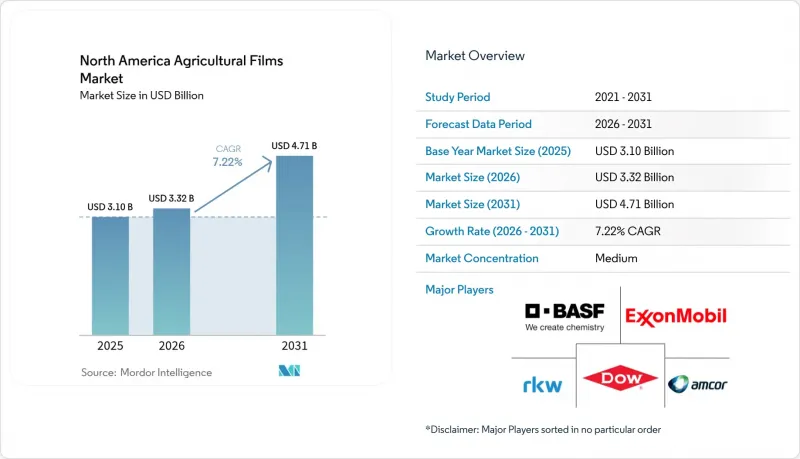
본 보고서는 유형별(저밀도 폴리에틸렌, 선형 저밀도 폴리에틸렌, 고밀도 폴리에틸렌, 에틸렌-비닐아세테이트,에틸렌-부틸-아크릴레이트 등), 용도별(멀칭, 온실 피복 등), 두께별(80마이크론 이하 등), 지역별(미국, 캐나다 등)로 분류되어 있습니다. 시장 예측은 금액(달러)으로 제시되어 있습니다.
북미의 농업용 필름 시장 동향 및 인사이트
감소하는 경작지에서 수확량을 극대화해야 할 필요성 증가
농업의 집약화가 진행되는 가운데, 농가들은 도시화와 기후 변화의 영향으로 생산 가능한 농지를 잃어가면서도 증가하는 인구를 먹여 살려야 하는 이중의 과제에 직면하고 있으며, 이것이 농업용 필름 도입을 촉진하고 있습니다. 2020년 이후 농지 용도 변경이 가속화되면서, 생산자들은 특수 작물의 수확량을 15-25% 향상시키고 물 사용량을 최대 40%까지 줄일 수 있는 멀칭 필름 도입을 추진하고 있습니다. 다층 구조의 제품은 토양 온도를 조절하고 수분을 유지하기 때문에 기후 변화가 심화되고 있음에도 불구하고 연중 여러 번의 재배 주기가 가능해집니다. 원자재 가격이 상승하더라도 1에이커당 증수분이 필름 비용을 상회하기 때문에 이러한 성능 향상은 매력적입니다.
기업의 탄소 중립 공약이 재활용 가능 필름 수요를 가속화
식품 기업들이 재활용 소재 사용률 목표나 탄소 배출 감축 목표를 설정함에 따라, 기업의 지속가능성 노력이 조달 우선순위를 재편하고 있습니다. Amcor plc와 같은 브랜드 소유 기업들은 2030년까지 재활용 소재 사용률을 30%로 높이겠다고 공약하고 있으며, 이 재활용 소재 사용률 목표가 공급망 전체로 파급되고 있습니다. 화학적 재활용 실증 실험을 통해 오염 물질에 대한 내성이 확인되면서, 사용 후 농업용 필름에 새로운 판로가 열리고 있습니다. 재활용 수지의 비용은 버진 수지 가격보다 높지만, 식품 기업들은 환경 보호 노력을 입증하기 위해 추가 비용을 지불하고 있으며, 이로 인해 재활용 필름 시장은 두 자릿수 성장을 유지하고 있습니다.
일회용 플라스틱에 대한 주 정부의 엄격한 금지 조치
캘리포니아주 상원 법안 54호는 2032년까지 일회용 플라스틱을 25% 감축할 것을 의무화하고 있으며, 규정안에서는 농업용 필름이 회색지대에 놓여 있습니다. 미국 뉴욕주와 워싱턴주도 유사한 법적 체계를 추진하고 있어, 농업용 기존 폴리에틸렌 필름의 사용이 제한될 가능성이 있습니다. 생산자 책임 조직과 관련된 규정 준수 비용 및 행정적 부담은 필름 제조업체와 유통업체의 업무 복잡성을 가중시키고 있습니다. 주마다 다른 규제가 뒤섞여 시장이 세분화되면서, 전국 규모공급업체들은 유통 전략 수립과 재고 관리에 어려움을 겪고 있습니다.
부문 분석
저밀도 폴리에틸렌은 확립된 공급망과 필름 제조업체 및 농업 분야 최종 사용자의 가공 기술 숙련도를 바탕으로, 2025년에도 북미의 농업용 필름 시장에서 41.12%의 점유율을 유지할 것으로 예측됩니다. 한편, 재생 필름은 기업의 지속가능성 정책과 순환형 경제 도입을 요구하는 규제적 압력에 힘입어, 2031년까지 연평균 성장률(CAGR) 10.02%를 기록하며 가장 빠르게 성장하는 부문으로 부상하고 있습니다. 선형 저밀도 폴리에틸렌 및 고밀도 폴리에틸렌은 특히 사일리지나 훈증 용도 등 높은 내천자성과 차단성이 요구되는 특수 용도에 사용됩니다. 에틸렌-비닐 아세테이트 공중합체 및 에틸렌-부틸 아크릴레이트 공중합체는 광투과성과 내구성이 요구되는 고급 온실 피복 용도를 대상으로 하며, 이러한 특성 덕분에 높은 가격 책정이 가능합니다.
퇴비화 가능한 필름 부문은 현재 시장 점유율은 작지만, 규제 체계가 발전하고 비용 프리미엄이 축소됨에 따라 큰 성장 가능성을 보이고 있습니다. BASF SE사의 ‘ecovio’ 멀치 필름 기술은 농업적 성능을 유지하면서 폐기 관련 우려를 해소하는 퇴비화 가능한 대체재를 제시하고 있습니다. Novamont S.p.A.의 ‘Mater-Bi’ 바이오플라스틱 플랫폼은 토양에서 퇴비화가 가능하다는 점이 경쟁 우위가 되는 유기 농업 용도 분야에서 지지를 넓혀가고 있습니다. 이 분야에서 바이오 함량 향상과 기계적 특성 개선을 위한 진화는 그동안 보급을 저해해 온 성능상의 제약을 해결하는 것입니다.
기타 혜택:
- 엑셀 형식 시장 예측(ME) 시트
- 3개월간의 애널리스트 지원
자주 묻는 질문
목차
제1장 서론
제2장 조사 방법
제3장 주요 요약
제4장 시장 구도
제5장 시장 규모와 성장 예측
제6장 경쟁 구도
제7장 시장 기회와 향후 전망
LSH 26.08.24According to Mordor Intelligence, the North America agricultural films market size was valued at USD 3.10 billion in 2025 and estimated to grow from USD 3.32 billion in 2026 to reach USD 4.71 billion by 2031, at a CAGR of 7.22% during the forecast period (2026-2031).
This report is Segmented by Type (Low-Density Polyethylene, Linear Low-Density Polyethylene, High-Density Polyethylene, Ethylene Vinyl Acetate, Ethylene Butyl Acrylate, and More), by Application (Mulching, Greenhouse Covering, and More), by Thickness (Up To 80 Micron, and More), and by Geography (United States, Canada, and More). The Market Forecasts are Provided in Terms of Value (USD).
North America Agricultural Films Market Trends and Insights
Growing need to maximize yields on shrinking arable land
Agricultural intensification drives film adoption as farmers confront the dual challenge of feeding growing populations while losing productive acreage to urbanization and climate impacts. Farmland conversion has accelerated since 2020, prompting growers to deploy mulch films that can lift specialty-crop yields 15-25% and cut water use up to 40%. Multi-layer products regulate soil temperature and retain moisture, allowing multiple crop cycles each year despite higher climate volatility. These performance gains are attractive even when feedstock prices rise, because the incremental revenue per acre still offsets film costs.
Corporate net-zero pledges accelerating demand for recyclable films
Corporate sustainability commitments reshape procurement priorities as food companies establish recycled content targets and carbon reduction goals. Brand owners such as Amcor plc pledge 30% recycled content by 2030, cascading recycled-material targets down the supply chain. Chemical-recycling pilots promise contamination tolerance, opening a new outlet for used farm films. Although recycled resin costs exceed virgin prices, food companies pay premiums to validate environmental claims, sustaining double-digit growth in recycled films.
Stringent state bans on single-use plastics
California Senate Bill 54 requires a 25% cut in single-use plastics by 2032, and draft rules leave agricultural films in a gray area. New York and Washington in the United States pursue similar legislative frameworks that could restrict conventional polyethylene film usage in agricultural applications. Compliance costs and administrative burdens associated with producer responsibility organizations add operational complexity for film manufacturers and distributors. The regulatory patchwork across states creates market fragmentation that complicates distribution strategies and inventory management for national suppliers.
Other drivers and restraints analyzed in the detailed report include:
- Adoption of smart, UV-selective films integrating IoT sensors
- State incentives for compostable mulch film trials
- Volatile ethylene feedstock prices
For complete list of drivers and restraints, kindly check the Table Of Contents.
Segment Analysis
Low-density polyethylene is anticipated to maintain a 41.12% share of the North America agricultural films market in 2025, benefiting from established supply chains and processing familiarity among film manufacturers and farming end-users. Recycled films emerge as the fastest-growing segment at 10.02% CAGR through 2031, driven by corporate sustainability mandates and regulatory pressures for circular economy adoption. Linear low-density polyethylene and high-density polyethylene serve specialized applications requiring enhanced puncture resistance and barrier properties, particularly in silage and fumigation applications. Ethylene vinyl acetate and ethylene butyl acrylate copolymers target premium greenhouse covering applications where light transmission and durability command higher pricing.
The compostable films segment, while representing a small current share, demonstrates significant growth potential as regulatory frameworks evolve and cost premiums narrow. BASF SE's ecovio mulch film technology showcases compostable alternatives that eliminate disposal concerns while maintaining agronomic performance. Novamont S.p.A.'s Mater-Bi bioplastic platform gains traction in organic farming applications, where soil compostability provides competitive advantages. The segment's evolution toward higher biobased content and improved mechanical properties addresses historical performance limitations that constrained adoption.
Complete Report Scope:
- By Type
- Low-Density Polyethylene (LDPE)
- Linear Low-Density Polyethylene (LLDPE)
- High-Density Polyethylene (HDPE)
- Ethylene Vinyl Acetate and Ethylene Butyl Acrylate
- Recycled Films
- Compostable Films
- By Application
- Mulching
- Greenhouse Covering
- Silage and Bale Wrap
- Fumigation
- By Thickness
- Up to 80 Micron
- 81 to 150 Micron
- Above 150 Micron
- By Geography
- United States
- Canada
- Mexico
- Rest of North America
List of Companies Covered in this Report:
- Amcor plc
- Exxon Mobil Corporation
- Dow Inc.
- BASF SE
- Armando Alvarez Group
- RKW Group
- Coveris
- Trioworld
- Novamont S.p.A.
- Rani Group
- Ginegar Plastic Products Ltd.
- Polifilm Group
- Sigma Plastics Group
Additional Benefits:
- The market estimate (ME) sheet in Excel format
- 3 months of analyst support
TABLE OF CONTENTS
1 Introduction
- 1.1 Study Assumptions and Market Definition
- 1.2 Scope of the Study
2 Research Methodology
3 Executive Summary
4 Market Landscape
- 4.1 Market Overview
- 4.2 Market Drivers
- 4.2.1 Growing need to maximize yields on shrinking arable land
- 4.2.2 Expansion of controlled-environment agriculture and vertical greenhouses
- 4.2.3 Rising silage demand from large-scale dairy operations
- 4.2.4 Corporate net-zero pledges accelerating demand for recyclable films
- 4.2.5 Adoption of smart, UV-selective films integrating IoT sensors
- 4.2.6 State incentives for compostable mulch film trials
- 4.3 Market Restraints
- 4.3.1 Stringent state bans on single-use plastics
- 4.3.2 Volatile ethylene feedstock prices
- 4.3.3 Slow farm-level ROI on premium multi-layer films
- 4.3.4 Recycling logistics gaps for contaminated agri-plastics
- 4.4 Regulatory Landscape
- 4.5 Technological Outlook
- 4.6 Porter's Five Forces Analysis
- 4.6.1 Threat of New Entrants
- 4.6.2 Bargaining Power of Buyers
- 4.6.3 Bargaining Power of Suppliers
- 4.6.4 Threat of Substitutes
- 4.6.5 Intensity of Competitive Rivalry
5 Market Size and Growth Forecasts (Value)
- 5.1 By Type
- 5.1.1 Low-Density Polyethylene (LDPE)
- 5.1.2 Linear Low-Density Polyethylene (LLDPE)
- 5.1.3 High-Density Polyethylene (HDPE)
- 5.1.4 Ethylene Vinyl Acetate and Ethylene Butyl Acrylate
- 5.1.5 Recycled Films
- 5.1.6 Compostable Films
- 5.2 By Application
- 5.2.1 Mulching
- 5.2.2 Greenhouse Covering
- 5.2.3 Silage and Bale Wrap
- 5.2.4 Fumigation
- 5.3 By Thickness
- 5.3.1 Up to 80 Micron
- 5.3.2 81 to 150 Micron
- 5.3.3 Above 150 Micron
- 5.4 By Geography
- 5.4.1 United States
- 5.4.2 Canada
- 5.4.3 Mexico
- 5.4.4 Rest of North America
6 Competitive Landscape
- 6.1 Market Concentration
- 6.2 Strategic Moves
- 6.3 Market Share Analysis
- 6.4 Company Profiles (Includes Global Level Overview, Market Level Overview, Core Segments, Financials as Available, Strategic Information, Market Rank/Share, Products and Services, and Recent Developments)
- 6.4.1 Amcor plc
- 6.4.2 Exxon Mobil Corporation
- 6.4.3 Dow Inc.
- 6.4.4 BASF SE
- 6.4.5 Armando Alvarez Group
- 6.4.6 RKW Group
- 6.4.7 Coveris
- 6.4.8 Trioworld
- 6.4.9 Novamont S.p.A.
- 6.4.10 Rani Group
- 6.4.11 Ginegar Plastic Products Ltd.
- 6.4.12 Polifilm Group
- 6.4.13 Sigma Plastics Group


