|
시장보고서
상품코드
2121596
농업용 필름 : 시장 점유율 분석, 업계 동향과 통계, 성장 예측(2026-2031년)Agricultural Films - Market Share Analysis, Industry Trends & Statistics, Growth Forecasts (2026 - 2031) |
||||||
 Mordor Intelligence
Mordor Intelligence에 의하면, 농업용 필름 시장 규모는 2025년 125억 달러에서 2026년에는 133억 7,000만 달러에 이르고, 2026-2031년 CAGR 6.98%로 성장을 지속하여 2031년에는 187억 3,000만 달러에 달할 것으로 예측됩니다.
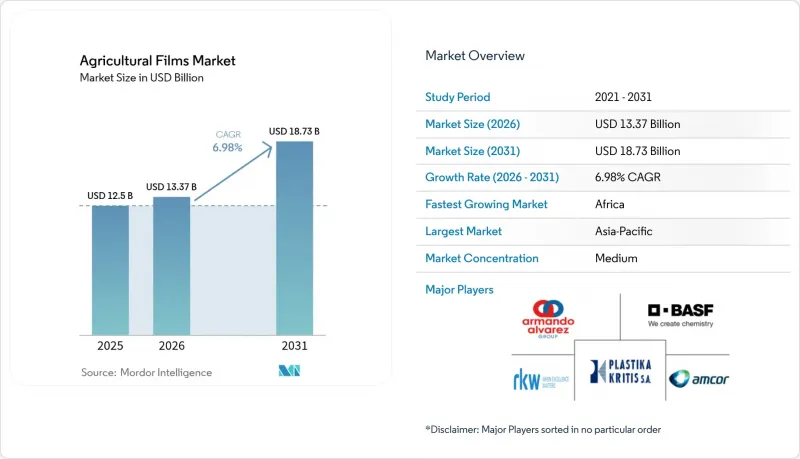
본 보고서는 유형별(저밀도 폴리에틸렌, 선형 저밀도 폴리에틸렌, 고밀도 폴리에틸렌, 재생재, 기타), 두께별(80mm 이하 및 그 이상), 용도별(온실, 멀칭,사일리지, 기타 용도), 지역(북미, 남미, 유럽, 아시아태평양, 중동 및 아프리카)별로 분류되어 있습니다. 시장 예측은 금액(달러) 기준으로 제시되어 있습니다.
전 세계 농업용 필름 시장 동향 및 인사이트
온실 재배의 확산
보호 재배는 현재 고부가가치 원예 작물에서 주곡 작물까지 확대되고 있으며, 25-40%의 수확량 증가를 가져와 연중 안정적인 공급을 뒷받침하고 있습니다. 자동화 및 인공지능(AI)을 활용한 기후 제어를 통해 노동 투입량이 감소하여 중규모 생산자도 이 분야에 진출할 수 있게 되었습니다. 배지 기반 시스템은 토양 전염성 병해의 매개를 차단하고, 우수한 불투수성을 갖춘 무균 배리어 필름이 필요하기 때문에 다층 PE 구조에 대한 수요를 촉진하고 있습니다. 대마, 영양 보충제용 작물, 의약품용 작물의 경우, 파장 관리, 보온성, 확산광 분포를 최적화하는 고성능 필름이 요구되고 있습니다. 브리티시컬럼비아주의 온실 운영자들은 재생에너지 도입을 통해 운영 비용을 더욱 절감하고, 2025년까지 채소 생산량을 18% 증가시킬 것으로 전망하고 있습니다.
증발을 억제하기 위한 멀칭의 인기가 높아지고 있습니다.
플라스틱 멀칭 필름은 건조 지대에서 관개량을 30-50% 줄여, 보전 농업에서의 재생 농업 실천을 점점 더 뒷받침하고 있습니다. 전 세계 소비량은 200만 메트르톤을 초과하며, 그 대부분은 집약적인 채소 재배 시스템이 이루어지는 아시아가 차지하고 있습니다. 반사 필름은 토양 표면 온도를 4-6°C 낮추어, 고온 스트레스가 있는 기후 조건에서 재배 기간을 연장합니다. 생분해성 혁신 기술은 유기 인증 요건을 충족하고 필름 회수에 따른 노동력을 줄여주지만, 높은 비용이 여전히 보급의 장벽으로 작용하고 있습니다. 가변율 멀칭기기를 정밀 농업 데이터와 결합함으로써, 생산자는 필름의 두께와 배치를 최적화하여 자원 효율 향상이라는 목표를 강화할 수 있습니다. 재활용성을 높이기 위해 더 두꺼운 멀칭 필름 사용을 의무화하는 중국의 지침에 따라, 재료 과학 분야에서는 여러 번의 재활용 주기를 견딜 수 있는 고강도 배합 개발이 진행되고 있습니다.
온실 인프라에 대한 막대한 초기 투자
첨단 온실의 건설비는 1제곱미터당 2,500-4,000달러인 반면, 저기술 온실은 400-500달러에 불과하기 때문에 소규모 농가에게는 초기 투자 부담이 매우 큽니다. 건설비에 더해 기후 제어, 비료 및 관개, 에너지 시스템에 연간 수익의 40%가 소요되기도 하여, 농산물 가격이 하락할 경우 수익성 확보가 어려워집니다. 담보 부족이나 높은 금리로 인해, 특히 개척 경제권에서는 대출 접근이 제한되고 있습니다. 설비 리스 모델이나 ‘생산 확대에 따른 지불’ 방식의 서비스 계약은 자금 조달 부담을 경감시켜 주지만, 충실한 농업 보급 지원이 필요합니다. 재무적 실행 가능성은 작물에 따라 다르며, 표고버섯은 내부수익률을 확보할 수 있는 반면, 동일한 비용 구조하에서도 멜론은 여전히 수익성이 나지 않습니다.
부문 분석
2025년, 저밀도 폴리에틸렌(LDPE)은 농업용 필름 시장 점유율의 42.75%를 차지했습니다. 이는 비용과 성능의 균형이 뛰어나고, 피복재로 압출 성형이 용이하기 때문입니다. 이 소재가 시장을 독점하고 있는 이유는 뛰어난 광학 투명도와 신장 특성에 있으며, 이를 통해 설치 시 기계적 스트레스를 최소화할 수 있기 때문입니다. 업계의 지속가능성으로의 전환은 2031년까지 재생 소재 시장의 연평균 성장률(CAGR)을 8.35%로 끌어올리고 있으며, 작물과 접촉하는 기능성을 해치지 않으면서 재생 소재를 통합한 다층 구조 설계가 이를 뒷받침하고 있습니다. 용해제의 화학적 발전으로 인해 PCR(재활용 폴리에틸렌) 비율을 높일 수 있게 되었으며, 기존에 재활용 PE의 채택을 방해하던 악취나 겔화 문제가 완화되고 있습니다.
선형 저밀도 폴리에틸렌(LLDPE)은 사일리지 사용자들이 요구하는 내천자성을 부여하는 반면, 에틸렌-비닐 아세테이트 공중합체는 고급 온실용 필름에 뛰어난 광확산성을 부여합니다. 고밀도 폴리에틸렌이나 폴리아미드 등의 특수 수지는 구조적 강성이나 내용제성 같은 틈새 시장 요구 사항을 충족시키고 있지만, 여전히 비용 면에서 제약이 있습니다. 얇은 필름에 대한 수요가 증가함에 따라, 얇아져도 인장 강도를 유지할 수 있는 고용융 강도 등급 수요가 증가하고 있으며, 이를 통해 헥타르당 수지 사용량이 감소하여 플라스틱의 전반적인 환경 부하가 경감됩니다.
지역별 분석
2025년, 아시아태평양은 농업용 필름 시장의 37.10%를 차지했습니다. 이는 중국의 광대한 온실 면적과 인도, 일본, 한국의 보조금 지원 현대화 프로그램이 주도한 결과입니다. 이 지역의 제조업체들은 비용 면에서 우위를 점하고 있으며, 안정제나 압출 성형기를 현지에서 조달할 수 있어 신속한 제품 개선 및 개량이 가능합니다. 국내 기술 혁신은 높은 일사 강도에 대처하면서도 작물의 광합성 효율을 최적화하는 확산 필름에 중점을 두고 있습니다. 플라스틱 폐기물 감축을 목표로 하는 정부 프로그램 덕분에 더 두껍고 재활용 가능한 멀칭 필름의 개발이 촉진되고 있으며, 수지 제조업체와 농업 연구 기관 간의 지역적 연구 협력도 강화되고 있습니다.
아프리카는 원예 작물의 수출 확대와 유리한 무역 우대 조치에 힘입어 2031년까지 연평균 성장률(CAGR)이 8.85%를 나타낼 것으로 예측되는 가장 빠르게 성장하는 지역입니다. 케냐의 절화 산업은 보호 재배를 중시하고 있으며, 주변 국가들의 경제를 온실 재배 모델로 이끌며 그 발전을 주도하고 있습니다. 남아프리카의 바이오플라스틱은 ‘아프리카 성장 기회법(AGOA)’에 따른 관세 면제 조치를 활용하여, 지역 필름 가공업체에 비용 경쟁력 있는 생분해성 자재를 제공합니다. 성장 잠재력은 있으나, 필름 회수 및 재활용에 있어 뿌리 깊은 인프라 부족이 순환형 경제 실현을 위한 노력을 제약하고 있습니다.
유럽과 북미는 성숙해 가고 있지만 여전히 역동적인 시장이며, 지속가능성에 관한 규제가 소재의 지속적인 발전을 뒷받침하고 있습니다. 유럽연합 집행위원회의 2025년 식품 접촉 재료 규정 개정안에서는 더욱 엄격한 순도 기준이 부과됨에 따라, 필름 배합 제조업체들은 첨가제 배합 및 오염 관리 프로토콜을 개선할 수밖에 없는 상황입니다. 중동에서는 수자원 효율화와 연중 생산을 위한 투자가 진행되고 있으며, 폐쇄형 루프 시스템에서 고확산성 커버와 탈염수 또는 재생수를 함께 사용하고 있습니다. 한편, 남미 및 오세아니아의 틈새 시장에서는 수출 주도형 농산물 품질 요건을 충족하는 특수 멀칭재 및 사일리지 제품이 선호되고 있습니다.
기타 혜택:
- 엑셀 형식 시장 예측(ME) 시트
- 3개월간의 애널리스트 지원
자주 묻는 질문
목차
제1장 서론
제2장 조사 방법
제3장 주요 요약
제4장 시장 구도
제5장 시장 규모와 성장 예측
제6장 경쟁 구도
제7장 시장 기회와 향후 전망
LSH 26.09.09According to Mordor Intelligence, the agricultural films market size is expected to grow from USD 12.50 billion in 2025 to USD 13.37 billion in 2026 and is forecast to reach USD 18.73 billion by 2031 at 6.98% CAGR over 2026-2031.
This report is Segmented by Type (Low-Density Polyethylene, Linear Low-Density Polyethylene, High-Density Polyethylene, Reclaims, and More), by Thickness (Up To 80 Mm and More), by Application (Greenhouse, Mulching, Silage, and Other Applications), and by Geography (North America, South America, Europe, Asia-Pacific, Middle East, and Africa). The Market Forecasts are Provided in Terms of Value (USD).
Global Agricultural Films Market Trends and Insights
Rising adoption of greenhouse cultivation
Protected cultivation now extends from high-value horticulture to staple crops, delivering yield increases of 25-40% and supporting year-round supply continuity. Automation and artificial-intelligence climate controls lower labor inputs, enabling mid-scaled growers to enter the segment. Substrate-based systems eliminate soil-borne disease vectors and require sterile barrier films with superior impermeability, spurring demand for multilayer PE structures. Cannabis, nutraceutical, and pharmaceutical crops command premium film specifications that optimize wavelength management, thermal retention, and diffused light distribution. Greenhouse operators in British Columbia forecast an 18% vegetable-output lift by 2025 through renewable-energy integration that further lowers operational overhead.
Growing popularity of mulching to curb evaporation
Plastic mulch films cut irrigation volumes 30-50% in arid zones and increasingly underpin regeneration practices within conservation agriculture. Global consumption has surpassed 2 million metric tons, with Asia accounting for the bulk due to intensive vegetable systems. Reflective films lower soil-surface temperatures 4-6 °C, extending cropping windows in heat-stressed climates. Biodegradable innovations meet organic-certification needs and reduce labor associated with film retrieval, though elevated cost remains an adoption hurdle. Variable-rate mulch applicators paired with precision agriculture data help growers optimize film thickness and placement, reinforcing resource-efficiency goals. Chinese directives mandating thicker mulch to improve recyclability push material science toward higher-strength formulations that withstand multiple cycles.
High initial investment in greenhouse infrastructure
Hi-tech greenhouses demand USD 2,500-4,000 per m2 compared with USD 400-500 for low-tech counterparts, posing steep upfront barriers for smallholders. Beyond construction, climate controls, fertigation, and energy systems can consume 40% of annual revenue, challenging profitability when produce prices fall. Limited collateral and high interest rates restrict access to credit, especially in frontier economies. Equipment leasing models and pay-as-you-grow service contracts ease the capital strain but require robust extension support. Financial viability varies by crop, and shiitake mushrooms yield internal returns, yet melons remain unprofitable under identical cost structures.
Other drivers and restraints analyzed in the detailed report include:
- Government subsidies for protected cultivation
- Surge in demand for photo-selective spectral films
- Environmental concerns over disposal of PE films
For complete list of drivers and restraints, kindly check the Table Of Contents.
Segment Analysis
Low-Density Polyethylene held 42.75% agricultural films market share in 2025, underpinned by its balanced cost-to-performance ratio and ease of extrusion into covers. The material's dominance stems from superior optical clarity and elongation properties that minimize mechanical stress during installation. The industry's pivot to sustainability is catalyzing an 8.35% CAGR for Reclaims through 2031, aided by multilayer designs that embed recycled content without compromising crop-facing functionality. Chemical advances in compatibilizers allow higher PCR ratios, mitigating odor and gel issues that historically constrained recycled-PE uptake.
Linear-Low-Density Polyethylene adds puncture resistance requested by silage users, while Ethyl Vinyl Acetate copolymers impart enhanced light diffusion for premium greenhouse films. High-density polyethylene and specialized resins, such as polyamide, address niche requirements for structural rigidity and solvent resistance, but remain cost-limited. Rising demand for downgauged films drives the need for high-melt-strength grades that sustain tensile integrity at reduced thickness, thereby compressing resin usage metric tons per hectare and lowering the overall plastic footprint.
Complete Report Scope:
- By Product Type
- Low-Density Polyethylene
- Linear Low-Density Polyethylene
- High-Density Polyethylene
- Ethyl Vinyl Acetate / Ethylene Butyl Acrylate
- Reclaims (Recycled PE)
- Other Types (Polypropylene Agricultural Films, Polyamide Agricultural Films, Ethylene Vinyl-Alcohol Copolymer Resins, and PVC)
- By Thickness
- Up to 80 µm
- 80-150 µm
- Above 150 µm
- By Application
- Greenhouse
- Mulching
- Silage
- Other Applications (Low Tunnels, Fumigation)
- By Geography
- North America
- United States
- Canada
- Mexico
- Rest of North America
- South America
- Brazil
- Argentina
- Rest of South America
- Europe
- Germany
- United Kingdom
- France
- Spain
- Italy
- Russia
- Rest of Europe
- Asia-Pacific
- China
- India
- Japan
- Australia
- Rest of Asia-Pacific
- Middle East
- Saudi Arabia
- United Arab Emirates
- Rest of Middle East
- Africa
- South Africa
- Egypt
- Rest of Africa
- North America
Geography Analysis
Asia-Pacific held 37.10% of the agricultural films market in 2025, driven by extensive greenhouse acreage in China and subsidy-backed modernization programs in India, Japan, and South Korea. Regional manufacturers have cost advantages and benefit from a localized supply of stabilizer additives and extrusion machinery, enabling rapid product iteration. Domestic innovation focuses on diffusive films that counteract high solar-irradiation intensity while optimizing crop photosynthetic efficiency. Government programs targeting plastic waste reduction prompt the development of thicker, recyclable mulch variants, cementing local research collaborations between resin producers and agricultural institutes.
Africa represents the fastest-growing territory with a projected 8.85% CAGR through 2031, supported by horticultural export expansion and favorable trade preferences. Kenya's floriculture valorizes protected cultivation, generating and guiding neighboring economies toward greenhouse models. South African bioplastics leverage duty-free access under the African Growth and Opportunity Act, offering cost-competitive biodegradable inputs for regional film converters. Despite growth potential, endemic infrastructure gaps in film retrieval and recycling constrain circular-economy ambitions.
Europe and North America illustrate mature yet dynamic markets where sustainability regulation spurs continual material advancement. The European Commission's 2025 update to food-contact regulations imposes stricter purity thresholds, compelling film formulators to refine additive packages and contamination-control protocols. Middle East investments in water-efficiency and year-round production use high-diffusion covers paired with desalinated or recycled water in closed-loop systems, while South American and Oceanian niche segments favor specialty mulch and silage products aligned with export-driven produce quality requirements.
- Berry Global Inc. (Amcor)
- Armando Alvarez Group
- BASF SE
- Novamont SpA
- Polifilm Group
- Ginegar Plastic Products
- Trioplast Industrier
- NDVECO Group
- Plastika Kritis SA
- Exxon Mobil Corporation
- Kuraray Co.
- AB Rani Plast Oy
- RKW Group
- Group Barbier
- Coveris Holding
Additional Benefits:
- The market estimate (ME) sheet in Excel format
- 3 months of analyst support
TABLE OF CONTENTS
1 Introduction
- 1.1 Study Assumptions and Market Definition
- 1.2 Scope of the Study
2 Research Methodology
3 Executive Summary
4 Market Landscape
- 4.1 Market Overview
- 4.2 Market Drivers
- 4.2.1 Rising adoption of greenhouse cultivation
- 4.2.2 Growing popularity of mulching to curb evaporation
- 4.2.3 Government subsidies for protected cultivation
- 4.2.4 Surge in demand for photo-selective spectral films
- 4.2.5 Farm-level shift toward recycled-content films
- 4.2.6 Carbon-credit monetization for biodegradable films
- 4.3 Market Restraints
- 4.3.1 High initial investment in greenhouse infrastructure
- 4.3.2 Environmental concerns over disposal of PE films
- 4.3.3 Volatility in ethylene feedstock pricing
- 4.3.4 Lack of standardized film recovery logistics
- 4.4 Regulatory Landscape
- 4.5 Technological Outlook
- 4.6 Porter's Five Forces
- 4.6.1 Bargaining Power of Suppliers
- 4.6.2 Bargaining Power of Buyers
- 4.6.3 Threat of New Entrants
- 4.6.4 Threat of Substitute Products
- 4.6.5 Intensity of Competitive Rivalry
5 Market Size and Growth Forecasts (Value)
- 5.1 By Product Type
- 5.1.1 Low-Density Polyethylene
- 5.1.2 Linear Low-Density Polyethylene
- 5.1.3 High-Density Polyethylene
- 5.1.4 Ethyl Vinyl Acetate / Ethylene Butyl Acrylate
- 5.1.5 Reclaims (Recycled PE)
- 5.1.6 Other Types (Polypropylene Agricultural Films, Polyamide Agricultural Films, Ethylene Vinyl-Alcohol Copolymer Resins, and PVC)
- 5.2 By Thickness
- 5.2.1 Up to 80 µm
- 5.2.2 80-150 µm
- 5.2.3 Above 150 µm
- 5.3 By Application
- 5.3.1 Greenhouse
- 5.3.2 Mulching
- 5.3.3 Silage
- 5.3.4 Other Applications (Low Tunnels, Fumigation)
- 5.4 By Geography
- 5.4.1 North America
- 5.4.1.1 United States
- 5.4.1.2 Canada
- 5.4.1.3 Mexico
- 5.4.1.4 Rest of North America
- 5.4.2 South America
- 5.4.2.1 Brazil
- 5.4.2.2 Argentina
- 5.4.2.3 Rest of South America
- 5.4.3 Europe
- 5.4.3.1 Germany
- 5.4.3.2 United Kingdom
- 5.4.3.3 France
- 5.4.3.4 Spain
- 5.4.3.5 Italy
- 5.4.3.6 Russia
- 5.4.3.7 Rest of Europe
- 5.4.4 Asia-Pacific
- 5.4.4.1 China
- 5.4.4.2 India
- 5.4.4.3 Japan
- 5.4.4.4 Australia
- 5.4.4.5 Rest of Asia-Pacific
- 5.4.5 Middle East
- 5.4.5.1 Saudi Arabia
- 5.4.5.2 United Arab Emirates
- 5.4.5.3 Rest of Middle East
- 5.4.6 Africa
- 5.4.6.1 South Africa
- 5.4.6.2 Egypt
- 5.4.6.3 Rest of Africa
- 5.4.1 North America
6 Competitive Landscape
- 6.1 Market Concentration
- 6.2 Strategic Moves
- 6.3 Market Share Analysis
- 6.4 Company Profiles (Includes Global Level Overview, Market Level Overview, Core Segments, Financials as Available, Strategic Information, Market Rank/Share for Key Companies, Products and Services, and Recent Developments)
- 6.4.1 Berry Global Inc. (Amcor)
- 6.4.2 Armando Alvarez Group
- 6.4.3 BASF SE
- 6.4.4 Novamont SpA
- 6.4.5 Polifilm Group
- 6.4.6 Ginegar Plastic Products
- 6.4.7 Trioplast Industrier
- 6.4.8 NDVECO Group
- 6.4.9 Plastika Kritis SA
- 6.4.10 Exxon Mobil Corporation
- 6.4.11 Kuraray Co.
- 6.4.12 AB Rani Plast Oy
- 6.4.13 RKW Group
- 6.4.14 Group Barbier
- 6.4.15 Coveris Holding