

|
시장보고서
상품코드
2113309
클라우드 기업 컨텐츠 관리 : 시장 점유율 분석, 업계 동향과 통계, 성장 예측(2026-2031년)Cloud Enterprise Content Management - Market Share Analysis, Industry Trends & Statistics, Growth Forecasts (2026 - 2031) |
||||||
 Mordor Intelligence
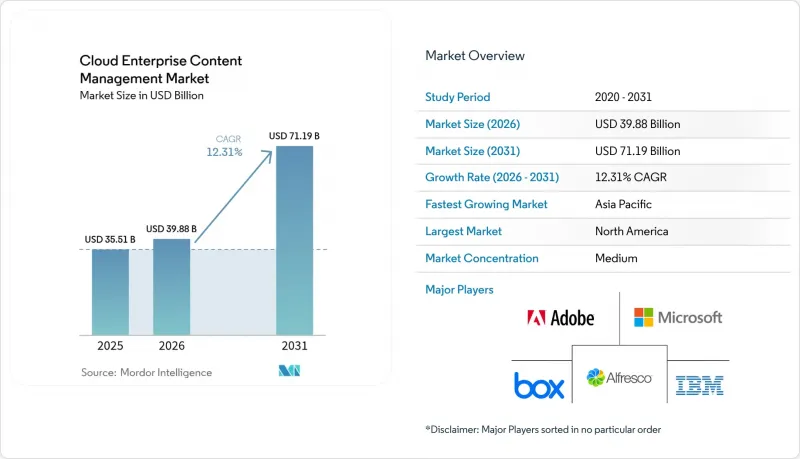
Mordor Intelligence에 따르면 클라우드형 기업 컨텐츠 관리 시장 규모는 2025년에 355억 1,000만 달러로 평가되며, 2026년 398억 8,000만 달러에서 2031년까지 711억 9,000만 달러에 달할 것으로 예측되고 있으며, 예측 기간(2026-2031년)에 CAGR은 12.31%에 달할 전망입니다.
이 보고서는 솔루션별(컨텐츠 관리, 케이스 관리 등), 도입 모델별(퍼블릭 클라우드, 프라이빗 클라우드, 하이브리드 클라우드), 최종사용자 산업별(BFSI, 에너지·전력 등), 서비스별(전문 서비스, 매니지드 서비스), 조직 규모별(중소기업, 대기업),지역별(북미 등)로 분류되어 있습니다. 시장 예측은 금액(달러) 기준으로 제시되어 있습니다.
전 세계 클라우드 기반 기업 컨텐츠 관리 시장의 동향 및 인사이트
거버넌스 및 규정 준수를 위한 AI 기반 컨텐츠 자동화
생성형 AI는 분류, 메타데이터 태깅 및 보존 기간 준수를 자동화함으로써 컨텐츠 거버넌스 주기를 수 주간 단축하고 있습니다. SharePoint Premium의 Microsoft Copilot은 요약문 자동 생성, 조항 추출, 기밀성 라벨 적용을 가능하게 하여 감사 대응 준비를 가속화합니다. 특히 규제가 엄격한 업계의 조기 도입 기업으로부터는 미처리 심사 건수가 대폭 감소했으며, 감독 당국의 검사 후 시정 비용이 절감되었다는 보고가 접수되고 있습니다. OpenText Aviator는 레거시 아카이브 전체에서 자연 언어 검색을 가능하게 하여, 법무 팀이 규제 당국보다 먼저 규정 위반 기록을 식별할 수 있도록 지원합니다. 효율성 향상과 더불어 정책의 자동 적용을 통해 전 세계 매출의 최대 4%에 달할 수 있는 과태료 대상 위반 위험을 줄입니다. 툴의 성숙도에 따라 AI 주도 거버넌스는 중견 기업으로의 도입도 확대되어, 클라우드 기업 컨텐츠 관리 시장에서 그 영향력을 공고히 할 것으로 예상됩니다.
규제 대상 산업에서의 디지털 전환 진전
새로운 법규에 따라 BFSI(은행·금융·보험) 및 의료 사업자는 컨텐츠 워크플로우의 현대화를 요구받고 있으며, 이에 응하지 않을 경우 제재를 받을 위험이 있습니다. 유럽의 ‘디지털 운영 복원력 법(Digital Operational Resilience Act)’은 은행에 대해 위조가 불가능한 공급업체와의 거래 로그를 보관할 것을 의무화하고 있는 반면,미국의 ‘21세기 치료법(21st Century Cures Act)’은 의료 제공자에 의한 정보 축적을 금지하고 있습니다. 인도의 ‘디지털 개인 데이터 보호법(Digital Personal Data Protection Act)’은 데이터 접근 및 삭제 이벤트에 관한 상세한 로그 기록을 의무화하고 있습니다. 수십 년 전에 구축된 저장소를 기한 내에 개조할 수 없기 때문에 각 기관은 미리 설정된 보존 기간 및 변조 방지 기능을 갖춘 로그 기록을 포함한 클라우드 이전을 서둘러 진행하고 있습니다. 각 벤더사는 현재 도입 주기를 절반으로 단축하는 산업별 템플릿을 제공하고 있으며, 규정 준수 대응 준비가 갖춰져 있다는 점이 클라우드 기업 컨텐츠 관리 시장에서 중요한 구매 동기가 되고 있습니다.
레거시 ECM에서 클라우드 네이티브 플랫폼으로의 복잡한 전환
수십년에 축적된 맞춤형 메타데이터, 커스텀 워크플로우, 독자적인 파일 형식이 클라우드 배포을 복잡하게 만들고 있습니다. 문서 링크 손상, 감사 추적 기록 누락, 호환되지 않는 보존 기간 코드 등이 프로젝트의 정체나 예산 증가를 초래하여, 병행하여 시스템을 유지 관리할 수밖에 없는 상황입니다. 금융 기관은 증권 규제로 인해 7년 동안 원본 형식으로 접근해야 할 의무가 있으며, 추가적인 난관에 직면하고 있으며, 이로 인해 시스템 폐기 계획이 지연되고 있습니다. 레거시 시스템과 클라우드 환경을 모두 다룰 수 있는 숙련된 통합 전문 인력이 부족하여 비용이 상승하고 있으며, 이로 인해 클라우드 기업 컨텐츠 관리 시장의 단기적인 성장세가 둔화되고 있습니다.
부문 분석
컨텐츠 관리는 2025년 매출의 33.62%를 차지하며, 정책, 표준 운영 절차(SOP), 계약 증거의 공식 기록 보관소로서의 위상을 반영하고 있습니다. 마케팅 및 교육 팀이 테라바이트 규모의 동영상과 고해상도 이미지를 생성함에 따라 디지털 자산 관리는 연평균 성장률(CAGR) 15.18%로 성장하고 있습니다. 100만 건 이상의 자산을 관리하는 기업에서는 임시적인 파일 공유 대신 자동 태그 지정 및 버전 관리를 도입한 결과, 캠페인 출시 시간이 40% 단축되었다고 보고되고 있습니다. 사건 관리 및 워크플로우 엔진은 보험금 청구 및 인허가 업무 현장에서 널리 이용되고 있습니다. 이러한 업무에서는 다단계 승인 프로세스에서 법적으로 정해진 기한과 고객과의 SLA(서비스 수준 계약)를 모두 충족해야 합니다. 기록 관리는 ISO 15489의 보존 의무 대상인 업계에서 전략적 중요성을 유지하고 있으며, 정당한 근거에 기반한 삭제와 법적 보존 의무(리걸 홀드)의 효과적인 관리를 보장합니다. 이러한 모듈들은 종합적으로 클라우드 기반 기업 컨텐츠 관리 시장에서 교차 판매 기회를 지원하며, 계정 수익 향상과 벤더 종속성 심화로 이어지고 있습니다.
노코드 툴을 통해 비즈니스 사용자가 개발자의 개입 없이 일반적인 승인 프로세스를 자동화할 수 있게 됨에 따라 워크플로 오케스트레이션이 다시 주목받고 있습니다. Microsoft Power Automate와 OpenText AppWorks는 드래그 앤 드롭 방식의 디자인 캔버스를 제공하여 IT 부서의 백로그를 줄이고, ROI의 조기 실현을 촉진하고 있습니다. Hyland OnBase와 같은 사례 관리 제품군은 정부 기관이 시민의 청원을 추적하고, 법정 기한이 다가올 때 알림을 발송할 수 있도록 지원합니다. 기록 관리 기능은 협업 회의록이나 소셜미디어 게시물까지 대상 범위를 확대하고 있으며, 이러한 자료들은 현재 일부 규제 당국에 의해 업무 기록으로 간주되고 있습니다. 이러한 기능의 융합을 통해 벤더들은 캡처, 관리, 저장, 보존, 배포 기능을 단일 라이선스 하에 통합한 컨텐츠 서비스 플랫폼으로 전환하고 있으며, ‘원스톱 샵’으로서의 입지를 강화하고 있습니다.
하이브리드 아키텍처는 연평균 성장률(CAGR) 16.52%로 성장하고 있으며, 순수 퍼블릭 클라우드 및 프라이빗 클라우드 각 부문을 상회하고 있습니다. 기업에서는 고객의 재무 기록 및 지적 재산(IP)을 프라이빗 클라우드 노드에 상시 보관하는 한편, 위험이 낮은 자산에 대해서는 탄력적 검색 및 AI 기반 분석을 위해 퍼블릭 SaaS로 집약하는 것이 일반화되고 있습니다. 유럽연합(EU)에서는 조사 대상 은행의 73%가 GDPR의 현지화 규정을 준수하기 위해 하이브리드 프레임워크를 채택하고 있으며, 이러한 추세는 중국의 ‘개인정보보호법(PIPL)’에 기반한 중국 본토내 호스팅 정책에도 반영되고 있습니다. 2025년에는 퍼블릭 클라우드가 기업용 클라우드 컨텐츠 관리 시장의 63.54% 점유율을 차지했으나, 데이터 전송 비용 및 멀티테넌트 환경에 대한 우려로 인해 대규모 구매 기업은 규제 리스크를 헤지하기 위해 하이브리드 환경으로 전환하고 있습니다.
물리적 격리가 필수적인 방위 관련 기업이나 제약 연구소에게 프라이빗 클라우드 서비스는 여전히 필수적이지만, 그 성장은 고액의 설비 투자와 전문 인력에 대한 수요로 인해 제약을 받고 있습니다. AWS Outposts나 Microsoft Azure Stack과 같은 어플라이언스는 고객의 구내에서 SaaS API를 제공함으로써 기존의 경계를 모호하게 만들고 있습니다. 재해 복구(DR) 설계 역시 하이브리드화를 촉진하는 요인 중 하나입니다. 변함없는 오프사이트 백업은 데이터 보관 장소에 관한 규정을 위반하지 않으면서 랜섬웨어에 대한 내성을 강화합니다. 그 결과, 아키텍처의 유연성이 확보되고 플랫폼 선택의 폭이 넓어지며, 클라우드 기업 컨텐츠 관리 시장 전체에서 멀티 벤더 간의 경쟁과 혁신의 속도가 유지되고 있습니다.
지역별 분석
북미는 2025년 매출의 37.56%를 차지했습니다. 이는 미국 증권거래위원회(SEC), 미국 식품의약국(FDA) 및 각 주의 개인정보 보호법이 기록 보관 미비에 대해 엄격한 처벌을 부과했기 때문입니다. 이 지역에 본사를 둔 다국적 기업은 정교한 컨텐츠 분류 엔진을 활용하여 캘리포니아주 소비자 개인정보 보호법(CCPA)의 규제 대상인 개인 데이터와 일반적인 기업 문서를 구분함으로써 소송 위험을 줄이고 있습니다. 또한 미국에 기반을 둔 주요 기술 기업은 전 세계로 파급되는 아키텍처 청사진을 수립하고 있으며, 이는 클라우드 기업 컨텐츠 관리 시장 전체의 혁신 주기를 가속화하고 있습니다.
유럽에서는 GDPR(일반 데이터 보호 규정) 및 디지털 운영 복원력 법에 의해 형성된 ‘규정 준수를 최우선으로 하는’ 궤도를 따르고 있습니다. 금융 기관은 감독 당국의 면밀한 검토를 견딜 수 있는 변조 불가능한 아카이브 계층에 투자하고 있는 반면, 행정 기관은 견고한 버전 관리가 요구되는 전자 정부 포털에 자금을 지원하고 있습니다. 벤더에 의한 데이터 소재지 보증 및 슈렘스 II를 준수하는 계약 조항은 현재 RFP(제안 요청서)의 표준 요구 사항이 되었습니다. 중동 및 아프리카에서는 ‘두바이 페이퍼리스 구상’와 같은 국가 주도의 디지털화 전략이 도입을 지원하고 있지만, 사하라 이남 지역의 불안정한 통신 환경이 실시간 협업을 방해하여 시장 규모의 즉각적인 확대를 억제하고 있습니다.
연평균 성장률(CAGR) 16.05%가 예상되는 아시아태평양에서는 인도, 중국, 일본의 전자 조달, 세무, 라이선싱 기록 의무화와 같은 우선순위가 높은 정부 프로그램이 성장의 동력이 되고 있습니다. 각국의 주요 클라우드 기업은 글로벌 벤더와 제휴하여 데이터 거주 요건을 충족하면서도 세계 수준의 기능을 제공하는 현지 시장에 최적화된 SaaS 서비스를 전개하고 있습니다. 남미에서는 대역폭 가격 하락과 세무 당국의 디지털 보고 전환에 따라 신중한 도입이 진행되고 있지만, 환율 변동이 구매 결정에 걸림돌이 될 가능성이 있습니다. 전반적으로 규제 명확화와 인프라 업그레이드에 힘입어 2031년까지 지역별 도입 경로가 확대되며, 클라우드 기반 기업 컨텐츠 관리 시장의 지속적인 성장이 지원될 것으로 예상됩니다.
기타 혜택:
- 엑셀 형식의 시장 예측(ME) 시트
- 3개월간 애널리스트 지원
자주 묻는 질문
목차
제1장 서론
제2장 조사 방법
제3장 개요
제4장 시장 구도
제5장 시장 규모와 성장 예측
제6장 경쟁 구도
제7장 시장 기회와 향후 전망
KSA 26.08.25According to Mordor Intelligence, the cloud enterprise content management market size was valued at USD 35.51 billion in 2025 and estimated to grow from USD 39.88 billion in 2026 to reach USD 71.19 billion by 2031, at a CAGR of 12.31% during the forecast period (2026-2031).
This report is Segmented by Solution (Content Management, Case Management, and More), Deployment Model (Public Cloud, Private Cloud, and Hybrid Cloud), End-User Industry (BFSI, Energy and Power, and More), Service (Professional, and Managed), Organization Size (SMEs, and Large Enterprises), and Geography (North America, and More). The Market Forecasts are Provided in Terms of Value (USD).
Global Cloud Enterprise Content Management Market Trends and Insights
AI-Powered Content Automation for Governance and Compliance
Generative AI is trimming weeks from content-governance cycles by automating classification, metadata tagging, and retention enforcement. Microsoft Copilot in SharePoint Premium now automatically drafts summaries, extracts clauses, and applies sensitivity labels, accelerating audit readiness. Early adopters, particularly in regulated verticals, report steep reductions in review backlogs and lower remediation costs after supervisory exams. OpenText Aviator enables natural-language search across legacy archives, allowing legal teams to surface non-compliant records before regulators do. Beyond efficiency, automated policy application lowers breach exposure under penalties that can reach 4% of global turnover. As tooling matures, AI-driven governance is expected to permeate mid-market deployments, solidifying its influence on the cloud enterprise content management market.
Growing Digital Transformation in Regulated Industries
New statutes are forcing BFSI and healthcare operators to modernize content workflows or risk sanctions. Europe's Digital Operational Resilience Act obliges banks to store immutable vendor-interaction logs, while the U.S. 21st Century Cures Act blocks information hoarding by providers. India's Digital Personal Data Protection Act mandates granular logs of data-access and erasure events. Unable to retrofit decades-old repositories in time, institutions are fast-tracking cloud migrations that include pre-configured retention schedules and tamper-evident logging. Vendors now ship sector templates that cut implementation cycles in half, making compliance readiness a key purchase trigger for the cloud enterprise content management market.
Complex Migration From Legacy ECM to Cloud-Native Platforms
Decades of bespoke metadata, custom workflows, and proprietary file formats complicate cloud rollouts. Broken document links, missing audit trails, and incompatible retention codes stall projects, inflate budgets, and force parallel system upkeep. Financial institutions face additional hurdles because securities rules require original-format access for seven years, which slows down decommissioning plans. Skilled integrators who can navigate both legacy and cloud stacks are scarce, which pushes costs higher and dampens near-term momentum in the cloud enterprise content management market.
Other drivers and restraints analyzed in the detailed report include:
- Increasing Adoption of Cloud Computing
- Shift Toward Remote and Hybrid Work Models
- Multi-Tenant Security and Compliance Concerns
For complete list of drivers and restraints, kindly check the Table Of Contents.
Segment Analysis
Content management accounted for 33.62% of 2025 revenue, reflecting its stature as the repository of record for policies, SOPs, and contractual evidence. Digital asset management is growing at a 15.18% CAGR as marketing and training teams generate terabytes of video and high-resolution imagery. Enterprises running more than 1 million assets report campaign launch times 40% faster once automated tagging and version control replace ad-hoc file shares. Case management and workflow engines are popular in insurance claims and permitting offices, where multistep approvals must reconcile statutory clocks with customer SLAs. Record management retains strategic relevance for industries subject to ISO 15489 retention mandates, ensuring defensible deletion and effective management of legal holds. Collectively, these modules anchor cross-sell opportunities that raise account revenue and deepen vendor lock-in within the cloud enterprise content management market.
Workflow orchestration is reclaiming attention as no-code tooling empowers business users to automate common approvals without developer intervention. Microsoft Power Automate and OpenText AppWorks now offer drag-and-drop design canvases, reducing IT backlog and accelerating ROI. Case-management suites, such as Hyland OnBase, support government agencies in tracking citizen petitions and triggering alerts when statutory deadlines approach. Record-management features have expanded to encompass collaboration transcripts and social posts, which are now considered business records by several regulators. The convergence of these capabilities is nudging vendors toward content-services platforms that bundle capture, management, storage, preservation, and delivery functions under a single license, reinforcing a one-stop-shop positioning.
Hybrid architectures are expanding at 16.52% CAGR, eclipsing both pure public and private segments. Enterprises routinely retain customer financial records and IP on private cloud nodes while funneling lower-risk assets to public SaaS for elastic search and AI-based analytics. In the European Union, 73% of surveyed banks adopted hybrid frameworks to comply with GDPR localization rules, a pattern also reflected in China's PIPL-driven mainland hosting policies. Although the public cloud held a 63.54% share of the cloud enterprise content management market in 2025, egress fees and shared-tenant concerns are steering larger buyers toward mixed estates that hedge regulatory exposure.
Private-cloud offerings remain vital for defense contractors and pharmaceutical labs that stipulate physical isolation, yet their growth is constrained by high capex and the need for specialized staff. Appliances such as AWS Outposts and Microsoft Azure Stack blur boundaries by delivering SaaS APIs on customer premises. Disaster-recovery design is another hybrid driver: immutable off-site backups harden ransomware resilience without breaching residency rules. The resulting architectural flexibility keeps platform selection fluid, sustaining multi-vendor competition and innovation cadence across the cloud enterprise content management market.
Complete Report Scope:
- By Solution
- Content Management
- Case Management
- Workflow Management
- Record Management
- Digital Asset Management
- Other Solutions
- By Deployment Model
- Public Cloud
- Private Cloud
- Hybrid Cloud
- By End-User Industry
- Banking, Financial Services and Insurance (BFSI)
- Energy and Power
- Medical and Healthcare
- Manufacturing
- Retail
- Information Technology and Telecom
- Other End-User Industries
- By Service
- Professional
- Managed
- By Organization Size
- Small and Medium Enterprises
- Large Enterprises
- By Geography
- North America
- United States
- Canada
- Mexico
- South America
- Brazil
- Argentina
- Rest of South America
- Europe
- United Kingdom
- Germany
- France
- Italy
- Spain
- Russia
- Rest of Europe
- Asia Pacific
- China
- Japan
- India
- South Korea
- Australia
- Rest of Asia Pacific
- Middle East
- Saudi Arabia
- United Arab Emirates
- Turkey
- Rest of Middle East
- Africa
- South Africa
- Nigeria
- Egypt
- Rest of Africa
- North America
Geography Analysis
North America generated 37.56% of 2025 revenue as the Securities and Exchange Commission, the Food and Drug Administration, and state privacy acts enforced stiff penalties for lapses in record retention. Multinationals headquartered in the region utilize granular content-classification engines to distinguish between personal data subject to California Consumer Privacy Act rules and general corporate documents, thereby reducing litigation exposure. U.S.-based tech giants also set architectural blueprints that ripple worldwide, accelerating innovation cycles across the cloud enterprise content management market.
Europe follows a compliance-first trajectory shaped by GDPR and the Digital Operational Resilience Act. Financial institutions invest in immutable archival layers that withstand supervisory scrutiny, while public administrations fund e-governance portals that demand robust version control. Vendor data residency commitments and Schrems-II-compliant contractual clauses are now standard requirements in RFPs. In the Middle East and Africa, sovereign digitization strategies, such as the Dubai Paperless Initiative, stimulate adoption; however, sporadic connectivity in Sub-Saharan regions hinders real-time collaboration and tempers immediate market size gains.
Asia Pacific, forecast to grow at 16.05% CAGR, benefits from high-priority government programs in India, China, and Japan that mandate electronic procurement, tax, and licensing records. Domestic cloud champions partner with global vendors to launch localized SaaS offerings that satisfy residency rules while offering global-class features. South America exhibits a cautious uptake as bandwidth prices decline and tax authorities transition to digital reporting, yet currency volatility can hinder purchase decisions. Overall, regulatory clarity and infrastructure upgrades are expected to expand regional adoption channels through 2031, supporting sustained growth for the cloud-based enterprise content management market.
- Adobe Inc.
- Alfresco Software Inc.
- Box Inc.
- Hyland Software Inc.
- IBM Corporation
- Microsoft Corporation
- OpenText Corporation
- Oracle Corporation
- Xerox Holdings Corporation
- Newgen Software Technologies Limited
- DocuWare GmbH
- Laserfiche
- M-Files Corporation
- Fabasoft AG
- Everteam SAS
- SERgroup Holding International GmbH
- KnowledgeLake Inc.
- Objective Corporation Limited
- Kiteworks Inc.
- Veeva Systems Inc.
- Micro Focus International plc
- Epicor Software Corporation
- Nuxeo SA
- KYOCERA Document Solutions Inc.
- Systemware Inc.
Additional Benefits:
- The market estimate (ME) sheet in Excel format
- 3 months of analyst support
TABLE OF CONTENTS
1 INTRODUCTION
- 1.1 Study Assumptions and Market Definition
- 1.2 Scope of the Study
2 RESEARCH METHODOLOGY
3 EXECUTIVE SUMMARY
4 MARKET LANDSCAPE
- 4.1 Market Overview
- 4.2 Market Drivers
- 4.2.1 Increasing Adoption of Cloud Computing
- 4.2.2 Rising Enterprise Mobility and BYOD Policies
- 4.2.3 Growing Digital Transformation in Regulated Industries
- 4.2.4 Shift Toward Remote and Hybrid Work Models
- 4.2.5 AI-Powered Content Automation for Governance and Compliance
- 4.2.6 Confidential Computing and Tokenization Enabling Highly Secure Cloud ECM
- 4.3 Market Restraints
- 4.3.1 Bandwidth Limitations in Developing Regions
- 4.3.2 Multi-Tenant Security and Compliance Concerns
- 4.3.3 Complex Migration From Legacy ECM to Cloud-Native Platforms
- 4.3.4 Vendor Lock-In Risks Limiting Strategic Flexibility
- 4.4 Industry Value Chain Analysis
- 4.5 Regulatory Landscape
- 4.6 Technological Outlook
- 4.7 Impact of Macroeconomic Factors on the Market
- 4.8 Porter's Five Forces Analysis
- 4.8.1 Bargaining Power of Suppliers
- 4.8.2 Bargaining Power of Buyers
- 4.8.3 Threat of New Entrants
- 4.8.4 Threat of Substitute Products
- 4.8.5 Intensity of Competitive Rivalry
5 MARKET SIZE AND GROWTH FORECASTS (VALUE)
- 5.1 By Solution
- 5.1.1 Content Management
- 5.1.2 Case Management
- 5.1.3 Workflow Management
- 5.1.4 Record Management
- 5.1.5 Digital Asset Management
- 5.1.6 Other Solutions
- 5.2 By Deployment Model
- 5.2.1 Public Cloud
- 5.2.2 Private Cloud
- 5.2.3 Hybrid Cloud
- 5.3 By End-User Industry
- 5.3.1 Banking, Financial Services and Insurance (BFSI)
- 5.3.2 Energy and Power
- 5.3.3 Medical and Healthcare
- 5.3.4 Manufacturing
- 5.3.5 Retail
- 5.3.6 Information Technology and Telecom
- 5.3.7 Other End-User Industries
- 5.4 By Service
- 5.4.1 Professional
- 5.4.2 Managed
- 5.5 By Organization Size
- 5.5.1 Small and Medium Enterprises
- 5.5.2 Large Enterprises
- 5.6 By Geography
- 5.6.1 North America
- 5.6.1.1 United States
- 5.6.1.2 Canada
- 5.6.1.3 Mexico
- 5.6.2 South America
- 5.6.2.1 Brazil
- 5.6.2.2 Argentina
- 5.6.2.3 Rest of South America
- 5.6.3 Europe
- 5.6.3.1 United Kingdom
- 5.6.3.2 Germany
- 5.6.3.3 France
- 5.6.3.4 Italy
- 5.6.3.5 Spain
- 5.6.3.6 Russia
- 5.6.3.7 Rest of Europe
- 5.6.4 Asia Pacific
- 5.6.4.1 China
- 5.6.4.2 Japan
- 5.6.4.3 India
- 5.6.4.4 South Korea
- 5.6.4.5 Australia
- 5.6.4.6 Rest of Asia Pacific
- 5.6.5 Middle East
- 5.6.5.1 Saudi Arabia
- 5.6.5.2 United Arab Emirates
- 5.6.5.3 Turkey
- 5.6.5.4 Rest of Middle East
- 5.6.6 Africa
- 5.6.6.1 South Africa
- 5.6.6.2 Nigeria
- 5.6.6.3 Egypt
- 5.6.6.4 Rest of Africa
- 5.6.1 North America
6 COMPETITIVE LANDSCAPE
- 6.1 Market Concentration
- 6.2 Strategic Moves
- 6.3 Market Share Analysis
- 6.4 Company Profiles (includes Global level Overview, Market level overview, Core Segments, Financials as available, Strategic Information, Market Rank/Share for key companies, Products and Services, and Recent Developments)
- 6.4.1 Adobe Inc.
- 6.4.2 Alfresco Software Inc.
- 6.4.3 Box Inc.
- 6.4.4 Hyland Software Inc.
- 6.4.5 IBM Corporation
- 6.4.6 Microsoft Corporation
- 6.4.7 OpenText Corporation
- 6.4.8 Oracle Corporation
- 6.4.9 Xerox Holdings Corporation
- 6.4.10 Newgen Software Technologies Limited
- 6.4.11 DocuWare GmbH
- 6.4.12 Laserfiche
- 6.4.13 M-Files Corporation
- 6.4.14 Fabasoft AG
- 6.4.15 Everteam SAS
- 6.4.16 SERgroup Holding International GmbH
- 6.4.17 KnowledgeLake Inc.
- 6.4.18 Objective Corporation Limited
- 6.4.19 Kiteworks Inc.
- 6.4.20 Veeva Systems Inc.
- 6.4.21 Micro Focus International plc
- 6.4.22 Epicor Software Corporation
- 6.4.23 Nuxeo SA
- 6.4.24 KYOCERA Document Solutions Inc.
- 6.4.25 Systemware Inc.
7 MARKET OPPORTUNITIES AND FUTURE OUTLOOK
- 7.1 White-space and Unmet-Need Assessment


