

|
시장보고서
상품코드
2113311
신생아 스크리닝 : 시장 점유율 분석, 업계 동향과 통계, 성장 예측(2026-2031년)Newborn Screening - Market Share Analysis, Industry Trends & Statistics, Growth Forecasts (2026 - 2031) |
||||||
 Mordor Intelligence
Mordor Intelligence에 따르면 2026년 신생아 스크리닝 시장의 규모는 15억 2,000만 달러로 추정되고 있으며, 2025년 14억 달러에서 확대하며, 2031년에는 23억 2,000만 달러에 달할 것으로 예측됩니다.
2026-2031년 동안 연평균 성장률(CAGR) 8.78%로 성장할 것으로 전망됩니다.
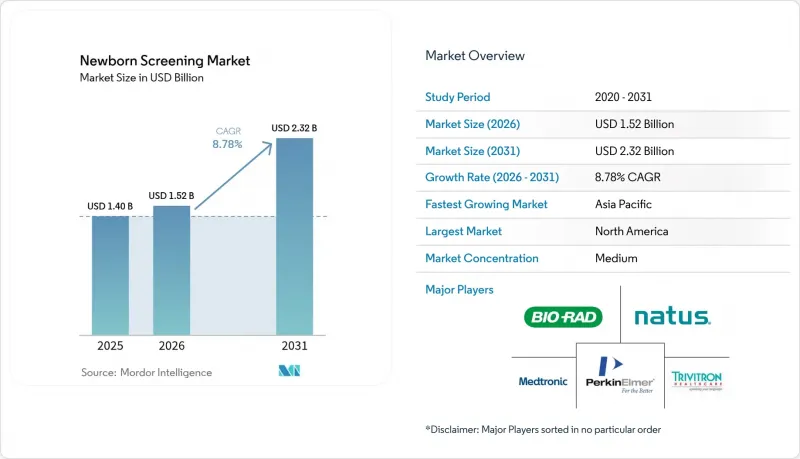
이 보고서에서는 산업을 기술별(탠덤 질량분석법, 맥박 산소 측정법, 기타), 검사 유형별(건조 혈액 스팟, 청각 선별 검사, 기타), 최종사용자별(병원, 진단·검사 기관, 기타), 지역별로 분류하고 있습니다. 시장 규모와 전망은 금액(달러)으로 표시되어 있습니다.
전 세계 신생아 선별 검사 시장의 동향 및 인사이트
선천성 및 유전성 대사 질환의 부담 증가
유전성 대사 질환의 발생률은 증가하고 있으며, 이란의 데이터에 따르면 유병률은 출생 1,000명당 1명에 달하여 과거 평균을 크게 상회하고 있습니다. 중동 일부 지역의 근친결혼 비율이 높아 위험이 증가하고 있으며, 이에 따라 사우디아라비아는 선별 검사 대상 질환을 18종으로 확대하고, 헤모글로빈 질환을 추가할 준비를 진행하고 있습니다. 고령 출산으로 인한 인구 동태의 변화와 질환을 앓는 영아의 생존율 향상으로 인해 더 광범위한 선별 검사 대상 질환에 대한 수요가 지속되고 있습니다. BeginNGS와 같은 조기 유전체 선별 검사 구상에서는 민감도 99% 이상을 유지하면서 위양성을 97% 감소시키는 것이 입증되었으며, 증상 발현 전 치료를 가능하게 함으로써 평생 치료비를 절감하고 있습니다. 치료받지 않은 사례가 후속 의료비를 증가시키기 때문에 의료경제학적 관점에서도 예방적 선별 검사가 권장되고 있습니다.
전국적인 선별 검사 패널에 대한 정부의 의무화 및 자금 확충
세계보건기구(WHO)는 2024년 4월, 청력 선별검사와 고빌리루빈혈증 선별검사의 보편화를 권장하는 지침을 발표했으며, 여러 지역에서 입법 조치가 가속화되고 있습니다. 미국에서는 2024년 말까지 48개 프로그램에서 척수성 근위축증 선별검사가 실시될 예정이며, 한편 식품의약국(FDA)은 새로운 검사법의 심사를 효율화하기 위해 유전성 대사질환 자문위원회를 설립했습니다. 벨기에 대한 ‘BabyDetect’ 시범 사업에서는 165가지 질환을 대상으로 했으며, 보호자의 검사 참여율은 90%에 달했고, 71건의 조치가 필요한 사례가 확인되었습니다. 그중 30건은 기존 선별 검사 패널에서는 놓쳤던 사례입니다. 이러한 의무화에 수반되는 자금 풀을 통해 예측 가능한 조달 주기가 형성되어, 검증된 처리 능력을 갖춘 공급업체에 이점이 제공됩니다.
NBS(신생아 선별검사) 정책 및 검사 패널에 있으며, 전 세계적인 통일성 부족
검사 패널은 전 세계에서 10개 질환 이하에서 50개 질환 이상까지 폭이 넓어, 국경을 넘는 기술 도입 및 교육을 복잡하게 만들고 있습니다. 영국에서 갱신된 집단 선별 검사 지침은 공급업체가 따라야 할 프로토콜이 끊임없이 변화하고 있음을 여실히 보여줍니다. 게놈 검사에 관한 동의 기준의 차이는 다국적 진출을 지연시키고 있으며, 데이터 형식의 불일치는 알고리즘의 성능을 제한하고 있습니다. 그 결과, 공급업체는 더 높은 맞춤화 비용을 부담하게 되어 시장 출시까지의 기간이 지연되고 있습니다.
부문 분석
2025년, 탠덤 MS/MS는 고처리량 대사 검사의 주류 기법으로서 신생아 선별 검사 시장 점유율의 24.63%를 차지했습니다. iDIA-QC와 같은 통합 소프트웨어를 통해 현재 수십 개의 검사실에서 품질관리가 자동화되어, 수작업에 의한 모니터링과 오류율이 감소하고 있습니다. 지역 검사실들이 유지보수 부담이 적은 대안을 모색하고 있는 만큼, 효소법을 이용한 신생아 선별 검사 시장 규모는 연평균 성장률(CAGR) 9.21%로 확대될 것으로 예측됩니다. 맥박 산소 포화도 측정기는 중증 선천성 심장병 선별 검사가 모든 사례에 적용됨에 따라 계속해서 안정적으로 도입되고 있으며, 선별 검사 비용은 신생아 1명당 5-14달러입니다.
전장 유전체 시퀀싱은 장기적인 성장 양상을 변화시키고 있습니다. 초고속 프로토콜을 통해 3시간 이내에 진단이 가능해지면서, 유전체학은 단일 워크플로우 내에서 여러 개별 검사를 대체하는 입지를 확립해 가고 있습니다. 255가지 질환을 대상으로 한 NGS 검증이 시작됨에 따라 거의 완벽한 민감도를 갖춘 확장성이 입증되고 있습니다. 장비 가격이 하락하는 가운데, 대사 산물의 MS/MS 분석과 복잡한 유전학적 검사를 위한 시퀀싱을 결합한 하이브리드 모델이 공공 검사 기관들 사이에서 지지를 얻고 있습니다.
지역별 분석
북미는 53개 프로그램에서 포괄적인 ‘권장 통합 선별 패널(RUSP)’을 채택하고 유리한 환급 제도의 지원을 받아 2025년 매출의 42.11%를 차지했습니다. 신생아 선별 검사 시장은 실험실 개발 검사(LDT)에 관한 FDA 지침과 검사법 승인을 신속화하는 유전성 대사 질환 자문 위원회(Genetic Metabolic Diseases Advisory Committee)의 혜택을 받고 있습니다. GeneDx가 1만 7,000명의 영아를 대상으로 실시한 GUARDIAN 연구에서는 기존 선별 패널로는 놓쳤던 질환이 3.7%의 사례에서 확인되어, 유전체 분석 확대에 대한 잠재적 수요가 부각되었습니다.
아시아태평양은 10.09%의 연평균 성장률(CAGR)을 보이고 있으며, 이는 리소좀 축적증에서 효소 분석법을 능가하는 성과를 거둔 중국의 대규모 신생아 선별 검사(NBGS) 시범 사업에 힘입은 결과입니다. 대만의 5년에 걸친 척수성 근위축증 프로그램에서는 44만 6,966명의 신생아 중 23건의 무증상기 사례가 확인되어 구체적인 임상적 이점이 입증되었습니다. 인도의 낭포성 섬유증 선별 검사 노력과 태국 농촌 지역의 98.6%에 달하는 커버리지는 공공 투자의 확대를 시사합니다.
유럽에서는 벨기에 대한 ‘BabyDetect’와 같은 협력 프로젝트를 통해 꾸준한 확대가 이어지고 있습니다. 이 프로젝트는 영아 1명당 365유로의 비용으로 165가지 질환을 선별하고 있으며, 수용률은 90%에 달합니다. 영국은 검체 처리 시간을 단축하기 위해 운영 협정을 개편하고, 희귀 질환 선별 검사와 관련해 Revvity에 3,780만 달러 규모의 계약을 체결했습니다. 신흥 지역에서는 사하라 이남 아프리카에서 매년 40만 명의 겸상적혈구증 환아들이 태어나고 있으며, 비용 대비 효과가 높은 기술이 시급히 요구되고 있습니다.
기타 혜택
- 엑셀 형식의 시장 예측(ME) 시트
- 3개월간의 애널리스트 지원
자주 묻는 질문
목차
제1장 서론
제2장 조사 방법
제3장 개요
제4장 시장 구도
제5장 시장 규모와 성장 예측
제6장 경쟁 구도
제7장 시장 기회와 향후 전망
KSA 26.08.25According to Mordor Intelligence, the newborn screening market size in 2026 is estimated at USD 1.52 billion, growing from 2025 value of USD 1.40 billion with 2031 projections showing USD 2.32 billion, growing at 8.78% CAGR over 2026-2031.
This report Segments the Industry Into by Technology (Tandem Mass Spectrometry, Pulse Oximetry, and More), by Test Type (Dried Blood Spot, Hearing Screening, and More), by End User (Hospitals, Diagnostic & Reference Laboratories, Other End Users), and Geography. The Market Sizes and Forecasts are Provided in Terms of Value (USD).
Global Newborn Screening Market Trends and Insights
Rising burden of congenital & inherited metabolic disorders
Incidence rates for inherited metabolic diseases are climbing, with Iranian data indicating prevalence as high as 1:1,000 births, far above historical averages. High consanguinity in parts of the Middle East magnifies risk, prompting Saudi Arabia to expand its panel to 18 disorders and prepare to add hemoglobinopathies. Demographic shifts toward older maternal age and improved survival of affected infants sustain demand for broader panels. Early-genome initiatives such as BeginNGS have demonstrated a 97% reduction in false positives while preserving >99% sensitivity, lowering lifetime treatment costs by enabling presymptomatic therapy. Health-system economics favor preventive screening as untreated cases drive high downstream expenditures.
Government mandates & funding expansions for national panels
The World Health Organization issued April 2024 guidance promoting universal hearing and hyperbilirubinemia screening, accelerating legislative action across multiple regions . In the United States, spinal muscular atrophy reached implementation in 48 programs by late-2024, while the Food and Drug Administration formed the Genetic Metabolic Diseases Advisory Committee to streamline review of new assays. Belgium's BabyDetect pilot covered 165 disorders with 90% parental uptake, revealing 71 actionable cases, 30 of which conventional panels would miss . Funding pools attached to such mandates create predictable procurement cycles that reward suppliers with proven throughput.
Lack of global uniformity in NBS policies & test panels
Panels vary from fewer than 10 to more than 50 conditions worldwide, complicating cross-border technology deployment and training. The United Kingdom's updated population-screening pathway highlights ever-shifting protocols that vendors must track. Divergent consent standards for genomic tests slow multinational roll-outs, while inconsistent data formats limit algorithm performance. Suppliers consequently absorb higher customization costs, delaying time-to-market.
Other drivers and restraints analyzed in the detailed report include:
- Rapid adoption of tandem-mass-spectrometry platforms
- AI algorithms reducing false positives
- Acute shortage of biochemical-genetics specialists
For complete list of drivers and restraints, kindly check the Table Of Contents.
Segment Analysis
Tandem MS/MS accounted for 24.63% of newborn screening market share in 2025 as the method of choice for high-throughput metabolic testing. Integrated software such as iDIA-QC now automates quality control across dozens of labs, cutting manual oversight and error rates. The newborn screening market size for enzyme-based assays is projected to rise at 9.21% CAGR as regional laboratories search for low-maintenance alternatives. Pulse-oximetry equipment continues stable uptake following universal critical-congenital-heart-defect mandates, with screening costs ranging USD 5-14 per newborn.
Whole-genome sequencing is reshaping long-term growth. Ultra-rapid protocols deliver diagnoses within three hours, positioning genomics to displace multiple standalone assays within one workflow. BeginNGS validations across 255 conditions showcase scalability with near-perfect sensitivity. As instrument prices fall, hybrid models combining MS/MS for metabolites and sequencing for complex genetics are gaining favor among public laboratories.
Complete Report Scope:
- By Technology
- Tandem Mass Spectrometry
- Pulse Oximetry
- Enzyme-based Assays
- DNA / Genome Sequencing Assays
- Other Technologies
- By Test Type
- Dried Blood Spot (DBS)
- Hearing Screening
- Critical Congenital Heart Defect (CCHD)
- Other Test Types
- By End User
- Hospitals
- Diagnostic & Reference Laboratories
- Other End Users
- By Geography
- North America
- United States
- Canada
- Mexico
- Europe
- Germany
- United Kingdom
- France
- Italy
- Spain
- Rest of Europe
- Asia-Pacific
- China
- Japan
- India
- Australia
- South Korea
- Rest of Asia-Pacific
- Middle East & Africa
- GCC
- South Africa
- Rest of Middle East & Africa
- South America
- Brazil
- Argentina
- Rest of South America
- North America
Geography Analysis
North America commanded 42.11% of 2025 revenue, buoyed by comprehensive Recommended Uniform Screening Panel adoption across 53 programs and favorable reimbursement. The newborn screening market benefits from FDA guidance on laboratory-developed tests and the Genetic Metabolic Diseases Advisory Committee, which accelerate assay clearance. GeneDx's GUARDIAN study of 17,000 infants revealed conditions missed by traditional panels in 3.7% of cases, underscoring latent demand for genomic expansion.
Asia-Pacific exhibits a 10.09% CAGR, fueled by China's large NBGS pilots that outperformed enzyme assays for lysosomal storage disorders. Taiwan's five-year spinal muscular atrophy program confirmed 23 presymptomatic cases among 446,966 newborns, illustrating tangible clinical benefits. India's cystic-fibrosis screening initiatives and Thailand's 98.6% coverage in rural settings point to mounting public investment.
Europe sustains stable expansion through coordinated projects such as Belgium's BabyDetect, which screens 165 disorders at EUR 365 per infant with 90% acceptance. The United Kingdom modernized operational agreements to tighten specimen processing times and awarded Revvity a USD 37.8 million contract for rare-disease screening. In emerging regions, sub-Saharan Africa confronts 400,000 annual sickle-cell births, highlighting urgent need for cost-adapted technologies .
- Revvity, Inc.
- Natus Medical
- Bio-Rad Laboratories
- Thermo Fisher Scientific
- Danaher
- Waters Corporation
- Agilent Technologies
- GE Healthcare
- Masimo
- Demant
- Trivitron Healthcare
- ZenTech
- Baebies
- Labsystems Diagnostics
- GeneDx
- Illumina
- LabCorp
- BGI
Additional Benefits:
- The market estimate (ME) sheet in Excel format
- 3 months of analyst support
TABLE OF CONTENTS
1 Introduction
- 1.1 Study Assumptions & Market Definition
- 1.2 Scope of the Study
2 Research Methodology
3 Executive Summary
4 Market Landscape
- 4.1 Market Overview
- 4.2 Market Drivers
- 4.2.1 Rising burden of congenital & inherited metabolic disorders
- 4.2.2 Government mandates & funding expansions for national panels
- 4.2.3 Rapid adoption of tandem-mass-spectrometry (MS/MS) platforms
- 4.2.4 AI / machine-learning algorithms slashing false-positive rates
- 4.2.5 Roll-out of ultra-rapid whole-genome sequencing in NICUs
- 4.2.6 Emergence of at-home supplemental DNA newborn kits
- 4.3 Market Restraints
- 4.3.1 Lack of global uniformity in NBS policies & test panels
- 4.3.2 Persisting false-positive/false-negative follow-ups
- 4.3.3 Acute shortage of biochemical-genetics specialists
- 4.3.4 Data-privacy & consent concerns around genomic data
- 4.4 Value / Supply-Chain Analysis
- 4.5 Regulatory Landscape
- 4.6 Technological Outlook
- 4.7 Porter's Five Forces Analysis Analysis
- 4.7.1 Bargaining Power of Buyers/Consumers
- 4.7.2 Bargaining Power of Suppliers
- 4.7.3 Threat of New Entrants
- 4.7.4 Threat of Substitute Products
- 4.7.5 Intensity of Competitive Rivalry
5 Market Size & Growth Forecasts (Value)
- 5.1 By Technology
- 5.1.1 Tandem Mass Spectrometry
- 5.1.2 Pulse Oximetry
- 5.1.3 Enzyme-based Assays
- 5.1.4 DNA / Genome Sequencing Assays
- 5.1.5 Other Technologies
- 5.2 By Test Type
- 5.2.1 Dried Blood Spot (DBS)
- 5.2.2 Hearing Screening
- 5.2.3 Critical Congenital Heart Defect (CCHD)
- 5.2.4 Other Test Types
- 5.3 By End User
- 5.3.1 Hospitals
- 5.3.2 Diagnostic & Reference Laboratories
- 5.3.3 Other End Users
- 5.4 By Geography
- 5.4.1 North America
- 5.4.1.1 United States
- 5.4.1.2 Canada
- 5.4.1.3 Mexico
- 5.4.2 Europe
- 5.4.2.1 Germany
- 5.4.2.2 United Kingdom
- 5.4.2.3 France
- 5.4.2.4 Italy
- 5.4.2.5 Spain
- 5.4.2.6 Rest of Europe
- 5.4.3 Asia-Pacific
- 5.4.3.1 China
- 5.4.3.2 Japan
- 5.4.3.3 India
- 5.4.3.4 Australia
- 5.4.3.5 South Korea
- 5.4.3.6 Rest of Asia-Pacific
- 5.4.4 Middle East & Africa
- 5.4.4.1 GCC
- 5.4.4.2 South Africa
- 5.4.4.3 Rest of Middle East & Africa
- 5.4.5 South America
- 5.4.5.1 Brazil
- 5.4.5.2 Argentina
- 5.4.5.3 Rest of South America
- 5.4.1 North America
6 Competitive Landscape
- 6.1 Market Concentration
- 6.2 Market Share Analysis
- 6.3 Company Profiles (includes Global level Overview, Market level overview, Core Segments, Financials as available, Strategic Information, Market Rank/Share for key companies, Products & Services, and Recent Developments)
- 6.3.1 Revvity, Inc.
- 6.3.2 Natus Medical
- 6.3.3 Bio-Rad Laboratories
- 6.3.4 Thermo Fisher Scientific
- 6.3.5 Danaher
- 6.3.6 Waters Corporation
- 6.3.7 Agilent Technologies
- 6.3.8 GE HealthCare
- 6.3.9 Masimo Corporation
- 6.3.10 Demant A/S
- 6.3.11 Trivitron Healthcare
- 6.3.12 ZenTech SA
- 6.3.13 Baebies
- 6.3.14 Labsystems Diagnostics
- 6.3.15 GeneDx
- 6.3.16 Illumina
- 6.3.17 Labcorp
- 6.3.18 BGI Genomics
7 Market Opportunities & Future Outlook
- 7.1 White-space & Unmet-need Assessment


