

|
시장보고서
상품코드
2113314
가스치환포장(MAP) : 시장 점유율 분석, 업계 동향과 통계, 성장 예측(2026-2031년)Modified Atmosphere Packaging (MAP) - Market Share Analysis, Industry Trends & Statistics, Growth Forecasts (2026 - 2031) |
||||||
 Mordor Intelligence
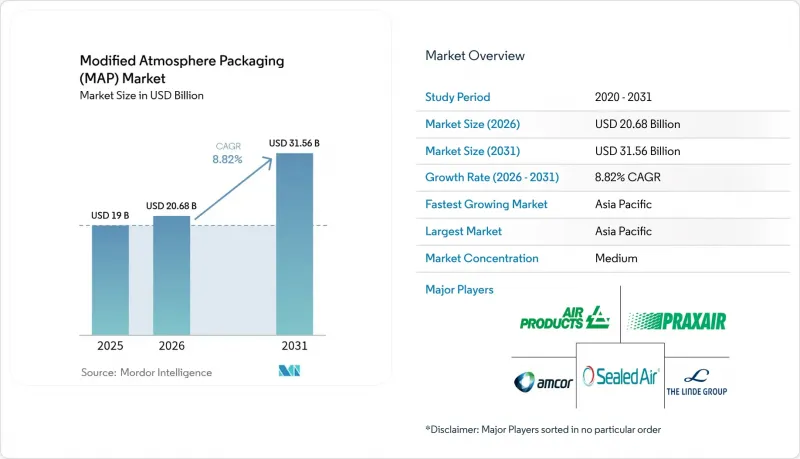
가스치환포장 시장 규모는 2026년에 206억 8,000만 달러로 추정되고 있으며, 2025년 190억 달러에서 확대하며, 2031년에는 315억 6,000만 달러에 달할 것으로 예측됩니다.
2026-2031년까지 연평균 성장률(CAGR) 8.82%로 성장할 것으로 전망됩니다.
이 보고서는 포장 가스(산소, 질소, 이산화탄소 등), 포장 재료(폴리에틸렌, 폴리프로필렌,PET, 퇴비화 가능한 소재 등), 용도(과일·채소, 육류·가금류·수산물 등), 장비 유형(트레이 실, 폼·필·실, 백 실 등) 및 지역(북미 등)별로 분류되어 있습니다. 시장 전망은 금액(달러) 기준으로 제시되어 있습니다.
전 세계 가스치환포장(MAP) 시장의 동향 및 인사이트
온라인 식료품 구매의 급증으로 인해 유통기한 연장이 요구됨
온라인 식료품 시장의 보급률이 높아짐에 따라 배송 시간이 24시간에서 최대 72시간으로 연장되면서, 소매업체들은 라스트 마일 배송 전 과정을 통해 품질을 유지할 수 있는 포장을 채택할 수밖에 없게 되었습니다. 주요 밀키트 기업은 현재 단백질 제품에 대해 질소 충전 트레이를 표준 사양으로 지정하고 있으며, 이 사양 덕분에 2024년 사업 운영에서 부패로 인한 손실이 이미 8-12%에서 3-5%로 감소했습니다. 따라서 진공 챔버 라인에 대한 설비 투자는 구독 처리량에 비례하여 확대되고 있으며, 이는 가스치환포장 시장용 설비에 대한 장기적인 수요를 지원하고 있습니다. 공급망 데이터의 가시화는 동적인 유통기한 모델링을 더욱 촉진하여, 소매업체와 소비자 모두에게 이익이 되는 재고 최적화를 가능하게 하고 있습니다. 그 결과, 가스치환포장 시장은 식품 E-Commerce 소매의 성장 궤적에 부합하는 견고한 수요 곡선을 보이고 있습니다.
식품 폐기물 감축을 위한 규제 동향
EU의 ‘농장에서 식탁까지(Farm to Fork) 전략’과 이와 유사한 미국의 지침에서는 2030년까지 폐기물을 50% 감축한다는 목표를 달성하기 위한 검증된 수단으로 MAP가 특히 언급되고 있습니다. 프랑스의 식품 폐기물 감축법에서는 인증된 MAP 솔루션을 도입하는 소매업체에 우대 조치를 부여하고 있으며, 이를 통해 고성능 설비로의 전환이 진행되고 있습니다. 수출 지향적인 가공업체들은 단순한 규제 준수를 넘어 서유럽 및 북미의 고수익 시장 진출을 확보하기 위해서도 가스치환포장을 채택하고 있습니다. 그 결과, 인증 프로토콜은 경쟁상의 차별화 요소가 되어 세계 무역 흐름 속에서 가스치환포장 시장의 역할을 더욱 확대시키고 있습니다. 이러한 법규제의 추세에 따라 중소기업은 설비 업그레이드를 강요받고 있으며, 그렇지 않을 경우 수익성이 높은 소매 계약에서 배제될 위험이 있으며, 설비 갱신 주기가 유지되고 있습니다.
MAP 기계에 대한 막대한 설비 투자
가스 충전 모듈이 장착된 보급형 트레이 실러는 20만 달러 전후부터 시작하지만, 높은 처리 능력을 갖춘 진공 챔버 시스템은 60만 달러를 초과하며, 이 금액은 일반적인 중소기업의 연간 매출의 15-20%에 해당합니다. 재판매 가치가 불투명하고 기술적 위험에 대한 이해도 부족하므로 기존 금융 기관들은 대출에 신중한 태도를 보이고 있습니다. 유지보수 계약에는 매년 구매 가격의 12-15%가 추가로 소요되어 현금 흐름을 압박하고, 투자 회수 기간을 장기화시키고 있습니다. 그 결과, 대형 가공업체들이 시장 점유율을 확대하며 규모의 경제를 더욱 강화하고, 가스치환포장 시장을 적정한 수준의 집중화로 이끌고 있습니다. 공급업체의 금융 프로그램이나 정부 보조금을 통해 이러한 장벽은 부분적으로 완화되고 있지만, 특히 신흥 국가에서는 자금 조달의 격차가 여전히 남아 있습니다.
부문 분석
2025년, 질소는 가스치환포장 시장에서 37.78%의 점유율을 유지했습니다. 이는 저렴한 가격과 산소에 민감한 품목에 대한 폭넓은 적용성을 반영한 결과입니다. 한편, 이산화탄소의 사용량은 저장 기간의 대폭적인 연장이 요구되는 단백질 제품에서 뛰어난 항균 효과를 발휘하므로 연평균 성장률(CAGR) 9.05%로 증가하고 있습니다. 헤드스페이스를 ±0.3% 범위 내에서 조정할 수 있는 고정밀 믹서를 통해 제품별로 최적화된 배합이 가능해짐에 따라 가스치환포장 시장의 규모 전망은 점차 멀티 가스 솔루션으로 전환되고 있습니다.
또한 가공업체가 유량을 실시간으로 조절하는 인라인 센서를 도입함으로써 과도한 가스 주입을 억제하고 가스 소비량을 12-15% 절감할 수 있게 되어, 차별화가 더욱 진전되고 있습니다. 산소는 적절한 농도 관리를 통해 선명한 색상을 유지할 수 있는 미리 썰어 놓은 신선 채소 분야에서 틈새 시장으로서의 중요성을 유지하고 있는 반면, 아르곤은 풍미 변질을 완전히 방지해야 하는 섬세한 과자류에 사용되고 있습니다. 장기적으로는 바이오에탄올 플랜트에서 회수된 탄소 중립 CO₂가 공급을 안정화시켜, 가스치환포장 업계를 현재의 가격 변동 충격으로부터 보호할 수 있을 것입니다.
폴리에틸렌은 일관된 차단 성능과 생산 라인에서의 익숙한 사용 덕분에 2025년에도 매출 점유율 28.96%를 유지했으나, 비용 격차가 줄어들고 규제 관련 비용이 증가함에 따라 생분해성 소재는 연평균 9.94%의 성장세를 보였습니다. 금속화 PLA 필름이 PET-알루미늄 라미네이트에 필적하는 산소 투과율을 달성함에 따라 단일 소재 솔루션을 활용한 가스치환포장 시장의 규모는 확대될 전망입니다.
현재 소재 연구개발에서는 밀봉 강도를 저하시키지 않으면서 두께를 얇게 만드는 데 초점을 맞추고 있으며, 파일럿 라인에서는 동등한 내천자성을 유지하면서 봉지당 8-10%의 수지 절감 효과가 확인되었습니다. 매장 수거 시스템에 대응하는 재활용 가능한 PE/PE 구조는 브랜드 소유자가 2027년 소매업체의 의무 요건을 충족하는 데 도움이 되며, 수수료 부담을 상쇄합니다. 규모 확대가 가속화되는 가운데, 퇴비화 가능한 필름은 2031년까지 두 자릿수 시장 점유율을 차지할 것으로 예측되며, 이는 가스치환포장 업계를 재편하고 있는 지속가능성으로의 전환을 반영합니다.
지역별 분석
아시아태평양은 2025년 매출의 38.22%를 차지할 것으로 보이며, 도시로의 인구 이동, 콜드 체인의 확대, 그리고 중산층의 식품 안전에 대한 기대감 고조에 힘입어 2031년까지 연평균 성장률(CAGR) 10.11%를 기록할 전망입니다. 중국에서는 스마트 패키징에 대한 보조금을 제공하는 ‘식품 폐기물 제로’ 정책에 따라 도입이 가속화되고 있는 반면, 인도에서는 조직화된 소매업의 성장에 힘입어 가공업체들이 더 높은 사양의 MAP 라인으로 전환하고 있습니다.
북미는 꾸준하고 혁신이 활발한 시장으로 자리매김하고 있으며, 온라인 식품 주문 처리 센터에서는 재고 관리 시스템과 연동되는 IoT 지원 장비가 요구되고 있습니다. 유럽의 로드맵은 폐기물 감축 및 순환 경제에 관한 지침을 중심으로 하고 있으며, 퇴비화 가능한 솔루션이 해당 지역의 가스치환포장 시장 성장을 압도적으로 견인하고 있습니다.
중동 및 아프리카에서는 시장 점유율이 한 자릿수에 그치고 있지만, 물류 회랑의 정비가 진행됨에 따라 두 자릿수 성장을 기록하고 있습니다. 남아프리카의 감귤류 수출업체가 설정한 품질 기준은 인근 국가에도 영향을 미치고 있으며, 수출 요건이 지역 밸류체인 전반으로 파급되고 있는 모습을 엿볼 수 있습니다. 라틴아메리카는 시장 규모는 작지만, 미국의 수입 규제를 충족하기 위해 소고기 가공업체들이 질소와 CO₂ 혼합 가스를 채택하는 움직임이 나타나고 있으며, 전 세계 가스치환포장 업계의 기준을 통일하려는 규제 수렴 현상이 두드러지고 있습니다.
기타 혜택:
- 엑셀 형식의 시장 예측(ME) 시트
- 3개월간의 애널리스트 지원
자주 묻는 질문
목차
제1장 서론
제2장 조사 방법
제3장 개요
제4장 시장 구도
제5장 시장 규모와 성장 예측
제6장 경쟁 구도
제7장 시장 기회와 향후 전망
KSA 26.08.25According to Mordor Intelligence, the modified atmosphere packaging market size in 2026 is estimated at USD 20.68 billion, growing from 2025 value of USD 19.0 billion with 2031 projections showing USD 31.56 billion, growing at 8.82% CAGR over 2026-2031.
This report is Segmented by Packaging Gas (Oxygen, Nitrogen, Carbon Dioxide, and More), Packaging Material (Polyethylene, Polypropylene, PET, Compostable, and More), Application (Fruits and Vegetables, Meat/Poultry/Seafood, and More), Equipment Type (Tray-Sealing, Form-Fill-Seal, Bag-Sealing, and More), and Geography (North America, and More). The Market Forecasts are Provided in Terms of Value (USD).
Global Modified Atmosphere Packaging (MAP) Market Trends and Insights
Surge in E-grocery Adoption Requiring Extended Shelf-Life
Rising online grocery penetration lengthens distribution windows from 24 hours to as much as 72 hours, forcing retailers to adopt packages that preserve quality throughout last-mile delivery. Meal-kit leaders now specify nitrogen-flushed trays as standard for proteins, a specification that has already lowered spoilage losses from 8-12% to 3-5% in 2024 operations. Capital spending on vacuum-chamber lines therefore scales proportionally with subscription volume, underpinning long-term demand for modified atmosphere packaging market equipment. Supply-chain data visibility further supports dynamic shelf-life modeling, enabling inventory optimization that benefits both retailers and consumers. Consequently, the modified atmosphere packaging market enjoys a durable demand curve aligned with the growth trajectory of e-commerce food retail.
Regulatory Push to Cut Food Waste
The EU's Farm-to-Fork Strategy and similar United States guidance single out MAP as a validated tool for achieving 50% waste-reduction targets by 2030. France's anti-waste law even grants preferential status to retailers implementing certified MAP solutions, nudging procurement toward higher-specification equipment. Export-oriented processors adopt MAP not merely for compliance but also to secure access to high-margin markets in Western Europe and North America. Certification protocols have thus become competitive differentiators, amplifying the modified atmosphere packaging market's role in global trade flows. The legislative momentum places smaller firms under pressure to upgrade or risk exclusion from lucrative retail contracts, sustaining equipment replacement cycles.
High Capital Outlay for MAP Machinery
Entry-level tray sealers with gas-flush modules start near USD 200,000, while high-throughput vacuum-chamber systems surpass USD 600,000, sums that equal 15-20% of annual sales for typical SMEs. Traditional lenders hesitate because resale values are opaque and technology risk is poorly understood. Maintenance contracts add 12-15% of purchase price annually, stretching cash flows and slowing payback periods. Consequently, large processors consolidate share, widening scale advantages and nudging the modified atmosphere packaging market toward moderate concentration. Vendor-financing programs and government grants partially offset the barrier, but funding gaps persist, particularly in emerging economies.
Other drivers and restraints analyzed in the detailed report include:
- Emerging Cold-Chain Infrastructure in Africa
- Clean-Label Demand for Minimally Processed Foods
- Recycling Challenges of Multi-Layer Films
For complete list of drivers and restraints, kindly check the Table Of Contents.
Segment Analysis
Nitrogen retained 37.78% modified atmosphere packaging market share in 2025, reflecting its affordability and broad applicability in oxygen-sensitive categories. Carbon dioxide usage, however, is climbing at a 9.05% CAGR thanks to superior antimicrobial efficacy in proteins that command premium shelf-life extensions. Precision mixers able to regulate head-space to +-0.3% unlock product-specific recipes, gradually shifting the modified atmosphere packaging market size outlook toward multi-gas solutions.
Further differentiation arises as processors integrate inline sensors that adjust flow rates in real time, mitigating over-flush and trimming gas consumption by 12-15% . Oxygen retains niche relevance in fresh-cut produce where controlled levels preserve color, while argon appears in delicate confectionery demanding zero flavor carry-over. Long term, carbon-neutral CO2 captured from bio-ethanol plants could stabilize supply, insulating the modified atmosphere packaging industry from current price shocks.
Polyethylene kept 28.96% revenue share in 2025 because of consistent barrier performance and line familiarity, yet compostables expanded 9.94% annually as cost gaps narrowed and regulatory fees intensified. The modified atmosphere packaging market size for mono-material solutions is set to rise as metallized PLA films achieve oxygen transmission rates rivaling PET-aluminum laminates.
Material R&D now targets downgauging without compromising seal integrity, with pilot lines showing 8-10% resin savings per pouch at equal puncture resistance. Recycling-ready PE/PE structures compatible with store-drop streams help brand owners meet 2027 retailer mandates, offsetting fee exposure. As scale accelerates, compostable films are projected to command double-digit share by 2031, reflecting the sustainability pivot reshaping the modified atmosphere packaging industry.
Complete Report Scope:
- By Packaging Gas
- Oxygen
- Nitrogen
- Carbon Dioxide
- Other Packaging Gases
- By Packaging Material
- Polyethylene (PE)
- Polypropylene (PP)
- Polyethylene Terephthalate (PET)
- Compostable
- Other Packaging Materials
- By Application
- Fruits and Vegetables
- Meat, Poultry and Seafood
- Bakery and Confectionery
- Online Grocery Meal-Kits
- Other Applications
- By Equipment Type
- Tray-Sealing Machines
- Form-Fill-Seal Systems
- Bag-Sealing Machines
- Vacuum Chamber Machines
- Other Equipment Types
- By Geography
- North America
- United States
- Canada
- Mexico
- South America
- Brazil
- Argentina
- Chile
- Rest of South America
- Europe
- United Kingdom
- Germany
- France
- Spain
- Italy
- Rest of Europe
- Asia-Pacific
- China
- India
- Japan
- Australia
- South Korea
- Vietnam
- Rest of Asia-Pacific
- Middle East and Africa
- Middle East
- Saudi Arabia
- United Arab Emirates
- Turkey
- Rest of Middle East
- Africa
- South Africa
- Nigeria
- Egypt
- Rest of Africa
- Middle East
- North America
Geography Analysis
Asia-Pacific anchored 38.22% revenue in 2025 and is on track to post a 10.11% CAGR to 2031, propelled by urban migration, expanding cold chains, and rising middle-class food-safety expectations. China accelerates adoption under its "Zero Food Waste" policy that subsidizes smart packaging, while India's organized retail growth steers processors toward higher-specification MAP lines.
North America remains a steady yet innovation-intensive arena where e-grocery fulfillment centers demand IoT-ready machines that synchronize with inventory-management systems. Europe's roadmap centers on waste-reduction and circular-economy directives, making compostable solutions a disproportionate driver of regional modified atmosphere packaging market growth
The Middle East and Africa record single-digit share but double-digit growth as logistics corridors mature; South-Africa's citrus exporters set quality benchmarks influencing neighboring nations, illustrating how export requirements cascade through regional value chains. Latin America, while smaller, witnesses beef processors adopting hybrid nitrogen-CO2 blends to meet U.S. import regulations, underscoring regulatory convergence that aligns global modified atmosphere packaging industry standards.
- Amcor plc
- Sealed Air Corporation
- Linde plc
- Air Products and Chemicals Inc.
- Praxair Packaging Solutions LLC
- Mondi Group plc
- Multisorb Technologies Inc.
- StePac Ltd.
- Robert Reiser and Co. Inc.
- Wespertech s.r.o.
- CV Thermoformers Ltd.
- Orics Industries Inc.
- Ilapak International SA
- GEA Group AG
- Ulma Packaging S. Coop.
- Harpak-Ulma Packaging LLC
- CVP Systems Inc.
- Wipak Oy
- Coveris Holdings SA
Additional Benefits:
- The market estimate (ME) sheet in Excel format
- 3 months of analyst support
TABLE OF CONTENTS
1 INTRODUCTION
- 1.1 Study Assumptions and Market Definition
- 1.2 Scope of the Study
2 RESEARCH METHODOLOGY
3 EXECUTIVE SUMMARY
4 MARKET LANDSCAPE
- 4.1 Market Overview
- 4.2 Market Drivers
- 4.2.1 Surge in e-grocery adoption requiring extended shelf-life
- 4.2.2 Regulatory push to cut food waste
- 4.2.3 Emerging cold-chain infrastructure in Africa
- 4.2.4 Clean-label demand for minimally processed foods
- 4.2.5 IoT-enabled dynamic MAP solutions
- 4.2.6 Growth in compostable MAP films
- 4.3 Market Restraints
- 4.3.1 High capital outlay for MAP machinery
- 4.3.2 Recycling challenges of multi-layer films
- 4.3.3 Industrial-gas price volatility
- 4.3.4 CO2 supply shortages from decarbonisation drives
- 4.4 Industry Value Chain Analysis
- 4.5 Regulatory Landscape
- 4.6 Technological Outlook
- 4.7 Impact of Macroeconomic Factors on the Market
- 4.8 Porters Five Forces Analysis
- 4.8.1 Threat of New Entrants
- 4.8.2 Bargaining Power of Buyers
- 4.8.3 Bargaining Power of Suppliers
- 4.8.4 Threat of Substitutes
- 4.8.5 Intensity of Competitive Rivalry
5 MARKET SIZE AND GROWTH FORECASTS (VALUE)
- 5.1 By Packaging Gas
- 5.1.1 Oxygen
- 5.1.2 Nitrogen
- 5.1.3 Carbon Dioxide
- 5.1.4 Other Packaging Gases
- 5.2 By Packaging Material
- 5.2.1 Polyethylene (PE)
- 5.2.2 Polypropylene (PP)
- 5.2.3 Polyethylene Terephthalate (PET)
- 5.2.4 Compostable
- 5.2.5 Other Packaging Materials
- 5.3 By Application
- 5.3.1 Fruits and Vegetables
- 5.3.2 Meat, Poultry and Seafood
- 5.3.3 Bakery and Confectionery
- 5.3.4 Online Grocery Meal-Kits
- 5.3.5 Other Applications
- 5.4 By Equipment Type
- 5.4.1 Tray-Sealing Machines
- 5.4.2 Form-Fill-Seal Systems
- 5.4.3 Bag-Sealing Machines
- 5.4.4 Vacuum Chamber Machines
- 5.4.5 Other Equipment Types
- 5.5 By Geography
- 5.5.1 North America
- 5.5.1.1 United States
- 5.5.1.2 Canada
- 5.5.1.3 Mexico
- 5.5.2 South America
- 5.5.2.1 Brazil
- 5.5.2.2 Argentina
- 5.5.2.3 Chile
- 5.5.2.4 Rest of South America
- 5.5.3 Europe
- 5.5.3.1 United Kingdom
- 5.5.3.2 Germany
- 5.5.3.3 France
- 5.5.3.4 Spain
- 5.5.3.5 Italy
- 5.5.3.6 Rest of Europe
- 5.5.4 Asia-Pacific
- 5.5.4.1 China
- 5.5.4.2 India
- 5.5.4.3 Japan
- 5.5.4.4 Australia
- 5.5.4.5 South Korea
- 5.5.4.6 Vietnam
- 5.5.4.7 Rest of Asia-Pacific
- 5.5.5 Middle East and Africa
- 5.5.5.1 Middle East
- 5.5.5.1.1 Saudi Arabia
- 5.5.5.1.2 United Arab Emirates
- 5.5.5.1.3 Turkey
- 5.5.5.1.4 Rest of Middle East
- 5.5.5.2 Africa
- 5.5.5.2.1 South Africa
- 5.5.5.2.2 Nigeria
- 5.5.5.2.3 Egypt
- 5.5.5.2.4 Rest of Africa
- 5.5.5.1 Middle East
- 5.5.1 North America
6 COMPETITIVE LANDSCAPE
- 6.1 Market Concentration
- 6.2 Strategic Moves
- 6.3 Market Share Analysis
- 6.4 Company Profiles (includes Global-level overview, market-level overview, core segments, financials as available, strategic information, market rank/share for key companies, products and services, and recent developments)
- 6.4.1 Amcor plc
- 6.4.2 Sealed Air Corporation
- 6.4.3 Linde plc
- 6.4.4 Air Products and Chemicals Inc.
- 6.4.5 Praxair Packaging Solutions LLC
- 6.4.6 Mondi Group plc
- 6.4.7 Multisorb Technologies Inc.
- 6.4.8 StePac Ltd.
- 6.4.9 Robert Reiser and Co. Inc.
- 6.4.10 Wespertech s.r.o.
- 6.4.11 CV Thermoformers Ltd.
- 6.4.12 Orics Industries Inc.
- 6.4.13 Ilapak International SA
- 6.4.14 GEA Group AG
- 6.4.15 Ulma Packaging S. Coop.
- 6.4.16 Harpak-Ulma Packaging LLC
- 6.4.17 CVP Systems Inc.
- 6.4.18 Wipak Oy
- 6.4.19 Coveris Holdings SA
7 MARKET OPPORTUNITIES AND FUTURE OUTLOOK
- 7.1 White-space and Unmet-need Assessment


