|
시장보고서
상품코드
2113436
아시아태평양의 디지털 X선 : 시장 점유율 분석, 업계 동향과 통계, 성장 예측(2026-2031년)Asia-Pacific Digital X-ray - Market Share Analysis, Industry Trends & Statistics, Growth Forecasts (2026 - 2031) |
||||||
 Mordor Intelligence
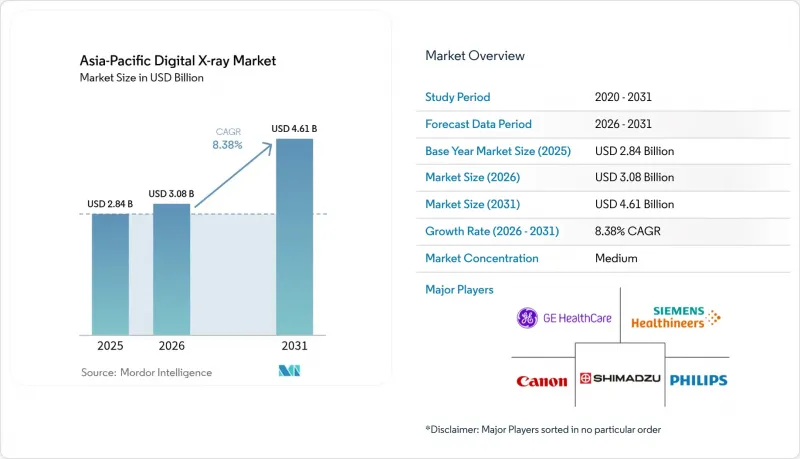
Mordor Intelligence에 따르면 아시아태평양의 디지털 X선 시장 규모는 2025년에 28억 4,000만 달러로 평가되며, 2026년 30억 8,000만 달러에서 2031년까지 46억 1,000만 달러에 달할 것으로 예측되며, 예측 기간(2026-2031년) 동안 CAGR은 8.38%가 될 전망입니다.
본 보고서는 휴대성(고정식 시스템, 이동식 DR 시스템, 핸드헬드 시스템), 검출기 패널 유형(비정질 실리콘 등), 용도(정형외과, 흉부 영상 진단 등), 최종사용자(병원·종합진료 클리닉, 치과 등), 및 국가(중국, 일본, 인도,호주 등)별로 분류되어 있습니다. 시장 예측은 금액(달러) 기준으로 제시되어 있습니다.
아시아태평양 디지털 X선 시장의 동향 및 인사이트
만성 질환 및 외상 관련 질환의 유병률 증가
아시아태평양의 급속한 고령화로 인해 당뇨병, 심혈관질환, 골다공증 등 정기적인 영상 진단이 필요한 환자층이 확대되고 있습니다. WHO의 추계에 따르면, 이 지역의 60세 이상 인구 비율은 2050년까지 22.9%로 거의 두 배로 증가할 것으로 보이며, 정형외과 및 흉부 X선 검사 건수가 급증할 것으로 예상됩니다. 이와 병행하여 진행되는 도시화로 인해 도로 교통사고로 인한 부상자가 증가하며, 신속한 X선 삼분류를 필요로 하는 외상 사례가 더욱 늘어나고 있습니다. 이러한 배경 속에서 디지털 X선 촬영의 높은 처리 능력과 반복 촬영의 효율성 덕분에 이 기술은 일선 진단 기법으로서의 입지를 확고히 하고 있습니다. 병원에서는 골절이나 폐 이상을 실시간으로 감지하는 AI 분류 소프트웨어 도입이 진행되고 있어, 보고서 작성 지연을 최소화하고 임상 판단의 신뢰성을 높이고 있습니다. 이러한 역학적 요인과 워크플로우상의 요인이 맞물려, 아시아태평양의 디지털 X선 시장 연평균 성장률(CAGR) 전망에 2.1%의 상승 요인으로 작용하고 있습니다.
급속한 기술 혁신(FPD, AI 재구성, 선량 저감)
플랫 패널 검출기(FPD)의 픽셀 아키텍처는 현재 AI 노이즈 제거 엔진과 결합되어 있어, 피폭량을 30-70% 줄이면서도 화질을 유지할 수 있게 되었으며, 진단의 선명도를 저해하지 않고 더 엄격한 방사선 안전 프로토콜을 충족하고 있습니다. 인도의 한 3차 의료기관에서는 콘트라스트 대 잡음비를 유지하면서 성인 흉부 X선 촬영 시 평균 피폭량을 0.20 mGy에서 0.10 mGy로 낮췄습니다. 광자 계수 기술과 IGZO 기판을 통해 패널 두께가 더욱 얇아져, 휴대용 기기의 구현과 배터리 수명 연장이 가능해졌습니다. 일본과 한국의 규제 당국은 12건 이상의 AI 기반 영상 진단용 SaMD를 승인하며, 소프트웨어 주도의 품질 향상에 대한 정책적 지지를 표명하고 있습니다. 이러한 기술적 호재 덕분에 아시아태평양의 디지털 X선 시장 성장 궤도는 종합적으로 1.8% 상승했습니다.
디지털 전환에 따른 고액의 설비 투자 및 업그레이드 비용
엔트리 레벨 디지털 X선 촬영실의 도입 비용은 15,000-5만 달러로, 이는 많은 지방 진료소의 연간 설비 예산을 초과하는 금액입니다. PACS 서버, Wi-Fi 개조, 직원 재교육에 드는 추가 비용으로 인해 프로젝트 총 비용은 40% 증가합니다. OECD에 따르면, 아시아태평양의 일부 경제권에서는 의료비 본인 부담금이 여전히 총 지출의 50%를 초과하고 있어, 자본 프로젝트에 할당할 수 있는 재정적 여력을 좁히고 있습니다. 리스나 이미지당 과금 모델이 등장하고는 있지만, 외딴 지역의 벤더 서비스 제공 범위가 제한적이어서 도입이 더딘 상황이며, 이로 인해 CAGR 전망치에서 1.4%가 차감되었습니다.
부문 분석
2025년에는 고정식 장비가 매출의 59.12%를 차지하여, 환자 처리량이 높은 병원 진료 영역에서 그 우위를 입증하고 있습니다. 그러나 아시아태평양의 디지털 X선 시장에서 핸드헬드형 모델의 시장 규모는 한 번의 충전으로 400회의 스캔을 완료할 수 있는 25kg의 배터리 구동형 기기에 힘입어 2031년까지 연평균 12.7%로 성장할 것으로 예상됩니다. 이동식 카트는 중환자실(ICU) 및 응급실의 입원 환자 치료 요구를 충족시키는 한편, 이동식 밴은 외딴 섬 지역에서의 공중보건 검진을 가능하게 합니다. 또한, 핸드헬드형 장치의 도입은 병원의 조달 주기를 우회하는 NGO의 지원과도 시너지 효과를 내고 있습니다.
후지필름이 2024년에 출시한 ‘FDR Xair’의 현장 데이터에 따르면, 결핵 대책 프로그램에서 수입업자가 무거운 X선 발생 장치용 보강 차량을 더 이상 필요로 하지 않게 됨에 따라 도입 기간이 수개월에서 수일로 단축되었습니다. 이러한 워크플로우상의 이점은 의료 분야 외에도 국경 경비 및 재난 대응 기관 등 새로운 구매자들을 끌어들이고 있습니다. 그 결과, 휴대용 장치는 고정식 장치의 우위를 꾸준히 잠식해 나가며 아시아태평양의 디지털 X선 시장 총 잠재 시장 규모를 확대해 나갈 것입니다.
비정질 실리콘은 성숙한 공급망과 입증된 신뢰성 덕분에 2025년 매출의 47.05%를 차지했습니다. 그러나 IGZO/플렉서블 패널을 활용한 아시아태평양 디지털 X선 시장 점유율은, 더 얇은 기판을 통해 검출 양자 효율을 저하시키지 않으면서 시스템 무게를 30% 줄일 수 있기 때문에 2031년까지 연평균 성장률(CAGR) 12.25%로 확대될 전망입니다. 현재 중국 기업들은 1,600달러 미만의 가격대로 IGZO 패널을 수출하고 있으며, 이는 수입품보다 22% 저렴한 가격입니다. 광자 계수형 프로토타입은 벤치 테스트를 통과했으며, 거의 자연 상태에 가까운 저선량에서 연조직을 식별할 수 있는 스펙트럼 데이터 획득이 기대됩니다.
일본과 호주의 의료 조달 컨소시엄은 2027년 입찰에 이미 스펙트럼 대응 조항을 포함시켰으며, 병원 측에 미래를 내다보는 검출기 플랫폼으로의 전환을 촉구하고 있습니다. 그 결과, 현재 실리콘이 규모의 경제성을 유지하고 있음에도 불구하고, 신흥 패널 화학 기술과 연계된 아시아태평양의 디지털 X선 시장 규모는 두 자릿수 성장이 예상됩니다.
기타 혜택:
- 엑셀 형식의 시장 예측(ME) 시트
- 3개월간의 애널리스트 지원
자주 묻는 질문
목차
제1장 소개
제2장 조사 방법
제3장 주요 요약
제4장 시장 구도
제5장 시장 규모와 성장 예측
제6장 경쟁 구도
제7장 시장 기회와 향후 전망
KSM 26.08.25According to Mordor Intelligence, the Asia Pacific digital X-ray market size was valued at USD 2.84 billion in 2025 and estimated to grow from USD 3.08 billion in 2026 to reach USD 4.61 billion by 2031, at a CAGR of 8.38% during the forecast period (2026-2031).
This report is Segmented by Portability (Fixed Systems, Mobile DR Systems, and Hand-Held Systems), Detector Panel Type (Amorphous Silicon, and More), Application (Orthopedic, Chest Imaging, and More), End User (Hospitals & Multispecialty Clinics, Dental Practices, and More), and Country (China, Japan, India, Australia, and More). The Market Forecasts are Provided in Terms of Value (USD).
Asia-Pacific Digital X-ray Market Trends and Insights
Rising Incidence of Chronic and Trauma-Related Conditions
Asia Pacific's quickly greying population widens the baseline of patients requiring periodic imaging for diabetes, cardiovascular disease, and osteoporosis. WHO estimates the region's 60 + cohort will almost double to 22.9% by 2050, sharply lifting orthopedic and chest X-ray volumes. Parallel urbanization raises road-traffic injuries, deepening trauma caseloads that necessitate rapid radiographic triage. Against this backdrop, digital radiography's high throughput and repeat-scan efficiency position it as the frontline diagnostic modality. Hospitals increasingly embed AI triage software that flags fractures or pulmonary anomalies in real time, minimizing reporting delays and boosting clinical confidence. Collectively, these epidemiologic and workflow factors add 2.1% to CAGR forecasts for the Asia Pacific digital X-ray market.
Rapid Technology Upgrades (FPD, AI Reconstruction, Dose Reduction)
Flat-panel detector pixel architectures now pair with AI denoising engines capable of maintaining image quality at 30-70% lower dose, satisfying stricter radiation-safety protocols without compromising diagnostic clarity. One tertiary hospital in India reduced mean adult chest-X-ray exposure from 0.20 mGy to 0.10 mGy while preserving contrast-to-noise ratios. Photon-counting and IGZO substrates further shrink panel thickness, unlocking handheld device form factors and longer battery life. Regulatory bodies in Japan and South Korea have approved more than a dozen AI-based imaging SaMDs, signaling policy alignment with software-driven quality gains. These technology tailwinds collectively raise the Asia Pacific digital X-ray market's growth trajectory by 1.8%.
High Capex & Upgrade Costs for Digital Migration
Entry-level digital radiography rooms cost USD 15,000-50,000, a sum exceeding annual equipment budgets of many provincial clinics. Additional outlays for PACS servers, Wi-Fi retrofits, and staff retraining elevate total project spend by 40 %. OECD notes out-of-pocket health payments still exceed 50 % of total spending in several Asia Pacific economies, narrowing fiscal bandwidth for capital projects. Although leasing and pay-per-image models are emerging, limited vendor service footprints in remote districts slow uptake, removing 1.4% from the CAGR outlook.
Other drivers and restraints analyzed in the detailed report include:
- Government Imaging-Infrastructure Stimulus & PPP Roll-Outs
- Mobile Chest-X-ray Vans Targeting Remote Islands & Border Areas
- Shortage of Certified Radiographers & Service Engineers
For complete list of drivers and restraints, kindly check the Table Of Contents.
Segment Analysis
Fixed rooms retained 59.12% revenue in 2025, underscoring their primacy in high-throughput hospital corridors. Yet the Asia Pacific digital X-ray market size attached to hand-held models is set to grow 12.7% annually to 2031, buoyed by 25 kg battery-powered units that complete 400 scans on a single charge. Mobile carts bridge inpatient care needs for ICUs and ERs, while vans extend public health screening to archipelagos. Hand-held adoption also dovetails with NGO sponsorships that bypass hospital procurement cycles.
Field evidence from Fujifilm's 2024 FDR Xair launch shows tuberculosis programs slashing deployment times from months to days, as importers no longer need reinforced vehicles for heavy X-ray generators. These workflow wins draw new buyers beyond healthcare, including border security and disaster-response agencies. As a result, hand-held units will steadily nibble at fixed-room dominance while expanding the total addressable Asia Pacific digital X-ray market.
Amorphous silicon commanded 47.05% of 2025 revenue thanks to its mature supply chain and proven reliability. The Asia Pacific digital X-ray market share attributable to IGZO/flexible panels, however, is on course for a 12.25% CAGR through 2031 as thinner substrates lower system weight by 30% without degrading detective quantum efficiency. Chinese firms now export IGZO panels at price points under USD 1,600, undercutting imports by 22%. Photon-counting prototypes passed bench testing, promising spectral data capture that differentiates soft tissues at near-native low dose.
Healthcare purchasing consortia in Japan and Australia already include spectral readiness clauses in 2027 tenders, nudging hospitals toward future-proof detector platforms. Consequently, while silicon retains scale economies today, the Asia Pacific digital X-ray market size tied to emerging panel chemistries is poised for double-digit gains.
Complete Report Scope:
- By Portability
- Fixed Systems
- Mobile DR Systems
- Hand-held Systems
- By Detector Panel Type
- Amorphous Silicon
- CMOS
- IGZO / Flexible Panels
- By Application
- Orthopedic
- Chest Imaging
- Cardiovascular
- Dental
- Other Applications
- By End User
- Hospitals & Multispecialty Clinics
- Diagnostic Imaging Centers
- Mobile Screening Units
- Dental Practices
- Veterinary Clinics
- By Country
- China
- Japan
- India
- Australia
- South Korea
- Rest of Asia-Pacific
List of Companies Covered in this Report:
- Agfa-Gevaert
- Canon
- Fujifilm Holdings Corp.
- GE Healthcare
- Hitachi
- Hologic
- Konica Minolta
- Koninklijke Philips
- Landwind Medical
- Mindray Bio-Medical
- MinXray
- OR Technology
- Perlove Medical
- Samsung Electronics (Samsung Medison)
- Shimadzu
- Siemens Healthineers
- Skanray Technologies
- United Imaging Healthcare
- Varex Imaging
- Wandong Medical
Additional Benefits:
- The market estimate (ME) sheet in Excel format
- 3 months of analyst support
TABLE OF CONTENTS
1 Introduction
- 1.1 Study Assumptions & Market Definition
- 1.2 Scope of the Study
2 Research Methodology
3 Executive Summary
4 Market Landscape
- 4.1 Market Overview
- 4.2 Market Drivers
- 4.2.1 Rising Incidence of Chronic and Trauma-Related Conditions
- 4.2.2 Rapid Technology Upgrades (FPD, AI Reconstruction, Dose-Reduction)
- 4.2.3 Government Imaging-Infrastructure Stimulus & PPP Roll-Outs
- 4.2.4 Mobile Chest-X-Ray Vans Targeting Remote Islands & Border Areas
- 4.2.5 Localization Mandates in China, India, Indonesia Favouring Regional OEMs
- 4.2.6 5G-Enabled Cloud Teleradiology Hubs Unlocking Rural Demand
- 4.3 Market Restraints
- 4.3.1 High Capex & Upgrade Costs for Digital Migration
- 4.3.2 Shortage of Certified Radiographers & Service Engineers
- 4.3.3 Fragmented Radiation-Safety Certification Across APAC Delaying Launches
- 4.3.4 ESG Push for Lead-Free Disposal Adding Compliance Costs
- 4.4 Supply-Chain Analysis
- 4.5 Regulatory Landscape
- 4.6 Technological Outlook
- 4.7 Porter's Five Forces
- 4.7.1 Threat of New Entrants
- 4.7.2 Bargaining Power of Buyers
- 4.7.3 Bargaining Power of Suppliers
- 4.7.4 Threat of Substitutes
- 4.7.5 Competitive Rivalry
5 Market Size & Growth Forecasts (Value, USD)
- 5.1 By Portability
- 5.1.1 Fixed Systems
- 5.1.2 Mobile DR Systems
- 5.1.3 Hand-held Systems
- 5.2 By Detector Panel Type
- 5.2.1 Amorphous Silicon
- 5.2.2 CMOS
- 5.2.3 IGZO / Flexible Panels
- 5.3 By Application
- 5.3.1 Orthopedic
- 5.3.2 Chest Imaging
- 5.3.3 Cardiovascular
- 5.3.4 Dental
- 5.3.5 Other Applications
- 5.4 By End User
- 5.4.1 Hospitals & Multispecialty Clinics
- 5.4.2 Diagnostic Imaging Centers
- 5.4.3 Mobile Screening Units
- 5.4.4 Dental Practices
- 5.4.5 Veterinary Clinics
- 5.5 By Country
- 5.5.1 China
- 5.5.2 Japan
- 5.5.3 India
- 5.5.4 Australia
- 5.5.5 South Korea
- 5.5.6 Rest of Asia-Pacific
6 Competitive Landscape
- 6.1 Market Concentration
- 6.2 Market Share Analysis
- 6.3 Company Profiles (includes Global level Overview, Market level overview, Core Business Segments, Financials, Headcount, Key Information, Market Rank, Market Share, Products and Services, and analysis of Recent Developments)
- 6.3.1 Agfa-Gevaert Group
- 6.3.2 Canon Inc.
- 6.3.3 Fujifilm Holdings Corp.
- 6.3.4 GE Healthcare
- 6.3.5 Hitachi, Ltd.
- 6.3.6 Hologic Inc.
- 6.3.7 Konica Minolta Inc.
- 6.3.8 Koninklijke Philips NV
- 6.3.9 Landwind Medical
- 6.3.10 Mindray Bio-Medical
- 6.3.11 MinXray Inc.
- 6.3.12 OR Technology
- 6.3.13 Perlove Medical
- 6.3.14 Samsung Electronics (Samsung Medison)
- 6.3.15 Shimadzu Corp.
- 6.3.16 Siemens Healthineers
- 6.3.17 Skanray Technologies
- 6.3.18 United Imaging Healthcare
- 6.3.19 Varex Imaging
- 6.3.20 Wandong Medical
7 Market Opportunities & Future Outlook
- 7.1 White-space & Unmet-need Assessment