

|
시장보고서
상품코드
2122039
디지털 X선 장비 : 시장 점유율 분석, 업계 동향과 통계, 성장 예측(2026-2031년)Global Digital X-ray Devices - Market Share Analysis, Industry Trends & Statistics, Growth Forecasts (2026 - 2031) |
||||||
 Mordor Intelligence
Mordor Intelligence에 의하면, 디지털 X선 장비 시장 규모는 2025년에 150억 2,000만 달러로 평가되었고, 2026년 161억 5,000만 달러에서 2031년까지 232억 3,000만 달러에 이를 것으로 예측되며, 예측 기간(2026-2031년) CAGR은 7.52%를 기록할 전망입니다.
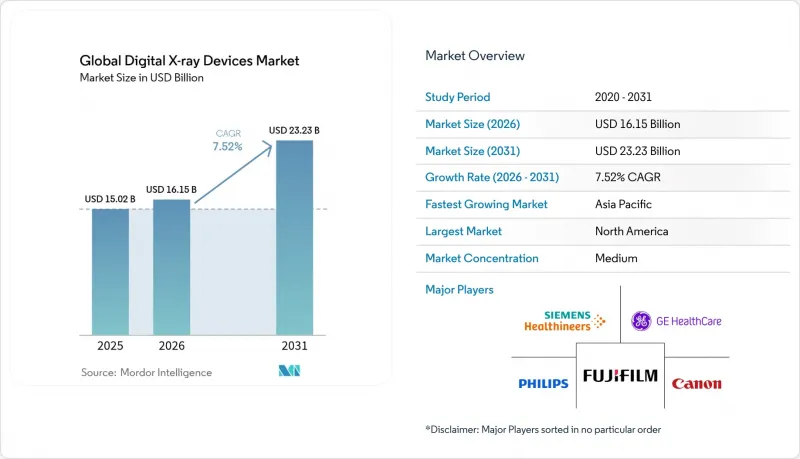
본 보고서는 용도별(정형외과, 치과, 기타), 기술별(컴퓨터 방사선 촬영 및 직접 방사선 촬영(플랫 패널 검출기 등)), 휴대성별(고정식 시스템 및 휴대용 시스템(핸드헬드 유닛 및 모바일 카트)), 최종 사용자(병원 등), 지역(북미, 유럽, 아시아태평양 등)별로 분류되어 있습니다. 시장 예측은 금액(달러) 기준으로 제시되어 있습니다.
전 세계 디지털 X선 장비 시장 동향 및 인사이트
만성 질환 및 정형외과 질환 유병률 증가
세계 인구의 고령화에 따라 근골격계 및 흉부 영상 진단이 필요한 환자층이 확대되고 있습니다. 골다공증, 퇴행성 관절염, 심폐 질환은 현재 외래 진단의 중심을 차지하고 있으며, 정기적인 X선 검사를 통한 경과 관찰을 촉진하여 장비의 반복적인 사용을 유도하고 있습니다. 세계보건기구(WHO)는 2030년까지 전 세계 사망 원인의 4분의 3 가까이를 만성 질환이 차지할 것으로 예측하고 있으며, X선 촬영은 일선 진단 도구로서의 입지를 공고히 하고 있습니다. AI를 활용한 DR 플랫폼은 정기 검사 중 미세한 척추체 골절을 감지함으로써 부가가치를 제공합니다. Nanox AI사의 ‘HealthOST’ 알고리즘이 NHS(영국 국민건강서비스) 각 시설에서 수천 건의 미진단 사례를 밝혀낸 것이 그 실례입니다. 조기 발견을 통해 향후 의료비를 절감할 수 있을 뿐만 아니라, 예방적 영상 진단에 대한 보험 급여도 촉진됩니다. 따라서 정형외과 영상 진단 수요 증가는 디지털 X선 장비 시장에서 병원, 영상 진단센터, 외래 진료소 등에서의 안정적인 도입 대수를 뒷받침하고 있습니다.
DR 패널에서 검출기와 AI의 급속한 진화
플랫 패널 검출기에는 현재 피폭 매개변수 개선, 노이즈 억제, 자동 콜리메이션을 실현하는 온보드 컴퓨팅 기능이 내장되어 있습니다. 광자 계수 아키텍처는 공간 분해능과 명암비(CNR)를 더욱 향상시켜, 더 낮은 피폭 선량으로 임상의에게 풍부한 진단 정보를 제공합니다. 지멘스 헬스인어즈, GE 헬스케어 및 기타 OEM 기업들은 이미 도입된 장비군의 경쟁적인 수명을 연장하기 위해 하드웨어와 소프트웨어를 통합한 로드맵에 막대한 투자를 하고 있습니다. GE 헬스케어와 NVIDIA의 제휴는 이러한 변화를 여실히 보여주며, 이미지 위치 지정 및 품질 검사의 자동화를 목표로 하여 검사 시간을 단축하고 기술자의 생산성을 향상시키는 것을 목적으로 하고 있습니다. 따라서 의료 기관들은 지속적인 펌웨어 업그레이드를 받을 수 있는 검출기를 우선적으로 도입하고 있으며, 이를 통해 설비 투자를 보호하고 디지털 X선 장비 시장의 혁신 속도를 가속화하고 있습니다.
높은 설비 투자(CAPEX)와 총 소유 비용(TCO)
고급 AI 기능을 갖춘 프리미엄 DR실의 가격은 50만 달러를 초과하기도 하여, 소규모 병원에게는 큰 재정적 장벽이 되고 있습니다. 지속적인 유지보수 계약, 사이버 보안 업그레이드, 정기적인 검출기 교체가 전체 수명 주기 동안의 지출을 늘리고 있습니다. 미국에서는 2025년 의사 보수 일정(Physician Fee Schedule) 조정에 따라 영상 진단 전체의 보상액이 3.55% 삭감되어, 신규 장비의 투자 회수 기간이 길어지고 있습니다. 이에 따라 의료 기관들은 설비 투자 계획을 그 어느 때보다 엄격하게 검토하며, 일부 구매를 연기하는 한편, 개조 키트나 재생 검출기를 우선적으로 도입하는 경향을 보이고 있습니다.
부문 분석
2025년, 흉부 및 폐 검사는 디지털 X선 장비 시장 규모의 32.21%를 차지했습니다. 응급, 중환자 치료 및 일반 외래 진료에서 높은 검사 빈도가 시스템의 이용률을 유지하고, 검출기의 지속적인 업그레이드를 촉진하고 있습니다. 폐렴 및 결핵에 대한 AI 선별 알고리즘은 진단의 신뢰성을 높여, 호흡기 계통의 1차 평가에서 DR의 입지를 공고히 하고 있습니다. 치과용 영상 진단은 소형 구강 내 센서와 체어사이드 워크플로우를 효율화하는 AI 지원 충치 감지 기술에 힘입어 연평균 성장률(CAGR) 8.64%로 가장 빠른 성장세를 기록하고 있습니다. 정형외과용 영상 진단도 고령자가 빈번하게 골절 평가나 수술 후 경과 관찰을 필요로 하기 때문에 꾸준히 성장하고 있습니다.
촬영 건수뿐만 아니라, 흉부 X선 촬영은 방대한 이미지 라이브러리와 표준화된 라벨링 덕분에 알고리즘을 신속하게 개발할 수 있어 AI 도입을 주도하고 있습니다. 감염병 유행 시 도입된 휴대용 흉부 X선 시스템은 의료의 연속성을 확보하면서 교차 감염 위험을 줄임으로써 명확한 가치를 입증했습니다. 치과 진료소에서는 3차원 재구성 및 클라우드 기반 상담의 혜택을 받아, 1회 내원당 수익 증가가 예상됩니다. 이러한 요인들이 맞물려 디지털 X선 장비 시장의 용도 구성이 확대되었으며, 성숙한 대량 수요 부문과 빠르게 성장하는 전문 분야의 틈새 시장 간 균형이 잡혀 있습니다.
2025년에는 직접 라디오그래피 플랫폼이 디지털 X선 장비 시장 점유율의 83.90%를 차지할 것으로 예상되며, 뛰어난 화질, 워크플로우 속도, 그리고 유리한 보험 환급을 바탕으로 그 확장이 지속되고 있습니다. 현재 평가가 진행 중인 광자 계수형 검출기는 이중 에너지 분리 및 동등한 해상도에서의 저선량화에 유망한 것으로 평가되며, 검출기 기술 혁신의 다음 도약이 될 것입니다. 컴퓨터 방사선 촬영(CR)은 여전히 예산 제약이 있는 시설에서만 이용되고 있지만, 보험 환급 제재 강화와 보급형 DR 장비의 가격 하락으로 인해 DR로의 전환이 진행되고 있습니다.
디지털 X선 장비 업계에서는 현재 검출기의 픽셀 크기 그 자체보다 통합 소프트웨어의 성능이 주요 차별화 요소로 작용하고 있습니다. 스마트 촬영 프로토콜, 예측 유지보수 알림, 자동화된 품질 보증을 통해 임상 현장에서의 신뢰성이 향상되는 동시에 서비스 비용도 절감되고 있습니다. 그 결과, 조달 담당자들은 하드웨어 도입을 결정하기 전에 소프트웨어 생태계 전체의 역량을 평가하게 되었으며, 이로 인해 직접 라디오그래피(DR)가 디지털 X선 장비 시장의 기술적 기반으로서 그 입지를 확고히 하고 있습니다.
지역별 분석
북미는 성숙한 병원 네트워크와 메디케어의 제재에 따른 업그레이드 주기 가속화를 배경으로, 2025년 디지털 X선 장비 시장 매출의 38.10%를 차지했습니다. 미국 병원들이 2025년도 설비 투자 예산에서 방사선 안전, 사이버 보안, AI 대응을 우선시한 결과, OEM 각사는 검출기 출하 대수를 늘렸습니다. 캐나다에서도 유사한 선량 저감 목표가 적용되고 있으나, 멕시코의 ‘세그로 포풀라르(Seguro Popular)’ 대체 제도에서는 주립 영상진단센터로 자금이 배정되고 있습니다. 이러한 규모에도 불구하고, 수요는 신규 도입보다는 기존 장비의 교체가 주류를 이루고 있어 연간 성장률은 7.05%에 그치고 있습니다.
아시아태평양은 수십억 달러 규모의 공립 병원 건설 프로그램과 중산층에 대한 보험 적용 범위 확대에 힘입어 연평균 성장률(CAGR) 8.55%로 가장 빠르게 성장하고 있는 지역입니다. 중국의 ‘건강 중국 2030’ 계획에서는 현(縣) 차원의 영상 진단 역량 확대가 의무화되어 있으며, 이에 따라 지역 OEM 기업들은 검출기 조립의 현지화를 촉진하고 있습니다. 인도의 스마트 시티 및 ‘아유슈만 바라트’ 이니셔티브는 농촌 지역의 진단 접근성을 확대하여 견고한 휴대용 DR의 판매를 촉진하고 있습니다. 한편, 일본 및 한국의 의료 기관들은 순환기 및 종양학 세부 전문 분야를 위해 고성능 광자 계수형 프로토타입을 구매하고 있습니다. 그러나 희토류 신틸레이터 공급망의 위험은 수출 규제가 지속될 경우 최종 가격을 상승시키고, 아시아태평양의 조달 주기에 변동을 초래할 가능성이 있습니다. 유럽에서는 노후화된 CR 장비가 범용 보건 시스템에 의해 교체됨에 따라 2031년까지 연평균 성장률(CAGR) 7.45%의 꾸준한 성장이 예상됩니다. 유럽 방사선 방호 지침에 따라 선량 추적 소프트웨어 도입이 의무화되면서 AI 지원 DR의 채택이 확대되고 있습니다. 독일과 프랑스는 지방 지역에 서비스를 제공하기 위해 원격 방사선 진단 네트워크에 투자하고 있는 반면, 영국은 휴대용 DR을 중시하는 지역 진단 허브 구축을 추진하고 있습니다. 중동 및 아프리카은 걸프협력회의(GCC) 회원국 내 여러 진료소에 대한 투자와 남아프리카공화국의 보험 보급률 확대에 힘입어 연평균 성장률(CAGR) 8.02%로 성장을 지속하고, 있습니다. 남미는 브라질의 민관협력(PPP) 모델을 통한 진단 장비 자금 지원으로 인해 장기간 지속된 공급 부족이 해소되며, 7.78%의 성장이 예상됩니다.
기타 혜택:
- 엑셀 형식 시장 예측(ME) 시트
- 3개월간의 애널리스트 지원
자주 묻는 질문
목차
제1장 서론
제2장 조사 방법
제3장 주요 요약
제4장 시장 구도
제5장 시장 규모와 성장 예측
제6장 경쟁 구도
제7장 시장 기회와 향후 전망
LSH 26.09.10According to Mordor Intelligence, the digital X-ray devices market size was valued at USD 15.02 billion in 2025 and estimated to grow from USD 16.15 billion in 2026 to reach USD 23.23 billion by 2031, at a CAGR of 7.52% during the forecast period (2026-2031).
This report is Segmented by Application (Orthopedic, Dental, and More), Technology (Computed Radiography and Direct Radiography [Flat-Panel Detectors and More]), Portability (Fixed Systems and Portable Systems [Hand-Held Units and Mobile Carts]), End-User (Hospitals and More), and Geography (North America, Europe, Asia-Pacific, and More). The Market Forecasts are Provided in Terms of Value (USD).
Global Digital X-ray Devices Market Trends and Insights
Rising Prevalence of Chronic & Orthopedic Disorders
Global population aging enlarges the base of patients requiring musculoskeletal and chest imaging. Osteoporosis, osteoarthritis, and cardiopulmonary diseases now dominate outpatient diagnostics, driving regular radiographic follow-ups that create repeat equipment utilization. The World Health Organization projects that chronic disorders will account for nearly three-quarters of worldwide deaths by 2030, firmly anchoring radiography as a frontline diagnostic tool. AI-enhanced DR platforms add value by detecting subtle vertebral fractures during routine studies, as demonstrated by Nanox AI's HealthOST algorithm, which uncovered thousands of undiagnosed cases across NHS sites. Early detection lowers downstream costs and supports reimbursement for preventative imaging. Growing orthopedic imaging demand, therefore, sustains consistent unit placements across hospitals, imaging centers, and ambulatory clinics within the digital X-ray devices market.
Rapid Detector & AI Upgrades in DR Panels
Flat-panel detectors now incorporate on-board computing that improves exposure parameters, noise suppression, and automated collimation. Photon-counting architectures further enhance spatial resolution and contrast-to-noise ratios, giving clinicians more diagnostic information at lower doses. Siemens Healthineers, GE Healthcare, and other OEMs invest heavily in joint hardware-software roadmaps that extend competitive life cycles for installed fleets. GE Healthcare's collaboration with NVIDIA illustrates this pivot, aiming to automate image positioning and quality checks, thereby shortening exam times and improving technologist productivity. Facilities, therefore, prioritize detectors that can receive continuous firmware upgrades, protecting capital investments and reinforcing the digital X-ray devices market's innovation cadence.
High CAPEX & Total-Cost-of-Ownership
Premium DR rooms with advanced AI features can exceed USD 500,000, representing significant financial barriers for small hospitals. Ongoing maintenance contracts, cybersecurity upgrades, and periodic detector replacements inflate lifecycle spending. In the United States, 2025 Physician Fee Schedule adjustments cut global imaging reimbursement by 3.55%, lengthening return-on-investment horizons for new equipment. Facilities therefore scrutinize capital plans more closely, delaying some purchases and selectively favoring retrofit kits or refurbished detectors.
Other drivers and restraints analyzed in the detailed report include:
- Cost-Savings & Dose-Reduction Versus Film/CR
- Procurement Incentives for Retrofit Upgrades in Mid-Tier Hospitals
- Reimbursement Gaps in Outpatient Settings
For complete list of drivers and restraints, kindly check the Table Of Contents.
Segment Analysis
Chest and pulmonary studies represented 32.21% of the digital X-ray devices market size in 2025. High examination frequency in emergency, critical-care, and routine outpatient settings sustains system utilization and encourages continuous detector upgrades. AI screening algorithms for pneumonia and tuberculosis enhance diagnostic confidence, reinforcing DR as the modality of choice for first-line respiratory evaluation. Dental imaging registers the fastest expansion at an 8.64% CAGR, helped by compact intraoral sensors and AI-assisted caries detection that streamline chairside workflows. Orthopedic imaging also climbs steadily as elderly populations require frequent fracture assessment and postoperative monitoring.
Beyond volumes, chest radiography leads AI adoption because image libraries are large and labeling is standardized, enabling rapid algorithm development. Portable chest systems deployed during infectious disease outbreaks demonstrated clear value, ensuring continuity of care while reducing cross-contamination risks. Dental practices benefit from three-dimensional reconstruction and cloud-based consults, increasing the revenue potential per visit. Together, these factors broaden the digital X-ray devices market's application mix, balancing mature high-volume segments with faster-growing specialty niches.
Direct radiography platforms captured 83.90% of digital X-ray devices market share in 2025, with continued expansion underpinned by superior image quality, workflow speed, and favorable reimbursement. Photon-counting detectors under evaluation show promise for dual-energy separation and lower dose at equal resolution, marking the next leap in detector innovation. Computed radiography remains only in budget-constrained facilities, yet escalating reimbursement penalties and the falling price of entry-level DR units drive conversion.
The digital X-ray devices industry now differentiates primarily on integrated software performance rather than raw detector pixel size. Smart acquisition protocols, predictive maintenance alerts, and automated quality assurance raise clinical confidence while reducing service costs. Consequently, procurement teams assess total software ecosystem capability before committing to hardware, cementing direct radiography's role as the technology backbone of the digital X-ray devices market.
Complete Report Scope:
- By Application
- Orthopaedic
- Chest / Pulmonary
- Dental
- Cardiovascular
- Oncology
- Other Applications
- By Technology
- Computed Radiography (CR)
- Direct Radiography (DR)
- Flat-Panel Detectors
- CCD/CMOS Panels
- By Portability
- Fixed Room-Based Systems
- Portable Systems
- Hand-held Units
- Mobile Carts
- By End-User
- Hospitals
- Diagnostic Imaging Centres
- Ambulatory Surgical Centers (ASCs)
- Other End-Users
- By Geography
- North America
- United States
- Canada
- Mexico
- Europe
- Germany
- United Kingdom
- France
- Italy
- Spain
- Rest of Europe
- Asia-Pacific
- China
- India
- Japan
- Australia
- South Korea
- Rest of Asia-Pacific
- Middle East and Africa
- GCC
- South Africa
- Rest of Middle East and Africa
- South America
- Brazil
- Argentina
- Rest of South America
- North America
Geography Analysis
North America generated 38.10% of 2025 revenue within the digital X-ray devices market, anchored by mature hospital networks and accelerated upgrade cycles motivated by Medicare penalties. OEMs raised detector shipments after U.S. hospitals prioritized radiation safety, cybersecurity, and AI readiness in their 2025 capital budgets. Canada applies similar dose-reduction targets, while Mexico's Seguro Popular replacement scheme channels funding toward provincial imaging centers. Despite this scale, annual growth moderates to 7.05% as substitution rather than new installation dominates demand.
Asia-Pacific is the fastest-growing territory at 8.55% CAGR, propelled by multi-billion-dollar public hospital construction programs and expanding middle-class insurance coverage. China's Healthy China 2030 blueprint mandates imaging capacity expansion at county level, incentivizing regional OEMs to localize detector assembly. India's smart-city and Ayushman Bharat initiatives increase rural diagnostic reach, spurring sales of rugged portable DR. Meanwhile, Japanese and South-Korean providers purchase high-end photon-counting prototypes for cardiovascular and oncology subspecialties. Supply-chain risk in rare-earth scintillators, however, could inflate end prices if export restrictions persist, injecting volatility into Asia-Pacific procurement cycles. Europe posts a steady 7.45% CAGR to 2031 as universal health systems replace aging CR fleets. The European Radiation Protection Directive enforces dose-tracking software, elevating AI-ready DR adoption. Germany and France invest in teleradiology networks to serve rural regions, while the United Kingdom advances community diagnostic hubs that favor portable DR. Middle East & Africa demonstrates 8.02% CAGR owing to multi-clinic investments in Gulf Cooperation Council states and expanding insurance penetration in South Africa. South America grows 7.78% as Brazil's public-private concession model funds diagnostic equipment, combating historical under-supply.
- Agfa-Gevaert
- Analogic
- Canon
- Carestream Health
- DRGEM Corporation
- Esaote S.p.A.
- FUJIFILM
- GE Healthcare
- Hitachi
- Hologic
- Konica Minolta
- Koninklijke Philips
- Lotus Healthcare
- Mindray
- Planmed
- Samsung Group
- Shimadzu
- Siemens Healthineers
- Skanray Technologies Limited
- United Imaging Healthcare Co., Ltd.
- Varex Imaging
- Vieworks Co., Ltd.
Additional Benefits:
- The market estimate (ME) sheet in Excel format
- 3 months of analyst support
TABLE OF CONTENTS
1 Introduction
- 1.1 Study Assumptions & Market Definition
- 1.2 Scope of the Study
2 Research Methodology
3 Executive Summary
4 Market Landscape
- 4.1 Market Overview
- 4.2 Market Drivers
- 4.2.1 Rising prevalence of chronic & orthopaedic disorders
- 4.2.2 Rapid detector & AI upgrades in DR panels
- 4.2.3 Cost-savings & dose-reduction versus film/CR
- 4.2.4 Procurement incentives for retrofit upgrades in mid-tier hospitals
- 4.2.5 Growth of point-of-care & home imaging ecosystems
- 4.2.6 Expansion of AI-driven teleradiology networks
- 4.3 Market Restraints
- 4.3.1 High CAPEX & total-cost-of-ownership
- 4.3.2 Reimbursement gaps in outpatient settings
- 4.3.3 Skilled radiographer shortage for advanced DR & AI workflows
- 4.3.4 Supply-chain risk in rare-earth scintillators
- 4.4 Supply Chain Analysis
- 4.5 Regulatory Landscape
- 4.6 Technological Outlook
- 4.7 Porter's Five Forces Analysis
- 4.7.1 Threat of New Entrants
- 4.7.2 Bargaining Power of Buyers
- 4.7.3 Bargaining Power of Suppliers
- 4.7.4 Threat of Substitutes
- 4.7.5 Competitive Rivalry
5 Market Size & Growth Forecasts (Value)
- 5.1 By Application
- 5.1.1 Orthopaedic
- 5.1.2 Chest / Pulmonary
- 5.1.3 Dental
- 5.1.4 Cardiovascular
- 5.1.5 Oncology
- 5.1.6 Other Applications
- 5.2 By Technology
- 5.2.1 Computed Radiography (CR)
- 5.2.2 Direct Radiography (DR)
- 5.2.2.1 Flat-Panel Detectors
- 5.2.2.2 CCD/CMOS Panels
- 5.3 By Portability
- 5.3.1 Fixed Room-Based Systems
- 5.3.2 Portable Systems
- 5.3.2.1 Hand-held Units
- 5.3.2.2 Mobile Carts
- 5.4 By End-User
- 5.4.1 Hospitals
- 5.4.2 Diagnostic Imaging Centres
- 5.4.3 Ambulatory Surgical Centers (ASCs)
- 5.4.4 Other End-Users
- 5.5 By Geography
- 5.5.1 North America
- 5.5.1.1 United States
- 5.5.1.2 Canada
- 5.5.1.3 Mexico
- 5.5.2 Europe
- 5.5.2.1 Germany
- 5.5.2.2 United Kingdom
- 5.5.2.3 France
- 5.5.2.4 Italy
- 5.5.2.5 Spain
- 5.5.2.6 Rest of Europe
- 5.5.3 Asia-Pacific
- 5.5.3.1 China
- 5.5.3.2 India
- 5.5.3.3 Japan
- 5.5.3.4 Australia
- 5.5.3.5 South Korea
- 5.5.3.6 Rest of Asia-Pacific
- 5.5.4 Middle East and Africa
- 5.5.4.1 GCC
- 5.5.4.2 South Africa
- 5.5.4.3 Rest of Middle East and Africa
- 5.5.5 South America
- 5.5.5.1 Brazil
- 5.5.5.2 Argentina
- 5.5.5.3 Rest of South America
- 5.5.1 North America
6 Competitive Landscape
- 6.1 Market Concentration
- 6.2 Competitive Benchmarking
- 6.3 Market Share Analysis
- 6.4 Company Profiles (includes Global level Overview, Market level overview, Core Segments, Financials as available, Strategic Information, Market Rank/Share for key companies, Products & Services, and Recent Developments)
- 6.4.1 Agfa-Gevaert N.V.
- 6.4.2 Analogic Corporation
- 6.4.3 Canon Medical Systems Corporation
- 6.4.4 Carestream Health, Inc.
- 6.4.5 DRGEM Corporation
- 6.4.6 Esaote S.p.A.
- 6.4.7 Fujifilm Holdings Corporation
- 6.4.8 GE Healthcare
- 6.4.9 Hitachi, Ltd.
- 6.4.10 Hologic, Inc.
- 6.4.11 Konica Minolta, Inc.
- 6.4.12 Koninklijke Philips N.V.
- 6.4.13 Lotus Healthcare
- 6.4.14 Mindray Medical International Limited
- 6.4.15 Planmed Oy
- 6.4.16 Samsung Electronics Co., Ltd.
- 6.4.17 Shimadzu Corporation
- 6.4.18 Siemens Healthineers AG
- 6.4.19 Skanray Technologies Limited
- 6.4.20 United Imaging Healthcare Co., Ltd.
- 6.4.21 Varex Imaging Corporation
- 6.4.22 Vieworks Co., Ltd.
7 Market Opportunities & Future Outlook
- 7.1 White-space & Unmet-Need Assessment


