

|
시장보고서
상품코드
2113472
유럽의 자동차용 열가소성 폴리머 복합재료 : 시장 점유율 분석, 업계 동향과 통계, 성장 예측(2026-2031년)Europe Automotive Thermoplastic Polymer Composites - Market Share Analysis, Industry Trends & Statistics, Growth Forecasts (2026 - 2031) |
||||||
 Mordor Intelligence
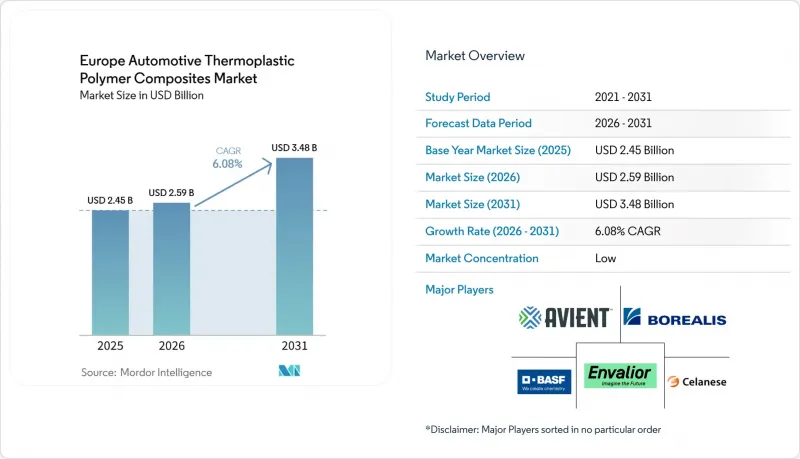
Mordor Intelligence에 따르면 유럽의 자동차용 열가소성 폴리머 복합재료 시장 규모는 2025년에 24억 5,000만 달러로 추정되며, 예측 기간(2026-2031년) 동안 CAGR 6.08%로 확대되어 2026년 25억 9,000만 달러에서 2031년에는 34억 8,000만 달러에 달할 것으로 전망됩니다.
본 보고서는 제조 공정(사출 성형 등), 용도(구조 부품 등), 제품 형태(단섬유 열가소성 플라스틱 등), 차종(승용차 등), 및 국가(독일, 영국, 프랑스, 이탈리아, 스페인, 북유럽 국가, 러시아 및 기타 유럽 국가)별로 분류되어 있습니다. 시장 전망은 금액(달러) 기준으로 제시되어 있습니다.
유럽 자동차용 열가소성 폴리머 복합재료 시장의 동향 및 인사이트
EU의 자동차 배기가스 규제(CO2) 및 차량 경량화
2025년 12월의 자동차 패키지에서는 2035년까지 신형 승용차의 CO2 배출량을 2021년 수준에서 90% 감축한다는 목표를 포함한 차량 총 배출량 규제가 유지되었습니다. 또한, 2025년 신형 승용차의 총 배출량 평균 목표인 93.6 g CO2/km도 유지되었지만, 일부 내연기관 차량 및 하이브리드 차량에 대해서는 제한적인 유연성이 허용되었습니다. 플릿 목표를 초과하는 제조사는 판매한 차량 1대당 목표치를 초과하는 CO2 배출량 1g/km마다 95유로의 과금 대상이 될 수 있습니다. 100 kg의 경량화를 통해 내연기관 차량(ICE)의 CO2 배출량을 8-12 g/km 절감하고, 배터리식 전기자동차의 주행 거리를 6-10 km 연장할 수 있습니다. 이러한 이점 덕분에 유럽의 자동차용 열가소성 폴리머 복합재료 시장에서 새로운 전기자동차 플랫폼과 계속 생산되는 내연기관 플랫폼 모두에서 경량화의 중요성은 여전히 높습니다. 또한, EU 형식 인증 규정에 따른 소재 인증은 이미 OEM으로부터 승인을 획득한 공급업체를 지원하는 것입니다.
복합재료 부품을 통한 전기자동차 배터리 중량 상쇄
배터리 팩은 현대식 배터리식 전기자동차의 차체 중량을 250-600 kg 증가시키기 때문에 차체, 클로저 및 모듈 설계에서 경량화의 필요성이 높아지고 있습니다. 열가소성 수지로 제작된 배터리 인클로저 및 구조용 커버는 유럽의 자동차용 열가소성 폴리머 복합재료 시장이 이러한 요구 사항을 충족하기 위한 수단이 될 것입니다. GroKuBat 컨소시엄은 알루미늄으로 제작된 기준 제품과 비교하여 무게를 15% 줄이고, 전체 수명주기 동안의 CO2 배출량을 25% 감축한 열가소성 섬유 복합재로 만든 배터리 하우징을 개발했습니다. 또한, 이 프로젝트에서는 기둥 충돌 시뮬레이션 및 실물 시험 결과를 바탕으로 생산 사이클 시간을 2분 미만으로 단축할 수 있음이 입증되었습니다. 또 다른 오버몰딩 방식 배터리 커버 실증 실험에서는 탄소섬유 강화 열가소성 수지(CFRTP)로 만든 오가노 시트 인서트와 장섬유 열가소성 수지를 1.3m×1.8m 크기의 부품에 조합하여 사이클 타임을 90초 미만으로 단축했습니다. 내화성 및 구조적 무결성 인증을 획득한 공급업체는 열 폭주 억제가 소재 선정의 필수 요건이 됨에 따라 시장 내 입지를 강화할 수 있습니다.
자동차 생산의 변동과 유럽 내 생산능력 이전
2025년 유럽의 열가소성 복합재료 생산량은 총 1,329킬로톤으로, 2024년의 1,368킬로톤에서 2.9% 감소했습니다. 이 생산량의 60% 이상을 운송 부문이 차지하고 있으며, 유럽 자동차용 열가소성 폴리머 복합재료 시장의 수요는 자동차 생산과 밀접한 관련이 있습니다. 생산 거점의 이전은, 특히 구조용 프로그램에서 압축 성형 프레스와의 근접성이 요구되는 경우, Tier 1 및 Tier 2 복합재 공급업체의 조달 패턴에 영향을 미칠 가능성이 있습니다. 조립 거점을 유럽 내 저비용 지역으로 이전하면 물류 비용이 증가하고, 적시 공급 체제가 차질을 빚을 우려가 있습니다. 소규모 공급업체는 이전 대상 프로그램 인근에 제조 거점을 설립하기 위해 추가 자본이 필요할 수 있습니다. 그 결과, 고객 집중도가 높아져 단일 OEM 프로그램이나 현지 공장의 결정에 따른 위험에 노출될 가능성이 있습니다.
부문 분석
2025년, 유럽 자동차용 열가소성 폴리머 복합재료 시장에서 사출 성형은 35.56%의 점유율을 차지했습니다. 이러한 위상은 유럽 자동차 프로그램 전반에 걸쳐 수십 년간 이어져 온 OEM의 금형 투자를 반영한 것입니다. 이 공정에서는 사이클 시간이 60-90초인 복잡한 형상의 멀티게이트 및 일체형 벽면 부품을 생산합니다. 이러한 사이클 시간은 확립된 승용차 생산의 규모 및 비용 요건에 부합합니다. 인테리어 트림, 보닛 하부 브래킷 및 하우징은 여전히 이 공정의 주요 용도입니다. 제조사들은 정교한 형상이나 높은 치수 재현성이 요구되는 부품에 사출 성형을 채택하고 있습니다. 또한, 새로운 차량 설계에서 배터리 부품의 오버몰딩도 점점 더 중요해지고 있습니다. 원샷 성형을 통해 구조용 인서트, 하우징의 벽면 및 커넥터의 인터페이스를 일체화할 수 있습니다. 이러한 일체화를 통해 잠재적인 고장 원인이 될 수 있는 조립 접합부가 제거됩니다. 성숙한 설비 기반을 통해 각 컨버터 업체는 생산 시스템 전체를 재설계하지 않고도 섬유 강화 복합재를 도입할 수 있는 현실적인 경로를 확보할 수 있습니다. 이 이점은 매우 중요합니다. 왜냐하면 유럽의 확립된 프로그램에서는 대규모 자동차 생산에서 단가 기대치를 충족시키면서도, 기존의 프레스 기계, 금형 제작 기법, 품질 관리 절차에 부합하는 소재가 요구되고 있기 때문입니다. 이러한 상황이 엔지니어링 작업의 필요성을 배제하는 것은 아니지만, OEM 팀이 이미 이해하고 있는 공정 지식을 유지하면서 개선된 섬유 보강재, 재생 소재 또는 재설계된 부품 기능을 도입하기 위한 명확한 로드맵을 컨버터에게 제공합니다.
압축 성형은 2026년부터 2031년까지 연평균 성장률(CAGR) 6.86%를 기록하며 가장 높은 공정 성장률을 보일 것으로 예측됩니다. 이 성형법은 장섬유 열가소성 수지(LFT)나 유리 매트 열가소성 수지를 사용한 플로어 모듈,언더바디 실드, 배터리 하우징 분야에서 보급이 확대되고 있습니다. 이러한 용도에서는 많은 기존 사출 성형 부품보다 대형 구조 부품이 요구됩니다. LFT-D 공정에서는 프레스 공정 전에 연속 섬유를 이축 스크류 압출기에 공급합니다. 이 공정을 통해 섬유의 길이를 유지할 수 있으며, 별도의 반제품을 취급하는 수고를 덜 수 있습니다. 따라서 구조적 성능을 확보하면서도 공정의 복잡성을 줄일 수 있습니다. GroKuBat사는 폐기물이 발생하지 않는 직사각형 반제품을 기반으로 설계된 레이아웃에서 배터리 하우징 제조에 압축 성형을 채택했습니다. 이 사례는 유럽의 자동차용 열가소성 폴리머 복합재료 시장에서 대형 배터리 구조 부품에 대한 압축 성형의 적용 가능성을 입증하는 것입니다. 수지 이송 성형(RTM) 및 진공 주입 성형은 계속해서 소량 생산의 연속 섬유 용도에 활용되고 있습니다. 핸드 레이업은 여전히 특수한 용도로만 제한되고 있지만, ISO 16750 시험은 모든 공정 형태에 걸친 부품 검증 기준으로 계속해서 적용되고 있습니다. 이러한 적합성 요건의 부담으로 인해, 환경 노출, 기계적 하중 및 장기적인 차량 프로그램 일정을 통해 재현 가능한 부품 성능을 입증할 수 있는, 실적이 검증된 컨버터가 유리해집니다. 따라서 압축 성형은 단순히 경량 부품을 제조하는 데 그치지 않습니다. 그 역할은 공급업체가 OEM이 요구하는 생산 기간 내에 대형 구조 부품을 일관되게 제조할 수 있는지 여부에 달려 있습니다. 가공 속도, 섬유 유지율 및 인증 실적이 결합되어 성장하는 시장에서 이 공정의 위상을 설명하고 있습니다.
2025년, 유럽 자동차용 열가소성 폴리머 복합재료 시장 규모 중 구조용 부품이 33.11%를 차지했습니다. 섬유 강화된 충돌 관리용 레일, 크로스 멤버 및 배터리 하우징 구조에 대한 수요가 이러한 위상을 뒷받침했습니다. 이러한 부품은 필요한 하중 지지 기능을 유지하면서 무게를 줄여야 합니다. 또한, 엄격한 충돌 관리 요건도 충족해야 합니다. 유럽 신차 평가 프로그램(Euro NCAP)의 성능 요건은 특히 배터리 구조체와 보강 부품에 있어 중요한 의미를 지닙니다. GroKuBat 프로젝트에서는 압축 성형된 열가소성 FRP 배터리 하우징이 시험에서 폴 충돌 기준을 충족할 수 있음이 입증되었습니다. 이 프로젝트는 열가소성 복합재료가 더 엄격한 구조적 요건이 요구되는 부위에도 사용 가능함을 보여주었습니다. 또한, 배터리 하우징 인증을 위한 참고 사례도 창출했습니다. 단일 복합재료 구조체를 통해, 기존에는 여러 금속 부품이 담당하던 기능을 통합할 수 있게 되었습니다. 따라서 프로그램이 양산 단계에 들어가기 전에 부품의 형상, 섬유의 배향, 접합 방법 및 배터리 시스템과의 인터페이스를 해결해야 하므로, 수지 공급업체, 컨버터 및 OEM 설계 팀 간의 조기 협력이 필수적입니다. 따라서 복합재 솔루션이 여러 금속 부품을 대체하거나 후속 조립 공정을 생략할 수 있는 경우, 구조적 이점이 가장 커집니다. 이는 단순한 재료 대체라기보다는 중량, 충돌 성능, 생산 방법 및 인증 요건을 종합적으로 고려한, 조정된 설계 선택에 달려 있습니다.
인테리어 부품 시장은 2026년부터 2031년까지 연평균 성장률(CAGR) 6.97%로 확대될 것으로 예측됩니다. 계기판, 도어 라이너, 오버헤드 시스템에서는 바이오 복합재 및 재생 소재가 점차 채택되고 있습니다. 이러한 소재는 확립된 사출 성형 공정과의 호환성을 유지하면서 지속가능성 요건을 충족할 수 있습니다. Materi'act사는 2025년에 르노 마스터의 계기판용 ‘IniCycled-P’의 양산을 시작했습니다. 이 컴파운드에는 폐차에서 유래한 재생 폴리프로필렌이 20% 포함되어 있습니다. 또한, 버진 폴리프로필렌을 기준으로 했을 때와 비교해 CO₂ 배출량이 24% 감소한 것으로 보고되었습니다. 파워트레인 용도에서는 고전압 전기자동차용 커넥터용 BASF사의 ‘Ultramid Advanced N3U42G6’를 비롯한 내열성 엔지니어링 폴리아미드가 사용되고 있습니다. 외장 용도에는 성형 착색된 폴리메틸메타크릴레이트(PMMA)나 유리섬유 강화 열가소성 플라스틱으로 제작된 페시아가 사용되고 있습니다. 그 밖의 용도로는 언더바디 실드, 배터리 인클로저, 프론트엔드 모듈 등이 포함됩니다. 이처럼 폭넓은 용도로 인해 유럽의 자동차용 열가소성 폴리머 복합재료 시장은 기존의 트림 부품에 그치지 않고 확대되고 있습니다. 이는 동일한 소재 계열이 시인성이 높은 실내 표면, 기능적인 외장 부품, 고전압 커넥터 시스템, 그리고 내구성과 제조상의 호환성이 중요한 기타 모듈에 활용될 수 있기 때문입니다. 이러한 다양성 덕분에 컨버터 기업들은 단일 자동차 부품에 의존하지 않고도 재활용 소재나 바이오 기반 소재를 적용할 수 있는 다양한 선택지를 확보할 수 있습니다. 또한, OEM 기업들이 순환형 소재 요건을 보다 광범위한 내장재 프로그램에 반영함에 따라 기존 사출 성형 설비의 활용도도 높아집니다.
기타 혜택:
- 엑셀 형식의 시장 예측(ME) 시트
- 3개월간의 애널리스트 지원
자주 묻는 질문
목차
제1장 소개
제2장 조사 방법
제3장 주요 요약
제4장 시장 구도
제5장 시장 규모와 성장 예측
제6장 경쟁 구도
제7장 시장 기회와 향후 전망
KSM 26.08.25According to Mordor Intelligence, the Europe automotive thermoplastic polymer composites market size is estimated at USD 2.45 billion in 2025 and is estimated to grow from USD 2.59 billion in 2026 to USD 3.48 billion by 2031, at a CAGR of 6.08% during the forecast period (2026-2031).
This report is Segmented by Manufacturing Process (Injection Molding and More), Application (Structural Components and More), Product Form (Short Fiber Thermoplastics and More), Vehicle Type (Passenger Cars and More), and Country (Germany, United Kingdom, France, Italy, Spain, NORDIC Countries, Russia, and Rest of Europe). The Market Forecasts are Provided in Terms of Value (USD).
Europe Automotive Thermoplastic Polymer Composites Market Trends and Insights
EU Fleet CO2 Compliance and Vehicle Lightweighting
The December 2025 Automotive Package retained fleet-emissions requirements, including a 90% CO2 reduction objective from 2021 levels for new passenger cars by 2035. It also retained the 2025 fleet average target of 93.6 g CO2/km for new passenger cars while allowing a limited flexibility corridor for some internal combustion and hybrid vehicles. Manufacturers that exceed fleet targets may face a EUR 95 charge for every g CO2/km above the target for each vehicle sold. A 100 kg weight reduction can lower CO2 emissions from internal combustion engine (ICE) vehicles by 8 to 12 g/km and extend battery-electric driving range by 6 to 10 km. These benefits keep lightweighting relevant across new electric platforms and carryover combustion-engine platforms in the Europe automotive thermoplastic polymer composite market. Material qualification under EU type-approval rules also supports suppliers with established OEM approvals.
EV Battery Mass Offset Through Composite Components
Battery packs add 250 to 600 kg to modern battery-electric vehicles, increasing the need for mass savings in body, closure, and module designs. Thermoplastic battery enclosures and structural covers provide a route for the Europe automotive thermoplastic polymer composite market to address this requirement. The GroKuBat consortium developed a thermoplastic fiber-composite battery housing that reduced weight by 15% compared to an aluminum reference and lowered life-cycle CO2 emissions by 25%. The project also demonstrated production cycle times of less than 2 minutes, supported by pole-impact simulations and physical tests. A separate over-molded battery-cover demonstration combined carbon fiber reinforced thermoplastic (CFRTP) organosheet inserts and long-fiber thermoplastic resin in a component measuring 1.3 m by 1.8 m, with cycle times of less than 90 seconds. Suppliers that complete fire-resistance and structural-integrity qualifications can improve their market position as thermal-runaway containment becomes a material-selection requirement.
Automotive Production Volatility and European Capacity Relocation
European thermoplastic composite production totaled 1,329 kilotons in 2025, down 2.9% from 1,368 kilotons in 2024. Transportation accounted for more than 60% of this output, linking demand in the Europe automotive thermoplastic polymer composite market to vehicle production. Production shifts can affect purchasing patterns for Tier-1 and Tier-2 composite suppliers, particularly when structural programs require proximity to compression-molding presses. Relocating assembly to lower-cost European locations can increase logistics costs and disrupt just-in-time supply arrangements. Smaller suppliers may need additional capital to establish manufacturing operations near relocated programs. As a result, customer concentration can increase exposure to a single OEM program or local plant decision.
Other drivers and restraints analyzed in the detailed report include:
- Recyclable, Weldable, and High-Throughput Thermoplastic Processing
- OEM Demand for Complex, Integrated Modules
- High Cost of Carbon Fiber and High-Performance Resins
For complete list of drivers and restraints, kindly check the Table Of Contents.
Segment Analysis
Injection molding held 35.56% of the Europe automotive thermoplastic polymer composite market in 2025. This position reflected decades of OEM tooling investment across European vehicle programs. The process produces complex, multi-gate, wall-integrated components with cycle times of 60 to 90 seconds. These cycle times align with the scale and cost requirements of established passenger-car production. Interior trim, under-hood brackets, and housings remain core applications for the process. Manufacturers use injection molding where parts require detailed geometry and repeatable dimensions. Battery-component overmolding is also becoming increasingly relevant in newer vehicle designs. A one-shot operation can combine a structural insert, housing wall, and connector interface. This integration eliminates assembly joints that can become potential failure points. The mature equipment base gives converters a practical route to introduce fiber-reinforced formulations without redesigning the entire production system. This advantage matters because established European programs require materials that fit existing presses, tooling practices, and quality routines while meeting the unit-cost expectations of large-scale vehicle production. This position does not eliminate the need for engineering work, but it gives converters a clear path to introduce improved fiber reinforcement, recycled content, or redesigned part functions while retaining the process knowledge that OEM teams already understand.
Compression molding is forecast to record the highest process growth, at a 6.86% CAGR from 2026 to 2031. It is gaining ground in Long Fiber Thermoplastic (LFT) and glass-mat thermoplastic floor modules, underbody shields, and battery housings. These applications require larger structural parts than many conventional injection-molded components. The LFT-D route feeds continuous fibers into a twin-screw extruder before the press. This process preserves fiber length and avoids handling a separate semi-finished product. It can therefore support structural performance while reducing process complexity. GroKuBat used compression molding for a battery housing in a layout designed around waste-free rectangular semi-finished products. This example supports the use of compression molding for large-format battery structures in the Europe automotive thermoplastic polymer composite market. Resin transfer molding and vacuum infusion continue to serve lower-output continuous-fiber applications. Hand layup remains limited to specialized uses, while ISO 16750 testing continues to govern component validation across process types. This compliance burden favors established converters that can demonstrate repeatable part performance across environmental exposure, mechanical loading, and long vehicle program timelines. Compression molding, therefore, does more than produce lighter parts. Its role also depends on whether a supplier can consistently manufacture a large structural component within the production window required by an original equipment manufacturer (OEM). This combination of processing speed, fiber retention, and qualification experience explains the process's position in the growth market.
Structural components accounted for 33.11% of the Europe automotive thermoplastic polymer composite market size in 2025. Demand for fiber-reinforced crash-management rails, crossmembers, and battery-housing structures supported this position. These components must control weight while maintaining their required load-bearing function. They must also meet demanding crash-management requirements. The European New Car Assessment Program (Euro NCAP) performance expectations are particularly relevant to battery structures and reinforcement components. GroKuBat demonstrated that a compression-molded thermoplastic FRP battery housing could meet pole-impact criteria during testing. The project showed that thermoplastic composites can be used in more demanding structural positions. It also created a reference case for battery housing qualification. A single composite structure can combine functions that several metal parts previously handled. This makes early cooperation among resin suppliers, converters, and OEM design teams essential, as component geometry, fiber orientation, joining methods, and battery-system interfaces must be resolved before a program enters series production. The structural opportunity is therefore strongest where a composite solution replaces several metal parts or removes a later assembly stage. It depends less on simple material substitution and more on a coordinated design choice that addresses weight, crash performance, production method, and qualification requirements together.
Interior components are forecast to grow at a 6.97% CAGR from 2026 to 2031. Instrument panels, door liners, and overhead systems are adopting bio-composites and recycled-content formulations. These materials can meet sustainability requirements while retaining compatibility with established injection-molding processes. Materi'act placed IniCycled-P into series production for the Renault Master instrument panel in 2025. The compound contains 20% recycled end-of-life vehicle polypropylene. It also reported 24% lower CO2 emissions than a virgin polypropylene baseline. Powertrain applications use high-temperature engineering polyamides, including BASF Ultramid Advanced N3U42G6 for high-voltage electric-vehicle connectors. Exterior applications use mold-in-color polymethyl methacrylate (PMMA) and glass-fiber thermoplastic fascias. Other applications include underbody shields, battery enclosures, and front-end modules. This range of uses broadens the Europe automotive thermoplastic polymer composite market beyond conventional trim components because the same material family can serve visible interior surfaces, functional exterior parts, high-voltage connector systems, and other modules where durability and manufacturing compatibility are important. This diversity gives converters several routes to apply recycled or bio-based content without relying on a single vehicle part. It also makes existing injection-molding equipment more useful as OEMs bring circular-material requirements into broader interior programs.
Complete Report Scope:
- By Manufacturing Process
- Injection Molding
- Compression Molding
- Resin Transfer Molding
- Vacuum Infusion Processing
- Hand Layup
- By Application
- Structural Components
- Powertrain Components
- Interior Components
- Exterior Components
- Others (Underbody Shields, Battery Enclosures and Covers, Front-End Modules)
- By Product Form
- Short Fiber Thermoplastics
- Long Fiber Thermoplastics
- Continuous Fiber Thermoplastics
- Others (Glass Mat Thermoplastics, Organosheets, Prepregs and Composite Plates)
- By Vehicle Type
- Passenger Cars
- Commercial Vehicles
- Others
- By Country
- Germany
- United Kingdom
- France
- Italy
- Spain
- NORDIC Countries
- Russia
- Rest of Europe
List of Companies Covered in this Report:
- Arkema Group
- Avient Corporation
- BASF
- Bcomp
- Borealis GmbH
- Celanese Corporation
- Covestro AG
- DuPont
- Ensinger
- Envalior
- Hexcel Corporation
- LANXESS
- Mitsubishi Chemical Corporation
- Rochling
- SABIC
- SGL Carbon
- Solvay
- Teijin Limited
- TORAY INDUSTRIES, INC.
Additional Benefits:
- The market estimate (ME) sheet in Excel format
- 3 months of analyst support
TABLE OF CONTENTS
1 Introduction
- 1.1 Study Assumptions and Market Definition
- 1.2 Scope of the Study
2 Research Methodology
3 Executive Summary
4 Market Landscape
- 4.1 Market Overview
- 4.2 Market Drivers
- 4.2.1 EU Fleet CO2 Compliance and Vehicle Lightweighting
- 4.2.2 EV Battery Mass Offset Through Composite Components
- 4.2.3 Recyclable, Weldable and High-Throughput Thermoplastic Processing
- 4.2.4 OEM Demand for Complex, Integrated Modules
- 4.2.5 Growth of Natural-Fiber and Recycled-Content Programs
- 4.2.6 Battery-Enclosure Qualification Pull From Thermal-Runaway Requirements
- 4.3 Market Restraints
- 4.3.1 Automotive Production Volatility and European Capacity Relocation
- 4.3.2 High Energy, Labor and Compliance Costs for European Converters
- 4.3.3 High Cost of Carbon Fiber and High-Performance Resins
- 4.3.4 Fragmented End-of-Life Sorting by Resin and Fiber Architecture
- 4.4 Value Chain Analysis
- 4.5 Porter's Five Forces Analysis
- 4.5.1 Threat of New Entrants
- 4.5.2 Bargaining Power of Suppliers
- 4.5.3 Bargaining Power of Buyers
- 4.5.4 Threat of Substitutes
- 4.5.5 Competitive Rivalry
5 Market Size and Growth Forecasts (Value)
- 5.1 By Manufacturing Process
- 5.1.1 Injection Molding
- 5.1.2 Compression Molding
- 5.1.3 Resin Transfer Molding
- 5.1.4 Vacuum Infusion Processing
- 5.1.5 Hand Layup
- 5.2 By Application
- 5.2.1 Structural Components
- 5.2.2 Powertrain Components
- 5.2.3 Interior Components
- 5.2.4 Exterior Components
- 5.2.5 Others (Underbody Shields, Battery Enclosures and Covers, Front-End Modules)
- 5.3 By Product Form
- 5.3.1 Short Fiber Thermoplastics
- 5.3.2 Long Fiber Thermoplastics
- 5.3.3 Continuous Fiber Thermoplastics
- 5.3.4 Others (Glass Mat Thermoplastics, Organosheets, Prepregs and Composite Plates)
- 5.4 By Vehicle Type
- 5.4.1 Passenger Cars
- 5.4.2 Commercial Vehicles
- 5.4.3 Others
- 5.5 By Country
- 5.5.1 Germany
- 5.5.2 United Kingdom
- 5.5.3 France
- 5.5.4 Italy
- 5.5.5 Spain
- 5.5.6 NORDIC Countries
- 5.5.7 Russia
- 5.5.8 Rest of Europe
6 Competitive Landscape
- 6.1 Market Concentration
- 6.2 Strategic Moves
- 6.3 Market Share (%)/Ranking Analysis
- 6.4 Company Profiles (includes Global Overview, Market Overview, Core Segments, Financials as available, Strategic Information, Products and Services, and Recent Developments)
- 6.4.1 Arkema Group
- 6.4.2 Avient Corporation
- 6.4.3 BASF
- 6.4.4 Bcomp
- 6.4.5 Borealis GmbH
- 6.4.6 Celanese Corporation
- 6.4.7 Covestro AG
- 6.4.8 DuPont
- 6.4.9 Ensinger
- 6.4.10 Envalior
- 6.4.11 Hexcel Corporation
- 6.4.12 LANXESS
- 6.4.13 Mitsubishi Chemical Corporation
- 6.4.14 Rochling
- 6.4.15 SABIC
- 6.4.16 SGL Carbon
- 6.4.17 Solvay
- 6.4.18 Teijin Limited
- 6.4.19 TORAY INDUSTRIES, INC.
7 Market Opportunities and Future Outlook
- 7.1 White-Space and Unmet-Need Assessment


