
|
시장보고서
상품코드
2113524
임상 의사결정 지원 시스템(CDSS) : 시장 점유율 분석, 업계 동향 및 통계, 성장 예측(2026-2031년)Clinical Decision Support Systems - Market Share Analysis, Industry Trends & Statistics, Growth Forecasts (2026 - 2031) |
||||||
 Mordor Intelligence
Mordor Intelligence에 의하면, 임상 의사결정 지원 시스템(CDSS) 시장 규모는 2025년 27억 2,000만 달러, 2026년 30억 달러에서 2031년까지 49억 4,000만 달러에 달하고, 2026-2031년 연평균 복합 성장률(CAGR)은 10.49%를 기록할 전망입니다.
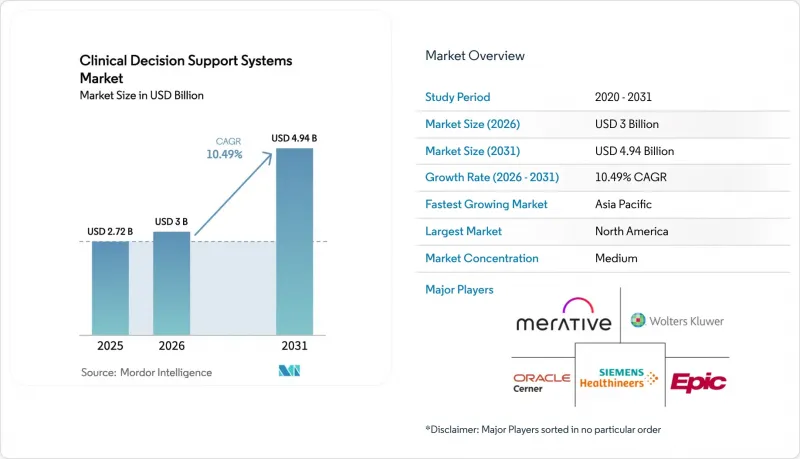
본 보고서는 모델(지식 기반형 CDSS 및 비지식 기반형 CDSS), 제공 형태(클라우드 기반 및 On-Premise형), 구성 요소(하드웨어, 소프트웨어, 서비스), 제품(통합형 CDSS 및 독립형 CDSS), 용도(의료 진단, 알림 및 리마인더 등),지역(북미, 유럽 등)별로 분류되어 있습니다. 시장 예측은 금액(달러) 기준으로 제시되어 있습니다.
전 세계 임상 의사결정 지원 시스템(CDSS) 시장 동향 및 인사이트
EHR 통합형 CDSS 도입 확대
2024년 말까지 미국의 거의 모든 급성기 병원이 인증된 EHR을 도입함에 따라, 내장형 의사결정 엔진을 위한 확립된 데이터 기반이 형성되었습니다. Epic사의 2025년 릴리스에서는 Cosmos 기반 머신러닝 도구가 간소화되어, 추가 클릭 없이도 진료 기록 확인 화면 내에 위험 점수가 표시되게 됨으로써 워크플로 준수율이 향상되었습니다. Oracle Health의 15억 달러 규모 코드베이스 재구축을 통해 CDSS 로직을 네이티브 클라우드 마이크로서비스로 이전하여, 컨텍스트 매개변수가 충족된 경우에만 알림을 전송하게 되었습니다. 이로 인해 파일럿 병원에서 중복 팝업이 28% 감소했습니다. 상호 운용성 의무화로 인해 타사 알고리즘 통합 장벽은 낮아졌지만, 한편으로는 EHR을 전환할 때 수천 개의 맞춤형 CDS 규칙을 이전해야 하기 때문에 벤더 종속성이 더욱 심화되는 결과를 낳고 있습니다. 그 결과, 병원 측은 주요 EHR 생태계 내에서 충분히 기능하면서도 플랫폼 전략이 변경되더라도 계약상 이식이 가능한 ‘베스트 오브 브リ?ド(Best-of-Breed)’ 모듈을 선호하게 되었습니다.
AI/ML을 활용한 분석을 통한 의사결정 정확도 향상
미국 FDA는 2024년에 171건의 AI 탑재 의료기기를 승인했는데, 그중 42건은 여러 의료기관의 데이터 세트를 활용하여 조정된 방사선 진단 알고리즘이었습니다. GE 헬스케어의 ‘AIR Recon DL’은 영상의 충실도를 유지하면서 MRI 스캔 시간을 절반으로 단축해, 자원이 제한된 영상진단실의 환자 처리 능력 병목 현상을 해소합니다. Philips의 ‘Azurion’ 플랫폼은 방사선 피폭량을 자동으로 조정하여, 병원이 IAEA의 새로운 피폭량 지침을 준수하고 보험 환급 감액 처분을 피할 수 있도록 지원합니다. 지속 학습 모델은 클라우드상의 샌드박스 환경에서 매월 재학습을 수행하여, 수동 규칙 조정보다 더 신속하게 최신 임상시험 결과를 반영합니다. 규제 당국은 현재 시판 후 모니터링 대시보드의 도입을 의무화하고 있으며, 이를 통해 인구통계학적 코호트 간에 알고리즘 성능에 편차가 발생하더라도 공중 보건과 관련된 리콜 조치를 취하기보다는 선제적인 업데이트가 이루어지게 됩니다.
데이터 개인정보 보호 및 사이버 보안 관련 우려(클라우드)
체인지 헬스케어(Change Healthcare)와 어센션 헬스(Ascension Health)에 대한 랜섬웨어 공격으로 인해 청구 및 전자건강기록(EHR) 시스템이 수 주간 사용 불가 상태가 되었으며, 다단계 인증 및 네트워크 세분화에서 취약점이 드러났습니다. 이에 대해 미국 보건복지부(HHS)는 연례 침투 테스트를 의무화하는 규정안을 제시했습니다. 이로 인해 클라우드 기반 CDSS 도입을 검토 중인 지역 병원들에게는 규정 준수 비용 증가라는 부담이 발생하고 있습니다. 벤더 측은 처리 중에 데이터를 암호화하는 ‘기밀 컴퓨팅 엔클레이브’를 내세워 이에 대응하고 있지만, CIO들은 여전히 제3자의 접근에 대해 경계심을 가지고 있습니다. 그 결과, 하이브리드 아키텍처가 부상하고 있습니다. 기밀성이 높은 식별자는 On-Premise에 남겨두고, 익명화된 훈련 데이터만을 탄력적인 클라우드 클러스터로 이전하는 방식입니다.
부문 분석
비지식 기반 CDSS는 연평균 성장률(CAGR) 14.25%로 확대될 것으로 예측되며, 이는 임상 의사결정 지원 시스템 시장 전체의 성장률을 크게 상회합니다. 지식 기반 엔진은 여전히 매출의 61.56%를 차지하고 있지만, 그 정적인 규칙 트리는 특히 의학 문헌이 73일마다 두 배로 증가하는 현 상황에서 비용이 많이 드는 분기별 업데이트를 필요로 합니다. Google Health의 당뇨병성 망막병증 알고리즘은 매달 새로운 이미지를 사용하여 재학습되고 있으며, 이는 ML 시스템이 수동 큐레이션 없이 최신 증거를 어떻게 반영하는지를 보여줍니다. 결정론적 논리만으로도 충분한 의약품 안전성 분야에서는 지식 기반 플랫폼이 계속 사용될 것이지만, 방사선과나 병리학 워크플로우에서는 영상 분석에서 인간의 정확도를 능가하는 컨볼루션 네트워크가 현재 주류를 이루고 있습니다.
규칙 엔진의 선도 기업들은 기존의 규칙 트리거 위에 머신러닝에서 도출된 확률 점수를 중첩하는 하이브리드 접근 방식을 채택하고 있습니다. Watson Health의 2024년 철수가 보여주듯이, 이러한 전환에 실패한 벤더는 시대에 뒤처질 위험을 감수하게 될 것입니다. 예측 기간 동안, 성숙한 EHR 공급업체들은 기존 CDSS GUI 내에 ML 파이프라인을 통합하여 규칙 기반 모델과 데이터 주도형 모델의 경계를 모호하게 만들 것입니다. 병원들은 두 패러다임의 총 소유 비용(TCO)을 비교하게 될 것이며, 자동화된 재학습과 투명한 버전 관리를 제공하는 벤더가 시스템 업데이트 주기에서 우위를 점하게 될 것입니다.
클라우드를 통해 제공되는 CDSS는 데이터 유출에 대한 우려가 높아지고 있음에도 불구하고, 2031년까지 연평균 16.85%의 성장률을 유지할 것으로 전망됩니다. On-Premise형 아키텍처에 의존하는 임상 의사결정 지원 시스템(CDSS) 시장 규모는 여전히 크지만, CIO(최고정보책임자)들은 매일 밤 보안 패치 및 모델 재훈련을 위한 GPU 버스트 처리를 포함하는 SaaS 라이선스에 점점 더 많은 예산을 할당하고 있습니다. 지연 시간 요구 사항과 데이터 주권에 관한 법률 간의 상충으로 인해, 패혈증이나 뇌졸중 경보는 로컬 엣지 서버에서 실행되고, 긴급성이 낮은 분석 처리는 클라우드 클러스터에서 수행되는 하이브리드 토폴로지가 권장되고 있습니다.
2024년에는 랜섬웨어 발생으로 인해 클라우드 전환이 일시적으로 중단되었지만, 이러한 사고를 통해 On-Premise 방어 체계에 대한 투자 부족이 드러났습니다. 그 결과, 많은 의료 시스템은 ‘소버린 클라우드’ 조항을 협상하여 환자 식별자를 현지 지역에 보관하는 한편, 연구 벤치마킹 목적으로 익명화된 데이터 풀을 국경을 넘어 이용할 수 있도록 하고 있습니다. 이 체계는 규제 당국의 요건을 충족하고 규모의 경제도 실현하기 때문에 2020년대 중반까지 클라우드 이용이 하드웨어 교체 주기를 앞지르는 속도로 증가할 전망입니다.
지역별 분석
2025년 매출의 46.53%를 차지하는 북미에서는 메디케어의 가치 기반 구매 제도 내 페널티를 활용하여 재입원 및 병원 내 감염을 줄이는 CDSS에 대한 투자를 정당화하고 있습니다. ‘21세기 치료법(21st Century Cures Act)’은 또한 정보 차단(information blocking)을 불법으로 규정하고 있어, 이를 통해 제3자 CDSS 공급업체가 임상 데이터에 대한 API 접근 권한을 얻게 됨에 따라 ‘플러그 앤 플레이(plug-and-play)’ 방식의 도입이 가속화되고 있습니다. 캐나다의 ‘Connect Care’ 플랫폼은 만성 질환용 CDSS를 전국적으로 도입하고 있지만, 각 주별 맞춤화에는 지연이 나타나고 있습니다. 멕시코에서는 200개 진료소를 대상으로 한 당뇨병 CDSS 시범 사업을 통해 저대역폭 환경에서의 알고리즘 이식성이 입증되었으나, 전국적인 확대는 5G 보급 여부에 달려 있습니다.
아시아태평양은 12.21%라는 가장 높은 연평균 성장률(CAGR)을 기록하고 있습니다. 중국의 전자건강기록(EMR) 성숙도 요건에서는 레벨 4 기능이 요구되며, 3,000개 병원에서 의사 컴퓨터 처방 입력(CPOE)과 기본적인 CDSS가 직접 통합되어 있습니다. 인도의 ‘아유슈만 바라트 디지털 미션’에서는 통합된 건강 식별자가 할당되어 있으며, 결핵 선별 알고리즘이 엑스레이 사진과 검사 데이터를 연계함으로써 시험에서 95%의 민감도를 달성하고 있습니다. 일본에서는 고령화 사회에서 발생하는 약물 관련 이상반응 발생률에 대처하기 위해 중소규모 병원을 대상으로 다제 병용 관리용 CDSS 도입을 지원하고 있습니다. 한국에서는 패혈증 대응 CDSS의 준수 지표를 진료보수와 연계하고 있어, 의사결정 지원 시스템의 도입은 재정적 측면에서 필수적입니다. 호주의 ‘My Health Record’는 의료기관 전반에 걸친 약물 안전 경보를 통합하여, 공공·민간 혼합 시스템에서의 중복 처방을 억제하고 있습니다.
유럽에서는 엄격한 AI 거버넌스가 시행되고 있습니다. ‘AI법’에서는 적합성 평가가 의무화되어 있어 제품 출시가 최대 12개월 지연될 가능성이 있지만, 병원 측은 데이터 보안 및 편향 완화 노력이 인증된 CE 마크가 부착된 소프트웨어를 선호하여 채택하고 있습니다. 독일에서는 ‘디지털 헬스케어법’에 따라 당뇨병용 CDSS를 포함한 14가지 디지털 치료제에 대해 보험 급여를 실시하고 있으며, 공급업체에 보험사와의 협력을 위한 템플릿을 제공합니다. 영국에서는 140개 트러스트에 조기 경보 점수 산출 알고리즘을 확대 도입했으나, 30%의 트러스트에서 현지 보정을 수행할 정보과학 담당자가 부족한 것으로 드러나 인력 측면의 병목 현상이 부각되었습니다. 프랑스의 ‘헬스 데이터 허브(Health Data Hub)’는 6,700만 명의 시민으로부터 수집된 가명 처리된 데이터를 제공하여 심혈관 질환 위험 모델 학습에 활용함으로써, 민관 연구개발 파트너십을 촉진하고 있습니다.
라틴아메리카, 중동 및 아프리카는 시장 점유율은 작지만, 국가 차원의 전자의무기록(EHR) 프로그램이 존재하는 지역에서는 두 자릿수 성장을 기록하고 있습니다. 2026년까지 공립 병원 전체에 CDSS 도입을 의무화하는 아랍에미리트(UAE)의 노력은 해당 지역의 벤치마크가 되고 있습니다. 남아프리카공화국의 50개 진료소에 도입된 HIV 동반 감염증용 CDSS는 치료법 전환 지연을 단축했습니다. 한편, 브라질의 산모 건강 관리를 위한 CDSS는 유망한 것으로 평가받고 있으나, 아마존 지역에서는 통신 환경의 문제에 직면해 있습니다. 이러한 도입 사례는 알고리즘이 지역의 질병 부담에 맞추어 조정된다면, 자원이 제한된 환경에서도 CDSS가 가치를 창출할 수 있음을 입증하고 있습니다.
기타 혜택:
- 엑셀 형식 시장 예측(ME) 시트
- 3개월간의 애널리스트 지원
자주 묻는 질문
목차
제1장 서론
제2장 조사 방법
제3장 주요 요약
제4장 시장 구도
제5장 시장 규모와 성장 예측
제6장 경쟁 구도
제7장 시장 기회와 향후 전망
LSH 26.08.25According to Mordor Intelligence, the clinical decision support systems market size is projected to expand from USD 2.72 billion in 2025 and USD 3 billion in 2026 to USD 4.94 billion by 2031, registering a CAGR of 10.49% between 2026 to 2031.
This report is Segmented by Model (Knowledge-Based CDSS and Non-Knowledge CDSS), Mode of Delivery (Cloud-Based and On-Premise), Component (Hardware, Software, and Services), Product (Integrated CDSS and Standalone CDSS), Application (Medical Diagnosis, Alerts and Reminders, and More), and Geography (North America, Europe, and More). The Market Forecasts are Provided in Terms of Value (USD).
Global Clinical Decision Support Systems Market Trends and Insights
Rising Adoption of EHR-Integrated CDSS
Nearly all U.S. acute-care hospitals deployed certified EHRs by late 2024, creating an established data substrate for embedded decision engines. Epic's 2025 release streamlined Cosmos-based machine-learning tools so that risk scores appear inside chart review screens without extra clicks, boosting workflow adherence. Oracle Health's USD 1.50 billion codebase rebuild migrated CDSS logic to native cloud microservices that fire alerts only when contextual parameters are met, cutting duplicate pop-ups by 28% in pilot hospitals. Interoperability mandates lower integration barriers for third-party algorithms, yet they also deepen vendor lock-in because switching EHRs now means migrating thousands of custom CDS rules. Hospitals consequently prefer best-of-breed modules that can thrive inside major EHR ecosystems yet remain contractually portable if platform strategy shifts.
AI/ML-Powered Analytics Enhancing Decision Precision
The U.S. FDA cleared 171 AI-enabled medical devices in 2024, 42 of which were radiology algorithms calibrated on multi-site datasets. GE HealthCare's AIR Recon DL halves MRI scan times while preserving image fidelity, cutting patient throughput bottlenecks in resource-constrained imaging suites. Philips' Azurion platform automatically moderates radiation dose, helping hospitals comply with new IAEA dosage guidelines and avoid reimbursement penalties. Continuous-learning models retrain monthly in cloud sandboxes, incorporating fresh trial results faster than manual rule curation. Regulators now require post-market surveillance dashboards so that drift in algorithm performance across demographic cohorts triggers proactive updates rather than public-safety recalls.
Data-Privacy & Cybersecurity Concerns (Cloud)
Ransomware attacks on Change Healthcare and Ascension Health disabled billing and EHR systems for weeks, exposing gaps in multifactor authentication and network segmentation. The U.S. HHS responded with proposed rules mandating annual penetration tests, adding compliance costs that strain community hospitals contemplating cloud CDSS. Vendors counter by marketing confidential-computing enclaves that encrypt data during processing, yet CIOs remain wary of third-party access. Hybrid architectures are therefore rising: sensitive identifiers stay on-premise while de-identified training data moves to elastic cloud clusters.
Other drivers and restraints analyzed in the detailed report include:
- Pressure to Lower Healthcare Costs & Medical Errors
- Ambient Voice-Enabled CDSS Easing Clinician Burnout
- Shortage of Informatics-Skilled Workforce
For complete list of drivers and restraints, kindly check the Table Of Contents.
Segment Analysis
Non-knowledge-based CDSS are forecast to expand at a 14.25% CAGR, dwarfing the overall clinical decision support systems market growth. Knowledge-based engines still hold 61.56% revenue, yet their static rule trees require costly quarterly updates, especially as medical literature doubles every 73 days. Google Health's diabetic-retinopathy algorithm, retrained on new images monthly, illustrates how ML systems assimilate latest evidence without manual curation. Knowledge-based platforms will persist in medication safety where deterministic logic remains sufficient, but radiology and pathology workflows now favor convolutional networks that surpass human accuracy in image interpretation.
Rule-engine stalwarts are adopting hybrid approaches, layering ML-derived probability scores under traditional rule triggers. Vendors that fail to pivot risk obsolescence, as Watson Health's 2024 exit demonstrated. Over the forecast period, mature EHR providers will embed ML pipelines inside existing CDSS GUIs, blurring the boundary between rule-based and data-driven models. Hospitals will compare total-cost-of-ownership across both paradigms, and vendors offering automated retraining plus transparent version control stand to win replacement cycles.
Cloud-delivered CDSS will compound at a 16.85% rate through 2031, despite heightened breach anxiety. The clinical decision support systems market size tied to on-premise architectures remains substantial, but CIOs increasingly allocate new budgets to SaaS licenses that include nightly security patches and GPU bursts for model re-training. Conflicts between latency requirements and data-sovereignty laws encourage hybrid topologies where sepsis and stroke alerts run on local edge servers while non-urgent analytics process in cloud clusters.
Ransomware events prompted temporary moratoriums on cloud transitions in 2024, yet those same incidents exposed under-invested on-premise defenses. Consequently, many health systems have negotiated "sovereign cloud" clauses that place patient identifiers in local regions while allowing de-identified pools to cross borders for research benchmarking. This arrangement satisfies regulators and delivers scale economics, positioning cloud consumption to outpace hardware refresh cycles by mid-decade.
Complete Report Scope:
- By Model
- Knowledge-based CDSS
- Non-knowledge-based CDSS
- By Mode of Delivery
- Cloud-based
- On-premise
- By Component
- Hardware
- Software
- Services
- By Product
- Integrated CDSS
- Stand-alone CDSS
- By Application
- Medical Diagnosis
- Alerts & Reminders
- Prescription Decision Support
- Information Retrieval
- Other Applications
- By Geography
- North America
- United States
- Canada
- Mexico
- Europe
- Germany
- United Kingdom
- France
- Italy
- Spain
- Rest of Europe
- Asia-Pacific
- China
- Japan
- India
- South Korea
- Australia
- Rest of Asia-Pacific
- Middle East & Africa
- GCC
- South Africa
- Rest of Middle East & Africa
- South America
- Brazil
- Argentina
- Rest of South America
- North America
Geography Analysis
North America, holding 46.53% of 2025 revenue, leverages Medicare's value-based purchasing penalties to justify CDSS investments that cut readmissions and hospital-acquired conditions. The 21st-Century Cures Act also criminalizes information blocking, giving third-party CDSS vendors API access to clinical data and accelerating plug-and-play adoption. Canada's Connect Care platform embeds chronic-disease CDSS nationally but suffers provincial customization lags. Mexico's diabetes CDSS pilot across 200 clinics demonstrates algorithm portability in low-bandwidth settings, yet national scaling depends on 5G rollouts.
Asia-Pacific records the fastest 12.21% CAGR. China's EMR-maturity mandate requires Level 4 capabilities, directly embedding computerized-physician-order-entry and basic CDSS in 3,000 hospitals. India's Ayushman Bharat Digital Mission assigns a unified health identifier, enabling tuberculosis screening algorithms to link radiographs with lab data for 95% sensitivity in trials. Japan subsidizes smaller hospitals to include polypharmacy CDSS, addressing medication adverse-event rates in its aging population. South Korea ties reimbursement to sepsis CDSS compliance metrics, making decision support financially non-negotiable. Australia's My Health Record integrates cross-provider medication safety alerts, limiting duplication across its mixed private-public system.
Europe enforces strict AI governance. The AI Act imposes conformity assessments that extend product launches by up to 12 months, yet hospitals prefer CE-marked software because it certifies data-security and bias-mitigation practices. Germany reimburses 14 digital therapeutics, including diabetes CDSS, under its Digital Healthcare Act, offering vendors a template for payer engagement. The U.K. scaled an early-warning-score algorithm across 140 trusts but found 30% lacked informatics staff for local calibration, highlighting workforce bottlenecks. France's Health Data Hub provides pseudonymized data from 67 million citizens to train cardiovascular-risk models, fostering public-private R&D partnerships.
Latin America, the Middle East, and Africa represent smaller slices but register double-digit growth where national EHR programs exist. The UAE's mandatory CDSS rollout across public hospitals by 2026 sets a regional benchmark. South Africa's HIV-co-infection CDSS in 50 clinics lowered regimen-switch delays, while Brazil's maternal-health CDSS shows promise but faces connectivity challenges in Amazon regions. These rollouts validate that CDSS delivers value even in resource-constrained environments when algorithms are tailored to local disease burdens.
- Agfa-Gevaert
- Allscripts
- Athenahealth
- UnitedHealth Group (Change Healthcare)
- EBSCO Information Services
- Elsevier B.V.
- Epic Systems
- GE Healthcare
- Meditech
- Merative
- NextGen Healthcare
- Optum
- Oracle
- Koninklijke Philips
- Siemens Healthineers
- VisualDx
- Wolters Kluwer
- Zynx Health
Additional Benefits:
- The market estimate (ME) sheet in Excel format
- 3 months of analyst support
TABLE OF CONTENTS
1 Introduction
- 1.1 Study Assumptions & Market Definition
- 1.2 Scope of the Study
2 Research Methodology
3 Executive Summary
4 Market Landscape
- 4.1 Market Overview
- 4.2 Market Drivers
- 4.2.1 Rising adoption of EHR-integrated CDSS
- 4.2.2 AI/ML-powered analytics enhancing decision precision
- 4.2.3 Pressure to lower healthcare costs & medical errors
- 4.2.4 Ambient voice-enabled CDSS easing clinician burnout
- 4.2.5 Regulation-driven demand for explainable algorithms
- 4.3 Market Restraints
- 4.3.1 Data-privacy & cyber-security concerns (cloud)
- 4.3.2 Shortage of informatics-skilled workforce
- 4.3.3 Alert-fatigue eroding clinician trust
- 4.4 Regulatory Landscape
- 4.5 Technological Outlook
- 4.6 Porter's Five Forces
- 4.6.1 Threat of New Entrants
- 4.6.2 Bargaining Power of Buyers
- 4.6.3 Bargaining Power of Suppliers
- 4.6.4 Threat of Substitutes
- 4.6.5 Competitive Rivalry
5 Market Size & Growth Forecasts (Value, USD)
- 5.1 By Model
- 5.1.1 Knowledge-based CDSS
- 5.1.2 Non-knowledge-based CDSS
- 5.2 By Mode of Delivery
- 5.2.1 Cloud-based
- 5.2.2 On-premise
- 5.3 By Component
- 5.3.1 Hardware
- 5.3.2 Software
- 5.3.3 Services
- 5.4 By Product
- 5.4.1 Integrated CDSS
- 5.4.2 Stand-alone CDSS
- 5.5 By Application
- 5.5.1 Medical Diagnosis
- 5.5.2 Alerts & Reminders
- 5.5.3 Prescription Decision Support
- 5.5.4 Information Retrieval
- 5.5.5 Other Applications
- 5.6 By Geography
- 5.6.1 North America
- 5.6.1.1 United States
- 5.6.1.2 Canada
- 5.6.1.3 Mexico
- 5.6.2 Europe
- 5.6.2.1 Germany
- 5.6.2.2 United Kingdom
- 5.6.2.3 France
- 5.6.2.4 Italy
- 5.6.2.5 Spain
- 5.6.2.6 Rest of Europe
- 5.6.3 Asia-Pacific
- 5.6.3.1 China
- 5.6.3.2 Japan
- 5.6.3.3 India
- 5.6.3.4 South Korea
- 5.6.3.5 Australia
- 5.6.3.6 Rest of Asia-Pacific
- 5.6.4 Middle East & Africa
- 5.6.4.1 GCC
- 5.6.4.2 South Africa
- 5.6.4.3 Rest of Middle East & Africa
- 5.6.5 South America
- 5.6.5.1 Brazil
- 5.6.5.2 Argentina
- 5.6.5.3 Rest of South America
- 5.6.1 North America
6 Competitive Landscape
- 6.1 Market Concentration
- 6.2 Market Share Analysis
- 6.3 Company Profiles (includes Global level Overview, Market level overview, Core Segments, Financials as available, Strategic Information, Market Rank/Share, Products & Services, Recent Developments)
- 6.3.1 Agfa-Gevaert Group
- 6.3.2 Allscripts Healthcare Solutions
- 6.3.3 Athenahealth
- 6.3.4 UnitedHealth Group (Change Healthcare)
- 6.3.5 EBSCO Information Services
- 6.3.6 Elsevier B.V.
- 6.3.7 Epic Systems Corporation
- 6.3.8 GE HealthCare
- 6.3.9 MEDITECH
- 6.3.10 Merative
- 6.3.11 NextGen Healthcare
- 6.3.12 Optum
- 6.3.13 Oracle (Cerner)
- 6.3.14 Philips Healthcare
- 6.3.15 Siemens Healthineers
- 6.3.16 VisualDx
- 6.3.17 Wolters Kluwer N.V.
- 6.3.18 Zynx Health
7 Market Opportunities & Future Outlook
- 7.1 White-space & Unmet-need Assessment