

|
시장보고서
상품코드
2118264
임상 의사결정 지원 소프트웨어 시장 : 시장 점유율 분석, 업계 동향 및 통계, 성장 예측(2026-2031년)Clinical Decision Support Software - Market Share Analysis, Industry Trends & Statistics, Growth Forecasts (2026 - 2031) |
||||||
 Mordor Intelligence
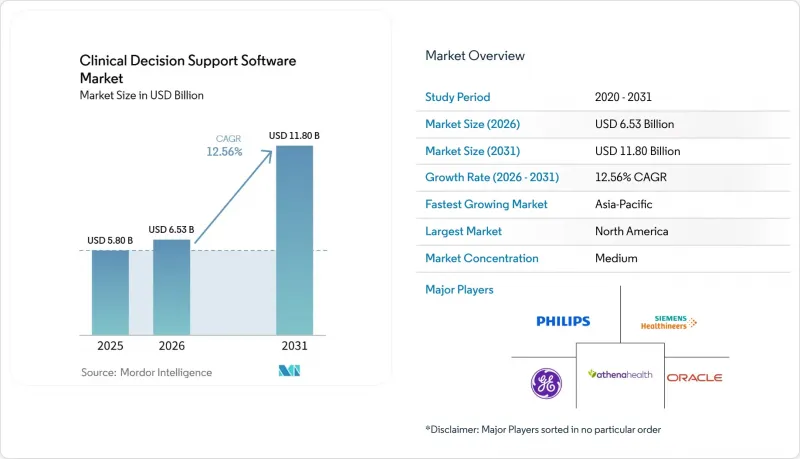
Mordor Intelligence에 의하면, 임상 의사결정 지원 소프트웨어 시장 규모는 2025년 58억 달러로 평가되었고, 2026년 65억 3,000만 달러에서 2031년까지 118억 달러로 확대될 것으로 예측되며, 2026-2031년 연평균 성장률(CAGR)은 12.56%를 나타낼 전망입니다.
본 보고서는 제품 아키텍처별(통합형 CDSS, 독립형 CDSS), 구성 요소별(소프트웨어, 서비스), 제공 형태별(온프레미스, 클라우드 기반, 하이브리드), 임상 기능별(진단 의사결정 지원 등), 용도별(약물 알레르기 경고 등), 최종 사용자별(병원 등), 지역별(북미, 유럽, 아시아태평양 등)로 분류되어 있습니다. 예측치는 금액(달러)으로 표시되어 있습니다.
세계의 임상 의사결정 지원 소프트웨어 시장 동향 및 인사이트
EHR 및 임상 워크플로우의 디지털화
미국 및 서유럽에서의 전자건강기록(EHR) 도입으로 인해 구형 의사결정 지원 모듈의 업데이트 주기가 형성되고 있습니다. 기존 모듈로는 현재의 워크플로우 요구 사항을 충족할 수 없게 되자, 의료 기관들은 AI 기반 도구를 도입하고 있습니다. 2025년 메타분석에 따르면, 전자 의사결정 지원 도입으로 투약 오류가 15% 감소한 것으로 나타났으며, 상대 위험도는 0.85, 95% 신뢰 구간은 0.70-0.94였습니다. Oracle 헬스는 2026년 3월, 미국의 입원 환자 및 응급실 부문을 대상으로 ‘Clinical AI Agent’의 일반 제공을 시작했습니다. 아틀란티케어(Atlantica)에서의 선행 도입을 통해 문서 작성 시간이 41% 단축되었으며, 이 회사는 미국 의료 제공업체들에게 누적 20만 시간 이상의 시간 절감을 실현했다고 보고하고 있습니다. 임상 의사결정 지원 소프트웨어 시장에서는 기존의 임상 워크플로우 내에서 측정 가능한 가치를 제공하는 제품이 지지를 받고 있습니다.
정부의 인증 및 상호 운용성 의무화
규제는 임상 의사결정 지원 소프트웨어 시장의 제품 설계 및 규정 준수 활동을 형성하고 있습니다. 미국 보건정보기술조정관실(ONC)은 2025년 7월 ‘HTI-4 최종 규정’을 공표하고, 전자건강기록(EHR) 워크플로우 내에서 표준화된 제공을 위한 API 기반 임상 의사결정 지원 기준을 추가했습니다. 이 기관은 관련 효율화를 통해 10년 동안 190억 달러의 인건비를 절감할 수 있을 것으로 추정하고 있습니다. 2025년 12월 29일에 공표된 ‘HTI-5 규정안’에서는 FHIR 애플리케이션 프로그래밍 인터페이스(API)를 통한 AI 기반 상호 운용성이 제안되었습니다. 이러한 방향성은 폐쇄형 도입 방식보다 모듈형 제품을 우대할 가능성이 있는 반면, 인증 및 CMS(미국 의료보험서비스센터)의 요건으로 인해 병원의 조달 주기가 가속화되고 있습니다. 유럽의 ‘헬스 데이터 스페이스’ 요건과 인도의 의료기기 규제 역시 상호 운용 가능한 시스템에 대한 유사한 수요를 확대되고 있습니다.
경고 피로와 워크플로우 혼란
경고 피로는 의사결정 지원에 대한 투자에 대한 임상적 및 재정적 근거를 약화시킵니다. 2025년 연구에 따르면, 로컬로 구성된 투약 시스템에서 적절한 임상적 내용을 포함한 경고 중 환자와 관련된 것은 고작 19.6%에 불과했습니다. 한 준실험적 연구에 따르면, 심각도가 높은 중단형 알림은 잠재적인 약물 상호작용을 줄이기는 했으나, 임상적으로 관련된 상호작용이나 환자에게 미치는 해를 줄이지는 못한 것으로 나타났습니다. 병원 측은 경보의 특이도, 무시 사유, 도입 후 성과를 더욱 엄격하게 평가하게 되었으며, 그 결과 임상 의사결정 지원 소프트웨어 시장의 도입 및 조달 일정이 장기화되고 있습니다.
부문 분석
2025년, 통합형 CDSS는 임상 의사결정 지원 소프트웨어 시장 점유율의 58.23%를 차지했습니다. 이러한 상황은 전자 의료 기록 계약의 경제적 요인을 반영한 것으로, Epic이나 Oracle Health 환경을 채택하고 있는 병원 입장에서는 독립형 대안을 도입할 정당성을 입증하기 어려웠습니다. 통합을 통해 컨텍스트 전환이 줄어들었고, 권장 사항이 임상의의 일상적인 워크플로우에 통합되었습니다. 2026년 체계적 문헌 인사이트에 따르면, Epic의 의사결정 지원 도구는 전 세계적으로 3억 2,500만 명 이상의 환자 기록을 관리하고 있으며, 이로 인해 통합형 제품은 데이터 및 워크플로우 측면에서 큰 우위를 점하고 있습니다.
독립형 CDSS는 2026-2031년 연평균 성장률(CAGR) 15.25%를 나타낼 것으로 예측됩니다. 이는 종양학 처방 관리, 패혈증 예측, 영상 진단과 연계된 진단 지원 등 전자 건강 기록에 통합된 기능만으로는 대응이 부족한 전문 분야에서 그 이용이 확대되고 있기 때문입니다. 엘스비어는 2026년 6월, 환자 데이터의 집약과 ClinicalKey AI의 근거 기반 컨텐츠를 통합하기 위해 Wellsheet를 인수했습니다. Wellsheet는 미국 내 139개 병원 시설에 도입되어 있는 반면, ClinicalKey AI의 컨텐츠는 전 세계 300개 이상의 병원에서 이용되고 있었습니다. CDS Hooks는 외부 서비스가 전자의무기록 인터페이스 내에서 권장 사항을 표시할 수 있도록 함으로써, 통합형과 독립형 제품의 경계를 좁히고 있습니다.
2025년, 서비스 부문은 매출의 43.64%를 차지했습니다. 복잡한 전자의무기록 환경을 가진 대규모 병원에 도입할 때는 여전히 도입 지원, 맞춤 설정 및 컨텐츠 관리 업무가 필요했습니다. 다년 계약이 임상 의사결정 지원 소프트웨어 시장에서 이러한 점유율을 뒷받침했습니다. 또한 서비스 부문은 특히 오래된 인프라나 부서별로 다른 체계를 가진 의료 기관에서 의료 제공업체가 알림, 워크플로우, 컨텐츠를 현지 임상 관행에 맞게 조정할 수 있도록 지원했습니다.
소프트웨어 시장은 2026-2031년 연평균 성장률(CAGR) 17.67%로 확대될 것으로 예측됩니다. 클라우드 네이티브 설계 덕분에 업데이트를 자동화하고, 버전 관리에 있어 전문 서비스에 대한 의존도를 낮출 수 있습니다. 월터스 클루어(Wolters Kluwer)의 보고서에 따르면, ‘UpToDate Expert AI’는 2025년 4분기 출시 이후 300만 명 이상의 임상의가 이용했습니다. 지속적으로 업데이트되는 근거 기반 제품은 구독 가격 정책을 뒷받침하면서도 서비스 부담을 줄일 수 있기 때문에 컨설팅 수익에 크게 의존하고 있는 공급업체들에게 AI를 활용한 구독 서비스 강화를 요구하는 압박 요인으로 작용하고 있습니다.
지역별 분석
2025년, 북미는 임상 의사결정 지원 소프트웨어 시장 매출의 39.67%를 차지했습니다. 이 지역은 전자의무기록(EMR) 보급률이 높고, 연방 정부의 인증 제도 및 가치 기반 의료에 대한 인센티브의 혜택을 받았습니다. 2025년 7월에 도입된 ‘HTI-4 최종 규정’에서는 API 기반의 임상 의사결정 지원 기준이 도입되었으며, ONC는 관련 효율화를 통해 10년 동안 누적 190억 달러의 인건비 절감이 예상된다고 추정했습니다. 캐나다는 ‘캐나다 헬스 인포웨이(Canada Health Infoway)’를 통해 국가 의료 데이터 인프라를 추진한 반면, 멕시코의 IMSS-Bienestar 디지털화 프로그램은 공립 병원의 도입 과정을 지원하기 시작했습니다.
유럽은 북미에 이어 독일, 영국, 프랑스, 북유럽 국가들의 디지털 투자에 힘입어 진전을 보였습니다. ‘유럽 헬스 데이터 스페이스(European Health Data Space)’의 설립으로 국경을 초월한 데이터 교환 기준의 필요성이 대두되었습니다. 월터스 클루버(Wolters Kluwer)는 2026년 7월, 노르웨이 전국 의료 시스템을 대상으로 ‘UpToDate Enterprise Edition’ 계약을 갱신하여 50개 이상의 공립 병원과 1만 1,000개의 병상을 포괄하게 되었습니다. 이러한 동향에 따라 임상 의사결정 지원 소프트웨어 시장에서 상호 운용 가능한 제품에 대한 수요가 높아졌습니다.
아시아태평양은 2026-2031년 연평균 성장률(CAGR) 15.56%를 나타낼 것으로 예측됩니다. 중국의 의료 디지털화와 AI 인프라에 대한 투자가 1급 및 2급 도시에서의 도입을 촉진하고 있습니다. 인도에서는 2026년 5월 기준으로 ABHA 계정에 연동된 의료 기록이 10억 건을 넘어섰습니다. 일본, 한국, 호주, 뉴질랜드도 의료 IT 역량을 강화하고 있습니다. 월터스 크루어는 2025년 9월, 아시아태평양을 대상으로 AI 기능을 강화한 ‘UpToDate Enterprise Edition’을 출시했으나, 중동 및 아프리카, 남미는 여전히 초기 단계 시장 기회를 보이고 있습니다.
기타 혜택 :
- 엑셀 형식 시장 예측(ME) 시트
- 3개월간의 애널리스트 지원
자주 묻는 질문
목차
제1장 서론
제2장 조사 방법
제3장 개요
제4장 시장 구도
제5장 시장 규모 및 성장 예측
제6장 경쟁 구도
제7장 시장 기회 및 향후 전망
AJY 26.09.01According to Mordor Intelligence, the clinical decision support software market size is projected to expand from USD 5.80 billion in 2025 and USD 6.53 billion in 2026 to USD 11.80 billion by 2031, registering a CAGR of 12.56% between 2026 to 2031.
This report is Segmented by Product Architecture (Integrated CDSS, Standalone CDSS), Component (Software, Services), Delivery Mode (On-Premise, Cloud-Based, Hybrid), Clinical Function (Diagnostic Decision Support, and More), Application (Drug Allergy Alerts, and More), End User (Hospitals, Aand More), and Geography (North America, Europe, Asia-Pacific, and More). Forecasts are in Value (USD).
Global Clinical Decision Support Software Market Trends and Insights
EHR and Clinical Workflow Digitization
Electronic health record adoption in the United States and Western Europe has created a replacement cycle for older decision support modules. Health systems are adding AI-enabled tools as earlier modules no longer meet current workflow needs. A 2025 meta-analysis found a 15% reduction in medication errors with electronic decision support, with a relative risk of 0.85 and a 95% confidence interval of 0.70-0.94. Oracle Health made its Clinical AI Agent generally available in March 2026 for U.S. inpatient and emergency department settings. Its earlier deployment at AtlantiCare reduced documentation time by 41%, and the company reported more than 200,000 cumulative hours saved for U.S. providers. The clinical decision support software market favors products that deliver measurable value within existing clinical workflows.
Government Certification and Interoperability Mandates
Regulation is shaping product design and compliance activity in the clinical decision support software market. The Office of the National Coordinator for Health Information Technology published the HTI-4 Final Rule in July 2025, adding an API-based clinical decision support criterion for standardized delivery within electronic health record workflows. The agency estimated that related efficiencies could save USD 19 billion in labor costs over 10 years. The HTI-5 Proposed Rule, published December 29, 2025, proposed AI-enabled interoperability through FHIR application programming interfaces. This direction could favor modular products over closed deployments, while certification and CMS requirements accelerate hospital procurement cycles. European Health Data Space requirements and Indian medical device rules are extending the same demand for interoperable systems.
Alert Fatigue and Workflow Disruption
Alert fatigue weakens the clinical and financial case for decision support investment. A 2025 study found that only 19.6% of alerts with appropriate clinical content were patient-relevant in a locally configured medication system. A quasi-experimental study found that high-severity interruptive alerts reduced potential drug-drug interactions but did not reduce clinically relevant interactions or patient harm. Hospitals assessed alert specificity, override reasons, and post-implementation outcomes more closely, extending implementation and procurement timelines in the clinical decision support software market.
Other drivers and restraints analyzed in the detailed report include:
- Rising Medication Safety and Quality-Reporting Requirements
- AI-Assisted Alert Optimization
- High Customization and Maintenance Cost
For complete list of drivers and restraints, kindly check the Table Of Contents.
Segment Analysis
Integrated CDSS accounted for 58.23% of the clinical decision support software market share in 2025. This position reflected electronic health record contract economics, which made standalone alternatives difficult to justify for hospitals committed to Epic or Oracle Health environments. Integration reduced context switching and kept recommendations within clinicians' routine workflows. A 2026 systematic review found that Epic's decision support tools managed records for more than 325 million patients globally, giving integrated products a substantial data and workflow advantage.
Standalone CDSS is forecast to grow at a 15.25% CAGR from 2026 to 2031. It is gaining traction in specialties where bundled electronic health record functions can be less capable, including oncology order management, sepsis prediction, and imaging-linked diagnostic support. Elsevier acquired Wellsheet in June 2026 to combine patient data aggregation with ClinicalKey AI evidence content. Wellsheet was deployed across 139 U.S. hospital sites, while ClinicalKey AI content was used in more than 300 hospitals globally. CDS Hooks is narrowing the line between integrated and standalone offerings by allowing external services to display recommendations inside electronic health record interfaces.
Services held 43.64% of revenue in 2025. Implementation, customization, and managed-content work remained necessary for large hospital deployments with complex electronic health record environments. Multi-year contracts supported this share of the clinical decision support software market. Services also helped providers tailor alerts, workflows, and content to local clinical practice, especially in systems with older infrastructure or varied departments.
Software is forecast to expand at a 17.67% CAGR from 2026 to 2031. Cloud-native designs can automate updates and reduce dependence on professional services for version management. Wolters Kluwer reported that UpToDate Expert AI reached more than 3 million clinician users after its fourth-quarter 2025 launch. Continuously updated evidence products can support subscription pricing while lowering service intensity, pressuring suppliers that rely heavily on consulting revenue to strengthen AI-enabled subscriptions.
Complete Report Scope:
- By Product Architecture
- Integrated CDSS
- Standalone CDSS
- By Component
- Software
- Services
- By Delivery Mode
- On-Premise
- Cloud-Based
- Hybrid
- By Clinical Function
- Diagnostic Decision Support
- Therapeutic Decision Support
- Medication Management
- Care Pathway and Guideline Management
- Risk Prediction and Early Warning
- Clinical Documentation and Quality Improvement
- By Application
- Drug Allergy Alerts
- Drug-Drug Interaction Alerts
- Dosing and Renal Adjustment
- Medical Diagnosis
- Clinical Guidelines and Order Sets
- Oncology Decision Support
- Cardiology Decision Support
- Sepsis and Deterioration Prediction
- Population Health and Preventive Care
- By End User
- Hospitals and Health Systems
- Ambulatory Care Centers
- Pharmacies and Pharmacy Benefit Managers
- Specialty Clinics
- Long-Term Care and Post-Acute Care Providers
- Others
- By Geography
- North America
- United States
- Canada
- Mexico
- Europe
- Germany
- United Kingdom
- France
- Italy
- Spain
- Rest of Europe
- Asia-Pacific
- China
- India
- Japan
- Australia
- South Korea
- Rest of Asia-Pacific
- Middle East and Africa
- GCC
- South Africa
- Rest of Middle East and Africa
- South America
- Brazil
- Argentina
- Rest of South America
- North America
Geography Analysis
North America held 39.67% of clinical decision support software market revenue in 2025. The region benefited from high electronic health record adoption, federal certification systems, and value-based care incentives. The HTI-4 Final Rule introduced an API-based clinical decision support criterion in July 2025, and ONC estimated USD 19 billion in cumulative labor savings over 10 years from related efficiencies. Canada advanced its national health data infrastructure through Canada Health Infoway, while Mexico's IMSS-Bienestar digitalization program began supporting adoption pathways in public hospitals.
Europe followed North America, supported by digital investment in Germany, the United Kingdom, France, and the Nordic countries. The European Health Data Space increased the need for cross-border data exchange standards. Wolters Kluwer renewed UpToDate Enterprise Edition for Norway's nationwide health system in July 2026, covering more than 50 public hospitals and 11,000 beds. These developments increased demand for interoperable products in the clinical decision support software market.
Asia-Pacific is forecast to grow at a 15.56% CAGR from 2026 to 2031. China's healthcare digitalization and AI infrastructure investment support adoption in tier-1 and tier-2 cities. India had more than 1 billion health records linked to ABHA accounts as of May 2026. Japan, South Korea, Australia, and New Zealand are also increasing health IT capacity. Wolters Kluwer launched AI-enhanced UpToDate Enterprise Edition for Asia-Pacific in September 2025, while the Middle East, Africa, and South America remain earlier-stage opportunities.
- Athenahealth
- Clinical Architecture
- EBSCO Information Services, Inc.
- Elsevier B.V.
- Epic Systems
- EvidenceCare, Inc.
- First Databank, Inc.
- GE HealthCare Technologies Inc.
- Intersystems
- Isabel Healthcare, Inc.
- Koninklijke Philips
- Medical Information Technology
- Merative, Inc.
- NextGen Healthcare
- Optum
- Oracle
- Siemens Healthineers
- Veradigm Inc.
- VisualDx, Inc.
- Zynx Health, Inc.
Additional Benefits:
- The market estimate (ME) sheet in Excel format
- 3 months of analyst support
TABLE OF CONTENTS
1 INTRODUCTION
- 1.1 Study Assumptions and Market Definition
- 1.2 Scope of the Study
2 RESEARCH METHODOLOGY
3 EXECUTIVE SUMMARY
4 MARKET LANDSCAPE
- 4.1 Market Overview
- 4.2 Market Drivers
- 4.2.1 EHR and Clinical Workflow Digitization
- 4.2.2 Government Certification and Interoperability Mandates
- 4.2.3 Rising Medication Safety and Quality-Reporting Requirements
- 4.2.4 Expansion of Evidence-Based and Patient-Specific Care
- 4.2.5 AI-Assisted Alert Optimization
- 4.2.6 Shareable Standards-Based CDS Content
- 4.3 Market Restraints
- 4.3.1 Alert Fatigue and Workflow Disruption
- 4.3.2 High Customization and Maintenance Cost
- 4.3.3 Weak Patient-Outcome and ROI Evidence
- 4.3.4 Limited External Validation and Algorithm Trust
- 4.4 Value/Supply-Chain Analysis
- 4.5 Regulatory Landscape
- 4.6 Technological Outlook
- 4.7 Porter's Five Forces Analysis
- 4.7.1 Threat of New Entrants
- 4.7.2 Bargaining Power of Suppliers
- 4.7.3 Bargaining Power of Buyers
- 4.7.4 Threat of Substitutes
- 4.7.5 Competitive Rivalry
- 4.7.6 Analysis
5 MARKET SIZE AND GROWTH FORECASTS (VALUE, USD)
- 5.1 By Product Architecture
- 5.1.1 Integrated CDSS
- 5.1.2 Standalone CDSS
- 5.2 By Component
- 5.2.1 Software
- 5.2.2 Services
- 5.3 By Delivery Mode
- 5.3.1 On-Premise
- 5.3.2 Cloud-Based
- 5.3.3 Hybrid
- 5.4 By Clinical Function
- 5.4.1 Diagnostic Decision Support
- 5.4.2 Therapeutic Decision Support
- 5.4.3 Medication Management
- 5.4.4 Care Pathway and Guideline Management
- 5.4.5 Risk Prediction and Early Warning
- 5.4.6 Clinical Documentation and Quality Improvement
- 5.5 By Application
- 5.5.1 Drug Allergy Alerts
- 5.5.2 Drug-Drug Interaction Alerts
- 5.5.3 Dosing and Renal Adjustment
- 5.5.4 Medical Diagnosis
- 5.5.5 Clinical Guidelines and Order Sets
- 5.5.6 Oncology Decision Support
- 5.5.7 Cardiology Decision Support
- 5.5.8 Sepsis and Deterioration Prediction
- 5.5.9 Population Health and Preventive Care
- 5.6 By End User
- 5.6.1 Hospitals and Health Systems
- 5.6.2 Ambulatory Care Centers
- 5.6.3 Pharmacies and Pharmacy Benefit Managers
- 5.6.4 Specialty Clinics
- 5.6.5 Long-Term Care and Post-Acute Care Providers
- 5.6.6 Others
- 5.7 By Geography
- 5.7.1 North America
- 5.7.1.1 United States
- 5.7.1.2 Canada
- 5.7.1.3 Mexico
- 5.7.2 Europe
- 5.7.2.1 Germany
- 5.7.2.2 United Kingdom
- 5.7.2.3 France
- 5.7.2.4 Italy
- 5.7.2.5 Spain
- 5.7.2.6 Rest of Europe
- 5.7.3 Asia-Pacific
- 5.7.3.1 China
- 5.7.3.2 India
- 5.7.3.3 Japan
- 5.7.3.4 Australia
- 5.7.3.5 South Korea
- 5.7.3.6 Rest of Asia-Pacific
- 5.7.4 Middle East and Africa
- 5.7.4.1 GCC
- 5.7.4.2 South Africa
- 5.7.4.3 Rest of Middle East and Africa
- 5.7.5 South America
- 5.7.5.1 Brazil
- 5.7.5.2 Argentina
- 5.7.5.3 Rest of South America
- 5.7.1 North America
6 COMPETITIVE LANDSCAPE
- 6.1 Market Concentration
- 6.2 Market Share Analysis
- 6.3 Company Profiles (includes Global Level Overview, Market Level Overview, Core Segments, Financials as available, Strategic Information, Market Rank/Share, Products and Services, Recent Developments)
- 6.3.1 athenahealth, Inc.
- 6.3.2 Clinical Architecture, LLC
- 6.3.3 EBSCO Information Services, Inc.
- 6.3.4 Elsevier B.V.
- 6.3.5 Epic Systems Corporation
- 6.3.6 EvidenceCare, Inc.
- 6.3.7 First Databank, Inc.
- 6.3.8 GE HealthCare Technologies Inc.
- 6.3.9 InterSystems Corporation
- 6.3.10 Isabel Healthcare, Inc.
- 6.3.11 Koninklijke Philips N.V.
- 6.3.12 Medical Information Technology, Inc.
- 6.3.13 Merative, Inc.
- 6.3.14 NextGen Healthcare, Inc.
- 6.3.15 Optum, Inc.
- 6.3.16 Oracle Corporation
- 6.3.17 Siemens Healthineers AG
- 6.3.18 Veradigm Inc.
- 6.3.19 VisualDx, Inc.
- 6.3.20 Zynx Health, Inc.
7 MARKET OPPORTUNITIES AND FUTURE OUTLOOK
- 7.1 White-Space and Unmet-Need Assessment


