

|
시장보고서
상품코드
2113529
인도의 접착제 및 실란트 : 시장 점유율 분석, 업계 동향 및 통계, 성장 예측(2026-2031년)India Adhesives And Sealants - Market Share Analysis, Industry Trends & Statistics, Growth Forecasts (2026 - 2031) |
||||||
 Mordor Intelligence
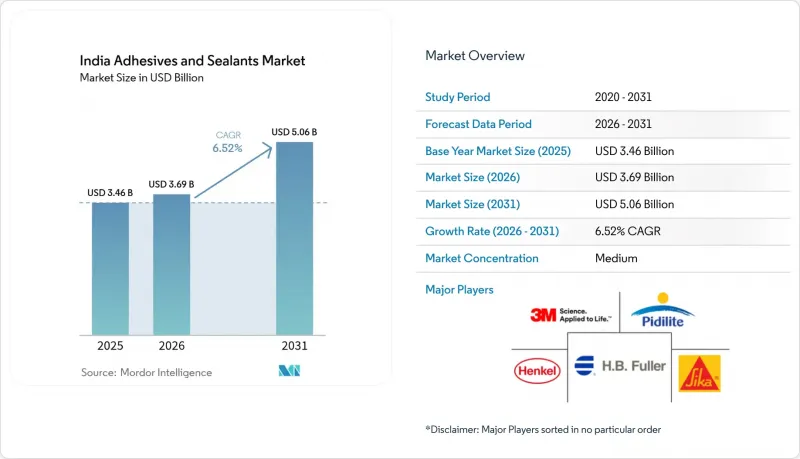
Mordor Intelligence에 의하면, 인도의 접착제 및 실란트 시장 규모는 2025년 34억 6,000만 달러에서 2026년에는 36억 9,000만 달러에 이르고, 2026-2031년 CAGR 6.52%로 성장을 지속하여 2031년에는 50억 6,000만 달러에 달할 것으로 예측됩니다.
본 보고서는 접착제 수지(폴리우레탄, 에폭시, 아크릴, 실리콘 등), 접착제 기술(수성, 용제형, 반응형 등), 실란트 수지(실리콘, 폴리우레탄,아크릴 등), 최종 사용자 산업(항공우주, 자동차, 건축 및 건설, 신발·가죽, 헬스케어 등)별로 분류되어 있습니다. 시장 예측은 금액(달러) 기준으로 제시되어 있습니다.
인도의 접착제 및 실란트 시장 동향 및 인사이트
주택 및 인프라 건설 수요 증가
2024년에 주택 및 도시 개발에 배정된 1,200억 달러 규모의 인프라 계획에 따라, 구조용 접착제, 파사드 유리용 실란트, 에너지 절약형 건축 외피 솔루션 등 건설용 화학제품의 사용량이 급증하고 있습니다. 공장에서 접착 공정을 거친 모듈식 및 조립식 공법은 현장 노동력을 대폭 줄이고 프로젝트 공사 기간을 단축할 수 있어 지지를 얻고 있습니다. 또한, 건설업체들은 인도 표준청(BIS)의 더욱 엄격해진 요건에 직면해 있으며, 이로 인해 인증을 받은 저VOC 접착 시스템의 채택이 촉진되고 있습니다. BIS 규격을 준수하는 폴리우레탄 및 실리콘 제품 라인을 보유한 제조업체들은 현장에서 기술 감사 및 교육 서비스를 제공함으로써 시장 점유율을 확대되고 있습니다. 특히 인도의 극심한 기온 변동을 견딜 수 있는 내후성 실란트에 대한 수요가 강해, 공급업체들은 델리 수도권(NCR)이나 하이데라바드와 같은 주요 건설 거점 근처에 연구개발 센터를 확장해야 하는 압박을 받고 있습니다.
전자상거래의 급속한 성장으로 인한 포장 수요
온라인 소매의 두 자릿수 성장에 따라 포장은 단순한 비용 센터에서 위조 방지 기능, 내열성, 재활용성을 필요로 하는 브랜드 보호 도구로 변화했습니다. 연포장 가공업체들은월5,000톤이 넘는 주문을 처리하기 위해 UFlex사의 착색 백색 라미네이팅 시스템 및 습식 라미네이팅 시스템 등 수성 및 무용제 라미네이팅용 접착제의 생산 규모를 확대되고 있습니다. 식품 등급의 이행 한계치 및 확대된 생산자 책임(EPR) 규제로 인해, 전 세계 식품 접촉 테스트를 통해 검증된 저VOC 화학 물질이 선호되고 있습니다. 콜드체인의 확대에 따라 -20°C에서 50°C 범위에서 접착 강도를 유지하는 실런트에 대한 수요가 증가하고 있습니다. 한편, 소비자에게 직접 배송하는 경우가 늘어나면서, 라스트 마일 배송 과정에서도 골판지 상자가 파손되지 않도록 하는 속경화형 핫멜트의 도입이 확대되고 있습니다. 이 분야에서 성공을 거두고 있는 공급업체들은 온라인 점도 모니터링과 접착제 사용량 분석 기능을 결합하여 폐기물을 8-10% 줄이고 있습니다.
엄격한 VOC 및 EHS 규제
중앙공해관리위원회가 VOC 허용 한계를 하향 조정함에 따라, 제조업체들은 생산 라인에 재생식 열산화 장치를 도입하고, 제품 포트폴리오를 수성 및 핫멜트 계열 제품으로 전환할 수밖에 없게 되었습니다. 중소기업의 경우, 설비 투자액이 100만 달러에 달할 가능성이 있어 단기적으로는 영업이익률 하락으로 이어집니다. 또한, 메틸렌 클로라이드를 함유한 항공우주용 배합제는 전 세계적으로 단계적 폐지가 진행되고 있어, 재인증에 드는 비용과 일시적인 공급 부족이 발생하고 있습니다. 뭄바이 및 방갈로르 공장에서는 규제 준수를 위해 폐쇄형 용제 회수 시스템을 도입하고 있지만, 그 복잡성이 높아 확립된 환경 엔지니어링 팀을 보유한 다국적 기업에 유리하게 작용하고 있습니다. 한편, 최종 사용자는 GHS 제8판에 준거한 안전 데이터 시트(SDS)를 요구하고 있어 문서 작성 부담이 더욱 가중되고 있습니다.
부문 분석
2025년, 인도의 접착제 및 실런트 시장에서 폴리우레탄은 21.88%의 점유율을 차지했습니다. 이는 건설 및 자동차 접합부에서 이종 기질의 접착 및 내화학성을 발휘하는 능력에 힘입은 결과입니다. 에폭시 및 아크릴계는 내열성 및 자외선 안정성이 요구되는 용도에서 그 뒤를 잇고 있습니다. VAE/EVA는 시장 규모는 작지만, 연포장 제조업체들이 재활용 가능한 단일 소재 필름으로 전환하는 추세에 따라 2031년까지의 연평균 성장률(CAGR)이 7.42%로 가장 높은 성장세를 보이고 있습니다. 시장을 선도하는 기업들은 CO₂ 회수 폴리올 및 식물성 오일 유래 중간체를 제품에 접목하여 환경 보호 노력을 강화하고 있으며, 이러한 움직임은 브랜드 소유자의 지속가능성 평가 기준에 부합하는 것입니다.
예측 기간 동안 인도의 접착제·실런트 시장 수요는 특히 고층 빌딩의 유리 외장 분야에서 도장성과 내후성을 겸비한 하이브리드 폴리우레탄·실리콘 블렌드로 전환될 전망입니다. 시아노아크릴레이트계 접착제는 순간적인 접착 속도로 인해 전자제품,긴급 수리, 소비자용 DIY 키트와 같은 틈새 시장에서 여전히 입지를 유지하고 있습니다. 바이오 원료 사용을 확대하고 있는 공급업체들은 유해 폐기물 처리 비용 절감 및 탄소 크레딧을 통한 상쇄 가능성을 강조함으로써 총 소유 비용(TCO) 측면에서 경쟁력을 높이고 있습니다. 새로운 화학 조성으로 BIS 인증을 획득한 배합 제조업체는 부동산 업계 및 자동차 OEM으로부터 사양 승인을 더 신속하게 얻을 수 있을 것으로 예측됩니다.
핫멜트는 2025년 인도의 접착제·실런트 시장 규모의 36.62%를 차지하고 있으며, 2031년까지 연평균 성장률(CAGR) 6.88%로 다른 플랫폼을 능가하는 성장을 이어가고 있습니다. 용제를 전혀 포함하지 않고, 경화 속도가 빠르며, 낮은 에너지로도 경화가 가능하기 때문에 핫멜트는 분당 최대 600개 단위로 처리되는 골판지 포장 및 위생용 일회용 제품에 가장 적합합니다. 수성 에멀젼형은 배합 설계자가 입자 직경이나 계면활성제 계를 조정함으로써 VOC(휘발성 유기 화합물)를 5 g/L 미만으로 억제하면서도 용제형에 필적하는 접착력을 실현하고 있어, 2위 시장 점유율을 차지하고 있습니다.
대도시권 지자체들이 공장의 배기 허가 기준을 엄격화함에 따라 용제계 접착제의 생산량은 해마다 감소하고 있지만, 기판에 깊은 침투가 요구되는 가죽 접착이나 특정 금속 전처리 분야에서는 여전히 중요한 역할을 하고 있습니다. 반응성 폴리우레탄은 오픈 타임과 온디맨드 경화를 통해 조립의 유연성을 제공하는 전면 유리 접착 분야에서 채택이 확대되고 있습니다. UV 경화형 아크릴레이트는 미니 LED 및 OLED 디스플레이 제조업체들이 정밀한 접착을 중시함에 따라 전자제품 생산 라인에서의 채택이 확대되고 있습니다. 인도의 접착제 및 실란트 시장 동향에 대응하는 장비 제조업체들은 현재 용융 장치에 인더스트리 4.0 대응 센서를 결합하여, 점도 및 온도 데이터를 클라우드 대시보드로 전송함으로써 1교대당 접착제 소비량을 8-12% 절감하고 있습니다.
기타 혜택:
- 엑셀 형식 시장 예측(ME) 시트
- 3개월간의 애널리스트 지원
자주 묻는 질문
목차
제1장 서론
제2장 조사 방법
제3장 주요 요약
제4장 시장 구도
제5장 시장 규모와 성장 예측
제6장 경쟁 구도
제7장 시장 기회와 향후 전망
LSH 26.08.25According to Mordor Intelligence, the India adhesives and Sealants Market size is expected to grow from USD 3.46 billion in 2025 to USD 3.69 billion in 2026 and is forecast to reach USD 5.06 billion by 2031 at 6.52% CAGR over 2026-2031.
This report is Segmented by Adhesive Resin (Polyurethane, Epoxy, Acrylic, Silicone, and More), Adhesive Technology (Water-Borne, Solvent-Borne, Reactive, and More), Sealant Resin (Silicone, Polyurethane, Acrylic, and More), End-User Industry (Aerospace, Automotive, Building and Construction, Footwear and Leather, Healthcare, and More). The Market Forecasts are Provided in Terms of Value (USD).
India Adhesives And Sealants Market Trends and Insights
Rising Residential and Infrastructure Construction Demand
Infrastructure programs worth USD 120 billion allocated to housing and urban development in 2024 are triggering a spike in construction chemical usage, including structural adhesives, sealants for facade glazing, and energy-efficient building envelope solutions. Modular and prefabricated techniques that rely on factory-applied bonding are gaining favor because they slash on-site labor and accelerate project schedules. Builders also face stricter Bureau of Indian Standards (BIS) requirements, which encourage the adoption of certified, low-VOC bonding systems. Manufacturers with BIS-compliant polyurethane and silicone lines win share by offering on-site technical audits and training services. Demand is particularly strong for weather-resistant sealants that tolerate India's temperature swings, pushing suppliers to expand research and development centers near major construction hubs in Delhi-NCR and Hyderabad.
Booming E-Commerce-Led Packaging Requirements
Double-digit online retail growth has changed packaging from a cost-center to a brand-protection tool requiring tamper evidence, heat resistance, and recyclability. Flexible packaging converters are scaling up water-borne and solvent-free laminating adhesives, such as UFlex's pigmented white and wet-lamination systems, to service monthly order runs exceeding 5,000 tonnes. Food-grade migration limits and Extended Producer Responsibility rules favor low-VOC chemistries validated under global food-contact tests. Cold-chain expansion drives the need for sealants that maintain bond strength from -20 °C to 50 °C, while direct-to-consumer shipments fuel the uptake of fast-setting hot-melts that keep corrugated boxes intact over last-mile cycles. Suppliers winning in this space bundle online viscosity monitoring and adhesive usage analytics that cut waste by 8-10%.
Stringent VOC and EHS Regulations
The Central Pollution Control Board has lowered allowable VOC thresholds, compelling producers to retrofit lines with regenerative thermal oxidizers and to shift portfolio mix toward water-borne and hot-melt grades. Capital outlays for small firms can reach USD 1 million, reducing operating margins in the near term. Aerospace formulations containing methylene chloride are under global phase-out, creating requalification costs and temporary shortages. Plants in Mumbai and Bangalore have introduced closed-loop solvent recovery to stay compliant, but the added complexity favors multinationals with established environmental engineering teams. End-users meanwhile insist on Safety Data Sheets aligned with GHS version 8, adding further documentation overhead.
Other drivers and restraints analyzed in the detailed report include:
- Automotive Lightweighting and Localisation Push
- Woodworking and Modular Furniture Uptake
- Petro-Feedstock Price Volatility
For complete list of drivers and restraints, kindly check the Table Of Contents.
Segment Analysis
Polyurethane accounted for 21.88% of India's adhesives and sealants market share in 2025, underpinned by its ability to bond dissimilar substrates and resist chemicals in construction and automotive joints. Epoxy and acrylic systems follow for applications that demand high-temperature endurance or UV stability. VAE/EVA, though smaller in base, is registering the fastest 7.42% CAGR through 2031 as flexible packaging converters switch to recyclable mono-material films. Market leaders are improving green credentials by incorporating CO2-captured polyols and plant-oil intermediates, moves that align with brand-owner sustainability scorecards.
Over the forecast window, India's adhesives and sealants market demand shifts toward hybrid polyurethane-silicone blends that combine paintability with weatherability, especially in high-rise glazing. Cyanoacrylates retain niches in electronics, fast repair, and consumer DIY kits owing to instant bonding speeds. Suppliers scaling bio-based feedstocks compete on total cost of ownership by highlighting lower hazardous-waste fees and possible carbon-credit offsets. Formulators that earn BIS certification for their new chemistries are expected to gain quicker specification approvals from real estate and automotive OEMs.
Hot-melt held 36.62% of India adhesives and sealants market size in 2025 and continues to outpace other platforms with a 6.88% CAGR through 2031. Zero-solvent content, fast set times, and low energy curing make hot-melts ideal for corrugated packaging and hygiene disposables processed at up to 600 units-per-minute. Water-borne emulsions stand second as formulators tune particle size and surfactant systems to approach solvent-borne tack while remaining under 5 g/L VOC.
Solvent-borne volumes decline annually as metro governments tighten plant-air permits, yet remain relevant for leather bonding and certain metal pretreatments requiring deep substrate penetration. Reactive polyurethanes gain traction in windshield bonding, where open time and cure-on-demand deliver assembly flexibility. UV-curable acrylates capture more electronics lines as mini-LED and OLED display makers prioritize precision bonding. Equipment manufacturers responding toIndia'sa adhesives and sealants market trends now bundle melter systems with Industry 4.0 sensors that feed viscosity and temperature data to cloud dashboards, cutting glue consumption 8-12% per shift.
Complete Report Scope:
- By Adhesives Resin
- Polyurethane
- Epoxy
- Acrylic
- Silicone
- Cyanoacrylate
- VAE / EVA
- Other Resins
- By Adhesives Technology
- Water-borne
- Solvent-borne
- Reactive
- Hot-Melt
- UV Cured
- By Sealants Resin
- Silicone
- Polyurethane
- Acrylic
- Epoxy
- Other Resins
- By End-user Industry
- Aerospace
- Automotive
- Building and Construction
- Footwear and Leather
- Healthcare
- Packaging
- Woodworking And Joinery
- Other End-user Industries
List of Companies Covered in this Report:
- 3M
- Arkema
- Ashland
- Astral Adhesives
- Atul Ltd
- AVERY DENNISON CORPORATION
- BASF
- Dow
- H.B. Fuller Company
- Henkel AG & Co. KGaA
- HP Adhesives
- Huntsman International LLC
- Jubilant Agri and Consumer Products Limited (JACPL)
- Mapei SpA
- Parker Hannifin Corp
- Pidilite Industries Ltd.
- Sika AG
- Soudal India Private Limited
Additional Benefits:
- The market estimate (ME) sheet in Excel format
- 3 months of analyst support
TABLE OF CONTENTS
1 Introduction
- 1.1 Study Assumptions and Market Definition
- 1.2 Scope of the Study
2 Research Methodology
3 Executive Summary
4 Market Landscape
- 4.1 Market Overview
- 4.2 Market Drivers
- 4.2.1 Rising residential and infrastructure construction demand
- 4.2.2 Booming e-commerce-led packaging requirements
- 4.2.3 Automotive lightweighting and localisation push
- 4.2.4 Woodworking and modular furniture uptake
- 4.2.5 Make-in-India defence / aerospace offsets fuel high-spec bonding
- 4.3 Market Restraints
- 4.3.1 Stringent VOC and EHS regulations
- 4.3.2 Petro-feedstock price volatility
- 4.3.3 Import-dependency for specialty monomers (isocyanates, silanes)
- 4.4 Value Chain Analysis
- 4.5 Porter's Five Forces
- 4.5.1 Bargaining Power of Suppliers
- 4.5.2 Bargaining Power of Buyers
- 4.5.3 Threat of New Entrants
- 4.5.4 Threat of Substitutes
- 4.5.5 Degree of Competition
5 Market Size and Growth Forecasts (Value)
- 5.1 By Adhesives Resin
- 5.1.1 Polyurethane
- 5.1.2 Epoxy
- 5.1.3 Acrylic
- 5.1.4 Silicone
- 5.1.5 Cyanoacrylate
- 5.1.6 VAE / EVA
- 5.1.7 Other Resins
- 5.2 By Adhesives Technology
- 5.2.1 Water-borne
- 5.2.2 Solvent-borne
- 5.2.3 Reactive
- 5.2.4 Hot-Melt
- 5.2.5 UV Cured
- 5.3 By Sealants Resin
- 5.3.1 Silicone
- 5.3.2 Polyurethane
- 5.3.3 Acrylic
- 5.3.4 Epoxy
- 5.3.5 Other Resins
- 5.4 By End-user Industry
- 5.4.1 Aerospace
- 5.4.2 Automotive
- 5.4.3 Building and Construction
- 5.4.4 Footwear and Leather
- 5.4.5 Healthcare
- 5.4.6 Packaging
- 5.4.7 Woodworking And Joinery
- 5.4.8 Other End-user Industries
6 Competitive Landscape
- 6.1 Market Concentration
- 6.2 Strategic Moves (Mergers and Acquisitions, JVs, Capacity Expansions)
- 6.3 Market Share (%)/Ranking Analysis
- 6.4 Company Profiles (includes Global level Overview, Market level overview, Core Segments, Financials as available, Strategic Information, Market Rank/Share for key companies, Products and Services, and Recent Developments)
- 6.4.1 3M
- 6.4.2 Arkema
- 6.4.3 Ashland
- 6.4.4 Astral Adhesives
- 6.4.5 Atul Ltd
- 6.4.6 AVERY DENNISON CORPORATION
- 6.4.7 BASF
- 6.4.8 Dow
- 6.4.9 H.B. Fuller Company
- 6.4.10 Henkel AG & Co. KGaA
- 6.4.11 HP Adhesives
- 6.4.12 Huntsman International LLC
- 6.4.13 Jubilant Agri and Consumer Products Limited (JACPL)
- 6.4.14 Mapei SpA
- 6.4.15 Parker Hannifin Corp
- 6.4.16 Pidilite Industries Ltd.
- 6.4.17 Sika AG
- 6.4.18 Soudal India Private Limited
7 Market Opportunities and Future Outlook
- 7.1 White-space and Unmet-need Assessment


