

|
시장보고서
상품코드
2113570
스마트 섬유 : 시장 점유율 분석, 업계 동향 및 통계, 성장 예측(2026-2031년)Smart Fabrics - Market Share Analysis, Industry Trends & Statistics, Growth Forecasts (2026 - 2031) |
||||||
 Mordor Intelligence
Mordor Intelligence에 의하면, 스마트 섬유 시장 규모는 2025년에 775만 유닛으로 평가되었고, 2026년 858만 유닛에서 2031년까지 1,425만 유닛에 이를 것으로 예측되며, 예측 기간(2026년-2031년) CAGR은 10.68%를 기록할 전망입니다.
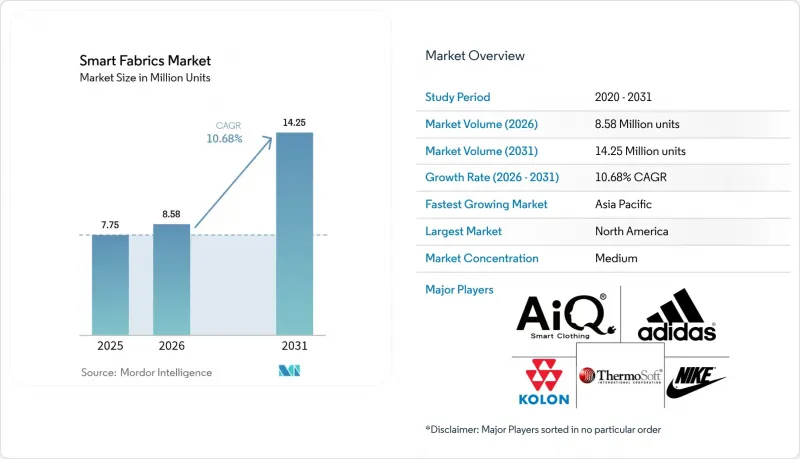
본 보고서는 유형별(패시브형 스마트 섬유, 액티브형 스마트 섬유, 울트라 스마트 섬유), 기능별(센싱, 체온 조절 등), 소재별(면 계열, 폴리에스터·나일론 계열, 고성능 소재), 용도별(패션·엔터테인먼트,스포츠 및 피트니스 등) 및 지역별로 분류되어 있습니다. 시장 예측은 수량(단위) 기준으로 제시되어 있습니다.
세계 스마트 섬유 시장 동향 및 인사이트
웨어러블 전자 기기 생태계의 성장
웨어러블 기기의 보급 확대에 따라 스마트 의류에 대한 수요가 급증하고 있습니다. 워털루 대학교 연구진은 태양광이나 체열 에너지를 회수하여 외부 배터리가 필요 없는 원단을 시연했습니다. 코넬 대학교의 ‘SeamFit’ 셔츠는 평상복 티셔츠에 꿰매어 넣은 전도성 실을 이용해 93.4%의 정확도로 운동 유형을 분류했습니다. 의료 분야의 시제품도 급속히 발전하고 있으며, 캘리포니아 공과대학의 스마트 붕대는 전문가 수준의 정확도로 상처 치유 기간을 예측합니다. 『가디언』지는 주변의 전자기 에너지를 흡수하고 인체를 회로의 일부로 활용함으로써, 의류에 내장된 초저전력 센서에 전력을 공급하는 섬유 기반 전자 기기에 대해 보도했습니다. 이러한 발전들이 맞물리면서 의류와 전자기기의 경계가 모호해지고 있으며, 스마트 섬유 시장은 라이프스타일, 의료, 산업 등 다양한 분야로 확대되고 있습니다.
급속한 소형화와 플렉서블 IC의 통합
전자 기기를 직물에 내장해도 착용감이 떨어지지 않는 기준이 바뀌었습니다. MIT의 엔지니어들은 마이크로 디바이스, 센서, 블루투스 모듈을 내장하고 세탁기 세탁도 견딜 수 있는 신축성 섬유 컴퓨터를 개발했습니다. 이를 통해 부피를 차지하지 않으면서도 생체 신호를 모니터링할 수 있는 북극권 임무용 웨어러블 기기가 실현되었습니다. 또한, 자수를 수놓은 마찰 발전 나노 발전기는 한 번의 미끄러짐 주기당 307.5µJ의 전력을 발생시켜, 일반적인 의복의 움직임을 통해 실용적인 에너지 회수가 가능함을 보여주었습니다. 홍콩대학교에서 개발된 유기 전기화학 트랜지스터는 직물 위에서 데이터를 국소적으로 처리할 수 있게 되어 통신 부하를 줄이고 개인정보 보호를 강화하고 있습니다. 이러한 획기적인 기술 덕분에 드레이프성과 유연성을 유지하면서도 고급 처리 능력을 직물에 통합할 수 있게 되어 소비자의 수용도가 높아지고 있습니다.
높은 제조 비용과 사이버 보안 위험
생산 라인에서는 도체, 센서, 마이크로컨트롤러를 내장하기 위한 전용 설비가 필요하며, 그 결과 단가는 일반 섬유 제품보다 높게 책정되고 있습니다. 2024년의 인플레이션과 공급망 혼란으로 인해 미국 섬유 제조업체의 이익률은 더욱 압박을 받게 되었으며, 이들 중 다수가 자동화 업그레이드를 위한 설비 투자를 줄일 수밖에 없게 되었습니다. 또한 의류는 건강 데이터 규제의 대상이 되는 생체 인증 정보를 수집하기 때문에 데이터 보안에 대한 우려도 동시에 제기되고 있습니다. 암호화에는 부품 비용이 추가될 뿐만 아니라, 제품의 수명 주기 전반에 걸쳐 소프트웨어 업데이트가 의무화되므로 총 소유 비용이 증가합니다. 소규모 브랜드들은 규제 준수 설계를 위한 자금 확보에 어려움을 겪고 있어, 저소득층 시장으로의 진출이 지연되고 있습니다.
부문 분석
예측 분석 및 자동 적응 기술이 연구실에서 양산 단계로 넘어감에 따라, 울트라 스마트 유형은 2031년까지 연평균 성장률(CAGR) 11.06%를 기록하며 부문 1위를 차지할 것으로 예측됩니다. 패시브형은 기본적인 센싱 작업에서 입증된 내구성 덕분에 여전히 스마트 섬유 시장의 44.62%를 차지하고 있습니다. 자극에 따라 통기성 등의 특성을 변화시키는 액티브형 패브릭은 그 격차를 메우는 존재이지만, 전력 소비와 내구성 사이의 상충 관계라는 과제를 극복해야 합니다. 압전사를 사용한 스마트 음향 직물은 굽힘이나 촉각을 정확한 전기 신호로 변환하며, 하루 종일 착용해도 통기성과 열적 안정성을 유지합니다. 연구개발 파이프라인에는 착용자의 패턴을 학습하여 이상을 예측하는 직물 내장형 신경망이 통합되어 있어, 예방적 건강 경보를 실현하고 있습니다. 이러한 기능 덕분에 울트라 스마트 섬유은 뚜렷한 가치 프리미엄을 창출하며, 고성능 스포츠웨어, 국방, 만성 질환 모니터링 분야의 스마트 섬유 시장 점유율 확대를 뒷받침하고 있습니다.
스마트 음향 기술은 패시브 및 액티브 카테고리 모두에 이점을 제공합니다. 최적화된 레이어링 방식을 통해 신호 대 잡음비가 향상되어, 엔트리 레벨 밸런스 모니터링 벨트나 저비용 자세 교정 기기의 성능이 개선되고 있습니다. 패시브 제품 제조업체는 기존 직기를 활용하고 있기 때문에 울트라 스마트 분야의 신규 진출기업보다 신속하게 규모를 확대할 수 있습니다. 제조 라인이 통합됨에 따라, 직기 제조업체와 칩 공급업체 간의 특허 공유를 통해 수율이 향상되고, 각 티어 간의 성장이 균형을 이룰 것입니다.
에너지 수확 기능은 13.28%라는 가장 높은 예측 연평균 성장률(CAGR)을 보이고 있지만, 2025년에도 센싱은 스마트 섬유 시장의 55.42% 점유율을 유지할 전망입니다. 상변화 잉크나 미세 유체 채널을 통해 가열 및 냉각을 수행하는 체온 조절 스웨터는 틈새 시장의 성능 요구를 충족시키는 한편, 발광성 직물은 패션성이 뛰어난 신발이나 이벤트용 의상을 돋보이게 합니다. 암밴드에 짜여진 고효율 마찰 발전 나노 발전기는 격렬한 운동 중에 3 mW cm-2 이상의 전력을 공급하게 되어, 외부 전원이 없어도 블루투스 비콘을 지속적으로 작동시킬 수 있게 되었습니다(arxiv.org). 수분을 에너지원으로 하는 슈퍼커패시터를 이러한 발전기와 결합함으로써 며칠 동안 전하를 유지할 수 있어 매일 충전해야 하는 번거로움을 덜 수 있습니다. 이러한 전원 시스템을 통해 구조대원을 위한 자율형 필드 재킷의 실용화가 가능해졌으며, 환자가 움직일 수 없는 상황에서도 생체 신호를 추적할 수 있는 병원용 가운도 실현됩니다.
센싱 기술은 훈련용 티셔츠에 내장된 심박수 및 체온 측정 모듈을 통해 계속해서 주도적인 위치를 유지하고 있습니다. 섬유 기반 유도 코일이 근육의 산소 포화도를 측정함으로써, 스포츠 용품의 부상 예방에 있어 그 역할이 확대되고 있습니다. 제조업체들이 다기능 원사를 제품에 통합함에 따라, 제품군은 센싱 기능과 마이크로 에너지 셀을 융합하고 있으며, 이러한 카테고리들은 서로 배타적이지 않고 상호 보완적인 관계를 형성하고 있습니다.
지역별 분석
북미는 견실한 국방 예산, 활기찬 헬스테크 생태계, 그리고 혁신적인 스포츠웨어에 대한 소비자의 열정을 바탕으로 2025년에는 28.12%의 시장 점유율로 1위를 차지했습니다. 국방부는 파이버 컴퓨터와 기후 적응형 제복에 자금을 지원하며, 고사양 원단에 대한 국내 수요를 확보하고 있습니다. MIT, 워털루 대학교, 캘리포니아 공과대학교는 자사의 텍스타일 플랫폼 라이선스를 부여하는 스타트업을 분사시켜 지역의 혁신 파이프라인을 지속적으로 강화하고 있습니다. 일부 방적 공장은 공급 충격을 완화하기 위해 니어쇼어 생산으로 전환하고, 지역 제조업 재건을 목표로 한 정부의 장려 조치를 활용했습니다.
아시아태평양은 성장의 원동력이며, 2031년까지 연평균 성장률(CAGR)은 12.05%로 예측됩니다. 중국의 기능성 섬유 분야는 이미 중국 전체 섬유 산업의 20% 이상을 차지하고 있으며, 의료, 여과, 보호 각 부문에서 연평균 9-13%의 성장률을 기록하고 있습니다. 베이징 매트릭스텍(Beijing Matrix Tech)의 ‘Y-Warm’ 단열재는 뛰어난 보온성과 항균성을 갖추고 있어, 한랭지용 스포츠웨어 브랜드로의 수출 가능성을 내포하고 있습니다. 일본공급업체들은 초미세 전도성 필라멘트 개발을 추진하는 한편, 한국의 한 기업 그룹은 인터랙티브 의류용 세탁 가능한 OLED 실 패턴을 상품화하고 있습니다. 인도에서는 지방 진료소를 대상으로 가격 경쟁력이 있는 스마트 붕대를 제조하는 스타트업이 육성되고 있어, 이 지역에서의 폭넓은 응용 가능성을 보여주고 있습니다. 유럽은 지속가능성에 관한 규제와 첨단 엔지니어링이 교차하는 지점에 위치해 있습니다. EU 역내의 선진적인 PFAS 규제로 인해, 독성 위험을 줄이면서도 전도성을 유지하는 대체 코팅재에 대한 연구가 추진되고 있습니다. 렌징(Lenzing)사가 TreeToTextile에 소액 출자함에 따라, 물과 에너지 발자국을 줄이는 셀룰로오스 섬유 개발이 가속화되고 있습니다. 독일, 프랑스, 스페인에서는 섬유 재활용 클러스터가 육성되고 있으나, 소비자 조사에 따르면 지속가능성으로 인한 가격 프리미엄에 대해 가격 민감도가 높은 것으로 나타났습니다. 대학들은 자동차 부품 제조업체와 협력하여 운전자의 피로를 감지하는 시트 원단을 개발하고 있으며, 이를 통해 산업계에서의 채택이 확대되면서 스마트 섬유 시장에서 유럽의 혁신 허브로서의 역할이 강화되고 있습니다.
기타 혜택:
- 엑셀 형식 시장 예측(ME) 시트
- 3개월간의 애널리스트 지원
자주 묻는 질문
목차
제1장 서론
제2장 조사 방법
제3장 주요 요약
제4장 시장 구도
제5장 시장 규모와 성장 예측
제6장 경쟁 구도
제7장 시장 기회와 향후 전망
LSH 26.08.25According to Mordor Intelligence, the smart fabrics market size was valued at 7.75 million units in 2025 and estimated to grow from 8.58 million units in 2026 to reach 14.25 million units by 2031, at a CAGR of 10.68% during the forecast period (2026-2031).
This report is Segmented by Type (Passive Smart Fabrics, Active Smart Fabrics, Ultra-Smart Fabrics), Functionality (Sensing, Thermoregulation, and More), Material (Cotton-Based, Polyester and Nylon, High-Performance), Application (Fashion and Entertainment, Sports and Fitness, and More), and Geography. The Market Forecasts are Provided in Terms of Volume (Units).
Global Smart Fabrics Market Trends and Insights
Growth in Wearable-Electronics Ecosystem
Demand for smart garments has surged in tandem with the wider wearable device boom. Researchers at the University of Waterloo demonstrated fabrics that harvest solar and body-heat energy, removing the need for external batteries. Cornell University's SeamFit shirts classified exercises with 93.4% accuracy using conductive threads stitched into everyday tees. Healthcare prototypes are progressing quickly, including smart bandages from the California Institute of Technology that predict wound-healing timelines at expert-level precision. The Guardian reported fiber-based electronics that draw ambient electromagnetic energy, turning the human body into part of the circuit and fueling ultra-low-power sensors embedded inside clothing. Collectively, these advances blur the line between attire and electronics, expanding the smart fabrics market into lifestyle, medical, and industrial realms.
Rapid Miniaturization and Flexible-IC Integration
The threshold at which integrated electronics compromise fabric comfort has shifted. MIT engineers produced elastic fiber computers containing micro-devices, sensors, and Bluetooth modules that survive machine washes, enabling Arctic mission wearables that monitor vital signs without bulk.Embroidered triboelectric nanogenerators yielded 307.5 µJ per sliding cycle, showcasing viable energy capture through regular garment motion. Organic electrochemical transistors developed at the University of Hong Kong now process data locally on the fabric, lowering transmission loads and boosting privacy. These breakthroughs place sophisticated processing power inside textiles while preserving drape and flexibility, enhancing consumer acceptance.
High Fabrication Cost and Cybersecurity Risks
Production lines require specialized equipment for embedding conductors, sensors, and microcontrollers, pushing unit costs above those of regular textiles. Inflation and supply chain disruptions in 2024 further squeezed margins for U.S. textile mills, many of which diverted capex away from automation upgrades. Data security remains a parallel concern because garments collect biometrics that fall under health-data regulations. Encryption adds component expense and mandates software updates throughout a product's life, increasing total cost of ownership. Smaller brands face hurdles securing capital for compliant design, slowing penetration in low-income markets.
Other drivers and restraints analyzed in the detailed report include:
- Textile-Embedded Energy-Harvesting Supercapacitors
- Military Mandates for Cognitive-Load Monitoring Gear
- Absence of Global E-Textile Interoperability Standards
For complete list of drivers and restraints, kindly check the Table Of Contents.
Segment Analysis
Ultra-smart variants are forecast to post the segment-leading 11.06% CAGR to 2031 as predictive analytics and automated adaptation move from labs into volume production. Passive formats still command 44.62% of the smart fabrics market due to proven durability across basic sensing tasks. Active fabrics, which modify properties like breathability in response to stimuli, bridge the gap but must overcome power and durability trade-offs. Smart acoustic cloth using piezoelectric threads translates bending and touch into precise electrical signals, maintaining airflow and thermal stability for day-long wear. R&D pipelines are embedding on-textile neural networks that learn wearer patterns and predict anomalies, unlocking proactive wellness alerts. These capabilities give Ultra-smart fabrics a clear value premium, propelling their share of the smart fabrics market in high-performance sportswear, defense, and chronic-care monitoring.
Smart acoustics also benefit Passive and Active categories. Tailored layering schemes now boost signal-to-noise ratios, enhancing entry-level balance monitoring belts and low-cost posture trainers. Builders of Passive goods leverage established looms, so they scale faster than Ultra-smart newcomers. As manufacturing lines converge, patent sharing between loom makers and chip vendors will compress yields, balancing growth across tiers.
Energy Harvesting functions show the highest forecast CAGR of 13.28%, though Sensing retained a 55.42% share of the smart fabrics market in 2025. Thermoregulation sweaters that heat or cool through phase-change inks and microfluidic channels fulfill niche performance needs, while luminescent fabrics enrich aesthetic footwear and event costumes. Efficient triboelectric nanogenerators woven into arm bands now deliver over 3 mW cm-2 during intense motion, enabling continuous Bluetooth beacons without external power arxiv.org. Moisture-enabled supercapacitors pair with those generators to retain charge for days, removing the daily charging chore. These power systems make autonomous field jackets viable for rescue crews and enable hospital gowns that track vitals even when patients lack mobility.
Sensing retains leadership through ubiquitous heart-rate and temperature modules in workout tees. Textile-based inductive coils measure muscle oxygenation, expanding the role of sports gear in injury prevention. As manufacturers integrate multi-functional yarns, product families combine sensing with micro-energy cells, making the categories mutually reinforcing rather than mutually exclusive.
Complete Report Scope:
- By Type
- Passive Smart Fabrics
- Active Smart Fabrics
- Ultra-smart Fabrics
- By Functionality
- Sensing
- Thermoregulation
- Energy Harvesting
- Luminescent and Aesthetic
- By Material
- Cotton-based
- Polyester and Nylon
- High-performance (Kevlar, Dyneema, etc.)
- By Application
- Fashion and Entertainment
- Sports and Fitness
- Medical and Healthcare
- Transportation - Automotive and Aerospace
- Military and Defense
- Industrial and Safety
- By Geography
- North America
- United States
- Canada
- Mexico
- South America
- Brazil
- Argentina
- Rest of South America
- Europe
- Germany
- United Kingdom
- France
- Italy
- Spain
- Netherlands
- Rest of Europe
- Asia-Pacific
- China
- Japan
- South Korea
- India
- Rest of Asia-Pacific
- Middle East and Africa
- Middle East
- Saudi Arabia
- United Arab Emirates
- Rest of Middle East
- Africa
- South Africa
- Nigeria
- Rest of Africa
- Middle East
- North America
Geography Analysis
North America led with 28.12% market share in 2025 on the back of strong defense budgets, vibrant health-tech ecosystems, and consumer enthusiasm for innovative sportswear. The Department of Defense funds fiber computers and climate-adaptive uniforms, ensuring domestic demand for high-spec fabrics. MIT, University of Waterloo, and Caltech spin out start-ups that license their textile platforms, keeping regional innovation pipelines full. Several mills moved to near-shore production to mitigate supply shocks, unlocking government incentives aimed at rebuilding local manufacturing.
Asia Pacific is the growth engine, projected at a 12.05% CAGR through 2031. China's technical textile segment already forms over 20% of its broader textile industry, posting 9-13% annual growth in medical, filtration, and protective categories. Beijing MatrixTech's Y-Warm insulation delivers superior thermal retention and antimicrobial properties, offering export potential to cold-weather sportswear brands. Japanese suppliers refine ultrafine conductive filaments, while Korean groups commercialize washable OLED thread patterns for interactive apparel. India nurtures start-ups that craft price-competitive smart bandages for rural clinics, demonstrating the region's wide application spread. Europe sits at the convergence of sustainability mandates and advanced engineering. The bloc's progressive PFAS restrictions drive research into alternative coatings that cut toxic risk yet retain conductivity. Lenzing's minority stake in TreeToTextile fast-tracks cellulose fibers that lower water and energy footprints. Germany, France, and Spain foster textile recycling clusters, but consumer surveys reveal price sensitivity to sustainability premiums. Universities collaborate with automotive suppliers on seat fabrics that detect driver fatigue, broadening industrial uptake and reinforcing Europe's role as an innovation hub in the smart fabrics market.
- Adidas AG
- NIKE Inc.
- AIQ Smart Clothing Inc.
- DuPont de Nemours Inc.
- Kolon Industries Inc.
- Sensoria Inc.
- ThermoSoft International Corp.
- Interactive Wear AG
- Ohmatex ApS
- Schoeller Textil AG
- Toray Industries Inc.
- Hexoskin / Carre Technologies Inc.
- Gentherm Inc.
- VF Corporation (The North Face)
- Under Armour Inc.
- Laird PLC (Advanced Thermal)
- Jabil Inc. (BlueSky e-textile)
- Google LLC (Jacquard by Levi's)
- Textronics Inc.
- Wearable X
- VT Garment Co. (Gravitech)
Additional Benefits:
- The market estimate (ME) sheet in Excel format
- 3 months of analyst support
TABLE OF CONTENTS
1 INTRODUCTION
- 1.1 Study Assumptions and Market Definition
- 1.2 Scope of the Study
2 RESEARCH METHODOLOGY
3 EXECUTIVE SUMMARY
4 MARKET LANDSCAPE
- 4.1 Market Overview
- 4.2 Market Drivers
- 4.2.1 Growth in wearable-electronics ecosystem
- 4.2.2 Rapid miniaturization and flexible-IC integration
- 4.2.3 Surge in conductive-yarn patent filings (post-2025)
- 4.2.4 Textile-embedded energy-harvesting supercapacitors
- 4.2.5 Military mandates for cognitive-load monitoring gear
- 4.2.6 Sustainability premiums from circular-textile brands
- 4.3 Market Restraints
- 4.3.1 High fabrication cost and cybersecurity risks
- 4.3.2 Absence of global e-textile interoperability standards
- 4.3.3 Emerging toxicity rules on nano-coatings
- 4.3.4 End-of-life recycling complexity of e-textile waste
- 4.4 Supply-Chain Analysis
- 4.5 Regulatory Landscape
- 4.6 Technological Outlook
- 4.7 Porter's Five Forces Analysis
- 4.7.1 Threat of New Entrants
- 4.7.2 Bargaining Power of Suppliers
- 4.7.3 Bargaining Power of Buyers
- 4.7.4 Threat of Substitutes
- 4.7.5 Competitive Rivalry
- 4.8 Assesment of Macroeconomic Factors on the Market
5 MARKET SIZE AND GROWTH FORECASTS (UNITS)
- 5.1 By Type
- 5.1.1 Passive Smart Fabrics
- 5.1.2 Active Smart Fabrics
- 5.1.3 Ultra-smart Fabrics
- 5.2 By Functionality
- 5.2.1 Sensing
- 5.2.2 Thermoregulation
- 5.2.3 Energy Harvesting
- 5.2.4 Luminescent and Aesthetic
- 5.3 By Material
- 5.3.1 Cotton-based
- 5.3.2 Polyester and Nylon
- 5.3.3 High-performance (Kevlar, Dyneema, etc.)
- 5.4 By Application
- 5.4.1 Fashion and Entertainment
- 5.4.2 Sports and Fitness
- 5.4.3 Medical and Healthcare
- 5.4.4 Transportation - Automotive and Aerospace
- 5.4.5 Military and Defense
- 5.4.6 Industrial and Safety
- 5.5 By Geography
- 5.5.1 North America
- 5.5.1.1 United States
- 5.5.1.2 Canada
- 5.5.1.3 Mexico
- 5.5.2 South America
- 5.5.2.1 Brazil
- 5.5.2.2 Argentina
- 5.5.2.3 Rest of South America
- 5.5.3 Europe
- 5.5.3.1 Germany
- 5.5.3.2 United Kingdom
- 5.5.3.3 France
- 5.5.3.4 Italy
- 5.5.3.5 Spain
- 5.5.3.6 Netherlands
- 5.5.3.7 Rest of Europe
- 5.5.4 Asia-Pacific
- 5.5.4.1 China
- 5.5.4.2 Japan
- 5.5.4.3 South Korea
- 5.5.4.4 India
- 5.5.4.5 Rest of Asia-Pacific
- 5.5.5 Middle East and Africa
- 5.5.5.1 Middle East
- 5.5.5.1.1 Saudi Arabia
- 5.5.5.1.2 United Arab Emirates
- 5.5.5.1.3 Rest of Middle East
- 5.5.5.2 Africa
- 5.5.5.2.1 South Africa
- 5.5.5.2.2 Nigeria
- 5.5.5.2.3 Rest of Africa
- 5.5.5.1 Middle East
- 5.5.1 North America
6 COMPETITIVE LANDSCAPE
- 6.1 Market Concentration
- 6.2 Strategic Moves
- 6.3 Market Share Analysis
- 6.4 Company Profiles (includes Global level Overview, Market level overview, Core Segments, Financials as available, Strategic Information, Market Rank/Share for key companies, Products and Services, and Recent Developments)
- 6.4.1 Adidas AG
- 6.4.2 NIKE Inc.
- 6.4.3 AIQ Smart Clothing Inc.
- 6.4.4 DuPont de Nemours Inc.
- 6.4.5 Kolon Industries Inc.
- 6.4.6 Sensoria Inc.
- 6.4.7 ThermoSoft International Corp.
- 6.4.8 Interactive Wear AG
- 6.4.9 Ohmatex ApS
- 6.4.10 Schoeller Textil AG
- 6.4.11 Toray Industries Inc.
- 6.4.12 Hexoskin / Carre Technologies Inc.
- 6.4.13 Gentherm Inc.
- 6.4.14 VF Corporation (The North Face)
- 6.4.15 Under Armour Inc.
- 6.4.16 Laird PLC (Advanced Thermal)
- 6.4.17 Jabil Inc. (BlueSky e-textile)
- 6.4.18 Google LLC (Jacquard by Levi's)
- 6.4.19 Textronics Inc.
- 6.4.20 Wearable X
- 6.4.21 VT Garment Co. (Gravitech)
7 MARKET OPPORTUNITIES AND FUTURE OUTLOOK
- 7.1 White-space and Unmet-need Assessment


