|
시장보고서
상품코드
2113586
피임약 및 피임기구 : 시장 점유율 분석, 업계 동향 및 통계, 성장 예측(2026-2031년)Contraceptive Drugs And Devices - Market Share Analysis, Industry Trends & Statistics, Growth Forecasts (2026 - 2031) |
||||||
 Mordor Intelligence
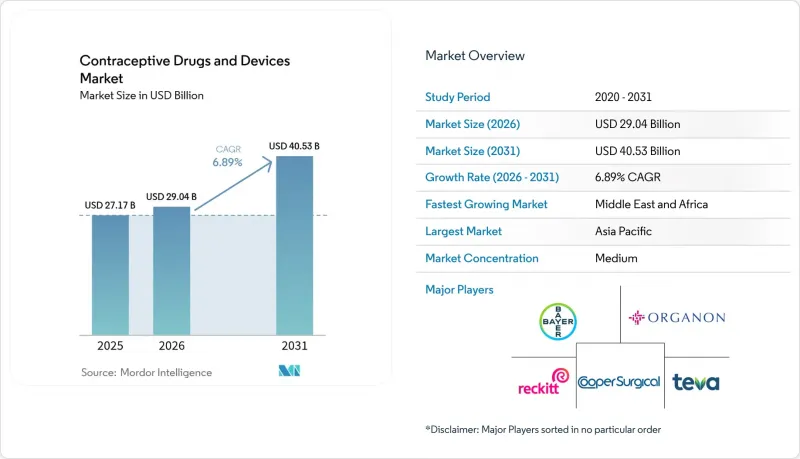
Mordor Intelligence에 의하면, 피임약 및 피임기구 시장 규모는 2025년 271억 7,000만 달러에서 2026년에는 290억 4,000만 달러에 이르고, 2026-2031년 CAGR 6.89%로 성장을 지속하여 2031년에는 405억 3,000만 달러에 달할 것으로 예측됩니다.
본 보고서는 제품 유형(의약품(경구 피임약 등) 및 피임 기구(장벽법 등)), 호르몬 분류(호르몬계 및 비호르몬계), 성별(남성 및 여성), 연령대(15-24세, 25-34세 및 그 이상), 판매 채널(병원 약국, 온라인 채널 등), 지역(북미, 유럽 등)별로 분류되어 있습니다. 시장 규모 및 전망은 금액(달러)으로 표시되어 있습니다.
전 세계 피임약 및 피임기구 시장 동향과 인사이트
장기 작용형 가역 피임법(LARCs)의 이용 확대
LARCs는 99% 이상의 유효성을 자랑하며, 사용상의 실수를 대폭 줄여주기 때문에 임상의들 사이에서 첫 번째 선택으로 권장되고 있습니다. 산후 직후 삽입에 대한 메디케이드의 별도 환급과 같은 정책 전환으로 인해 이용률은 0.74퍼센트 포인트 상승했습니다. 1상 임상시험 단계에 있는 생분해성 임플란트에 대한 혁신은 제거 시술의 필요성을 없애는 것을 목표로 하고 있습니다. 단기 작용형 경구 피임약에서 LARCs로의 전환이 미미하더라도 의도파관 않은 임신율이 감소하므로, 지불자 측에는 비용 절감 효과가 발생하여 지불자의 지지가 강화되고 있습니다. 이러한 요인들이 결합되어 피임약 및 피임기구 시장은 구조적으로 높은 성장 궤도를 유지하고 있습니다.
보상 이니셔티브의 확대와 접근성 및 인지도 제고 프로그램의 연계
2025 회계연도 미국 타이틀 X(Title X) 예산은 3억 9,000만 달러(전년 대비 36% 증가)로, 저소득층에 대한 보조금 지원 접근 범위가 확대되고 있습니다. 그 밖의 14개 주 정부도 예산 배정을 유지하거나 확대하여, 그 총액은 3,530만 달러에 달했습니다. 브리티시컬럼비아주의 전역에 걸친 무료 피임 정책은 비용 장벽이 제거될 때 이용량이 어떻게 증가하는지를 보여주고 있지만, 기존 서비스 제공업체들은 수익 모델을 재검토해야 하는 상황에 직면해 있습니다. 바이엘(Bayer)의 ‘Your Life’나 UNFPA 인도와의 제휴와 같은 디지털 파트너십은 교육과 공급을 융합하여 저·중소득 국가에서의 보급률을 더욱 높이고 있습니다. 이러한 노력들은 종합적으로 볼 때 현대적 피임법의 보급률을 향상시키고, 피임약 및 피임기구 시장의 확장을 지속시키고 있습니다.
피임법 도입에 따른 문화적·종교적 장벽
사우디아라비아에서는 피임기구 미사용 이유의 37%, 나이지리아에서는 42%, 파키스탄에서는 28%가 종교적 반대 때문입니다. 종교적 영향이 강한 국가들에서는 피임기구 보급률이 비슷한 소득 수준의 다른 국가들에 비해 18포인트 낮습니다. 인디애나주 메디케이드의 IUD(자궁 내 피임 기구)에 대한 제한 등의 정책 사례는 이러한 장벽이 제도화되어 있음을 보여줍니다. 모잠비크의 주별 격차는 지역별 미묘한 차이를 여실히 드러내고 있습니다(contraceptionmedicine.biomedcentral.com). 각 제조업체들은 거부감을 완화하고 피임약 및 피임기구 시장의 성장 궤도를 유지하기 위해 종교 지도자들과의 협력을 강화하고 지역 사회에 대한 홍보 활동을 전개하고 있습니다.
부문 분석
2025년 매출액 중 피임 기구가 64.92%를 차지하며, 피임약·기구 시장에서 가장 큰 점유율을 기록하고 있습니다. 이는 IUD나 임플란트의 유효성이 99% 이상인 데 기인합니다. 생분해성 임플란트와 장기 작용형 호르몬 IUD의 보급이 확대됨에 따라, 이 부문은 연평균 6.15%의 성장률을 보이고 있습니다. 또한, 호르몬 IUD는 과다 출혈 치료에도 효과적이어서 임상적 매력이 높아지고 있습니다. ‘오바프렌(Ovaprene)’과 같은 신흥 비호르몬 계열 기기는 부작용을 우려하는 계층을 대상으로 하고 있습니다.
2025년에는 약물 기반 제품이 나머지 35.08%를 차지했으나, 향후 더 빠른 성장이 예상됩니다. 그럼에도 불구하고 72시간 유효 기간에 대한 인지도가 높아지고 있는 시장에서 응급 피임약 시장 규모는 확대되고 있습니다. 2024년 3월 ‘Opill’이 FDA로부터 OTC(일반의약품) 판매 승인을 받음에 따라, 처방전이 필요하다는 장벽이 제거되어 피임약 판매량이 회복될 가능성이 있습니다.
호르몬 기반 피임법은 매출의 60.75%를 차지하고 있지만, 비호르몬 기반 대안 수단은 연평균 8.61%의 성장률을 기록하며 피임약 및 피임 기구 시장 전체의 연평균 성장률(CAGR)을 크게 상회하고 있습니다. 사용자들이 호르몬이 포함되지 않은 대안을 찾으면서 구리제 IUD에 대한 수요도 증가하고 있습니다. 초기 연구에서 나타난 오바프렌의 86-91%에 달하는 유효성은 그 상업적 전망이 밝음을 시사합니다.
저용량 호르몬계 신제품은 유효성을 유지하면서 전신에 미치는 영향을 줄이는 것을 목표로 하고 있습니다. 한편, 게이츠 재단이 비호르몬 계열 연구 개발에 연간 2억 8,000만 달러를 지원하기로 한 것은 투자자들의 확신을 뒷받침하는 것입니다. 이러한 자금 유입으로 인해 비호르몬 계열 솔루션을 위한 피임약 및 피임 기구 시장 규모가 확대될 것으로 예측됩니다.
지역별 분석
북미에서는 2025년에 3억 9,000만 달러의 타이틀 X 자금이 투입될 뿐만 아니라, 처방전이라는 장벽을 없앤 일반의약품(OTC) 제품 ‘Opill’이 출시되는 등, 풍부한 보험 환급 혜택을 누리고 있습니다. 그러나 ‘프로젝트 2025’와 같은 조치로 인해 4,800만 명의 여성에게 제공되던 무료 응급 피임약 공급이 제한될 우려가 있어 정책적 불확실성이 발생하고 있습니다.
아시아태평양은 33.05%의 점유율을 차지하며, 이 지역 내에서 가장 중요한 위치를 차지하고 있지만, 지역 내 격차는 여전히 존재합니다. 방글라데시에서는 임신을 피하고자 하는 여성 중 LARCs(장기 작용형 피임법)를 이용하는 비율이 고작 20.2%에 그치고 있어, 성장 여지가 크다는 점이 부각되고 있습니다. 디지털 유통과 보험 적용 범위 확대를 통해 이러한 격차는 축소될 것으로 예측됩니다.
중동 및 아프리카의 2031년까지 연평균 성장률(CAGR) 8.54%는 자금 조달 및 인식 제고 활동의 강화에 기인한 것으로, 예를 들어 잠비아에서는 2026년까지 보급률을 40%로 끌어올릴 계획이 있습니다. 우간다의 청년 대상 조사에 따르면, 장벽이 완화된다면 72.4%가 피임 방법을 이용하고 싶다고 생각하는 것으로 나타났습니다.
유럽의 성숙한 시장에서는 피임 방법의 구성이 다양해지는 가운데 꾸준한 성장이 나타나고 있습니다. 호르몬제 사용률은 남부의 28%에서 북부의 54%까지 폭이 넓습니다. 2024년 유럽의약품청(EMA)이 3가지 제제를 승인함에 따라 제품 갱신 주기가 유지되고 있습니다.
남미에서는 무료 장기 작용형 피임법(LARCs)이 지속적인 사용을 촉진하고 있어 견조한 수요가 나타나고 있습니다. 브라질에서는 LNG IUD의 24개월 시점 지속 사용률이 82.1%로 보고되어, 공공 부문 조달 전략의 유효성이 입증되었습니다.
기타 혜택:
- 엑셀 형식 시장 예측(ME) 시트
- 3개월간의 애널리스트 지원
자주 묻는 질문
목차
제1장 서론
제2장 조사 방법
제3장 주요 요약
제4장 시장 구도
제5장 시장 규모와 성장 예측
제6장 경쟁 구도
제7장 시장 기회와 향후 전망
LSH 26.08.25According to Mordor Intelligence, the contraceptive drugs and devices market size is expected to grow from USD 27.17 billion in 2025 to USD 29.04 billion in 2026 and is forecast to reach USD 40.53 billion by 2031 at 6.89% CAGR over 2026-2031.
This report is Segmented by Product Type (Drugs [Oral Pills and More] and Devices[Barrier Devices and More]), Hormonal Class (Hormonal and Non-Hormonal), Gender (Male and Female), Age Group (15-24 Years, 25-34 Years and More), Distribution Channel (Hospital Pharmacies, Online Channels and More) and Geography (North America, Europe and More). The Market and Forecasts are Provided in Terms of Value (USD).
Global Contraceptive Drugs And Devices Market Trends and Insights
Rising Uptake of Long Acting Reversible Contraceptives
LARCs offer over 99% effectiveness and significantly reduce user error, making them the first-line recommendation among clinicians. Policy shifts such as separate Medicaid reimbursement for immediate postpartum placement lifted utilization by 0.74 percentage points. Innovation surrounding biodegradable implants in Phase 1 trials aims to eliminate the need for removal procedures. Cost savings accrue to payers as even modest migration from short-acting pills to LARCs lowers unintended pregnancy rates, strengthening payer support. Together, these dynamics keep the contraceptive drugs and devices market on a structurally higher growth path.
Expansion of Reimbursement Initiatives Coupled with Access and Awareness Programs
A USD 390 million U.S. Title X budget for 2025-up 36%-broadens subsidized access for low-income users. Fourteen other governments maintained or grew allocations, totaling USD 35.3 million. British Columbia's province-wide free-contraception policy demonstrates the volume lift that occurs when cost barriers are removed, although legacy providers must recalibrate their revenue models. Digital partnerships-such as Bayer's collaborations with Your Life and UNFPA India-blend education and fulfillment, deepening penetration in low- and middle-income countries. These initiatives collectively raise modern-method prevalence and sustain the contraceptive drugs and devices market expansion.
Cultural-Religious Barrier in Adoption of Contraceptives
Religious objections account for 37% of non-use in Saudi Arabia, 42% in Nigeria, and 28% in Pakistan. Countries with strong faith influence post contraceptive prevalence rates 18 points lower than peers of similar income. Policy examples, such as Indiana's Medicaid restrictions on IUDs, illustrate the institutionalization of such barriers. Province-level disparities in Mozambique underline localized nuance contraceptionmedicine.biomedcentral.com. Manufacturers increasingly engage religious leaders and deploy community outreach to soften resistance and protect the contraceptive drugs and devices market trajectory.
Other drivers and restraints analyzed in the detailed report include:
- Technological Advancement and Innovation Pipeline
- Shift to E-commerce for OTC Barrier Products
- Regulatory Issues and Proliferation of Counterfeit Products
For complete list of drivers and restraints, kindly check the Table Of Contents.
Segment Analysis
Devices held 64.92% of 2025 revenue, giving them the largest contraceptive drugs and devices market share, thanks to the more than 99% effectiveness of IUDs and implants. The category is growing at a rate of 6.15% annually, as biodegradable implants and extended-duration hormonal IUDs boost uptake. Hormonal IUDs also treat heavy bleeding, adding clinical appeal. Emerging non-hormonal devices like Ovaprene aim to address the side-effect-conscious segment.
Drug-based products represented the remaining 35.08% in 2025, but are expected to experience faster growth. The contraceptive drugs and devices market size for emergency pills is nevertheless expanding in markets where awareness of the 72-hour window rises. FDA clearance of Opill for OTC sale in March 2024 removes prescription friction and could revive pill volumes.
Hormonal methods controlled 60.75% revenue, yet non-hormonal alternatives are expanding 8.61% yearly, far above the total contraceptive drugs and devices market CAGR. Copper IUD demand is also rising as users seek hormone-free choices. Ovaprene's 86-91% efficacy in early studies suggests a strong commercial outlook.
Lower-dose hormonal innovations seek to mitigate systemic effects while maintaining efficacy. Meanwhile, the Gates Foundation's USD 280 million annual pledge to non-hormonal R&D underscores investor conviction. This funding influx is expected to expand the contraceptive drugs and devices market size for hormone-free solutions.
Complete Report Scope:
- By Product Type
- Drugs
- Oral Pills
- Transdermal Patch
- Injectable Contraceptives
- Emergency Pills
- Devices
- Barrier Devices
- Male Condom
- Female Condom
- Diaphragm
- Cervical Cap
- Contraceptive Sponge
- Long-Acting Reversible
- Hormonal IUD
- Copper IUD
- Sub-dermal Implant
- Vaginal Ring
- Permanent
- Tubal Occlusion Device
- Barrier Devices
- Drugs
- By Hormonal Class
- Hormonal Methods
- Non-Hormonal Methods
- By Gender
- Male
- Female
- By Age Group
- 15-24 Years
- 25-34 Years
- 35-44 Years
- 45+ Years
- By Distribution Channel
- Hospital Pharmacies
- Retail Pharmacies & Drug Stores
- Online Channels
- Geography
- North America
- United States
- Canada
- Mexico
- Europe
- Germany
- United Kingdom
- France
- Italy
- Spain
- Rest of Europe
- Asia-Pacific
- China
- Japan
- India
- Australia
- South Korea
- Rest of Asia-Pacific
- Middle East and Africa
- GCC
- South Africa
- Rest of Middle East and Africa
- South America
- Brazil
- Argentina
- Rest of South America
- North America
Geography Analysis
North America benefits from substantial reimbursement, with USD 390 million Title X funding in 2025 and OTC Opill availability that removes prescription hurdles. Nonetheless, initiatives such as Project 2025 threaten to curtail free emergency contraception for 48 million women, creating policy uncertainty.
The Asia-Pacific region holds the most prominent regional position, with a 33.05% share, yet intra-regional disparities persist, only 20.2% of Bangladeshi women wishing to avoid pregnancy use LARCs, highlighting a sizeable runway. Digital distribution and expanded reimbursement are expected to narrow this gap.
The Middle East & Africa's 8.54% CAGR through 2031 stems from enhanced funding and outreach, such as Zambia's plan to lift prevalence to 40% by 2026. Youth surveys in Uganda reveal 72.4% intend to use contraception once barriers ease.
Europe's mature market posts steady growth amid varied method mixes; hormonal usage ranges from 28% in southern to 54% in northern states. EMA approvals of three formulations in 2024 sustain product refresh cycles.
South America registers solid demand where no-cost LARCs drive adherence; Brazil reports 82.1% continuation for LNG IUDs at 24 months, validating public-sector procurement strategies.
- Bayer
- Organon
- Pfizer
- Teva Pharmaceutical Industries
- The Cooper Companies
- Reckitt Benckiser Group
- Church & Dwight
- Abbvie
- Agile Therapeutics Inc.
- Viatris
- Gedeon Richter Plc
- Glenmark Pharmaceuticals
- Cipla
- Pregna International Ltd
- Mayer Laboratories
- HLL Lifecare
- Karex Berhad
- Church & Dwight
- Okamoto Industries Inc.
- Femcap Inc.
- Amneal Pharmaceuticals
Additional Benefits:
- The market estimate (ME) sheet in Excel format
- 3 months of analyst support
TABLE OF CONTENTS
1 Introduction
- 1.1 Study Assumptions and Market Definition
- 1.2 Scope of the Study
2 Research Methodology
3 Executive Summary
4 Market Landscape
- 4.1 Market Overview
- 4.2 Market Drivers
- 4.2.1 Rising Uptake of Long Acting Reversible Contraceptives
- 4.2.2 Expansion Reimbursement Initiatives Coupled with Access and Awarness Programs
- 4.2.3 Technological Advancement and Innovation pipeline
- 4.2.4 Shift to e-commerce for OTC barrier products
- 4.2.5 Rising Awareness of Family Planning and Sexual Health
- 4.2.6 Rising Global Population and Unintended Pregnancy
- 4.3 Market Restraints
- 4.3.1 Cultural-religious Barrier in Adoption of Contraceptives
- 4.3.2 Side Effects, Risk Factors Associated with Contraceptives
- 4.3.3 Regulatory Issues and Proliferation of counterfeit Products
- 4.3.4 High Upfront Cost of devices coupled with Limited Access in Rural and Low Income Regions
- 4.4 Value / Supply-Chain Analysis
- 4.5 Regulatory and Technological Outlook
- 4.6 Porter's Five Forces Analysis
- 4.6.1 Bargaining Power of Suppliers
- 4.6.2 Bargaining Power of Buyers
- 4.6.3 Threat of New Entrants
- 4.6.4 Threat of Substitutes
- 4.6.5 Intensity of Competitive Rivalry
5 Market Size and Growth Forecasts (Value-USD)
- 5.1 By Product Type
- 5.1.1 Drugs
- 5.1.1.1 Oral Pills
- 5.1.1.2 Transdermal Patch
- 5.1.1.3 Injectable Contraceptives
- 5.1.1.4 Emergency Pills
- 5.1.2 Devices
- 5.1.2.1 Barrier Devices
- 5.1.2.1.1 Male Condom
- 5.1.2.1.2 Female Condom
- 5.1.2.1.3 Diaphragm
- 5.1.2.1.4 Cervical Cap
- 5.1.2.1.5 Contraceptive Sponge
- 5.1.2.2 Long-Acting Reversible
- 5.1.2.2.1 Hormonal IUD
- 5.1.2.2.2 Copper IUD
- 5.1.2.2.3 Sub-dermal Implant
- 5.1.2.2.4 Vaginal Ring
- 5.1.2.3 Permanent
- 5.1.2.3.1 Tubal Occlusion Device
- 5.1.2.1 Barrier Devices
- 5.1.1 Drugs
- 5.2 By Hormonal Class
- 5.2.1 Hormonal Methods
- 5.2.2 Non-Hormonal Methods
- 5.3 By Gender
- 5.3.1 Male
- 5.3.2 Female
- 5.4 By Age Group
- 5.4.1 15-24 Years
- 5.4.2 25-34 Years
- 5.4.3 35-44 Years
- 5.4.4 45+ Years
- 5.5 By Distribution Channel
- 5.5.1 Hospital Pharmacies
- 5.5.2 Retail Pharmacies & Drug Stores
- 5.5.3 Online Channels
- 5.6 Geography
- 5.6.1 North America
- 5.6.1.1 United States
- 5.6.1.2 Canada
- 5.6.1.3 Mexico
- 5.6.2 Europe
- 5.6.2.1 Germany
- 5.6.2.2 United Kingdom
- 5.6.2.3 France
- 5.6.2.4 Italy
- 5.6.2.5 Spain
- 5.6.2.6 Rest of Europe
- 5.6.3 Asia-Pacific
- 5.6.3.1 China
- 5.6.3.2 Japan
- 5.6.3.3 India
- 5.6.3.4 Australia
- 5.6.3.5 South Korea
- 5.6.3.6 Rest of Asia-Pacific
- 5.6.4 Middle East and Africa
- 5.6.4.1 GCC
- 5.6.4.2 South Africa
- 5.6.4.3 Rest of Middle East and Africa
- 5.6.5 South America
- 5.6.5.1 Brazil
- 5.6.5.2 Argentina
- 5.6.5.3 Rest of South America
- 5.6.1 North America
6 Competitive Landscape
- 6.1 Market Concentration
- 6.2 Market Share Analysis
- 6.3 Company Profiles (includes Global level Overview, Market level overview, Core Segments, Financials as available, Strategic Information, Market Rank/Share for key companies, Products and Services, and Recent Developments)
- 6.3.1 Bayer AG
- 6.3.2 Organon & Co.
- 6.3.3 Pfizer Inc.
- 6.3.4 Teva Pharmaceutical Industries Ltd
- 6.3.5 CooperSurgical Inc.
- 6.3.6 Reckitt Benckiser Group plc
- 6.3.7 Church & Dwight Co. Inc.
- 6.3.8 AbbVie Inc. (Allergan)
- 6.3.9 Agile Therapeutics Inc.
- 6.3.10 Viatris
- 6.3.11 Gedeon Richter Plc
- 6.3.12 Glenmark Pharmaceuticals Ltd
- 6.3.13 Cipla Ltd
- 6.3.14 Pregna International Ltd
- 6.3.15 Mayer Laboratories Inc.
- 6.3.16 HLL Lifecare Ltd
- 6.3.17 Karex Berhad
- 6.3.18 Church & Dwight Co. Inc.
- 6.3.19 Okamoto Industries Inc.
- 6.3.20 Femcap Inc.
- 6.3.21 Amneal Pharmaceuticals LLC
7 Market Opportunities and Future Outlook
- 7.1 White-Space and Unmet-Need Assessment