|
시장보고서
상품코드
2113597
인도의 사료용 종자 : 시장 점유율 분석, 업계 동향 및 통계, 성장 예측(2026-2031년)India Forage Seed - Market Share Analysis, Industry Trends & Statistics, Growth Forecasts (2026 - 2031) |
||||||
 Mordor Intelligence
인도의 사료용 종자 시장 규모는 2025년 4억 8,000만 달러에서 2026년에는 5억 1,854만 달러에 이르고, 2026-2031년 CAGR 8.03%로 성장을 지속하여 2031년까지 7억 6,283만 달러에 달할 것으로 예측됩니다.
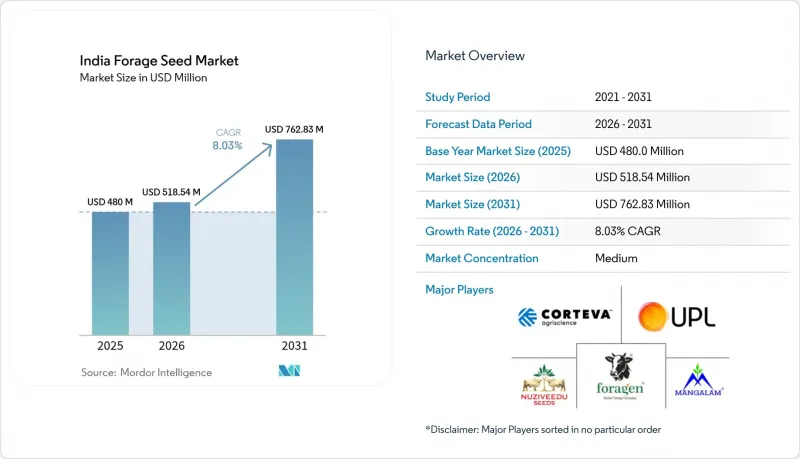
본 보고서는 육종 기술(하이브리드, 개방 수분 품종, 하이브리드 파생 품종) 및 작물(알팔파, 사료용 옥수수, 사료용 수수, 기타 사료 작물)별로 분류되어 있습니다. 시장 전망은 금액(달러) 기준으로 제시되어 있습니다.
인도의 사료용 종자 시장 동향 및 인사이트
가축 사육 두수 증가
인도의 소 사육 두수는 지속적인 동물 위생 프로그램으로 인해 분만율이 향상되고 일일 건물 섭취량이 증가함에 따라 2025년에는 3억 750만 마리에 달할 것으로 예상되며, 이는 인도의 사료용 종자 시장을 확대시키고 있습니다. 젖소 1마리가 늘어날 때마다 하루 약 15kg의 건물이 필요하기 때문에 에너지와 단백질 요구량의 균형이 잡힌, 여러 번 수확이 가능한 수수나 콩과 작물을 혼합한 사료에 대한 즉각적인 수요가 발생하고 있습니다. 우타르프라데시 주만 해도 전국 우유 생산량의 16.21%를 차지하고 있어, 인증 사료용 종자에 대한 수요가 집중되는 거점이 되고 있습니다. ‘국가 가축 미션’에 따른 품종 개량 보조금은 농장 내 사료용 작물 재배를 촉진하고, 고품질 종자의 이용을 더욱 정착시키고 있습니다. ‘국가 가축 미션’이 품종 개량과 사료 확보에 중점을 두고 있는 점은 인증 사료용 종자 생산 이니셔티브를 통해 이 시장의 확장을 직접적으로 뒷받침하고 있습니다.
유제품 및 육류 제품에 대한 수요 증가
소득 증가와 건강에 대한 인식 제고를 배경으로, 2030년까지 1인당 우유 소비량은 하루 550g에 달할 것으로 예측됩니다. 생우유만 해도 2025년에는 9,100만 메트르톤에 달할 것으로 전망되며, 이에 따라 유제품 업체들은 소화율이 높은 사료에 의존하는 사료 공급 프로그램을 강화할 수밖에 없습니다. 치즈나 요거트 등 가공 유제품으로의 전환에 따라 더 높은 우유 품질 기준이 요구되고 있으며, 이를 위해서는 우수한 사료 영양이 필수적입니다. 한편, 치즈와 요거트 생산 라인이 확대됨에 따라 가공용 우유 소비량은 1억 2,550만 메트르톤으로 증가하고 있으며, 이로 인해 우수한 유지방 함량을 확보하기 위해 콩과 식물이 풍부하게 포함된 사일리지 블렌드의 도입이 촉진되고 있습니다. 도시 지역의 육류 소비, 특히 육계 수요도 증가하고 있어, 생산자들은 도체 품질을 향상시키기 위해 생사료를 도입하도록 권장받고 있습니다. 이러한 추세로 인해 곡물의 지속 가능한 생산성을 뒷받침하기 위해서는 사료의 품질과 공급량을 체계적으로 향상시켜야 합니다.
식용 작물과의 경작 면적 경쟁
최저 지지 가격(MSP)에 따른 인센티브로 인해 농가들은 계속해서 쌀과 밀 재배에 주력하고 있으며, 2024년에는 이 두 작물이 경작 면적의 60% 이상을 차지하여 사료 전용 농지를 압박하고 있습니다. 펀자브 주에서는 사일리지용 여름 옥수수의 수익성이 매력적이지만, 지하수 양수량이涵養량을 1,066만 에이커피트 이상과하여 장기적인 지속가능성이 위협받고 있습니다. 에탄올 혼합 목표에 따라 사탕수수, 쌀, 옥수수가 연료 생산으로 전용되면서 추가적인 경쟁이 발생하고 있습니다. 또한, 수확량 감소에 따른 정부의 설탕 및 쌀 수출 규제가 토지 배분 결정에 영향을 미치고 있습니다. 전체 작물에 대한 최저 지지 가격(MSP) 보장에 드는 추정 비용이 23억 8,000만 달러(21,000 카롤 루피)인 점을 고려할 때, 단기적으로는 사료 작물에 대한 지원을 확대할 재정적 여력이 제한적일 것으로 보입니다.
부문 분석
2025년, 인도의 사료용 종자 시장에서 하이브리드 품종은 68.40%의 점유율을 차지했습니다. 강력한 잡종 우세 덕분에 바이오매스가 25-40% 증가하여, 사료 전환율 최적화를 추구하는 전문 낙농장에 결정적인 우위를 제공합니다. 이러한 뛰어난 성능 덕분에 매년 지속적인 구매가 보장되며, 인도의 사료용 종자 시장에서 하이브리드 품종 시장 규모는 가장 빠르게 성장하는 부문으로 확대되고 있습니다. 수요의 대부분은 펀자브주, 하리야나주, 구자라트주에 집중되어 있으며, 이 지역에서는 관개 덕분에 농가들이 하이브리드 네이피어그래스와 사료용 옥수수의 다회 수확 주기를 활용할 수 있습니다. 바이엘이나 신젠타와 같은 기업들은 잡초 관리를 간소화하는 제초제 패키지를 종자와 함께 제공함으로써 하이브리드 품종에 대한 충성도를 공고히 하고 있습니다.
나머지 시장은 개방 수분 품종과 하이브리드 파생 품종이 차지하고 있으며, 이들은 현재 2031년까지 연평균 성장률(CAGR) 10.35%라는 가장 빠른 성장세를 보이고 있습니다. 종자 보존의 가능성은 강우에 의존하는 지역에서 자원이 제한된 농가들로부터 지지를 받고 있으며, 계절에 관계없이 활용할 수 있을 뿐만 아니라 현금 지출을 줄여줍니다. 인도농업연구위원회(ICAR)가 개발 중인 품종은 합리적인 가격에 단백질 함량이 1-2퍼센트 포인트 향상된 개방 수분 품종을 제공하여, 가정 텃밭에서 자급자족하는 농업의 영양 부족 해소에 기여하고 있습니다. 지역 사회의 종자 은행과 결합하여, 이러한 품종은 정규 시장으로의 보급을 확대하고, 농가 집단 간 기술 접근성을 균형 있게 조정하고 있습니다.
기타 혜택:
- 엑셀 형식 시장 예측(ME) 시트
- 3개월간의 애널리스트 지원
자주 묻는 질문
목차
제1장 서론
제2장 조사 방법
제3장 주요 요약
제4장 시장 구도
제5장 시장 규모와 성장 예측
제6장 경쟁 구도
제7장 시장 기회와 향후 전망
LSH 26.08.25According to Mordor Intelligence, the India forage seed market size is expected to grow from USD 480.0 million in 2025 to USD 518.54 million in 2026 and is forecast to reach USD 762.83 million by 2031 at 8.03% CAGR over 2026-2031.
This report is Segmented by Breeding Technology (Hybrids, Open-Pollinated Varieties, and Hybrid Derivatives) and by Crop (Alfalfa, Forage Corn, Forage Sorghum, and Other Forage Crops). The Market Forecasts are Provided in Terms of Value (USD).
India Forage Seed Market Trends and Insights
Growing Livestock Population
India's cattle herd climbs to 307.5 million head in 2025 as sustained animal health programs improve calving rates, lifting daily dry-matter requirements and enlarging the Indian forage seed market . Each additional dairy animal requires approximately 15 kg of dry matter daily, creating an immediate demand for multi-cut sorghum and legume mixes that balance energy and protein needs. Uttar Pradesh alone contributes 16.21% of national milk output, forming a concentrated demand hub for certified forage seed . Breed-improvement grants within the National Livestock Mission stimulate on-farm fodder plots, further embedding quality seed use. The National Livestock Mission's focus on breed development and feed availability directly supports this expansion through certified fodder seed production initiatives.
Rising Demand for Dairy and Meat Products
Per-capita milk intake is projected to reach 550 g per day by 2030, underpinned by income growth and health awareness. Fluid milk alone is forecast to reach 91 million metric tons in 2025, forcing dairies to intensify their feeding programs, which hinge on high-digestibility forages. The shift toward processed dairy products, including cheese and yogurt, requires higher milk quality standards that depend on superior forage nutrition. Meanwhile, factory-use milk climbs toward 125.5 million metric tons as cheese and yogurt lines expand, spurring uptake of legume-rich silage blends for superior butterfat levels. Urban meat consumption also rises, particularly broiler demand, encouraging growers to incorporate fresh forage to enhance carcass quality. This trajectory necessitates systematic improvements in forage quality and availability to support the sustainable productivity of grains.
Competition with Food Crops for Acreage
Minimum Support Price (MSP) incentives keep farmers centered on rice and wheat together, they captured more than 60% of field acreage in 2024, crowding out dedicated fodder plots. Summer maize for silage shows attractive margins in Punjab, yet groundwater extraction surpasses recharge by 10.66 MAF (Million Acre Feet), jeopardizing long-term viability. Ethanol blending targets create additional competition as sugarcane, rice, and maize are diverted for fuel production, with government restrictions on sugar and rice exports due to lower yields affecting land allocation decisions. The estimated cost of guaranteeing MSP (Minimum Support Price) across all crops at USD 2.38 billion (INR 21,000 crore ) suggests limited fiscal space for expanding support to forage crops in the near term.
Other drivers and restraints analyzed in the detailed report include:
- Advancements in Forage-Crop Genetics
- Government Fodder-Security Schemes
- Digitization of Seed Distribution Networks
- High Input Costs of Hybrid Seeds
For complete list of drivers and restraints, kindly check the Table Of Contents.
Segment Analysis
Hybrid varieties contributed 68.40% of the India forage seed market share in 2025. Robust heterosis yields an additional 25-40% biomass, providing a decisive edge for professional dairies optimizing feed conversion. Strong performance secures repeated annual purchases, ensuring the India forage seed market size for hybrids climbs at the fastest-growing segment. Most demand concentrates in Punjab, Haryana, and Gujarat, where irrigation lets farmers exploit multi-cut cycles for hybrid Napier and forage corn. Firms such as Bayer and Syngenta complement seed with herbicide packages that simplify weed management, embedding hybrid loyalty.
Open-pollinated varieties and hybrid derivatives captured the remainder and are now exhibiting the swiftest expansion at a 10.35% CAGR through 2031. Seed-saving potential resonates with resource-constrained farmers in rain-fed areas, extending utility across seasons and reducing cash expenditures. The Indian Council of Agricultural Research (ICAR) pipeline supplies affordable, open-pollinated lines with protein gains of 1-2 percentage points, helping to close nutrition gaps in backyard dairies. Coupled with community seed banks, these varieties expand formal market penetration and balance access to technology across farm segments.
Complete Report Scope:
- By Breeding Technology
- Hybrids
- Non-Transgenic Hybrids
- Transgenic Hybrids
- Herbicide-Tolerant Hybrids
- Other Traits
- Open-Pollinated Varieties and Hybrid Derivatives
- Hybrids
- By Crop
- Alfalfa
- Forage Corn
- Forage Sorghum
- Other Forage Crops
List of Companies Covered in this Report:
- Advanta Seeds International (UPL Limited)
- Corteva Agriscience
- Bayer AG
- Nuziveedu Seeds Limited
- Mahyco Private Limited
- Mangalam Seeds Ltd
- Syngenta AG
- Bioseed Research India Pvt Ltd
- Kaveri Seed Company Ltd
- Foragen Seeds Pvt Ltd
- JK Agri Genetics Ltd
- Rasi Seed Pvt Ltd
- Proline Seeds Company Ltd
- Shriram Seeds Pvt Ltd
- Vibha Agrotech Ltd
Additional Benefits:
- The market estimate (ME) sheet in Excel format
- 3 months of analyst support
TABLE OF CONTENTS
1 Introduction
- 1.1 Study Assumptions and Market Definition
- 1.2 Scope of the Study
2 Research Methodology
3 Executive Summary
4 Market Landscape
- 4.1 Market Drivers
- 4.1.1 Growing livestock population
- 4.1.2 Rising demand for dairy and meat products
- 4.1.3 Advancements in forage-crop genetics
- 4.1.4 Government fodder-security schemes
- 4.1.5 Digitization of seed distribution networks
- 4.1.6 Climate-resilient forage varieties uptake
- 4.2 Market Restraints
- 4.2.1 Competition with food crops for acreage
- 4.2.2 High input costs of hybrid seeds
- 4.2.3 Fragmented last-mile cold-chain for seeds
- 4.2.4 Low seed-replacement rate among smallholders
- 4.3 Regulatory Landscape
- 4.4 Technological Outlook
- 4.5 Porter's Five Forces Analysis
- 4.5.1 Bargaining Power of Suppliers
- 4.5.2 Bargaining Power of Buyers
- 4.5.3 Threat of New Entrants
- 4.5.4 Threat of Substitutes
- 4.5.5 Intensity of Competitive Rivalry
5 Market Size and Growth Forecasts (Value)
- 5.1 By Breeding Technology
- 5.1.1 Hybrids
- 5.1.1.1 Non-Transgenic Hybrids
- 5.1.1.2 Transgenic Hybrids
- 5.1.1.2.1 Herbicide-Tolerant Hybrids
- 5.1.1.2.2 Other Traits
- 5.1.2 Open-Pollinated Varieties and Hybrid Derivatives
- 5.1.1 Hybrids
- 5.2 By Crop
- 5.2.1 Alfalfa
- 5.2.2 Forage Corn
- 5.2.3 Forage Sorghum
- 5.2.4 Other Forage Crops
6 Competitive Landscape
- 6.1 Market Concentration
- 6.2 Strategic Moves
- 6.3 Market Share Analysis
- 6.4 Company Profiles (Includes Global Level Overview, Market Level Overview, Core Segments, Financials as Available, Strategic Information, Market Rank/Share for Key Companies, Products and Services, and Recent Developments)
- 6.4.1 Advanta Seeds International (UPL Limited)
- 6.4.2 Corteva Agriscience
- 6.4.3 Bayer AG
- 6.4.4 Nuziveedu Seeds Limited
- 6.4.5 Mahyco Private Limited
- 6.4.6 Mangalam Seeds Ltd
- 6.4.7 Syngenta AG
- 6.4.8 Bioseed Research India Pvt Ltd
- 6.4.9 Kaveri Seed Company Ltd
- 6.4.10 Foragen Seeds Pvt Ltd
- 6.4.11 JK Agri Genetics Ltd
- 6.4.12 Rasi Seed Pvt Ltd
- 6.4.13 Proline Seeds Company Ltd
- 6.4.14 Shriram Seeds Pvt Ltd
- 6.4.15 Vibha Agrotech Ltd