|
시장보고서
상품코드
2113599
아시아태평양의 서비스 로봇 시장 : 점유율 분석, 업계 동향과 통계, 성장 예측(2026-2031년)Asia-Pacific Service Robots - Market Share Analysis, Industry Trends & Statistics, Growth Forecasts (2026 - 2031) |
||||||
 Mordor Intelligence
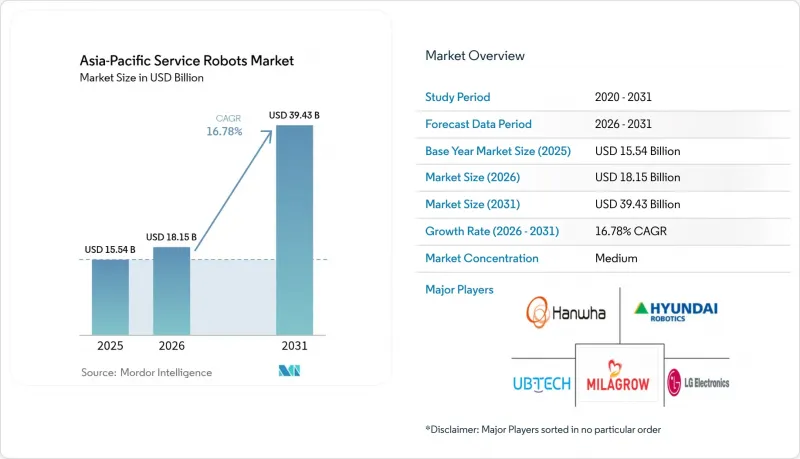
아시아태평양 서비스 로봇 시장 규모는 2026년에 181억 5,000만 달러로 추정되고 있어 2025년 155억 4,000만 달러에서 확대해, 2031년에는 394억 3,000만 달러에 이를 것으로 예측됩니다.
2026년부터 2031년까지 연평균 성장률(CAGR)은 16.78%를 나타낼 것으로 전망됩니다.
본 보고서는 로봇의 유형(산업용 로봇, 개인용 로봇), 용도(군 및 방위, 농업, 건설 및 광업 등), 구성 요소(하드웨어, 소프트웨어, 서비스), 운용 환경(지상, 공중, 해상), 이동 방식(이동형 로봇, 고정형 로봇) 및 국가별로 분류되어 있습니다. 시장 전망은 금액(달러) 기준으로 제시되어 있습니다.
아시아태평양 서비스 로봇 시장 동향과 인사이트
전자상거래의 급성장이 물류용 AMR을 견인
아시아 전역에서 온라인 소매 거래량이 증가하고 있어, 창고 운영 사업자들은 주문 처리 시간을 단축하고 인력 부족을 완화하기 위해 자율 이동 로봇(AMR) 도입을 추진하고 있습니다. 중국의 벤더인 Syrius Robotics는 현지 초과 근무 시간 제한으로 인해 운전기사 확보가 어려워지고 있어, 일본 거점으로 연간 3,000대의 AMR을 출하할 계획입니다. 이는 현재 출하 속도의 10배에 해당합니다. Libiao Robotics의 현지 생산은 니어쇼어 생산이 공급망의 마찰과 수입 관세를 회피하는 방법을 더욱 여실히 보여주고 있습니다. 현재 투자 회수 기간은 평균 2.5년 미만으로, AMR은 중규모 유통업체에게도 현실적인 선택지가 되고 있습니다. 따라서 규제 변화는 수요의 촉매제 역할을 하며, AMR을 아시아태평양 서비스 로봇 시장에서 필수적인 인프라로 변화시키고 있습니다.
고령화에 따른 의료 수요
2025년, 일본 65세 이상 인구 비율은 27.3%에 달할 전망이며, 이에 따라 병원 및 요양 시설에서는 환자의 이동 지원, 기저귀 교환, 투약 관리를 위해 로봇이 도입되고 있습니다. 와세다 대학의 돌봄 로봇 ‘AIREC’은 단순한 감시 기능을 넘어선 고도의 신체 지원 기능을 입증하고 있습니다. 로봇 도입으로 인해 직원의 이직률이 낮아졌으며, 인간적인 배려가 필요한 업무에 인력을 배정할 수 있게 되었습니다. 또한, 식사 자동 운반을 통해 시설 한 곳당 연간 9,596유로(1만 356달러)의 비용 절감이 실현되고 있습니다. 중국이 제정한 돌봄 로봇에 관한 새로운 국제 규격은 국내 공급업체가 전 세계 응용 분야에서 주도권을 잡을 수 있는 기반이 되며, 아시아태평양의 서비스 로봇 시장을 의료 분야의 가치 창출로 가속화하고 있습니다.
도입 및 통합 비용의 고가
하드웨어 가격은 계속 하락하고 있지만(휴머노이드형 로봇의 평균 가격은 2025년에 20,000-3만 달러에 달할 것으로 예측됩니다), 시설 개조나 직원 교육 등의 비용으로 인해 도입에 드는 총 비용은 구매 가격의 2-3배에 달하는 경우가 많습니다. 많은 중소기업의 경우, 자금 면에서의 제약으로 인해 아시아태평양 서비스 로봇 시장에서의 도입이 지연되고 있습니다. 현재 RaaS(Robot as a Service) 공급업체들은 유지보수 및 업데이트를 포함한 구독 모델을 제공하여, 고객이 막대한 초기 비용을 피할 수 있도록 지원하고 있습니다.
부문 분석
2025년 매출의 대부분을 차지한 것은 산업용 로봇으로, 아시아태평양 서비스 로봇 시장 점유율의 68.35%를 차지하고 있습니다. 이러한 선도적 지위는 구체적인 ROI(투자 수익률)에 의해 뒷받침되고 있습니다. AMR(자율 이동 로봇) 도입으로 피킹 시간이 50% 단축되었으며, 전동 외골격은 작업장 내 부상을 줄여줍니다. 옴니채널 소매 및 당일 배송 수요에 힘입어 물류 시스템은 여전히 매출이 가장 높은 하위 부문으로 자리 잡고 있습니다. 의료용 로봇은 외과 수술의 정밀도나 병원 내 물류 분야에서 고가 제품으로 제공되는 반면, 외골격 로봇은 조립 라인에서 중량물 운반 및 피로 문제를 해결하고 있습니다. 고객 응대용 로봇은 호스피탈리티 업계에서 컨시어지 서비스를 제공하고 있으나, 그 보급은 문화적 수용도와 언어의 미묘한 차이에 의해 제한받고 있습니다.
개인용 로봇은 급속히 확대되고 있으며, 2031년까지 연평균 성장률(CAGR)은 18.02%로 예측됩니다. 가정용 청소 로봇이 출하 대수를 주도하고 있으며, 그 일례로 Ecovacs사는 이익률 압박에도 불구하고 2024년 매출이 165억 4,000만 위안(23억 달러)에 달했습니다. 고령화 사회가 수요를 견인하는 가운데, 고령자용 간병 로봇과 웨어러블 지원 기기가 다음 성장의 원동력이 될 전망입니다. 엔터테인먼트용 모델(반려동물을 모티브로 한 로봇 및 STEM 교육 키트)이 이 부문을 마무리하며, 아시아태평양 서비스 로봇 시장 전체에서 롱테일 판매를 촉진하고 있습니다.
2025년 매출액 중 하드웨어가 63.20%를 차지했습니다. 토크 밀도의 향상과 함께 액추에이터는 여전히 가장 비용이 많이 드는 요소이며, 센서 융합으로 인해 LiDAR 및 깊이 카메라의 평균 판매 가격(ASP)이 상승하고 있습니다. 존슨 일렉트릭(Johnson Electric)은 로봇 수요에 연동하여 아시아 내 모션 시스템 매출이 두 자릿수 성장을 기록했다고 보고했습니다.
소프트웨어는 가치 창출의 원동력으로서 그 역할을 확고히 하고 있으며, 2031년까지 연평균 성장률(CAGR) 18.70%를 기록할 전망입니다. 클라우드 연결을 통한 오케스트레이션, 지각 알고리즘, 그리고 차량 관리 대시보드를 통해 단순한 하드웨어가 적응성이 뛰어난 솔루션으로 변모하고 있습니다. 오므론은 2027년까지 데이터 솔루션 매출을 1,000억 엔(6억 8,200만 달러) 이상으로 확대하는 것을 목표로 하고 있으며, 이는 벤더에서 플랫폼 오케스트레이터로의 전환을 상징합니다. 서비스 및 유지보수, 분석, 교육은 아시아태평양의 서비스 로봇 시장에서 지속적인 수익을 창출하고 있습니다.
기타 혜택:
- 엑셀 형식 시장 예측(ME) 시트
- 3개월간의 애널리스트 지원
자주 묻는 질문
목차
제1장 서론
제2장 조사 방법
제3장 주요 요약
제4장 시장 구도
제5장 시장 규모와 성장 예측
제6장 경쟁 구도
제7장 시장 기회와 향후 전망
JHS 26.09.03According to Mordor Intelligence, Asia Pacific service robots market size market size in 2026 is estimated at USD 18.15 billion, growing from 2025 value of USD 15.54 billion with 2031 projections showing USD 39.43 billion, growing at 16.78% CAGR over 2026-2031.
This report is Segmented by Robots Type (Professional Robots, and Personal Robots), Application (Military and Defense, Agriculture, Construction and Mining, and More), Component (Hardware, Software, and Services), Operating Environment (Ground, Aerial, and Marine), Mobility (Mobile Robots, and Stationary Robots), and Country. The Market Forecasts are Provided in Terms of Value (USD).
Asia-Pacific Service Robots Market Trends and Insights
E-commerce boom driving logistics AMRs
Rising online retail volumes across Asia have pushed warehouse operators toward autonomous mobile robots (AMRs) that shrink fulfillment times and mitigate labor shortages. Chinese vendor Syrius Robotics plans to ship 3,000 AMRs annually to Japanese sites-10 times its current run-rate-as local overtime caps restrict driver availability. Localized manufacturing by Libiao Robotics further illustrates how near-shore production sidesteps supply-chain friction and import duties. Payback periods now average under 2.5 years, making AMRs a viable option for mid-sized distributors. Regulatory changes therefore act as a demand catalyst, turning AMRs into essential infrastructure within the Asia Pacific Service Robots Market.
Aging-population healthcare demand
Japan's share of citizens aged 65+ reached 27.3% in 2025, prompting hospitals and care homes to deploy robots for patient lifting, diaper changing and medication logistics. The AIREC caregiving robot from Waseda University showcases advanced physical assistance that surpasses basic monitoring. Robot integration has cut staff turnover and freed personnel for empathy-intensive tasks, while automated meal transport yields EUR 9,596 (USD 10,356) in annual savings per clinic. China's new international standard for elderly-care robots positions domestic suppliers for leadership in global applications, accelerating the Asia-Pacific service robots market toward healthcare value creation.
High installation and integration cost
Although hardware prices keep falling-the average humanoid is projected to reach USD 20,000-30,000 in 2025-total integration outlays often run two to three times the purchase cost due to site retrofits and staff training. For many SMEs, capital constraints delay adoption in the Asia Pacific Service Robots market. RaaS vendors now offer subscription models covering maintenance and updates, helping customers bypass large upfront expense.
Other drivers and restraints analyzed in the detailed report include:
- Government incentives and Made-in-Asia Pacific programs
- 5G/AI convergence enabling remote autonomy
- Fragmented safety/certification regimes
For complete list of drivers and restraints, kindly check the Table Of Contents.
Segment Analysis
Professional robots generated the bulk of 2025 revenues, holding 68.35% of Asia Pacific Service Robots market share. Their leadership rests on tangible ROI: AMR fleets cut picking time by 50% while powered exoskeletons reduce workplace injuries. Logistics systems remain the highest-revenue subsegment, propelled by omnichannel retail and same-day delivery obligations. Medical robots command premium prices for surgical precision and hospital logistics, whereas exoskeletons address lifting and fatigue issues on assembly lines. Public-relation robots offer concierge services in hospitality but adoption is moderated by cultural acceptance and language nuance.
Personal robots are scaling quickly, posting a 18.02% CAGR forecast through 2031. Domestic cleaning units lead shipments, illustrated by Ecovacs hitting RMB 16.54 billion (USD 2.3 billion) in 2024 revenue despite margin pressure. Elderly-care companions and wearable assistance devices promise the next leg of growth as aging societies drive demand. Entertainment models-pet-inspired bots and STEM education kits-round out the segment, enhancing long-tail sales across the Asia Pacific Service Robots Market.
Hardware captured 63.20% of 2025 revenue. Actuators remain the costliest element as torque density advances, and sensor fusion raises ASPs for LiDAR and depth cameras. Johnson Electric reported double-digit Asian growth in motion systems linked to robotics demand.
Software is cementing its role as the value engine, set to post 18.70% CAGR to 2031. Cloud-connected orchestration, perception algorithms and fleet-management dashboards convert raw hardware into adaptable solutions. OMRON intends to surpass JPY 100 billion (USD 682 million) in data-solution sales by 2027, symbolizing the transition from product vendor to platform orchestrator. Services-maintenance, analytics, training-unlock recurring revenue in the Asia Pacific Service Robots market.
Complete Report Scope:
- By Robots Type
- Professional Robots
- Logistic Systems
- Medical Robots
- Powered Human Exoskeletons
- Public-Relation Robots
- Personal Robots
- Domestic
- Entertainment
- Elderly and Handicap Assistance
- Professional Robots
- By Application
- Military and Defense
- Agriculture, Construction and Mining
- Transportation and Logistics
- Healthcare
- Government
- Other Applications
- By Component
- Hardware
- Actuators
- Sensors
- Controllers
- Software
- Services
- Hardware
- By Operating Environment
- Ground
- Aerial
- Marine
- By Mobility
- Mobile Robots
- Stationary Robots
- By Country
- China
- India
- Japan
- South Korea
- Rest of Asia-Pacific
List of Companies Covered in this Report:
- UBTECH Robotics Inc.
- Ecovacs Robotics Co. Ltd.
- SIASUN Robot and Automation Co. Ltd.
- LG Electronics Inc.
- SoftBank Robotics Corp.
- Omron Corp.
- Hyundai Robotics Co. Ltd.
- Panasonic Holdings - Robotics BU
- DJI Innovations
- Geek+ Robotics Co. Ltd.
- Milagrow HumanTech
- Reeman Intelligent Tech
- Rainbow Robotics Co. Ltd.
- Roborock Technology Co. Ltd.
- UB-Tech (Shanghai) Intelligent
- Yamaha Motor - Robotics BU
- Doosan Robotics Inc.
- Hanwha Robotics
- Keenon Robotics
- TMi Robotics (TMiRob)
Additional Benefits:
- The market estimate (ME) sheet in Excel format
- 3 months of analyst support
TABLE OF CONTENTS
1 INTRODUCTION
- 1.1 Study Assumptions and Market Definition
- 1.2 Scope of the Study
2 RESEARCH METHODOLOGY
3 EXECUTIVE SUMMARY
4 MARKET LANDSCAPE
- 4.1 Market Overview
- 4.2 Market Drivers
- 4.2.1 E-commerce Doom Driving Logistics AMRs
- 4.2.2 Aging-population Healthcare Demand
- 4.2.3 Government Incentives and Made-in-Asia Pacific Programs
- 4.2.4 5G/AI Convergence Enabling Remote Autonomy
- 4.2.5 Humanoid Robots for EV-battery Lines
- 4.2.6 Infrastructure-inspection Robots for Aging Assets
- 4.3 Market Restraints
- 4.3.1 High Installation and Integration Cost
- 4.3.2 Fragmented Safety / Certification Regimes
- 4.3.3 Data-privacy and Cyber-security Concerns
- 4.3.4 Import Dependence on Precision Actuators and Sensors
- 4.4 Industry Value Chain Analysis
- 4.5 Technological Outlook
- 4.6 Regulatory Landscape
- 4.7 Porter's Five Forces Analysis
- 4.7.1 Bargaining Power of Suppliers
- 4.7.2 Bargaining Power of Consumers
- 4.7.3 Threat of New Entrants
- 4.7.4 Intensity of Competitive Rivalry
- 4.7.5 Threat of Substitutes
- 4.8 Assessment of Macro Economic Trends on the Market
5 MARKET SIZE AND GROWTH FORECASTS (VALUES)
- 5.1 By Robots Type
- 5.1.1 Professional Robots
- 5.1.1.1 Logistic Systems
- 5.1.1.2 Medical Robots
- 5.1.1.3 Powered Human Exoskeletons
- 5.1.1.4 Public-Relation Robots
- 5.1.2 Personal Robots
- 5.1.2.1 Domestic
- 5.1.2.2 Entertainment
- 5.1.2.3 Elderly and Handicap Assistance
- 5.1.1 Professional Robots
- 5.2 By Application
- 5.2.1 Military and Defense
- 5.2.2 Agriculture, Construction and Mining
- 5.2.3 Transportation and Logistics
- 5.2.4 Healthcare
- 5.2.5 Government
- 5.2.6 Other Applications
- 5.3 By Component
- 5.3.1 Hardware
- 5.3.1.1 Actuators
- 5.3.1.2 Sensors
- 5.3.1.3 Controllers
- 5.3.2 Software
- 5.3.3 Services
- 5.3.1 Hardware
- 5.4 By Operating Environment
- 5.4.1 Ground
- 5.4.2 Aerial
- 5.4.3 Marine
- 5.5 By Mobility
- 5.5.1 Mobile Robots
- 5.5.2 Stationary Robots
- 5.6 By Country
- 5.6.1 China
- 5.6.2 India
- 5.6.3 Japan
- 5.6.4 South Korea
- 5.6.5 Rest of Asia-Pacific
6 COMPETITIVE LANDSCAPE
- 6.1 Market Concentration
- 6.2 Strategic Moves
- 6.3 Market Share Analysis
- 6.4 Company Profiles (Includes Global-level Overview, Market-level Overview, Core Segments, Financials as available, Strategic Information, Market Rank/Share, Products and Services, Recent Developments)
- 6.4.1 UBTECH Robotics Inc.
- 6.4.2 Ecovacs Robotics Co. Ltd.
- 6.4.3 SIASUN Robot and Automation Co. Ltd.
- 6.4.4 LG Electronics Inc.
- 6.4.5 SoftBank Robotics Corp.
- 6.4.6 Omron Corp.
- 6.4.7 Hyundai Robotics Co. Ltd.
- 6.4.8 Panasonic Holdings - Robotics BU
- 6.4.9 DJI Innovations
- 6.4.10 Geek+ Robotics Co. Ltd.
- 6.4.11 Milagrow HumanTech
- 6.4.12 Reeman Intelligent Tech
- 6.4.13 Rainbow Robotics Co. Ltd.
- 6.4.14 Roborock Technology Co. Ltd.
- 6.4.15 UB-Tech (Shanghai) Intelligent
- 6.4.16 Yamaha Motor - Robotics BU
- 6.4.17 Doosan Robotics Inc.
- 6.4.18 Hanwha Robotics
- 6.4.19 Keenon Robotics
- 6.4.20 TMi Robotics (TMiRob)
7 MARKET OPPORTUNITIES AND FUTURE OUTLOOK
- 7.1 White-space and Unmet-Need Assessment