

|
시장보고서
상품코드
2113611
농장 동물 의료 : 시장 점유율 분석, 업계 동향 및 통계, 성장 예측(2026-2031년)Farm Animal Healthcare - Market Share Analysis, Industry Trends & Statistics, Growth Forecasts (2026 - 2031) |
||||||
 Mordor Intelligence
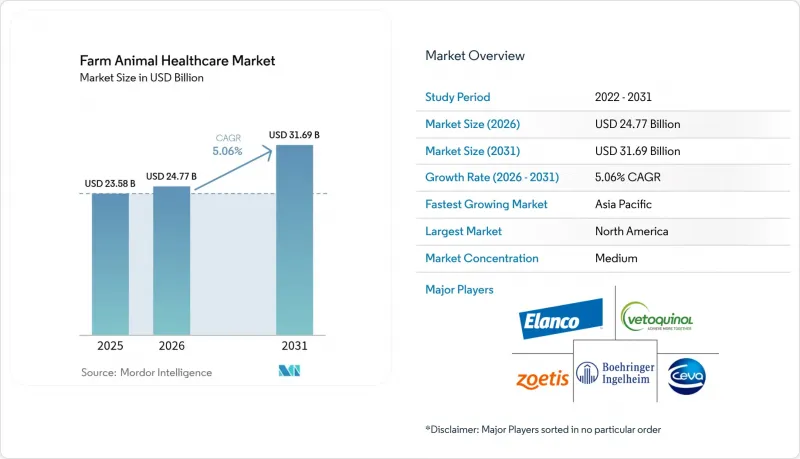
농장 동물 의료 시장 규모는 2025년에 235억 8,000만 달러, 2026년 247억 7,000만 달러에서 2031년까지 316억 9,000만 달러에 이를 것으로 예측되며, 예측 기간(2026년-2031년) CAGR은 5.06%를 기록할 전망입니다.
본 보고서는 제품별(백신, 구충제, 항감염제 등), 동물종별(소, 돼지 등),투여 경로별(경구, 비경구 등), 유통 채널별(동물병원, 동물진료소 등), 지역별(북미, 유럽, 아시아태평양, 중동 및 아프리카, 남미)로 분류되어 있습니다. 시장 예측은 금액(달러) 기준으로 제시되어 있습니다.
전 세계 농장 동물 의료 시장 동향 및 인사이트
첨단 기술이 농장 내 진단을 가속화
휴대용 PCR 장치와 스마트폰용 바이오센서를 통해 축사 내에서 수 분 이내에 병원체를 검출할 수 있게 되었으며, 한국의 KAHIS 플랫폼과 같은 시스템을 통해 집단 발생에 대한 대응 시간이 72시간에서 12시간 미만으로 단축되었습니다. 진단의 신속화는 적시 치료를 촉진하고 손실을 억제하는 동시에, 가축 관리 소프트웨어와 원활하게 연동되는 커넥티드 기기에 대한 수요를 높이고 있습니다. 도입이 가장 두드러지는 지역은 설비 투자 예산과 광대역 보급률이 높은 북미 및 서유럽입니다. 기기 제조업체들은 시약 카트리지와 데이터 구독 서비스를 통해 지속적인 수익을 창출하고 있습니다. 외딴 지역으로의 더 광범위한 확산은 합리적인 가격의 하드웨어와 검사 키트를 위한 견고한 콜드체인 물류에 달려 있습니다.
정부 및 동물 복지 차원의 백신 접종 의무
유럽연합(EU)의 아프리카 돼지열병 대책 프로그램과 미국 농무부(USDA)의 ‘국가 가금류 개량 계획’은 상업 농장에 대해 엄격한 예방접종 일정의 준수를 의무화하고 있습니다. 이러한 규제는 안정적인 백신 수요를 창출하고, 규정 준수에 대한 전문 지식을 갖춘 기업에 유리한 환경을 조성하는 동시에 제네릭 공급업체의 진입 장벽을 높이고 있습니다. 또한 의무화 프로그램은 콜드체인 인프라 및 자동 대량 백신 접종 장치에 대한 투자도 촉진하고 있습니다. 신흥국들도 수출 인증을 확보하기 위해 유사한 정책을 도입하고 있으며, 이로 인해 농장 동물 의료 시장은 더욱 확대되고 있습니다. 그러나 소규모 농가들은 운영 비용이 높기 때문에 규정을 준수하기 위해서는 보조금이나 협동조합 모델이 필요합니다.
위조 의약품 및 규격 미달 의약품
규격 미달 제품은 전 세계 수의약품 공급량의 10-15%를 차지하고 있으며, 이는 농가의 신뢰를 훼손하고 항생제 내성을 조장하고 있습니다. 텍사스주에서 240만 달러 상당의 백신이 압수된 것과 같은 단속 사례는 불법 거래의 규모를 여실히 드러내고 있습니다. 정식 기업들은 일련번호 부여, 블록체인 기반 추적, 인식 제고 캠페인에 투자할 수밖에 없어 운영 비용이 증가하고 있습니다. 신흥 시장은 감독 체계가 미흡하고 국경 관리가 느슨하기 때문에 그 영향을 가장 크게 받고 있습니다. 이로 인해 정식 기업 시장 진입이 지연되고, 가축 건강 관리 시장이 잠재력을 충분히 발휘하지 못하고 있습니다.
부문 분석
백신 부문의 2031년까지 연평균 성장률(CAGR) 7.31%는 예방 중심의 전환을 뒷받침하고 있습니다. 이는 2025년 매출에서 37.02%의 선두를 달리고 있는 항감염제조차도 적정 사용에 대한 압박에 직면해 있기 때문입니다. 농장 동물 의료 시장 규모 확대는 mRNA 플랫폼, 신규 보조제, 그리고 인건비를 절감하는 자동 투여 시스템 덕분입니다. 각 제조업체들은 차별화된 생물학적 제제를 통해 프리미엄 가격을 책정함으로써, 제네릭 항생제로 인한 이익률 하락을 상쇄하고 있습니다. 기생충 구제제는 매개 생물의 범위가 확대되어 방목 가축을 위협하고 있기 때문에 안정적인 성장을 유지하고 있지만, 약용 사료 첨가제는 잔류 기준이 엄격해짐에 따라 수요가 줄어들고 있습니다.
자체 생산 백신은 폭넓은 백신 포트폴리오 내에서 빠르게 확대되고 있습니다. 브라질과 호주의 시설들은 공급망을 단축하고 각 농장에 특화된 병원체에 맞추어 항원을 맞춤 제작함으로써 효능을 높이고 더 높은 가격 책정을 실현하고 있습니다. 항감염제는 차별화를 유지하기 위해 복합제제나 서방형 주사제로 전환되고 있습니다. 진단제 제조업체는 생물제제 공급업체와 제휴하여 가축 건강 관리 패키지를 세트로 판매함으로써, 산업용 동물 건강 관리 시장의 침투를 더욱 촉진하고 있습니다.
2025년, 집약적인 육계 및 산란계 사육 시스템에서 백신 접종 및 생물 보안 프로토콜이 표준화됨에 따라 가금류 부문은 매출 점유율 38.10%를 유지했습니다. 한편, 소 부문은 낙농 업계의 통합과 유방염 및 호흡기 질환의 급격한 악화를 조기에 파악하는 정밀 농업 도구의 확산에 힘입어 연평균 성장률(CAGR) 6.61%로 향후 성장을 주도할 전망입니다. 소용 제품 분야의 산업동물 헬스케어 시장 규모는 웨어러블 센서와 AI 분석을 통해 표적 투약이 가능해지고, 번식 성적이 최적화됨에 따라 확대될 전망입니다.
양돈 농가들은 아프리카 돼지열병의 위험이 여전히 지속되는 상황에 직면해 있으며, 견고한 생물안전 대책과 다가 백신에 대한 투자를 추진하고 있습니다. 양 및 염소의 건강 관리는 여전히 틈새 분야이지만, 건조 지역에서는 기생충 방제 전용 제품이 인기를 얻고 있습니다. 육상 양식업자들이 다각화를 추진하는 가운데, 수산 양식과의 융합 기술이 주목을 받으며, 산업동물 헬스케어 시장은 육상 종을 넘어 확대되고 있습니다.
지역별 분석
북미는 2025년 매출의 42.70%를 차지하고 있으며, 강력한 연구개발(R&D) 생태계, 수의학 서비스에 대한 확립된 보험 환급 제도, 그리고 AI를 활용한 감시 시스템의 조기 도입의 혜택을 받고 있습니다. 그러나 농촌 지역의 만성적인 수의사 부족은 서비스 제공 범위를 위협하고 있으며, 외딴 카운티의 농장 동물 의료 시장 성장을 둔화시킬 가능성이 있습니다. 연방 정부의 대출 면제 프로그램과 이동 진료소 운영은 이러한 격차를 완화하기 위한 것입니다.
아시아태평양은 중국의 대규모 농장 현대화와 인도의 낙농 협동조합 확장에 힘입어 2031년까지 연평균 성장률(CAGR) 6.39%로 성장을 주도할 것입니다. 신청 서류 심사를 효율화하고 국제적 우수 제조 기준(GMP) 인증을 승인하는 규제 개혁으로 인해 시장 진입까지의 기간이 단축되고 있습니다. 그러나 다양한 언어와 통일되지 않은 생물안전 규정이 상업화 전략을 여전히 복잡하게 만들고 있습니다.
유럽에서는 엄격한 동물 복지법과 종합적인 백신 접종 의무 하에서 완만한 성장을 유지하고 있습니다. 생산자들은 수출 시장의 잔류 기준을 충족하기 위해 고품질 생물학적 제제 및 진단제에 투자하고 있습니다. 동유럽 회원국들은 EU 부흥 기금을 콜드체인 물류의 현대화에 투입하여 농장 동물 의료 시장에 대한 접근성을 확대되고 있습니다.
남미, 중동 및 아프리카는 높은 잠재력을 지닌 초기 단계 시장입니다. 브라질과 아르헨티나는 풍토병 균주를 대상으로 한 자체 생산 백신의 생산 능력을 갖추고 있는 반면, 걸프 연안 국가들은 대규모 낙농·양계 사업을 포함한 식량 안보 프로그램에 투자하고 있습니다. 규제 역량의 한계와 위조 제품의 유입은 여전히 장벽으로 남아 있지만, 메르코수르(Mercosur)와 같은 무역 블록 내의 단계적인 규제 조화를 통해 농장 동물 의료 시장 확대를 위한 길이 더욱 명확해지고 있습니다.
기타 혜택:
- 엑셀 형식 시장 예측(ME) 시트
- 3개월간 애널리스트 지원
자주 묻는 질문
목차
제1장 서론
제2장 조사 방법
제3장 주요 요약
제4장 시장 구도
제5장 시장 규모와 성장 예측
제6장 경쟁 구도
제7장 시장 기회와 향후 전망
LSH 26.08.25According to Mordor Intelligence, the farm animal healthcare market size was valued at USD 23.58 billion in 2025 and estimated to grow from USD 24.77 billion in 2026 to reach USD 31.69 billion by 2031, at a CAGR of 5.06% during the forecast period (2026-2031).
This report is Segmented by Product (Vaccines, Parasiticides, Anti-Infectives, and More), Animal Type (Cattle, Swine, and More), Route of Administration (Oral, Parenteral, and More), Distribution Channel (Veterinary Hospitals, Veterinary Clinics, and More), and Geography (North America, Europe, Asia-Pacific, Middle East & Africa, South America). The Market Forecasts are Provided in Terms of Value (USD).
Global Farm Animal Healthcare Market Trends and Insights
Advanced Technology Accelerating On-Farm Diagnostics
Portable PCR units and smartphone biosensors now allow barn-side pathogen detection within minutes, reducing outbreak response time from 72 hours to under 12 hours in systems such as Korea's KAHIS platform. Faster diagnosis drives timely treatment, curbs losses, and lifts demand for connected devices that integrate seamlessly with herd-management software. Adoption is most pronounced in North America and Western Europe where capital budgets and broadband coverage are strong. Device makers enjoy recurring revenue through reagent cartridges and data-subscription services. Wider rollout to remote regions hinges on affordable hardware and robust cold-chain logistics for test kits.
Government and Animal Welfare Vaccination Mandates
The European Union's African Swine Fever program and the USDA National Poultry Improvement Plan obligate commercial farms to follow strict immunization schedules. These rules create steady vaccine demand, favor firms with regulatory compliance expertise, and raise entry barriers for generic suppliers. Mandatory programs also spur investment in cold-chain infrastructure and automated mass-vaccination equipment. Emerging economies mirror these policies to secure export certifications, further enlarging the Farm Animal Healthcare market. However, smallholders face higher operating costs and need subsidies or cooperative models to comply.
Counterfeit and Sub-Standard Medicines
Substandard products account for 10-15% of global veterinary supply, eroding farmer confidence and fostering antimicrobial resistance. Enforcement raids, such as a USD 2.4 million vaccine seizure in Texas, spotlight the scale of illicit trade. Legitimate firms must invest in serialization, blockchain tracking, and education campaigns, raising operating costs. Emerging markets bear the brunt due to limited oversight and porous borders, which slows legitimate market entry and keeps the Farm Animal Healthcare market from achieving its full potential.
Other drivers and restraints analyzed in the detailed report include:
- Growing Threat of Emerging Zoonoses
- Shift Toward Preventive Biologics and Integrated Health Plans
- Rising Costs of Veterinary Services and Testing
For complete list of drivers and restraints, kindly check the Table Of Contents.
Segment Analysis
The vaccine segment's 7.31% CAGR through 2031 underscores a decisive transition to prevention as anti-infectives, despite a 37.02% 2025 revenue lead, face stewardship pressure. Farm Animal Healthcare market size gains stem from mRNA platforms, novel adjuvants, and automated delivery systems that cut labor costs. Manufacturers leverage premium pricing on differentiated biologics, offsetting margins lost to generic antibiotics. Parasiticides keep stable growth as expanding vector ranges threaten grazing herds, while medicinal feed additives face stricter residue rules that trim demand.
Autogenous vaccines expand quickly within the wider vaccine portfolio. Facilities in Brazil and Australia shorten supply chains and customize antigens to farm-specific pathogens, enhancing efficacy and commanding higher prices. Anti-infectives pivot to combination formulations and slow-release injectables to sustain differentiation. Diagnostic manufacturers partner with biologics suppliers to bundle herd-health packages, further boosting Farm Animal Healthcare market penetration.
Poultry maintained a 38.10% revenue share in 2025 as intensive broiler and layer systems standardize vaccination and biosecurity protocols. The cattle segment, however, leads future growth at a 6.61% CAGR, driven by dairy consolidation and precision farming tools that pinpoint mastitis or respiratory flare-ups early. Farm Animal Healthcare market size for cattle products is set to expand as wearable sensors and AI analytics enable targeted dosing and optimize reproductive performance.
Swine producers grapple with persistent African Swine Fever risks, steering investment toward robust biosecurity and multivalent vaccines. Sheep and goat health remains niche, though targeted parasite control products find traction in arid regions. Aquaculture cross-over technologies gain attention as land-based farmers diversify, enlarging the Farm Animal Healthcare market beyond terrestrial species.
Complete Report Scope:
- By Product
- Vaccines
- Parasiticides
- Anti-infectives
- Medicinal Feed Additives
- Other Products
- By Animal Type
- Cattle
- Swine
- Poultry
- Sheep & Goats
- Other Animal Types
- By Route of Administration
- Oral
- Parenteral
- Topical
- Other Route of Administrations
- By Distribution Channel
- Veterinary Hospitals
- Veterinary Clinics
- Pharmacies & Drug Stores
- E-commerce
- On-farm Direct
- Geography
- North America
- United States
- Canada
- Mexico
- Europe
- Germany
- United Kingdom
- France
- Italy
- Spain
- Rest of Europe
- Asia-Pacific
- China
- Japan
- India
- Australia
- South Korea
- Rest of Asia-Pacific
- Middle East & Africa
- GCC
- South Africa
- Rest of Middle East & Africa
- South America
- Brazil
- Argentina
- Rest of South America
- GCC
- North America
Geography Analysis
North America, holding 42.70% revenue in 2025, benefits from strong R&D ecosystems, established reimbursement for veterinary services, and early adoption of AI-based surveillance. Ongoing rural veterinarian shortages, though, threaten service coverage and may temper Farm Animal Healthcare market growth in frontier counties. Federal loan-forgiveness programs and mobile clinic initiatives aim to mitigate the gap.
Asia-Pacific leads growth with a 6.39% CAGR through 2031 as China modernizes mega-farms and India scales dairy cooperatives. Regulatory reforms that streamline dossier reviews and recognize international Good Manufacturing Practice certificates improve market entry timelines. Yet diverse languages and non-uniform biosecurity rules continue to complicate commercialization strategies.
Europe sustains moderate gains under strict welfare legislation and comprehensive vaccination mandates. Producers invest in premium biologics and diagnostics to satisfy export-market residue tolerances. Eastern member states allocate EU recovery funds to upgrade cold-chain logistics, broadening Farm Animal Healthcare market access.
South America and the Middle East and Africa represent high-potential, early-stage markets. Brazil and Argentina deploy autogenous vaccine capacity aimed at endemic strains, while Gulf states invest in food-security programs that include large-scale dairy and poultry ventures. Regulatory capacity constraints and counterfeit-product infiltration remain hurdles yet gradual harmonization under trade blocs such as Mercosur offers a clearer path for Farm Animal Healthcare market expansion.
- Bayer Animal Health
- Bimeda
- Boehringer Ingelheim
- Ceva Sante Animale
- Dechra Pharmaceuticals
- Elanco
- Hester Biosciences
- Huvepharma
- Indian Immunologicals
- Intas Pharmaceuticals
- Merck
- Norbrook
- Ouro Fino Saude Animal
- Phibro Animal Health
- Vetoquinol
- Virbac
- Virbac South Africa
Additional Benefits:
- The market estimate (ME) sheet in Excel format
- 3 months of analyst support
TABLE OF CONTENTS
1 Introduction
- 1.1 Study Assumptions & Market Definition
- 1.2 Scope of the Study
2 Research Methodology
3 Executive Summary
4 Market Landscape
- 4.1 Market Overview
- 4.2 Market Drivers
- 4.2.1 Advanced Technology Accelerating On-Farm Diagnostics
- 4.2.2 Government & Animal-Welfare Vaccination Mandates
- 4.2.3 Growing Threat of Emerging Zoonoses
- 4.2.4 Shift Toward Preventive Biologics & Integrated Health Plans
- 4.2.5 AI-Enabled Real-Time Disease-Surveillance Platforms (Under-The-Radar)
- 4.2.6 Autogenous-Vaccine CDMO Investments In Emerging Markets (Under-The-Radar)
- 4.3 Market Restraints
- 4.3.1 Counterfeit & Sub-Standard Medicines
- 4.3.2 Rising Costs Of Veterinary Services & Testing
- 4.3.3 Acute Rural-Veterinarian Shortage After U.S. FDA GFI-263 (Under-The-Radar)
- 4.3.4 Fragmented Regulatory Harmonisation In Lmics Delaying Launches (Under-The-Radar)
- 4.4 Value / Supply-Chain Analysis
- 4.5 Regulatory Landscape
- 4.6 Technological Outlook
- 4.7 Porter's Five Forces Analysis
- 4.7.1 Threat of New Entrants
- 4.7.2 Bargaining Power of Buyers
- 4.7.3 Bargaining Power of Suppliers
- 4.7.4 Threat of Substitutes
- 4.7.5 Industry Rivalry
5 Market Size & Growth Forecasts (Value, USD)
- 5.1 By Product
- 5.1.1 Vaccines
- 5.1.2 Parasiticides
- 5.1.3 Anti-infectives
- 5.1.4 Medicinal Feed Additives
- 5.1.5 Other Products
- 5.2 By Animal Type
- 5.2.1 Cattle
- 5.2.2 Swine
- 5.2.3 Poultry
- 5.2.4 Sheep & Goats
- 5.2.5 Other Animal Types
- 5.3 By Route of Administration
- 5.3.1 Oral
- 5.3.2 Parenteral
- 5.3.3 Topical
- 5.3.4 Other Route of Administrations
- 5.4 By Distribution Channel
- 5.4.1 Veterinary Hospitals
- 5.4.2 Veterinary Clinics
- 5.4.3 Pharmacies & Drug Stores
- 5.4.4 E-commerce
- 5.4.5 On-farm Direct
- 5.5 Geography
- 5.5.1 North America
- 5.5.1.1 United States
- 5.5.1.2 Canada
- 5.5.1.3 Mexico
- 5.5.2 Europe
- 5.5.2.1 Germany
- 5.5.2.2 United Kingdom
- 5.5.2.3 France
- 5.5.2.4 Italy
- 5.5.2.5 Spain
- 5.5.2.6 Rest of Europe
- 5.5.3 Asia-Pacific
- 5.5.3.1 China
- 5.5.3.2 Japan
- 5.5.3.3 India
- 5.5.3.4 Australia
- 5.5.3.5 South Korea
- 5.5.3.6 Rest of Asia-Pacific
- 5.5.4 Middle East & Africa
- 5.5.4.1 GCC
- 5.5.4.2 South Africa
- 5.5.4.3 Rest of Middle East & Africa
- 5.5.5 South America
- 5.5.5.1 Brazil
- 5.5.5.2 Argentina
- 5.5.5.3 Rest of South America
- 5.5.5.3.1 GCC
- 5.5.1 North America
6 Competitive Landscape
- 6.1 Market Concentration
- 6.2 Market Share Analysis
- 6.3 Company Profiles (includes Global level Overview, Market level overview, Core Segments, Financials as available, Strategic Information, Market Rank/Share for key companies, Products & Services, Recent Developments)
- 6.3.1 Bayer Animal Health
- 6.3.2 Bimeda
- 6.3.3 Boehringer Ingelheim Animal Health
- 6.3.4 Ceva Sante Animale
- 6.3.5 Dechra Pharmaceuticals
- 6.3.6 Elanco
- 6.3.7 Hester Biosciences
- 6.3.8 Huvepharma
- 6.3.9 Indian Immunologicals
- 6.3.10 Intas Pharmaceuticals
- 6.3.11 Merck Animal Health
- 6.3.12 Norbrook
- 6.3.13 Ouro Fino Saude Animal
- 6.3.14 Phibro Animal Health
- 6.3.15 Vetoquinol
- 6.3.16 Virbac
- 6.3.17 Virbac South Africa
7 Market Opportunities & Future Outlook
- 7.1 White-space & Unmet-Need Assessment


