

|
시장보고서
상품코드
2113627
임신 진단 키트 : 시장 점유율 분석, 업계 동향 및 통계, 성장 예측(2026-2031년)Pregnancy Detection Kits - Market Share Analysis, Industry Trends & Statistics, Growth Forecasts (2026 - 2031) |
||||||
 Mordor Intelligence
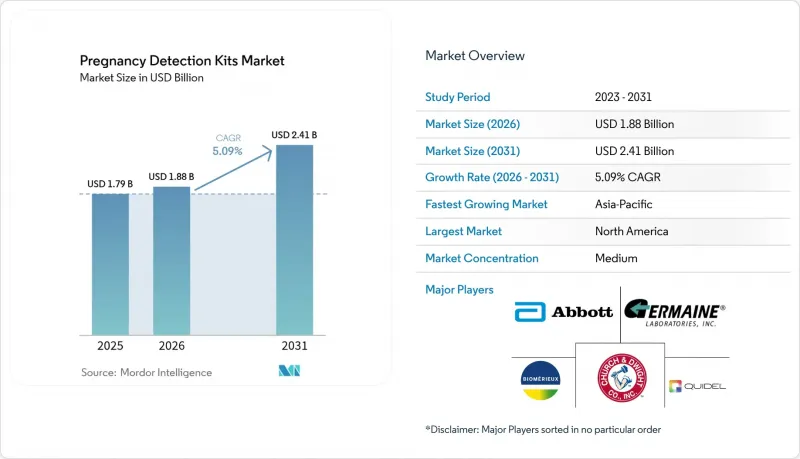
Mordor Intelligence에 의하면, 임신 진단 키트 시장 규모는 2025년 17억 9,000만 달러에서 2026년에는 18억 8,000만 달러에 이르고, 2026-2031년 CAGR 5.09%로 성장을 지속하여 2031년에는 24억 1,000만 달러에 달할 것으로 예측됩니다.
본 보고서는 제품 유형(라인식 임신 진단 키트, 디지털 기기, 기타), 검사 유형(소변 HCG 검사, 혈중 HCG 검사), 유통 채널(병원 내 약국, 독립 약국, 기타), 최종 사용자(재택 간호 이용자, 산부인과 클리닉, 기타),및 지역(북미, 유럽, 기타)별로 분류되어 있습니다. 시장 예측은 금액(달러) 기준으로 제시되어 있습니다.
전 세계 임신 진단 키트 시장 동향 및 인사이트
예기치 못한 임신 증가
세계보건기구(WHO)의 추정에 따르면, 전 세계적으로 매년 1억 2,100만 건의 의도파관 않은 임신이 발생하고 있으며, 이는 기본 수요를 뒷받침하고 경제 사이클로부터 임신 진단 키트 시장을 보호하고 있습니다. 개발도상 지역의 인구 통계학적 변화가 타겟층을 확대하는 한편, 선진국 시장에서는 출산 연령의 상승에 따라 고령 여성들이 자신의 생식 능력을 더 주의 깊게 모니터링하게 되면서 검사 빈도가 증가하고 있습니다. 따라서 임신 진단 키트는 선택적 구매품이라기보다는 필수품으로 기능하고 있으며, 가계 형편이 어려워진 경우에도 매출을 유지하고 있습니다. 조기 발견을 장려하는 공중보건 캠페인으로 인해 반복적인 자가 검사가 더욱 보편화되고 있습니다. 이러한 요인들이 복합적으로 작용하여 안정적인 판매량을 뒷받침하고, 수익성이 높은 디지털 형식으로의 점진적인 전환을 촉진하고 있습니다.
가처분 소득 증가와 자가 관리에 대한 지출 의향 고조
아시아태평양의 중산층 소득 증가는 구매력을 강화하며, 앱을 통한 안내 및 데이터 추적 기능을 갖춘 블루투스 지원 기기로의 프리미엄화 기회를 창출하고 있습니다. 소비자들은 임신 검사를 보다 광범위한 자가 관리 및 ‘퀀티파이드 헬스(데이터 기반 건강 관리)’ 트렌드에 부합하는 적극적인 건강 관리 루틴의 일환으로 인식하고 있습니다. 기술 및 금융 업계의 고용주들은 임신 검사 비용을 지원하는 불임 치료 관련 복리후생 제도를 도입하고 있으며, 이를 Maven이나 Kindbody와 같은 플랫폼이 주도하는 종합적인 생식 건강 프로그램에 통합하고 있습니다. 지원 범위가 확대됨에 따라 제조업체들은 정확성, 연결성, 데이터 보안을 강조함으로써 가격 프리미엄을 정당화할 수 있게 됩니다.
저소득 국가에서의 낮은 인지도와 접근성
의료 인프라의 격차로 인해 약국이 적고 공급망이 단절된 아프리카 및 남아시아의 농촌 지역에서는 임신 테스트 키트 시장이 제한적입니다. 케냐와 우간다의 조사에 따르면, 많은 여성들이 가정에서 검사할 수 있는 선택지를 인식하지 못하고 있으며, 대신 이동 비용과 대기 시간이 수반되는 진료소 방문에 의존하고 있는 것으로 나타났습니다. 가격에 대한 민감성이 디지털 형식의 보급을 더욱 제한하고 있으며, 가장 저렴한 검사 스트립에 대한 의존도를 높이고 있습니다. 개발 기관과 NGO는 인식 제고 활동 및 보조금 지원 배포를 시범적으로 실시하고 있으나, 그 성과는 여전히 국지적인 수준에 그치고 있습니다. 통신 환경과 소매 물류가 개선될 때까지는 이러한 지역에서 시장 침투가 완만하게 진행될 뿐이며, 이는 전 세계 연평균 성장률(CAGR) 상승을 억제하는 요인이 될 것입니다.
부문 분석
2005년, 라인형 임신 테스트기는 매출의 61.78%를 차지하며, 비용 리더십과 약국에서의 보편적인 보급을 반영하고 있습니다. 이러한 우위는 임신 테스트 키트 시장 규모(11억 1,000만 달러)에서의 점유율로 이어져, 이 카테고리의 규모의 경제를 뒷받침하고 있습니다. 반면, 스마트 연결형 기기는 2001년까지 연평균 성장률(CAGR) 6.6%를 기록했으며, 블루투스 리더, 전용 앱, 개인 맞춤형 컨텐츠를 결합함으로써 다른 어떤 형식보다 높은 성장률을 보였으며, 이러한 요소들이 더 높은 가격 책정을 정당화하고 있습니다. 디지털 기기는 중간적인 위치를 차지하고 있으며, 연결 기능 없이 전자 디스플레이를 제공함으로써 결과의 명확성을 원하면서도 데이터 개인정보 보호를 우려하는 소비자들에게 매력적인 선택지가 되고 있습니다.
경쟁사들의 대응을 보면, 혁신이 단계적으로 진행되고 있음을 알 수 있습니다. 처치 앤 드와이트(Church & Dwight)사가 2004년에 출시한 ‘멀티체크(MultiCheck)’ 키트는 검체 채취를 간소화하는 ‘이지컵(EasyCup)’ 채취기를 통합하면서도, 완전 연결형 검사 키트보다 가격 프리미엄을 낮게 유지하고 있습니다. ‘MissLan™’ 및 ‘Clearblue® Early Digital’에 대한 FDA 승인은 가독성 향상에 대한 규제 당국의 신뢰를 뒷받침하고 있습니다. 2004년 12월 호주 TGA로부터 승인을 받은 사리노스틱스(Salignostics)사의 타액 기반 키트 등 개발 중인 제품들은 소변 채취를 완전히 배제함으로써 향후 시장 변혁의 조짐을 보이고 있습니다. 다양한 형태에서 실용성과 합리적인 가격을 모두 실현하고 있는 제조업체야말로, 끊임없이 진화하는 임신 진단 키트 시장을 장악하는 데 있어 가장 유리한 입장에 있습니다.
소변을 이용한 hCG 검사는 2005년 매출의 9.61%를 차지하며, 임신 진단 키트 시장의 기반이 되는 기술입니다. 의료 종사자들의 확고한 지지, CLIA 면제, 그리고 소비자들의 익숙함이 이 시장 점유율을 뒷받침하고 있으며, 규모의 경제로 인해 단가는 낮게 유지되고 있습니다. 혈액을 이용한 신속 검사는 규모는 작지만, 임신을 6-10일 더 빨리 감지할 수 있어 불임 치료에 주력하는 부부들에게 지지를 받고 있으며, 연평균 성장률(CAGR) 5.7%로 확대되고 있습니다.
Atomo Diagnostics와 NG Biotech는 2004년에 CE 마크를 획득한 혈액 검사 키트를 출시하여, 의료 종사자 대상 시장 및 이후 가정용 시장을 타겟으로 하고 있습니다. 가정에서 손가락 끝 채혈이 보급되기 위해서는 소비자의 거부감, 랜싯의 안전한 폐기, 규제 당국의 추가적인 감시 등의 과제가 있습니다. 그러나 조기 검출이라는 장점 덕분에 혈액 검사는 대체 제품이 아닌 보완적인 제품으로 자리매김하며, 산부인과 의사 및 원격 불임 치료 플랫폼의 임상 도구 키트를 확충하고 있습니다. 만약 미국 FDA의 승인을 받게 된다면, 혈액 검사는 소변 검사를 중심으로 한 과점 상태인 임신 진단 키트 시장 점유율을 서서히 빼앗아 갈 가능성이 있습니다.
지역별 분석
북미가 주도적인 위치를 차지하고 있는 배경에는 소매점 밀집도가 높고, 건강보험 제도가 잘 갖춰져 있으며, 제품 출시 주기를 가속화하는 FDA의 승인 효율성이 높기 때문입니다. 소비자들은 강한 브랜드 충성도를 보이고 있으며, 이는 높은 재구매율을 유지하고 프리미엄 라인 확장을 뒷받침하고 있습니다. CLIA 면제 프로그램 및 데이터 개인정보 보호법에 기반한 규제의 투명성은 커넥티드 기기에 대한 소비자의 신뢰를 높여, 임신 진단 키트 시장에서 하이엔드 제품의 성장을 뒷받침하고 있습니다.
아시아태평양은 가장 가파른 성장 곡선을 보이고 있으며, 인도와 중국에서만 매년 수백만 가구가 잠재 고객층에 합류하고 있습니다. 도시 지역의 직장 여성들은 눈에 띄지 않는 온라인 구매를 선호하는 반면, 스마트폰 보급률 상승에 따라 결과를 현지 언어로 된 모바일 앱으로 전송하는 블루투스 지원 검사 키트의 보급이 가속화되고 있습니다. 인도네시아와 베트남 정부의 임산부 보건 이니셔티브에는 임신 테스트 키트의 보조금 지원 배포가 포함되어 있어, 소매망 확대와 판매량 증가를 촉진하고 있습니다.
유럽은 임상적 타당성과 환경 관리를 우선시하는 성숙하고 품질을 중시하는 환경이 특징입니다. EU의 규제 조화 하에 국경을 초월한 온라인 약국이 활발히 전개되고 있지만, 현지 언어로 된 표시 요건으로 인해 패키지의 맞춤화가 요구되고 있습니다. 일회용 플라스틱 감축과 같은 지속가능성 노력은 구매 결정에 영향을 미치며, 환경 의식이 높은 소비자의 선호도를 고려한 기존 기업들에게는 차별화의 계기가 되고 있습니다. 전반적으로 전 세계 임신 테스트 키트 시장에서는 각 지역의 특성에 따라 마케팅 믹스, 패키지 디자인, 규제 전략이 결정됩니다.
기타 혜택:
- 엑셀 형식 시장 예측(ME) 시트
- 3개월간의 애널리스트 지원
자주 묻는 질문
목차
제1장 서론
제2장 조사 방법
제3장 주요 요약
제4장 시장 구도
제5장 시장 규모와 성장 예측
제6장 경쟁 구도
제7장 시장 기회와 향후 전망
LSH 26.08.25According to Mordor Intelligence, the pregnancy detection kits market size is expected to grow from USD 1.79 billion in 2025 to USD 1.88 billion in 2026 and is forecast to reach USD 2.41 billion by 2031 at 5.09% CAGR over 2026-2031.
This report is Segmented by Product Type (Line Pregnancy Tests, Digital Devices, and Others), Type of Test (Urine HCG Test, Blood HCG Test), Distribution Channel (Hospital Pharmacies, Independent Pharmacies, and Others), End User (Home-Care Individuals, Gynecology Clinics, and Others), and Geography (North America, Europe, and Others). The Market Forecasts are Provided in Terms of Value (USD).
Global Pregnancy Detection Kits Market Trends and Insights
Growing Incidence of Unplanned Pregnancies
The World Health Organization estimates 121 million unintended pregnancies occur worldwide each year, sustaining baseline demand that buffers the pregnancy detection kits market against economic cycles. Demographic momentum in developing regions enlarges the target population, while delayed childbearing in developed markets elevates testing frequency as older women monitor fertility more closely. Pregnancy tests thus function as necessity goods rather than discretionary purchases, preserving revenue even when household budgets tighten. Public-health campaigns promoting early detection further normalize repeat self-testing. Combined, these factors anchor stable unit volumes and underpin incremental upgrades to higher-margin digital formats.
Increasing Disposable Income and Willingness to Spend on Self-care
Rising middle-class income in Asia-Pacific strengthens spending power and unlocks premiumization opportunities for Bluetooth-enabled devices that deliver app-based guidance and data tracking. Consumers view pregnancy testing as part of a proactive wellness routine, aligning with broader self-care and quantified-health trends. Employers in technology and finance add fertility benefits that reimburse pregnancy tests, integrating them into comprehensive reproductive-health programs led by platforms such as Maven and Kindbody. As reimbursement expands, manufacturers can justify price premiums by emphasizing accuracy, connectivity, and data security.
Low Awareness & Access in Low-income Nations
Gaps in healthcare infrastructure restrict the pregnancy detection kits market in rural Africa and South Asia, where pharmacies are scarce and supply chains fragmented. Studies in Kenya and Uganda show many women are unaware of home-testing alternatives, relying instead on clinic visits that entail travel costs and wait times. Price sensitivity further limits adoption of digital formats, reinforcing reliance on the lowest-cost strips. Development agencies and NGOs pilot educational outreach and subsidized distribution, yet results remain localized. Until connectivity and retail logistics improve, market penetration in these areas will progress slowly, capping global CAGR uplift.
Other drivers and restraints analyzed in the detailed report include:
- Wider Retail & E-commerce Penetration of Home-testing Products
- Regulatory Backing for Self-diagnostics in Major Markets
- Social Stigma in Parts of MEA & South Asia
For complete list of drivers and restraints, kindly check the Table Of Contents.
Segment Analysis
Line pregnancy tests retained 61.78% revenue in 05, reflecting cost leadership and universal pharmacy presence. That dominance translates into a (USD 1.11 billion) slice of the pregnancy detection kits market size and underpins the category's scale efficiencies. Yet smart-connected devices post a 6.6% CAGR to 01, outpacing any other format by layering Bluetooth readers, companion apps, and personalized content that justify higher price points. Digital devices occupy a middle position, offering electronic readouts without connectivity-attractive to consumers seeking clarity but wary of data privacy.
Competitive responses illustrate an innovation stair-step. Church & Dwight's 04 Multi Check kit integrates an EasyCup collector that simplifies sampling while holding price premiums below fully connected tests. FDA clearances for MissLan(TM) and Clearblue(R) Early Digital reinforce regulatory confidence in enhanced readability. Pipeline products such as Salignostics' saliva-based kit, cleared by Australia's TGA in December 04, hint at future disruption by eliminating urine collection entirely. Manufacturers that bridge utility and affordability across formats are best placed to capture the evolving pregnancy detection kits market.
Urine-based hCG tests represented 9.61% of sales in 05 and form the baseline technology of the pregnancy detection kits market. Robust clinician acceptance, CLIA waivers, and consumer familiarity anchor this share while economies of scale keep unit prices low. Blood-based rapid tests, though small, expand at 5.7% CAGR because they detect pregnancy 6-10 days earlier, appealing to fertility-focused couples.
Atomo Diagnostics and NG Biotech secured a CE-marked blood-based kit in 04, targeting professional and later home-use markets. Home finger-stick adoption faces hurdles: consumer comfort, safe lancet disposal, and added regulatory scrutiny. However, early-detection benefits position blood tests as complementary rather than replacement products, widening the clinical toolkit for obstetricians and tele-fertility platforms. If U.S. FDA clearance follows, blood tests could nudge the pregnancy detection kits market share away from the urine oligopoly.
Complete Report Scope:
- By Product Type
- Line Pregnancy Tests
- Test Cassette Format
- Test Strip Format
- Test Midstream Format
- Digital Devices
- Smart-Connected Devices
- Line Pregnancy Tests
- By Type of Test
- Urine hCG Test
- Blood hCG Test
- By Distribution Channel
- Hospital Pharmacies
- Independent Pharmacies & Drug Stores
- Online Pharmacies
- Modern Retail & Hypermarkets
- By End User
- Home-care (Individuals)
- Gynecology & Obstetrics Clinics
- Hospitals & Diagnostic Centers
- By Geography
- North America
- United States
- Canada
- Mexico
- Europe
- Germany
- United Kingdom
- France
- Italy
- Spain
- Rest of Europe
- Asia-Pacific
- China
- Japan
- India
- Australia
- South Korea
- Rest of Asia-Pacific
- Middle East and Africa
- GCC
- South Africa
- Rest of Middle East and Africa
- South America
- Brazil
- Argentina
- Rest of South America
- North America
Geography Analysis
North America's leadership stems from high retail density, advanced health insurance coverage, and FDA approval efficiency that accelerates product launch cycles. Consumers demonstrate strong brand allegiance, which sustains high repeat-purchase rates and encourages premium line extensions. Regulatory transparency under the CLIA waiver program and data-privacy legislation fosters consumer confidence in connected devices, supporting upscale growth within the pregnancy detection kits market.
Asia-Pacific provides the steepest growth curve, with India and China alone adding millions of new households to the addressable base annually. Urban working women favor discreet e-commerce purchases, while rising smartphone penetration accelerates adoption of Bluetooth-enabled tests that channel results into local language mobile apps. Government maternal-health initiatives in Indonesia and Vietnam include subsidized pregnancy test distribution, widening retail reach and stimulating volume gains.
Europe presents a mature, quality-focused environment prioritizing clinical validation and environmental stewardship. Cross-border e-pharmacies thrive under harmonized EU regulations, though local language labeling requirements demand tailored packaging. Sustainability credentials, such as reduced single-use plastics, influence purchasing decisions and create differentiation angles for incumbents attuned to eco-conscious preferences. Overall, regional nuances dictate marketing mix, packaging design, and regulatory strategy within the global pregnancy detection kits market.
- Abbott Laboratories
- Axis Medicare
- bioMerieux
- Cardinal Health
- Church & Dwight
- Germaine Laboratories
- Mankind Pharma
- Piramal Enterprises Ltd.
- Procter & Gamble
- QuidelOrtho
- SPD Swiss Precision Diagnostics GmbH
- Roche
- Siemens Healthineers
- Beckton Dickinson
- Nantong Egens Biotechnology
- Guangzhou Wondfo Biotech
- Prestige Consumer Healthcare
- Biosynex SA
- BTNX
- AdvaCare
Additional Benefits:
- The market estimate (ME) sheet in Excel format
- 3 months of analyst support
TABLE OF CONTENTS
1 Introduction
- 1.1 Study Assumptions & Market Definition
- 1.2 Scope of the Study
2 Research Methodology
3 Executive Summary
4 Market Landscape
- 4.1 Market Overview
- 4.2 Market Drivers
- 4.2.1 Growing Incidence of Unplanned Pregnancies
- 4.2.2 Increasing Disposable Income and Willingness to Spend on Self-care
- 4.2.3 Wider Retail & E-commerce Penetration of Home-testing Products
- 4.2.4 Regulatory Backing for Self-diagnostics in Major Markets
- 4.2.5 Smartphone-linked Digital Test Innovation
- 4.2.6 Male-partner Involvement Campaigns Boosting Early Testing
- 4.3 Market Restraints
- 4.3.1 Low Awareness & Access in Low-income Nations
- 4.3.2 Social stigma in Parts of MEA & South Asia
- 4.3.3 Supply-chain Counterfeit Risks
- 4.3.4 Data-privacy Concerns with Connected Test Apps
- 4.4 Supply-Chain Analysis
- 4.5 Regulatory Landscape
- 4.6 Technological Outlook
- 4.7 Porter's Five Forces
- 4.7.1 Threat of New Entrants
- 4.7.2 Bargaining Power of Buyers/Consumers
- 4.7.3 Bargaining Power of Suppliers
- 4.7.4 Threat of Substitute Products
- 4.7.5 Intensity of Competitive Rivalry
5 Market Size & Growth Forecasts (Value)
- 5.1 By Product Type
- 5.1.1 Line Pregnancy Tests
- 5.1.1.1 Test Cassette Format
- 5.1.1.2 Test Strip Format
- 5.1.1.3 Test Midstream Format
- 5.1.2 Digital Devices
- 5.1.3 Smart-Connected Devices
- 5.1.1 Line Pregnancy Tests
- 5.2 By Type of Test
- 5.2.1 Urine hCG Test
- 5.2.2 Blood hCG Test
- 5.3 By Distribution Channel
- 5.3.1 Hospital Pharmacies
- 5.3.2 Independent Pharmacies & Drug Stores
- 5.3.3 Online Pharmacies
- 5.3.4 Modern Retail & Hypermarkets
- 5.4 By End User
- 5.4.1 Home-care (Individuals)
- 5.4.2 Gynecology & Obstetrics Clinics
- 5.4.3 Hospitals & Diagnostic Centers
- 5.5 By Geography
- 5.5.1 North America
- 5.5.1.1 United States
- 5.5.1.2 Canada
- 5.5.1.3 Mexico
- 5.5.2 Europe
- 5.5.2.1 Germany
- 5.5.2.2 United Kingdom
- 5.5.2.3 France
- 5.5.2.4 Italy
- 5.5.2.5 Spain
- 5.5.2.6 Rest of Europe
- 5.5.3 Asia-Pacific
- 5.5.3.1 China
- 5.5.3.2 Japan
- 5.5.3.3 India
- 5.5.3.4 Australia
- 5.5.3.5 South Korea
- 5.5.3.6 Rest of Asia-Pacific
- 5.5.4 Middle East and Africa
- 5.5.4.1 GCC
- 5.5.4.2 South Africa
- 5.5.4.3 Rest of Middle East and Africa
- 5.5.5 South America
- 5.5.5.1 Brazil
- 5.5.5.2 Argentina
- 5.5.5.3 Rest of South America
- 5.5.1 North America
6 Competitive Landscape
- 6.1 Market Concentration
- 6.2 Strategic Moves
- 6.3 Market Share Analysis
- 6.4 Company Profiles (includes Global level Overview, Market level overview, Core Segments, Financials as available, Strategic Information, Market Rank/Share for key companies, Products & Services, and Recent Developments)
- 6.4.1 Abbott Laboratories
- 6.4.2 Axis Medicare
- 6.4.3 bioMerieux SA
- 6.4.4 Cardinal Health Inc.
- 6.4.5 Church & Dwight Co., Inc.
- 6.4.6 Germaine Laboratories Inc.
- 6.4.7 Mankind Pharma
- 6.4.8 Piramal Enterprises Ltd.
- 6.4.9 Procter & Gamble Co.
- 6.4.10 QuidelOrtho Corporation
- 6.4.11 SPD Swiss Precision Diagnostics GmbH
- 6.4.12 Roche Diagnostics
- 6.4.13 Siemens Healthineers
- 6.4.14 Becton, Dickinson and Company
- 6.4.15 Nantong Egens Biotechnology
- 6.4.16 Guangzhou Wondfo Biotech
- 6.4.17 Prestige Consumer Healthcare
- 6.4.18 Biosynex SA
- 6.4.19 BTNX Inc.
- 6.4.20 AdvaCare Pharma
7 Market Opportunities & Future Outlook
- 7.1 White-space & Unmet-need Assessment


