

|
시장보고서
상품코드
2113667
자동차 전자식 안정성 제어 시스템 : 시장 점유율 분석, 업계 동향 및 통계, 성장 예측(2026-2031년)Automotive Electronic Stability Control Systems - Market Share Analysis, Industry Trends & Statistics, Growth Forecasts (2026 - 2031) |
||||||
 Mordor Intelligence
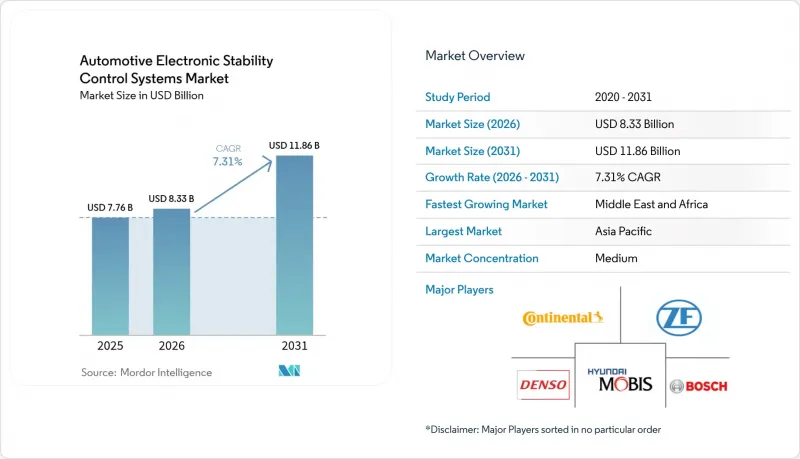
Mordor Intelligence에 의하면, 자동차 전자식 안정성 제어 시스템 시장 규모는 2025년에 77억 6,000만 달러로 평가되었습니다. 2026년 83억 3,000만 달러에서 2031년까지 118억 6,000만 달러에 이를 것으로 예상되며, 예측 기간(2026-2031년) CAGR은 7.31%를 나타낼 전망입니다.
본 보고서는 차종(승용차 등), 구성품(센서 등), 기술(유압식 ESC 및 전기유압식/전기기계식 ESC), 구동 방식(내연기관 차량 등), 판매 채널(OEM 순정 장착 및 애프터마켓용 사후 장착), 그리고 지역별로 분류되어 있습니다. 시장 전망은 금액(미 달러) 기준으로 제시되어 있습니다.
세계의 자동차 전자식 안정성 제어 시스템 시장 동향 및 인사이트
경차 부문에서의 ESC 의무화
세계적인 규제 정비에 따라 자동차 전자식 안정성 제어 시스템 시장은 선택적 기술에서 의무화된 차량 하위 시스템으로 그 위상이 높아지고 있습니다. 2024년 7월부터 신형 모델에 적용되는 유럽연합(EU)의 ‘일반 안전 규정 II’에서는 모든 승용차 및 소형 상용차에 대해 다른 능동 안전 기능과 함께 ESC 탑재가 의무화되어 있습니다. 미국에서도 FMVSS 126에 따라 유사한 기준이 적용되고 있습니다. 규제 시한이 통일됨에 따라 각 OEM 업체들은 플랫폼 정의 단계부터 ESC를 통합하도록 권장받고 있으며, 채널당 비용을 절감하는 대량 공급 계약이 활발해지고 있습니다. 이러한 규모의 경제 효과는 기존에 옵션 채택률이 낮았던 소형차 부문에서 특히 두드러집니다. 따라서 부품 제조업체는 3대륙에 걸친 검증, 형식 인증 및 소프트웨어 릴리스 일정을 동기화하여 개발 주기를 단축하는 동시에, 브랜드 고유의 페달 감각 조정을 위해 플래시 업데이트가 가능한 모듈식 아키텍처의 가치를 높여야 합니다.
ADAS 및 자율주행의 급속한 보급
차선 유지, 자동 긴급 제동, 어댑티브 크루즈 컨트롤은 센서 퓨전이 이루어질 때 안정적인 차체 자세에 의존합니다. 따라서 ESC는 도메인 컨트롤러의 핵심이 되며, 그 역할은 사후적인 슬립 보정에서 예측적인 궤적 제어로 전환되고 있습니다. 중앙 집중형 컴퓨팅 플랫폼은 요율, 횡가속도, 조향각 데이터를 머신러닝 모델에 공급하여 마찰 한계를 예측하고 제동 압력을 사전에 조정합니다. 그 결과, 개입이 더욱 부드러워지고 탑승자의 쾌적성이 향상되며, 보증 청구도 감소합니다. 또한, 프로세서의 처리량이 향상됨에 따라 공급업체는 정비소에 차량을 반입할 필요 없이 알고리즘 매개변수를 미세 조정하는 OTA(Over-the-Air) 업데이트를 제공할 수 있게 되어, 자동차 전자식 안정성 제어 시장에서 지속적인 수익원을 창출하고 있습니다.
ESC 모듈의 높은 초기 비용과 수명 주기 비용
단품으로는 대당 300-800달러, 레이더와 결합하면 2,000달러 가까이 치솟기 때문에 그 비용은 엔트리 부문의 거래 가격에서 두 자릿수 비율을 차지할 가능성이 있습니다. 반도체 가격 급등으로 인해 2030년까지 차량당 전자 장비 지출은 2배로 증가할 전망이며, OEM 각사는 수량 할인이나 현지 조달을 요구하고 있습니다. 소유자의 관점에서 볼 때, 충돌 후 수리 시 보정 장비가 필요한 경우 수리 비용은 50-100% 더 높아집니다. 따라서 차량 대여 사업자들은 소매 가격 그 자체보다는 총 운영 비용을 평가하는 경향이 있으며, 이로 인해 비공식 카셰어링 시장이나 노후화된 차량 군에서의 보급이 더뎌지고 있습니다.
부문 분석
승용차는 법적 규제와 소비자의 안전 의식 고조에 힘입어 2025년 자동차 전자식 안정성 제어 시스템 시장 매출의 63.92%를 차지했습니다. 소형 상용차는 전자상거래의 확대에 따라 도시 지역의 배송 교통량이 증가하고 전복 방지 기능의 혜택을 받기 때문에 큰 수요를 차지하고 있습니다. 승용차 부문은 예측 기간 동안 가장 높은 성장률을 보일 것으로 예상되며, 연평균 성장률(CAGR)은 7.62%를 나타낼 것으로 전망됩니다. 이는 주로 높은 순간 토크를 발생시키는 구동계를 올바른 궤도에 유지하기 위한 토크 벡터링 로직이 필요한 배터리 전기차(BEV)에 기인합니다.
고급 세단의 경우, ESC 알고리즘이 액티브 서스펜션 댐퍼와 연동하여 급격한 차선 변경 시의 무게 이동을 제어하며, 이 기능은 현재 유럽의 C 부문에서 표준 사양으로 장착되어 있습니다. 배송용 밴의 차량 운영 사업자는 텔레매틱스 포털을 활용하여 ESC 작동 이벤트를 운전자 교육용 대시보드에 반영함으로써 보험금 청구를 줄이고 있습니다. 이러한 활용 사례는 소프트웨어 분석이 하드웨어의 이익률을 뛰어넘어, 자동차 전자식 안정성 제어 시장에서 가치의 원천을 어떻게 확대하고 있는지를 보여줍니다.
2025년 지출 중 센서 어셈블리가 44.25%를 차지했으며, 이는 차량 동역학 데이터를 포착하는 자이로스코프, 가속도계, 휠 속도 센서의 필요성을 반영합니다. 그러나 각 OEM 업체들이 중앙 집중형 컴퓨팅 영역으로 전환함에 따라 소프트웨어 및 알고리즘 스택은 연평균 성장률(CAGR) 17.65%로 확대되고 있습니다. 전자 제어 장치(ECU)는 여전히 중추적인 역할을 하며, 데이터 버스의 대역폭과 실시간 OS의 결정성을 모두 충족시키고 있습니다.
알고리즘 공급업체들은 OTA(Over-the-Air) 파이프라인을 활용하여 기능의 수명을 연장하고, 서킷 주행 시 보다 적극적인 토크 배분을 실현하는 구독형 퍼포먼스 모드를 가능하게 하고 있습니다. 차량이 기가비트 이더넷 백본으로 전환됨에 따라, 센서 퓨전은 LiDAR 및 카메라 영상 데이터까지 대상 범위를 확대하며, 자동차 전자식 안정성 제어 시스템 시장을 기계적 차별화에서 디지털적 차별화로 더욱 추진하고 있습니다.
지역별 분석
2025년에는 아시아태평양이 전 세계 매출의 48.12%를 차지했으나, 중동 및 아프리카는 2031년까지 연평균 성장률(CAGR) 10.66%를 기록하며 가장 빠르게 성장하는 지역이 될 것으로 예측됩니다. 중국 자동차 제조업체들은 생산 거점을 아세안(ASEAN) 국가들로 확대하여, 2030년대 중반까지 해당 지역의 경차 생산 대수 전망치를 420만 대에서 600만 대 가까이까지 상향 조정했습니다. 신에너지차에 대한 정부의 인센티브로 인해 소프트웨어 중심의 브레이크 시스템 도입이 가속화되고 있는 한편, 현지 반도체 제조 공장이 공급망을 단축하고 있습니다. 인도의 산업 정책은 2035년까지 자동차 산업의 매출을 1조 달러로 늘리는 것을 목표로 하고 있으며, 이로 인해 전자식 안정성 제어 시스템 시장의 확대를 위한 추가적인 여지가 생기고 있습니다. 일본과 한국은 액추에이터 및 ECU에 관한 전문 지식을 제공하며 기술적 리더십을 공고히 하고 있습니다.
북미는 성숙 단계에 접어들었음에도 안정적인 성장 궤도를 보이고 있습니다. 2012년형 모델부터 의무화된 탑재로 인해 신차 보급률은 포화 상태에 도달했으며, 성장의 초점은 교체 수요나 레벨 3 고속도로 자율주행과 연계되는 예측 요 제어 모듈 등의 기능 업그레이드로 이동하고 있습니다. 캐나다의 조립 공장은 미국 규제와 일치하며, 대륙 규모의 경제 규모를 확보하고 있습니다. 선벨트 주에서 진행 중인 자율주행 셔틀 실증 실험은 맞춤형 전기 기계식 브레이크 시스템에 새로운 판로를 제공하며, 공급업체의 라이프사이클 가치를 확대되고 있습니다.
유럽에서는 자동차 판매 대수가 정체되는 한편, Euro-NCAP 기준이 강화되고 있는 것을 배경으로 완만한 연평균 성장률(CAGR)을 보이고 있습니다. 2024년 안전 규제 패키지에 따라 고급 ESC가 기본 사양으로 채택됨에 따라, 개입의 부드러움을 향상시키는 소프트웨어 업데이트에 초점이 맞추어지고 있습니다. 독일의 Tier 1 공급업체는 에너지 회생 분석과 연동된 Brake-by-wire 모듈의 실증 시험을 진행하는 한편, 남유럽의 제조업체는 A부문 도시형 차량을 위한 비용 최적화된 유압 블록에 주력하고 있습니다. 동유럽의 위탁 조립 제조업체는 아시아에서 센서 모듈을 수입하고 있으며, 이를 통해 지역 간 공급망이 강화되어 중동 및 아프리카의 안정화에 기여하고 있습니다. 이 지역은 인프라 확장과 UNECE 안전 기준에 대한 정책 조화를 원동력으로 삼아 10.66%라는 지역 내 가장 높은 연평균 성장률(CAGR)을 기록하고 있습니다. 걸프협력회의(GCC) 회원국의 차량 플릿에서는 사막 고속도로에서 사용되는 무게 중심이 높은 SUV에 전복 방지 기능이 요구되고 있으며, 이것이 조기 도입을 뒷받침하고 있습니다. 남미는 연평균 성장률(CAGR) 7.98%로 그 뒤를 잇고 있으며, 2023년 브라질의 40만 18대의 신규 등록 대수가 견인 역할을 하여 현지 조달률 제고가 가속화되고 있습니다. 관세 조치로 인해 전자 모듈의 역내 생산이 촉진되어 다국적 공급업체의 환율 변동 위험이 완화되고 있습니다.
기타 혜택 :
- 엑셀 형식 시장 예측(ME) 시트
- 3개월간의 애널리스트 지원
자주 묻는 질문
목차
제1장 서론
제2장 조사 방법
제3장 주요 요약
제4장 시장 구도
제5장 시장 규모 및 성장 예측
제6장 경쟁 구도
제7장 시장 기회 및 향후 전망
KTH 26.08.26According to Mordor Intelligence, the automotive electronic stability control market size was valued at USD 7.76 billion in 2025 and estimated to grow from USD 8.33 billion in 2026 to reach USD 11.86 billion by 2031, at a CAGR of 7.31% during the forecast period (2026-2031).
This report is Segmented by Vehicle Type (Passenger Cars and More), Component (Sensors and More), Technology (Hydraulic ESC and Electro-Hydraulic / Electro-Mechanical ESC), Propulsion Type (Internal-Combustion Engine Vehicles and More), Sales Channel (OEM-Fitted and Aftermarket Retrofit), and Geography. The Market Forecasts are Provided in Terms of Value (USD).
Global Automotive Electronic Stability Control Systems Market Trends and Insights
Mandatory ESC Legislation in Light-Vehicle Categories
Global rulemaking elevates the automotive electronic stability control market from an optional technology to a compulsory vehicle sub-system. The European Union's General Safety Regulation II, in force for new models from July 2024, obliges every passenger vehicle and light commercial vehicle to incorporate ESC along with other active-safety functions. Comparable standards apply in the United States under FMVSS 126. Harmonised deadlines motivate OEMs to integrate ESC at the platform-definition stage, fuelling bulk supply agreements that lower the cost per channel. This scale benefit is especially pronounced in compact-car segments, where prior option-take rates were modest. Component makers must therefore synchronize validation, homologation, and software-release calendars across three continents, shortening development loops and raising the value of modular architectures that can be flashed for brand-specific pedal-feel tuning.
Rapid ADAS and Automated-Driving Adoption
Lane-keeping, automatic emergency braking, and adaptive cruise control rely on a stable chassis attitude during sensor-fusion events. ESC thus becomes the backbone of the domain controller, shifting its role from reactive skid correction to predictive trajectory governance. Centralized compute platforms feed yaw-rate, lateral-acceleration, and steering-angle data into machine-learning models that forecast friction limits and pre-condition brake pressure. The outcome is smoother intervention, which improves passenger comfort and reduces warranty claims. Higher processor throughput also enables suppliers to push over-the-air updates that refine algorithm parameters without workshop visits, creating annuity revenue streams inside the automotive electronic stability control market.
High Upfront and Lifecycle Cost of ESC Modules
At USD 300 to 800 per vehicle in stand-alone form and escalating toward USD 2,000 when bundled with radar, the bill can absorb a double-digit share of entry-segment transaction prices. Semiconductor inflation doubles the per-vehicle electronics spend by 2030, prompting OEMs to demand volume discounts and local sourcing. On the ownership side, post-collision repairs cost 50-100% more when calibration rigs are required. Fleets therefore evaluate total-cost-of-operation rather than headline retail prices, slowing penetration in informal ride-sharing markets and ageing car parks.
Other drivers and restraints analyzed in the detailed report include:
- EV-Specific Regenerative-Braking Stability Needs
- Transition Toward Brake-by-Wire Architectures
- Platform Saturation in Mature Markets
For complete list of drivers and restraints, kindly check the Table Of Contents.
Segment Analysis
Passenger cars generated 63.92% of 2025 revenue in the automotive electronic stability control market, supported by legal mandates and consumer safety awareness. Light commercial vehicles contribute a sizeable demand as e-commerce accelerates urban delivery traffic that benefits from rollover mitigation. The passenger cars segment is anticipated to witness the fastest growth rate during the forecast period, marking a CAGR of 7.62%, primarily due to battery electric cars, requiring torque-vectoring logic that keeps high-instant-torque drivetrains on course.
In premium sedans, ESC algorithms coordinate with active-suspension dampers to manage weight transfer during rapid lane changes, a feature now standard in Europe's C-segment. Fleet operators of delivery vans employ telematics portals that feed ESC-trigger events into driver-coaching dashboards, cutting insurance claims. These usage cases illustrate how software analytics enlarge the value pool inside the Automotive electronic stability control market beyond hardware margins.
Sensor assemblies held 44.25% of 2025 spend, reflecting the need for gyroscopes, accelerometers, and wheel-speed pick-ups that capture vehicle-dynamics data. Software and algorithm stacks, however, advance at 17.65% CAGR as OEMs migrate to centralized compute zones. Electronic control units remain the nerve centre, balancing data bus bandwidth and real-time operating-system determinism.
Algorithm suppliers exploit over-the-air pipelines to extend feature life, enabling subscription-based performance modes that unlock more aggressive torque allocation on track days. As vehicles transition to gigabit Ethernet backbones, sensor fusion broadens to include lidar and camera feeds, further pushing the automotive electronic stability control market toward digital rather than mechanical differentiation.
Complete Report Scope:
- By Vehicle Type
- Passenger Cars
- Light Commercial Vehicles
- Medium and Heavy Commercial Vehicles
- By Component
- Sensors
- Electronic Control Unit (ECU)
- Actuator / Hydraulic Unit
- Software and Algorithms
- Other Components
- By Technology
- Hydraulic ESC
- Electro-Hydraulic / Electro-Mechanical ESC
- By Propulsion Type
- Internal-Combustion Engine Vehicles
- Hybrid and Plug-in Hybrid Vehicles
- Battery-Electric Vehicles
- By Sales Channel
- OEM-Fitted
- Aftermarket Retrofit
- By Geography
- North America
- United States
- Canada
- Rest of North America
- South America
- Brazil
- Argentina
- Rest of South America
- Europe
- Germany
- United Kingdom
- France
- Italy
- Spain
- Russia
- Rest of Europe
- Asia-Pacific
- China
- Japan
- India
- South Korea
- Australia and New Zealand
- Rest of Asia-Pacific
- Middle East and Africa
- Saudi Arabia
- United Arab Emirates
- Turkey
- South Africa
- Egypt
- Rest of Middle East and Africa
- North America
Geography Analysis
Asia-Pacific contributed 48.12% of global revenue in 2025, while the Middle East and Africa are expected to be the fastest-growing regions with a 10.66% CAGR through 2031. China's automakers extended production into ASEAN, lifting regional light-vehicle output projections from 4.2 million to nearly 6 million units by the mid-2030s. Government incentives for new-energy vehicles accelerate software-centric braking adoption, while local semiconductor fabs shorten supply chains. India's industrial policy seeks a USD 1 trillion automotive turnover by 2035, carving further runway for the electronic stability control market expansion. Japan and South Korea supply actuator and ECU expertise, anchoring technology leadership.
North America exhibits a mature yet stable trajectory. Mandated fitment since model-year 2012 saturates new-car penetration, shifting growth to replacement units and feature upgrades such as predictive-yaw modules that integrate with L3 highway pilots. Canadian assembly plants harmonize with United States regulations, ensuring continental-scale economies. Autonomous-shuttle pilots in Sun Belt states offer a fresh outlet for bespoke electro-mechanical brake systems, extending lifecycle value for suppliers.
Europe posts a moderate CAGR under a backdrop of plateauing vehicle sales yet stringent Euro-NCAP targets. The 2024 safety regulation bundle turned advanced ESC into a baseline specification, driving focus toward software updates that refine intervention smoothness. German tier-1s pilot brake-by-wire modules tied to energy recuperation analytics, while Southern European manufacturers focus on cost-optimized hydraulic blocks for A-segment city cars. Eastern-European contract assemblers import sensor modules from Asia, reinforcing cross-regional supply networks that stabilize the Middle East & Africa, unlock the fastest regional CAGR at 10.66%, propelled by infrastructure expansion and policy alignment with UNECE safety codes. Gulf Cooperation Council fleets demand rollover mitigation in high-centre-of-gravity SUVs used on desert highways, stimulating early adoption. South America follows with 7.98% CAGR, led by Brazil's 400,018 vehicle registrations in 2023, which heighten local content mandates. Tariffs incentivize in-region production of electronic modules, which tempers currency volatility for multinational suppliers.
- Robert Bosch GmbH
- Continental AG
- ZF Friedrichshafen AG
- Denso Corporation
- Hyundai Mobis Co., Ltd.
- Mando Corporation
- Aisin Seiki Co., Ltd.
- Knorr-Bremse AG
- Hitachi Astemo Ltd.
- Autoliv Inc.
- Aptiv PLC
- Veoneer Inc.
Additional Benefits:
- The market estimate (ME) sheet in Excel format
- 3 months of analyst support
TABLE OF CONTENTS
1 Introduction
- 1.1 Study Assumptions and Market Definition
- 1.2 Scope of the Study
2 Research Methodology
3 Executive Summary
4 Market Landscape
- 4.1 Market Overview
- 4.2 Market Drivers
- 4.2.1 Mandatory ESC legislation in light-vehicle categories
- 4.2.2 Rapid ADAS and automated-driving adoption
- 4.2.3 EV-specific regenerative-braking stability needs
- 4.2.4 Transition toward brake-by-wire architectures
- 4.2.5 Growing consumer focus on 5-star NCAP ratings
- 4.2.6 Rising light-vehicle output in emerging economies
- 4.3 Market Restraints
- 4.3.1 High upfront and lifecycle cost of ESC modules
- 4.3.2 Platform saturation in mature markets
- 4.3.3 Cyber-security risks in networked ESC ECUs
- 4.3.4 Calibration issues after suspension / tyre retrofits
- 4.4 Value / Supply-Chain Analysis
- 4.5 Regulatory Landscape
- 4.6 Technological Outlook
- 4.7 Porter's Five Forces
- 4.7.1 Bargaining Power of Suppliers
- 4.7.2 Bargaining Power of Buyers
- 4.7.3 Threat of New Entrants
- 4.7.4 Threat of Substitutes
- 4.7.5 Intensity of Competitive Rivalry
5 Market Size and Growth Forecasts (Value (USD))
- 5.1 By Vehicle Type
- 5.1.1 Passenger Cars
- 5.1.2 Light Commercial Vehicles
- 5.1.3 Medium and Heavy Commercial Vehicles
- 5.2 By Component
- 5.2.1 Sensors
- 5.2.2 Electronic Control Unit (ECU)
- 5.2.3 Actuator / Hydraulic Unit
- 5.2.4 Software and Algorithms
- 5.2.5 Other Components
- 5.3 By Technology
- 5.3.1 Hydraulic ESC
- 5.3.2 Electro-Hydraulic / Electro-Mechanical ESC
- 5.4 By Propulsion Type
- 5.4.1 Internal-Combustion Engine Vehicles
- 5.4.2 Hybrid and Plug-in Hybrid Vehicles
- 5.4.3 Battery-Electric Vehicles
- 5.5 By Sales Channel
- 5.5.1 OEM-Fitted
- 5.5.2 Aftermarket Retrofit
- 5.6 By Geography
- 5.6.1 North America
- 5.6.1.1 United States
- 5.6.1.2 Canada
- 5.6.1.3 Rest of North America
- 5.6.2 South America
- 5.6.2.1 Brazil
- 5.6.2.2 Argentina
- 5.6.2.3 Rest of South America
- 5.6.3 Europe
- 5.6.3.1 Germany
- 5.6.3.2 United Kingdom
- 5.6.3.3 France
- 5.6.3.4 Italy
- 5.6.3.5 Spain
- 5.6.3.6 Russia
- 5.6.3.7 Rest of Europe
- 5.6.4 Asia-Pacific
- 5.6.4.1 China
- 5.6.4.2 Japan
- 5.6.4.3 India
- 5.6.4.4 South Korea
- 5.6.4.5 Australia and New Zealand
- 5.6.4.6 Rest of Asia-Pacific
- 5.6.5 Middle East and Africa
- 5.6.5.1 Saudi Arabia
- 5.6.5.2 United Arab Emirates
- 5.6.5.3 Turkey
- 5.6.5.4 South Africa
- 5.6.5.5 Egypt
- 5.6.5.6 Rest of Middle East and Africa
- 5.6.1 North America
6 Competitive Landscape
- 6.1 Market Concentration
- 6.2 Strategic Moves
- 6.3 Market Share Analysis
- 6.4 Company Profiles (includes Global Level Overview, Market Level Overview, Core Segments, Financials as Available, Strategic Information, Market Rank/Share for Key Companies, Products and Services, SWOT Analysis, and Recent Developments)
- 6.4.1 Robert Bosch GmbH
- 6.4.2 Continental AG
- 6.4.3 ZF Friedrichshafen AG
- 6.4.4 Denso Corporation
- 6.4.5 Hyundai Mobis Co., Ltd.
- 6.4.6 Mando Corporation
- 6.4.7 Aisin Seiki Co., Ltd.
- 6.4.8 Knorr-Bremse AG
- 6.4.9 Hitachi Astemo Ltd.
- 6.4.10 Autoliv Inc.
- 6.4.11 Aptiv PLC
- 6.4.12 Veoneer Inc.
7 Market Opportunities and Future Outlook
- 7.1 White-space & Unmet-Need Assessment


