
|
시장보고서
상품코드
2113670
자동차 관성 시스템 : 시장 점유율 분석, 산업 동향 및 통계 데이터, 성장 예측(2026-2031년)Automotive Inertial Systems - Market Share Analysis, Industry Trends & Statistics, Growth Forecasts (2026 - 2031) |
||||||
 Mordor Intelligence
Mordor Intelligence에 의하면, 자동차 관성 시스템 시장 규모는 2025년 31억 1,000만 달러로 평가되었습니다. 2026년에는 34억 3,000만 달러로 확대되어 2026년부터 2031년에 걸쳐 CAGR 10.31%로 성장을 지속하여, 2031년에는 56억 1,000만 달러에 이를 것으로 예측됩니다.
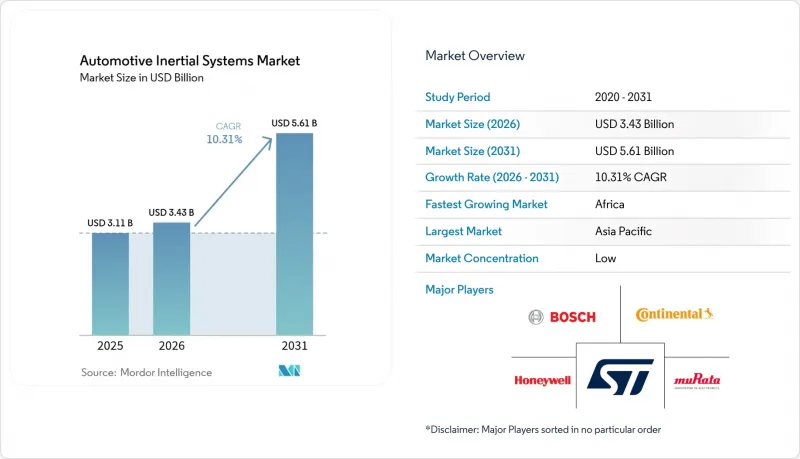
본 보고서는 구성 요소(가속도계, 자이로스코프 등),차종(승용차, 소형 상용차 등), 기술(MEMS, 광섬유 자이로 등), 용도(전자식 안정성 제어, 첨단 운전자 지원 시스템 등), 판매 채널(OEM 순정 장착, 애프터마켓), 지역별로 분류되어 있습니다. 시장 예측은 금액(미 달러) 기준으로 제시되어 있습니다.
세계의 자동차 관성 시스템 시장 동향 및 인사이트
MEMS 제조 공정의 발전
웨이퍼 레벨 패키징(WLP)과 실리콘 관통 비아(TSV)를 결합함으로써, MEMS 자이로스코프의 실적를 2024년 디바이스에 비해 40% 줄일 수 있으며, Tier 1 공급업체는 다층 기판을 재설계하지 않고도 소형 ADAS 도메인 컨트롤러 내에 중복 IMU를 배치할 수 있게 됩니다. 대만 팹의 12인치 실리콘 전환으로 단위당 비용이 28% 절감되는 동시에 웨이퍼 시작 수량이 2배로 늘어납니다. 이는 많은 자동차 제조업체가 엔트리 부문 차량에 대해 설정하고 있는 100억 달러 미만의 부품 원가(BOM) 목표를 달성하는 데 중요한 요인이 됩니다. 보쉬의 MEMS와 CMOS를 통합한 ‘ThELMA’ 기술은 본딩 와이어의 기생 성분을 제거하고 대역폭을 10배인 10kHz까지 확대함으로써, 기존에는 부피가 큰 디스크리트 전자 부품을 필요로 했던 액티브 서스펜션의 적용 사례를 실현합니다. 그러나 수율은 여전히 심부 식각에 의한 결함 밀도에 좌우되며, 결함 밀도가 0.1 cm-2를 초과하면 자동차용 인증 취득은 경제성이 떨어집니다. 진공 웨이퍼 레벨 패키징에 대한 지속적인 설비 투자를 통해 캐비티 압력이 1 Pa 미만으로 낮아질 것으로 예상되며, 그로 인해 고G 충돌 프로파일 하에서도 품질 계수와 바이어스가 안정될 것으로 전망됩니다.
ADAS에서의 관성 측정 장치(IMU) 채택 확대
자동 긴급 제동 및 차선 유지 보조와 같은 운전 보조 기능에서는 현재 6축 IMU의 데이터를 비전 및 레이더 스트림과 400 Hz로 융합하여 차량의 움직임을 정확하게 추정하고 있습니다. Euro NCAP의 2025년 프로토콜에서는 긴급 회피 조작 중 횡가속도가 0.3 g 미만으로 유지된 경우에만 만점을 부여하지만, 이 임계값을 달성할 수 있는 것은 폐루프 IMU 피드백을 채택한 경우뿐입니다. 개별 가속도계와 자이로스코프를 통합형 IMU에 탑재함으로써 부품 원가를 8-12달러 절감할 수 있을 뿐만 아니라, 두 가지 별도의 교정 공정이 필요 없어지기 때문에 비용 효율을 중시하는 소형차에서도 도입이 가속화되고 있습니다. 중국의 GB/T 38186 데이터 로깅 규정에 따르면, 레벨 2+ 차량의 경우 IMU 신호를 최소 100Hz로 기록해야 할 의무가 있으며, 이로 인해 특성이 완전히 검증된 모듈을 출하하는 솔루션 제공업체에 유리한, 사실상 기본 성능 기준이 확립되었습니다.
안전상 중요한 용도에서의 높은 교정 비용
ASIL-D 기능을 대상으로 하는 자동차용 IMU는 -40°C에서 +125°C까지의 다축 온도 사이클 시험을 18-24시간 동안 실시해야 하며, 시험실의 정밀도는 0.1°C가 요구됩니다. 이로 인해 공장 출하 가격 기준 1대당 12-18달러의 비용이 추가됩니다. ISO 26262의 추적성 요구 사항에 따라 교정 장비의 연간 재인증이 필요하며, 그 비용은 3만 달러를 초과할 수 있어 소규모 2차 공급업체에게는 결코 가볍게 여길 수 없는 지출이 됩니다. 비휘발성 메모리에 저장되는 다항식 온도 바이어스 보정은 펌웨어의 복잡성을 증가시키고, 검증 주기를 6-9개월 연장시킵니다. 2시간 내에 처리가 가능한 유망한 머신러닝 기반 교정 기술도 여전히 자동차 업계의 인증을 기다리고 있는 상황이어서, 단기적인 부담 완화는 미뤄지고 있습니다.
부문 분석
2025년, 가속도계는 자동차 관성 시스템 시장 점유율의 38.05%를 차지하며, 에어백 작동, 전복 감지 및 비용 중심의 ESC를 뒷받침했습니다. 대조적으로, 자동차 제조업체들이 인쇄 회로 기판의 점유 면적을 줄이기 위해 6축 모노리식 패키지 내에 가속도계와 자이로스코프 채널을 통합함에 따라, 통합형 IMU는 연평균 성장률(CAGR) 12.34%를 기록할 전망입니다. 보쉬의 BHI360은 MEMS 스택과 Arm Cortex-M0 프로세서를 결합하고 센서 퓨전 알고리즘을 로컬에서 실행함으로써 전자 제어 장치(ECU)의 부하를 30% 경감시키고 있습니다.
현재 독립형 자이로스코프는 스티어 바이 와이어(steer-by-wire) 용도의 틈새 요율 루프에 사용되고 있지만, 1,000달러를 초과하는 고가 대의 관성 항법 시스템은 여전히 하이엔드 자율 주행 파일럿 프로젝트로 한정되어 있습니다. 디스크리트형 가속도계에서 IMU로의 전환은 코패키징을 향한 반도체 업계의 광범위한 추세를 반영하고 있습니다. 이를 통해 기판당 2개의 ADC 채널, 1개의 전압 조정기 및 여러 수동 부품을 줄일 수 있어 시스템 비용을 15-20% 절감할 수 있습니다. 따라서 자동차 관성 시스템 시장에서 가속도계가 수량 면에서 우위를 점하고 있음에도 불구하고, 통합형 IMU의 채택 사례는 증가하는 추세입니다.
2025년에는 승용차가 총 매출의 54.60%라는 큰 비중을 차지했습니다. 그러나 가장 빠른 성장세를 보이고 있는 분야는 정밀 유도식 토목·농업 기계입니다. 오프로드 기계 시장은 연평균 성장률(CAGR) 11.10%라는 눈부신 성장을 보일 것으로 예측됩니다. 캐터필러(Caterpillar)의 혁신적인 ‘그레이드 컨트롤(Grade Control)’ 시스템은 듀얼 IMU와 GNSS 수신기를 활용하여 블레이드 높이를 1cm 이내의 정밀도로 제어함으로써 작업 주기를 25% 단축하고 있습니다.
한편, 존 디어의 ‘머신 싱크(Machine Think)’ 기술은 피치 및 롤에 관한 IMU 데이터를 활용하여, 곡물 운반차가 콤바인으로부터 5cm 이내의 거리를 유지한 채로 운반을 수행할 수 있게 합니다. 이러한 정밀도로 인해 수확 손실을 3-5% 줄일 수 있습니다. 한편, 코마츠는 IMU를 버킷 제어 루프에 통합하여 2cm의 도랑 파기 정밀도를 실현함과 동시에 운전자의 피로를 40%나 대폭 경감하고 있습니다. 이러한 고도화된 용도에는 높은 갱신 속도와 견고한 설계가 요구되며, 그 결과 센서 도입이 가속화되고 있어 그 보급 속도는 승용차 분야의 기존 이용 현황을 상회하고 있습니다.
지역별 분석
2025년 매출액 중 아시아태평양이 43.20%를 차지했습니다. 이는 중국이 3,000만 대의 경차를 생산하고, 인도가 500만 대로 세계 3위 시장으로 도약했기 때문입니다. 중국의 ESC 시험 사양에서는 드웰이 적용된 사인파 작동 중 요 레이트를 5% 이내로 추적해야 하므로, 갱신 주파수 400 Hz의 6축 IMU가 선호되고 있습니다. 일본에서는 상용차 차량군의 ADAS 사후 장착 비용의 30%를 보조하고 있어, 애프터마켓용 모듈에 대한 수요를 끌어올리고 있습니다. 한편, 한국의 세종 테스트베드에서는 레벨 4 파일럿 프로그램에서 이중 중복화된 센서의 사용이 의무화되어 있습니다.
아프리카는 연평균 성장률(CAGR) 10.72%로 가장 빠르게 성장하는 지역이며, 그 원동력은 남아프리카공화국의 ‘자동차 생산·개발 프로그램’과 이집트의 센서 수입 관세를 40%에서 10%로 인하한 조치입니다. 남아프리카공화국에서는 2024년에 63만 1,000대의 자동차가 생산되었으며, 각 OEM 업체들은 남부아프리카개발공동체(SADC)의 조화된 규정을 충족하기 위해 엔트리 레벨 등급 차량에도 ESC 탑재를 시작하고 있습니다. 이집트에서는 라마단 10일 산업지대를 중심으로 2억 달러 규모의 센서 모듈 투자가 유치되었으며, 카이로는 지역 공급 허브로서의 입지를 확고히 했습니다. 북미와 유럽에서는 ESC 시장이 이미 포화 상태에 이른 가운데, ADAS 업그레이드에 주력하고 있습니다. NHTSA가 검토 중인 대형 트럭용 자동 긴급 제동에 관한 신규 규정에 따라, 연간 40만 대의 미국 클래스 7-8 차량에 IMU 기반의 전복 감지 시스템 탑재가 의무화될 예정입니다. 유럽연합(EU)은 2024년에 1,320만 대의 자동차를 생산할 예정이며, 2025년 유로 NCAP 별점 평가를 실시간 관성 피드백이 필요한 횡방향 제어 지표와 연동하고 있습니다. 2024년에 180만 대의 차량을 수입한 중동 시장에서는 경상용차에 ESC 탑재를 의무화하는 걸프협력회의(GCC) 기준을 준수하고 있습니다. 남미는 ADAS 도입이 늦어지고 있지만, 2027년까지 상용차용 ESC에 관한 메르코수르 규정 140을 단계적으로 도입할 예정이며, 브라질의 210만 대 규모 산업에서 사후 장착 시장의 기회가 생겨납니다.
기타 혜택 :
- Excel 형식 시장 예측(ME) 시트
- 3개월간의 애널리스트 지원
자주 묻는 질문
목차
제1장 서론
제2장 분석 방법
제3장 주요 요약
제4장 시장 구도
제5장 시장 규모 및 성장 예측
제6장 경쟁 구도
제7장 시장 기회 및 향후 전망
KTH 26.08.26According to Mordor Intelligence, the automotive inertial systems market size is expected to grow from USD 3.11 billion in 2025 to USD 3.43 billion in 2026 and is forecast to reach USD 5.61 billion by 2031 at 10.31% CAGR over 2026-2031.
This report is Segmented by Component (Accelerometer, Gyroscope, and More), Vehicle Type (Passenger Cars, Light Commercial Vehicles, and More), Technology (MEMS, Fiber-Optic Gyro, and More), Application (Electronic Stability Control, Advanced Driver Assistance Systems, and More), Sales Channel (OEM-Fitted, and Aftermarket), and Geography. The Market Forecasts are Provided in Terms of Value (USD).
Global Automotive Inertial Systems Market Trends and Insights
Advancements In MEMS Manufacturing Processes
Wafer-level packaging combined with through-silicon vias trims MEMS gyroscope footprints by 40% versus 2024 devices, letting Tier 1 suppliers place redundant IMUs inside compact ADAS domain controllers without redesigning multilayer boards. Transitioning to 12-inch silicon at Taiwanese fabs reduces per-unit cost by 28% while doubling wafer starts, a key enabler for the sub-USD 10 billion bill-of-materials target many automakers stipulate for entry-segment vehicles. Bosch's ThELMA co-integration of MEMS and CMOS eliminates bond-wire parasitics and increases bandwidth tenfold to 10 kHz, unlocking active-suspension use cases that previously required bulky discrete electronics. Yield, however, remains hostage to deep-etch defect density; if faults exceed 0.1 cm-2, automotive qualification turns uneconomical. Continued capex in vacuum wafer-level packaging is forecast to reduce cavity pressure below 1 Pa, thereby stabilizing the quality factor and bias over high-G crash profiles.
Rising Adoption Of Inertial Measurement Units In ADAS
Driver-assistance features such as automatic emergency braking and lane-keeping support now blend six-axis IMU data with vision and radar streams at 400 Hz for precise ego-motion estimates. Euro NCAP's 2025 protocol awards full points only when lateral accelerations remain under 0.3 g during emergency maneuvers, a threshold that is viable solely with closed-loop IMU feedback. Integrating discrete accelerometers and gyroscopes into unified IMUs reduces USD 8-12 from the bill of materials and eliminates two separate calibration stages, thereby accelerating adoption, even in cost-sensitive compact cars. China's GB/T 38186 data-logging rule requires Level 2+ vehicles to record IMU signals at a minimum of 100 Hz, effectively establishing a baseline performance tier that favors solution providers shipping fully characterized modules.
High Calibration Costs For Safety-Critical Applications
Automotive-grade IMUs intended for ASIL-D functions must undergo 18-24 hours of multi-axis temperature cycling from -40 °C to +125 °C with 0.1 °C chamber precision, adding USD 12-18 per unit at the factory gate. ISO 26262 traceability requires the annual recertification of calibration rigs, which can cost over USD 30,000, a non-trivial expense for small Tier 2 suppliers. Polynomial temperature-bias corrections stored in non-volatile memory increase firmware complexity and validation cycles by six to nine months. Machine-learning calibration, promising a two-hour throughput, is still awaiting automotive qualification, delaying near-term relief.
Other drivers and restraints analyzed in the detailed report include:
- Increasing Vehicle Autonomy Levels Across Passenger Cars
- Stringent Safety Mandates On Electronic Stability Control
- Sensor Signal Drift Limiting Long-Term Navigation Accuracy
For complete list of drivers and restraints, kindly check the Table Of Contents.
Segment Analysis
Accelerometers held 38.05% of the automotive inertial systems market share in 2025, underpinning airbag triggers, rollover detection, and cost-sensitive ESC. In contrast, integrated IMUs will post a 12.34% CAGR as automakers merge accelerometer and gyroscope channels inside six-axis monolithic packages to shrink printed-circuit footprints. Bosch's BHI360 couples a MEMS stack with an Arm Cortex-M0 processor that executes sensor-fusion algorithms locally, offloading 30% of the electronic control unit's load.
Standalone gyroscopes now serve niche yaw-rate loops in steer-by-wire applications, while premium inertial navigation systems, costing above USD 1,000, remain confined to high-end autonomy pilots. The migration from discrete accelerometers to IMUs reflects broader semiconductor trends toward co-packaging, which can eliminate two ADC channels, one voltage regulator, and several passive components per board, resulting in a 15-20% reduction in system cost. Integrated IMUs, therefore, command growing design wins despite accelerometers' numeric supremacy within the automotive inertial systems market.
Passenger cars accounted for a significant 54.60% of total revenue in 2025. However, it's the precision-guided earthmoving and farming equipment that's witnessing the most rapid growth. Off-highway machinery is projected to expand at an impressive 11.10% CAGR. Caterpillar's innovative Grade Control system, utilizing dual IMUs and GNSS receivers, ensures blade height precision within 1 cm, effectively shortening duty cycles 25%.
Meanwhile, John Deere's Machine Sync technology harnesses IMU data on pitch and roll, allowing grain carts to stay within 5 cm of combines during transfers. This precision helps in reducing harvest losses by 3-5%. Komatsu, on the other hand, integrates IMUs into bucket-control loops, achieving trench accuracy of 2 cm and cutting down operator fatigue by a notable 40%. Such advanced applications demand high update rates and robust designs, leading to the quicker adoption of sensors, which outpace their already established use in the passenger car sector.
Complete Report Scope:
- By Component
- Accelerometer
- Gyroscope
- Inertial Measurement Units (IMU)
- Inertial Navigation Systems (INS)
- Other Components
- By Vehicle Type
- Passenger Cars
- Light Commercial Vehicles
- Heavy Commercial Vehicles
- Off-Highway Vehicles
- By Technology
- MEMS
- Fiber-Optic Gyro
- Ring-Laser Gyro
- Others
- By Application
- Electronic Stability Control
- Advanced Driver Assistance Systems
- Navigation and Dead-Reckoning
- Suspension and Chassis Control
- By Sales Channel
- OEM-Fitted
- Aftermarket
- By Geography
- North America
- United States
- Canada
- Mexico
- South America
- Brazil
- Argentina
- Rest of South America
- Europe
- Germany
- United Kingdom
- France
- Italy
- Spain
- Rest of Europe
- Asia-Pacific
- China
- India
- Japan
- South Korea
- ASEAN
- Rest of Asia-Pacific
- Middle East and Africa
- Middle East
- Saudi Arabia
- United Arab Emirates
- Rest of Middle East
- Africa
- South Africa
- Nigeria
- Rest of Africa
- Middle East
- North America
Geography Analysis
Asia-Pacific commanded 43.20% of 2025 revenue as China built 30 million light vehicles and India rose to the world's third-largest market at 5 million units. China's ESC test spec requires yaw-rate tracking within 5% during sine-with-dwell maneuvers, favoring six-axis IMUs with 400 Hz update rates. Japan subsidizes 30% of ADAS retrofit bills for commercial fleets, boosting demand for aftermarket modules, while South Korea's Sejong testbed mandates dual-redundant sensors for Level 4 pilots.
Africa is the fastest-growing region, with a 10.72% CAGR, driven by South Africa's Automotive Production and Development Programme and Egypt's tariff reduction on sensor imports from 40% to 10%. South Africa produced 631,000 vehicles in 2024, and OEMs have begun equipping entry-level trims with ESC to meet the harmonized rules of the Southern African Development Community. Egypt attracted USD 200 million of sensor-module investment clustered around the 10th of Ramadan industrial zone, positioning Cairo as a regional supply hub. North America and Europe focus on ADAS upgrades in otherwise saturated ESC environments. NHTSA's pending rule for automatic emergency braking on heavy trucks will obligate IMU-based rollover detection on 400,000 U.S. Class 7-8 units annually. The European Union manufactured 13.2 million vehicles in 2024, and ties 2025 Euro NCAP star ratings to lateral-control metrics that require real-time inertial feedback. Middle East markets, which imported 1.8 million vehicles in 2024, align with Gulf Cooperation Council standards that enforce ESC for light commercial vehicles. South America lags on ADAS but will phase Mercosur Regulation 140 for commercial-vehicle ESC by 2027, opening retrofit opportunities in Brazil's 2.1 million-unit industry.
- Robert Bosch GmbH
- Continental AG
- Honeywell International Inc.
- STMicroelectronics N.V.
- Murata Manufacturing Co., Ltd.
- TE Connectivity Ltd.
- Analog Devices, Inc.
- Infineon Technologies AG
- Safran Electronics and Defense (Safran S.A.)
- Thales Group
- EMCORE Corporation
- MEMSIC, Inc.
- Lord Corporation (MicroStrain Inc.)
- Xsens Technologies B.V.
- VectorNav Technologies, LLC
- SBG Systems S.A.S.
- Aceinna Inc.
- Sensonor AS
- TDK Corporation (InvenSense)
- NXP Semiconductors N.V.
Additional Benefits:
- The market estimate (ME) sheet in Excel format
- 3 months of analyst support
TABLE OF CONTENTS
1 INTRODUCTION
- 1.1 Study Assumptions and Market Definition
- 1.2 Scope of the Study
2 RESEARCH METHODOLOGY
3 EXECUTIVE SUMMARY
4 MARKET LANDSCAPE
- 4.1 Market Overview
- 4.2 Market Drivers
- 4.2.1 Advancements in MEMS Manufacturing Processes
- 4.2.2 Rising Adoption of Inertial Measurement Units in ADAS
- 4.2.3 Increasing Vehicle Autonomy Levels Across Passenger Cars
- 4.2.4 Growing Demand for Precision Farming Machinery
- 4.2.5 Stringent Safety Mandates on Electronic Stability Control
- 4.2.6 Emergence of Low-Cost Solid-State IMUs for Two-Wheelers
- 4.3 Market Restraints
- 4.3.1 High Calibration Costs for Safety-Critical Applications
- 4.3.2 Sensor Signal Drift Limiting Long-Term Navigation Accuracy
- 4.3.3 Supply Chain Concentration in Few MEMS Foundries
- 4.3.4 Price Pressure from Commodity Accelerometers
- 4.4 Value Chain Analysis
- 4.5 Regulatory Landscape
- 4.6 Technological Outlook
- 4.7 Porter's Five Forces Analysis
- 4.7.1 Bargaining Power of Suppliers
- 4.7.2 Bargaining Power of Buyers
- 4.7.3 Threat of New Entrants
- 4.7.4 Threat of Substitutes
- 4.7.5 Intensity of Competitive Rivalry
- 4.8 Investment Analysis
5 MARKET SIZE AND GROWTH FORECASTS (VALUE)
- 5.1 By Component
- 5.1.1 Accelerometer
- 5.1.2 Gyroscope
- 5.1.3 Inertial Measurement Units (IMU)
- 5.1.4 Inertial Navigation Systems (INS)
- 5.1.5 Other Components
- 5.2 By Vehicle Type
- 5.2.1 Passenger Cars
- 5.2.2 Light Commercial Vehicles
- 5.2.3 Heavy Commercial Vehicles
- 5.2.4 Off-Highway Vehicles
- 5.3 By Technology
- 5.3.1 MEMS
- 5.3.2 Fiber-Optic Gyro
- 5.3.3 Ring-Laser Gyro
- 5.3.4 Others
- 5.4 By Application
- 5.4.1 Electronic Stability Control
- 5.4.2 Advanced Driver Assistance Systems
- 5.4.3 Navigation and Dead-Reckoning
- 5.4.4 Suspension and Chassis Control
- 5.5 By Sales Channel
- 5.5.1 OEM-Fitted
- 5.5.2 Aftermarket
- 5.6 By Geography
- 5.6.1 North America
- 5.6.1.1 United States
- 5.6.1.2 Canada
- 5.6.1.3 Mexico
- 5.6.2 South America
- 5.6.2.1 Brazil
- 5.6.2.2 Argentina
- 5.6.2.3 Rest of South America
- 5.6.3 Europe
- 5.6.3.1 Germany
- 5.6.3.2 United Kingdom
- 5.6.3.3 France
- 5.6.3.4 Italy
- 5.6.3.5 Spain
- 5.6.3.6 Rest of Europe
- 5.6.4 Asia-Pacific
- 5.6.4.1 China
- 5.6.4.2 India
- 5.6.4.3 Japan
- 5.6.4.4 South Korea
- 5.6.4.5 ASEAN
- 5.6.4.6 Rest of Asia-Pacific
- 5.6.5 Middle East and Africa
- 5.6.5.1 Middle East
- 5.6.5.1.1 Saudi Arabia
- 5.6.5.1.2 United Arab Emirates
- 5.6.5.1.3 Rest of Middle East
- 5.6.5.2 Africa
- 5.6.5.2.1 South Africa
- 5.6.5.2.2 Nigeria
- 5.6.5.2.3 Rest of Africa
- 5.6.5.1 Middle East
- 5.6.1 North America
6 COMPETITIVE LANDSCAPE
- 6.1 Market Concentration
- 6.2 Strategic Moves
- 6.3 Market Share Analysis
- 6.4 Company Profiles (includes Global level Overview, Market level overview, Core Segments, Financials as available, Strategic Information, Market Rank/Share for key companies, Products and Services, and Recent Developments)
- 6.4.1 Robert Bosch GmbH
- 6.4.2 Continental AG
- 6.4.3 Honeywell International Inc.
- 6.4.4 STMicroelectronics N.V.
- 6.4.5 Murata Manufacturing Co., Ltd.
- 6.4.6 TE Connectivity Ltd.
- 6.4.7 Analog Devices, Inc.
- 6.4.8 Infineon Technologies AG
- 6.4.9 Safran Electronics and Defense (Safran S.A.)
- 6.4.10 Thales Group
- 6.4.11 EMCORE Corporation
- 6.4.12 MEMSIC, Inc.
- 6.4.13 Lord Corporation (MicroStrain Inc.)
- 6.4.14 Xsens Technologies B.V.
- 6.4.15 VectorNav Technologies, LLC
- 6.4.16 SBG Systems S.A.S.
- 6.4.17 Aceinna Inc.
- 6.4.18 Sensonor AS
- 6.4.19 TDK Corporation (InvenSense)
- 6.4.20 NXP Semiconductors N.V.
7 MARKET OPPORTUNITIES AND FUTURE OUTLOOK
- 7.1 White-space and Unmet-Need Assessment