
|
시장보고서
상품코드
2113816
하이엔드 관성 시스템 : 시장 점유율 분석, 업계 동향 및 통계, 성장 예측(2026-2031년)High-end Inertial Systems - Market Share Analysis, Industry Trends & Statistics, Growth Forecasts (2026 - 2031) |
||||||
 Mordor Intelligence
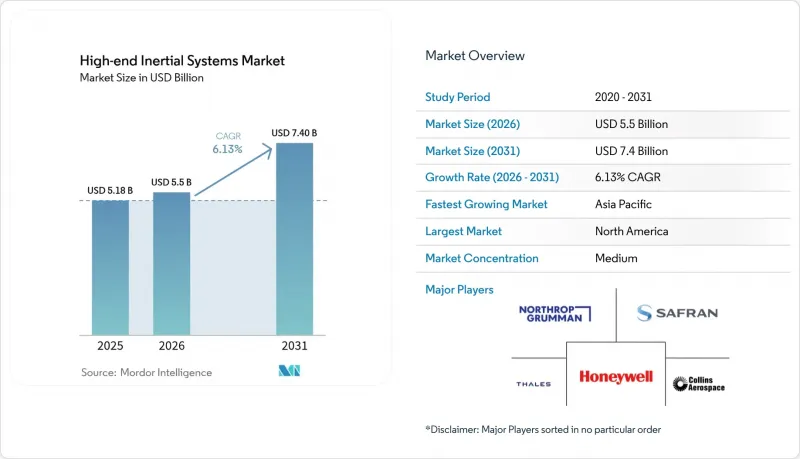
Mordor Intelligence에 의하면, 하이엔드 관성 시스템 시장 규모는 2025년 51억 8,000만 달러로 평가되었습니다. 2026년에는 55억 달러로 확대되어 2026-2031년에 걸쳐 CAGR 6.13%로 성장을 지속하여, 2031년에는 74억 달러에 이를 것으로 예측됩니다.
본 보고서는 유형별(관성 측정 장치, 관성 항법 시스템, 기타), 구성 요소별(센서, 프로세서, 소프트웨어·알고리즘, 기타), 최종 사용자 산업별(방위 및 항공우주, 산업, 해양·해저, 기타),내비게이션 등급별(전략 등급, 내비게이션 등급, 기타), 지역별로 분류되어 있습니다. 시장 예측은 금액(달러) 기준으로 제시되어 있습니다.
세계의 하이엔드 관성 시스템 시장 동향 및 인사이트
무인항공기(UAV) 및 자율주행차의 보급
UAV 기체 수 증가와 자율 시스템 도입 확대로 인해, 운용자는 드리프트를 1°/h 이하로 억제하는 전술 등급 IMU를 채택할 수밖에 없게 되었습니다. 이를 통해 GPS 교란 상황에서도 임무를 지속할 수 있게 됩니다. 미국 특수작전사령부는 2024년부터 2029년에 걸쳐 1,200대 이상의 그룹 3 UAV를 조달할 전망을 제시하고 있어, 고정밀 IMU에 대한 안정적인 수요 기반이 형성되고 있습니다. 광업 및 농업 분야에서는 시각·관성 오도메트리가 IMU의 출력과 스테레오 카메라 영상을 통합함으로써, 누적 위치 오차를 주행 거리의 0.5% 이하로 억제하면서도 단가를 5,000달러 이하로 유지하고 있습니다. 융합 데이터의 로컬 처리를 통해 클라우드로의 오프로드에 따른 지연이 해소되므로, 각 센서 제조업체들은 안전상 중요한 응답 요건을 충족하는 온보드 칼만 필터의 공동 개발을 추진하고 있습니다. 이러한 추세는 전략적 수준의 수주 잔고를 훼손하지 않으면서, 민수 부문에서 하이엔드 관성 시스템의 추가적인 보급을 뒷받침하고 있습니다.
관성 항법 시스템의 국방 현대화 예산
2024 회계연도에는 국방부의 예산 배정이 증가했으며, 그 일례로 Honeywell에 전술 등급 IMU와 방해 대책 수신기를 결합한 ‘분산형 방해 대책 GPS 시스템’에 대해 9,900만 달러 규모의 계약이 발주되었습니다. 유럽 각국의 해군에서도 유사한 업그레이드 주기가 진행되고 있으며, 1990년대에 제작된 광섬유 자이로스코프를 새로운 전술 등급의 INS로 교체함으로써 단가를 약 30% 절감하고 플랫폼의 수명을 연장하고 있습니다. 미국 육군의 ‘Mounted Assured Positioning, Navigation and Timing(MAPT)’ 아키텍처는 LN-251 광섬유 자이로와 암호화 GPS를 융합하여 전자 공격에 대한 차량의 내성을 높이고 있습니다. 이로 인해 1티어 주요 제조업체들에게는 지속적인 수익원이 확고해지는 반면, 신규 진출기업들에게는 인증 장벽이 높아지고 있습니다. 이러한 계약들은 상용 수요가 변동하는 경우에도 하이엔드 관성 시스템 시장을 지탱하는 기반이 되고 있습니다.
높은 초기 조달 비용 및 교정 비용
50만 달러를 초과하는 전략급 관성 항법 시스템에는 6축 열 보정이 필요하며, 이로 인해 구매 비용이 20% 증가하고 리드 타임이 18개월 이상 연장될 가능성이 있습니다. 전술급 IMU의 경우에도 72시간에 달하는 공장 내 조정 과정이 필요하기 때문에 중소규모 산업용 구매자들은 1,000달러 미만의 GNSS 전용 모듈을 선택하여 도입을 미루는 경향이 있습니다. 리스나 ‘CaaS(Calibration-as-a-Service)’와 같은 제도는 여전히 미성숙한 상태이기 때문에 최종 사용자는 소비자용 하드웨어의 수명 주기를 상회하는 10년 단위의 갱신 주기에 걸쳐 자본 지출을 상각할 수밖에 없으며,이로 인해 하이엔드 관성 시스템 시장으로의 단기적인 확산이 제한되고 있습니다.
부문 분석
관성 측정 장치(IMU)는 2025년 매출의 37.85%를 차지하며, 멀티 도메인 내비게이션 플랫폼용 하이엔드 관성 시스템 시장 규모에서 그 중심적인 역할을 부각시켰습니다. 이 모듈식 아키텍처는 3축 가속도계와 자이로스코프를 외부 프로세서와 결합하는 방식으로, OEM 각사는 항공우주 부문이나 산업용 로봇 분야에서 성능 대 비용 비율을 최적화할 수 있습니다. 자세·방위 참조 시스템(AHRS)은 연평균 성장률(CAGR) 8.28%를 기록할 전망입니다. 이는 주로 해상 풍력 발전 설비 설치 선박에서 0.5° 이내의 방위 정밀도가 요구되며, 이 부문에서는 통합형 자력계가 독립형 IMU보다 우수한 성능을 발휘하기 때문입니다. 이러한 성능 향상은 단순한 지출 증가가 아니라, 단계적인 센서 융합이 부문 간 대체를 촉진하고 있음을 보여줍니다.
IMU는 UAV 및 미사일 부문에서 설계 채택 기회가 확대되는 혜택을 누리고 있는 반면, AHRS는 플러그 앤 플레이 방식의 피치·롤 솔루션을 필요로 하는 선박 및 광산 장비 부문에서 성장세를 보이고 있습니다. 광섬유 또는 MEMS 자이로를 플럭스게이트 방식 또는 솔리드 스테이트 방식 나침반과 결합함으로써, AHRS는 가격에 민감한 플랫폼에서 더 고가의 INS 장치를 대체할 수 있게 됩니다. 2024년에 0.001°/h의 바이어스 안정성을 달성한 노스롭 그루먼사의 LR-500과 같은 양자 간섭법을 이용한 프로토타입은 여전히 실험실 단계에 머물러 있지만, 소형화 로드맵을 통해 2030년까지 하이엔드 관성 시스템 시장에서 파괴적인 경쟁이 발생할 것임을 시사하고 있습니다.
2025년에는 센서 하드웨어가 부품 매출의 42.15%를 차지했습니다. 이는 클린룸에서의 MEMS 웨이퍼 가공이나 파이버 코일 권선과 같은 공정이 자본 집약적이기 때문이며, 이는 하이엔드 관성 시스템 시장의 비용 구조에 영향을 미치고 있습니다. 그러나 적응형 칼만 필터 라이브러리 및 AI를 활용한 오차 모델링에 대한 라이선스 비용을 고객이 부담하게 됨에 따라, 소프트웨어·알고리즘 부문은 연평균 성장률(CAGR) 8.37%를 나타낼 것으로 예측됩니다. 각 벤더들은 풀스루 수익을 확보하고 고객을 자사의 보정 프레임워크에 묶어두기 위해 하드웨어에 미들웨어를 번들로 제공하는 경향이 강해지고 있습니다.
프로세서(일반적으로 ARM Cortex-M7 또는 DSP 코어)는 부품 원가의 약 9%를 차지하지만, IMU의 샷 노이즈를 억제하는 데 필수적인 1밀리초 이하의 결정론적 루프 시간을 확보합니다. 티타늄 및 탄소섬유로 제작된 기계 프레임은 진동으로 인한 오차를 줄여주며, 이는 군사 및 해양 응용 분야에서 매우 중요합니다. 한편, 9-36V 레일용으로 설계된 전원 모듈은 크로스 플랫폼 통합의 폭을 넓혀, 하이엔드 관성 시스템 시장의 총 잠재 시장 규모 확대에 기여하고 있습니다.
지역별 분석
북미는 2025년 매출의 37.65%를 차지하며, 미국 국방부는 항공, 육상, 해상 플랫폼에 걸친 관성 시스템 업그레이드에 12억 달러를 투자했습니다. Honeywell의 클리어워터 공장과 노스롭 그루먼의 우드랜드 힐스 공장이 전략급 제품 생산을 주도하고 있으며, 캐나다 북극권에서의 프로그램이 -55°C를 지원하는 IMU에 대한 수요를 뒷받침하고 있습니다. 멕시코의 케레타로 클러스터에서는 USMCA(미국·멕시코·캐나다 협정)의 관세 우대 조치 대상인 전술급 센서의 조립이 이루어지고 있으나, ITAR(국제무기거래규정)의 재수출 규제 대상에 포함되어 있어 하이엔드 관성 시스템 시장공급망 상호의존 관계가 부각되고 있습니다.
아시아태평양에서는 베이두(BeiDou)를 이용할 수 없는 경우를 대비한 백업 시스템, 1억 달러를 초과하는 일본 구축함 개조, 인도의 ‘메이크 인 인디아(Make in India)’ 방위 오프셋 정책에 힘입어 2031년까지 연평균 성장률(CAGR) 8.21%를 나타낼 것으로 예측됩니다. K2 전차와 연간 2,000대 이상의 IMU를 사용하는 호주의 광산 차량용으로 한화가 공급하는 국산 IMU는 전략적 회복탄력성과 산업 자동화 모두에 대한 해당 지역 수요를 반영하고 있습니다. 대만과 한국의 반도체 제조 공장은 MEMS의 대량 생산 능력을 보유하고 있으며, 출하 대수 증가에 따라 해당 지역이 센서 하드웨어 시장에서 더 큰 점유율을 확보할 준비가 되어 있습니다.
하이엔드 관성 시스템 시장의 나머지 부분은 유럽, 중동 및 아프리카가 차지하고 있습니다. Orsted의 Hornsea 2와 같은 유럽의 해상 풍력 발전 프로젝트에서는 동적 위치 결정에 광섬유 자이로가 채택되어, 수익성이 높은 해양 틈새 시장이 유지되고 있습니다. 중동 수요는 UCAV(무인 전투기)용 전술 등급 제품의 수입이 주를 이루는 반면, 남아프리카의 지하 백금 광산에서는 GNSS를 이용할 수 없는 환경에서의 산업용 등급 비즈니스 기회가 주목받고 있습니다. 또한, 이 지역에서는 독일과 프랑스에서 생산되는 광섬유공급망에 제약이 발생하고 있어, 이로 인해 광섬유 유닛의 리드타임이 길어질 가능성이 있습니다.
기타 혜택
- 엑셀 형식 시장 예측(ME) 시트
- 3개월간의 애널리스트 지원
자주 묻는 질문
목차
제1장 서론
제2장 조사 방법
제3장 주요 요약
제4장 시장 구도
제5장 시장 규모 및 성장 예측
제6장 경쟁 구도
제7장 시장 기회 및 향후 전망
KTH 26.08.26According to Mordor Intelligence, the high-end inertial systems market size is expected to grow from USD 5.18 billion in 2025 to USD 5.5 billion in 2026 and is forecast to reach USD 7.4 billion by 2031 at 6.13% CAGR over 2026-2031.
This report is Segmented by Type (Inertial Measurement Units, Inertial Navigation Systems, and More), Component (Sensors, Processors, Software and Algorithms, and More), End-User Industry (Defense and Aerospace, Industrial, Marine and Sub-Sea, and More), Navigation Grade (Strategic Grade, Navigation Grade, and More), and Geography. The Market Forecasts are Provided in Terms of Value (USD).
Global High-end Inertial Systems Market Trends and Insights
Proliferation of UAVs And Autonomous Vehicles
Rising UAV fleet sizes and autonomous-system deployments compel operators to adopt tactical-grade IMUs that minimize drift below 1°/h, allowing missions to continue during GPS jamming. U.S. Special Operations Command forecast procurement of more than 1,200 Group-3 UAVs between 2024 and 2029, embedding a steady base of high-rate IMU demand. In mining and agriculture, visual-inertial odometry integrates IMU outputs with stereo-camera feeds, reducing cumulative position error to under 0.5% of the distance traveled while keeping the unit price below USD 5,000. Local processing of fused data eliminates latency associated with cloud offloading, prompting sensor makers to co-develop on-board Kalman filters that satisfy safety-critical response requirements. This momentum supports the broader penetration of high-end inertial systems in the civilian sector without diluting the strategic-grade backlog.
Defense Modernization Budgets For Inertial Navigation
Pentagon allocations rose in fiscal 2024, exemplified by a USD 99 million award to Honeywell for the Distributed Anti-Jam GPS System that pairs tactical-grade IMUs with anti-jam receivers. Similar upgrade cycles in European navies are replacing 1990s-era fiber-optic gyros with newer tactical-grade INS, cutting per-unit costs by roughly 30% and extending platform life. The U.S. Army's Mounted Assured Positioning, Navigation and Timing architecture blends LN-251 fiber-optic gyros with encrypted GPS to harden vehicles against electronic attack, solidifying recurring revenue for Tier-1 primes but raising certification barriers for entrants. These contracts anchor the high-end inertial systems market even when commercial demand fluctuates.
High Initial Procurement And Calibration Costs
Strategic-grade inertial navigation systems priced above USD 500,000 require six-axis thermal calibration, which can add 20% to the purchase cost and extend lead times by more than 18 months. Tactical-grade IMUs still require factory cycles spanning 72 hours, pushing smaller industrial buyers to postpone adoption in favor of GNSS-only modules under USD 1,000. Leasing and calibration-as-a-service schemes remain immature, forcing end users to amortize capital expenses over decade-long refresh cycles that exceed consumer-hardware timelines, constraining near-term penetration of the high-end inertial systems market.
Other drivers and restraints analyzed in the detailed report include:
- Advancements In MEMS Manufacturing Reducing SWaP
- Increasing Demand For GNSS-Denied Navigation In Aerospace
- Complex System Integration Challenges In Multi-Sensor Fusion
For complete list of drivers and restraints, kindly check the Table Of Contents.
Segment Analysis
Inertial measurement units contributed 37.85% of 2025 revenue, underscoring their centrality to the high-end inertial systems market size for multi-domain navigation platforms. Their modular architecture pairs tri-axis accelerometers and gyroscopes with external processors, allowing OEMs to tailor performance-to-cost ratios across aerospace and industrial robots. Attitude and heading reference systems are set to clock an 8.28% CAGR, mainly because offshore-wind installation vessels demand heading accuracy within 0.5°, where integrated magnetometers outperform standalone IMUs. This performance uptick underlines how incremental sensor fusion is driving segment substitution rather than pure additive spend.
IMUs benefit from broader design-win opportunities in UAVs and missiles; yet AHRS gains traction in marine and mining equipment seeking plug-and-play pitch-roll solutions. Fiber-optic or MEMS gyros, when combined with fluxgate or solid-state compasses, enable AHRS to replace more expensive INS units on price-sensitive platforms. Quantum-interferometry prototypes, such as Northrop Grumman's LR-500, which achieved 0.001°/h bias stability in 2024, remain in laboratories; however, miniaturization roadmaps suggest disruptive competition within the high-end inertial systems market before 2030.
Sensor hardware accounted for 42.15% of component revenue in 2025, reflecting the capital-intensive nature of clean-room MEMS wafering and fiber-coil winding, which influences the cost structure across the high-end inertial systems market share. However, software and algorithms are expected to record an 8.37% CAGR as customers pay licensing fees for adaptive Kalman-filter libraries and AI-enhanced error modeling. Vendors increasingly bundle middleware with hardware to secure pull-through revenue and lock customers into their calibration frameworks.
Processors, typically ARM Cortex-M7 or DSP cores, account for roughly 9% of the bill-of-materials value but ensure deterministic loop times of less than 1 ms, which is necessary for suppressing IMU shot noise. Mechanical frames made of titanium or carbon fiber stave off vibration-induced errors, which are critical for military and offshore applications. Meanwhile, power-supply modules designed for 9-36 V rails broaden cross-platform integration, helping to expand the total addressable spend within the high-end inertial systems market.
Complete Report Scope:
- By Type
- Inertial Measurement Units
- Inertial Navigation Systems
- Accelerometers
- Gyroscopes
- Attitude and Heading Reference Systems
- Others
- By Component
- Sensors
- Processors (DSP and Micro-controllers)
- Software and Algorithms
- Mechanical Frames
- Power Supplies
- Others
- By End-user Industry
- Defense and Aerospace
- Industrial
- Marine and Sub-sea
- Mining and Drilling
- Automotive
- Other End-user Industries
- By Navigation Grade
- Strategic Grade
- Navigation Grade
- Tactical Grade
- Industrial Grade
- By Geography
- North America
- United States
- Canada
- Mexico
- South America
- Brazil
- Argentina
- Rest of South America
- Europe
- Germany
- United Kingdom
- France
- Italy
- Spain
- Russia
- Rest of Europe
- Asia Pacific
- China
- Japan
- India
- South Korea
- Australia
- Rest of Asia Pacific
- Middle East and Africa
- Middle East
- Saudi Arabia
- United Arab Emirates
- Turkey
- Rest of Middle East
- Africa
- South Africa
- Nigeria
- Egypt
- Rest of Africa
- Middle East
- North America
Geography Analysis
North America generated 37.65% of 2025 revenue as Pentagon funding of USD 1.2 billion flowed into inertial upgrades across air, land, and sea platforms. Honeywell's Clearwater and Northrop Grumman's Woodland Hills plants dominate strategic-grade output, with Canadian Arctic programs spurring demand for -55 °C-rated IMUs. Mexico's Queretaro cluster assembles tactical-grade sensors that qualify for USMCA duty benefits yet remain subject to ITAR re-export rules, illustrating the interdependence of supply chains within the high-end inertial systems market.
Asia Pacific is predicted to log an 8.21% CAGR through 2031, propelled by BeiDou-denied backup systems, Japanese destroyer retrofits worth over USD 100 million, and India's Make-in-India defense offsets. Hanwha's domestic IMU for the K2 tank and Australian mining fleets, which utilize more than 2,000 IMUs annually, reflect the regional appetite for both strategic resilience and industrial automation. Taiwan and South Korea's semiconductor fabs offer MEMS volume capacity, positioning the region to capture a larger share of sensor hardware as unit shipments rise.
Europe, the Middle East, and Africa supply the remainder of the high-end inertial systems market. European offshore wind projects, such as Orsted's Hornsea 2, employ fiber-optic gyros for dynamic positioning, sustaining a high-margin marine niche. Middle Eastern demand centers around UCAV tactical-grade imports, while South African underground platinum mining highlights industrial-grade opportunities in GNSS-denied environments. The region also faces supply-chain constraints for optical fiber produced in Germany and France, which could potentially lengthen lead times for fiber-optic units.
- Honeywell International Inc.
- Northrop Grumman Corporation
- Safran S.A.
- Thales S.A.
- Collins Aerospace (Raytheon Technologies Corp.)
- Bosch Sensortec GmbH
- Analog Devices Inc.
- Moog Inc.
- ON Semiconductor Corp.
- VectorNav Technologies LLC
- STMicroelectronics N.V.
- KVH Industries Inc.
- Silicon Sensing Systems Ltd.
- Exail Group (formerly iXblue SAS)
- Trimble Inc.
- Colibrys (Safran Sensors and Electronics) SA
- TDK InvenSense Inc.
- Teledyne Technologies Inc.
- Systron Donner Inertial (EMCORE Corp.)
- Epson ToyoCom Corp.
Additional Benefits:
- The market estimate (ME) sheet in Excel format
- 3 months of analyst support
TABLE OF CONTENTS
1 INTRODUCTION
- 1.1 Study Assumptions and Market Definition
- 1.2 Scope of the Study
2 RESEARCH METHODOLOGY
3 EXECUTIVE SUMMARY
4 MARKET LANDSCAPE
- 4.1 Market Overview
- 4.2 Impact of Macroeconomic Factors
- 4.3 Market Drivers
- 4.3.1 Proliferation of UAVs and autonomous vehicles
- 4.3.2 Defense modernization budgets for inertial navigation
- 4.3.3 Advancements in MEMS manufacturing reducing SWaP
- 4.3.4 Increasing demand for GNSS-denied navigation in aerospace
- 4.3.5 Emergence of quantum-enhanced inertial sensors
- 4.3.6 Integration with fiber-optic gyros in offshore wind installation vessels
- 4.4 Market Restraints
- 4.4.1 High initial procurement and calibration costs
- 4.4.2 Complex system integration challenges in multi-sensor fusion
- 4.4.3 Supply-chain vulnerabilities for specialty inertial-grade quartz and optical fibers
- 4.4.4 Regulatory export controls limiting high-performance IMU shipments
- 4.5 Industry Value Chain Analysis
- 4.6 Regulatory Landscape
- 4.7 Technological Outlook
- 4.8 Porter's Five Forces Analysis
- 4.8.1 Bargaining Power of Suppliers
- 4.8.2 Bargaining Power of Consumers
- 4.8.3 Threat of New Entrants
- 4.8.4 Threat of Substitute Products
- 4.8.5 Intensity of Competitive Rivalry
5 MARKET SIZE AND GROWTH FORECASTS (VALUE)
- 5.1 By Type
- 5.1.1 Inertial Measurement Units
- 5.1.2 Inertial Navigation Systems
- 5.1.3 Accelerometers
- 5.1.4 Gyroscopes
- 5.1.5 Attitude and Heading Reference Systems
- 5.1.6 Others
- 5.2 By Component
- 5.2.1 Sensors
- 5.2.2 Processors (DSP and Micro-controllers)
- 5.2.3 Software and Algorithms
- 5.2.4 Mechanical Frames
- 5.2.5 Power Supplies
- 5.2.6 Others
- 5.3 By End-user Industry
- 5.3.1 Defense and Aerospace
- 5.3.2 Industrial
- 5.3.3 Marine and Sub-sea
- 5.3.4 Mining and Drilling
- 5.3.5 Automotive
- 5.3.6 Other End-user Industries
- 5.4 By Navigation Grade
- 5.4.1 Strategic Grade
- 5.4.2 Navigation Grade
- 5.4.3 Tactical Grade
- 5.4.4 Industrial Grade
- 5.5 By Geography
- 5.5.1 North America
- 5.5.1.1 United States
- 5.5.1.2 Canada
- 5.5.1.3 Mexico
- 5.5.2 South America
- 5.5.2.1 Brazil
- 5.5.2.2 Argentina
- 5.5.2.3 Rest of South America
- 5.5.3 Europe
- 5.5.3.1 Germany
- 5.5.3.2 United Kingdom
- 5.5.3.3 France
- 5.5.3.4 Italy
- 5.5.3.5 Spain
- 5.5.3.6 Russia
- 5.5.3.7 Rest of Europe
- 5.5.4 Asia Pacific
- 5.5.4.1 China
- 5.5.4.2 Japan
- 5.5.4.3 India
- 5.5.4.4 South Korea
- 5.5.4.5 Australia
- 5.5.4.6 Rest of Asia Pacific
- 5.5.5 Middle East and Africa
- 5.5.5.1 Middle East
- 5.5.5.1.1 Saudi Arabia
- 5.5.5.1.2 United Arab Emirates
- 5.5.5.1.3 Turkey
- 5.5.5.1.4 Rest of Middle East
- 5.5.5.2 Africa
- 5.5.5.2.1 South Africa
- 5.5.5.2.2 Nigeria
- 5.5.5.2.3 Egypt
- 5.5.5.2.4 Rest of Africa
- 5.5.5.1 Middle East
- 5.5.1 North America
6 COMPETITIVE LANDSCAPE
- 6.1 Market Concentration
- 6.2 Strategic Moves
- 6.3 Market Share Analysis
- 6.4 Company Profiles (includes Global level overview, Market level overview, Core Segments, Financials as available, Strategic Information, Market Rank/Share, Products and Services, Recent Developments)
- 6.4.1 Honeywell International Inc.
- 6.4.2 Northrop Grumman Corporation
- 6.4.3 Safran S.A.
- 6.4.4 Thales S.A.
- 6.4.5 Collins Aerospace (Raytheon Technologies Corp.)
- 6.4.6 Bosch Sensortec GmbH
- 6.4.7 Analog Devices Inc.
- 6.4.8 Moog Inc.
- 6.4.9 ON Semiconductor Corp.
- 6.4.10 VectorNav Technologies LLC
- 6.4.11 STMicroelectronics N.V.
- 6.4.12 KVH Industries Inc.
- 6.4.13 Silicon Sensing Systems Ltd.
- 6.4.14 Exail Group (formerly iXblue SAS)
- 6.4.15 Trimble Inc.
- 6.4.16 Colibrys (Safran Sensors and Electronics) SA
- 6.4.17 TDK InvenSense Inc.
- 6.4.18 Teledyne Technologies Inc.
- 6.4.19 Systron Donner Inertial (EMCORE Corp.)
- 6.4.20 Epson ToyoCom Corp.
7 MARKET OPPORTUNITIES AND FUTURE OUTLOOK
- 7.1 White-space and Unmet-Need Assessment