

|
시장보고서
상품코드
2113753
말초혈관 디바이스 : 시장 점유율 분석, 업계 동향과 통계, 성장 예측(2026-2031년)Peripheral Vascular Devices - Market Share Analysis, Industry Trends & Statistics, Growth Forecasts (2026 - 2031) |
||||||
 Mordor Intelligence
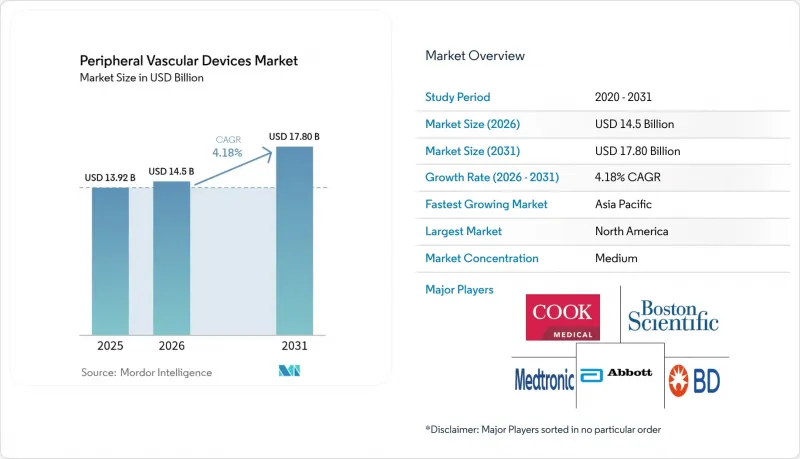
말초혈관 디바이스 시장 규모는 2025년 139억 2,000만 달러에서 2026년에는 145억 달러로 확대하며, 2031년까지 178억 달러에 달할 것으로 예상되고 있으며, 2026-2031년에 CAGR 4.18%로 성장할 것으로 전망되고 있습니다.
이 보고서는 기기 유형별(혈관성형술용 풍선, 혈관성형술용 스텐트, 아테렉토미 기기, 혈전 제거 기기, 색전 방지 기기, 하대정맥 필터, 말초 가이드와이어, 기타),임상 용도별(말초동맥질환(PAD), 중증 하지 허혈(CLI), 심부정맥혈전증(DVT), 기타), 최종사용자별(병원, ASC, OBL, 전문 클리닉) 및 지역별(북미, 유럽, 아시아태평양, 기타)로 분류되어 있습니다. 시장 전망은 금액(달러) 기준으로 제시됩니다.
전 세계 말초 혈관 치료 기기 시장의 동향 및 인사이트
말초동맥 및 정맥 질환 유병률의 급증
메디케어 청구 데이터에 따르면 2019-2024년까지 하지 혈관 재건술이 19% 증가한 반면, 평균 입원 일수는 23% 감소하여, 더 신속하고 기기를 많이 사용하는 치료로 전환되고 있음이 드러났습니다. OECD 회원국에서 심부정맥혈전증(DVT)의 발생률은 COVID-19 후유증과 비만을 배경으로 2020-2025년까지 연평균 8% 증가했습니다. 미국심장협회(AHA)는 2025년 최신 보고서에서 심부정맥혈전증(DVT)을 급성 심혈관 증후군 중 3위 규모의 질환으로 규정하며, 이를 틈새 질환에서 주류 중재 치료 대상으로 격상시켰습니다.
저침습적 카테터를 이용한 혈관 재건술로의 전환
미국내 개흉 우회술 시행 건수는 2015-2024년 사이에 31% 감소한 반면, 경피적 중재술은 47% 증가했습니다. 약물 방출형 스텐트는 현재 대퇴슬와동맥 질환에서 5년 개존율 78%를 달성하여, 기존 수술이 가졌던 내구성 면에서의 우위를 상쇄하고 있습니다. 일본에서는 2024년 아테렉토미에 대한 보험 적용 결정에 따라 다음 분기에 시술 건수가 40% 급증했습니다.
미국 및 일부 EU 시장에서 의료기기 보험 환급액 삭감
2026년 CMS(미국 의료보험 및 의료보조 서비스 센터)가 90일간의 PAD(말초동맥질환) 에피소드당 1만 8,500달러의 포괄 지급 상한선을 설정함에 따라 병원들은 의료기기 가격을 15-25% 인하할 수밖에 없게 되었습니다. 독일에서는 2025년에 하지 DRG(진단 관련군) 가중치를 8% 인하했습니다. 또한 영국의 지침에 따라 1차 선택 치료법으로서의 DCB(약물 방출 풍선) 사용을 스텐트내 재협착으로 제한하게 되어, 최첨단 기술의 도입이 억제되고 있습니다.
부문 분석
아테렉토미 제품의 매출은 2026-2031년까지 연평균 성장률(CAGR) 8.22%를 기록할 것으로 예상되며, 이는 의료기기 부문에서 가장 높은 수치입니다. 2025년 말초혈관 치료 기기 시장에서 혈관성형술용 풍선의 시장 점유율은 35.18%였으나, 아시아의 제네릭 제품과의 치열한 경쟁으로 인해 평균 판매 가격은 2022년 대비 12% 하락했습니다. 아테렉토미 시스템의 말초 혈관 치료 기기 시장 규모는 일본과 호주에서 석회화가 심한 병변의 비율이 높고, 보험 환급 제도의 지원도 있으며, 2031년까지 매출이 크게 증가할 것으로 예측됩니다. DEFINITIVE LE 데이터세트에 따르면 방향성 아테렉토미와 DCB를 병용함으로써 석회화 혈관에서 18개월간의 개존율 81%를 달성했습니다. 그러나 카테터 1개의 가격이 여전히 2,500-3,500달러에 달하므로 병원 측에서는 영상 진단을 통해 확인된 중증 석회화에 한해 사용하고 있습니다.
2차 제품군에서는 양극화가 나타나고 있습니다. 2024년에 장골대퇴정맥혈전증(DVT)용 흡입 시스템이 FDA 승인을 받은 후, 혈전 제거술의 채택이 급증했습니다. 자가팽창형 스텐트는 상품화가 진행되고 있으며, 각 벤더사는 파열에 강한 합금이나 더 얇은 스트럿 프로파일로 전환을 추진하고 있습니다. 예방적 사용에 반대하는 ACCP 가이드라인 개정에 따라 하대정맥(IVC) 필터의 수요는 감소했으나, 가이드와이어와 시스는 이익률은 낮지만 필수적인 지속적인 수입원으로 자리 잡고 있습니다.
지역별 분석
2025년 매출 중 42.25%를 북미가 차지했습니다. 미국에서는 지급 상한선 및 진료 장소의 전환으로 인해 협상이 활발해지고 있으며, 1건당 평균 의료기기 비용이 병원의 2,400달러에 비해 외래 수술 센터(ASC)에서는 1,800달러로 낮아지는 등 성장이 둔화될 것으로 예상됩니다. 캐나다에서는 카테터실 수용 능력에 대한 투자가 이루어졌으나, 주별 대기 기간이 12주에 달하므로 수술 건수는 억제되고 있습니다. 멕시코의 민간 병원 부문에서는 체외 충격파 쇄석술 및 리무스 풍선 도입이 진행되고 있는데, 이는 자원이 제한된 공립 의료기관과는 대조적입니다.
아시아태평양은 연평균 성장률(CAGR) 7.68%의 궤도에 올라 있습니다. 중국의 말초 혈관 치료 기기 시장은 국내 유력 기업이 적극적인 가격 책정을 통해 큰 시장 점유율을 확보하고 있는 데서 혜택을 보고 있습니다. 인도의 ‘프라단 만트리 스와스야 수용샤 요자나(Pradhan Mantri Swasthya Suraksha Yojana)’에 따라 1급 대도시권 이외 지역에서의 카테터실 설치가 가속화되며 의료 격차가 줄어들고 있습니다. 일본에서는 당뇨병 위험이 높은 고령 인구의 증가로 말초동맥질환(PAD) 유병률이 상승하고 있지만, 입원 기간 단축에 따라 1건당 의료기기 비용은 평균 1,600달러에 그치고 있습니다. 호주에서는 2025년 OBL(의약품·의료기기 리스트)에 품목이 등재됨에 따라 차세대 시롤리무스 풍선의 시범 도입 거점으로서의 입지를 확고히 하고 있습니다.
유럽은 절대액 기준으로 큰 시장 규모를 자랑하지만, 보험 급여 규정의 차이로 인해 도입 속도에 차이가 발생하고 있습니다. 독일에서는 DCB가 1차 치료법으로 보험 급여 대상인 반면, 영국에서는 재협착에 대한 DCB 사용에 상한선이 설정되어 있습니다. 프랑스는 2024년에 궤도상 아테렉토미를 승인했습니다. 구세대 풍선에 의존하고 있는 동유럽 국가들에는 카테터실 설비 갱신을 목적으로 한 EU 구조 기금이 배정되어 있으며, 이는 기술적 측면에서의 점진적인 추격을 지원하게 될 것입니다.
기타 혜택:
- 엑셀 형식의 시장 예측(ME) 시트
- 3개월간의 애널리스트 지원
자주 묻는 질문
목차
제1장 서론
제2장 조사 방법
제3장 개요
제4장 시장 구도
제5장 시장 규모와 성장 예측
제6장 경쟁 구도
제7장 시장 기회와 향후 전망
KSA 26.08.25According to Mordor Intelligence, the peripheral vascular devices market size is expected to increase from USD 13.92 billion in 2025 to USD 14.5 billion in 2026 and reach USD 17.80 billion by 2031, growing at a CAGR of 4.18% over 2026-2031.
This report is Segmented by Device Type (Angioplasty Balloons, Angioplasty Stents, Atherectomy Devices, Thrombectomy Devices, Embolic Protection Devices, IVC Filters, Peripheral Guidewires, Others), Clinical Application (PAD, CLI, DVT, Other), End User (Hospitals, Ascs, Obls, Specialty Clinics), and Geography (North America, Europe, Asia-Pacific, and More). Market Forecasts are in Value (USD).
Global Peripheral Vascular Devices Market Trends and Insights
Rapid Rise in Peripheral Artery & Venous Disease Prevalence
Medicare claims showed a 19% jump in lower-extremity revascularizations between 2019 and 2024, even while average length of stay fell 23%, underscoring the push for faster, device-intensive therapy. Deep-vein thrombosis incidence across OECD members increased 8% annually over 2020-2025, fueled by post-COVID sequelae and obesity. The American Heart Association positioned DVT as the third largest acute cardiovascular syndrome in its 2025 update, elevating it from a niche condition to a mainstream interventional focus.
Shift Toward Minimally-Invasive, Catheter-Based Revascularization
Open bypass volumes in the United States dropped 31% between 2015 and 2024, while percutaneous interventions rose 47%. Drug-eluting stents now deliver 78% 5-year patency in femoropopliteal disease, neutralizing the historic durability edge of surgery. Japan's 2024 reimbursement decision on atherectomy prompted a 40% spike in procedure counts the next quarter.
Device Reimbursement Cuts in the US & Select EU Markets
The 2026 CMS bundled-payment ceiling of USD 18,500 per 90-day PAD episode forces hospitals to secure 15-25% device discounts. Germany trimmed lower-extremity DRG weights 8% in 2025; United Kingdom guidance now limits first-line DCB use to in-stent restenosis, curbing premium-technology uptake.
Other drivers and restraints analyzed in the detailed report include:
- Rapid Adoption of Drug-Coated Balloon Technology
- Growth of Office-Based Labs in OECD Nations
- Safety Concerns Over Paclitaxel-Eluting Peripherals
For complete list of drivers and restraints, kindly check the Table Of Contents.
Segment Analysis
Atherectomy revenue is expected to post an 8.22% CAGR between 2026-2031, the highest among device classes. The peripheral vascular devices market share for angioplasty balloons was 35.18% in 2025, but aggressive price competition from Asian generics cut average selling prices 12% compared with 2022. The peripheral vascular devices market size for atherectomy systems is projected to reach a significant revenue by 2031, alongside the calcium-heavy lesion mix and supportive coding in Japan and Australia. Directional atherectomy plus DCB achieved 81% 18-month patency in calcified vessels per the DEFINITIVE LE data set. Hospitals, however, cap usage to imaging-confirmed severe calcification because a single catheter still costs USD 2,500-3,500.
Second-tier products illustrate polarization. Thrombectomy adoption surged after FDA clearance of aspiration systems for iliofemoral DVT in 2024. Self-expanding stents edge toward commoditization, with vendors pivoting to fracture-resistant alloys and thinner strut profiles. IVC filters have declined after updated ACCP guidelines against prophylactic use, whereas guidewires and sheaths anchor low-margin but indispensable recurring revenue streams.
Complete Report Scope:
- By Device Type
- Angioplasty Balloons
- Angioplasty Stents
- Atherectomy Devices
- Thrombectomy Devices
- Embolic Protection Devices
- Inferior Vena Cava (IVC) Filters
- Peripheral Guidewires
- Others
- By Clinical Application
- Peripheral Arterial Disease (PAD)
- Critical Limb Ischaemia (CLI)
- Deep Vein Thrombosis (DVT)
- Other Clinical Applications
- By End User
- Hospitals
- Ambulatory Surgical Centers (ASCs)
- Office-Based Labs (OBLs)
- Specialty Vascular & Cardiology Clinics
- By Geography
- North America
- United States
- Canada
- Mexico
- Europe
- Germany
- United Kingdom
- France
- Italy
- Spain
- Rest of Europe
- Asia-Pacific
- China
- India
- Japan
- Australia
- South Korea
- Rest of Asia-Pacific
- Middle East and Africa
- GCC
- South Africa
- Rest of Middle East and Africa
- South America
- Brazil
- Argentina
- Rest of South America
- North America
Geography Analysis
North America provided 42.25% of 2025 revenue. The United States braces for tempered growth as payment caps and site-of-care migration drive negotiations that pull average device spend per case down to USD 1,800 in ASCs versus USD 2,400 in hospitals. Canada invested in cath-lab capacity, yet provincial wait times of 12 weeks restrain volume. Mexico's private-hospital tier moves ahead with lithotripsy and limus balloons, contrasting with resource-limited public institutions.
Asia-Pacific is on track for a 7.68% CAGR. China's peripheral vascular devices market benefits from domestic champions capturing significant market share through aggressive pricing. India's Pradhan Mantri Swasthya Suraksha Yojana accelerates cath-lab installations beyond tier-1 metros, narrowing care disparities. Japan's aging diabetogenic population fuels PAD prevalence, though device spend per case averages USD 1,600 amid shorter hospital stays. Australia's 2025 OBL item numbers position it as a proving ground for next-wave sirolimus balloons.
Europe contributes sizeable absolute dollars, yet heterogenous reimbursement rules split adoption curves. Germany reimburses DCBs as first-line therapy, while the United Kingdom caps DCBs for restenosis. France green-lit orbital atherectomy in 2024. Eastern Europe, reliant on earlier-generation balloons, receives EU structural funds earmarked for cath-lab upgrades that will underpin gradual technology catch-up.
- Abbott Laboratories
- AngioDynamics
- Asahi Intecc Co., Ltd.
- Beckton Dickinson
- BIOTRONIK
- Boston Scientific
- Cardinal Health
- Cardiovascular Systems
- Cook Group
- iVascular S.L.U.
- Medtronic
- MicroPort
- Nipro
- Penumbra
- Philips Healthcare (Spectranetics)
- Shockwave Medical Inc.
- Teleflex
- Terumo
Additional Benefits:
- The market estimate (ME) sheet in Excel format
- 3 months of analyst support
TABLE OF CONTENTS
1 Introduction
- 1.1 Study Assumptions & Market Definition
- 1.2 Scope of the Study
2 Research Methodology
3 Executive Summary
4 Market Landscape
- 4.1 Market Overview
- 4.2 Market Drivers
- 4.2.1 Rapid rise in peripheral artery & venous disease prevalence
- 4.2.2 Shift toward minimally-invasive, catheter-based revascularisation
- 4.2.3 Rapid adoption of drug-coated balloon technology
- 4.2.4 Growth of office-based labs (OBLs) in OECD nations
- 4.2.5 Hospital-to-ASC site-of-care migration for PAD procedures
- 4.2.6 National screening programmes for critical-limb ischaemia (CLI)
- 4.3 Market Restraints
- 4.3.1 Device reimbursement cuts in the US & select EU markets
- 4.3.2 Safety concerns over paclitaxel-eluting peripherals
- 4.3.3 Supply-chain fragility for specialty polymers & nitinol
- 4.3.4 Short product life-cycles driving inventory obsolescence
- 4.4 Supply-Chain Analysis
- 4.5 Regulatory Landscape
- 4.6 Technological Outlook
- 4.7 Porter's Five Forces
- 4.7.1 Threat of New Entrants
- 4.7.2 Bargaining Power of Suppliers
- 4.7.3 Bargaining Power of Buyers
- 4.7.4 Threat of Substitutes
- 4.7.5 Industry Rivalry
5 Market Size & Growth Forecasts (Value, USD)
- 5.1 By Device Type
- 5.1.1 Angioplasty Balloons
- 5.1.2 Angioplasty Stents
- 5.1.3 Atherectomy Devices
- 5.1.4 Thrombectomy Devices
- 5.1.5 Embolic Protection Devices
- 5.1.6 Inferior Vena Cava (IVC) Filters
- 5.1.7 Peripheral Guidewires
- 5.1.8 Others
- 5.2 By Clinical Application
- 5.2.1 Peripheral Arterial Disease (PAD)
- 5.2.2 Critical Limb Ischaemia (CLI)
- 5.2.3 Deep Vein Thrombosis (DVT)
- 5.2.4 Other Clinical Applications
- 5.3 By End User
- 5.3.1 Hospitals
- 5.3.2 Ambulatory Surgical Centers (ASCs)
- 5.3.3 Office-Based Labs (OBLs)
- 5.3.4 Specialty Vascular & Cardiology Clinics
- 5.4 By Geography
- 5.4.1 North America
- 5.4.1.1 United States
- 5.4.1.2 Canada
- 5.4.1.3 Mexico
- 5.4.2 Europe
- 5.4.2.1 Germany
- 5.4.2.2 United Kingdom
- 5.4.2.3 France
- 5.4.2.4 Italy
- 5.4.2.5 Spain
- 5.4.2.6 Rest of Europe
- 5.4.3 Asia-Pacific
- 5.4.3.1 China
- 5.4.3.2 India
- 5.4.3.3 Japan
- 5.4.3.4 Australia
- 5.4.3.5 South Korea
- 5.4.3.6 Rest of Asia-Pacific
- 5.4.4 Middle East and Africa
- 5.4.4.1 GCC
- 5.4.4.2 South Africa
- 5.4.4.3 Rest of Middle East and Africa
- 5.4.5 South America
- 5.4.5.1 Brazil
- 5.4.5.2 Argentina
- 5.4.5.3 Rest of South America
- 5.4.1 North America
6 Competitive Landscape
- 6.1 Market Concentration
- 6.2 Market Share Analysis
- 6.3 Company Profiles (includes Global level overview, Market level overview, Core Segments, Financials as available, Strategic Information, Market Rank/Share for key companies, Products & Services, and Recent Developments)
- 6.3.1 Abbott Laboratories
- 6.3.2 AngioDynamics Inc.
- 6.3.3 Asahi Intecc Co., Ltd.
- 6.3.4 Becton, Dickinson and Company
- 6.3.5 Biotronik SE & Co. KG
- 6.3.6 Boston Scientific Corporation
- 6.3.7 Cardinal Health (Cordis)
- 6.3.8 Cardiovascular Systems Inc.
- 6.3.9 Cook Medical LLC
- 6.3.10 iVascular S.L.U.
- 6.3.11 Medtronic plc
- 6.3.12 MicroPort Scientific Corporation
- 6.3.13 Nipro Corporation
- 6.3.14 Penumbra Inc.
- 6.3.15 Philips Healthcare (Spectranetics)
- 6.3.16 Shockwave Medical Inc.
- 6.3.17 Teleflex Incorporated
- 6.3.18 Terumo Corporation
7 Market Opportunities & Future Outlook
- 7.1 White-space & Unmet-Need Assessment


