

|
시장보고서
상품코드
2116468
말초혈관 기기 및 부속품 : 시장 점유율 분석, 업계 동향 및 통계, 성장 예측(2026-2031년)Peripheral Vascular Devices And Accessories - Market Share Analysis, Industry Trends & Statistics, Growth Forecasts (2026 - 2031) |
||||||
 Mordor Intelligence
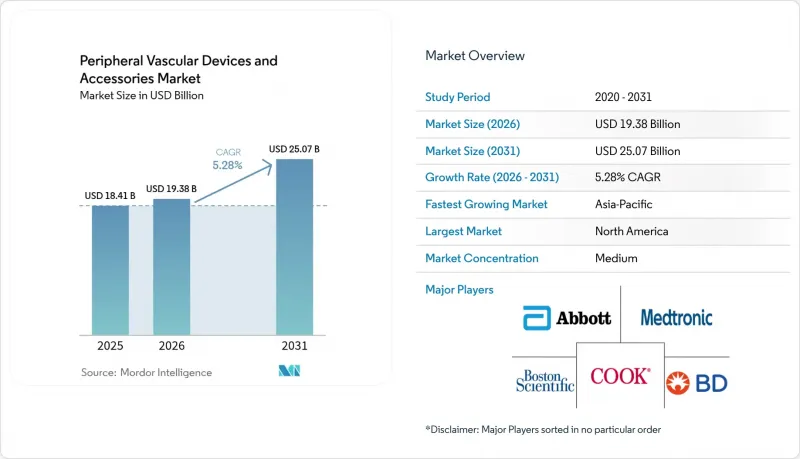
Mordor Intelligence에 의하면, 말초혈관 기기 및 부속품 시장 규모는 2025년 184억 1,000만 달러로 평가되었습니다. 2026년에는 193억 8,000만 달러로 확대되어 2026년부터 2031년에 걸쳐 CAGR 5.28%로 성장을 지속하여, 2031년에는 250억 7,000만 달러에 이를 것으로 예측됩니다.
본 보고서에서는 업계를 제품 유형별(기기, 부속품), 용도별(말초동맥질환, 심부정맥혈전증 등), 최종 사용자별(병원, 외래수술센터(ASC) 등), 지역별(북미, 유럽, 아시아태평양 등)로 분류하고 있습니다. 시장 예측은 금액(달러) 기준으로 제시되어 있습니다.
세계의 말초혈관 기기 및 부속품 시장 동향 및 인사이트
고령화에 따른 말초동맥질환(PAD) 유병률 상승
미국에서는 2,000만 명 이상의 성인이 말초동맥질환(PAD)을 앓고 있으며, 65세 이상 인구 증가에 따라 치료 건수도 증가하고 있습니다. 고령 환자에서는 다발성 병변이나 석회화 병변이 빈번하게 나타나며, 이를 치료하기 위해서는 고품질의 약물 코팅 풍선, 생체 흡수성 스캐폴드 및 첨단 아테렉토미 기구가 필요합니다. 메디케어의 외래 혈관 중재술에 대한 보험 적용으로 접근성이 확대되고 있으며, 병원 네트워크는 수용 능력을 관리하기 위해 당일 퇴원 제도를 활용하고 있습니다. 노화에 따라 해부학적 변이성이 증가함에 따라 환자별로 맞춤화된 이식편에 대한 수요가 높아지고 있으며, 3D 프린팅 및 조직 공학을 통한 대안의 조기 도입이 촉진되고 있습니다. 이러한 인구 통계학적 변화가 맞물리면서, 말초혈관 기기 및 부속품 시장의 고부가가치 기기 하위 부문에서는 두 자릿수 성장이 지속되고 있습니다.
저침습적 혈관 내 치료에 대한 선호
임상적 증거에 따르면, 혈관 내 치료는 개복 수술에 비해 합병증을 줄이고 회복을 앞당기는 것으로 나타났습니다. 또한, 외래수술센터(ASC)가 가장 빠르게 성장하는 시술 장소로 부상하면서, 콤팩트하고 통합된 기기 설계를 촉진하고 있습니다. 한편, 약물 코팅 풍선 및 혈관 내 결석 분쇄 카테터는 막대한 설비 투자가 필요 없이 병원 수준의 치료 성과를 제공하고 있으며, CMS(미국 의료보험센터)는 현재 이러한 기술에 대해 별도의 외래 진료 보상 코드를 제공합니다. 지급 기관이 일괄 지급을 중시하는 가운데, 의료기기, 내비게이션 소프트웨어, 수술 후 모니터링 앱을 세트로 제공하는 공급업체는 협상에서 우위를 점하고 있습니다.
미국 FDA 및 EU-MDR의 엄격한 증거 요건
2024년 9월 이후, 유럽 규제 당국은 승인 갱신 시 보다 상세한 임상 데이터 세트와 지속적인 시판 후 감시를 요구하고 있으며, 이로 인해 개발 기간이 장기화되고 규정 준수 비용이 증가하고 있습니다. 2026년 2월에 발효된 미국 품질 시스템 규정의 개정은 ISO 13485를 준수하며, 제조업체에게 설계부터 제품 수명 종료에 이르는 위험 관리 루프를 문서화할 것을 의무화하고 있습니다. 중견 기업들은 새로운 무작위 대조 시험 자금 조달에 어려움을 겪고 있으며, 다국적 기업의 규제 대응 인프라의 보호를 구하는 움직임이 가속화되면서 업계 재편이 진행되고 있습니다. 이러한 장벽은 후발 기업들의 진입을 가로막는 한편, 성숙한 품질 시스템을 갖춘 선도 기업들에게는 규정 준수 부담이 말초혈관 기기 및 부속품 시장에서 확고한 경쟁 우위로 전환됩니다.
부문별 분석
2025년, 말초혈관 기기 및 부속품 시장에서 73.85%의 점유율을 차지한 것은 경피적 혈관 성형술(PTA)용 풍선과 장기적인 개통성이 입증된 자가 팽창형 스텐트로 뒷받침된 이 기기 카테고리였습니다. 약물 방출형 제제 및 차세대 니티놀 구조 덕분에, 병원 측이 대량 구매 계약을 추진하는 상황에서도 이러한 주력 제품들은 단가를 유지하고 있습니다. 폐포 절제술 및 혈전 제거 시스템은 특수한 툴 키트가 필요한 석회화, 만성 완전 폐색, 정맥 혈전색전증 사례에 대응함으로써 이익률을 높이고 있습니다. 하대정맥(IVC) 필터 및 색전 방지 라인은 여전히 소규모 틈새 시장에 머물러 있지만, 그 중요한 안전상의 역할 덕분에 보험 적용이 보장되고 있습니다.
액세서리는 2025년 매출에서 차지하는 비중이 26.15%에 그쳤지만, 2031년까지 연평균 성장률(CAGR) 5.94%로 상위 카테고리를 상회하는 성장이 예상되며, 이를 통해 말초혈관용 기기 및 부속품 시장 전체의 규모 확대를 견인할 것으로 전망됩니다. 친수성 코팅 가이드와이어, 토크 반응형 카테터 및 조향 가능한 시스는 구부러진 해부학적 구조에서 시술 시간을 단축하여 ASC의 처리 능력 향상으로 직접 연결됩니다. MYNX CONTROL과 같은 혈관 폐쇄 기기는 보행 개시까지의 시간을 50% 이상 단축하여 가치 기반 지표와 부합합니다. 압박 시스템 및 압력 모니터링 키트는 퇴원 후 수익원을 개척하여 공급업체를 치료 과정의 경제성에 깊이 통합시킵니다.
지역별 분석
2025년, 북미는 전 세계 매출의 39.92%를 차지했습니다. 이는 애보트(Abbott)사의 ‘Esprit BTK’ 용해형 스캐폴드나 휴마사이트(Humasite)사의 ‘SYMVESS’ 조직공학 혈관과 같은 획기적인 기기에 대한 조기 보험 급여가 원동력이 되었습니다. 이 지역의 병원들은 재협착 위험을 파악하기 위해 예측 분석을 도입하고 있으며, 보험사 측은 장기적인 개통성을 평가하는 말초혈관 치료 번들 제도를 확대되고 있습니다. M&A 활동-스트라이커사의 49억 달러 규모 이나리사 인수와 보스턴 사이언티피크사의 일련의 볼트온형 인수-는 가격 압박 속에서 시장 점유율을 지키기 위한 규모 확대 전략을 반영하고 있습니다. 캐나다와 멕시코는 미국에 비해 도입이 2-3년 늦어지고 있지만, 민관 협력 모델에 따라 카테터실 수용 능력 확대를 가속화하고 있습니다.
유럽에서는 혁신에 대한 리더십과 강화되는 규제의 균형을 모색하고 있습니다. EU-MDR의 전면 시행으로 인해 기업들은 더 장기간에 걸친 주요 임상시험을 실시할 수밖에 없게 되었으며, 평균 승인까지 소요되는 기간은 24개월을 초과하고 있습니다. 각국의 의료 제도는 가치 기반 조달로 전환되고 있으며, 공급업체들에게 의료기기와 함께 교육, 등록 시스템, 원격 모니터링을 세트로 제공하도록 요구하고 있습니다. 독일과 영국은 여전히 AI 기반 영상 진단 도입이 가장 앞서 있는 반면, 프랑스는 경기 부양 자금을 외래 진료 시설 업그레이드에 투입하고 있습니다. 남유럽 국가들은 병원 예산을 늘리지 않으면서도 증가하는 말초동맥질환(PAD) 부담을 관리하기 위해 비용 대비 효과가 높은 DES 및 가이드와이어 키트를 중시하고 있습니다.
아시아태평양은 가장 빠르게 성장하는 시장으로, 2031년까지 연평균 성장률(CAGR) 7.05%를 나타낼 것으로 전망됩니다. 중국 중앙 정부는 120개 이상의 2급 도시에 카테터실 도입을 지원하고 있으며, 이는 풍선, 스텐트, IVL 콘솔에 대한 대규모 입찰을 직접 촉진하고 있습니다. 현지 생산에 대한 우대 조치로 관세 장벽이 완화됨에 따라, 유럽과 미국의 OEM 기업들이 가치 공학(Value Engineering)을 목적으로 한 합작 투자 설립을 촉진하고 있습니다. 일본의 초고령화 사회는 저조도·저방사선량 의료기기에 대한 수요를 견인하고 있으며, 보험사는 입원 일수를 단축하기 위해 IVL에 대한 보험 급여를 ‘입원·외래 동등’ 기준으로 적용하고 있습니다. 인도에서는 민간 심장 치료 체인이 확대되고 있어, 비용과 내구성의 균형을 갖춘 중저가 의료기기에 대한 수요가 증가하고 있습니다. 한편, 호주와 한국에서는 중재적 방사선 전문의의 부족을 보완하기 위해 AI를 활용한 가이던스를 우선적으로 도입하고 있습니다. 전반적으로 이 지역에서는 말초혈관 기기 및 부속품 시장의 다양한 가격대에 맞추어 제품 포트폴리오를 조정하는 기업이 우위를 점함에 따라 경쟁 구도가 재편되고 있습니다.
기타 혜택 :
- 엑셀 형식 시장 예측(ME) 시트
- 3개월간의 애널리스트 지원
자주 묻는 질문
목차
제1장 A
제2장 서론
제3장 조사 방법
제4장 개요
제5장 시장 구도
제6장 시장 규모 및 성장 예측
제7장 경쟁 구도
제8장 시장 기회 및 향후 전망
KTH 26.08.31According to Mordor Intelligence, the peripheral vascular devices and accessories market size is expected to grow from USD 18.41 billion in 2025 to USD 19.38 billion in 2026 and is forecast to reach USD 25.07 billion by 2031 at 5.28% CAGR over 2026-2031.
This report Segments the Industry Into by Product Type (Devices and Accessories), by Application (Peripheral Artery Disease, Deep Vein Thrombosis and More), by End User (Hospitals, Ambultory Surgical Centers and More) and Geography (North America, Europe, Asia-Pacific and More). The Market Forecasts are Provided in Terms of Value (USD).
Global Peripheral Vascular Devices And Accessories Market Trends and Insights
Rising PAD Prevalence in Ageing Population
More than 20 million U.S. adults live with PAD, and growth in the 65-plus population is increasing procedure volumes. Elderly patients frequently present multivessel, calcified lesions that require premium drug-coated balloons, bio-absorbable scaffolds and advanced atherectomy tools. Medicare reimbursement for outpatient vascular interventions broadens access, and hospital networks lean on same-day discharge pathways to manage capacity. Demand for patient-specific grafts is rising because anatomical variability increases with age, supporting early adoption of 3-D-printed or tissue-engineered options. Collectively, the demographic wave sustains double-digit growth in the high-value device sub-segments of the peripheral vascular devices and accessories market.
Preference for Minimally Invasive Endovascular Therapy
Clinical evidence indicates that endovascular approaches reduce complications and speed recovery compared with open surgery, with ASCs emerging as the fastest-growing site of service and spurring compact, integrated device designs, while drug-coated balloons and intravascular lithotripsy catheters deliver hospital-level outcomes without major capital outlays, and CMS now provides distinct outpatient reimbursement codes for these technologies. As payers lean on bundled payments, suppliers that bundle devices, navigation software and post-procedure monitoring apps gain negotiating leverage.
Stringent US-FDA & EU-MDR Evidence Requirements
Since September 2024 European regulators demand deeper clinical datasets and ongoing post-market surveillance before renewing licenses, lengthening development timelines and raising compliance costs . The U.S. Quality System Regulation rewrite, effective February 2026, mirrors ISO 13485 and obliges manufacturers to document risk-management loops from design through end of life. Mid-size firms struggle to bankroll new randomized trials, which accelerates consolidation as they seek the shelter of multinationals' regulatory infrastructures. While the bar deters fast followers, first movers with mature quality systems turn the compliance burden into a durable moat within the peripheral vascular devices and accessories market.
Other drivers and restraints analyzed in the detailed report include:
- Favourable Reimbursement for Drug-Eluting Stents & Balloons
- AI-Guided Intravascular Imaging Catheters Boost Procedural Success
- High Device Recall Incidence Hurting Clinician Confidence
For complete list of drivers and restraints, kindly check the Table Of Contents.
Segment Analysis
The device category accounted for 73.85% of peripheral vascular devices and accessories market share in 2025, anchored by percutaneous transluminal angioplasty (PTA) balloons and self-expanding stents with proven long-term patency. Drug-eluting formulations and next-generation nitinol architectures allow these workhorse products to defend unit prices even as hospitals push bulk-buy contracts. Atherectomy and thrombectomy systems deepen margins by addressing calcific, chronic total occlusion and venous thromboembolism cases that demand specialized toolkits. IVC filters and embolic-protection lines remain smaller niches, yet their critical safety roles secure formulary access.
Accessories, although accounting for only 26.15% of 2025 revenue, are projected to outpace the parent class at a 5.94% CAGR through 2031, thereby lifting the overall peripheral vascular devices and accessories market size trajectory. Hydrophilic-coated guidewires, torque-responsive catheters and steerable sheaths shorten procedure times in tortuous anatomy, directly translating into ASC throughput gains. Vascular closure devices such as MYNX CONTROL cut time-to-ambulation by more than 50%, aligning with value-based metrics. Compression systems and pressure-monitoring kits unlock post-discharge revenue streams and embed vendors deeper into episode-of-care economics.
Complete Report Scope:
- By Product Type
- Device (Value)
- Percutaneous Transluminal Angioplasty (PTA) Balloons
- Peripheral Stents (Bare-metal, Drug-eluting, Covered)
- Atherectomy Devices
- Thrombectomy Devices
- Inferior Vena Cava (IVC) Filters
- Embolic Protection Devices
- Accessories (Value)
- Guidewires
- Introducer Sheaths
- Vascular Closure Devices
- Compression Devices
- Device (Value)
- By Application (Value)
- Peripheral Artery Disease
- Deep Vein Thrombosis
- Varicose Veins
- Hemodialysis Access
- By End User (Value)
- Hospitals
- Ambulatory Surgical Centers
- Specialty Clinics
- By Geography (Value)
- North America
- United States
- Canada
- Mexico
- Europe
- Germany
- United Kingdom
- France
- Italy
- Spain
- Rest of Europe
- Asia-Pacific
- China
- Japan
- India
- South Korea
- Australia
- Rest of Asia-Pacific
- Middle East and Africa
- GCC
- South Africa
- Rest of Middle East and Africa
- North America
Geography Analysis
North America delivered 39.92% of global revenue in 2025, powered by early reimbursement for breakthrough devices such as Abbott's Esprit BTK dissolving scaffold and Humacyte's SYMVESS tissue-engineered vessel . The region's hospitals adopt predictive analytics to flag restenosis risk, and payers expand peripheral bundles that reward durable patency. M&A activity-Stryker's USD 4.9 billion Inari purchase and Boston Scientific's serial bolt-ons-reflect scale plays to defend share amid price compression. Canada and Mexico trail U.S. adoption curves by two to three years but accelerate catheter-lab capacity expansion under public-private partnership models.
Europe balances innovation leadership against intensified regulation. Full EU-MDR enforcement forces companies to run longer pivotal trials, stretching average approval timelines past 24 months. National health systems pivot to value-based procurement, pushing suppliers to package devices with training, registries and remote monitoring. Germany and the United Kingdom remain the top adopters of AI-guided imaging, while France channels stimulus funds into outpatient facility upgrades. Southern European nations emphasize cost-effective DES and guidewire kits to manage rising PAD burden without inflating hospital budgets.
Asia-Pacific is the fastest-growing theatre, set to grow at 7.05% CAGR through 2031. China's central government is underwriting cath-lab rollouts in more than 120 tier-2 cities, directly fueling bulk tenders for balloons, stents and IVL consoles. Local manufacturing incentives reduce tariff barriers and encourage Western OEMs to form joint ventures for value-engineering. Japan's super-aged society drives demand for low-contrast, low-radiation tools, and insurers reimburse IVL at hospital-outpatient parity to cut length of stay. India expands private cardiac-care chains, seeking mid-price devices that balance cost and durability, while Australia and South Korea prioritize AI-enabled guidance to offset interventional radiologist shortages. Collectively, the region reshapes competitive dynamics by favoring companies that tailor portfolios to diverse price points within the peripheral vascular devices and accessories market.
List of Companies Covered in this Report:
- Abbott Laboratories
- Terumo Corp.
- Cook Group
- B. Braun
- Cardinal Health
- Cardinal Health (Access business)
- W. L. Gore & Associates
- Endologix
- Penumbra
- AngioDynamics
- Merit Medical Systems
- Straub Medical
- BIOTRONIK
- Philips (Spectranetics)
- Shockwave Medical
- CSI - Cardiovascular Systems Inc.
- Reflow Medical
- InspireMD
- BD - Becton, Dickinson and Company
- MicroPort
- JOTEC GmbH (CryoLife)
Additional Benefits:
- The market estimate (ME) sheet in Excel format
- 3 months of analyst support
TABLE OF CONTENTS
1 A
2 Introduction
- 2.1 Study Assumptions & Market Definition
- 2.2 Scope of the Study
3 Research Methodology
4 Executive Summary
5 Market Landscape
- 5.1 Market Overview
- 5.2 Market Drivers
- 5.2.1 Rising PAD prevalence in ageing population
- 5.2.2 Preference for minimally-invasive endovascular therapy
- 5.2.3 Favourable reimbursement for drug-eluting stents & balloons
- 5.2.4 AI-guided intravascular imaging catheters boost procedural success
- 5.2.5 3-D printed, patient-specific vascular grafts enter pilot use
- 5.2.6 Government cath-lab build-outs in tier-2 cities
- 5.3 Market Restraints
- 5.3.1 Stringent US-FDA & EU MDR evidence requirements
- 5.3.2 High device recall incidence hurting clinician confidence
- 5.3.3 Shortage of trained interventional radiologists in ASEAN & LATAM
- 5.3.4 Hospital CAPEX freezes amid value-based procurement in Europe
- 5.4 Supply-Chain Analysis
- 5.5 Regulatory Landscape
- 5.6 Technological Outlook
- 5.7 Porter's Five Forces
- 5.7.1 Threat of New Entrants
- 5.7.2 Bargaining Power of Suppliers
- 5.7.3 Bargaining Power of Buyers
- 5.7.4 Threat of Substitutes
- 5.7.5 Competitive Rivalry
6 5. Market Size & Growth Forecasts (Value)
- 6.1 By Product Type
- 6.1.1 Device (Value)
- 6.1.1.1 Percutaneous Transluminal Angioplasty (PTA) Balloons
- 6.1.1.2 Peripheral Stents (Bare-metal, Drug-eluting, Covered)
- 6.1.1.3 Atherectomy Devices
- 6.1.1.4 Thrombectomy Devices
- 6.1.1.5 Inferior Vena Cava (IVC) Filters
- 6.1.1.6 Embolic Protection Devices
- 6.1.2 Accessories (Value)
- 6.1.2.1 Guidewires
- 6.1.2.2 Introducer Sheaths
- 6.1.2.3 Vascular Closure Devices
- 6.1.2.4 Compression Devices
- 6.1.1 Device (Value)
- 6.2 By Application (Value)
- 6.2.1 Peripheral Artery Disease
- 6.2.2 Deep Vein Thrombosis
- 6.2.3 Varicose Veins
- 6.2.4 Hemodialysis Access
- 6.3 By End User (Value)
- 6.3.1 Hospitals
- 6.3.2 Ambulatory Surgical Centers
- 6.3.3 Specialty Clinics
- 6.4 By Geography (Value)
- 6.4.1 North America
- 6.4.1.1 United States
- 6.4.1.2 Canada
- 6.4.1.3 Mexico
- 6.4.2 Europe
- 6.4.2.1 Germany
- 6.4.2.2 United Kingdom
- 6.4.2.3 France
- 6.4.2.4 Italy
- 6.4.2.5 Spain
- 6.4.2.6 Rest of Europe
- 6.4.3 Asia-Pacific
- 6.4.3.1 China
- 6.4.3.2 Japan
- 6.4.3.3 India
- 6.4.3.4 South Korea
- 6.4.3.5 Australia
- 6.4.3.6 Rest of Asia-Pacific
- 6.4.4 Middle East and Africa
- 6.4.4.1 GCC
- 6.4.4.2 South Africa
- 6.4.4.3 Rest of Middle East and Africa
- 6.4.1 North America
7 Competitive Landscape
- 7.1 Market Concentration
- 7.2 Strategic Moves
- 7.3 Market Share Analysis
- 7.4 Company Profiles (includes Global level Overview, Market level overview, Core Segments, Financials as available, Strategic Information, Market Rank/Share for key companies, Products & Services, and Recent Developments)
- 7.4.1 Abbott Laboratories
- 7.4.2 Terumo Corp.
- 7.4.3 Cook Medical
- 7.4.4 B. Braun Melsungen AG
- 7.4.5 Cordis (Cardinal Health)
- 7.4.6 Cardinal Health (Access business)
- 7.4.7 W. L. Gore & Associates
- 7.4.8 Endologix
- 7.4.9 Penumbra Inc.
- 7.4.10 AngioDynamics
- 7.4.11 Merit Medical Systems
- 7.4.12 Straub Medical
- 7.4.13 Biotronik SE & Co. KG
- 7.4.14 Philips (Spectranetics)
- 7.4.15 Shockwave Medical
- 7.4.16 CSI - Cardiovascular Systems Inc.
- 7.4.17 Reflow Medical
- 7.4.18 InspireMD
- 7.4.19 BD - Becton, Dickinson and Company
- 7.4.20 MicroPort Scientific
- 7.4.21 JOTEC GmbH (CryoLife)
8 Market Opportunities & Future Outlook
- 8.1 White-space & Unmet-need Assessment


