
|
시장보고서
상품코드
2113754
은행 업계용 UCaaS : 시장 점유율 분석, 업계 동향과 통계, 성장 예측(2026-2031년)UCaaS In Banking - Market Share Analysis, Industry Trends & Statistics, Growth Forecasts (2026 - 2031) |
||||||
 Mordor Intelligence
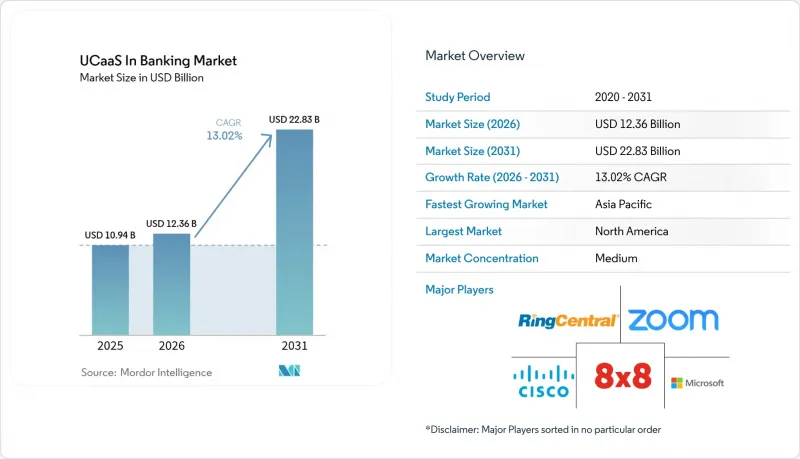
은행 업계용 UCaaS 시장 규모는 2025년에 109억 4,000만 달러로 평가되며, 2026년 123억 6,000만 달러에서 2031년까지 228억 3,000만 달러에 달할 것으로 예측되고 있으며, 예측 기간(2026-2031년)에 CAGR은 13.02%에 달할 전망입니다.
이 보고서는 구성 요소별(전화 기능, 통합 메시징, 컨택 센터, 협업 플랫폼 등), 도입 모델별(퍼블릭 클라우드, 하이브리드 클라우드, 프라이빗 클라우드), 조직 규모별(중소기업, 대기업),은행 업무 용도별(소매 은행, 법인·도매 은행 등), 그리고 지역별로 분류되어 있습니다.
전 세계 은행 업계의 UCaaS 시장 동향 및 인사이트
BYOD와 직원의 모빌리티
하이브리드 근무 방식이 정착되고, 직원의 개인 단말기 사용이 일반화됨에 따라 금융 기관은 유선 전화에 대한 의존도를 점차 줄이고 있습니다. 트래픽을 엔드투엔드로 암호화하고, 역할 기반 정책을 적용하며, ID 페더레이션을 실현하는 UCaaS 툴을 통해 직원은 규정 준수를 저해하지 않으면서 어디서나 연결할 수 있게 됩니다. 미즈호 증권이 액티브 호스트 과금 모델을 기반으로 대외 커뮤니케이션을 Zoom으로 전환하기로 결정한 것은 유연한 라이선싱 체계가 감사 가능성을 유지하면서 휴면 라이선스 비용을 절감할 수 있음을 여실히 보여줍니다. BYOD 전략은 하드웨어 지출을 줄이고 직원 만족도를 높이지만, 업계의 데이터 유출 방지 규정을 충족하기 위해서는 고급 모바일 기기 관리 및 지오펜싱이 필요합니다. 모빌리티 구현과 UCaaS 보안의 시너지 효과를 통해 유연성과 엄격한 감독을 양립할 수 있는 은행의 경쟁 우위가 확고해집니다.
전사적 UC 통합의 필요성
기존에는 음성, 채팅, 트레이딩 플로어 등 각 채널이 사일로화되어 있으며, 원활한 협업이 저해되었습니다. 현대적인 UCaaS 플랫폼은 이러한 접점을 통합하고 워크플로우 트리거를 통합함으로써 지점, 컨택 센터, 컴플라이언스 부서 간에 알림과 문서가 원활하게 유통되도록 합니다. NTT 커뮤니케이션즈는 싱글 테넌트형 글로벌 UC 패브릭을 통해 190개국 이상을 지원하고 있으며, 다국적 은행이 다이얼 플랜, 보고서, 정책 적용을 표준화하는 동시에 유지보수 비용을 절감할 수 있도록 하고 있습니다. 통합의 필요성은 합병시 특히 커집니다. 합병을 통해 새로 인수한 지점을 신속하게 전환해야 하기 때문입니다. 현재 최첨단 솔루션은 AI를 활용하여 문의를 최적의 전문가에게 배정함으로써 첫 대응 해결률을 높이고 인력 배치를 최적화하고 있습니다. 또한 채널을 아우르는 통합된 거래 내역을 통해 규제 당국이 수 시간 이내 대응을 요구하는 e-디스커버리 요청에 대한 대응도 간소화됩니다.
2·3선 은행의 클라우드 UC에 대한 인식 부족
지역 금융기관에서는 UCaaS 제안을 평가할 수 있는 전문 인력이 부족한 경우가 많아, 기존 전화 서비스에 대해서는 기존 통신 사업자에 의존할 수밖에 없는 상황입니다. 미국 재무부가 의뢰한 평가 보고서에 따르면 클라우드에 대한 지식이 제한적이라는 점이 중소 은행을 숨겨진 장애 위험 및 사이버 위험에 노출시키고, 레거시 시스템의 계속된 사용을 장기화하며, 현대화를 저해하고 있다고 경고하고 있습니다. 따라서 교육용 액셀러레이터, 블루프린트 템플릿, 그리고 매니지드 서비스 번들은 진입 장벽을 낮추는 데 있으며, 매우 중요한 역할을 합니다. 이전 인센티브, 턴키식의 보안 대책 및 규제 대응 문서를 제공하는 공급업체는 이처럼 서비스가 충분히 제공되지 않는 고객층을 개발할 수 있을 것입니다.
부문 분석
2025년 은행 업계의 UCaaS 시장 규모 중 전화 통신이 41.88%를 차지했습니다. 이는 부정 방지 확인, 거래 실행, 고객 본인 확인에 있으며, 음성 통신이 여전히 필수적이기 때문입니다. 한편, 협업 제품군은 화상, 상시 접속형 채팅, 문서 공유 작업 공간이 단일 화면으로 통합됨에 따라 2031년까지 연평균 성장률(CAGR) 18.04%로 성장할 것으로 예측됩니다. 이러한 통합을 통해 관계 관리자의 업무 전환이 줄어들고, 온보딩 및 문제 해결이 신속해집니다. Five9사의 보고서에 따르면 자연 언어 처리(NLP) 라우터를 통해 현재 수신 통화의 80%가 사람의 선별 과정 없이 적절한 스킬 그룹으로 배정되어 통화 포기율이 감소하고 있습니다. 통합 메시징은 이메일,SMS, 보안 채팅 피드를 스레드 형식의 기록으로 통합하여 규정 준수 감사의 추적 가능성을 높입니다. 비디오 뱅킹 키오스크는 지방 지역으로의 자문 서비스를 확대하며, 한편 커뮤니케이션 플랫폼의 API를 통해 2단계 인증용 음성 통화가 모바일 앱에 직접 통합됩니다. 이러한 모듈성 덕분에 은행은 백엔드 핵심 시스템을 재구축하지 않고도 채널을 추가할 수 있으며, 플랫폼에 대한 고객 충성도를 높이고 이탈 비용을 증가시킵니다.
은행이 앱내 배너, RCS, OTT 메신저를 통해 대출 승인 알림, 환율 알림, 카드 사용 이상과 같은 상황에 맞는 알림을 제공함에 따라 내장형 커뮤니케이션에 대한 수요가 증가하고 있습니다. Webex CPaaS의 뱅킹 모듈은 WhatsApp 및 Apple Messages용 즉시 사용 가능한 템플릿을 제공하여, 암호화 및 감사 로그 기능을 유지하면서 도입을 가속화합니다. 이러한 API 우선 모델을 통해 개발자는 고액 거래가 정해진 임계값을 초과할 경우, 챗봇에서 보안 화상 통화로 에스컬레이션되는 고객 경험을 설계할 수 있게 됩니다. 가트너는 2030년까지 API 기반 채널이 금융 서비스 아웃바운드 트래픽의 절반을 차지할 것으로 예측하며, 전화 통신이 독립형 제품에서 통합 제품군 내의 기반 서비스로 점차 전환되고 있음을 강조하고 있습니다.
퍼블릭 클라우드는 턴키식의 확장성과 종량제 요금제를 바탕으로 2025년 은행 업계 UCaaS 시장 점유율의 60.72%를 차지했습니다. 그러나 2031년까지 연평균 성장률(CAGR) 18.74%가 예상되는 하이브리드형 접근 방식은 규제 준수 및 지연에 민감한 워크로드에 대한 경영진의 관심이 높아지고 있음을 반영하고 있습니다. 퍼스트 호라이즌 뱅크의 Webex 컨택 센터로의 전환 사례에서는 규제 대상인 직원의 통화 녹음은 온프레미스에 남겨두면서, AI 분석을 통해 익명화된 데이터를 시스코의 멀티테넌트형 클라우드에서 처리하는 다층적인 아키텍처가 채택되었습니다. 이 모델을 통해 해당 은행은 수탁자로서의 데이터 취급 의무를 위반하지 않으면서도, 하나의 콘솔에서 20,000개의 엔드포인트와 750명의 상담원을 관리할 수 있게 되었습니다.
고유한 암호화 요건이나 주권 관련 요건을 가진 전 세계 시스템적으로 중요한 은행(G-SIB)의 경우, 프라이빗 클라우드가 여전히 선택지 중 하나이지만, 자본 및 인력 요건이 그 보급을 저해하고 있습니다. 하이브리드 전략은 단계적인 전환을 지원합니다. 금융 기관은 노후화된 PBX를 지점별로 단계적으로 폐지하고, 세션 보더 컨트롤러를 통해 트래픽을 클라우드 코어로 유도할 수 있습니다. 그 후, 지속적 통합(CI) 파이프라인을 통해 노이즈 억제 및 자동 마스킹과 같은 새로운 기능이 다운타임 없이 제공됩니다. 환경·사회·지배구조(ESG)에 대한 관심이 높아지는 가운데, 워크로드의 탄력성 덕분에 유휴시 에너지 소비도 줄어들어 은행이 탄소 배출 감축 목표를 달성하는 데 도움이 됩니다.
지역별 분석
북미는 2025년 은행 업계에서 UCaaS 시장 점유율 36.25%를 유지했습니다. 이는 성숙한 클라우드 규제와 기업의 현대화를 위한 넉넉한 예산을 활용한 결과입니다. 바클레이즈, UBS, 시티그룹은 협업 제품군과 AI 코파일럿을 결합하여 자문가의 워크플로우를 효율화한 대규모 도입 사례로 꼽힙니다. 진전이 보이기는 하지만, 전환을 완료한 기업은 40% 미만에 그치고 있으며, 많은 지역 은행은 여전히 가치가 하락하고 있는 PBX에 얽매여 있습니다. 그 결과, 변혁의 모멘텀과 리스크 관리에 대한 신중함을 양립시키는 하이브리드형 도입이 주류를 이루고 있습니다.
아시아태평양은 모바일 우선 인구 동향이 디지털 은행으로 하여금 앱에 음성 및 메시지 기능을 직접 통합하도록 촉진함으로써, 2031년까지 연평균 성장률(CAGR) 14.54%로 성장을 주도하고 있습니다. NTT나 소프트뱅크와 같은 일본의 통신 사업자들은 UCaaS의 전 세계적 확장을 추진하고 있는 한편, 보네이지(VoNage)와 현지 시스템 통합사업자 간의 제휴를 통해 동남아시아 전역에서 컨택 센터의 디지털화가 진행되고 있습니다. 이에 따라 대화형 AI 도입도 증가하고 있으며, 첫 상담시 문제 해결률 향상과 연중무휴 24시간 다국어 지원 서비스 구현이 가능해졌습니다.
유럽에서는 데이터 주권이 중시되고 있으며, 은행들은 지역 한정 클라우드나 주권 파트너십을 우선시하고 있습니다. 유니크레딧(UniCredit)이 보데노(Vodeno)를 4억 달러에 인수함에 따라 스마트 계약 엔진이 통합된 클라우드 네이티브 플랫폼이 제공되어 PSD2의 오픈 뱅킹 요건을 준수하는 동시에 화이트 라벨 기능도 확대되고 있습니다. 중동 및 아프리카에서는 클라우드 배포이 기존의 PBX 단계를 뛰어넘고 있습니다. 예를 들어 에코뱅크와 Google Cloud의 제휴를 통해 35개국에 걸친 분석 주도형 금융 포용 프로그램이 추진되고 있습니다. 이러한 시장에서는 오프라인 지점이 여전히 부족한 지역의 서비스 격차를 해소하는 데 있으며, UCaaS가 수행하는 역할이 두드러집니다.
기타 혜택:
- 엑셀 형식의 시장 예측(ME) 시트
- 3개월간의 애널리스트 지원
자주 묻는 질문
목차
제1장 서론
제2장 조사 방법
제3장 개요
제4장 시장 구도
제5장 시장 세분화
제6장 경쟁 구도
제7장 시장 기회와 향후 전망
KSA 26.08.25According to Mordor Intelligence, the uCaaS in banking market size was valued at USD 10.94 billion in 2025 and estimated to grow from USD 12.36 billion in 2026 to reach USD 22.83 billion by 2031, at a CAGR of 13.02% during the forecast period (2026-2031).
This report is Segmented by Component (Telephony, Unified Messaging, Contact Center, Collaboration Platform, and More), Deployment Model (Public Cloud, Hybrid Cloud, and Private Cloud), Organization Size (Small and Medium-Sized Enterprises, Large Enterprises), Banking Application (Retail Banking, Corporate and Wholesale Banking, and More), and Geography.
Global UCaaS In Banking Market Trends and Insights
BYOD and Workforce Mobility
Banking institutions are dismantling desk-phone dependencies as hybrid workforces normalize personal device use. UCaaS tools that encrypt traffic end-to-end, enforce role-based policies and federate identity allow staff to connect from any location without jeopardizing compliance. Mizuho Securities' decision to migrate external communications to Zoom under an active-host billing model underscores how flexible licensing reduces dormant seat costs while sustaining auditability. BYOD strategies cut hardware outlays and elevate employee satisfaction, yet they demand advanced mobile-device-management and geo-fencing to meet sectoral data-loss-prevention rules. The interplay between mobility enablement and UCaaS security solidifies competitive advantage for banks able to blend flexibility with rigorous supervision.
Need for Enterprise-wide UC Integration
Historically, siloed voice, chat and trading-floor channels obstructed fluid collaboration. Contemporary UCaaS platforms unify these touchpoints and embed workflow triggers so alerts and documents flow between branches, contact centers and compliance desks. NTT Communications underpins more than 190 countries with a single-tenant global UC fabric, allowing multinational banks to standardize dial plans, reporting and policy enforcement while trimming maintenance overhead. Integration imperatives intensify during mergers, when newly acquired branches must migrate rapidly. Leading solutions now apply AI to route queries to the best-suited specialist, elevating first-call-resolution metrics and optimizing workforce allocation. Unified lineage across channels also simplifies e-discovery requests, which regulators expect within hours.
Low Cloud-UC Awareness in Tier-2/3 Banks
Community institutions often lack specialist staff to evaluate UCaaS proposals, defaulting to incumbent telcos for plain-old telephony. A U.S. Treasury-commissioned assessment warns that limited cloud acumen exposes smaller banks to hidden resiliency and cyber risks, prolonging legacy usage and constraining modernization. Educational accelerators, blueprint templates and managed-service bundles therefore play a pivotal role in lowering entry barriers. Providers that extend migration incentives, turnkey security controls and regulatory documentation can unlock this underserved cohort.
Other drivers and restraints analyzed in the detailed report include:
- Digital-only Banking Expansion
- AI-Enabled UCaaS for Compliance Monitoring
- Stringent Data-Security and Residency Mandates
For complete list of drivers and restraints, kindly check the Table Of Contents.
Segment Analysis
Telephony accounted for 41.88% of the UCaaS in banking market size in 2025 as voice remains indispensable for fraud verification, trade execution and customer identity confirmation. Collaboration suites, however, are projected to drive an 18.04% CAGR through 2031 as video, persistent chat and shared-document workspaces coalesce into a single pane. The convergence reduces swivel-chair actions for relationship managers, speeding onboarding and issue resolution. Five9 reports that natural-language-processing routers now direct 80% of inbound calls to the correct skill group without human triage, trimming abandonment rates. Unified messaging compresses email, SMS and secure chat feeds into threaded histories, boosting compliance auditability. Video-banking kiosks extend advisory services to rural zones, while communication-platform APIs embed two-factor-authentication voice calls directly into mobile apps. This modularity ensures banks add channels without re-architecting back-end cores, reinforcing platform stickiness and raising switching costs.
Demand for embedded communications intensifies as banks deploy contextual notifications-loan-approval pings, FX-rate alerts and card-usage anomalies-through in-app banners, RCS and OTT messengers. Webex CPaaS banking modules deliver out-of-the-box templates for WhatsApp and Apple Messages, accelerating deployment while retaining encryption and audit logging. Such API-first models empower developers to orchestrate journeys where a chatbot escalates to secure video when high-value transactions exceed preset thresholds. Gartner predicts that by 2030, API-driven channels will account for half of financial-services outbound traffic, underscoring telephony's gradual transition from standalone product to foundational service within integrated suites.
Public-cloud captured 60.72% of UCaaS in banking market share in 2025 on the back of turnkey scalability and consumption pricing. Yet hybrid approaches, forecasting a 18.74% CAGR to 2031, reflect heightened boardroom focus on jurisdictional compliance and latency-sensitive workloads. First Horizon Bank's Webex Contact Center migration showcased a layered architecture where recordings of regulated staff remained on-prem while AI analytics processed anonymized data in Cisco's multitenant cloud. This blueprint allowed the bank to maintain 20,000 endpoints and 750 agents under one console without breaching fiduciary data-handling obligations.
Private-cloud remains an option for global systemically important banks with bespoke encryption and sovereignty mandates, although capital and staffing requirements curb its wider appeal. Hybrid strategies support phased migration: institutions can retire aging PBXs site by site, funneling traffic via session-border controllers to a cloud core. Continuous-integration pipelines then deliver feature drops such as noise suppression or auto-redaction without downtime. Given rising environmental, social and governance commitments, workload elasticity also lowers idle energy use, helping banks hit carbon-cut targets.
Complete Report Scope:
- By Component
- Telephony
- Unified Messaging
- Contact Center
- Collaboration Platform
- Video Conferencing
- Communication-Platform APIs
- By Deployment Model
- Public Cloud
- Private Cloud
- Hybrid Cloud
- By Organization Size
- Large Enterprises
- Small and Medium-Sized Enterprises
- By Banking Application
- Retail Banking
- Corporate and Wholesale Banking
- Investment Banking
- Payment and FinTech Subsidiaries
- By Geography
- North America
- United States
- Canada
- Mexico
- South America
- Brazil
- Argentina
- Rest of South America
- Europe
- Germany
- United Kingdom
- France
- Italy
- Spain
- Russia
- Rest of Europe
- Asia-Pacific
- China
- Japan
- India
- South Korea
- Australia and New Zealand
- Rest of Asia-Pacific
- Middle East and Africa
- Middle East
- Saudi Arabia
- United Arab Emirates
- Turkey
- Rest of Middle East
- Africa
- South Africa
- Nigeria
- Egypt
- Rest of Africa
- Middle East
- North America
Geography Analysis
North America retained 36.25% UCaaS in banking market share in 2025, capitalizing on mature cloud regulations and sizeable budgets for enterprise modernization. Barclays, UBS and Citigroup exemplify large-scale deployments that marry collaboration suites with AI copilots to streamline advisor workflows . Despite headway, many regional banks remain tethered to depreciating PBXs, as less than 40% of businesses have completed migration. Hybrid rollouts therefore dominate, balancing transformation momentum with risk-management caution.
Asia-Pacific leads growth at 14.54% CAGR through 2031 as mobile-first demographics spur digital banks to embed voice and messaging directly in apps. Japanese carriers such as NTT and SoftBank export UCaaS footprints globally, while partnerships between Vonage and local integrators digitize contact-center estates throughout Southeast Asia. Conversational-AI adoption rises in concert, lifting first-contact resolution and enabling 24/7 multilingual servicing.
Europe emphasizes data-sovereignty, prompting banks to prefer region-locked clouds or sovereign partnerships. UniCredit's USD 400 million acquisition of Vodeno delivers a cloud-native platform with built-in smart-contract engines, aligning with PSD2 open-banking requisites while expanding white-label capabilities. In the Middle East and Africa, cloud adoption leapfrogs legacy PBX phases; for instance, Ecobank's alliance with Google Cloud powers analytics-driven inclusion programs across 35 nations. These markets underline UCaaS' role in bridging service gaps where physical branches remain sparse.
- Microsoft Corporation
- Cisco Systems, Inc.
- RingCentral, Inc.
- 8x8, Inc.
- Zoom Video Communications, Inc.
- Avaya LLC
- Fuze, Inc.
- West Technology Group, LLC (formerly West UC)
- VOSS Solutions
- NetFortris, Inc.
- TetraVX (Netrix, LLC)
- Kurmi Software SAS
- Vonage Holdings Corp.
- Dialpad, Inc.
- Mitel Networks Corporation
- Revation Systems, Inc.
- NICE Ltd.
- Genesys Telecommunications Labs, Inc.
- Google LLC
- Amazon Web Services, Inc.
Additional Benefits:
- The market estimate (ME) sheet in Excel format
- 3 months of analyst support
TABLE OF CONTENTS
1 INTRODUCTION
- 1.1 Study Assumptions and Market Definition
- 1.2 Scope of the Study
2 RESEARCH METHODOLOGY
3 EXECUTIVE SUMMARY
4 MARKET LANDSCAPE
- 4.1 Market Overview
- 4.2 Market Drivers
- 4.2.1 BYOD and workforce mobility
- 4.2.2 Need for enterprise-wide UC integration
- 4.2.3 Digital-only banking expansion
- 4.2.4 AI-enabled UCaaS for compliance monitoring
- 4.2.5 5G private branch networks
- 4.2.6 Embedded CPaaS in banking apps
- 4.3 Market Restraints
- 4.3.1 Low cloud-UC awareness in tier-2/3 banks
- 4.3.2 Stringent data-security and residency mandates
- 4.3.3 Legacy on-prem PBX lock-ins
- 4.3.4 Vendor API lock-in risk
- 4.4 Evaluation of Critical Regulatory Framework
- 4.5 Value Chain Analysis
- 4.6 Technological Outlook
- 4.7 Porter's Five Forces
- 4.7.1 Bargaining Power of Suppliers
- 4.7.2 Bargaining Power of Buyers
- 4.7.3 Threat of New Entrants
- 4.7.4 Threat of Substitutes
- 4.7.5 Competitive Rivalry
- 4.8 Key Use Cases and Case Studies
- 4.9 Impact on Macroeconomic Factors of the Market
- 4.10 Investment Analysis
5 MARKET SEGMENTATION
- 5.1 By Component
- 5.1.1 Telephony
- 5.1.2 Unified Messaging
- 5.1.3 Contact Center
- 5.1.4 Collaboration Platform
- 5.1.5 Video Conferencing
- 5.1.6 Communication-Platform APIs
- 5.2 By Deployment Model
- 5.2.1 Public Cloud
- 5.2.2 Private Cloud
- 5.2.3 Hybrid Cloud
- 5.3 By Organization Size
- 5.3.1 Large Enterprises
- 5.3.2 Small and Medium-Sized Enterprises
- 5.4 By Banking Application
- 5.4.1 Retail Banking
- 5.4.2 Corporate and Wholesale Banking
- 5.4.3 Investment Banking
- 5.4.4 Payment and FinTech Subsidiaries
- 5.5 By Geography
- 5.5.1 North America
- 5.5.1.1 United States
- 5.5.1.2 Canada
- 5.5.1.3 Mexico
- 5.5.2 South America
- 5.5.2.1 Brazil
- 5.5.2.2 Argentina
- 5.5.2.3 Rest of South America
- 5.5.3 Europe
- 5.5.3.1 Germany
- 5.5.3.2 United Kingdom
- 5.5.3.3 France
- 5.5.3.4 Italy
- 5.5.3.5 Spain
- 5.5.3.6 Russia
- 5.5.3.7 Rest of Europe
- 5.5.4 Asia-Pacific
- 5.5.4.1 China
- 5.5.4.2 Japan
- 5.5.4.3 India
- 5.5.4.4 South Korea
- 5.5.4.5 Australia and New Zealand
- 5.5.4.6 Rest of Asia-Pacific
- 5.5.5 Middle East and Africa
- 5.5.5.1 Middle East
- 5.5.5.1.1 Saudi Arabia
- 5.5.5.1.2 United Arab Emirates
- 5.5.5.1.3 Turkey
- 5.5.5.1.4 Rest of Middle East
- 5.5.5.2 Africa
- 5.5.5.2.1 South Africa
- 5.5.5.2.2 Nigeria
- 5.5.5.2.3 Egypt
- 5.5.5.2.4 Rest of Africa
- 5.5.5.1 Middle East
- 5.5.1 North America
6 COMPETITIVE LANDSCAPE
- 6.1 Market Concentration
- 6.2 Strategic Moves
- 6.3 Market Share Analysis
- 6.4 Company Profiles {(includes Global level Overview, Market level overview, Core Segments, Financials as available, Strategic Information, Market Rank/Share for key companies, Products and Services, and Recent Developments)}
- 6.4.1 Microsoft Corporation
- 6.4.2 Cisco Systems, Inc.
- 6.4.3 RingCentral, Inc.
- 6.4.4 8x8, Inc.
- 6.4.5 Zoom Video Communications, Inc.
- 6.4.6 Avaya LLC
- 6.4.7 Fuze, Inc.
- 6.4.8 West Technology Group, LLC (formerly West UC)
- 6.4.9 VOSS Solutions
- 6.4.10 NetFortris, Inc.
- 6.4.11 TetraVX (Netrix, LLC)
- 6.4.12 Kurmi Software SAS
- 6.4.13 Vonage Holdings Corp.
- 6.4.14 Dialpad, Inc.
- 6.4.15 Mitel Networks Corporation
- 6.4.16 Revation Systems, Inc.
- 6.4.17 NICE Ltd.
- 6.4.18 Genesys Telecommunications Labs, Inc.
- 6.4.19 Google LLC
- 6.4.20 Amazon Web Services, Inc.
7 MARKET OPPORTUNITIES AND FUTURE OUTLOOK
- 7.1 White-space and Unmet-Need Assessment