

|
시장보고서
상품코드
2113808
재실 센서 : 시장 점유율 분석, 업계 동향 및 통계, 성장 예측(2026-2031년)Occupancy Sensor - Market Share Analysis, Industry Trends & Statistics, Growth Forecasts (2026 - 2031) |
||||||
 Mordor Intelligence
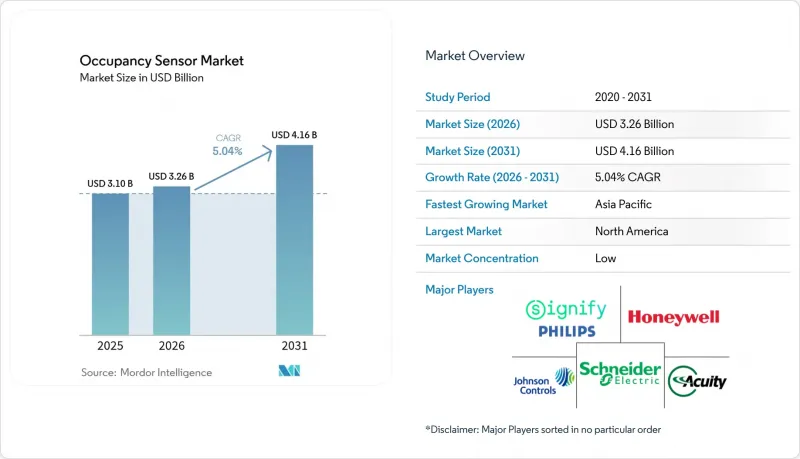
Mordor Intelligence에 의하면, 재실 센서 시장 규모는 2025년에 31억 달러로 평가되었습니다. 2026년 32억 6,000만 달러에서 2031년까지 41억 6,000만 달러에 이를 것으로 예상되며, 예측 기간(2026-2031년) CAGR은 5.04%를 나타낼 전망입니다.
본 보고서는 네트워크 연결 방식별(유선, 무선), 기술별(수동형 적외선(PIR), 초음파, 마이크로파, 기타), 설치 형태별(천장 설치형, 벽면 설치형, 기타), 설치 유형별(리모델링 설치, 신축),건축 유형별(주거용, 상업용, 산업·창고용, 기타), 용도별, 지역별로 분류되어 있습니다. 시장 예측은 금액(달러) 기준으로 제시되어 있습니다.
세계의 재실 센서 시장 동향 및 인사이트
미국·EU의 더욱 엄격해진 넷-제로 건축 기준 : 재실 상황에 따른 작동 중지 의무화
캘리포니아주의 ‘타이틀 24’에서는 무인 상태가 된 후 20분 이내에 콘센트와 환기 설비를 중단시키기 위한 재실 감지가 의무화되어 있으며, 2021년판 ‘국제 에너지 절약 기준(IECC)’에서는 밀폐 공간 내 자동 제어가 의무화되어 있습니다. 2030년까지 3,500만 동을 대상으로 하는 유럽의 개보수 프로그램도 이러한 규정을 따르고 있으며, 에너지 절약 효과보다는 규제 준수가 도입의 주요 요인으로 작용하고 있습니다. 따라서 상업시설 소유주들은 건설 후에 센서를 추가하는 대신, 설계 도면에 센서 설치를 반영하고 있습니다. 이러한 추세로 인해 재실 센서 시장 전체의 기초적인 수요가 증가하고 있습니다.
중국의 ‘이중 탄소’ 로드맵이 스마트 조명을 뒷받침
2030년 탄소 배출 정점과 2060년 탄소 중립을 목표로 하는 중국의 목표는 센서 기반 자동화를 중시하는 스마트 빌딩 개조를 뒷받침하고 있습니다. 공공 기관의 사례 연구에 따르면, 인체 감지 기능을 활용한 IoT 조명으로 전면 교체함으로써 20% 이상의 에너지 절감 효과가 확인되었습니다. 지역별 격차가 존재하기 때문에 특히 예산과 기술력이 갖춰진 1급 도시에서는 하드웨어와 소프트웨어를 결합한 턴키 패키지가 개별 부품 판매보다 더 큰 성공을 거두고 있습니다.
2.4GHz 메쉬 네트워크의 RF 혼잡 및 배터리 소모
192개의 노드를 보유한 Zigbee 네트워크는 전파 환경이 양호한 상황에서는 200밀리초 이하의 지연을 유지할 수 있지만, Wi-Fi 채널과 겹치는 경우 패킷 손실이 급격히 증가합니다. 잦은 재전송은 코인형 배터리의 수명을 단축시키고, 배터리 구동 장치의 유지보수 비용을 증가시킵니다. 따라서 건물 소유주는 주파수 대역 계획 도구가 마련되어 있지 않은 한, 중요한 부하를 무선으로 전환하는 것을 주저하고 있습니다.
부문 분석
유선 부문은 2025년 전 세계 매출의 61.55%를 차지하며, 재실 센서 시장에서 핵심 건물 시스템으로서 중심적인 역할을 하고 있음을 입증했습니다. 시설 관리자들은 무선 간섭에 대한 내성과 전력 공급의 용이성을 중시하기 때문에 신규 상업용 건물에서는 이더넷 기반 디지털 주소 지정 네트워크가 조명 및 HVAC 제어의 기반이 되고 있습니다. 배관 공간이 제한된 리모델링 환경에서는 설치 공수를 줄일 수 있는 무선 노드가 선호됩니다. 이것이 2031년까지 메쉬형 제품의 연평균 성장률(CAGR)이 12.18%로 예측되는 이유입니다. 하이브리드 설계도 부상하고 있습니다. 유선 백본이 PoE 지원 조명 기구에 전력을 공급하고, 주변부에는 Thread나 Zigbee 센서가 배치됨으로써 신뢰성과 유연성의 균형을 이루고 있습니다.
무선 시장의 성장은 프로토콜 통합에 의해 주도되고 있습니다. ‘Matter-over-Thread’는 기존의 벤더 락인을 해소했으며, Aqara 등의 벤더는 Apple, Amazon, Google의 각 생태계에서 자동 설정이 가능한 재실 센서를 출시했습니다. Philips Hue는 전구를 모션 센서로도 기능하게 하는 소프트웨어 업데이트를 시연하며, 모든 조명 기구가 데이터 노드가 되는 아키텍처의 가능성을 시사했습니다. 이로 인해 연결 등급 간의 경계가 모호해지면서 적용 가능한 설치 범위가 확대되고 있습니다.
수동형 적외선(PIR)은 2025년에 49.72%의 점유율을 차지하며, 재실 센서 시장에서 비용 면에서의 우위를 더욱 공고히 했습니다. 고정밀화에 대한 수요로 인해, PIR과 초음파 또는 mm파 레이더를 결합하여 미세한 움직임이나 정지해 있는 거주자를 감지하는 듀얼 기술 모듈 시장은 연평균 성장률(CAGR) 13.12%로 확대되고 있습니다. Texas Instruments의 AWRL6844 레이더는 노드당 비용을 20달러 절감하여, 고급 시설 이외의 도입도 확대되고 있습니다.
AI를 활용한 엣지 처리는 시설 고유의 재실 패턴을 학습함으로써 오경보를 줄입니다. Bosch Sensortech는 2030년까지 100억 개의 지능형 센서 보급을 목표로 하고 있으며, 그 중 90%에는 칩 상에서 원시 파형을 분석하는 AI 엔진이 탑재되어 있습니다. 이러한 개발을 통해 부품 명세서(BOM)의 가치가 높아지고, 재실 센서 시장에서 플랫폼의 입지가 더욱 공고해질 것입니다.
지역별 분석
2025년에는 북미가 최대 매출 점유율을 차지했습니다. 미국에서는 ‘타이틀 24’와 2021년판 IECC에 따라 상업시설 전체에서 자동 차단이 의무화되어 있으며, 이것이 수요의 기반이 되고 있습니다. 캐나다도 유사한 경향을 보이고 있으며, 난방 시즌이 길기 때문에 재실 여부에 따른 난방 제어에 큰 관심이 쏠리고 있습니다. 현재 진행 중인 개보수 공사에서는 도심 지역의 2.4GHz 대역 혼잡이 과제로 대두되고 있어, 유선 백본과 서브GHz 대역 무선을 결합한 하이브리드형 도입이 추진되고 있습니다.
유럽에서는 2030년까지 3,500만 동을 대상으로 하는 ‘리노베이션 웨이브(Renovation Wave)’ 프로그램 하에서 견조한 성장이 예상됩니다. 독일, 영국, 프랑스에서는 재실 여부에 따라 조명이나 환기를 차단하는 기능을 포함하는 국가 건축 기준이 제정되었습니다. GDPR(EU 개인정보보호규정)(일반 데이터 보호 규정) 준수는 비용 증가를 초래하여 AI 분석 도입을 지연시키고 있지만, On-Premise 데이터 처리를 제공하는 플랫폼 벤더들이 이러한 장벽을 완화하고 있습니다. 무선 프로토콜의 세분화로 인해 통합 업체들은 멀티 프로토콜 게이트웨이에 의존할 수밖에 없어 시스템의 복잡성은 증가하고 있지만, 한편으로는 재실 센서 시장의 서비스 수익도 증가하고 있습니다.
아시아태평양은 2031년까지 가장 높은 연평균 성장률(CAGR)을 기록하고 있습니다. 중국의 ‘이중 탄소’ 정책은 스마트 빌딩 도입 의무화를 가속화하고 있으며, 특히 1급 대도시의 공공 부문 프로젝트에서 센서 도입 후 20%의 에너지 절감 효과가 입증되었습니다. 일본과 한국에서는 쾌적성 최적화를 위해 mm파와 AI를 결합한 프리미엄 솔루션이 중시되고 있습니다. 인도 및 동남아시아에서는 비용 효율이 뛰어난 PIR 노드가 주류를 이루고 있지만, 벵갈루루와 싱가포르의 상업용 오피스 단지에서는 세계 기업의 ESG 목표에 부합하는 플랫폼 아키텍처가 채택되고 있습니다. 이러한 다양성은 재실 센서 시장 전체에서 벤더들에게 다층적인 진입 기회를 제공합니다.
기타 혜택
- 엑셀 형식 시장 예측(ME) 시트
- 3개월간의 애널리스트 지원
자주 묻는 질문
목차
제1장 서론
제2장 조사 방법
제3장 주요 요약
제4장 시장 구도
제5장 시장 규모 및 성장 예측
제6장 경쟁 구도
제7장 시장 기회 및 향후 전망
KTH 26.08.26According to Mordor Intelligence, the occupancy sensor market size was valued at USD 3.10 billion in 2025 and estimated to grow from USD 3.26 billion in 2026 to reach USD 4.16 billion by 2031, at a CAGR of 5.04% during the forecast period (2026-2031).
This report is Segmented by Network Connectivity (Wired, Wireless), Technology (Passive Infrared (PIR), Ultrasonic, Microwave, and More), Mounting Type (Ceiling-Mounted, Wall-Mounted, and More), Installation Type (Retrofit, New Construction), Building Type (Residential, Commercial, Industrial & Warehousing, and More), Application, and Geography. The Market Forecasts are Provided in Terms of Value (USD).
Global Occupancy Sensor Market Trends and Insights
Stricter net-zero building codes in U.S./EU mandating occupancy-based shut-off
California's Title 24 now requires occupancy sensing for receptacle and ventilation shut-off within 20 minutes of vacancy, while the 2021 International Energy Conservation Code mandates automatic controls in enclosed spaces. European renovation programs targeting 35 million buildings by 2030 echo these rules, making compliance rather than energy savings the primary adoption trigger. Commercial owners therefore embed sensors in construction documents rather than adding them post-build. This dynamic lifts baseline demand across the occupancy sensor market.
China dual-carbon roadmap boosting smart lighting IoT
China's goal of a 2030 carbon peak and 2060 neutrality propels smart building retrofits that favor sensor-based automation. Case studies in public institutions show energy savings above 20% after IoT lighting overhauls that rely on motion detection. Provincial disparity means turnkey packages that combine hardware and software succeed better than component sales, especially in tier-1 cities where budgets and technical skills align.
RF congestion & battery drain in 2.4 GHz mesh networks
Zigbee networks carrying 192 nodes keep sub-200 ms latency under clean radio conditions, yet packet loss rises sharply when Wi-Fi channels overlap. Frequent retransmits shorten coin-cell lifespan, raising maintenance costs for battery-powered devices. Building owners therefore hesitate to shift critical loads to wireless unless spectrum planning tools are in place.
Other drivers and restraints analyzed in the detailed report include:
- IoT-driven space utilization analytics upselling sensors
- Healthcare bed-occupancy programs under CMS & MDR
- False-positive events in high-heat data centers
For complete list of drivers and restraints, kindly check the Table Of Contents.
Segment Analysis
The wired category accounted for 61.55% of global 2025 revenues, confirming its central role in core building systems within the occupancy sensor market. Facility managers value immunity to radio interference and easier power delivery, so Ethernet-based digital addressable networks anchor lighting and HVAC controls in new commercial construction. Retrofit environments with limited conduit space lean toward wireless nodes that reduce installation labor, which explains the 12.18% CAGR forecast for mesh-based products through 2031. Hybrid designs are emerging: a wired backbone feeds PoE luminaires while Thread or Zigbee sensors populate the periphery, balancing reliability and flexibility.
Wireless growth is driven by protocol convergence. Matter-over-Thread eliminates prior vendor lock-in, and vendors like Aqara released presence sensors that self-commission across Apple, Amazon, and Google ecosystems. Philips Hue demonstrated a software update that lets light bulbs double as motion sensors, hinting at an architecture where every luminaire becomes a data node. This blurs the lines between connectivity classes and broadens addressable installations for the
Passive infrared achieved a 49.72% share in 2025, reinforcing its cost advantage inside the occupancy sensor market. Demand for higher fidelity propels dual-technology modules at a 13.12% CAGR, combining PIR with ultrasonic or mmWave radar to catch minor movements and stationary occupants. Texas Instruments' AWRL6844 radar lowers per-node cost by USD 20, expanding adoption beyond premium installations.
AI-enabled edge processing reduces nuisance alarms by learning site-specific occupancy patterns. Bosch Sensortec targets 10 billion intelligent sensors by 2030, with 90% embedding AI engines that distill raw waveforms on-chip. These developments increase bill-of-material value and reinforce platform stickiness inside the occupancy sensor market.
Complete Report Scope:
- By Network Connectivity
- Wired
- Wireless
- Wi-Fi
- Zigbee
- Z-Wave
- By Technology
- Passive Infrared (PIR)
- Ultrasonic
- Microwave
- Dual / Multi-Technology (PIR + mmWave, etc.)
- mmWave / FMCW Radar
- By Mounting Type
- Ceiling-Mounted
- Wall-Mounted
- Desk / Furniture-Integrated
- In-Fixture / Embedded Luminaire
- By Installation Type
- Retrofit
- New Construction
- By Building Type
- Residential
- Commercial
- Industrial and Warehousing
- Healthcare and Assisted Living
- Government and Education
- By Application
- Lighting Control
- HVAC and Ventilation
- Security and Surveillance
- People Counting and Space Utilization
- Bed / Restroom Occupancy Monitoring
- By Geography
- North America
- United States
- Canada
- Mexico
- South America
- Brazil
- Argentina
- Rest of South America
- Europe
- United Kingdom
- Germany
- France
- Italy
- Nordics (Sweden, Norway, Denmark, Finland)
- Rest of Europe
- Middle East
- Saudi Arabia
- UAE
- Turkey
- Rest of Middle East
- Africa
- South Africa
- Nigeria
- Rest of Africa
- Asia-Pacific
- China
- Japan
- India
- South Korea
- Australia
- Rest of Asia-Pacific
- North America
Geography Analysis
North America held the largest revenue share in 2025. The United States anchors demand with Title 24 and the 2021 IECC requiring automated shut-off across commercial spaces. Canada follows similar patterns and shows strong interest in occupancy-based heating due to long heating seasons. Ongoing retrofits contend with dense 2.4 GHz spectrum in urban cores, driving hybrid deployments that mix wired backbones and sub-GHz wireless.
Europe registers solid growth under the Renovation Wave program that targets 35 million buildings by 2030. Germany, the United Kingdom, and France institute national building codes that embed occupancy-triggered lighting and ventilation cut-offs. GDPR compliance adds cost and slows AI analytics roll-outs, yet platform vendors that offer on-premise data processing mitigate these barriers. Fragmented wireless protocols force integrators to rely on multiprotocol gateways, elevating system complexity but also boosting services revenue inside the occupancy sensor market.
Asia-Pacific records the fastest CAGR to 2031. China's dual-carbon policy accelerates smart building mandates, especially in tier-1 metros where public-sector projects showcase 20% energy reduction after sensor installations. Japan and South Korea emphasize premium solutions that pair mmWave with AI for comfort optimization. In India and Southeast Asia, cost-efficient PIR nodes dominate, yet commercial office parks in Bengaluru and Singapore adopt platform architectures that align with global corporate ESG goals. This heterogeneity offers multi-tiered entry points for vendors across the occupancy sensor market.
- Signify (Philips Lighting)
- Honeywell International Inc.
- Schneider Electric SE
- Johnson Controls International plc
- Legrand S.A.
- Eaton Corporation plc
- Acuity Brands, Inc.
- Leviton Manufacturing Co., Inc.
- Lutron Electronics Co., Inc.
- Hubbell Incorporated
- Siemens AG (Enlighted)
- Texas Instruments Incorporated
- Panasonic Corporation
- Bosch Sensortec GmbH
- Omron Corporation
- Delta Electronics, Inc.
- RAB Lighting Inc.
- SensorWorx (B.E.L. Products)
- Stanley Black and Decker (STANLEY Security)
- OccupEye Ltd
- Pammvi Group
- General Electric Co.
Additional Benefits:
- The market estimate (ME) sheet in Excel format
- 3 months of analyst support
TABLE OF CONTENTS
1 INTRODUCTION
- 1.1 Study Assumptions and Market Definition
- 1.2 Scope of the Study
2 RESEARCH METHODOLOGY
3 EXECUTIVE SUMMARY
4 MARKET LANDSCAPE
- 4.1 Market Overview
- 4.2 Market Drivers
- 4.2.1 Stricter Net-Zero Building Codes in U.S./EU Mandating Occupancy-Based Shut-off
- 4.2.2 Rapid Retrofit Wave of Post-COVID Office Stock (NA and EU)
- 4.2.3 China Dual-Carbon Roadmap Boosting Smart Lighting
- 4.2.4 IoT-Driven Space Utilization Analytics Upselling Sensors
- 4.2.5 Healthcare Bed-Occupancy Programs Under CMS and MDR
- 4.2.6 Multi-Sensor Chipset Cost Decline Opening HVAC OEM Channel
- 4.3 Market Restraints
- 4.3.1 RF Congestion and Battery Drain in 2.4 GHz Mesh Networks
- 4.3.2 False-Positive Events in High-Heat Data Centers
- 4.3.3 Fragmented Wireless Standards Hindering EU Retrofits
- 4.3.4 GDPR/CCPA Compliance Cost for AI People Analytics
- 4.4 Value / Supply-Chain Analysis
- 4.5 Regulatory Outlook
- 4.6 Technological Outlook
- 4.7 Porter's Five Forces Analysis
- 4.7.1 Threat of New Entrants
- 4.7.2 Bargaining Power of Buyers
- 4.7.3 Bargaining Power of Suppliers
- 4.7.4 Threat of Substitutes
- 4.7.5 Competitive Rivalry
- 4.8 Technology Snapshot
- 4.9 Investment Analysis
5 MARKET SIZE AND GROWTH FORECASTS (VALUE)
- 5.1 By Network Connectivity
- 5.1.1 Wired
- 5.1.2 Wireless
- 5.1.2.1 Wi-Fi
- 5.1.2.2 Zigbee
- 5.1.2.3 Z-Wave
- 5.2 By Technology
- 5.2.1 Passive Infrared (PIR)
- 5.2.2 Ultrasonic
- 5.2.3 Microwave
- 5.2.4 Dual / Multi-Technology (PIR + mmWave, etc.)
- 5.2.5 mmWave / FMCW Radar
- 5.3 By Mounting Type
- 5.3.1 Ceiling-Mounted
- 5.3.2 Wall-Mounted
- 5.3.3 Desk / Furniture-Integrated
- 5.3.4 In-Fixture / Embedded Luminaire
- 5.4 By Installation Type
- 5.4.1 Retrofit
- 5.4.2 New Construction
- 5.5 By Building Type
- 5.5.1 Residential
- 5.5.2 Commercial
- 5.5.3 Industrial and Warehousing
- 5.5.4 Healthcare and Assisted Living
- 5.5.5 Government and Education
- 5.6 By Application
- 5.6.1 Lighting Control
- 5.6.2 HVAC and Ventilation
- 5.6.3 Security and Surveillance
- 5.6.4 People Counting and Space Utilization
- 5.6.5 Bed / Restroom Occupancy Monitoring
- 5.7 By Geography
- 5.7.1 North America
- 5.7.1.1 United States
- 5.7.1.2 Canada
- 5.7.1.3 Mexico
- 5.7.2 South America
- 5.7.2.1 Brazil
- 5.7.2.2 Argentina
- 5.7.2.3 Rest of South America
- 5.7.3 Europe
- 5.7.3.1 United Kingdom
- 5.7.3.2 Germany
- 5.7.3.3 France
- 5.7.3.4 Italy
- 5.7.3.5 Nordics (Sweden, Norway, Denmark, Finland)
- 5.7.3.6 Rest of Europe
- 5.7.4 Middle East
- 5.7.4.1 Saudi Arabia
- 5.7.4.2 UAE
- 5.7.4.3 Turkey
- 5.7.4.4 Rest of Middle East
- 5.7.5 Africa
- 5.7.5.1 South Africa
- 5.7.5.2 Nigeria
- 5.7.5.3 Rest of Africa
- 5.7.6 Asia-Pacific
- 5.7.6.1 China
- 5.7.6.2 Japan
- 5.7.6.3 India
- 5.7.6.4 South Korea
- 5.7.6.5 Australia
- 5.7.6.6 Rest of Asia-Pacific
- 5.7.1 North America
6 COMPETITIVE LANDSCAPE
- 6.1 Market Concentration
- 6.2 Strategic Moves
- 6.3 Market Share Analysis
- 6.4 Company Profiles (includes Global level Overview, Market level overview, Core Segments, Financials as available, Strategic Information, Market Rank/Share for key companies, Products and Services, and Recent Developments)
- 6.4.1 Signify (Philips Lighting)
- 6.4.2 Honeywell International Inc.
- 6.4.3 Schneider Electric SE
- 6.4.4 Johnson Controls International plc
- 6.4.5 Legrand S.A.
- 6.4.6 Eaton Corporation plc
- 6.4.7 Acuity Brands, Inc.
- 6.4.8 Leviton Manufacturing Co., Inc.
- 6.4.9 Lutron Electronics Co., Inc.
- 6.4.10 Hubbell Incorporated
- 6.4.11 Siemens AG (Enlighted)
- 6.4.12 Texas Instruments Incorporated
- 6.4.13 Panasonic Corporation
- 6.4.14 Bosch Sensortec GmbH
- 6.4.15 Omron Corporation
- 6.4.16 Delta Electronics, Inc.
- 6.4.17 RAB Lighting Inc.
- 6.4.18 SensorWorx (B.E.L. Products)
- 6.4.19 Stanley Black and Decker (STANLEY Security)
- 6.4.20 OccupEye Ltd
- 6.4.21 Pammvi Group
- 6.4.22 General Electric Co.
7 MARKET OPPORTUNITIES AND FUTURE OUTLOOK
- 7.1 White-Space and Unmet-Need Assessment


