

|
시장보고서
상품코드
2113813
호지킨 림프종 치료 : 시장 점유율 분석, 업계 동향 및 통계, 성장 예측(2026-2031년)Global Hodgkin Lymphoma Treatment - Market Share Analysis, Industry Trends & Statistics, Growth Forecasts (2026 - 2031) |
||||||
 Mordor Intelligence
Mordor Intelligence에 의하면, 호지킨 림프종 치료 시장 규모는 2025년에 35억 1,000만 달러로 평가되었습니다. 2026년 37억 9,000만 달러에서 성장하여 2031년까지 55억 2,000만 달러에 이를 것으로 예측됩니다.
예측 기간(2026-2031년) 동안 연평균 성장률(CAGR)은 7.85%를 나타낼 것으로 전망됩니다.
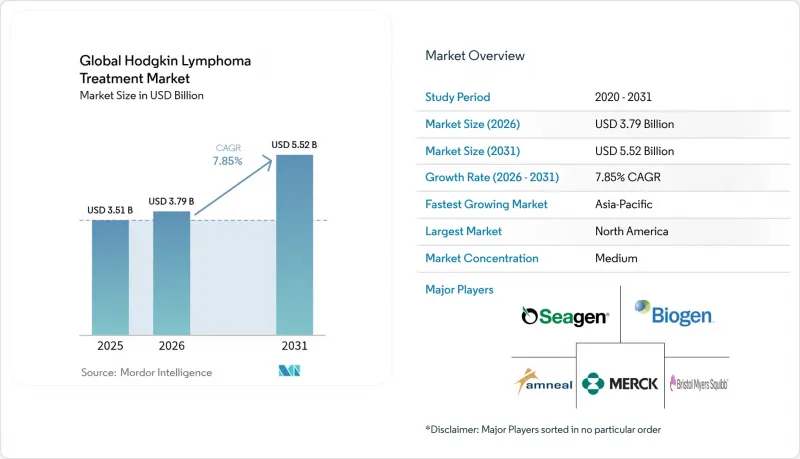
본 보고서는 치료 유형(화학요법, 방사선 요법 등), 병기(조기(I-II기), 진행기(III-IV기) 등), 환자 연령대(소아·청소년, 성인 등),투여 경로(정맥 내 투여, 경구 투여 등), 지역(북미, 유럽, 아시아태평양 등)별로 분류되어 있습니다. 시장 예측은 금액(미 달러) 기준으로 제시되어 있습니다.
세계의 호지킨 림프종 치료 시장 동향 및 인사이트
전 세계 질병 부담 증가와 생존율 향상
특히 고령화 사회에서 발병률이 증가하는 추세를 보이며, 환자 수가 증가하는 것은 물론 재발률이 30%에서 40% 사이를 유지하고 있어 지속적인 치료 수요가 발생하고 있습니다. 초기 단계 질환의 5년 생존율은 현재 90%를 초과하고 있습니다. 그러나 평균 수명의 연장에 따라 많은 생존자들이 수십 년에 걸쳐 여러 차례의 치료를 필요로 하고 있습니다. 집중적인 화학요법을 견디기 어려운 고령 환자에 대해서는 내약성이 좋은 표적 치료제나 체크포인트 억제제가 점점 더 많이 선택되고 있습니다. 그 결과, 호지킨 림프종 치료 시장은 장기적인 수익 전망을 강화하는 ‘인구 보너스’의 혜택을 누리고 있습니다.
PET 기반 치료 요법이 신약 도입을 가속화
치료 도중 실시하는 PET 스캔을 통해 치료 강화를 결정하거나 치료 강도를 낮출지 여부를 실시간으로 판단할 수 있게 됨에 따라, 신약 도입이 가속화되고 있습니다. 제3상 S1826 임상시험에서 니볼루맙-AVD의 2년 무재발 생존율이 92%에 달한 반면, 브렌톡시맙 베도틴-AVD는 83%에 그쳐 1차 치료법의 기준이 재정의되었습니다. PET 적응형 프로토콜은 보다 정밀한 약물 선택을 가능하게 하며, 특히 신속한 대사 반응을 유발하는 약물을 우선적으로 선택합니다. 이와 병행하여 AI를 활용한 영상 분석으로 진단 정확도가 향상됨에 따라, 호지킨 림프종 치료 시장에서 정밀의료 요법의 보급이 더욱 가속화되고 있습니다.
치료와 관련된 장기적 독성
기존 치료법에 수반되는 이차 악성 종양 및 심혈관 사건은 특히 예상 생존 기간이 50년을 초과하는 젊은 환자의 경우, 적극적인 치료 시행을 제한하고 있습니다. 체크포인트 억제제는 종종 장기간의 면역 억제가 필요한 면역 관련 부작용을 유발하는 반면, CAR-T 요법에는 신경 독성이나 사이토카인 방출의 위험이 수반됩니다. 이러한 독성으로 인해 임상의는 완치율과 질 조정 생존년(QALY)을 저울질해야 하며, 특정 하위 집단에서의 도입이 억제되어 호지킨 림프종 치료 시장의 성장이 둔화되고 있습니다.
부문 분석
2025년, 면역요법은 호지킨 림프종 치료 시장의 37.84%를 차지했으며, 높은 반응률과 양호한 내약성을 겸비한 체크포인트 억제제 덕분에 여전히 주요 치료법으로 자리 잡고 있습니다. 니볼마브와 AVD 병용 요법에서 2년 무재발 생존율이 92%에 달함에 따라, 면역요법은 향후 병용 전략의 기반으로서 입지를 확고히 하고 있습니다. 화학요법은 여전히 많은 1차 치료 요법의 기반을 이루고 있지만, 그 성장률은 표적 치료나 세포 치료에 뒤처지고 있습니다. 브렌톡시맙 베도틴이나 차세대 CD30 결합체와 같은 ADC가 초기 치료 단계에 보급됨에 따라, 표적 치료에 기인한 호지킨 림프종 치료 시장 규모는 연평균 성장률(CAGR) 8.47%로 성장할 전망입니다. PET에 적합한 프로토콜을 통해 조사 영역이 축소됨에 따라 방사선 치료는 완만하게 성장하고 있는 반면, 자가 조혈모세포 이식은 난치성 사례에서 틈새 시장을 계속 차지하고 있습니다. 새로운 CAR-T 요법(HSP-CAR30)은 면역 요법의 도구 상자가 확대되고 있음을 보여주며, 다제내성 환자의 50%에서 완전 관해를 달성하고 있습니다.
치료 시간을 대폭 단축하고 환자의 편의성을 향상시키는 피하 투여 제제 및 고정 용량 제제를 둘러싸고, 제2의 혁신 물결이 밀려오고 있습니다. 따라서 호지킨 림프종 치료 시장에서는 유전자 마커, 연령대, 독성에 대한 내성에 맞추어 최적화된 병용 요법을 통해 치료법의 다양화가 진행될 것으로 예측됩니다. 보험사가 고가의 약제를 승인하기 전에 생존율과 삶의 질의 명확한 향상을 요구하는 가운데, 실세계 데이터(REW)는 치료 순서 결정을 정교화하는 데 있어 점점 더 중요한 역할을 하게 될 것입니다.
2025년 시점에서 진행기 질환은 호지킨 림프종 치료 시장 규모의 45.12%를 차지했으며, 연평균 성장률(CAGR) 8.35%를 나타낼 것으로 예측되며, 복잡한 종양의 생물학적 특성에 대응하는 새로운 치료법이 등장함에 따라 그 점유율을 확대할 것으로 전망됩니다. 진행성 사례에서는 고가의 다제 병용 요법이 필요한 경우가 많아, 이에 따라 제약 기업의 매출 성장이 촉진될 것입니다. 반면, 초기 병기에서는 치유율을 희생하지 않으면서 지연성 독성을 최소화하는 것을 목표로 하는 치료의 단계적 축소(디에스컬레이션) 노력이 이루어지고 있어, 이에 따라 수익 잠재력은 소폭 억제되고 있습니다. 재발 또는 난치성 사례의 경우, 환자가 치료 단계를 순차적으로 진행함에 따라 치료당 비용이 높은 고도로 전문화된 치료가 반복되므로, 여전히 불균형할 정도로 큰 가치를 창출하고 있습니다.
PET 유도 치료 강화 및 순환 종양 DNA(ctDNA) 모니터링을 통해 병기에 따른 맞춤형 치료가 탄력을 받고 있습니다. 이러한 기술은 임상의가 잔류 병변을 조기에 식별하도록 지원하고, 다음 단계의 약물로 적시에 전환하도록 촉진하여 전반적인 치료 성과를 향상시킵니다. 그 결과, 호지킨 림프종 치료 시장에서는 병기에 관계없이 안정적인 수요가 나타나고 있으나, 절대적인 매출 성장의 주된 원동력은 여전히 진행성 사례가 차지하고 있습니다.
지역별 분석
북미는 311곳의 인증된 CAR-T 치료 센터, 신속한 규제 당국의 승인, 그리고 고가의 정가를 흡수할 수 있는 넉넉한 보험 환급 체계에 힘입어 2025년 총 매출의 39.88%를 차지했습니다. 2025년 펨브롤리주맙이 ‘획기적 치료제 지정’을 받은 것 등으로 인해 미국 내 출시 일정이 효율화되었으며, 이 지역에서의 조기 도입자로서의 입지가 더욱 공고해졌습니다. 그러나 가동률이 높은 시설의 수용 능력 제약과 예산에 미치는 영향에 대한 지불 주체의 엄격한 감시로 인해 이해관계자들은 피하 투여 및 지역 밀착형 치료 모델로 전환하고 있으며, 북미의 의료 제공 체계는 점차 분산화되고 있습니다.
아시아태평양은 가장 빠르게 성장하는 지역으로, 질병 발생률 상승, 현지 제조 거점, 그리고 정부 주도의 암 치료 프로그램을 배경으로 2031년까지 연평균 성장률(CAGR) 8.62%로 확대될 것으로 전망됩니다. 2035년까지 중국에서 10만 명당 5.57건으로 예측되는 발병률은 이 지역의 장기적인 수요 기반을 뒷받침하고 있습니다. 바이오시밀러의 보급과 국경을 초월한 임상 협력을 통해 비용을 절감하면서도 혁신적인 치료법에 조기에 접근할 수 있게 됩니다. WuXi Biologics와 Samsung Biologics의 생산 능력 확대는 세계 공급망을 동쪽으로 이동시키고, 현지 시장에 새로운 ADC 생산 능력에 대한 우선적인 접근권을 제공합니다.
유럽에서는 2024년 8월 오도로넥스타맙과 같은 유럽의약품청(EMA)의 조건부 승인을 바탕으로 꾸준한 성장을 유지하고 있습니다. 국경을 초월한 치료 프로토콜로 인해 회원국 간의 의료 연속성이 향상되고 있지만, 시장 내 보급은 여전히 임상적 가치와 재정적 제약을 저울질하는 국가 차원의 의료 기술 평가에 좌우되고 있습니다. 라틴아메리카 및 중동 및 아프리카에서는 의료 관광과 민관 파트너십에 힘입어 새로운 활기를 보이고 있지만, 보험 급여 및 진단 접근성과 관련된 과제가 여전히 남아 있어 도입 수준은 세계 평균보다 낮습니다.
기타 혜택 :
- 엑셀 형식 시장 예측(ME) 시트
- 3개월간의 애널리스트 지원
자주 묻는 질문
목차
제1장 서론
제2장 조사 방법
제3장 주요 요약
제4장 시장 구도
제5장 시장 규모 및 성장 예측
제6장 경쟁 구도
제7장 시장 기회 및 향후 전망
KTH 26.08.26According to Mordor Intelligence, the hodgkins lymphoma treatment market size was valued at USD 3.51 billion in 2025 and estimated to grow from USD 3.79 billion in 2026 to reach USD 5.52 billion by 2031, at a CAGR of 7.85% during the forecast period (2026-2031).
This report is Segmented by Treatment Type (Chemotherapy, Radiotherapy, and More), Stage of Disease (Early Stage (I-II), Advanced Stage (III-IV), and More), Patient Age Group (Pediatric & Adolescent, Adult, and More), Route of Administration (Intravenous, Oral, and More), and Geography (North America, Europe, Asia-Pacific, and More). The Market Forecasts are Provided in Terms of Value (USD).
Global Hodgkin Lymphoma Treatment Market Trends and Insights
Rising Global Disease Burden & Survivorship Improvements
An expanding incidence curve, particularly in aging societies, is swelling the patient pool and generating recurring therapy demand as relapse rates hover between 30% and 40%. Five-year survival for early-stage disease now exceeds 90%, yet longer life spans mean many survivors require multiple lines of therapy over decades. Targeted agents and checkpoint inhibitors with favorable tolerability profiles are increasingly chosen for elderly patients unable to tolerate intensive chemotherapy. As a result, the Hodgkins lymphoma treatment market is gaining a demographic dividend that reinforces long-term revenue visibility.
PET-adaptive Regimens Accelerating Adoption of Novel Drugs
Interim PET scanning guides therapy intensification or de-escalation in real time, driving faster integration of novel agents. The Phase III S1826 study showed nivolumab-AVD achieving a 92% two-year progression-free survival versus 83% for brentuximab vedotin-AVD, reshaping frontline standards. PET-adaptive protocols support more precise drug selection, particularly favoring agents that elicit rapid metabolic responses. In parallel, AI-enhanced image analysis is lifting diagnostic accuracy and further accelerating uptake of precision regimens within the Hodgkins lymphoma treatment market.
Treatment-related Long-term Toxicities
Secondary malignancies and cardiovascular events associated with legacy regimens constrain aggressive therapy use, especially in younger patients whose projected survival exceeds five decades. Checkpoint inhibitors introduce immune-related adverse events that often require prolonged immunosuppression, while CAR-T procedures carry neurotoxicity and cytokine-release risks. Such toxicities compel clinicians to weigh cure rates against quality-adjusted life years, tempering adoption in certain subgroups and moderating Hodgkins lymphoma treatment market growth.
Other drivers and restraints analyzed in the detailed report include:
- Shift to Fixed-dose Subcutaneous Checkpoint Inhibitors Enabling Day-care Therapy
- AI-powered Pathology & Liquid Biopsies Guiding Personalized Regimens
- High Total-care Costs & Reimbursement Hurdles
For complete list of drivers and restraints, kindly check the Table Of Contents.
Segment Analysis
Immunotherapy captured 37.84% of the Hodgkins lymphoma treatment market share in 2025 and remains the dominant modality thanks to checkpoint inhibitors that combine high response rates with favorable tolerability. Two-year progression-free survival of 92% for nivolumab-AVD positions immunotherapy as a backbone for future combination strategies. Chemotherapy still underpins many frontline regimens, but its growth rate trails targeted and cellular approaches. The hodgkins lymphoma treatment market size attributed to targeted therapy is set to expand at an 8.47% CAGR as ADCs such as brentuximab vedotin and next-generation CD30 conjugates penetrate earlier lines. Radiotherapy grows modestly as PET-adapted protocols trim field sizes, while autologous stem-cell rescue maintains a niche in highly refractory cases. Emerging CAR-T constructs (HSP-CAR30) attest to the expanding immunotherapy toolbox, delivering complete remission in 50% of heavily pre-treated patients.
A second wave of innovation is unfolding around subcutaneous and fixed-dose formulations that slash chair time and improve patient convenience. The hodgkins lymphoma treatment market is therefore likely to see increasing regimen diversity, with optimized combinations tailored to genetic markers, age cohorts, and toxicity tolerances. Real-world evidence will play a growing role in refining sequencing decisions as payers seek clear survival and quality-of-life gains before approving high list-price drugs.
Advanced-stage disease held 45.12% of the hodgkins lymphoma treatment market size in 2025 and is forecast to grow at 8.35% CAGR, capturing a rising share as novel modalities address complex tumor biology. Advanced cases often require multi-agent regimens that command premium pricing, bolstering topline growth for manufacturers. Early-stage disease benefits from de-escalation initiatives that strive to minimize late toxicities without sacrificing cure rates, thereby marginally tempering revenue potential. Relapsed or refractory presentations continue to generate disproportionate value as patients cycle through successive lines of increasingly specialized therapy, each with higher per-treatment costs.
Stage-specific personalization gains momentum with PET-guided escalation and circulating tumor DNA surveillance. These technologies help clinicians pinpoint residual disease early, facilitating timely switches to next-line agents and improving overall outcomes. Consequently, the hodgkins lymphoma treatment market sees steady demand across disease stages, though advanced cases remain the primary engine of absolute dollar growth.
Complete Report Scope:
- By Treatment Type
- Chemotherapy
- Radiotherapy
- Targeted Therapy
- Immunotherapy
- Stem-Cell Transplant
- By Stage of Disease
- Early Stage (I-II)
- Advanced Stage (III-IV)
- Relapsed / Refractory
- By Patient Age Group
- Pediatric & Adolescent (0-19 yrs)
- Adult (20-59 yrs)
- Geriatric (60 yrs +)
- By Route of Administration
- Intravenous
- Oral
- Subcutaneous
- By Geography
- North America
- United States
- Canada
- Mexico
- Europe
- Germany
- United Kingdom
- France
- Italy
- Spain
- Rest of Europe
- Asia-pacific
- China
- Japan
- India
- Australia
- South Korea
- Rest of Asia-pacific
- Middle East and Africa
- GCC
- South Africa
- Rest of Middle East and Africa
- South America
- Brazil
- Argentina
- Rest of South America
- North America
Geography Analysis
North America generated 39.88% of total revenue in 2025, powered by 311 accredited CAR-T centers, rapid regulatory approvals, and premium reimbursement frameworks that absorb high list prices. Breakthrough designations such as the 2025 status for pembrolizumab streamline U.S. launch timelines and reinforce the region's early-adopter profile. Nevertheless, capacity constraints at high-volume centers and payer scrutiny over budget impact are nudging stakeholders toward subcutaneous and community-based care models, gradually decentralizing the North American delivery landscape.
Asia-Pacific is the fastest-growing region, expanding at 8.62% CAGR through 2031 on the back of rising disease incidence, local manufacturing hubs, and government-sponsored oncology programs. China's projected incidence of 5.57 per 100,000 by 2035 underscores the region's long-term demand pool. Biosimilar uptake and cross-border clinical collaborations allow earlier access to innovation while containing costs. Manufacturing expansions by WuXi Biologics and Samsung Biologics shift global supply chains eastward, giving local markets preferential access to fresh ADC capacity.
Europe maintains steady growth, helped by EMA conditional approvals such as odronextamab in August 2024. Cross-border treatment protocols improve care continuity across member states, yet market uptake still hinges on country-level health technology assessments that weigh clinical value against fiscal restraint. Latin America and the Middle East/Africa show emerging momentum, supported by medical tourism and public-private partnerships, though lingering reimbursement and diagnostic-access hurdles keep adoption levels below global averages.
- Actiza Pharmaceutical Pvt Ltd
- Alkem Laboratories
- Amneal Pharmaceuticals
- Biogen
- Bristol-Myers Squibb
- Roche
- Incyte
- LGM Pharma
- Merck
- Seagen
- Teva Pharmaceutical Industries
- Pfizer
- AstraZeneca
- Novartis
- Gilead Sciences
- Abbvie
- Kite Pharma (Gilead)
- Amgen
- BeiGene
- Regeneron Pharmaceuticals
Additional Benefits:
- The market estimate (ME) sheet in Excel format
- 3 months of analyst support
TABLE OF CONTENTS
1 Introduction
- 1.1 Study Assumptions & Market Definition
- 1.2 Scope of the Study
2 Research Methodology
3 Executive Summary
4 Market Landscape
- 4.1 Market Overview
- 4.2 Market Drivers
- 4.2.1 Rising Global Disease Burden & Survivorship Improvements
- 4.2.2 Increasing Public- & Clinician-awareness Initiatives
- 4.2.3 PET-adaptive Regimens Accelerating Adoption of Novel Drugs
- 4.2.4 Shift to Fixed-dose SC Checkpoint Inhibitors Enabling Day-care Therapy
- 4.2.5 Orphan-drug & Accelerated-approval Incentives Boosting New Launches
- 4.2.6 AI-powered Pathology & Liquid Biopsies Guiding Personalized Regimens
- 4.3 Market Restraints
- 4.3.1 Treatment-related Long-term Toxicities
- 4.3.2 High Total-care Costs & Reimbursement Hurdles
- 4.3.3 ADC Manufacturing Bottlenecks & CD30-linker Supply Gaps
- 4.3.4 Unequal PET/biomarker Access in Low-income Regions
- 4.4 Supply-Chain Analysis
- 4.5 Regulatory Landscape
- 4.6 Porter's Five Forces Analysis
- 4.6.1 Threat of New Entrants
- 4.6.2 Bargaining Power of Buyers
- 4.6.3 Bargaining Power of Suppliers
- 4.6.4 Threat of Substitutes
- 4.6.5 Competitive Rivalry
5 Market Size & Growth Forecasts (Value-USD)
- 5.1 By Treatment Type
- 5.1.1 Chemotherapy
- 5.1.2 Radiotherapy
- 5.1.3 Targeted Therapy
- 5.1.4 Immunotherapy
- 5.1.5 Stem-Cell Transplant
- 5.2 By Stage of Disease
- 5.2.1 Early Stage (I-II)
- 5.2.2 Advanced Stage (III-IV)
- 5.2.3 Relapsed / Refractory
- 5.3 By Patient Age Group
- 5.3.1 Pediatric & Adolescent (0-19 yrs)
- 5.3.2 Adult (20-59 yrs)
- 5.3.3 Geriatric (60 yrs +)
- 5.4 By Route of Administration
- 5.4.1 Intravenous
- 5.4.2 Oral
- 5.4.3 Subcutaneous
- 5.5 By Geography
- 5.5.1 North America
- 5.5.1.1 United States
- 5.5.1.2 Canada
- 5.5.1.3 Mexico
- 5.5.2 Europe
- 5.5.2.1 Germany
- 5.5.2.2 United Kingdom
- 5.5.2.3 France
- 5.5.2.4 Italy
- 5.5.2.5 Spain
- 5.5.2.6 Rest of Europe
- 5.5.3 Asia-pacific
- 5.5.3.1 China
- 5.5.3.2 Japan
- 5.5.3.3 India
- 5.5.3.4 Australia
- 5.5.3.5 South Korea
- 5.5.3.6 Rest of Asia-pacific
- 5.5.4 Middle East and Africa
- 5.5.4.1 GCC
- 5.5.4.2 South Africa
- 5.5.4.3 Rest of Middle East and Africa
- 5.5.5 South America
- 5.5.5.1 Brazil
- 5.5.5.2 Argentina
- 5.5.5.3 Rest of South America
- 5.5.1 North America
6 Competitive Landscape
- 6.1 Market Concentration
- 6.2 Market Share Analysis
- 6.3 Company Profiles
- 6.3.1 Actiza Pharmaceutical Pvt Ltd
- 6.3.2 Alkem Laboratories
- 6.3.3 Amneal Pharmaceuticals Inc.
- 6.3.4 Biogen Inc.
- 6.3.5 Bristol Myers Squibb Co.
- 6.3.6 F. Hoffmann-La Roche Ltd
- 6.3.7 Incyte Corp
- 6.3.8 LGM Pharma
- 6.3.9 Merck & Co. Inc.
- 6.3.10 Seagen Inc.
- 6.3.11 Teva Pharmaceutical Industries Ltd
- 6.3.12 Pfizer Inc.
- 6.3.13 AstraZeneca plc
- 6.3.14 Novartis AG
- 6.3.15 Gilead Sciences Inc.
- 6.3.16 AbbVie Inc.
- 6.3.17 Kite Pharma (Gilead)
- 6.3.18 Amgen Inc.
- 6.3.19 BeiGene Ltd
- 6.3.20 Regeneron Pharmaceuticals Inc.
7 Market Opportunities & Future Outlook
- 7.1 White-space & Unmet-need Assessment


