
|
시장보고서
상품코드
2113839
인도의 신생아 및 산전 진단 기기 : 시장 점유율 분석, 업계 동향 및 통계, 성장 예측(2026-2031년)India Neonatal And Prenatal Devices - Market Share Analysis, Industry Trends & Statistics, Growth Forecasts (2026 - 2031) |
||||||
 Mordor Intelligence
Mordor Intelligence에 의하면, 인도의 신생아 및 산전 진단 기기 시장 규모는 2025년에 3억 1,023만 달러로 평가되었습니다. 2026년 3억 3,255만 달러에서 2031년까지 4억 7,058만 달러에 이를 것으로 예상되며, 예측 기간(2026-2031년) CAGR은 7.19%를 나타낼 전망입니다.
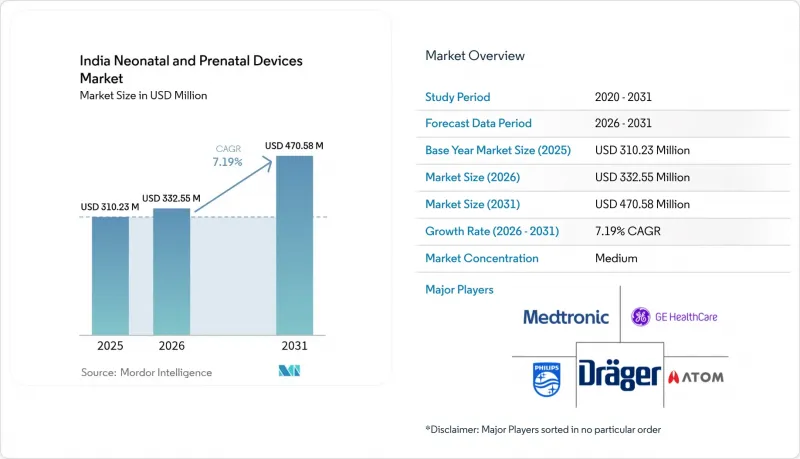
본 보고서는 제품 유형별(태아 관리 기기, 신생아 관리 기기), 최종 사용자별(병원, 신생아·소아 전문 클리닉, 산전·출산 센터, 재택 간호 또는 원격 모니터링 환경), 모달리티별(휴대용, 독립형)로 분류되어 있습니다. 시장 예측은 금액(달러)으로 표시되어 있습니다.
인도의 신생아 및 산전 진단 기기 시장 동향 및 인사이트
2·3급 도시의 NICU 병상 급속한 확장이 기기 수요를 견인
2024년, 지역 병원이 운영하는 가동 중인 NICU 병상은 2,847개에 달하여 2020년 대비 34% 증가했습니다. ‘아유슈만 바라트 보건 인프라 미션’은 모자 보건 인프라 확충을 위해 78억 달러를 투입하고 있으며, 이에 따라 민간 병원 체인이 지방 도시에 신생아 병동을 증설하는 움직임이 가속화되고 있습니다. 가처분 소득 증가와 보험 가입률의 향상은 이러한 건설 붐을 뒷받침하고 있습니다. 병상 수 증가에 따라 인큐베이터, 광선 요법 램프, 다기능 모니터의 수주가 증가하고 있으며, 조달 담당자들은 총 소유 비용(TCO)을 절감할 수 있는 모델을 우선적으로 선택하고 있습니다. 교육, 유지보수, 원격 지원을 패키지로 제공할 수 있는 공급업체는 가격 면에서 우위를 점하고 있습니다.
PLI 제도가 국내 제조 역량을 촉진
의료기기용 PLI 제도에서는 인도 국내에서 고급 신생아·태아용 기기 생산을 확대하는 기업에 6,000만 달러가 배정되었습니다. 21개 제조업체가 증분 매출액의 5-7%에 해당하는 환급금 수령 자격을 획득했습니다. BPL Medical Technologies는 인큐베이터 제품 라인 확충에 1,200만 달러를 투자했으며, Phoenix Medical Systems는 공장의 생산 능력을 40% 향상시켰습니다. 제품 승인 절차의 신속화와 관세 우대 조치로 인해 투자 회수 기간이 단축되고, 수입 기기와 가격 차이가 줄어들었으며, 사후 서비스 대응 시간도 개선되었습니다.
막대한 설비 투자가 첨단 시스템 도입을 가로막고 있습니다.
10병상 규모의 NICU(신생아 집중 치료실)를 구축하려면 120만-200만 달러가 필요하며, 연간 유지비는 장비 가치의 평균 8-12%를 차지합니다. 예산 제약으로 인해 많은 소규모 병원은 최소한의 임상적 요구만 충족하는 간소한 모니터를 선택할 수밖에 없습니다. 정부 입찰의 ‘최저가 입찰’ 규칙은 수명 주기 비용보다 초기 비용 절감을 우선시하는 경향이 있어, 그 결과 빈번한 수리 및 가동 중단 시간 증가를 초래하고 있습니다. 금융 리스나 종량제 요금 모델이 등장하고 있지만, 보급률은 여전히 낮은 상황입니다.
부문 분석
2025년, 신생아 치료용 의료기기는 인도의 신생아 및 산전 진단 기기 시장 점유율의 65.96%를 차지했습니다. 정부 방침에 따라 모든 지역 병원에는 최소 6개의 신생아 집중 치료실(NICU)을 설치해야 하며, 이로 인해 인큐베이터, 광선 요법 장치, 인공호흡기에 대한 지속적인 수요가 보장되고 있습니다. 피닉스 메디컬 시스템즈는 전압 변동이나 먼지가 많은 환경에서도 견딜 수 있도록 설계된 인큐베이터를 국내 시장의 25%에 공급하고 있습니다. 또한, 병원에서는 맥박 산소 포화도 측정, 심전도(ECG), 체온 모니터링을 통합한 모니터링 플랫폼이 병상 옆 공간을 최적화할 수 있다는 점에서 선호되고 있습니다.
태아 관리 기기는 2031년까지 연평균 성장률(CAGR) 8.03%를 나타낼 것으로 예측되며, 이는 모든 제품군 중 가장 높은 성장률입니다. 임산부의 고령화와 선택적 산전 선별 검사의 보급으로 인해, 민간 클리닉에서 전자 태아 모니터의 사용이 보편화되고 있습니다. GE Healthcare의 AI 기반 태아 심박동 측정기는 표준 모니터보다 30분 더 빨리 태아의 이상 패턴을 식별할 수 있어, 이를 통해 산부인과 의사는 응급 개입 비율을 낮출 수 있습니다. 또한, 이동 진료 캠프나 가정 방문 현장에서는 휴대용 도플러 프로브와 핸드헬드형 초음파 스캐너도 호평을 받고 있습니다. 기술 비용의 하락에 따라, 인도의 신생아 및 산전 진단 기기 시장에서 태아용 기기 시장 규모는 대도시권을 넘어 도시 주변 지역으로 확대될 것으로 예측됩니다.
기타 혜택
- 엑셀 형식 시장 예측(ME) 시트
- 3개월간의 애널리스트 지원
자주 묻는 질문
목차
제1장 서론
제2장 조사 방법
제3장 주요 요약
제4장 시장 구도
제5장 시장 규모 및 성장 예측
제6장 경쟁 구도
제7장 시장 기회 및 향후 전망
KTH 26.08.26According to Mordor Intelligence, the India neonatal and prenatal devices market size was valued at USD 310.23 million in 2025 and estimated to grow from USD 332.55 million in 2026 to reach USD 470.58 million by 2031, at a CAGR of 7.19% during the forecast period (2026-2031).
This report is Segmented by Product Type (Fetal Care Equipment, Neonatal Care Equipment), End User (Hospitals, Neonatal & Pediatric Specialty Clinics, Maternity & Birthing Centers, Home-Care or Remote Monitoring Settings), and Modality (Portable, Standalone). The Market Forecasts are Provided in Terms of Value (USD).
India Neonatal And Prenatal Devices Market Trends and Insights
Rapid NICU-bed expansion in Tier 2 and 3 cities drives equipment demand
District hospitals operated 2,847 functional NICUs in 2024, marking a 34% rise since 2020 . The Ayushman Bharat Health Infrastructure Mission is channeling USD 7.8 billion toward maternal and child health upgrades, prompting private hospital chains to add neonatal units in secondary cities. Higher disposable income and stronger insurance penetration support this wave of construction. Rising bed capacity lifts orders for incubators, phototherapy lamps, and multi-parameter monitors, with procurement teams favoring models that lower total cost of ownership. Vendors that can bundle training, maintenance, and remote support hold a pricing edge.
PLI scheme catalyzes domestic manufacturing capabilities
The medical-device PLI scheme earmarks USD 60 million for firms that expand Indian production of high-end neonatal and fetal equipment. Twenty-one manufacturers have qualified for rebates worth 5-7% of incremental sales . BPL Medical Technologies invested USD 12 million to extend its incubator line, and Phoenix Medical Systems lifted plant throughput by 40%. Faster product approvals and duty concessions are compressing payback periods, narrowing price gaps with imported devices, and improving after-sales response times.
High capital expenditure constrains adoption of advanced systems
Outfitting a ten-bed NICU demands USD 1.2 million to USD 2 million, and annual maintenance averages 8-12% of equipment value. Budget limitations steer many small hospitals toward stripped-down monitors that meet minimal clinical needs. Lowest-price bid rules in government tenders often elevate upfront savings over lifecycle economics, resulting in frequent repairs and higher downtime. Finance leasing and pay-per-use models are emerging but remain under-penetrated.
Other drivers and restraints analyzed in the detailed report include:
- AI-enabled predictive analytics transforms neonatal monitoring
- Import-substitution momentum builds amid supply-chain vulnerabilities
- Workforce shortage limits equipment utilization and market expansion
For complete list of drivers and restraints, kindly check the Table Of Contents.
Segment Analysis
Neonatal care devices captured 65.96% of the India neonatal and prenatal devices market share in 2025. Government policy requires every district hospital to house at least six NICU beds, which secures recurring demand for incubators, phototherapy units, and ventilators. Phoenix Medical Systems supplies 25% of domestic incubators with designs that withstand voltage fluctuations and dusty environments. Hospitals also favor integrated monitoring platforms that combine pulse oximetry, ECG, and temperature tracking to optimize bedside space.
Fetal care equipment is projected to record an 8.03% CAGR through 2031, the fastest among all product groups. Rising maternal age and elective prenatal screening are normalizing electronic fetal monitor use in private clinics. AI-embedded cardiotocography units from GE Healthcare can identify distress patterns thirty minutes earlier than standard monitors, which helps obstetricians lower emergency intervention rates. Portable Doppler probes and handheld ultrasound scanners are also gaining favor for outreach camps and home visits. As technology costs fall, the India neonatal and prenatal devices market size for fetal devices is expected to expand beyond metro clusters toward peri-urban areas.
Complete Report Scope:
- By Product Type
- Fetal Care Equipment
- Fetal Ultrasound Systems
- Fetal Dopplers
- Electronic Fetal Monitors (CTG)
- Fetal MRI & Pulse-Oximeters
- Neonatal Care Equipment
- Incubators
- Infant Warmers & Convertible Warmers
- Phototherapy Systems
- Neonatal Ventilators & CPAP
- Multi-parameter Monitors & Pulse-Oximeters
- Resuscitators & Syringe/Feeding Pumps
- Fetal Care Equipment
- By End User
- Hospitals
- Neonatal & Pediatric Specialty Clinics
- Maternity & Birthing Centers
- Home-care or Remote Monitoring Settings
- By Modality
- Portable
- Standalone
List of Companies Covered in this Report:
- GE Healthcare
- Koninklijke Philips
- Dragerwerk
- Medtronic
- Fisher & Paykel Healthcare
- Natus Medical
- Atom Medical Corp.
- Mindray Bio-Medical
- BPL
- Phoenix Medical Systems
- Nice Neotech Medical Systems
- AVI Healthcare Pvt Ltd
- Narang Medical
- Skanray Technologies
- Vyaire Medical
- Masimo Corp.
- Edan Instruments Inc.
- Comen Medical Instruments
Additional Benefits:
- The market estimate (ME) sheet in Excel format
- 3 months of analyst support
TABLE OF CONTENTS
1 Introduction
- 1.1 Study Assumptions & Market Definition
- 1.2 Scope of the Study
2 Research Methodology
3 Executive Summary
4 Market Landscape
- 4.1 Market Overview
- 4.2 Market Drivers
- 4.2.1 Rapid NICU-Bed Expansion in Tier 2/3 Cities
- 4.2.2 Shift Toward Portable and Home-Based Monitoring
- 4.2.3 Production-Linked Incentive (PLI) Scheme Boosts Local Supply
- 4.2.4 AI-Enabled Predictive Analytics Embedded in Devices
- 4.2.5 Import-Substitution Push Amid High Import Dependence
- 4.2.6 Rise In High-Risk Pregnancies & Late Maternal Age
- 4.3 Market Restraints
- 4.3.1 High Cap-Ex & Maintenance Cost for Advanced Systems
- 4.3.2 Shortage Of Trained Neonatologists & Biomedical Engineers
- 4.3.3 Fragmented Procurement Across Public Hospitals
- 4.3.4 Data-privacy Gaps for Connected Devices
- 4.4 Value / Supply-Chain Analysis
- 4.5 Regulatory Landscape
- 4.6 Technological Outlook
- 4.7 Porters Five Forces Analysis
- 4.7.1 Threat of New Entrants
- 4.7.2 Bargaining Power of Suppliers
- 4.7.3 Bargaining Power of Buyers
- 4.7.4 Threat of Substitutes
- 4.7.5 Competitive Rivalry
5 Market Size & Growth Forecasts (Value, USD)
- 5.1 By Product Type
- 5.1.1 Fetal Care Equipment
- 5.1.1.1 Fetal Ultrasound Systems
- 5.1.1.2 Fetal Dopplers
- 5.1.1.3 Electronic Fetal Monitors (CTG)
- 5.1.1.4 Fetal MRI & Pulse-Oximeters
- 5.1.2 Neonatal Care Equipment
- 5.1.2.1 Incubators
- 5.1.2.2 Infant Warmers & Convertible Warmers
- 5.1.2.3 Phototherapy Systems
- 5.1.2.4 Neonatal Ventilators & CPAP
- 5.1.2.5 Multi-parameter Monitors & Pulse-Oximeters
- 5.1.2.6 Resuscitators & Syringe/Feeding Pumps
- 5.1.1 Fetal Care Equipment
- 5.2 By End User
- 5.2.1 Hospitals
- 5.2.2 Neonatal & Pediatric Specialty Clinics
- 5.2.3 Maternity & Birthing Centers
- 5.2.4 Home-care or Remote Monitoring Settings
- 5.3 By Modality
- 5.3.1 Portable
- 5.3.2 Standalone
6 Competitive Landscape
- 6.1 Market Concentration
- 6.2 Market Share Analysis
- 6.3 Company Profiles (includes Global level Overview, Market level overview, Core Segments, Financials as available, Strategic Information, Market Rank/Share, Products & Services, and Recent Developments)
- 6.3.1 GE Healthcare
- 6.3.2 Philips Healthcare
- 6.3.3 Dragerwerk AG & Co. KGaA
- 6.3.4 Medtronic plc
- 6.3.5 Fisher & Paykel Healthcare
- 6.3.6 Natus Medical Inc.
- 6.3.7 Atom Medical Corp.
- 6.3.8 Mindray Bio-Medical
- 6.3.9 BPL Medical Technologies
- 6.3.10 Phoenix Medical Systems Pvt Ltd
- 6.3.11 Nice Neotech Medical Systems
- 6.3.12 AVI Healthcare Pvt Ltd
- 6.3.13 Narang Medical Ltd
- 6.3.14 Skanray Technologies
- 6.3.15 Vyaire Medical
- 6.3.16 Masimo Corp.
- 6.3.17 Edan Instruments Inc.
- 6.3.18 Comen Medical Instruments
7 Market Opportunities & Future Outlook
- 7.1 White-space & Unmet-need Assessment