|
시장보고서
상품코드
2113867
은행 산업 분야 클라우드 보안 : 시장 점유율 분석, 업계 동향 및 통계, 성장 예측(2026-2031년)Cloud Security In Banking Industry - Market Share Analysis, Industry Trends & Statistics, Growth Forecasts (2026 - 2031) |
||||||
 Mordor Intelligence
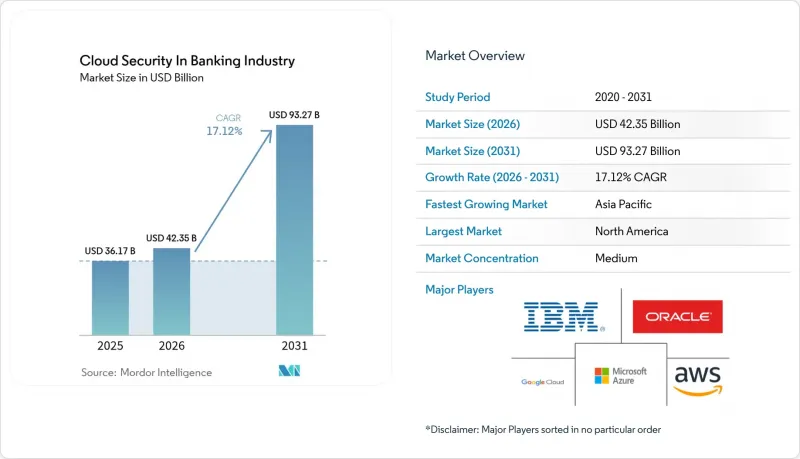
Mordor Intelligence에 의하면, 은행 산업 분야 클라우드 보안 시장 규모는 2025년에 361억 7,000만 달러로 평가되었습니다. 2026년 423억 5,000만 달러에서 2031년에는 932억 7,000만 달러에 이를 것으로 예상되며, 예측 기간(2026-2031년) CAGR은 17.12%를 나타낼 전망입니다.
본 보고서는 소프트웨어 유형(클라우드 ID 및 액세스 관리, 클라우드 이메일 보안 등), 도입 모델(퍼블릭 클라우드, 프라이빗 클라우드, 하이브리드 클라우드), 보안 서비스(데이터 보안, 용도 보안 등), 은행업 유형(소매/소비자 뱅킹,기업 및 투자 은행 업무 등) 및 지역별로 분류되어 있습니다. 시장 전망은 금액(미 달러)으로 표시되어 있습니다.
세계의 은행 산업 분야 클라우드 보안 시장 동향 및 인사이트
은행 업무 워크로드에 대한 사이버 공격 증가 및 고도화
2024년, 금융 기관이 랜섬웨어 공격을 받은 비율은 78%에 달하고, 전년 대비 2배로 증가했습니다. 공격자들은 현재 API 악용, 컨테이너 설정 오류, 타사 소프트웨어의 취약점을 악용하고 있으며, 한 사례에서는 클라우드 설정 오류로 인해 JP모건 체이스의 고객 약 50만 명이 위험에 노출되면서, 기존의 경계선에 의존하지 않는 새로운 위협의 실체가 부각되었습니다. 건당 평균 피해액은 1,000만 달러에 달하며, 모든 세션과 자산을 검증하는 행동 분석 기반의 제로 트러스트 통제로의 긴급한 전환이 요구되고 있습니다. 주요 은행들은 DevSecOps 파이프라인에 지속적인 규정 준수 스캔과 위협 감지를 통합하여, 취약점이 노출되는 기간을 며칠에서 몇 시간으로 단축하고 있습니다. 세계 결제 네트워크인 SWIFT는 Google Cloud와 협력하여 연합 학습 모델의 시범 운영을 진행 중이며, 기밀 데이터를 이동시키지 않고도 비정상적인 거래를 감지하고 있습니다. 이는 AI가 개인정보를 보호하면서 부정 행위를 감지할 수 있음을 입증하는 사례입니다. 조직 범죄가 다크넷 시장에서 도난당한 은행 인증 정보에 대한 접근 권한을 금전적으로 악용하고 있는 가운데, 예방적 클라우드 세분화과 최소 권한 원칙을 적용한 IAM은 이사회 차원의 최우선 과제가 되고 있습니다.
실시간 규정 준수 자동화 요건(바젤 III, DORA 등)
EU의 DORA는 2만 2,000개 금융 기관에 대해 중대한 사이버 사고를 24시간 이내에 보고하고, 주요 클라우드 공급자에 대한 대체 계획을 검증할 것을 의무화하고 있어, 은행들은 규제 당국에 거의 실시간으로 정보를 제공하는 자동 증거 수집 엔진의 도입을 요구받고 있습니다. 미국 규제 당국도 유사한 방향성을 보이고 있으며, 재무부의 2025년 클라우드 복원력 보고서는 시스템적으로 중요한 금융 기관에 대해 지속적인 통제 모니터링을 요구하고 있습니다. 클라우드 벤더들은 현재 바젤 III, PCI DSS, GDPR(EU 개인정보보호규정)에 대한 매핑 템플릿을 대시보드에 통합하여 수동 감사 업무 부담을 40% 줄이고 있습니다. 세계로 사업을 전개하는 은행들은 통합된 컴플라이언스 패브릭을 표준화하여, 단일 정책 세트로 중복되는 관할 구역의 요건을 충족할 수 있게 되었습니다. 이는 고객 데이터의 유통이 EU, 미국, 아시아에 걸쳐 있는 경우에 특히 유용합니다. 조기 도입 기업들로부터는 내장형 거버넌스를 통해 지루하게 이어지던 보안 검토 주기가 해소되고, 컴플라이언스가 장애 요인에서 수익 창출의 원동력으로 전환됨에 따라 제품 출시가 가속화되었습니다는 보고가 접수되고 있습니다.
데이터 상주 요건과 멀티테넌트형 퍼블릭 클라우드의 모순
GDPR(EU 개인정보보호규정), 중국의 CSL, 인도의 DPDP법은 은행에 데이터 현지화를 의무화하고 있으며, 이는 전 세계적인 멀티테넌트 환경과 상충됩니다. 하이퍼스케일러가 제공하는 소버린 클라우드의 다양한 형태는 메타데이터 분리 및 로컬 키 관리를 약속하고 있지만, 일부 규제 당국이 요구하는 세밀한 배치 제어 기능은 여전히 부족합니다. 아시아태평양의 소규모 시장에서는 규모의 경제를 저해하는 ‘국내 데이터센터 설치’ 규정이 종종 적용되고 있어, 은행들은 기밀성이 높은 데이터 세트를 On-Premise 또는 현지 프라이빗 리전에 보관하는 하이브리드 토폴로지로 전환할 수밖에 없는 실정입니다. 그 결과 발생하는 아키텍처의 복잡성은 비용을 증가시키고, 설정 오류 위험을 높이며, 클라우드의 광범위한 도입 계획을 저해하고 있습니다. 정책 입안자들은 사이버 복원력의 이점이 관할권상의 우려를 상회하도록 업계와 협의하여 데이터 거주 요건을 세밀하게 조정하고 있지만, 이 문제가 해결되려면 금세기 말이 되어야할 것으로 보입니다.
부문 분석
2025년, 은행 산업 분야 클라우드 보안 시장 중 클라우드 ID 및 액세스 관리(IAM)가 28.85%를 차지했습니다. 이는 은행이 경계 제어에서 사용자, 서비스, API를 밀리초 단위로 인증하는 ID 중심의 보호 조치로 전환하고 있음을 반영합니다. 분산형 업무 모델이 정착됨에 따라, IAM은 싱글 사인온(SSO), 특권 액세스 관리 및 기기 상태 점검을 통합하여 제로 트러스트 프로그램의 기반을 형성하고 있습니다. 각 벤더사는 현재 지속적인 위험 점수 산정 및 로그인 시 번거로움을 줄여주는 비밀번호 없는 인증 절차를 도입하고 있으며, 이는 소비자 뱅킹에서 매우 중요한 사용자 경험 요소로 자리 잡고 있습니다.
클라우드 암호화는 가장 빠르게 성장하는 부문으로, 2031년까지 연평균 성장률(CAGR)이 17.75%를 나타낼 것으로 예측됩니다. 양자 위협에 대한 인식이 높아지고 데이터 보호에 관한 법규가 엄격해짐에 따라, 은행들은 하드웨어 보안 모듈(HSM) 및 중앙 집중식 키 관리 도입을 추진하고 있습니다. 은행 부문에서 암호화에 특화된 제품의 클라우드 보안 시장 규모는 결제 인프라 전반에 걸친 양자 내성 알고리즘의 도입에 따라 확대될 것으로 예측되며, 암호화 기술은 규정 준수상의 필수 요건일 뿐만 아니라 경쟁적 차별화 요소로도 자리매김하고 있습니다. 다자간 계산 및 포맷 보존 암호화가 주목받고 있으며, 금융 기관은 데이터를 복호화하지 않고도 분석할 수 있게 됩니다. 이는 국경을 초월한 사기 분석 및 AI 모델 훈련에 있어 획기적인 진전입니다.
2025년에는 은행 산업 분야 클라우드 보안 시장 점유율의 61.55%를 퍼블릭 클라우드 도입이 차지했으며, 하이퍼스케일러의 방어 체계, 금융 서비스 전용 리전, 그리고 책임 분담 청사진에 대한 높은 신뢰도가 부각되었습니다. AWS나 Microsoft와 같은 제공업체들은 평가 시간을 단축하는 PCI DSS 온디맨드 감사 팩과 같은 도구의 지원을 받아, 은행용 워크로드에서 두 자릿수 성장을 보고하고 있습니다. 그러나 소버린 클라우드나 리저널 클라우드와 같은 다양한 형태는 단일 모델로 모든 관할 구역을 대응할 수 없음을 보여주고 있으며, 영국 감독 당국이 요구하는 ‘엑시트 전략’에 대한 검증은 여전히 남아 있는 집중 리스크를 부각시키고 있습니다.
하이브리드 클라우드 도입은 연평균 성장률(CAGR) 19.45%로 확대되고 있습니다. 이는 은행이 데이터 상주 요건을 충족하면서도, 분석 처리량이 급증할 때 퍼블릭 클라우드 인프라로 부하를 분산할 수 있기 때문입니다. 컨테이너와 서비스 메시는 워크로드의 이식성을 실현하며, 침해 피해를 입은 제공업체로부터의 트래픽을 몇 시간 이내에 전환하는 ‘스트레스 익시트’ 훈련을 가능하게 합니다. 규제 당국이 단일 벤더에 대한 의존도를 면밀히 검토하는 가운데, 멀티 클라우드 툴체인은 운영 복원력의 중요한 지표로 자리 잡고 있으며, 공급업체 전반에 걸쳐 보안을 확보하고 오케스트레이션을 수행하는 추상화 계층의 도입이 가속화되고 있습니다.
지역별 분석
북미는 은행 산업 분야 클라우드 보안 시장을 독점하고 있으며, 2025년에는 36.85%의 점유율을 차지했습니다. 수년에 걸친 규제 당국과 공급업체 간의 대화, 성숙한 민관 간 위협 정보 공유, 그리고 JP 모건 체이스의 연간 170억 달러에 달하는 기술 지출은 현지 수요의 깊이를 뒷받침하고 있습니다. 미국 재무부의 2025년 클라우드 복원력 관련 조사에서는 중요 기관에 대해 실시간 모니터링 파이프라인을 도입하면서 멀티 클라우드 접근 방식을 채택할 것을 공식적으로 권장하고 있으며, 이에 따라 여러 공급업체에 걸친 통합 보안 스택에 대한 발주가 가속화되고 있습니다. 캐나다 규제 당국은 현재 오픈 뱅킹 관련 지침에서 제로 트러스트 및 보안 API 기준을 명시적으로 언급하고 있으며, 이는 투자의 추가적인 모멘텀을 시사합니다.
아시아태평양에서는 규제 당국이 데이터 현지화와 혁신의 균형을 모색하고 있어, 2026년부터 2031년까지 17.35%라는 가장 높은 연평균 성장률(CAGR)이 예상됩니다. 일본의 지방은행 컨소시엄은 IBM 및 Kyndryl의 인프라에서 운영되는 공유 하이브리드 플랫폼을 채택하여, 비용 효율성이 뛰어나면서도 규정 준수를 준수하는 보안에 대한 협력적인 접근 방식을 보여주고 있습니다. 또한, 싱가포르의 전국 디지털 ID 도입과 말레이시아의 RMiT 표준도 각각 IAM(신원 및 접근 관리) 및 실시간 모니터링 도입을 촉진하고 있습니다. 중국의 다층 보호 체계(MLPS 2.0)에서는 암호화, 지속적인 모니터링, 그리고 국내 내 키 보관이 의무화되어 있으며, 이에 따라 각 공급업체들은 하드웨어 기반 인증 기능을 갖춘 ‘국내 전용’ 리전 구축을 추진하고 있습니다.
유럽에서는 DORA 및 PSD2/PSD3에 따라 움직임이 가속화되고 있습니다. 이탈리아의 은행 크레뎀 반카(Credem Banca)는 암호화 및 실시간 사고 알림 기능을 통합한 전문 보안 클라우드로 전환하여 규제 보고 처리 속도를 20% 향상시켰습니다. 탈레스(Thales)의 2024년 조사에 따르면, 유럽 기업의 65%가 클라우드 보안을 사이버 보안 분야에서 두 번째로 중요한 우선순위로 꼽고 있어, 이사회 차원에서 이를 중시하고 있음을 알 수 있습니다. 멀티 클라우드 복원력 훈련 및 소버린 클라우드 시범 도입은 현재 계약상 필수 요건이 되었으며, 아마존, 마이크로소프트, 구글의 각 환경에서 수동으로 규칙을 중복 생성할 필요 없이 정책을 적용할 수 있는 오케스트레이션 계층에 대한 수요를 촉진하고 있습니다.
기타 혜택 :
- 엑셀 형식 시장 예측(ME) 시트
- 3개월간의 애널리스트 지원
자주 묻는 질문
목차
제1장 서론
제2장 조사 방법
제3장 주요 요약
제4장 시장 구도
제5장 시장 규모 및 성장 예측
제6장 경쟁 구도
제7장 시장 기회 및 향후 동향
KTH 26.08.26According to Mordor Intelligence, the cloud security in banking industry was valued at USD 36.17 billion in 2025 and estimated to grow from USD 42.35 billion in 2026 to reach USD 93.27 billion by 2031, at a CAGR of 17.12% during the forecast period (2026-2031). This report is Segmented by Software Type (Cloud Identity and Access Management, Cloud Email Security, and More), Deployment Model (Public Cloud, Private Cloud, and Hybrid Cloud), Security Service (Data Security, Application Security, and More), Banking Type (Retail/Consumer Banking, Corporate and Investment Banking, and More), and Geography. The Market Forecasts are Provided in Terms of Value (USD).
Global Cloud Security In Banking Industry Trends and Insights
Growing Volume and Sophistication of Cyber-Attacks on Banking Workloads
Financial institutions faced 78% ransomware hit rates in 2024, double the prior year. Attackers are now exploiting API abuse, container misconfigurations, and third-party software flaws, in 1 incident, a cloud misconfiguration exposed nearly 500,000 JPMorgan Chase customers, underlining the new perimeter-free threat surface. Average breach costs reach USD 10 million per incident, prompting urgent migration to behavior analytics-driven zero-trust controls that verify every session and asset. Major banks are embedding continuous compliance scanning and threat hunting into DevSecOps pipelines to reduce exposure windows from days to hours. Global payments rail SWIFT is piloting federated learning models with Google Cloud that flag anomalous transactions without moving sensitive data, demonstrating how AI can detect fraud while protecting privacy. As organized crime monetizes access to stolen banking credentials on dark-net markets, proactive cloud segmentation and least-privilege IAM have become board-level priorities.
Real-Time Compliance Automation Requirements (Basel III, DORA, etc.)
The EU's DORA obliges 22,000 financial entities to report severe cyber incidents within 24 hours and test exit plans for critical cloud suppliers, pushing banks to deploy automated evidence-collection engines that feed regulators in near real time. U.S. regulators are moving in the same direction: the Treasury's 2025 cloud resilience report urges continuous control monitoring for systemic institutions. Cloud vendors now bundle mapping templates for Basel III, PCI DSS, and GDPR into dashboards, cutting manual audit workloads by 40%. Banks with global footprints are standardizing on unified compliance fabrics so a single policy set satisfies overlapping jurisdictions-particularly valuable when customer data flows span the EU, the U.S., and Asia. Early adopters report faster product launches because embedded governance eliminates lengthy security-review cycles, turning compliance from a blocker into a revenue enabler.
Data Residency Conflicts with Multi-Tenant Public Clouds
GDPR, China's CSL, and India's DPDP Act oblige banks to localize data, conflicting with global multi-tenant setups. Sovereign-cloud variants from hyperscalers promise metadata isolation and local key custody, yet still lack the granular placement controls some regulators demand. Smaller APAC markets often enforce data-center-in-country rules that erode economies of scale, nudging banks toward hybrid topologies where sensitive datasets stay on-prem or in local private regions. Resulting architectural complexity inflates cost and elevates configuration-error risk, adding drag to widespread cloud adoption plans. Policymakers are consulting with industry to refine residency stipulations so cyber resilience benefits outweigh jurisdictional concerns, but resolution is unlikely before the end of the decade.
Other drivers and restraints analyzed in the detailed report include:
- Cost Avoidance Through Serverless and Container-Native Security Controls
- Expansion of Open-Banking APIs Driving Zero-Trust Adoption
- Shortage of Cloud-Security-Skilled Talent in Banks' SOC Teams
For complete list of drivers and restraints, kindly check the Table Of Contents.
Segment Analysis
Cloud Identity and Access Management accounted for 28.85% of the cloud security in banking industry share in 2025, reflecting banks' shift from perimeter controls to identity-centric guardrails that authenticate users, services, and APIs at a millisecond scale. As distributed work models persist, IAM consolidates single sign-on, privileged access management, and device posture checks, forming the backbone of zero-trust programs. Vendors are now embedding continuous risk scoring and passwordless flows that trim login friction-a critical user-experience factor in consumer banking.
Cloud Encryption is the fastest segment, posting an 17.75% CAGR through 2031. Quantum threat awareness and stricter data protection statutes are prompting banks to implement hardware security modules and centralized key orchestration. The cloud security market size for encryption-focused products in the banking sector is forecast to rise alongside the implementation of quantum-safe algorithms across payment rails, positioning cryptography as both a compliance must-have and a competitive differentiator. Multi-party computation and format-preserving encryption are gaining traction, letting institutions analyze data without decrypting it, a breakthrough for cross-border fraud analytics and AI model training.
Public-cloud implementations captured 61.55% of the cloud security market share in the banking industry in 2025, underscoring confidence in hyperscaler defenses, dedicated financial services regions, and shared-responsibility blueprints. Providers such as AWS and Microsoft report double-digit growth in bank workloads, aided by artifacts like PCI DSS on-demand audit packs that slice assessment times. However, the sovereign-cloud and regional-cloud variants illustrate that one model will not fit every jurisdiction, and exit-strategy testing, as demanded by U.K. supervisors, underscores residual concentration risk.
Hybrid-cloud installations are expanding at a 19.45% CAGR because they let banks meet data residency mandates while still bursting to public fabric for analytics surges. Containers and service meshes deliver workload portability, enabling stress-exit drills that shift traffic off a compromised provider within hours. As regulators scrutinize single-vendor dependencies, multi-cloud toolchains are becoming a broad metric for operational resilience, accelerating the procurement of abstraction layers that secure and orchestrate across providers.
Complete Report Scope:
- By Software Type
- Cloud Identity and Access Management (IAM)
- Cloud Email Security
- Cloud Intrusion Detection and Prevention (IDPS)
- Cloud Encryption
- Cloud Network Security
- By Deployment Model
- Public Cloud
- Private Cloud
- Hybrid Cloud
- By Security Service
- Data Security
- Application Security
- Network Security
- Security Monitoring and Orchestration (SIEM/SOAR)
- Identity, Authentication and Fraud Analytics
- By Banking Type
- Retail/Consumer Banking
- Corporate and Investment Banking
- Card and Payment Service Providers
- Digital-Only/Neobanks
- By Geography
- North America
- United States
- Canada
- Mexico
- South America
- Brazil
- Argentina
- Chile
- Rest of South America
- Europe
- Germany
- United Kingdom
- France
- Italy
- Spain
- Russia
- Rest of Europe
- Asia-Pacific
- China
- India
- Japan
- South Korea
- Malaysia
- Singapore
- Australia
- Rest of Asia-Pacific
- Middle East and Africa
- Middle East
- United Arab Emirates
- Saudi Arabia
- Turkey
- Rest of Middle East
- Africa
- South Africa
- Nigeria
- Egypt
- Rest of Africa
- Middle East
- North America
Geography Analysis
North America dominated the cloud security market in banking industry, with a 36.85% share in 2025. A long-standing regulator-vendor dialogue, mature private-public threat-sharing, and USD 17 billion in annual tech spending at JPMorgan Chase underscore the depth of local demand. The U.S. Treasury's 2025 cloud-resilience study formally encourages critical institutions to adopt a multi-cloud approach while implementing real-time monitoring pipelines, thereby accelerating orders for unified security stacks that can span multiple providers. Canadian regulators now explicitly reference zero-trust and secure-API norms in their open-banking guidance, signaling further momentum in investment.
The Asia-Pacific region is expected to deliver the fastest CAGR of 17.35% from 2026 to 2031, as regulators balance data localization with innovation. Japan's consortium of regional banks adopted a shared hybrid platform running on IBM and Kyndryl infrastructure, illustrating collaborative approaches to cost-effective yet compliant security. Singapore's national digital ID roll-out and Malaysia's RMiT standard also drive the adoption of IAM and real-time monitoring, respectively. China's multi-level protection scheme (MLPS 2.0) compels encryption, continuous monitoring, and onshore key custody, prompting providers to launch local-only regions with hardware attestation.
Europe is accelerating due to DORA and PSD2/PSD3. Italian bank Credem Banca migrated to a specialist security cloud that embeds encryption and real-time incident notification, achieving 20% faster regulatory reporting. The Thales 2024 study notes that 65% of European firms rank cloud security as their second-largest cybersecurity priority, indicating a board-level focus. Multi-cloud resilience drills and sovereign-cloud pilots are now contractual requirements, spurring demand for orchestration layers that enforce policies across Amazon, Microsoft, and Google environments without manual rule duplication.
- AWS (Amazon.com, Inc.)
- Google Cloud Platform (Alphabet Inc.)
- Microsoft Azure (Microsoft Corporation)
- IBM Cloud Security (IBM Corporation)
- Oracle Cloud (Oracle Corporation)
- Salesforce, Inc.
- Palo Alto Networks, Inc.
- Fortinet Inc.
- Check Point Software Technologies Ltd.
- Trend Micro Inc.
- CrowdStrike Holdings, Inc.
- Zscaler, Inc.
- Proofpoint Inc.
- Okta, Inc.
- Ping Identity Corporation
- SailPoint Technologies Holdings Inc.
- Netskope, Inc.
- Imperva, Inc.
- Qualys, Inc.
- Rapid7, Inc.
- Sophos Ltd.
- Illumio Inc.
- Akamai Technologies Inc.
- Thales Group (Vormetric)
- Temenos AG
- nCino, Inc.
Additional Benefits:
- The market estimate (ME) sheet in Excel format
- 3 months of analyst support
TABLE OF CONTENTS
1 INTRODUCTION
- 1.1 Study Assumptions and Market Definition
- 1.2 Scope of the Study
2 RESEARCH METHODOLOGY
3 EXECUTIVE SUMMARY
4 MARKET LANDSCAPE
- 4.1 Market Overview
- 4.2 Market Drivers
- 4.2.1 Growing volume and sophistication of cyber-attacks on banking workloads
- 4.2.2 Real-time compliance automation requirements (Basel III, DORA, etc.)
- 4.2.3 Cost avoidance through serverless and container-native security controls
- 4.2.4 Expansion of open-banking APIs driving zero-trust adoption
- 4.2.5 AI-powered fraud detection bundled with cloud security suites
- 4.3 Market Restraints
- 4.3.1 Data residency conflicts with multi-tenant public clouds
- 4.3.2 Shortage of cloud-security-skilled talent in banks' SOC teams
- 4.3.3 Hidden dependency risk in third-party fintech integrations
- 4.4 Industry Value Chain Analysis
- 4.5 Regulatory Landscape
- 4.6 Technological Outlook
- 4.7 Industry Attractiveness - Porter's Five Forces Analysis
- 4.7.1 Threat of New Entrants
- 4.7.2 Bargaining Power of Buyers
- 4.7.3 Bargaining Power of Suppliers
- 4.7.4 Threat of Substitutes
- 4.7.5 Intensity of Competitive Rivalry
- 4.8 Impact of Macroeconomic Factors on the Market
5 MARKET SIZE AND GROWTH FORECASTS (VALUES)
- 5.1 By Software Type
- 5.1.1 Cloud Identity and Access Management (IAM)
- 5.1.2 Cloud Email Security
- 5.1.3 Cloud Intrusion Detection and Prevention (IDPS)
- 5.1.4 Cloud Encryption
- 5.1.5 Cloud Network Security
- 5.2 By Deployment Model
- 5.2.1 Public Cloud
- 5.2.2 Private Cloud
- 5.2.3 Hybrid Cloud
- 5.3 By Security Service
- 5.3.1 Data Security
- 5.3.2 Application Security
- 5.3.3 Network Security
- 5.3.4 Security Monitoring and Orchestration (SIEM/SOAR)
- 5.3.5 Identity, Authentication and Fraud Analytics
- 5.4 By Banking Type
- 5.4.1 Retail/Consumer Banking
- 5.4.2 Corporate and Investment Banking
- 5.4.3 Card and Payment Service Providers
- 5.4.4 Digital-Only/Neobanks
- 5.5 By Geography
- 5.5.1 North America
- 5.5.1.1 United States
- 5.5.1.2 Canada
- 5.5.1.3 Mexico
- 5.5.2 South America
- 5.5.2.1 Brazil
- 5.5.2.2 Argentina
- 5.5.2.3 Chile
- 5.5.2.4 Rest of South America
- 5.5.3 Europe
- 5.5.3.1 Germany
- 5.5.3.2 United Kingdom
- 5.5.3.3 France
- 5.5.3.4 Italy
- 5.5.3.5 Spain
- 5.5.3.6 Russia
- 5.5.3.7 Rest of Europe
- 5.5.4 Asia-Pacific
- 5.5.4.1 China
- 5.5.4.2 India
- 5.5.4.3 Japan
- 5.5.4.4 South Korea
- 5.5.4.5 Malaysia
- 5.5.4.6 Singapore
- 5.5.4.7 Australia
- 5.5.4.8 Rest of Asia-Pacific
- 5.5.5 Middle East and Africa
- 5.5.5.1 Middle East
- 5.5.5.1.1 United Arab Emirates
- 5.5.5.1.2 Saudi Arabia
- 5.5.5.1.3 Turkey
- 5.5.5.1.4 Rest of Middle East
- 5.5.5.2 Africa
- 5.5.5.2.1 South Africa
- 5.5.5.2.2 Nigeria
- 5.5.5.2.3 Egypt
- 5.5.5.2.4 Rest of Africa
- 5.5.5.1 Middle East
- 5.5.1 North America
6 COMPETITIVE LANDSCAPE
- 6.1 Market Concentration
- 6.2 Strategic Moves
- 6.3 Market Share Analysis
- 6.4 Company Profiles (includes Global level Overview, Market level overview, Core Segments, Financials as available, Strategic Information, Market Rank/Share for key companies, Products and Services, and Recent Developments)
- 6.4.1 AWS (Amazon.com, Inc.)
- 6.4.2 Google Cloud Platform (Alphabet Inc.)
- 6.4.3 Microsoft Azure (Microsoft Corporation)
- 6.4.4 IBM Cloud Security (IBM Corporation)
- 6.4.5 Oracle Cloud (Oracle Corporation)
- 6.4.6 Salesforce, Inc.
- 6.4.7 Palo Alto Networks, Inc.
- 6.4.8 Fortinet Inc.
- 6.4.9 Check Point Software Technologies Ltd.
- 6.4.10 Trend Micro Inc.
- 6.4.11 CrowdStrike Holdings, Inc.
- 6.4.12 Zscaler, Inc.
- 6.4.13 Proofpoint Inc.
- 6.4.14 Okta, Inc.
- 6.4.15 Ping Identity Corporation
- 6.4.16 SailPoint Technologies Holdings Inc.
- 6.4.17 Netskope, Inc.
- 6.4.18 Imperva, Inc.
- 6.4.19 Qualys, Inc.
- 6.4.20 Rapid7, Inc.
- 6.4.21 Sophos Ltd.
- 6.4.22 Illumio Inc.
- 6.4.23 Akamai Technologies Inc.
- 6.4.24 Thales Group (Vormetric)
- 6.4.25 Temenos AG
- 6.4.26 nCino, Inc.
7 MARKET OPPORTUNITIES AND FUTURE TRENDS
- 7.1 White-Space and Unmet-Need Assessment