

|
시장보고서
상품코드
2113868
항독소 : 시장 점유율 분석, 업계 동향 및 통계, 성장 예측(2026-2031년)Antivenom - Market Share Analysis, Industry Trends & Statistics, Growth Forecasts (2026 - 2031) |
||||||
 Mordor Intelligence
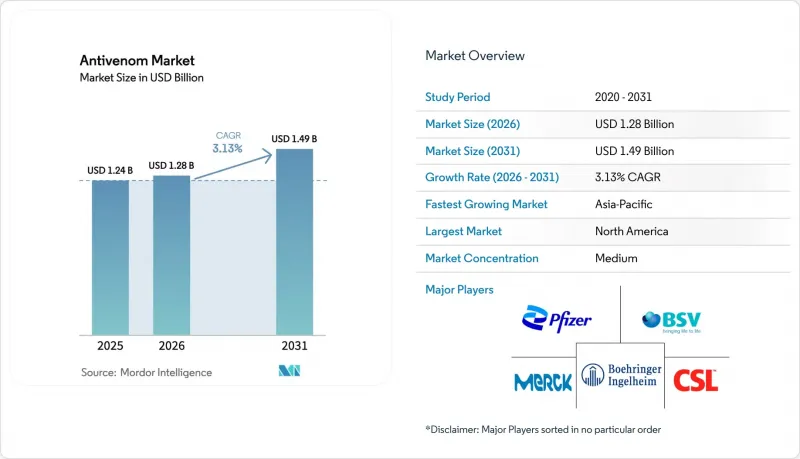
Mordor Intelligence에 의하면, 항독소 시장 규모는 2025년에 12억 4,000만 달러로 평가되었습니다. 2026년에 12억 8,000만 달러에 달하고, 2031년까지 14억 9,000만 달러에 이를 것으로 예측되며, 2026-2031년에 걸쳐 CAGR 3.13%로 성장할 전망입니다.
본 보고서는 제품 유형별(다가, 일가, 기타), 공급원별(말 유래, 양 유래, 재조합(DNA/단일클론)), 최종 사용자별(병원, 클리닉·외상 센터, 군사·특수 용도),지역별(북미, 유럽, 아시아태평양, 중동 및 아프리카, 남미)로 세분화되어 있습니다. 시장 예측은 금액(달러) 기준으로 제시되어 있습니다.
세계의 항독소 시장 동향 및 인사이트
독을 가진 생물에 의한 물림·찔림 사고 발생 건수 증가
WHO 기록에 따르면, 연간 540만 건의 뱀 물림 사고가 발생하고 있으며, 그 결과 최대 13만 8,000명이 사망하고 40만 명이 평생 장애를 겪고 있습니다. 인도에서만 전 세계 사망자 수의 거의 절반을 차지하며, 몬순기의 파종 시즌에 농업 종사자들이 크라이트나 코브라를 마주치는 경우가 많아 사례 수가 정점에 달할 전망입니다. 기후 변화로 인해 독을 가진 생물의 서식 범위가 기존 온대 지역까지 확대되면서, 대상 환자층도 넓어지고 있습니다. 보고 누락으로 인해 공식 집계 수는 실제보다 낮게 추산되고 있으며, 현장 조사에 따르면 실제 발생 건수는 30-50% 더 높을 가능성이 있습니다. 비축 및 현지 생산이 가속화되지 않는 한, 수요가 항독소 시장의 예상 성장률을 상회하여 현재공급망에 부담이 가해질 우려가 있습니다.
정부의 자금 지원 및 비축 프로그램 확대
WHO 지침에 따라 많은 고부담 국가에서는 현재 일시적인 구매가 아닌 예방적 항독소 비축에 예산을 편성하고 있습니다. 인도에서는 1차 의료시설에 대한 항독소 보급이 의무화되어 있어, 세람 인스티튜트(Serum Institute)나 바라트 세람즈(Bharat Serums)와 같은 국내 제조업체에 안정적인 판로가 보장되고 있습니다. 브라질의 공공 의료 시스템은 국내 공급을 부탄탄 연구소에 의존하고 있으며, 이는 수입 충격으로부터 스스로를 보호하는 수직 통합의 좋은 사례입니다. 미국 및 NATO 회원국의 군사 기관들도 부대용 항독소를 조달하고 있어, 경기 변동의 영향을 받지 않는 수요의 하한선을 형성하고 있습니다. 민간 및 국방 부문의 주문이 합쳐져 수익이 안정되므로, 제조업체들은 생산 능력 확충에 투자할 수 있게 됩니다.
부족한 콜드체인과 물류 체계
항독소는 공장에서 환자의 병상까지 2-8℃에서 보관되어야 하지만, 지방의 진료소에서는 냉장에 필요한 안정적인 전력 공급이 확보되지 않은 경우가 많습니다. 라스트 마일 운송 중의 온도 변동으로 인해 효능이 저하되어, 한정된 재고가 낭비되고 맙니다. 태양광 발전식 냉장고나 휴대용 보냉 용기는 존재하지만, 수납 공간이 제한적이어서 백신이나 인슐린과의 경쟁이 발생하며, 임상적 필요성보다는 회전율을 기준으로 우선순위가 정해지게 됩니다. 임시 배송 네트워크에서는 온도 관리가 거의 이루어지지 않으며, 보건소에서는 품질 저하의 위험을 인지하지 못한 채 방치되고 있습니다. 내열성 제제나 동결건조 제제는 미개척 지방 시장 수요를 개척할 가능성을 지니고 있지만, 이러한 기술은 아직 도입 초기 단계에 있습니다.
부문 분석
2025년에는 응급 부문이 재고 관리를 간소화하기 위해 광범위한 효능을 중시함에 따라, 다가 항독소가 항독소 시장 점유율의 62.43%를 차지했습니다. 동결건조 분말, Fab 단편, 실험적 재조합 구축체와 같은 다른 제품 형태는 연평균 성장률(CAGR) 5.65%로 확대될 것으로 예측되며, 이는 정밀 치료에 대한 관심이 높아지고 있음을 나타냅니다.
병원 측은 한 병으로 많은 증례에 대응할 수 있는 다가 제품의 편의성을 중시하고 있지만, 이러한 제품에는 개별 증례와 무관한 항체가 포함되어 있어 부작용 위험이 높아집니다. 2025년에 발표된 규제 지침에서는 보다 엄격한 순도 및 안정성 기준을 충족하는 차세대 제형 형태가 권장되고 있습니다. 동결건조 제제는 콜드체인의 제약을 해소하기 때문에 군나 외딴 지역의 진료소에 매력적이지만, 재구성 과정에는 시간적 제약이 따릅니다. 임상적 근거가 축적됨에 따라 다가 제제의 우위는 점차 감소할 것이므로, 2030년 이후를 내다보는 전략적 전개로서 내열성 제제나 재조합 제제에 대한 조기 투자가 중요해집니다.
지역별 분석
북미는 확립된 병원과의 계약 및 국방부 조달에 힘입어 2025년 항독소 시장 매출의 43.54%를 차지했습니다. 공급의 취약성은 여전히 지속되고 있으며, 대체품이 없었기 때문에 FDA는 2025년에 화이자의 산호뱀용 항독소의 유효 기간을 연장했습니다. 지불 의향이 높아, 저분자 화합물인 발레스프라디브 메틸과 같은 프리미엄 제품이 패스트 트랙 지정을 받아 개발을 진행할 수 있게 되었습니다.
아시아태평양은 2031년까지 연평균 성장률(CAGR) 4.54%를 기록하며, 지역별로는 가장 높은 성장률을 보일 것으로 예측됩니다. 인도에서는 매년 4만 6,000명이 뱀에 물려 사망하고 있으며, 이에 따라 세람 인스티튜트(Serum Institute)나 바라트 세람즈(Bharat Serums)와 같은 국내 기업들이 생산 확대를 추진하고 있습니다. 농촌 지역의 외상 치료 인프라와 11가지 유형의 국산 모바일 뱀물림 대응 앱을 통해 환자 이송 체계가 개선되고 있습니다. 중국의 ‘건강중국 2030’ 계획에서는 항독소가 향진 클리닉의 필수 의약품 목록에 포함되었으나, 구체적인 공급량에 대해서는 여전히 밝혀지지 않았습니다.
유럽, 중동 및 아프리카, 남미가 나머지 수요를 차지하고 있습니다. 사하라 이남 아프리카에서는 현재 46개국에서 WHO의 eSURV 플랫폼이 이용되고 있으며, 2024년 이후 뱀에 물려 의료기관을 방문한 건수는 55만 4,000건 이상에 달할 전망입니다. CSL의 파푸아뉴기니 기부와 같은 민관 협력 모델은 대상 범위를 좁힌 프로그램이 지원이 닿기 어려운 지역에도 전달될 수 있음을 보여줍니다. 이러한 지역에서 시장 확대는 기준을 충족하지 않는 수입품을 WHO 승인 제품으로 대체하고, 기부자로부터 자금을 확보하는 데 달려 있습니다.
기타 혜택
- 엑셀 형식 시장 예측(ME) 시트
- 3개월간의 애널리스트 지원
자주 묻는 질문
목차
제1장 서론
제2장 조사 방법
제3장 주요 요약
제4장 시장 구도
제5장 시장 규모 및 성장 예측
제6장 경쟁 구도
제7장 시장 기회 및 향후 전망
KTH 26.08.26According to Mordor Intelligence, the antivenom market size is projected to be USD 1.24 billion in 2025, USD 1.28 billion in 2026, and reach USD 1.49 billion by 2031, growing at a CAGR of 3.13% from 2026 to 2031.
This report is Segmented by Product Type (Polyvalent, and More), Source (Equine-Derived, Ovine-Derived, and Recombinant DNA/Monoclonal), End-User (Hospitals, Clinics & Trauma Centres, and Military & Special-Purpose), and Geography (North America, Europe, Asia-Pacific, Middle East & Africa, and South America). Market Forecasts are Provided in Terms of Value (USD).
Global Antivenom Market Trends and Insights
Rising Incidence of Venomous Bites and Stings
WHO records show 5.4 million snakebites a year, resulting in up to 138,000 deaths and 400,000 life-long disabilities. India alone accounts for nearly half of global mortality, with peak cases during the monsoon planting season, when agricultural workers encounter kraits and cobras. Climate change is extending the range of venomous species into former temperate zones, enlarging the addressable patient pool. Under-reporting skews official counts downward; field studies indicate the real incidence could be 30-50% higher. Unless stockpiling and local production accelerate, demand may outpace the projected growth rate of the antivenom market, stressing current supply chains.
Expansion of Government Funding and Stockpiling Programs
Following WHO guidance, many high-burden countries now budget for proactive antivenom reserves rather than ad-hoc purchases. India mandates antivenom at primary health centers, guaranteeing offtake for domestic producers such as Serum Institute and Bharat Serums. Brazil's public system relies on Instituto Butantan for national supply, illustrating vertical integration that insulates against import shocks. Military agencies in the United States and NATO allies also procure antivenoms for troops, creating a non-cyclical demand floor. Combined civilian and defense orders stabilize revenue, enabling manufacturers to invest in capacity upgrades.
Inadequate Cold Chain & Distribution Logistics
Antivenoms must be kept between 2-8 °C from the factory to the bedside, yet rural clinics often lack reliable power for refrigeration. Temperature excursions during last-mile transport degrade potency, wasting scarce inventory. Solar-powered refrigerators and portable carriers exist, but space is limited, competing with vaccines and insulin, leading to triage decisions based on turnover rather than clinical need. Ad hoc courier networks rarely monitor temperature, leaving health posts unaware of spoilage risks. Thermostable or lyophilized formulations could unlock untapped rural demand, but these technologies are still in early deployment.
Other drivers and restraints analyzed in the detailed report include:
- Advancements in Recombinant & Monoclonal Technologies
- International Regulatory Harmonization and WHO Prequalification
- Venom Diversity Limiting Cross-Neutralization Efficacy
For complete list of drivers and restraints, kindly check the Table Of Contents.
Segment Analysis
Polyvalent antivenoms captured 62.43% of the antivenom market share in 2025, as emergency departments prefer broad-spectrum coverage to simplify inventory management. Other product formats such as lyophilized powders, Fab fragments, and experimental recombinant constructs are projected to expand at a 5.65% CAGR, signaling rising interest in precision therapy.
Hospitals value the one-vial-fits-many convenience of polyvalent products, yet these products carry antibodies irrelevant to each case, heightening the risk of adverse reactions. Regulatory guidance released in 2025 favors next-generation formats that meet tighter purity and stability metrics. Lyophilized versions remove cold-chain constraints, appealing to military and remote clinics, although reconstitution adds a time-critical step. As clinical evidence mounts, polyvalent dominance will erode gradually, making early investment in thermostable or recombinant lines a strategic play for 2030 and beyond.
Complete Report Scope:
- By Product Type
- Polyvalent
- Monovalent
- Other Product Types
- By Source
- Equine-Derived
- Ovine-Derived
- Recombinant (DNA/Monoclonal)
- By End-User
- Hospitals
- Clinics & Trauma Centres
- Military & Special-Purpose
- Geography
- North America
- United States
- Canada
- Mexico
- Europe
- Germany
- United Kingdom
- France
- Italy
- Spain
- Rest of Europe
- Asia-Pacific
- China
- Japan
- India
- Australia
- South Korea
- Rest of Asia-Pacific
- Middle East & Africa
- GCC
- South Africa
- Rest of Middle East & Africa
- South America
- Brazil
- Argentina
- Rest of South America
- North America
Geography Analysis
North America held 43.54% of the antivenom market revenue in 2025, supported by established hospital contracts and Defense Department procurement. Supply fragility persists; FDA extended Pfizer's coral snake antivenin shelf life in 2025 because no alternative was available. Willingness to pay is high, enabling premium products like small-molecule varespladib-methyl to progress under Fast Track status.
Asia-Pacific is projected to register the fastest regional CAGR at 4.54% through 2031. India records 46,000 snakebite deaths annually, prompting domestic firms such as the Serum Institute and Bharat Serums to scale up production. Rural trauma infrastructure and 11 home-grown mobile snakebite apps improve patient routing. China's Healthy China 2030 blueprint places antivenom on essential lists for township clinics, although detailed volumes remain undisclosed.
Europe, Middle East & Africa, and South America occupy the balance of demand. Sub-Saharan Africa now uses WHO's eSURV platform in 46 countries, recording over 554,000 facility visits for snakebite since 2024. Public-private models, such as CSL's Papua New Guinea donations, show how targeted programs can reach orphan geographies. Market expansion in these regions hinges on replacing substandard imports with WHO-approved options and securing donor finance.
- Bharat Serums & Vaccines Ltd.
- BTG plc (Protherics UK Ltd.)
- CSL Behring
- Haffkine Bio-Pharmaceutical Corp.
- Incepta Pharmaceuticals Ltd.
- Instituto Butantan
- Instituto Clodomiro Picado
- Instituto Vital Brazil
- Merck
- Kamada Ltd.
- Laboratorios Bioclon S.A. de C.V.
- MicroPharm Ltd.
- Ophirex Inc.
- Pfizer
- Rare Disease Therapeutics
- Sanofi (Sanofi Pasteur)
- Serum Institute Of India
- South African Vaccine Producers (Pty) Ltd.
- Venomtech Ltd.
- Vins Bioproducts Ltd.
Additional Benefits:
- The market estimate (ME) sheet in Excel format
- 3 months of analyst support
TABLE OF CONTENTS
1 Introduction
- 1.1 Study Assumptions & Market Definition
- 1.2 Scope of the Study
2 Research Methodology
3 Executive Summary
4 Market Landscape
- 4.1 Market Overview
- 4.2 Market Drivers
- 4.2.1 Rising Incidence of Venomous Bites and Stings
- 4.2.2 Expansion of Government Funding and Stockpiling Programs
- 4.2.3 Advancements in Recombinant and Monoclonal Antivenom Technologies
- 4.2.4 Strengthening Rural Healthcare and Emergency Infrastructure
- 4.2.5 International Regulatory Harmonization and WHO Pre-Qualification
- 4.2.6 Growing Public Awareness and Digital Reporting Platforms
- 4.3 Market Restraints
- 4.3.1 Inadequate Cold Chain and Distribution Logistics
- 4.3.2 Venom Diversity Limiting Cross-Neutralization Efficacy
- 4.3.3 Adverse Immunogenic Reactions to Animal-Derived Antivenoms
- 4.3.4 Fluctuating Supply of High-Quality Equine/Ovine Plasma
- 4.4 Value / Supply-Chain Analysis
- 4.5 Regulatory Landscape
- 4.6 Technological Outlook
- 4.7 Porter's Five Forces Analysis
- 4.7.1 Threat of New Entrants
- 4.7.2 Bargaining Power of Suppliers
- 4.7.3 Bargaining Power of Buyers
- 4.7.4 Threat of Substitutes
- 4.7.5 Competitive Rivalry
5 Market Size & Growth Forecasts (Value, USD)
- 5.1 By Product Type
- 5.1.1 Polyvalent
- 5.1.2 Monovalent
- 5.1.3 Other Product Types
- 5.2 By Source
- 5.2.1 Equine-Derived
- 5.2.2 Ovine-Derived
- 5.2.3 Recombinant (DNA/Monoclonal)
- 5.3 By End-User
- 5.3.1 Hospitals
- 5.3.2 Clinics & Trauma Centres
- 5.3.3 Military & Special-Purpose
- 5.4 Geography
- 5.4.1 North America
- 5.4.1.1 United States
- 5.4.1.2 Canada
- 5.4.1.3 Mexico
- 5.4.2 Europe
- 5.4.2.1 Germany
- 5.4.2.2 United Kingdom
- 5.4.2.3 France
- 5.4.2.4 Italy
- 5.4.2.5 Spain
- 5.4.2.6 Rest of Europe
- 5.4.3 Asia-Pacific
- 5.4.3.1 China
- 5.4.3.2 Japan
- 5.4.3.3 India
- 5.4.3.4 Australia
- 5.4.3.5 South Korea
- 5.4.3.6 Rest of Asia-Pacific
- 5.4.4 Middle East & Africa
- 5.4.4.1 GCC
- 5.4.4.2 South Africa
- 5.4.4.3 Rest of Middle East & Africa
- 5.4.5 South America
- 5.4.5.1 Brazil
- 5.4.5.2 Argentina
- 5.4.5.3 Rest of South America
- 5.4.1 North America
6 Competitive Landscape
- 6.1 Market Concentration
- 6.2 Market Share Analysis
- 6.3 Company Profiles {(Includes Global Level Overview, Market Level Overview, Core Segments, Financials As Available, Strategic Information, Market Rank/Share For Key Companies, Products & Services, And Recent Developments)}
- 6.3.1 Bharat Serums & Vaccines Ltd.
- 6.3.2 BTG plc (Protherics UK Ltd.)
- 6.3.3 CSL Limited
- 6.3.4 Haffkine Bio-Pharmaceutical Corp.
- 6.3.5 Incepta Pharmaceuticals Ltd.
- 6.3.6 Instituto Butantan
- 6.3.7 Instituto Clodomiro Picado
- 6.3.8 Instituto Vital Brazil
- 6.3.9 Merck & Co., Inc.
- 6.3.10 Kamada Ltd.
- 6.3.11 Laboratorios Bioclon S.A. de C.V.
- 6.3.12 MicroPharm Ltd.
- 6.3.13 Ophirex Inc.
- 6.3.14 Pfizer Inc.
- 6.3.15 Rare Disease Therapeutics Inc.
- 6.3.16 Sanofi (Sanofi Pasteur)
- 6.3.17 Serum Institute Of India
- 6.3.18 South African Vaccine Producers (Pty) Ltd.
- 6.3.19 Venomtech Ltd.
- 6.3.20 Vins Bioproducts Ltd.
7 Market Opportunities & Future Outlook
- 7.1 White-Space & Unmet-Need Assessment


