|
시장보고서
상품코드
2113888
웨어러블 센서 : 시장 점유율 분석, 업계 동향 및 통계, 성장 예측(2026-2031년)Wearable Sensors - Market Share Analysis, Industry Trends & Statistics, Growth Forecasts (2026 - 2031) |
||||||
 Mordor Intelligence
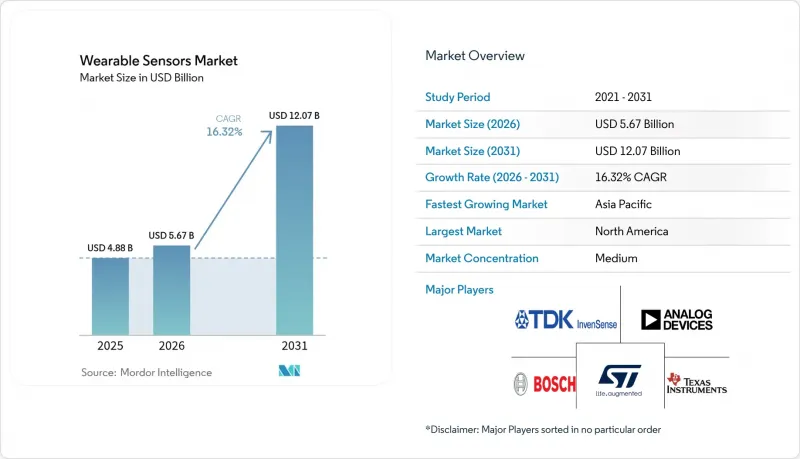
Mordor Intelligence에 의하면, 2026년 웨어러블 센서 시장 규모는 56억 7,000만 달러로 추정되고 2025년 48억 8,000만 달러에서 확대해, 2031년에는 120억 7,000만 달러에 이를 것으로 예측됩니다.
2026년부터 2031년까지의 연평균 성장률(CAGR)은 16.32%를 나타낼 것으로 전망됩니다.
본 보고서는 센서 유형(화학·가스, 압력 등), 용도(헬스케어 등), 기기 폼 팩터(스마트 워치 등), 최종 사용자 산업(일반 소비자, 의료 제공업체 등), 연결 기술(NFC 등) 및 지역별로 분류되어 있습니다. 시장 예측은 금액(달러)으로 제시되어 있습니다.
세계의 웨어러블 센서 시장 동향 및 인사이트
피트니스 및 예방 의료의 붐
소비자들은 일회성 치료에서 지속적인 건강 관리로 전환하고 있으며, 이는 신진대사, 수면, 스트레스 징후를 추적하는 스마트 워치와 패치에 대한 지속적인 수요를 이끌고 있습니다. 기업들은 생산성 및 안전성 측면에서 측정 가능한 ROI를 가져다주는 대규모 웰니스 도입을 통해 이러한 제품의 보급을 촉진하고 있습니다. 예를 들어, 셰브론이 도입한 수분 보충 패치는 열사병 관련 사고를 감소시켰습니다. 삼성 등이 제공하는 AI 기반 코칭 모듈은 원시 데이터를 개인 맞춤형 지침으로 변환하여 매일의 지속적인 사용을 촉진하는 동시에, 알고리즘 학습을 위한 데이터 풀을 확대되고 있습니다. 의료 보험 제공업체도 혜택을 보고 있습니다. 한 고혈압 원격 환자 모니터링(RPM) 프로그램에서는 응급실 방문 감소로 22.2%의 ROI를 달성했으며, 이를 통해 보험 환급 체계가 확립되어 웨어러블 센서 시장의 추가적인 확대로 이어지고 있습니다.
스마트 워치 출하량 급증
애플, 삼성, 그리고 신흥 링형 벤더들이 포화 상태에 이른 폼 팩터 경쟁에서 차별화를 꾀하기 위해 혈압 센서와 신경 신호 센서를 통합함에 따라, 전 세계 스마트 워치 출하량은 계속 증가하고 있습니다. ST마이크로일렉트로닉스의 MEMS 출하액은 2024년 4분기에 11억 9,800만 달러로 증가했으며, 제조 측면의 탄탄함과 가격 탄력성으로 인해 평균 판매 가격이 억제되고 있음이 부각되었습니다. 삼성의 Oura에 대한 선제적 소송 등 지적 재산권을 둘러싼 분쟁은 시장 출시 속도뿐만 아니라, 특허가 중요한 전략적 수단이 되는 성숙해 가는 시장의 현실을 보여줍니다.
데이터 개인정보 보호 규제 강화
워싱턴의 ‘My Health My Data Act’와 EU의 MDR(의료기기 규정)로 인해 중복된 동의 및 문서화 의무가 추가되면서, 규정 준수 관련 비용이 증가하고 여러 지역에서의 사업 확장이 지연되고 있습니다. 유럽에서는 약 50만 대의 의료기기를 단 43개의 인증 기관이 담당하고 있어 인증 병목 현상이 발생하고 있습니다. 이로 인해 기존 승인을 보유한 기존 기업들이 유리한 입지를 점하고 있습니다.
부문 분석
2025년, 모션 센서는 웨어러블 센서 시장 점유율의 33.60%를 차지하며, 피트니스 밴드 및 제스처 제어 인터페이스에서 사용자의 동작 분석을 지원했습니다. 가속도계, 자이로스코프, 자력계는 성숙한 비용 곡선을 보이며, 평균 판매 가격(ASP)의 압박에도 불구하고 매출 총이익률을 유지하고 있습니다. 한편, 바이오 센서는 연평균 성장률(CAGR) 18.85%로 성장을 지속하고, 있으며, 피부에 밀착되는 화학 기술을 통해 혈당 측정에서 코르티솔 모니터링으로 이용 사례가 확대됨에 따라 이 세력도에 도전하게 될 것입니다.
바이오 센서의 성장세는 정맥 천자 없이도 실험실 수준의 특이도를 제공하는 고분자 마이크로플루이딕스 기술에서 비롯됩니다. 화학 센서와 가스 센서는 산업 안전 분야의 틈새 시장을 채우고 있는 반면, 압력 센서는 커프 없는 혈압 측정 용도를 뒷받침하고 있습니다. 온도 센서는 열 스트레스 예방을 위한 산업 위생 요건을 충족시키고 있습니다. 이미징 및 광학 센서는 심박수 광티스모그래피에서 광코히어런스 기반 상처 관리로 전환되고 있으며, 이는 웨어러블 센서 시장을 확대할 다중 모드 융합의 도래를 예고합니다.
건강·웰니스 분야는 매출의 45.40%를 차지하고 있으며, 이는 확고히 자리 잡은 소비자 행동과 해지율을 낮게 유지하는 스마트폰 앱과의 시너지 효과를 반영합니다. 건강·웰니스 분야의 웨어러블 센서 시장 규모는 2025년에 22억 2,000만 달러에 달했으며, 부가가치가 높은 코칭 서비스가 하드웨어와 구독을 세트로 판매하는 추세에 힘입어 현재도 계속 확대되고 있습니다.
연평균 성장률(CAGR) 19.35%로 발전하고 있는 원격 환자 모니터링은 보험사가 조기 발견을 통한 비용 절감을 모색하는 가운데 그 존재감을 높이고 있습니다. 클라우드 AI로 데이터를 전송하는 멀티 센서 게이트웨이를 통해 의료진의 대응 시간이 단축되고, 또한 내원 진료와 동등한 보험 급여가 적용됨에 따라 의료 제공업체의 수익성이 향상되고 있습니다. 스포츠 애널리틱스는 생체역학 분야로 계속 확장되고 있는 반면, 산업 안전용 웨어러블 기기는 시범 공장에서 근골격계 산재 청구 건수가 30% 감소하는 등, 측정 가능한 부상 감소 효과를 통해 조달 예산을 확보하고 있습니다.
지역별 분석
북미는 2025년 매출의 37.70%를 차지했으며, 그 배경에는 지속적인 모니터링에 대해 보상을 지급하는 메디케어의 RPM 코드와 기기 도입을 지원하는 기업의 웰니스 예산이 있습니다. 벤처 캐피탈의 집중 투자가 스타트업의 파이프라인을 뒷받침하고 있으며, 이는 신경 인터페이스 등 특수 센서 기술 개발로 이어지고 있습니다. 그러나 주 차원의 데이터 관련 법규로 인해 규정 준수 부담이 증가하고 있어, 국경을 초월한 데이터 사이언스의 시너지 효과가 약화될 가능성이 있습니다.
아시아태평양은 중국의 부품 공장이 리드타임을 단축하고, 인도의 중산층이 저가형 리스트밴드를 채택함에 따라 연평균 성장률(CAGR) 18.05%로 성장을 주도하고 있습니다. 일본의 실버 경제는 병원의 지속적인 생체 신호 측정용 패치에 대한 투자를 뒷받침하고 있는 반면, 한국의 5G 커버리지 확대는 클라우드에서 엣지로 이어지는 분석 루프를 가속화하고 있습니다. 배터리 공급에서의 지역적 우위 또한 비용 상승 위험을 완화하고 있지만, 지정학적 마찰이 수출 흐름을 방해할 가능성이 있습니다.
유럽은 한 자릿수 중반대의 성장세를 유지하고 있습니다. MDR(의료기기 규정)에 따른 생산 능력 제약이 CE 마크 갱신 주기를 방해하여, 결과적으로 의료기기의 교체 주기를 사실상 연장시키고 혁신 속도를 둔화시키고 있습니다. 그러나 특히 앱 연동형 의료기기에 대한 지원을 제공하는 독일의 ‘디지털 헬스케어법’ 체계 하에서 전자 의료에 대한 공공 부문 수요는 여전히 견조합니다. 남유럽 및 동유럽에서는 원격의료가 의료기관 접근 격차를 해소함에 따라 수요가 서서히 증가하고 있습니다.
기타 혜택 :
- 엑셀 형식 시장 예측(ME) 시트
- 3개월간의 애널리스트 지원
자주 묻는 질문
목차
제1장 서론
제2장 조사 방법
제3장 주요 요약
제4장 시장 구도
제5장 시장 규모 및 성장 예측
제6장 경쟁 구도
제7장 시장 기회 및 향후 전망
KTH 26.08.26According to Mordor Intelligence, wearable sensors market size in 2026 is estimated at USD 5.67 billion, growing from 2025 value of USD 4.88 billion with 2031 projections showing USD 12.07 billion, growing at 16.32% CAGR over 2026-2031.
This report is Segmented by Sensor Type (Chemical and Gas, Pressure and More), Application (Health and More), Device Form Factor (Smartwatches and More), End-User Industry (Consumer, Healthcare Providers and More), Connectivity Technology (NFC and More) and Geography. The Market Forecasts are Provided in Terms of Value (USD).
Global Wearable Sensors Market Trends and Insights
Fitness & Preventive-Health Boom
Consumers are shifting from episodic treatment toward continuous wellness management, driving recurring demand for smartwatches and patches that track metabolic, sleep, and stress signals. Corporations reinforce uptake through large-scale wellness deployments that deliver measurable ROI in productivity and safety, such as Chevron's hydration patches that lowered heat-related incidents. AI-powered coaching modules from Samsung and others convert raw metrics into personalized guidance, which sustains day-to-day engagement and expands data pools for algorithm training . Health-plan providers also gain: a hypertension RPM program posted a 22.2% ROI through reduced emergency visits, validating reimbursement pathways that further enlarge the wearable sensors market .
Smart-Watch Unit Surge
Global smartwatch shipments continue to climb as Apple, Samsung, and emerging ring vendors integrate blood-pressure and neuro-signal sensors to differentiate in a saturating form-factor race. STMicroelectronics' MEMS volume increased to USD 1.198 billion in Q4 2024, underscoring manufacturing resilience and price elasticity that keep average selling prices in check. IP battles, such as Samsung's pre-emptive lawsuit against Oura, signal a maturing arena where patents become a key strategic lever rather than speed-to-market alone
Data-Privacy Regulation Tightenings
Washington's My Health My Data Act and the EU MDR add overlapping consent and documentation obligations that lift compliance spend and slow multi-region rollouts. Only 43 notified bodies cover roughly 500,000 devices in Europe, creating certification bottlenecks that reward incumbents with legacy approvals
Other drivers and restraints analyzed in the detailed report include:
- MEMS Cost Downsizing
- Remote-Patient-Monitoring Mandates
- High ASP for Multimodal Sensors
For complete list of drivers and restraints, kindly check the Table Of Contents.
Segment Analysis
Motion sensors captured 33.60% of wearable sensors market share in 2025, anchoring user motion analytics across fitness bands and gesture-controlled interfaces. Accelerometers, gyroscopes, and magnetometers hold mature cost curves, preserving gross margins despite ASP pressure. Biosensors, however, post a 18.85% CAGR and will challenge this hierarchy as skin-conformal chemistry extends use cases from glucose to cortisol monitoring.
Biosensor momentum derives from polymer microfluidics that deliver laboratory-grade specificity without venipuncture. Chemical and gas sensors fill industrial safety niches, while pressure devices support cuff-less blood-pressure applications. Temperature sensors win occupational-health mandates for heat-stress prevention. Image and optical sensors migrate from heart-rate photoplethysmography toward optical coherence-based wound care, foreshadowing multimodal fusion that enlarges the wearable sensors market.
Health and wellness held 45.40% revenue, reflecting entrenched consumer behavior and smartphone app synergies that keep churn low. The wearable sensors market size for health and wellness reached USD 2.22 billion in 2025 and still expands as value-added coaching services bundle subscriptions with hardware.
Remote patient monitoring, advancing at 19.35% CAGR, gains ground as payers seek cost-avoidance through early detection. Multi-sensor gateways feeding cloud AI shorten clinician response times, and reimbursement parity with in-clinic visits strengthens provider economics. Sports analytics continue to grow into biomechanics, while industrial safety wearables earn procurement budgets through measurable injury reduction, such as 30% fewer musculoskeletal claims in pilot factories
Complete Report Scope:
- By Sensor Type
- Chemical and Gas
- Pressure
- Image / Optical
- Motion
- Temperature
- Biosensors
- By Application
- Health and Wellness
- Safety Monitoring
- Sports and Fitness
- Military and Industrial
- By Device Form Factor
- Smartwatches
- Patches
- Smart Clothing
- Smart Glasses
- Hearables
- Footwear
- By End-User Industry
- Consumer
- Healthcare Providers
- Industrial/Enterprise
- Defense and First Responders
- By Connectivity Technology
- Bluetooth
- Wi-Fi
- NFC
- Cellular (LTE/5G)
- ANT+ / Proprietary
- By Geography
- North America
- United States
- Canada
- Mexico
- South America
- Brazil
- Argentina
- Rest of South America
- Europe
- Germany
- United Kingdom
- France
- Italy
- Spain
- Russia
- Rest of Europe
- APAC
- China
- Japan
- India
- South Korea
- Australia
- Rest of APAC
- Middle East and Africa
- Middle East
- Saudi Arabia
- UAE
- Turkey
- Rest of Middle East
- Africa
- South Africa
- Nigeria
- Rest of Africa
- Middle East
- North America
Geography Analysis
North America commands 37.70% of 2025 revenue, underpinned by Medicare RPM codes that reimburse continuous monitoring and corporate wellness budgets that subsidize device rollouts. Venture-capital density anchors a startup pipeline that feeds specialized sensor modalities such as neural interfaces. Nonetheless, state-level data laws amplify compliance overhead and could dilute cross-border data-science synergies.
Asia-Pacific leads growth with an 18.05% CAGR as China's component factories compress lead times and India's middle-income cohort adopts low-cost wristbands. Japan's silver-economy drives hospital investments in continuous vitals patches, while South Korea's 5G coverage accelerates cloud-to-edge analytic loops. Regional dominance in battery supply also moderates cost inflation risks, though geopolitical frictions could disrupt export flows.
Europe sustains mid-single-digit growth. MDR capacity constraints impede CE-mark renewal cycles, effectively lengthening device replacement lifetimes and slowing innovation churn. Yet public-sector appetite for e-health remains strong, especially in Germany's Digital Healthcare Act framework that subsidizes app-linked devices. Southern and Eastern Europe see incremental demand as telemedicine fills provider-access gaps.
- STMicroelectronics
- Texas Instruments
- Infineon Technologies
- Analog Devices
- TDK / InvenSense
- AMS-OSRAM
- Panasonic
- NXP Semiconductors
- TE Connectivity
- Bosch Sensortec
- Apple
- Fitbit (Google)
- Samsung Electronics
- Huawei
- Sensirion
- Knowles Corporation
- Valencell
- Murata Manufacturing
- Honeywell International
- Qualcomm
Additional Benefits:
- The market estimate (ME) sheet in Excel format
- 3 months of analyst support
TABLE OF CONTENTS
1 INTRODUCTION
- 1.1 Study Assumptions and Market Definition
- 1.2 Scope of the Study
2 RESEARCH METHODOLOGY
3 EXECUTIVE SUMMARY
4 MARKET LANDSCAPE
- 4.1 Market Overview
- 4.2 Market Drivers
- 4.2.1 Fitness and preventive-health boom
- 4.2.2 Smart-watch unit surge
- 4.2.3 MEMS cost downsizing
- 4.2.4 Remote-patient-monitoring mandates
- 4.2.5 Skin-conformal bio-sensor breakthroughs
- 4.2.6 Corporate ESG-linked wearables programs
- 4.3 Market Restraints
- 4.3.1 Data-privacy regulation tightenings
- 4.3.2 High ASP for multimodal sensors
- 4.3.3 Chronic Li-ion cell shortages
- 4.3.4 Algorithmic racial-bias litigation risk
- 4.4 Value / Supply-Chain Analysis
- 4.5 Regulatory Landscape
- 4.6 Technological Outlook
- 4.7 Porters Five Forces Analysis
- 4.7.1 Threat of New Entrants
- 4.7.2 Bargaining Power of Suppliers
- 4.7.3 Bargaining Power of Buyers
- 4.7.4 Threat of Substitutes
- 4.7.5 Intensity of Rivalry
5 MARKET SIZE AND GROWTH FORECASTS (VALUE)
- 5.1 By Sensor Type
- 5.1.1 Chemical and Gas
- 5.1.2 Pressure
- 5.1.3 Image / Optical
- 5.1.4 Motion
- 5.1.5 Temperature
- 5.1.6 Biosensors
- 5.2 By Application
- 5.2.1 Health and Wellness
- 5.2.2 Safety Monitoring
- 5.2.3 Sports and Fitness
- 5.2.4 Military and Industrial
- 5.3 By Device Form Factor
- 5.3.1 Smartwatches
- 5.3.2 Patches
- 5.3.3 Smart Clothing
- 5.3.4 Smart Glasses
- 5.3.5 Hearables
- 5.3.6 Footwear
- 5.4 By End-User Industry
- 5.4.1 Consumer
- 5.4.2 Healthcare Providers
- 5.4.3 Industrial/Enterprise
- 5.4.4 Defense and First Responders
- 5.5 By Connectivity Technology
- 5.5.1 Bluetooth
- 5.5.2 Wi-Fi
- 5.5.3 NFC
- 5.5.4 Cellular (LTE/5G)
- 5.5.5 ANT+ / Proprietary
- 5.6 By Geography
- 5.6.1 North America
- 5.6.1.1 United States
- 5.6.1.2 Canada
- 5.6.1.3 Mexico
- 5.6.2 South America
- 5.6.2.1 Brazil
- 5.6.2.2 Argentina
- 5.6.2.3 Rest of South America
- 5.6.3 Europe
- 5.6.3.1 Germany
- 5.6.3.2 United Kingdom
- 5.6.3.3 France
- 5.6.3.4 Italy
- 5.6.3.5 Spain
- 5.6.3.6 Russia
- 5.6.3.7 Rest of Europe
- 5.6.4 APAC
- 5.6.4.1 China
- 5.6.4.2 Japan
- 5.6.4.3 India
- 5.6.4.4 South Korea
- 5.6.4.5 Australia
- 5.6.4.6 Rest of APAC
- 5.6.5 Middle East and Africa
- 5.6.5.1 Middle East
- 5.6.5.1.1 Saudi Arabia
- 5.6.5.1.2 UAE
- 5.6.5.1.3 Turkey
- 5.6.5.1.4 Rest of Middle East
- 5.6.5.2 Africa
- 5.6.5.2.1 South Africa
- 5.6.5.2.2 Nigeria
- 5.6.5.2.3 Rest of Africa
- 5.6.5.1 Middle East
- 5.6.1 North America
6 COMPETITIVE LANDSCAPE
- 6.1 Market Concentration
- 6.2 Strategic Moves
- 6.3 Market Share Analysis
- 6.4 Company Profiles (includes Global level Overview, Market level overview, Core Segments, Financials as available, Strategic Information, Market Rank/Share, Products & Services, Recent Developments)
- 6.4.1 STMicroelectronics
- 6.4.2 Texas Instruments
- 6.4.3 Infineon Technologies
- 6.4.4 Analog Devices
- 6.4.5 TDK / InvenSense
- 6.4.6 AMS-OSRAM
- 6.4.7 Panasonic
- 6.4.8 NXP Semiconductors
- 6.4.9 TE Connectivity
- 6.4.10 Bosch Sensortec
- 6.4.11 Apple
- 6.4.12 Fitbit (Google)
- 6.4.13 Samsung Electronics
- 6.4.14 Huawei
- 6.4.15 Sensirion
- 6.4.16 Knowles Corporation
- 6.4.17 Valencell
- 6.4.18 Murata Manufacturing
- 6.4.19 Honeywell International
- 6.4.20 Qualcomm
7 MARKET OPPORTUNITIES AND FUTURE OUTLOOK
- 7.1 White-Space and Unmet-Need Assessment