|
시장보고서
상품코드
2113889
유럽의 지문 센서 : 시장 점유율 분석, 업계 동향 및 통계, 성장 예측(2026-2031년)Europe Fingerprint Sensor - Market Share Analysis, Industry Trends & Statistics, Growth Forecasts (2026 - 2031) |
||||||
 Mordor Intelligence
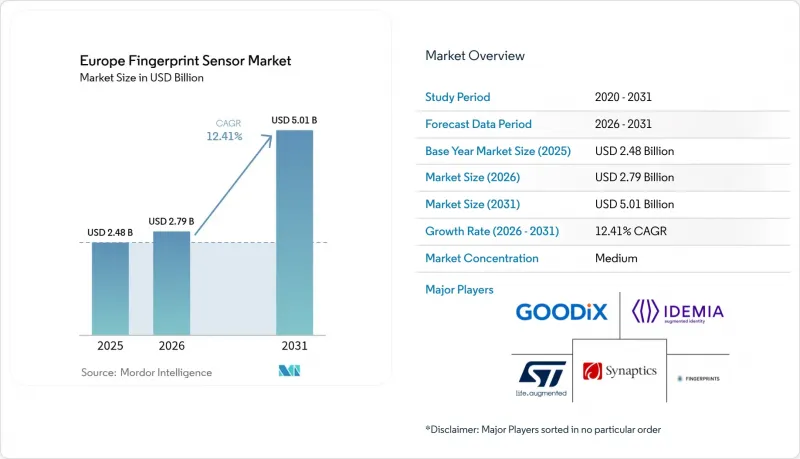
Mordor Intelligence에 의하면, 유럽의 지문 센서 시장 규모는 2025년 24억 8,000만 달러로 평가되었습니다. 2026년에는 27억 9,000만 달러로 확대되어 2026년부터 2031년에 걸쳐 CAGR 12.41%로 성장을 지속하여, 2031년에는 50억 1,000만 달러에 이를 것으로 예측됩니다.
본 보고서는 센서 유형(광학식, 정전용량식 등), 용도(스마트폰·태블릿, 노트북 등), 최종 사용자 산업(군 및 방위, 민수용 전자기기 등), 센서 배치(전면 탑재, 후면 탑재 등), 국가(독일, 영국, 프랑스 등)별로 분류되어 있습니다. 시장 예측은 금액(달러) 기준으로 제시되어 있습니다.
유럽의 지문 센서 시장 동향 및 인사이트
소비자용 전자기기에서의 생체 인증 도입 확대
주요 스마트폰 제조업체들은 OLED 패널 아래에 광범위한 초음파 감지 영역을 통합하여 베젤리스 디스플레이를 유지하면서도 손가락이 젖은 상태에서도 원터치로 등록할 수 있게 하고 있습니다. 퀄컴의 ‘3D Sonic Max’ 및 Goodix-Vivo의 프로토타입은 300밀리초 미만으로 인증을 완료하여, 기존의 정전용량식 부품과의 성능 격차를 더욱 벌리고 있습니다. 스마트폰, 태블릿, 스마트 워치에서 하드웨어가 공통화됨에 따라, 벤더들은 연구개발비를 상각할 수 있게 되었으며, 생체 인증 부품이 기존 주기보다 빠르게 중급 기기에 채택되고 있습니다. 메르세데스-벤츠 등 자동차 제조업체들은 이러한 모듈을 스티어링 휠이나 도어 필러에 통합하여, 대상 시장을 개인용 전자제품의 범위를 넘어 확장하고 있습니다. 탑재된 각 센서가 모바일 결제, 운전자 프로파일, 카셰어링용 키와 같은 프리미엄 기능에 대한 접근 제어 메커니즘 역할을 하기 때문에 거시경제가 침체된 시기에도 부품 탑재율은 견조한 추세를 보이고 있습니다.
유럽 내 전자 신분증 및 전자 여권 프로그램 강화를 위한 규제 동향
개정된 EU 규정 910/2014의 의무 사항에 따라 새로운 ID 카드에는 지문 이중 등록이 요구되게 되어, 불가리아와 포르투갈, 그 밖의 선행 국가들에서 조달 붐이 일고 있습니다. 이러한 프로그램은 ISO/IEC 19794-2 템플릿을 참조하고 있으며, 사전 인증된 알고리즘 및 하드웨어를 보유한 공급업체에게는 회원국의 승인 절차를 간소화할 수 있다는 이점이 있습니다. 에스토니아의 e-Residency 확대에 따라 디지털 ID는 이미 12만 건을 넘어섰으며, 5년 주기의 정기적인 갱신 주기가 서비스 수익을 안정화시키고 있습니다. 국경을 초월한 지갑의 상호 운용성이 성숙해짐에 따라, 소규모 국가의 각 부처는 상호 인정을 확보하기 위해 유사한 사양을 채택하는 경향이 있으며, 이는 피드백 루프를 형성하여 유럽 전체 지문 센서 시장의 판매량을 끌어올리고 있습니다.
얼굴 인식 및 홍채 인식 방식과의 경쟁
코로나19 팬데믹 기간 동안 비접촉식 기술에 대한 수요가 증가함에 따라, 기업들은 출입문이나 회전식 개찰구에 엔드포인트당 500유로 미만의 얼굴 인식 리더기를 사후 설치하기 시작했습니다. 이는 설치 비용을 포함한 지문 인증 키트보다 훨씬 저렴합니다. 그러나 GDPR(EU 개인정보보호규정)(일반 데이터 보호 규정) 준수에 따라, 자발적인 지문 스캔과 달리 지속적인 얼굴 인증 수집에는 더 엄격한 동의 및 데이터 최소화 요건이 부과되며, 추가적인 데이터 보호 영향 평가가 필요합니다. 그 결과, 많은 시설 관리자들은 규제 구역에서는 지문 인증을 높은 신뢰성의 요소로 유지하면서, 로비에서는 편의성의 요소로 얼굴 인증을 활용하는 이중 시스템을 채택하고 있습니다. 이러한 공존은 지문 인증의 완전한 대체를 제한하고 있지만, 그럼에도 불구하고 유럽의 지문 센서 시장의 기존 출입 통제 분야에서의 판매량 증가세를 둔화시키고 있습니다.
부문 분석
2025년에는 정전용량식 장치가 34.72%라는 최대 점유율을 유지했습니다. 이는 가격에 민감한 스마트폰 및 태블릿에 적합한 성숙한 금형 기술, 폭넓은 패키지 옵션, 안정적인 수율을 반영한 결과입니다. 대조적으로, 초음파 센서는 연평균 성장률(CAGR) 13.12%로 성장하고 있으며, 최대 4mm 두께의 OLED 유리를 투과하여 이미지를 획득할 수 있는 능력과 생체 감지 기능을 통한 신원 도용 공격 방지 기능을 활용하고 있습니다. 이러한 성능 향상으로 인해 각 OEM 업체들은 잠금 해제 속도를 저하시키지 않고도 방수 스마트폰을 시장에 출시할 수 있게 되었으며, 결과적으로 유럽의 지문 센서 시장의 프리미엄 부문을 뒷받침하고 있습니다. 광학식 센서는 국경 키오스크 단말기에서 법의학적 이미지 해상도 향상을 위해 여전히 수요가 있지만, 모듈의 두께가 두꺼워 얇은 웨어러블 단말기에 사용하기에는 한계가 있습니다. 열식 센서는 먼지, 기름때, 실외 습기를 견뎌야 하는 견고한 산업용 키오스크 단말기에 채택되고 있습니다. 틈새 시장이긴 하지만, 이러한 도입은 우수한 단위 이익률을 가져와 다른 분야의 평균 판매 가격(ASP) 하락을 완화하는 역할을 하고 있습니다.
유럽의 지문 센서 시장은 비용과 사양 면에서 양극화가 계속 진행되고 있습니다. 초음파식 다이는 수율 학습 곡선과 새로운 6인치 패널의 통합으로 모듈 비용이 낮아짐에 따라, 2026년부터 2027년에 걸쳐 중급형 휴대폰에 채택될 전망입니다. 정전용량식 제조업체들은 웨이퍼 레벨 칩 스케일 패키징(WLCSP)과 AI를 활용한 이미지 재구성 기술을 통해 정확도를 저하시키지 않으면서 실리콘 면적을 축소함으로써 기존 고객 기반을 지키고 있습니다. 그 결과, 각 센싱 방식이 각각 다른 수직 시장을 독점하는 공존 시나리오가 만들어집니다. 구체적으로 초음파 방식은 은행, 프리미엄 스마트폰, 자동차용, 정전용량 방식은 양산형 전자기기용, 광학 방식은 정부 기관용, 열식 방식은 미션 크리티컬한 산업용 사례에 적용되며, 이를 통해 전문 공급업체에게 있어 유럽의 지문 센서 시장의 잠재적 수익 규모가 확대될 것입니다.
2025년 출하 대수에서 스마트폰 및 태블릿이 차지하는 비율은 43.22%이었으며, 이는 최종 사용자에게 원활한 지문 등록을 제공하는 OS 네이티브 생체 인식 API에 의해 뒷받침되고 있습니다. 그러나 IoT 기기 및 기타 용도 분야는 안전한 로컬 액세스가 필요한 스마트 잠금 장치, 커넥티드 온도 조절기, 산업용 게이트웨이에 힘입어 2031년까지 연평균 성장률(CAGR) 14.23%라는 급속한 성장이 예상됩니다. ekey와 같은 유럽의 스마트 홈 통합 업체들은 이미 알프스 지역의 한랭 지대에 5만 대 이상의 생체 인증 도어 시스템을 도입하여, 영하의 기온에서도 센서의 견고성이 입증되었습니다. 노트북은 마이크로소프트의 ‘Windows Hello’ 인증과 기업 내 다단계 인증 의무화에 힘입어, 수요의 10-12%라는 안정적인 점유율을 유지하고 있습니다.
오스트리아와 네덜란드의 개발자들은 하나의 스마트 카드에 출입 기능과 결제 기능을 통합하는 시도를 진행 중이며, 이는 하나의 내장형 지문 센서가 여러 애플릿을 지원함으로써 기능당 비용을 절감하는 미래의 융합을 시사합니다. 이러한 다기능화 혁신은 스마트폰 보급률이 정체기에 접어들었을 때 판매량 성장을 유지하기 위해 필수적입니다.
기타 혜택 :
- 엑셀 형식 시장 예측(ME) 시트
- 3개월간의 애널리스트 지원
자주 묻는 질문
목차
제1장 서론
제2장 조사 방법
제3장 주요 요약
제4장 시장 구도
제5장 시장 규모 및 성장 예측
제6장 경쟁 구도
제7장 시장 기회 및 향후 전망
KTH 26.08.26According to Mordor Intelligence, the European fingerprint sensor market size is expected to grow from USD 2.48 billion in 2025 to USD 2.79 billion in 2026 and is forecast to reach USD 5.01 billion by 2031 at 12.41% CAGR over 2026-2031.

This report is Segmented by Sensor Type (Optical, Capacitive, and More), Application (Smartphones and Tablets, Laptops, and More), End-User Industry (Military and Defence, Consumer Electronics, and More), Sensor Placement (Front-Mounted, Rear-Mounted, and More), and Country (Germany, United Kingdom, France, and More). The Market Forecasts are Provided in Terms of Value (USD).
Europe Fingerprint Sensor Market Trends and Insights
Rising adoption of biometric authentication in consumer electronics
Flagship handset makers are embedding larger ultrasonic sensing areas beneath OLED panels, enabling one-tap enrollment even with wet fingers while preserving bezel-free displays. Qualcomm's 3D Sonic Max and Goodix-Vivo prototypes authenticate in under 300 ms, reinforcing a performance gap versus legacy capacitive parts. Hardware commonality in smartphones, tablets, and smartwatches enables vendors to amortize R&D costs, pushing biometric components into mid-tier devices sooner than in prior cycles. Automotive brands, such as Mercedes-Benz, have incorporated these modules into steering wheels and door pillars, extending the addressable volume beyond personal electronics. Because each installed sensor forms a gating mechanism for premium features such as mobile payments, driver profiles, and car-sharing keys, component attach rates remain resilient even during macroeconomic softness.
Regulatory push for stronger eID and ePassport programs in Europe
Revised EU Regulation 910/2014 obligations require dual fingerprint enrollment for new ID cards, prompting procurement waves across Bulgaria, Portugal, and other early movers. The programs reference ISO/IEC 19794-2 templates, rewarding suppliers with pre-certified algorithms and hardware that simplify member-state approval cycles. Estonia's e-Residency expansion already exceeds 120,000 digital IDs, providing a recurring replacement cycle every five years that locks in service revenue. As cross-border wallet interoperability matures, ministries in smaller countries are gravitating toward similar specs to ensure mutual recognition, forming a feedback loop that boosts volumes across the full European fingerprint sensor market.
Competition from face and iris recognition modalities
Contactless preferences that surged during COVID-19 prompted enterprises to retrofit doors and turnstiles with facial readers costing below EUR 500 per endpoint, substantially less than fingerprint-based kits after installation labor. Yet GDPR compliance imposes stricter consent and data minimization demands on continuous facial capture versus voluntary fingerprint scans, triggering extra data-protection-impact assessments. As a result, many facility managers adopt a dual system whereby fingerprint remains the high-assurance factor for regulated zones, while face serves as a convenience factor for the lobby. This coexistence limits full displacement but still trims unit sales growth in traditional access-control corridors of the European fingerprint sensor market.
Other drivers and restraints analyzed in the detailed report include:
- Growing demand for contactless payments and smartcards
- Integration of multimodal biometric fusion in border-control kiosks
- Semiconductor component shortages disrupting supply chains
For complete list of drivers and restraints, kindly check the Table Of Contents.
Segment Analysis
Capacitive devices retained the lion's share at 34.72% in 2025, reflecting mature tooling, broad package options, and stable yields that suit price-sensitive smartphones and tablets. In contrast, ultrasonic sensors are scaling at a 13.12% CAGR, leveraging their ability to image through up to 4 mm of OLED glass while rejecting spoof attempts via liveness detection. This performance upgrade enables original equipment manufacturers to market waterproof phones without compromising unlock speed, thereby supporting the European fingerprint sensor market's premium tier. Optical sensors remain in demand for enhanced forensic-image resolution in border kiosks, yet their thicker module height limits their usage in slim wearables. Thermal-based parts serve ruggedized industrial kiosks that must survive dust, grease, and outdoor moisture; although niche, these deployments carry superior unit margins that cushion vendors against ASP erosion elsewhere.
The European fingerprint sensor market continues to bifurcate along cost and specification lines. Ultrasonic dice are expected to migrate into mid-range handsets between 2026 and 2027 as yield learning curves and new 6-inch panel integrations lower module costs. Capacitive makers defend their installed base with wafer-level chip-scale packaging and AI-enhanced image reconstruction, which shrinks silicon area without compromising accuracy. The net result is a coexistence scenario in which each sensing modality commands distinct verticals: ultrasonic for banking, premium phones, and automotive; capacitive for mass-market electronics; optical for government; and thermal for mission-critical industrial use cases, thereby broadening the Europe fingerprint sensor market addressable revenue pool for specialized suppliers.
Smartphones and tablets accounted for 43.22% of 2025 shipments, supported by operating-system-native biometric APIs that make fingerprint enrollment seamless for end-users. However, the IoT devices and other applications bucket is forecast to expand at a rapid 14.23% CAGR through 2031, driven by smart locks, connected thermostats, and industrial gateways that require secure local access. European smart-home integrators such as ekey have already installed more than 50,000 biometric door systems in Alpine climates, validating sensor ruggedness at sub-zero temperatures. Laptops remain a steady 10-12% slice of demand, anchored by Microsoft's Windows Hello certification and enterprise multifactor mandates.
Developers in Austria and the Netherlands are trialing combined door-access and payment functionality on a single smart card, signaling a future convergence where one embedded fingerprint die supports multiple applets, thereby lowering per-function costs. Such multi-role innovation is crucial for sustaining unit growth when smartphone attachment rates plateau.
Complete Report Scope:
- By Sensor Type
- Optical
- Capacitive
- Thermal
- Ultrasonic
- By Application
- Smartphones and Tablets
- Laptops
- Smartcards
- IoT Devices and Other Applications
- By End-user Industry
- Military and Defence
- Consumer Electronics
- Banking, Financial Services and Insurance (BFSI)
- Government
- Other End-user Industries
- By Sensor Placement
- Front-mounted
- Rear-mounted
- Side-mounted
- In-display
- By Country
- Germany
- United Kingdom
- France
- Italy
- Spain
- Netherlands
- Sweden
- Rest of Europe
List of Companies Covered in this Report:
- Fingerprint Cards AB
- STMicroelectronics NV
- Synaptics Incorporated
- Guangdong Goodix Technology Co., Ltd.
- IDEMIA France SAS
- Egis Technology Inc.
- IDEX Biometrics ASA
- TDK Corporation
- Next Biometrics Group ASA
- Dermalog Identification Systems GmbH
- Gemalto NV (Thales Group)
- NuData Security, A Mastercard Company
- Jenetric GmbH
- Precise Biometrics AB
- Suprema Inc.
- Qualcomm Technologies, Inc.
- Apple Inc.
- Samsung Electronics Co., Ltd.
- NEC Corporation
- BIO-key International, Inc.
Additional Benefits:
- The market estimate (ME) sheet in Excel format
- 3 months of analyst support
TABLE OF CONTENTS
1 INTRODUCTION
- 1.1 Study Assumptions and Market Definition
- 1.2 Scope of the Study
2 RESEARCH METHODOLOGY
3 EXECUTIVE SUMMARY
4 MARKET LANDSCAPE
- 4.1 Market Overview
- 4.2 Market Drivers
- 4.2.1 Rising adoption of biometric authentication in consumer electronics
- 4.2.2 Regulatory push for stronger eID and ePassport programs in Europe
- 4.2.3 Growing demand for contactless payments and smartcards
- 4.2.4 Integration of multimodal biometric fusion in border-control kiosks
- 4.2.5 Emergence of ultra-thin flexible sensors for wearables and healthcare devices
- 4.2.6 EU Digital Identity Wallet initiative accelerating on-device standardization
- 4.3 Market Restraints
- 4.3.1 Competition from face and iris recognition modalities
- 4.3.2 Semiconductor component shortages disrupting supply chains
- 4.3.3 Heightened privacy-by-design requirements complicating edge encryption
- 4.3.4 Declining ASPs amid commoditisation pressure from Asian ODMs
- 4.4 Industry Value Chain Analysis
- 4.5 Regulatory Landscape
- 4.6 Technological Outlook
- 4.7 Porter's Five Forces Analysis
- 4.7.1 Bargaining Power of Suppliers
- 4.7.2 Bargaining Power of Buyers
- 4.7.3 Threat of New Entrants
- 4.7.4 Threat of Substitutes
- 4.7.5 Intensity of Competitive Rivalry
- 4.8 Impact of Macroeconomic Factors on the Market
5 MARKET SIZE AND GROWTH FORECASTS (VALUES)
- 5.1 By Sensor Type
- 5.1.1 Optical
- 5.1.2 Capacitive
- 5.1.3 Thermal
- 5.1.4 Ultrasonic
- 5.2 By Application
- 5.2.1 Smartphones and Tablets
- 5.2.2 Laptops
- 5.2.3 Smartcards
- 5.2.4 IoT Devices and Other Applications
- 5.3 By End-user Industry
- 5.3.1 Military and Defence
- 5.3.2 Consumer Electronics
- 5.3.3 Banking, Financial Services and Insurance (BFSI)
- 5.3.4 Government
- 5.3.5 Other End-user Industries
- 5.4 By Sensor Placement
- 5.4.1 Front-mounted
- 5.4.2 Rear-mounted
- 5.4.3 Side-mounted
- 5.4.4 In-display
- 5.5 By Country
- 5.5.1 Germany
- 5.5.2 United Kingdom
- 5.5.3 France
- 5.5.4 Italy
- 5.5.5 Spain
- 5.5.6 Netherlands
- 5.5.7 Sweden
- 5.5.8 Rest of Europe
6 COMPETITIVE LANDSCAPE
- 6.1 Market Concentration
- 6.2 Strategic Moves
- 6.3 Market Share Analysis
- 6.4 Company Profiles (includes Global level Overview, Market level overview, Core Segments, Financials as available, Strategic Information, Market Rank/Share for key companies, Products and Services, and Recent Developments)
- 6.4.1 Fingerprint Cards AB
- 6.4.2 STMicroelectronics NV
- 6.4.3 Synaptics Incorporated
- 6.4.4 Guangdong Goodix Technology Co., Ltd.
- 6.4.5 IDEMIA France SAS
- 6.4.6 Egis Technology Inc.
- 6.4.7 IDEX Biometrics ASA
- 6.4.8 TDK Corporation
- 6.4.9 Next Biometrics Group ASA
- 6.4.10 Dermalog Identification Systems GmbH
- 6.4.11 Gemalto NV (Thales Group)
- 6.4.12 NuData Security, A Mastercard Company
- 6.4.13 Jenetric GmbH
- 6.4.14 Precise Biometrics AB
- 6.4.15 Suprema Inc.
- 6.4.16 Qualcomm Technologies, Inc.
- 6.4.17 Apple Inc.
- 6.4.18 Samsung Electronics Co., Ltd.
- 6.4.19 NEC Corporation
- 6.4.20 BIO-key International, Inc.
7 MARKET OPPORTUNITIES AND FUTURE OUTLOOK
- 7.1 White-space and Unmet-need Assessment