|
시장보고서
상품코드
2121537
지문 센서 : 시장 점유율 분석, 산업 동향 및 통계 데이터, 성장 예측(2026-2031년)Fingerprint Sensors - Market Share Analysis, Industry Trends & Statistics, Growth Forecasts (2026 - 2031) |
||||||
 Mordor Intelligence
Mordor Intelligence에 의하면, 지문 센서 시장 규모는 2025년에 106억 8,000만 달러로 평가되었고, 2026년 119억 4,000만 달러에서 2031년까지 207억 9,000만 달러에 이를 것으로 예측되며, 예측 기간(2026-2031년) CAGR은 11.74%를 기록할 전망입니다.
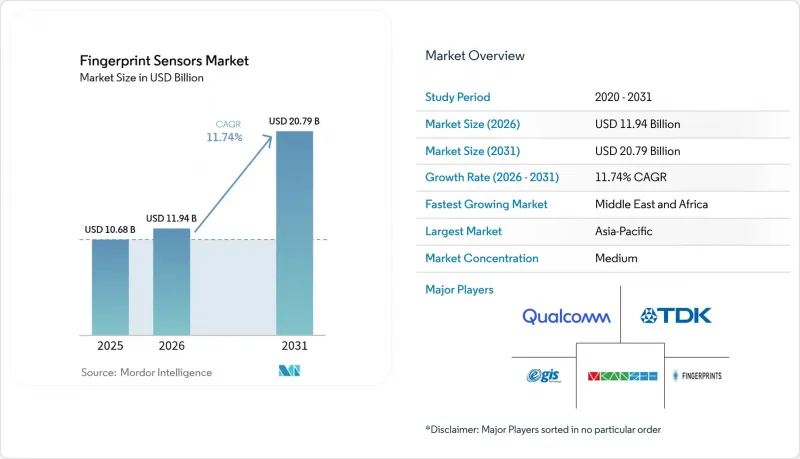
본 보고서는 센서 유형(광학식, 정전용량식 등), 폼 팩터(후면/전면 장착, 측면 장착 등), 용도(스마트폰, 태블릿, 노트북, PC 등), 최종 사용자 산업(소비자 가전, OEM, BFSI, 핀테크 등) 및 지역별로 분류되어 있습니다. 시장 전망은 금액(달러) 기준으로 제시되어 있습니다.
세계 지문 센서 시장 동향 및 인사이트
스마트폰 OEM 제조업체의 디스플레이 하부 초음파 센서로의 전환
디스플레이 하단 내장형 초음파 센서의 설계를 통해 단말기 제조업체는 높은 신뢰성을 자랑하는 생체 인증 보안을 유지하면서 엣지 투 엣지 OLED 화면을 구현할 수 있습니다. 퀄컴의 최신 트랜스듀서인 ‘3D Sonic Max’는 250밀리초 만에 600제곱mm의 이미지를 포착하며, 젖은 피부나 유분이 많은 피부에서도 잠금 해제가 가능하고, 스푸핑 테스트에서 광학 모듈을 능가하는 성능을 발휘합니다. 삼성, 구글, 샤오미는 2025년 제품 로드맵에서 플래그십 모델에 초음파 방식을 채택하기로 결정했으며, FAR/FRR 인증 기준을 높이는 안드로이드 16의 생체 인증 API를 지원합니다. 그 결과 발생하는 규모의 경제로 인해 Tier 2 OEM 제조업체의 평균 판매 가격(ASP)이 하락하고, 가격대에 관계없이 출하 대수 증가세가 가속화되어 지문 센서 시장을 다음 기기 주기로 끌어올리고 있습니다.
정부의 전자 신분증 및 전자 여권 도입이 수요를 가속화
UAE에서 남아프리카에 이르는 디지털 ID 프로그램에서는 현재 다중 요소 생체 인증이 규정되어 있으며, 일반적으로 보안 요소(Secure Element)에 저장된 지문 템플릿이 포함됩니다. 모리셔스는 2024년 2월 MNIC 3.0 카드를 발행하며, 지갑 기반의 국경 간 인증을 가능하게 하는 ‘카드 내 대조(Match-on-Card)’ 방식의 지문 인증 기능을 탑재했습니다. 파푸아뉴기니의 SevisPass 시범 사업은 소규모 경제국이 기존 인프라 없이도 생체 인증 ID로 비약적으로 전환할 수 있음을 보여주고 있습니다. 이러한 노력은 신뢰성 높은 센서 모듈에 대한 수년 규모의 조달 수요를 창출하며, 지문 센서 시장을 공공 부문의 예산 주기에 정착시키고 있습니다.
고사양 단말기에서의 얼굴 인식 급속한 보급
애플의 ‘iPhone 17’ 시리즈와 삼성의 ‘Galaxy Z7 Fold Pro’는 모두 기본적으로 3D 얼굴 인식을 통한 잠금 해제를 채택하고 있어, 생체 인증 분야의 관심은 카메라 기반 방식으로 이동하고 있습니다. 그러나 2025년에 출하될 스마트폰의 93%에는 여전히 지문 인식기가 탑재되어 있으며, 기술이 애플이 목표로 하는 0.002%의 FAR(오인식률)을 달성한다면 디스플레이 내장 센서가 아이폰 라인업에 다시 등장할 것으로 예측됩니다. 지문 인증 방식은 습기가 많은 환경이나 장갑을 착용한 상태에서의 사용, 또한 단말기 내에 템플릿 저장이 필요한 은행 앱 등 개인정보 보호가 필요한 워크플로우에서 여전히 선호되고 있기 때문에 캐니발라이제이션의 영향은 지문 센서 시장의 대다수가 아닌 주로 프리미엄 시장의 하위 부문에 국한될 것입니다.
부문 분석
정전용량식 센서는 비용 곡선이 성숙 단계에 접어들고 폭넓은 용도로 적용되고 있어, 2025년 지문 센서 시장에서 50.35%의 점유율을 유지했습니다. 한편, 초음파식 칩은 연평균 성장률(CAGR) 15.02%를 나타낼 것으로 예측되며, 각 OEM 업체들이 하이엔드 스마트폰 및 자동차용 콘솔을 볼륨 이미징 방식으로 전환함에 따라 2031년까지 매출 격차가 줄어들 것으로 전망됩니다. 초음파 디바이스용 지문 센서 시장 규모는 프리미엄 평균 판매 가격(ASP)과 자동차 분야의 인증 마진을 반영하여 2031년까지 43억 7,000만 달러를 넘어설 전망입니다. 버클리의 센서·액추에이터 센터(Sensor &Actuator Center)의 조사에 따르면, KNN 기반 PMUT 어레이는 105.5 dB/V의 출력을 발생시켜 두꺼운 커버 유리나 장갑을 뚫고도 감지 성능을 향상시키고 있습니다.
이러한 성능상의 우위는 인증 획득으로 이어지고 있습니다. 퀄컴의 ‘3D Sonic Max’는 2025년에 FIDO 레벨 3 및 BSI CC EAL 6+ 인증을 획득하여 독일 전자 신분증(eID) 규격 준수를 가능하게 했습니다. 광학식 센서는 비용 효율을 중시하는 가격대나 키오스크 단말기용으로 계속 제공되고 있지만, 열식 센서는 가혹한 환경이나 사후 감식을 위한 틈새 시장에 머물러 있습니다. 전반적으로 프리미엄 부문에서 초음파 기술의 우위가 확립되고 있음에도 불구하고, 기술의 다양성이 지문 센서 시장 전체를 지탱하고 있습니다.
후면/전면 장착형은 기존 휴대전화 디자인과 러기드 핸드헬드 단말기에 힘입어 2025년 매출의 41.55%를 차지했습니다. 그러나 OLED 기판의 얇아짐과 국소적인 음향 결합층의 활용으로 인해, 디스플레이 하단 배치형 초음파 모듈은 15.85%라는 가장 높은 연평균 성장률(CAGR)을 나타낼 전망입니다. 베젤리스 디자인이 400달러 미만의 단말기에서 보급됨에 따라, 디스플레이 내장형 지문 센서 시장 점유율은 2031년까지 39.15%를 나타낼 것으로 예측됩니다. 애플, 삼성, 오포 등 3사는 2024년 하반기 생산 할당량에서 총 2억 5,000만 개가 넘는 디스플레이 내장형 센서 다이를 발주했으며, 이는 대규모 채택이 진행되고 있음을 보여줍니다.
빠른 탭 감지를 중시하는 폴더블 단말기나 게이밍 스마트폰에서는 측면 배치형 정전용량식 스트립이 여전히 인기를 끌고 있습니다. 한편, 키보드 교체 주기가 스마트폰보다 2-3년 늦은 기업용 노트북에서는 버튼 위/홈 키형 디자인이 여전히 자리 잡고 있습니다. BOE 및 Visionox에서 시험 중인 ‘센서 인 OLED(Sensor-in-OLED)’ 프로토타입은 지문 인식과 심박수 광맥파측정(optical plethysmography)을 융합하고 있어, 지문 센서 시장의 새로운 국면을 열 가능성을 지닌 다기능 패널의 등장을 시사하고 있습니다.
지역별 분석
아시아태평양의 매출 점유율 45.60%는 공급망의 깊이와 최종 시장 수요가 독자적으로 융합되어 있음을 반영합니다. 중국의 수직 통합형 휴대전화 생태계, 한국의 AMOLED 혁신, 그리고 일본의 압전 세라믹 분야 리더십이 어우러져 견고한 지역 밸류체인을 뒷받침하고 있습니다. 인도의 ‘Aadhaar 2.0’ 로드맵과 인도네시아의 e-KTP 업그레이드 계획은 향후 몇 년간 국내 수요를 더욱 뒷받침할 것입니다. 또한 각 지역 정부는 현지 반도체 제조에 대한 지원 정책을 추진하고 있으며, 이를 통해 총비용이 절감되어 아시아태평양이 지문 센서 시장의 중심지로서의 입지를 더욱 공고히 하고 있습니다.
중동 및 아프리카은 연평균 성장률(CAGR) 14.95%를 나타낼 것으로 예측되며, 이는 세계에서 가장 빠른 속도입니다. 아랍에미리트(UAE)의 국가 생체 인식 지갑과 사우디아라비아의 ‘Nafath’ 플랫폼은 모두 시민 등록에 인증된 지문 모듈을 필요로 하며, 이는 카드 및 키오스크 단말기의 대량 발주를 촉진하고 있습니다. 남아프리카공화국의 250만 달러 규모의 스마트 ID 카드 입찰은 2029년 선거 전에 대량 발행을 목표로 하고 있으며, 이는 아프리카가 디지털 ID 인프라로 비약적으로 전환하고 있음을 보여줍니다. ‘made’나 ‘e-Fawateer’와 같은 지역 결제 네트워크가 생체 인증을 통한 토큰화로 전환됨에 따라 센서 공급 파이프라인이逼迫하고 있으며, 이는 신흥국 지문 센서 시장의 성장 가능성을 부각시키고 있습니다.
북미 및 유럽에서는 자동차용 생체 인증, 기업 보안 강화, 그리고 엄격한 데이터 개인정보 보호 규정 준수에 힘입어 한 자릿수 중반대의 성장 궤도를 유지하고 있습니다. 유럽 디지털 ID 프레임워크에서는 2026년까지 디지털 지갑 도입이 의무화되어 있으며, 이로 인해 4억 5,000만 명의 주민이 기기 또는 카드 기반의 지문 인증을 필요로 하게 될 것입니다. TSMC의 400억 달러 규모의 애리조나 공장은 2026년에 2단계 생산 라인을 가동할 예정이며, 미국의 주요 휴대폰 제조업체를 위해 초음파식 PMUT 웨이퍼 생산을 현지화할 계획입니다. 이를 통해 국내 공급망의 회복탄력성이 강화되고, 지문 센서 시장의 세계 분포 균형이 맞추어질 것입니다.
기타 혜택:
- Excel 형식 시장 예측(ME) 시트
- 3개월간의 애널리스트 지원
자주 묻는 질문
목차
제1장 서론
제2장 분석 방법
제3장 주요 요약
제4장 시장 구도
제5장 시장 규모·성장률 예측
제6장 경쟁 구도
제7장 시장 기회와 향후 전망
LSH 26.09.02According to Mordor Intelligence, the fingerprint sensors market size was valued at USD 10.68 billion in 2025 and estimated to grow from USD 11.94 billion in 2026 to reach USD 20.79 billion by 2031, at a CAGR of 11.74% during the forecast period (2026-2031).

This report is Segmented by Sensor Type (Optical, Capacitive, and More), Form Factor (Rear/Front Mount, Side-Mounted, and More), Application (Smartphones & Tablets, Laptops/PCs, and More), End-User Industry (Consumer Electronics OEM, BFSI & FinTech, and More), and Geography. The Market Forecasts are Provided in Terms of Value (USD).
Global Fingerprint Sensors Market Trends and Insights
Smartphone OEM Shift to Under-Display Ultrasonic Sensors
Ultrasonic under-display designs let handset makers preserve edge-to-edge OLED screens while retaining high-confidence biometric security. Qualcomm's latest 3D Sonic Max transducer captures a 600 mm2 image in 250 ms and sustains unlock even with damp or oily skin, outperforming optical modules in spoof testing. Samsung, Google and Xiaomi have committed flagship lines to ultrasonic implementations in 2025 product roadmaps, aligning with Android 16 biometric APIs that raise FAR/FRR certification thresholds. The resulting scale economies lower ASPs for tier-2 OEMs, accelerating volume growth across price bands and propelling the fingerprint sensors market into its next device cycle.
Government e-ID & e-Passport Rollouts Accelerating Demand
Digital identity programs from the UAE to South Africa now specify multi-factor biometrics, typically including fingerprint templates stored in secure elements. Mauritius issued its MNIC 3.0 card in February 2024, embedding match-on-card fingerprint authentication that enables wallet-based cross-border recognition. Papua New Guinea's SevisPass pilot underscores how small economies leapfrog to biometric IDs without legacy infrastructure. Such schemes create multi-year procurement waves for trusted sensor modules, anchoring the fingerprint sensors market in the public-sector budget cycle.
Rapid Adoption of Facial Recognition in Premium Devices
Apple's iPhone 17 range and Samsung's Galaxy Z7 Fold Pro both default to 3-D facial unlock, shifting biometric mindshare toward camera-based modalities. Yet 93% of handsets shipping in 2025 still carry a fingerprint reader, and under-display sensors are expected to return to the iPhone portfolio when technology meets Apple's 0.002 % FAR target. Fingerprint methods remain preferred for wet environments, gloved usage and privacy-sensitive workflows such as banking apps that require on-device template storage, so cannibalization largely affects the premium tail rather than the bulk of the fingerprint sensors market.
Other drivers and restraints analyzed in the detailed report include:
- Payment-Grade Biometric Smartcard Commercial Launches
- Automotive In-Cabin Biometrics Mandated for Keyless Access
- Data-Privacy Legislation Limiting Biometric Data Retention
For complete list of drivers and restraints, kindly check the Table Of Contents.
Segment Analysis
Capacitive units retained a 50.35% share of the fingerprint sensors market in 2025 owing to mature cost curves and broad application reach. Ultrasonic chips, however, are set to climb at 15.02% CAGR and are projected to narrow the revenue gap by 2031 as OEMs migrate high-tier phones and automotive consoles toward volumetric imaging. The fingerprint sensors market size for ultrasonic devices is on track to surpass USD 4.37 billion by 2031, reflecting premium ASPs and automotive qualification margins. Research from Berkeley's Sensor & Actuator Center shows KNN-based PMUT arrays generating 105.5 dB/V output, enhancing penetration through thick cover glass and gloves.
Performance advantages are translating into certification wins. Qualcomm's 3D Sonic Max achieved FIDO Level-3 and BSI CC EAL 6+ in 2025, enabling German eID compliance. Optical sensors continue servicing cost-sensitive tiers and kiosk terminals, while thermal variants remain niche for harsh-environment and postmortem forensics. Altogether, technology diversity sustains the broader fingerprint sensors market even as ultrasonic leadership cements in premium segments.
Rear/front mounts generated 41.55% of 2025 revenue, helped by legacy handset designs and rugged handhelds. Yet under-display ultrasonic modules will post the fastest 15.85% CAGR, taking advantage of OLED substrate thinning and localized acoustic coupling layers. The fingerprint sensors market share for under-display formats is expected to reach 39.15% by 2031 as bezel-less design becomes ubiquitous among sub-USD 400 devices. Apple, Samsung and Oppo collectively placed orders exceeding 250 million under-display sensors die in H2 2024 production slots, signalling scale adoption.
Side-mounted capacitive strips remain popular in foldables and gaming phones that prioritize rapid tap detection, while on-button/home-key designs linger in enterprise notebooks where keyboard replacement cycles lag smartphones by 2-3 years. Sensor-in-OLED prototypes under test at BOE and Visionox merge fingerprint capture with heart rate photoplethysmography, hinting at multifunctional panels that could redefine the next chapter of the fingerprint sensors market.
Complete Report Scope:
- By Sensor Type
- Optical
- Capacitive
- Thermal
- Ultrasonic
- By Form Factor / Placement
- Rear/Front Mount
- Side-mounted
- Under-display (Optical)
- Under-display (Ultrasonic)
- On-button / Home-key
- By Application
- Smartphones and Tablets
- Laptops / PCs
- Smart-Cards and Payment Tokens
- IoT / Smart Locks and Wearables
- By End-user Industry
- Consumer Electronics OEM
- BFSI and FinTech
- Government and Law-Enforcement
- Military and Defense
- Automotive and Mobility
- By Geography
- North America
- United States
- Canada
- Mexico
- Europe
- United Kingdom
- Germany
- France
- Italy
- Rest of Europe
- Asia-Pacific
- China
- Japan
- India
- South Korea
- Rest of Asia-Pacific
- Middle East
- Israel
- Saudi Arabia
- United Arab Emirates
- Turkey
- Rest of Middle East
- Africa
- South Africa
- Egypt
- Rest of Africa
- South America
- Brazil
- Argentina
- Rest of South America
- North America
Geography Analysis
Asia-Pacific's 45.60% revenue share reflects a unique integration of supply chain depth and end-market demand. China's vertically aligned handset ecosystem, Korea's AMOLED innovation and Japan's piezo ceramics leadership collectively anchor a resilient regional value chain. India's Aadhaar 2.0 roadmap and Indonesia's e-KTP upgrade pipeline further underwrite multi-year domestic demand. Regional governments also sponsor local silicon fabrication incentives, lowering landed costs and reinforcing Asia-Pacific as the gravitational center of the fingerprint sensors market.
Middle East & Africa is projected to expand at 14.95% CAGR, the fastest worldwide. The UAE's national biometric wallet and Saudi Arabia's Nafath platform both require certified fingerprint modules for citizen onboarding, catalysing bulk card and kiosk orders. South Africa's USD 2.5 million smart ID card tender aims for mass issuance before the 2029 elections, illustrating Africa's leapfrogging toward digital identity infrastructures. With regional payment networks such as made and e-Fawateer shifting to biometric tokenization, supplier pipelines for sensors are tightening, underscoring the growth potential of the fingerprint sensors market in emerging economies.
North America and Europe sustain mid-single-digit trajectories underpinned by automotive biometrics, enterprise security upgrades and stringent data-privacy compliance. The European Digital Identity Framework mandates wallet rollout by 2026, translating into 450 million residents requiring device or card-based fingerprint authentication. TSMC's USD 40 billion Arizona fabs, due to open Phase 2 lines in 2026, will localize ultrasonic PMUT wafer starts for key U.S. handset accounts, strengthening onshore supply resilience and balancing the global distribution of the fingerprint sensors market.
- Apple Inc.
- AU Optronics Corp.
- CrucialTec Co., Ltd.
- Egis Technology Inc.
- Fingerprint Cards AB
- Goodix Technology Co., Ltd.
- HID Global Corporation
- IDEX Biometrics ASA
- Infineon Technologies AG
- NEC Corporation
- Next Biometrics ASA
- Qualcomm Technologies Inc.
- Samsung System LSI Business
- Shenzhen Chipone / Novatek (Biometric BU)
- Sonavation Inc.
- STMicroelectronics N.V.
- Synaptics Incorporated
- TDK Corporation (InvenSense)
- Thales Group
- TKH Group (Nedap)
- VKANSEE Technology Inc.
Additional Benefits:
- The market estimate (ME) sheet in Excel format
- 3 months of analyst support
TABLE OF CONTENTS
1 INTRODUCTION
- 1.1 Study Assumptions and Market Definition
- 1.2 Scope of the Study
2 RESEARCH METHODOLOGY
3 EXECUTIVE SUMMARY
4 MARKET LANDSCAPE
- 4.1 Market Overview
- 4.2 Market Drivers
- 4.2.1 Smartphone OEM shift to under-display ultrasonic sensors
- 4.2.2 Government e-ID and e-Passport roll-outs accelerating demand
- 4.2.3 Payment-grade biometric smart-card commercial launches
- 4.2.4 Automotive in-cabin biometrics mandated for key-less access
- 4.2.5 AI-driven spoof-detection improving security certification
- 4.2.6 Falling cost/area of thin-film piezoelectric PMUT arrays
- 4.3 Market Restraints
- 4.3.1 Rapid adoption of facial recognition in premium devices
- 4.3.2 Data-privacy legislation limiting biometric data retention
- 4.3.3 Supply-chain reliance on high-end 8-inch CIS foundries
- 4.3.4 False-accept anxiety in wet-finger outdoor conditions
- 4.4 Value / Supply-Chain Analysis
- 4.5 Regulatory Landscape
- 4.6 Technological Outlook
- 4.7 Porter's Five Forces Analysis
- 4.7.1 Threat of New Entrants
- 4.7.2 Bargaining Power of Suppliers
- 4.7.3 Bargaining Power of Buyers
- 4.7.4 Threat of Substitutes
- 4.7.5 Intensity of Rivalry
5 MARKET SIZE AND GROWTH FORECASTS (VALUE)
- 5.1 By Sensor Type
- 5.1.1 Optical
- 5.1.2 Capacitive
- 5.1.3 Thermal
- 5.1.4 Ultrasonic
- 5.2 By Form Factor / Placement
- 5.2.1 Rear/Front Mount
- 5.2.2 Side-mounted
- 5.2.3 Under-display (Optical)
- 5.2.4 Under-display (Ultrasonic)
- 5.2.5 On-button / Home-key
- 5.3 By Application
- 5.3.1 Smartphones and Tablets
- 5.3.2 Laptops / PCs
- 5.3.3 Smart-Cards and Payment Tokens
- 5.3.4 IoT / Smart Locks and Wearables
- 5.4 By End-user Industry
- 5.4.1 Consumer Electronics OEM
- 5.4.2 BFSI and FinTech
- 5.4.3 Government and Law-Enforcement
- 5.4.4 Military and Defense
- 5.4.5 Automotive and Mobility
- 5.5 By Geography
- 5.5.1 North America
- 5.5.1.1 United States
- 5.5.1.2 Canada
- 5.5.1.3 Mexico
- 5.5.2 Europe
- 5.5.2.1 United Kingdom
- 5.5.2.2 Germany
- 5.5.2.3 France
- 5.5.2.4 Italy
- 5.5.2.5 Rest of Europe
- 5.5.3 Asia-Pacific
- 5.5.3.1 China
- 5.5.3.2 Japan
- 5.5.3.3 India
- 5.5.3.4 South Korea
- 5.5.3.5 Rest of Asia-Pacific
- 5.5.4 Middle East
- 5.5.4.1 Israel
- 5.5.4.2 Saudi Arabia
- 5.5.4.3 United Arab Emirates
- 5.5.4.4 Turkey
- 5.5.4.5 Rest of Middle East
- 5.5.5 Africa
- 5.5.5.1 South Africa
- 5.5.5.2 Egypt
- 5.5.5.3 Rest of Africa
- 5.5.6 South America
- 5.5.6.1 Brazil
- 5.5.6.2 Argentina
- 5.5.6.3 Rest of South America
- 5.5.1 North America
6 COMPETITIVE LANDSCAPE
- 6.1 Market Concentration
- 6.2 Strategic Moves
- 6.3 Market Share Analysis
- 6.4 Company Profiles (includes Global level Overview, Market level overview, Core Segments, Financials as available, Strategic Information, Market Rank/Share, Products and Services, Recent Developments)
- 6.4.1 Apple Inc.
- 6.4.2 AU Optronics Corp.
- 6.4.3 CrucialTec Co., Ltd.
- 6.4.4 Egis Technology Inc.
- 6.4.5 Fingerprint Cards AB
- 6.4.6 Goodix Technology Co., Ltd.
- 6.4.7 HID Global Corporation
- 6.4.8 IDEX Biometrics ASA
- 6.4.9 Infineon Technologies AG
- 6.4.10 NEC Corporation
- 6.4.11 Next Biometrics ASA
- 6.4.12 Qualcomm Technologies Inc.
- 6.4.13 Samsung System LSI Business
- 6.4.14 Shenzhen Chipone / Novatek (Biometric BU)
- 6.4.15 Sonavation Inc.
- 6.4.16 STMicroelectronics N.V.
- 6.4.17 Synaptics Incorporated
- 6.4.18 TDK Corporation (InvenSense)
- 6.4.19 Thales Group
- 6.4.20 TKH Group (Nedap)
- 6.4.21 VKANSEE Technology Inc.
7 MARKET OPPORTUNITIES AND FUTURE OUTLOOK
- 7.1 White-space and Unmet-need Assessment