|
시장보고서
상품코드
2113911
디지털 치료 기기 : 시장 점유율 분석, 업계 동향 및 통계, 성장 예측(2026-2031년)Digital Therapeutics Device - Market Share Analysis, Industry Trends & Statistics, Growth Forecasts (2026 - 2031) |
||||||
 Mordor Intelligence
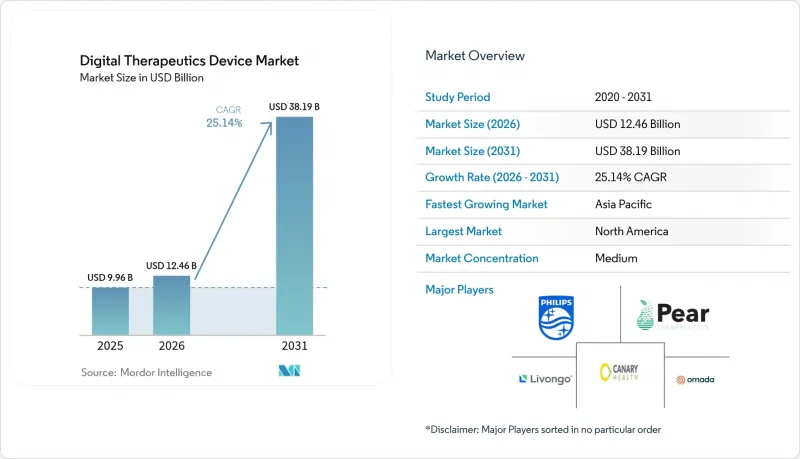
Mordor Intelligence에 의하면, 디지털 치료 기기 시장 규모는 2025년 99억 6,000만 달러로 평가되었습니다. 2026년에는 124억 6,000만 달러로 확대되어 2026-2031년에 걸쳐 CAGR 25.14%로 성장을 지속하여, 2031년에는 381억 9,000만 달러에 이를 것으로 예측됩니다.
본 보고서는 제품 유형별(소프트웨어 전용 디지털 치료, 커넥티드 디바이스, 기타), 치료 영역별(예방(전당뇨 등) 및 치료(당뇨병 등)), 모달리티별(독립형 처방전 DTx, DTx와 약물 병용, 기타),최종 사용자별(환자, 의료 제공업체·병원, 기타), 지역별로 분류되어 있습니다. 시장 예측은 금액(달러) 기준으로 제시되어 있습니다.
세계의 디지털 치료 기기 시장 동향 및 인사이트
만성 질환 부담 증가
당뇨병, 천식, 만성 폐쇄성 폐질환, 심혈관 질환의 유병률 증가로 인해, 간헐적인 내원만으로는 충족할 수 없는 지속적인 관리 수요가 발생하고 있습니다. AI를 활용한 디지털 트윈은 사용자의 89%가 12개월 이내에 HbA1c 수치를 7% 미만으로 낮추는 데 도움이 되어, 당뇨병 관리에 있어 임상적 유효성을 입증하고 있습니다. 만성 질환은 선진국 시장의 의료비 중 약 90%를 차지하고 있어, 응급실 방문이나 입원을 억제하고 비용을 절감할 수 있는 상시 이용 가능한 디지털 치료의 필요성이 점점 더 높아지고 있습니다. 스마트 흡입기를 활용한 호흡기 관리 용도는 실제 연구에서 입증된 바와 같이, 치료 순응도를 향상시키고 증상 악화를 완화합니다. 인구 고령화에 따라 스마트폰, 웨어러블 기기, 연결형 센서를 아우르는 직관적인 자가 관리 도구에 대한 수요는 더욱 높아지고 있습니다.
모바일 및 클라우드 기술의 급속한 성숙
5G, 엣지 컴퓨팅, 첨단 모바일 칩셋의 등장으로 치료용 알고리즘을 로컬에서 실행할 수 있게 되어 지연이 해소되고 개인정보도 보호됩니다. 소프트 마이크로일렉트로닉스를 기반으로 한 웨어러블 AI는 현재 기기 내에서 데이터를 처리하므로 지속적인 치료를 방해하지 않고 신속하게 대응할 수 있게 되었습니다. 성숙한 클라우드 아키텍처는 표준 FHIR 기반 API를 통해 다양한 기기와 전자건강기록(EHR) 플랫폼 간에 정보를 동기화하고, 환자의 경과에 따른 통합적인 관점을 제공함으로써 의사결정 지원을 정교화합니다. 헬스케어 앱 전용 앱 스토어 검증 프로그램을 통해 심사 완료된 배포 경로가 확립되어, 임상의와 환자 모두에게 안심감을 줍니다.
데이터 보안에 대한 우려와 의료진의 거부감
사이버 사고 증가는 특히 치료 과정에서 지속적인 행동 및 생리학적 모니터링이 필요한 경우, 의사와 환자 간의 신뢰를 훼손하고 있습니다. 유럽 규제 당국은 끊임없는 데이터 흐름이 정보 유출 위험을 높인다고 경고하고 있습니다. 알고리즘에 의한 제안이 의료적 의사 결정에 영향을 미치는 한편, 치료 결과가 기대에 미치지 못할 경우 명확한 책임 소재가 정해지지 않기 때문에 책임에 대한 우려는 여전히 남아 있습니다. 개인정보 보호형 암호화는 해결책 중 하나이지만, 비용이 높고 계산 부하도 크기 때문에 도입이 더딘 실정입니다.
부문 분석
2025년, 디지털 치료 기기 시장 매출액 중 소프트웨어 전용 솔루션이 70.68%를 차지했습니다. 이는 기존 임상 인프라와 원활하게 통합되어 운영 비용을 절감한 도입을 선호하는 의료 부문의 경향을 반영합니다. 또한, 이 부문이 주도하고 있는 배경에는 업데이트 주기가 빠르기 때문에 개발자가 하드웨어를 리콜하지 않고도 알고리즘 개선을 적용할 수 있다는 점도 있습니다. 가상현실 및 게임 제품은 2031년까지 27.92%라는 가장 높은 연평균 성장률(CAGR)을 보일 것으로 예상되며, 이는 환자의 동기를 높이고 통제된 자극을 이용한 노출 요법을 제공하는 몰입형 환경이 뒷받침하고 있습니다. 스마트 흡입기, 혈당 모니터, VR 헤드셋 등의 연결형 주변 기기는 생태계 융합을 뒷받침하는 기반이 되고 있으며, PaaS(Platform-as-a-Service) 모델은 분석을 간소화하는 통합 데이터 파이프라인을 제공합니다. 이러한 발전은 개별적인 포인트 솔루션이 아닌, 엔드투엔드 프레임워크를 제공하는 벤더가 지속적인 주도권을 잡게 될 것임을 시사합니다.
전자 건강 기록(EHR)과의 통합이 진행됨에 따라, 소프트웨어 플랫폼용 디지털 치료 기기 시장 규모는 확대될 것으로 예측됩니다. 동시에, 생체 피드백이 필요한 질환의 경우 하드웨어 연동 부문에 대한 수요가 증가하고 있습니다. 오픈 API를 통해 실현되는 상호 운용성은 기존의 단절을 완화하고, 병원이 여러 치료 라인을 단일 대시보드에 통합하도록 촉진합니다. 이를 통해 벤더 선정의 부담이 줄어들고, 임상의의 수용성도 향상됩니다.
확립된 보험 환급 경로와 명확한 진단 기준 덕분에 2025년에는 치료 용도가 디지털 치료 기기 시장의 72.88%를 차지했습니다. 임상 의사들은 치료 지향적 소프트웨어를 의약품의 직접적인 대체품 또는 보조 수단으로 간주하며, 익숙한 워크플로우 내에서 처방 절차를 신속하게 진행하고 있습니다. 당뇨병 위험 관리 프로그램에서 편두통 예방 요법에 이르는 예방 솔루션은 조기 개입을 장려하는 가치 기반 치료 모델에 힘입어 연평균 성장률(CAGR) 27.11%로 확대되고 있습니다. CT-132가 FDA 승인을 획득한 것은 발작성 편두통에 대한 최초의 예방 처방용 디지털 치료제로서 획기적인 사건이었으며, 보험사와 의료 제공업체 모두의 신뢰를 높였습니다.
의료 제도가 캐피테이션 및 공유 절감(shared savings) 방식으로 전환됨에 따라, 예방적 디지털 치료는 의료비 증가 추세를 억제하기 위한 전략적 수단이 되고 있습니다. 기업용 웰니스 계약은 예방 의료의 보급을 더욱 가속화하여, 개발자들에게 보험사 채널 이외의 대체 수익원을 제공합니다. 따라서 예방 프로그램용 디지털 치료 기기 시장 규모는 예측 기간 동안 절대값은 치료 부문보다 작을지라도, 2027년 이후부터는 치료 부문보다 빠른 속도로 성장할 것으로 전망됩니다.
지역별 분석
북미는 2025년 매출의 46.31%를 차지하며, 미국이 주도적인 역할을 했습니다. 그 배경에는 FDA의 명확한 지침, CMS의 보험 급여, 후기 임상시험에 대한 자금 지원 등 적극적인 투자 생태계가 있습니다. 2025년에 3가지 정신건강 관련 청구 코드가 도입됨에 따라 디지털 중재는 보험 급여 설계의 주류가 되었으며, 각종 건강보험 플랜에서의 신속한 통합이 촉진되었습니다. 캐나다와 멕시코에서는 국경을 넘는 원격의료 협력이 확대됨에 따라 점진적인 성장이 예상됩니다.
아시아태평양은 2031년까지 연평균 성장률(CAGR) 27.18%로 확대되며 가장 빠르게 성장하는 지역이 될 것으로 예측됩니다. 일본은 소프트웨어를 치료법으로 인정하는 규제 모델을 선구적으로 도입하여, 국내 제약 기업들이 신경 질환용 디지털 중재를 공동 개발하는 계기가 되었습니다. 중국은 모바일 결제와 도시 지역의 원격의료 포털이 널리 보급된 점을 활용하여 만성 질환 관리 프로그램을 확대되고 있습니다. 대조적으로, 인도에서는 스마트폰 보급이 급증하고 있어 외딴 지역에 거주하는 주민들에게도 저비용의 행동 건강 앱을 제공할 수 있게 되었습니다. 호주와 한국은 광대역 보급률이 높아, 첨단 VR 및 AI 알고리즘의 실증 실험장으로 기능하고 있습니다.
유럽에서는 분류 및 시판 후 모니터링 요건을 통일하는 ‘의료기기 규정(MDR)’에 따라 신중하지만 꾸준한 진전이 나타나고 있습니다. 독일의 DiGA 제도는 7,400만 명 이상의 피보험자를 대상으로 하고 있으며, 다른 회원국들이 점점 더 모방하고 있는 실용적인 보험 환급의 선례가 되고 있습니다. 프랑스, 이탈리아, 스페인에서는 국민보건서비스(NHS)를 통한 시범 사업이 통합되고 있는 반면, 영국에서는 소프트웨어 치료법에 대한 NICE의 평가 프로세스가 정교해지고 있습니다. 엄격한 데이터 보호 규정이 개인정보 보호형 분석 분야의 혁신을 촉진하고 있으며, 보안 측면에서의 실적을 통해 유럽공급업체들을 타사와 차별화하고 있습니다.
기타 혜택
- 엑셀 형식 시장 예측(ME) 시트
- 3개월간의 애널리스트 지원
자주 묻는 질문
목차
제1장 서론
제2장 조사 방법
제3장 주요 요약
제4장 시장 구도
제5장 시장 규모 및 성장 예측
제6장 경쟁 구도
제7장 시장 기회 및 향후 전망
KTH 26.08.26According to Mordor Intelligence, the digital therapeutics device market size is expected to grow from USD 9.96 billion in 2025 to USD 12.46 billion in 2026 and is forecast to reach USD 38.19 billion by 2031 at 25.14% CAGR over 2026-2031.
This report is Segmented by Product Type (Software-Only Digital Therapeutics, Connected Devices and More), Therapeutic Area (Preventive [Pre-Diabetes, and More] and Treatment [Diabetes and More]), Modality (Standalone Prescription DTx, Dtx + Drug Combination, and More), End User (Patients, Providers / Hospitals and More) and Geography. The Market Forecasts are Provided in Terms of Value (USD).
Global Digital Therapeutics Device Market Trends and Insights
Rising Burden of Chronic Diseases
Escalating rates of diabetes, asthma, chronic obstructive pulmonary disease, and cardiovascular disorders sustain continuous-care requirements that episodic clinical visits cannot satisfy. AI-driven digital twins helped 89% of users lower HbA1c below 7% within 12 months, underscoring clinical effectiveness in diabetes management. Chronic diseases absorb roughly 90% of developed-market spending, sharpening the argument for cost-saving, always-on digital therapies that curb emergency visits and hospitalizations. Respiratory-care applications with smart inhalers improve adherence and trim exacerbations, as documented in real-world studies. Demographic aging further heightens demand for intuitive self-management tools that operate across smartphones, wearables, and connected sensors.
Rapid Mobile & Cloud Technology Maturation
The arrival of 5G, edge computing, and advanced mobile chipsets lets therapeutic algorithms run locally, erasing latency and guarding privacy. Wearable AI built on soft microelectronics now processes data on-device, making continuous therapy unobtrusive and responsive. Mature cloud architectures synchronize information across gadgets and electronic health-record platforms via standard FHIR-based APIs, yielding a single longitudinal patient view that refines decision support. App-store validation programs dedicated to health applications create vetted distribution routes that reassure clinicians and reassure patients.
Data-Security Concerns & Clinician Resistance
Rising cyber-incidents erode trust among physicians and patients, especially when therapies require constant behavioral and physiologic monitoring. European regulators caution that perpetual data flows create heightened breach risk. Liability worries persist because algorithmic suggestions influence medical decisions without clear fault lines when outcomes falter. Privacy-preserving encryption offers a path forward but is costly and computationally heavy, slowing deployment.
Other drivers and restraints analyzed in the detailed report include:
- Reimbursement Expansion by Payers
- AI-Driven Hyper-Personalization Boosting Engagement
- High Development & Validation Costs
For complete list of drivers and restraints, kindly check the Table Of Contents.
Segment Analysis
Software-only solutions accounted for 70.68% of the digital therapeutics devices market revenue in 2025, reflecting the healthcare sector's inclination toward low-overhead deployments that integrate seamlessly with existing clinical infrastructure. The segment's lead also stems from rapid update cycles, enabling developers to push algorithm refinements without hardware recalls. Virtual-reality and gaming products hold the highest CAGR outlook at 27.92% to 2031, buoyed by immersive environments that elevate patient motivation and deliver exposure therapy with controlled stimuli. Connected peripherals-such as smart inhalers, glucose monitors, and VR headsets-anchor ecosystem convergence, as platform-as-a-service models provide unified data pipelines that simplify analytics. This progression suggests that sustained leadership will belong to vendors offering end-to-end frameworks, rather than individual point solutions.
The digital therapeutics devices market size for software platforms is projected to increase as electronic health record integration improves. At the same time, the hardware-linked segment commands a growing premium for conditions requiring biometric feedback. Interoperability, powered by open APIs, mitigates earlier fragmentation and encourages hospitals to consolidate multiple therapeutic lines on single dashboards, reducing vendor fatigue and improving clinician acceptance.
Treatment applications accounted for 72.88% of the digital therapeutics devices market share in 2025, thanks to established reimbursement routes and clear diagnostic triggers. Clinicians view treatment-oriented software as a direct substitute or adjunct for pharmaceuticals, expediting prescription within familiar workflows. Preventive solutions-ranging from diabetes risk programs to migraine prophylaxis-are advancing at a 27.11% CAGR, propelled by value-based care models that reward early intervention. FDA clearance of CT-132 marked the first preventive prescription digital therapeutic for episodic migraine, raising confidence among both payers and providers.
As health systems shift toward capitation and shared savings, preventive digital therapeutics become strategic levers for bending cost curves. Corporate wellness contracts further accelerate preventive care uptake, granting developers alternative revenue streams outside of insurer channels. The digital therapeutics devices market size for preventive programs is therefore poised to compound at a faster rate than the treatment segment beyond 2027, even though the absolute value remains smaller throughout the forecast horizon.
Complete Report Scope:
- By Product Type
- Software-only Digital Therapeutics
- Connected Devices (smart inhalers, CGMs, VR headsets)
- Platform-as-a-Service / APIs
- By Therapeutic Area
- Preventive
- Pre-diabetes
- Obesity
- Smoking Cessation
- Others
- Treatment
- Diabetes
- Cardiovascular Diseases
- Neurological Disorders
- Respiratory Diseases
- Oncology Support
- Others
- Preventive
- By Modality
- Standalone Prescription DTx
- DTx + Drug Combination (e.g., inhaled therapies)
- Virtual-Reality / Gaming-based DTx
- By End User
- Patients (D2C)
- Providers / Hospitals
- Payers & Insurers
- Employers & Corporate Wellness Programs
- By Geography
- North America
- United States
- Canada
- Mexico
- Europe
- Germany
- United Kingdom
- France
- Italy
- Spain
- Rest of Europe
- Asia-Pacific
- China
- Japan
- India
- Australia
- South Korea
- Rest of Asia-Pacific
- Middle East and Africa
- GCC
- South Africa
- Rest of Middle East and Africa
- South America
- Brazil
- Argentina
- Rest of South America
- North America
Geography Analysis
North America generated 46.31% of 2025 sales, with the U.S. leading the way, rooted in FDA clarity, CMS reimbursement, and an investment ecosystem willing to fund late-stage trials. The launch of three mental-health billing codes in 2025 vaulted digital interventions into mainstream benefit design, driving swift integration across health plans. Canada and Mexico contribute incremental growth as cross-border telehealth collaborations expand.
The Asia-Pacific region is projected to be the fastest-growing territory, advancing at a 27.18% CAGR through 2031. Japan pioneered regulatory models that recognize software as a therapy, prompting domestic pharmaceutical companies to co-develop digital interventions for neurological disorders. China leverages the expansive adoption of mobile payments and urban telehealth portals to scale its chronic disease management programs. In contrast, India's surge in smartphone adoption enables the delivery of low-cost behavioral health applications to remote populations. Australia and South Korea act as test beds for advanced VR and AI algorithms due to high broadband penetration.
Europe shows measured but steady progress under the Medical Device Regulation, which harmonizes classification and post-market vigilance requirements. Germany's DiGA pathway covers more than 74 million insured lives and provides a practical reimbursement precedent that other member states increasingly emulate. France, Italy, and Spain integrate national-health-service pilots, whereas the United Kingdom refines NICE appraisal processes for software therapies. Strict data-protection rules fuel innovation in privacy-preserving analytics, differentiating European vendors on security credentials.
- 2Morrow Inc.
- Akili Interactive Labs
- Better Therapeutics
- Big Health
- Biofourmis
- Canary Health
- Click Therapeutics
- Cognoa
- DarioHealth
- Happify Health
- Kaia Health
- Koninklijke Philips
- Livongo (Teladoc Health)
- MindMaze
- Noom Inc.
- Omada Health
- Pear Therapeutics
- Propeller Health
- Sword Health
- Twine Health
- Virta Health
- WellDoc
Additional Benefits:
- The market estimate (ME) sheet in Excel format
- 3 months of analyst support
TABLE OF CONTENTS
1 Introduction
- 1.1 Study Assumptions and Market Definition
- 1.2 Scope of the Study
2 Research Methodology
3 Executive Summary
4 Market Landscape
- 4.1 Market Overview
- 4.2 Market Drivers
- 4.2.1 Rising Burden Of Chronic Diseases
- 4.2.2 Rapid Mobile & Cloud Technology Maturation
- 4.2.3 Government-Backed Preventive-Care Initiatives & VC Funding
- 4.2.4 Reimbursement Expansion By Payers
- 4.2.5 AI-Driven Hyper-Personalisation Boosting Engagement
- 4.2.6 Corporate Well-Being Budgets Shifting To Prescription DTx
- 4.3 Market Restraints
- 4.3.1 Data-Security Concerns & Clinician Resistance
- 4.3.2 High Development & Validation Costs
- 4.3.3 Limited Long-Term Clinical-Outcome Evidence
- 4.3.4 Algorithmic Bias Triggering Regulatory Scrutiny
- 4.4 Value / Supply-Chain Analysis
- 4.5 Regulatory Landscape
- 4.6 Technology Outlook
- 4.7 Porter's Five Forces Analysis
- 4.7.1 Bargaining Power of Suppliers
- 4.7.2 Bargaining Power of Buyers
- 4.7.3 Threat of New Entrants
- 4.7.4 Threat of Substitutes
- 4.7.5 Intensity of Competitive Rivalry
5 Market Size and Growth Forecasts (Value-USD)
- 5.1 By Product Type
- 5.1.1 Software-only Digital Therapeutics
- 5.1.2 Connected Devices (smart inhalers, CGMs, VR headsets)
- 5.1.3 Platform-as-a-Service / APIs
- 5.2 By Therapeutic Area
- 5.2.1 Preventive
- 5.2.1.1 Pre-diabetes
- 5.2.1.2 Obesity
- 5.2.1.3 Smoking Cessation
- 5.2.1.4 Others
- 5.2.2 Treatment
- 5.2.2.1 Diabetes
- 5.2.2.2 Cardiovascular Diseases
- 5.2.2.3 Neurological Disorders
- 5.2.2.4 Respiratory Diseases
- 5.2.2.5 Oncology Support
- 5.2.2.6 Others
- 5.2.1 Preventive
- 5.3 By Modality
- 5.3.1 Standalone Prescription DTx
- 5.3.2 DTx + Drug Combination (e.g., inhaled therapies)
- 5.3.3 Virtual-Reality / Gaming-based DTx
- 5.4 By End User
- 5.4.1 Patients (D2C)
- 5.4.2 Providers / Hospitals
- 5.4.3 Payers & Insurers
- 5.4.4 Employers & Corporate Wellness Programs
- 5.5 By Geography
- 5.5.1 North America
- 5.5.1.1 United States
- 5.5.1.2 Canada
- 5.5.1.3 Mexico
- 5.5.2 Europe
- 5.5.2.1 Germany
- 5.5.2.2 United Kingdom
- 5.5.2.3 France
- 5.5.2.4 Italy
- 5.5.2.5 Spain
- 5.5.2.6 Rest of Europe
- 5.5.3 Asia-Pacific
- 5.5.3.1 China
- 5.5.3.2 Japan
- 5.5.3.3 India
- 5.5.3.4 Australia
- 5.5.3.5 South Korea
- 5.5.3.6 Rest of Asia-Pacific
- 5.5.4 Middle East and Africa
- 5.5.4.1 GCC
- 5.5.4.2 South Africa
- 5.5.4.3 Rest of Middle East and Africa
- 5.5.5 South America
- 5.5.5.1 Brazil
- 5.5.5.2 Argentina
- 5.5.5.3 Rest of South America
- 5.5.1 North America
6 Competitive Landscape
- 6.1 Market Concentration
- 6.2 Market Share Analysis
- 6.3 Company profiles (includes Global level Overview, Market level overview, Core Segments, Financials as available, Strategic Information, Market Rank/Share for key companies, Products and Services, and Recent Developments)
- 6.3.1 2Morrow Inc.
- 6.3.2 Akili Interactive Labs
- 6.3.3 Better Therapeutics
- 6.3.4 Big Health
- 6.3.5 Biofourmis
- 6.3.6 Canary Health
- 6.3.7 Click Therapeutics
- 6.3.8 Cognoa
- 6.3.9 DarioHealth
- 6.3.10 Happify Health
- 6.3.11 Kaia Health
- 6.3.12 Koninklijke Philips NV
- 6.3.13 Livongo (Teladoc Health)
- 6.3.14 MindMaze
- 6.3.15 Noom Inc.
- 6.3.16 Omada Health
- 6.3.17 Pear Therapeutics
- 6.3.18 Propeller Health
- 6.3.19 Sword Health
- 6.3.20 Twine Health
- 6.3.21 Virta Health
- 6.3.22 WellDoc Inc.
7 Market Opportunities and Future Outlook
- 7.1 White-Space and Unmet-Need Assessment