

|
시장보고서
상품코드
2113938
컨베이어 : 시장 점유율 분석, 업계 동향 및 통계, 성장 예측(2026-2031년)Conveyors - Market Share Analysis, Industry Trends & Statistics, Growth Forecasts (2026 - 2031) |
||||||
 Mordor Intelligence
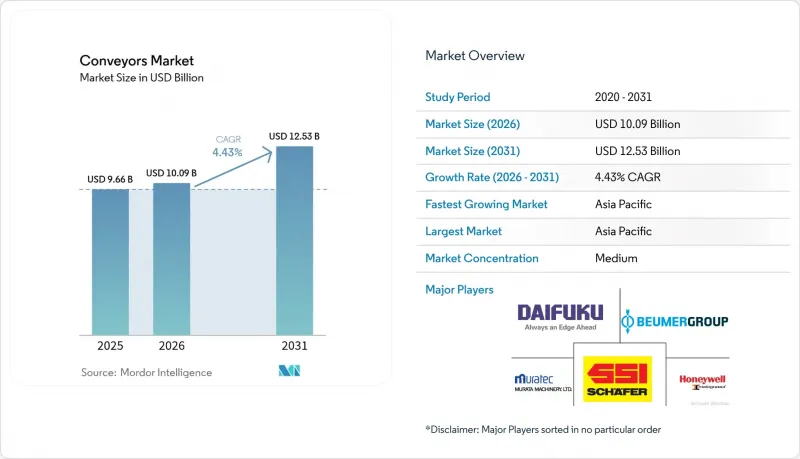
Mordor Intelligence에 의하면, 2026년 컨베이어 시장 규모는 100억 9,000만 달러로 추정되고 2025년 96억 6,000만 달러에서 확대해, 2031년에는 125억 3,000만 달러에 이를 것으로 예측됩니다.
2026-2031년 동안의 연평균 성장률(CAGR)은 4.43%가 될 것으로 전망됩니다.
본 보고서는 제품 유형(벨트, 롤러, 팔레트, 오버헤드, 슬랫 체인, 기타), 적재 유형(단위 취급, 벌크 취급), 최종 사용자 산업(공항, 소매 및 전자상거래, 자동차, 기타),시스템 구성(고정·선형, 모듈형·유연형), 구성 요소(이송 장비, 구동 장치·제어 장치, 소프트웨어·분석), 지역별로 분류되어 있습니다. 시장 예측은 금액(달러)으로 제시되어 있습니다.
세계의 컨베이어 시장 동향 및 인사이트
전자상거래 풀필먼트 센터의 급속한 확대
도시 지역의 마이크로 풀필먼트 거점에서는 최소한의 바닥 면적으로 시간당 7,200상자 이상을 분류할 수 있는 컨베이어 플랫폼이 요구되고 있습니다. ‘Cafe Amazon’의 태국 거점은 이러한 모델을 보여주고 있으며, 모듈식 Interroll 시스템을 사용하여 4,000개 매장에 걸쳐 하루 2만 상자를 처리하고 있습니다. 높은 처리량을 자랑하는 크로스 벨트 소터는 당일 배송 약속을 실현하며, 수직 레이아웃은 공간 제약이 있는 아시아의 메가시티에서 제한된 공간 내의 부피 처리량을 극대화합니다. 개발업체들은 토목 공사 없이도 시설 재배치가 가능하도록 플러그 앤 플레이 방식의 컨베이어 모듈을 지정하고 있습니다. 이러한 요구 사항이 견고한 설비 갱신 주기를 뒷받침하며, 라스트 마일 물류의 중추로서 컨베이어 시스템 시장을 강화하고 있습니다.
식품 및 음료 공장에서의 자동 이송 수요 증가
가공업체들은 위생 기준 준수에 그치지 않고, 엔드투엔드 처리 능력 최적화로 전환하고 있습니다. 바라지 웨퍼스(Baraji Wafers)는 제품을 부드럽게 취급하는 액티베이트 롤러 벨트 라인으로 전환함으로써 예기치 못한 가동 중단 시간을 제로로 줄였습니다. 비전 시스템을 탑재한 컨베이어는 실시간으로 결함 검사를 수행하여 수작업 검사를 줄이고 있습니다. 대량 생산되는 스낵 과자의 포장 공정에서 Diversified Foods는 ‘DirectDrive’ 나선형 컨베이어가 48시간 연속 가동되도록 함으로써, 기존 문제였던 기계적 고장을 해소했습니다. 모듈식 플라스틱 벨트는 수명을 연장해 주며, 신흥 식물 유래 제품 라인에서는 수분 함량이 다른 깨지기 쉬운 상품을 처리할 수 있는 적응성이 높은 레이아웃이 요구되고 있습니다.
높은 초기 투자(CAPEX)와 긴 ROI 회수 기간
내부수익률(IRR)이 15%라 하더라도 에너지 회생형 구동 장치의 투자 회수에는 6년이 소요되어, 자금 조달에 어려움을 겪는 기업들에게는 장벽이 되고 있습니다. 철강 가격이 톤당 870-950달러 사이에서 변동하고 있어 예산 수립이 어려워지고 있습니다. 리스 모델은 존재하지만, 신용 시장이 경색된 지역에서는 도입이 진전되지 않고 있습니다. 이러한 비용 측면의 과제가 컨베이어 시스템 시장에서 고급 장비의 보급을 저해하고 있습니다.
부문 분석
벨트 컨베이어는 2025년에 38.60%의 점유율을 유지하며, 광업, 식품, 일반 제조업의 생산 라인에서 핵심을 이루었습니다. 텍사스주의 ‘듄 익스프레스(Dune Express)’는 벨트 컨베이어의 효용성을 입증하고 있으며, 42마일에 걸쳐 연간 1,300만 톤을 수송함으로써 트럭 2만 5,000대 분량의 운행을 줄이고 있습니다. 공장이 바닥 면적을 효율적으로 활용하고 작업자의 안전성을 향상시킴에 따라, 오버헤드 컨베이어 시장은 연평균 성장률(CAGR) 7.85%로 확대되고 있습니다. 롤러 시스템은 재구성 가능한 조립 라인에 적합한 모듈식 프레임의 장점을 활용하며, 팔레트 라인은 자동차 산업의 정밀 작업에 활용되고 있습니다. 모든 카테고리에서 스마트 센서 도입으로 인해 예측 유지보수의 정확도는 95% 이상으로 높아졌습니다.
벨트식 솔루션의 컨베이어 시스템 시장 규모는 지속 가능한 광업 및 벌크 물류 프로젝트의 진전에 따라 확대될 것으로 예측됩니다. 한편, 오버헤드식 설계는 공간 활용률을 극대화함으로써 점유율을 서서히 확대되고 있습니다. 에너지 효율이 뛰어난 진동식 설계는 기존 구동력의 불과 20%만으로도 충분하기 때문에 부문 전반에 걸친 혁신을 반영하고 있습니다. 슬랫식 및 체인식 라인은 여전히 대형 차량 생산에 자리 잡고 있지만, 유연성이 높은 대체 수단에 대한 수요가 증가함에 따라 그 성장은 억제되고 있습니다.
유닛 핸들링은 2025년 수요의 63.55%를 차지했으며, 이는 제품에 대한 부드러운 취급과 무압 축적을 중시하는 전자상거래 및 개별 생산(디스크리트 제조)의 워크플로우에 의해 주도되었습니다. 비전 기반 결함 감지 기능을 갖춘 시스템은 안전성을 향상시키면서 현재 분류 작업도 처리하고 있습니다. 벌크 핸들링은 규모는 작지만, 상품 시장의 성장과 농업의 현대화를 배경으로 연평균 성장률(CAGR) 8.32%를 기록하며 유닛 핸들링의 성장률을 상회합니다. 공장이 팔레트와 입상 원료의 전환이 가능한 인프라를 요구하는 가운데, 하이브리드 설비의 도입으로 기존의 경계가 모호해지고 있습니다.
광업 부문에서는 TAKRAF의 콜라와시(Collahuasi) 프로젝트가 대형 벌크 이송 능력에 대한 높은 수요를 여실히 보여주고 있습니다. 제약 산업의 클린룸에서는 무균 상태를 유지하면서 시간당 1만 1,100리터 이상을 이송하는 진공 컨베이어가 필수적입니다. 이러한 두 가지 흐름이 컨베이어 시스템 시장의 다양한 수익원을 뒷받침하고 있습니다.
지역별 분석
2025년, 아시아태평양은 컨베이어 시스템 시장의 37.65%를 차지했으며, 중국, 인도, 동남아시아의 제조 클러스터 확대가 이를 뒷받침하고 있습니다. 다이후쿠사의 인도 신공장은 자동차 및 전자 부문에서 현지 수요가 증가하고 있음을 여실히 보여주고 있습니다. 중국에서는 광업 및 항만 인프라에 대형 벌크 벨트의 도입이 계속되고 있는 반면, 인도에서는 SAMARTH Udyog의 시설을 활용하여 스마트 팩토리로의 개조를 가속화하고 있습니다. 반도체 투자 확대에 따라 클린룸용 컨베이어 수요가 증가하고 있으며, 일본 전역에 걸쳐 310마일에 달하는 화물 노선은 메가 프로젝트에 대한 의지를 여실히 보여주고 있습니다.
연평균 성장률(CAGR) 8.55%를 기록하며 성장하는 중동은 물류 다각화 전략의 혜택을 누리고 있습니다. ‘사우디 비전 2030’에서는 옥사곤(Oksagon) 등의 화물 회랑에 1,066억 달러를 투자하여 대용량 분류 컨베이어 및 항만용 컨베이어 수요를 견인하고 있습니다. 2025년에 200억 3,000만 달러 규모에 달할 것으로 예상되는 아랍에미리트(UAE)의 물류 시장은 2025년까지 16억 달러에 달한 창고 자동화 투자를 뒷받침했습니다.
북미와 유럽에서는 미국 에너지부(DOE)의 에너지 효율화 보조금과 EU의 탄소 규제를 발판으로 기존 설비의 현대화가 진행되고 있습니다. 회생 구동 시스템은 특히 환경 규제로 인해 ROI(투자 수익률) 산정이 중시되는 유럽에서 조기에 도입이 확대되고 있습니다. 남미와 아프리카에서는 광업 및 항만 프로젝트와 연계된 국지적인 성장이 나타나고 있지만, 자금 면의 제약으로 인해 분석 기능을 많이 활용하는 시스템의 도입은 지연되고 있습니다.
기타 혜택
- 엑셀 형식 시장 예측(ME) 시트
- 3개월간 애널리스트의 지원
자주 묻는 질문
목차
제1장 서론
제2장 조사 방법
제3장 주요 요약
제4장 시장 구도
제5장 시장 규모 및 성장 예측
제6장 경쟁 구도
제7장 시장 기회 및 향후 전망
KTH 26.08.26According to Mordor Intelligence, conveyors market size in 2026 is estimated at USD 10.09 billion, growing from 2025 value of USD 9.66 billion with 2031 projections showing USD 12.53 billion, growing at 4.43% CAGR over 2026-2031.
This report is Segmented by Product Type (Belt, Roller, Pallet, Overhead, Slat/Chain and More), Load Type (Unit Handling, Bulk Handling), End-User Industry (Airport, Retail and E-Commerce, Automotive and More), System Configuration (Fixed/Linear, Modular/Flexible), Component (Conveying Equipment, Drives and Controls, Software and Analytics), and Geography. The Market Forecasts are Provided in Terms of Value (USD).
Global Conveyors Market Trends and Insights
Rapid growth of e-commerce fulfillment centres
Urban micro-fulfillment nodes now need conveyor platforms that sort more than 7,200 boxes per hour while occupying minimal floor area. Cafe Amazon's Thailand hub shows the model, handling 20,000 boxes a day across 4,000 outlets via a modular Interroll system. High-throughput crossbelt sorters keep same-day delivery promises, and vertical layouts maximize cubic throughput in space-restricted Asian megacities. Developers specify plug-and-play conveyor modules so that facilities can be re-arranged without civil works. These requirements sustain robust equipment replacement cycles and reinforce the conveyor systems market as a backbone of last-mile logistics.
Increasing demand for automated handling in food and beverage plants
Processors move beyond hygiene compliance toward end-to-end throughput optimization. Balaji Wafers reached zero unplanned downtime by shifting to Activated Roller Belt lines that maintain gentle product handling. Vision-equipped conveyors conduct real-time defect checks, shrinking manual inspection. In high-volume snack packaging, DirectDrive spirals now run for 48 hours straight at Diversified Foods, eliminating historic mechanical failures. Modular plastic belting extends service life, and emerging plant-based product lines require adaptable layouts able to process fragile items with varying moisture profiles.
High upfront CAPEX and long ROI periods
Even with 15% internal rates of return, energy-regenerative drives need six years to recoup capital, a hurdle for cash-constrained firms. Steel price swings between USD 870-950 per ton complicate budgeting. Leasing models exist, yet adoption lags in regions with tight credit markets. This cost tension restrains premium equipment penetration within the conveyor systems market.
Other drivers and restraints analyzed in the detailed report include:
- Rising airport passenger volumes boosting baggage-handling conveyors
- Government incentives for Industry 4.0 modernisation
- AMRs and AGVs emerging as substitute technologies
For complete list of drivers and restraints, kindly check the Table Of Contents.
Segment Analysis
Belt conveyors retained 38.60% share in 2025, a cornerstone of mining, food and general manufacturing lines. The Dune Express in Texas proves belt scale, moving 13 million tons annually across 42 miles and removing 25,000 truck trips. Overhead variants lift at an 7.85% CAGR as factories open floor space and improve worker safety. Roller systems benefit from modular frames suited to reconfigurable assembly, while pallet lines serve precision automotive tasks. Across categories, smart sensors push predictive maintenance accuracy above 95%.
The conveyor systems market size for belt solutions is projected to expand alongside sustainable mining and bulk logistics projects, whereas overhead designs capture incremental share by maximizing cubic utilization. Energy-efficient vibratory designs need only 20% of traditional drive force, reflecting cross-segment innovation. Slat and chain lines remain embedded in heavy vehicle production, yet their growth is tempered by rising demand for flexible alternatives.
Unit handling represented 63.55% of 2025 demand, driven by e-commerce and discrete manufacturing workflows that value gentle product control and zero-pressure accumulation. Systems with vision-assisted defect detection now handle classification tasks while improving safety. Bulk handling, though smaller, will outpace unit growth at 8.32% CAGR, keyed to commodities growth and agriculture modernisation. Hybrid installations blur boundaries as plants seek infrastructure able to switch between pallets and granular feed.
In mining, TAKRAF's Collahuasi project underlines heavy-duty bulk capacity requirements. Pharmaceutical cleanrooms depend on vacuum conveyors transferring more than 11,100 liters per hour while preserving sterility. These dual paths sustain diversified revenue streams within the conveyor systems market.
Complete Report Scope:
- By Product Type
- Belt
- Roller
- Pallet
- Overhead
- Slat / Chain
- Screw and Pneumatic
- By Load Type
- Unit Handling
- Bulk Handling
- By End-User Industry
- Airport
- Retail and E-commerce
- Automotive
- Food and Beverage
- Pharmaceuticals
- Mining and Quarrying
- Manufacturing (Discrete and Process)
- Others
- By System Configuration
- Fixed / Linear
- Modular / Flexible
- By Component
- Conveying Equipment
- Drives and Controls
- Software and Analytics
- By Region
- North America
- United States
- Canada
- Mexico
- South America
- Brazil
- Argentina
- Rest of South America
- Europe
- Germany
- France
- Italy
- United Kingdom
- Spain
- Rest of Europe
- Asia-Pacific
- China
- Japan
- India
- South Korea
- Australia
- Rest of Asia-Pacific
- Middle East
- Saudi Arabia
- United Arab Emirates
- Turkey
- Israel
- Rest of Middle East
- Africa
- South Africa
- Egypt
- Rest of Africa
- North America
Geography Analysis
Asia-Pacific accounted for 37.65% of the conveyor systems market in 2025, anchored by expanding manufacturing clusters in China, India, and Southeast Asia. Daifuku's new Indian factory underscores rising local demand from automotive and electronics verticals. China continues to install heavy-duty bulk belts in mining and port infrastructure, while India leverages SAMARTH Udyog facilities to accelerate smart-factory retrofits. Cleanroom conveyor demand rises with semiconductor investment, and Japan's 310-mile freight line spotlights megaproject ambition.
The Middle East, growing at an 8.55% CAGR, benefits from logistics diversification agendas. Saudi Vision 2030 dedicates USD 106.6 billion to freight corridors such as Oxagon, driving need for high-capacity sortation and port conveyors. The UAE logistics market, valued at USD 20.03 billion in 2025, underpins warehouse automation outlays forecast at USD 1.6 billion by 2025.
North America and Europe continue to modernize legacy installations, spurred by DOE energy-efficiency grants and EU carbon regulations. Regenerative drives see early uptake, especially in Europe where green mandates elevate ROI calculations. South America and Africa show pockets of growth tied to mining and port projects, yet capital constraints slow adoption of analytics-heavy systems.
- Daifuku Co., Ltd.
- SSI Schaefer AG
- Murata Machinery Ltd.
- Mecalux S.A.
- BEUMER Group GmbH & Co. KG
- KNAPP AG
- Swisslog AG (KUKA)
- Honeywell Intelligrated
- Flexco
- Vanderlande Industries
- Dematic (KION Group)
- Interroll Holding AG
- Fives Group
- TGW Logistics Group
- Hytrol Conveyor Company
- Bastian Solutions Inc.
- Siemens Logistics
- Martin Engineering
- Dorner Manufacturing
- Intralox L.L.C.
Additional Benefits:
- The market estimate (ME) sheet in Excel format
- 3 months of analyst support
TABLE OF CONTENTS
1 INTRODUCTION
- 1.1 Study Assumptions and Market Definition
- 1.2 Scope of the Study
2 RESEARCH METHODOLOGY
3 EXECUTIVE SUMMARY
4 MARKET LANDSCAPE
- 4.1 Market Overview
- 4.2 Market Drivers
- 4.2.1 Rapid growth of e-commerce fulfilment centres
- 4.2.2 Increasing demand for automated handling in food and beverage plants
- 4.2.3 Rising airport passenger volumes boosting baggage-handling conveyors
- 4.2.4 Government incentives for Industry 4.0 modernisation
- 4.2.5 Urban micro-fulfilment requires compact modular conveyors
- 4.2.6 Energy-regenerative conveyor drives support ESG targets
- 4.3 Market Restraints
- 4.3.1 High upfront CAPEX and long ROI periods
- 4.3.2 Retrofit integration risk causing production downtime
- 4.3.3 AMRs and AGVs emerging as substitute technologies
- 4.3.4 OT-IT cyber-vulnerabilities in conveyor control networks
- 4.4 Regulatory Landscape
- 4.5 Technological Outlook
- 4.6 Porter's Five Forces Analysis
- 4.6.1 Threat of New Entrants
- 4.6.2 Bargaining Power of Buyers
- 4.6.3 Bargaining Power of Suppliers
- 4.6.4 Threat of Substitutes
- 4.6.5 Intensity of Competitive Rivalry
5 MARKET SIZE AND GROWTH FORECASTS (VALUE)
- 5.1 By Product Type
- 5.1.1 Belt
- 5.1.2 Roller
- 5.1.3 Pallet
- 5.1.4 Overhead
- 5.1.5 Slat / Chain
- 5.1.6 Screw and Pneumatic
- 5.2 By Load Type
- 5.2.1 Unit Handling
- 5.2.2 Bulk Handling
- 5.3 By End-User Industry
- 5.3.1 Airport
- 5.3.2 Retail and E-commerce
- 5.3.3 Automotive
- 5.3.4 Food and Beverage
- 5.3.5 Pharmaceuticals
- 5.3.6 Mining and Quarrying
- 5.3.7 Manufacturing (Discrete and Process)
- 5.3.8 Others
- 5.4 By System Configuration
- 5.4.1 Fixed / Linear
- 5.4.2 Modular / Flexible
- 5.5 By Component
- 5.5.1 Conveying Equipment
- 5.5.2 Drives and Controls
- 5.5.3 Software and Analytics
- 5.6 By Region
- 5.6.1 North America
- 5.6.1.1 United States
- 5.6.1.2 Canada
- 5.6.1.3 Mexico
- 5.6.2 South America
- 5.6.2.1 Brazil
- 5.6.2.2 Argentina
- 5.6.2.3 Rest of South America
- 5.6.3 Europe
- 5.6.3.1 Germany
- 5.6.3.2 France
- 5.6.3.3 Italy
- 5.6.3.4 United Kingdom
- 5.6.3.5 Spain
- 5.6.3.6 Rest of Europe
- 5.6.4 Asia-Pacific
- 5.6.4.1 China
- 5.6.4.2 Japan
- 5.6.4.3 India
- 5.6.4.4 South Korea
- 5.6.4.5 Australia
- 5.6.4.6 Rest of Asia-Pacific
- 5.6.5 Middle East
- 5.6.5.1 Saudi Arabia
- 5.6.5.2 United Arab Emirates
- 5.6.5.3 Turkey
- 5.6.5.4 Israel
- 5.6.5.5 Rest of Middle East
- 5.6.6 Africa
- 5.6.6.1 South Africa
- 5.6.6.2 Egypt
- 5.6.6.3 Rest of Africa
- 5.6.1 North America
6 COMPETITIVE LANDSCAPE
- 6.1 Market Concentration
- 6.2 Strategic Moves
- 6.3 Market Share Analysis
- 6.4 Company Profiles (includes Global level Overview, Market level overview, Core Segments, Financials as available, Strategic Information, Market Rank/Share for key companies, Products and Services, and Recent Developments)
- 6.4.1 Daifuku Co., Ltd.
- 6.4.2 SSI Schaefer AG
- 6.4.3 Murata Machinery Ltd.
- 6.4.4 Mecalux S.A.
- 6.4.5 BEUMER Group GmbH & Co. KG
- 6.4.6 KNAPP AG
- 6.4.7 Swisslog AG (KUKA)
- 6.4.8 Honeywell Intelligrated
- 6.4.9 Flexco
- 6.4.10 Vanderlande Industries
- 6.4.11 Dematic (KION Group)
- 6.4.12 Interroll Holding AG
- 6.4.13 Fives Group
- 6.4.14 TGW Logistics Group
- 6.4.15 Hytrol Conveyor Company
- 6.4.16 Bastian Solutions Inc.
- 6.4.17 Siemens Logistics
- 6.4.18 Martin Engineering
- 6.4.19 Dorner Manufacturing
- 6.4.20 Intralox L.L.C.
7 MARKET OPPORTUNITIES AND FUTURE OUTLOOK
- 7.1 White-Space and Unmet-Need Assessment


