

|
시장보고서
상품코드
2123438
고무 컨베이어 벨트 시장 : 점유율 분석, 업계 동향과 통계, 성장 예측(2026-2031년)Rubber Conveyor Belt - Market Share Analysis, Industry Trends & Statistics, Growth Forecasts (2026 - 2031) |
||||||
 Mordor Intelligence
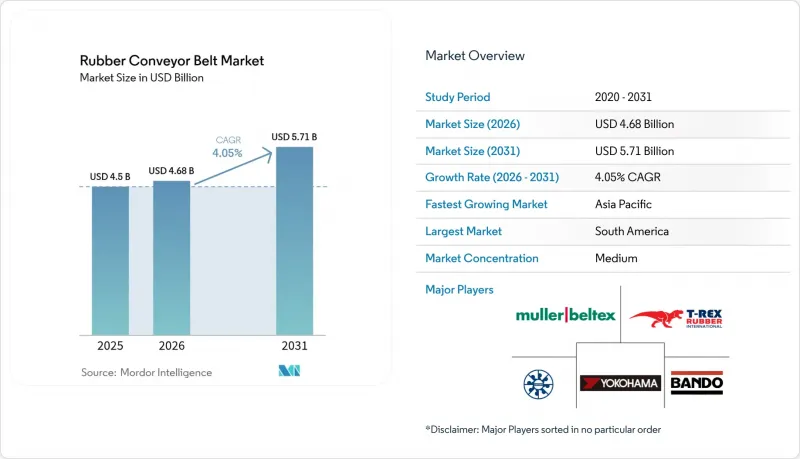
Mordor Intelligence에 의하면, 2026년 고무 컨베이어 벨트 시장 규모는 46억 8,000만 달러로 추정되고 있어 2025년 45억 달러에서 확대해, 2031년에는 57억 1,000만 달러에 이를 것으로 예측됩니다.
2026년부터 2031년까지 연평균 성장률(CAGR) 4.05%로 성장할 것으로 전망됩니다.
본 보고서는 벨트 유형(내열성, 내유성 등), 벨트 중량, 보강재(섬유/패브릭 카카스, 스틸 코드, 솔리드·우븐), 최종 사용자 산업(물류 및 창고, 광업·채석업 등) 및 지역별로 분류되어 있습니다. 시장 전망은 금액(달러) 기준으로 제시되어 있습니다.
세계 고무 컨베이어 벨트 시장 동향 및 인사이트
아시아에서 고온 배터리용 금속 가공이 급증하면서 내열 벨트에 대한 수요가 증가하고 있습니다.
중국, 한국, 인도네시아의 각 음극 및 전구체 공장에서는 200°C를 초과하는 온도에서 반응기를 가동하는 사례가 증가하고 있으며, 이는 열 안정성과 정전기 산재성을 겸비한 그래핀·나노튜브 강화 벨트의 급속한 보급을 촉진하고 있습니다. 이러한 벨트를 통해 가공 업체는 냉각 능력을 강화하지 않고도 처리 능력을 향상시킬 수 있으며, 그 결과로 얻어지는 생산성 향상 덕분에 수직 통합형 광산 기업들은 다년간공급 계약을 체결하고 있습니다. 새로운 인사이트력으로는 내열성 복합재료의 조기 인증이 프로젝트 일정의 신뢰성을 나타내는 지표가 되고 있다는 점이 있습니다.
북미의 자동 마이크로 풀필먼트 창고가 경량 벨트 수요를 주도
도시 지역의 마이크로 풀필먼트 센터는 10,000제곱피트 미만의 면적을 차지하며, 수 mm 이내에서 비틀리고, 올라가고, 정지할 수 있는 콤팩트하고 경량인 벨트에 의존하고 있습니다. 다층 구조에서 단층 구조로 전환한 사업자들로부터 20% 이상의 에너지 절감 효과가 보고되고 있어, 벨트의 질량이 총 운영 비용에 미치는 영향이 크다는 점이 부각되고 있습니다. 인력 부족이 지속되는 가운데, 저신축성 소재를 통한 피킹 정확도 향상은 1제곱피트당 수익을 직접적으로 끌어올리며, 재료 과학이 창고 운영의 핵심이 되고 있습니다.
인도의 태양광(PV) 제조 클러스터가 확대됨에 따라 내유성 벨트에 대한 수요가 증가하고 있습니다.
오디샤 주에 계획된 6GW 규모의 태양전지 모듈 공장에서는 기존 커버 재질을 열화시키는 가소제나 밀봉재를 취급하기 위해 내유성 벨트가 채택될 예정입니다. 니트릴 블렌드와 내마모성 카카스를 결합하여 층간 박리를 방지하고, 예상치 못한 가동 중단 시간을 줄입니다. 이러한 특수 화학 물질과 재생에너지의 전개 사이의 연관성은 국가 산업 정책이 고무 컨베이어 벨트 시장 규모를 어떻게 프리미엄 제품 시장으로 전환시킬 수 있는지를 여실히 보여줍니다.
부문 분석
2025년, 내열 벨트는 고무 컨베이어 벨트 시장 점유율의 28.65%를 차지했습니다. 실리카가 풍부한 컴파운드 기술의 발전으로 인해, 이러한 벨트는 200°C 이상의 환경에서도 연속 운전이 가능해졌으며, 가마 운영자는 가마의 설정 온도를 높여 처리 능력을 향상시킬 수 있습니다. 열 균열의 감소는 유지보수로 인한 가동 중단 시간을 단축시켜, 결과적으로 플랜트의 실효 가동률을 향상시킵니다. 내화성 벨트는 지하 광산의 안전 기준 및 EU의 재활용 의무화를 배경으로, 2026년부터 2031년까지 연평균 성장률(CAGR) 5.65%를 나타낼 것으로 예측됩니다. CAN/CSA-M422 규격에 기반한 A형 또는 B형 인증을 획득한 벨트는 고가대로 거래되고 있으며, 현재는 많은 현장에서 이러한 등급만 지정되고 있기 때문에 인증을 받지 않은 경쟁사들에게는 진입 장벽이 높아지고 있습니다.
2025년 기준, 중량급 벨트는 고무 컨베이어 벨트 시장 규모의 44.35%를 차지했습니다. 폴리에스터·나일론 소재의 카카스는 강도와 유연성의 균형이 뛰어나며, 소포 집배 센터에서는 구동 장치를 업그레이드하지 않고도 벨트의 수명을 연장할 수 있습니다. 그 결과, 에너지 절약과 구조용 강재 수요 감축이 실현되어, 특히 전기 요금이 높은 지역에서는 투자 회수가 촉진됩니다. 광산에서 더 긴 육상 컨베이어의 도입이 진행됨에 따라, 중량급 벨트 시장은 연평균 성장률(CAGR) 5.32%를 나타낼 것으로 예측됩니다. 굿이어(Goodyear)사의 초고강성 폴리에스터/나일론 설계는 수 킬로미터에 달하는 구간에서 신장을 최소화하고, 처짐을 설계 한계 내로 유지합니다. 성장률이 낮기 때문에 단일 구간의 레이아웃이 가능해져 이송 지점의 수를 줄일 수 있습니다. 이를 통해 분진 배출량과 유지보수 시간을 절감할 수 있습니다.
지역별 분석
아시아는 중국의 대규모 제조 거점과 인도의 인프라 확충 추진에 힘입어 2025년 매출의 33.55%를 차지하며 시장을 주도했습니다. 태국과 말레이시아에서 천연고무 원료를 확보할 수 있어 비용 충격을 완화하고, 지역 생산자들에게 원자재 측면에서 우위를 점하게 하고 있습니다. 배터리용 금속 제련 및 태양전지 모듈 제조에 대한 정책적 인센티브로 인해 벨트 수요는 내열성·내유성 품종으로 이동하고 있으며, 결과적으로 성장은 전문적인 틈새 시장에 집중되고 있습니다.
남미는 2031년까지 6.07%라는 가장 높은 연평균 성장률(CAGR)을 나타낼 전망입니다. 칠레, 페루, 브라질의 주요 구리 프로젝트에서는 운반 트럭이 지상 컨베이어로 대체되고 있으며, 이로 인해 중하중용 스틸 코드 벨트의 대량 수주가 촉진되고 있습니다. 안타미나(Antamina)사의 20억 달러 규모의 수명 연장 프로젝트에서는 새로운 컨베이어에 막대한 자본이 투자되고 있으며, 사이드월 구조와 급경사 설계를 제공하는 공급업체들이 고부가가치 계약을 수주하고 있습니다. 광산에서의 재생에너지 도입 노력으로 인해, 에너지 소비를 줄여주는 저신장 벨트에 대한 관심이 더욱 높아지고 있습니다.
북미와 유럽은 여전히 큰 시장 점유율을 차지하고 있지만, 그 이유는 다릅니다. 북미의 창고에서는 가동 시간 예측을 중시하기 때문에 센서가 장착된 벨트를 구매하는 경향이 있습니다. 반면, 유럽의 공장에서는 건강 기준을 충족하기 위해 저니트로소아민 배합 벨트에 중점을 두고 있습니다. 중동 및 아프리카는 아직 발전 단계에 있지만, 미래가 밝습니다. 철도 프로젝트나 철광석 광산에서는 고온 및 연마성 분진을 견딜 수 있는 벨트가 요구되며, 구매자들은 자외선 안정성이 뛰어난 커버를 갖춘 합성고무와 천연고무 혼합 소재의 벨트를 선택하고 있습니다.
기타 혜택:
- 엑셀 형식 시장 예측(ME) 시트
- 3개월간의 애널리스트 지원
자주 묻는 질문
목차
제1장 서론
제2장 조사 방법
제3장 주요 요약
제4장 시장 구도
제5장 시장 규모와 성장 예측
제6장 경쟁 구도
제7장 시장 기회와 향후 전망
JHS 26.09.09According to Mordor Intelligence, rubber conveyor belt market size in 2026 is estimated at USD 4.68 billion, growing from 2025 value of USD 4.5 billion with 2031 projections showing USD 5.71 billion, growing at 4.05% CAGR over 2026-2031.
This report is Segmented by Belt Type (Heat-Resistant, Oil-Resistant and More), Belt Weight, Reinforcement Material (Textile / Fabric Carcass, Steel Cord and Solid-Woven), End-User Industry (Logistics & Warehousing, Mining & Quarrying and More), and by Geography. The Market Forecasts are Provided in Terms of Value (USD).
Global Rubber Conveyor Belt Market Trends and Insights
Surge in High-Temperature Battery-Metals Processing in Asia Boosting Heat-Resistant Belts
Cathode and precursor plants across China, Korea, and Indonesia increasingly operate reactors above 200°C, driving rapid uptake of graphene-nanotube-enhanced belts that combine thermal stability with static dissipation. These belts allow processors to raise throughput without adding cooling capacity, and the resulting productivity gain is convincing vertically integrated miners to lock in multi-year supply agreements. A fresh inference is that early certification of high-heat compounds now serves as a proxy for project schedule reliability.
Automated Micro-Fulfilment Warehouses in North America Driving Lightweight Belt Demand
Urban micro-fulfilment centers occupy footprints under 10,000 sq ft and rely on compact lightweight belts that twist, climb, and stop within millimetres. Operators switching from multi-ply to single-ply constructions report energy savings exceeding 20%, highlighting how belt mass influences total operating cost. Because labour shortages persist, gains in picking accuracy linked to low-stretch fabrics directly elevate revenue per square foot, placing materials science at the heart of warehouse economics.
Expansion of Solar-PV Manufacturing Clusters in India Requiring Oil-Resistant Belts
A planned 6 GW solar-module plant in Odisha will employ oil-resistant belts to handle plasticisers and encapsulants that degrade conventional covers. Pairing nitrile blends with abrasion-resistant carcasses prevents delamination, cutting unplanned downtime. This linkage between specialty chemistry and renewable-energy rollout underscores how national industrial policy can redirect rubber conveyor belt market size toward premium variants.
Other drivers and restraints analyzed in the detailed report include:
- "Pit-to-Plant" Conveyor Retrofits in South American Copper Mines Elevating Replacement Cycle
- EU 2023/1115 Mandating Flame-Retardant Belts in Recycling Plants
- IoT-Enabled Condition-Monitoring Unlocking Pay-Per-Ton Service Contracts
For complete list of drivers and restraints, kindly check the Table Of Contents.
Segment Analysis
Heat-resistant belts held 28.65% of the rubber conveyor belt market share in 2025. Advances in silica-rich compounds let these belts run continuously above 200 °C, enabling kiln operators to raise furnace set-points and unlock throughput gains. Fewer thermal cracks mean shorter maintenance shutdowns, an outcome that expands effective plant availability. Fire-resistant variants are forecast to grow at a 5.65% CAGR between 2026-2031, fuelled by underground-mine safety codes and EU recycling mandates. Belts achieving Type A or B certification under CAN/CSA-M422 command premiums, and many sites now specify only these grades, elevating barriers for non-certified competitors.
Medium-weight belts provided 44.35% of the rubber conveyor belt market size in 2025. Polyester-nylon carcasses balance strength and flexibility, letting parcel hubs extend belt life without upgrading drives. The resulting energy savings and lower structural-steel requirements reinforce payback, especially where electricity tariffs are high. Heavy-weight belts are projected to post a 5.32% CAGR as mines adopt longer overland conveyors. Goodyear's extra-stiff polyester/nylon designs minimise stretch on multi-kilometre flights, keeping sag within design limits. Lower elongation allows single-flight layouts that reduce the number of transfer points, cutting dust emissions and maintenance hours.
Complete Report Scope:
- By Belt Type
- Heat-Resistant
- Oil-Resistant
- Fire-Resistant
- Chemical-Resistant
- General-Purpose
- By Belt Weight
- Lightweight
- Medium-Weight
- Heavy-Weight
- By Reinforcement Material
- Textile / Fabric Carcass
- Steel Cord
- Solid-Woven
- By End-user Industry
- Logistics and Warehousing
- Mining and Quarrying
- Manufacturing (Discrete and Process)
- Metal Processing and Steel Mills
- Power Generation (Thermal and Biomass)
- Food and Beverage
- Construction and Aggregates
- By Geography
- North America
- United States
- Canada
- Mexico
- South America
- Brazil
- Argentina
- Rest of South America
- Europe
- Germany
- United Kingdom
- France
- Italy
- Spain
- Rest of Europe
- Asia-Pacific
- China
- Japan
- South Korea
- India
- Australia
- New Zealand
- Rest of Asia-Pacific
- Middle East and Africa
- United Arab Emirates
- Saudi Arabia
- South Africa
- Rest of Middle East and Africa
- North America
Geography Analysis
Asia dominated with 33.55% of 2025 revenue, propelled by China's large manufacturing base and India's infrastructure push. Access to natural rubber feedstock from Thailand and Malaysia buffers cost shocks, giving regional producers an input advantage. Policy incentives for battery-metal refining and solar-module manufacturing channel belt demand toward heat- and oil-resistant variants, effectively concentrating growth in specialised niches.
South America is forecast to record the highest 6.07% CAGR to 2031. Major copper projects in Chile, Peru, and Brazil are replacing haul trucks with overland conveyors, driving large orders for heavy-duty steel-cord belts. Antamina's USD 2 billion life-extension dedicates substantial capital to new conveyors, and suppliers that offer sidewall or steep-angle designs are capturing premium contracts. The region's commitment to renewable power for mines further raises interest in low-stretch belts that cut energy draw.
North America and Europe retain significant shares, but for different reasons. North American warehouses prioritise predictive uptime and thus purchase sensor-equipped belts, while European factories focus on low-nitrosamine formulations to meet health standards. The Middle East and Africa remain nascent yet promising: rail projects and iron-ore mines require belts that withstand high heat and abrasive dust, pushing buyers toward blended synthetic-natural rubbers with UV-stable covers.
- Bridgestone Corporation
- Continental AG (ContiTech and Phoenix)
- The Yokohama Rubber Co. Ltd.
- Fenner Dunlop Holdings Ltd. (Michelin Conveyor Solutions)
- Bando Chemical Industries Ltd.
- Sempertrans (Semperit AG)
- Dunlop Conveyor Belting
- Qingdao Rubber Six Conveyor Belt Co.
- Zhejiang Double Arrow Rubber Co.
- Oriental Rubber Industries Pvt. Ltd.
- Oxford Rubbers Pvt. Ltd.
- Muller Beltex B.V.
- T-Rex Rubber International B.V.
- Mitsuboshi Belting Ltd.
- Wuxi Boton Belt Co. Ltd.
- Truco Group
- Smiley Monroe Ltd.
- GRT Rubber Technologies
- Continental Belting Pvt. Ltd.
- Probelt Global Ltd.
Additional Benefits:
- The market estimate (ME) sheet in Excel format
- 3 months of analyst support
TABLE OF CONTENTS
1 INTRODUCTION
- 1.1 Study Assumptions and Market Definition
- 1.2 Scope of the Study
2 RESEARCH METHODOLOGY
3 EXECUTIVE SUMMARY
4 MARKET LANDSCAPE
- 4.1 Market Overview
- 4.2 Market Drivers
- 4.2.1 Surge in High-Temperature Battery-Metals Processing in Asia Boosting Heat-Resistant Belts
- 4.2.2 Automated Micro-Fulfillment Warehouses in North America Driving Lightweight Belt Demand
- 4.2.3 Pit-to-Plant Conveyor Retrofits in South American Copper Mines Elevating Replacement Cycle
- 4.2.4 EU 2023/1115 Mandating Flame-Retardant Belts in Recycling Plants
- 4.2.5 Expansion of Solar-PV Manufacturing Clusters in India Requiring Oil-Resistant Belts
- 4.2.6 IoT-Enabled Condition-Monitoring Unlocking Pay-Per-Ton Service Contracts
- 4.3 Market Restraints
- 4.3.1 Volatility in Butadiene and Carbon Black Prices Compressing Margins
- 4.3.2 PVC and Modular Belt Substitution in European Food Processing
- 4.3.3 Certification Lead-Times for UL/CSA Flame Tests in North America
- 4.3.4 EU Scrutiny of Nitrosamine Exposure During Vulcanization
- 4.4 Value / Supply-Chain Analysis
- 4.5 Regulatory Outlook
- 4.6 Technological Outlook
- 4.7 Porter's Five Forces Analysis
- 4.7.1 Threat of New Entrants
- 4.7.2 Bargaining Power of Buyers/Consumers
- 4.7.3 Bargaining Power of Suppliers
- 4.7.4 Threat of Substitute Products
- 4.7.5 Intensity of Competitive Rivalry
- 4.8 Investment Analysis (Capex, MandA, VC Funding)
5 MARKET SIZE AND GROWTH FORECASTS (VALUE)
- 5.1 By Belt Type
- 5.1.1 Heat-Resistant
- 5.1.2 Oil-Resistant
- 5.1.3 Fire-Resistant
- 5.1.4 Chemical-Resistant
- 5.1.5 General-Purpose
- 5.2 By Belt Weight
- 5.2.1 Lightweight
- 5.2.2 Medium-Weight
- 5.2.3 Heavy-Weight
- 5.3 By Reinforcement Material
- 5.3.1 Textile / Fabric Carcass
- 5.3.2 Steel Cord
- 5.3.3 Solid-Woven
- 5.4 By End-user Industry
- 5.4.1 Logistics and Warehousing
- 5.4.2 Mining and Quarrying
- 5.4.3 Manufacturing (Discrete and Process)
- 5.4.4 Metal Processing and Steel Mills
- 5.4.5 Power Generation (Thermal and Biomass)
- 5.4.6 Food and Beverage
- 5.4.7 Construction and Aggregates
- 5.5 By Geography
- 5.5.1 North America
- 5.5.1.1 United States
- 5.5.1.2 Canada
- 5.5.1.3 Mexico
- 5.5.2 South America
- 5.5.2.1 Brazil
- 5.5.2.2 Argentina
- 5.5.2.3 Rest of South America
- 5.5.3 Europe
- 5.5.3.1 Germany
- 5.5.3.2 United Kingdom
- 5.5.3.3 France
- 5.5.3.4 Italy
- 5.5.3.5 Spain
- 5.5.3.6 Rest of Europe
- 5.5.4 Asia-Pacific
- 5.5.4.1 China
- 5.5.4.2 Japan
- 5.5.4.3 South Korea
- 5.5.4.4 India
- 5.5.4.5 Australia
- 5.5.4.6 New Zealand
- 5.5.4.7 Rest of Asia-Pacific
- 5.5.5 Middle East and Africa
- 5.5.5.1 United Arab Emirates
- 5.5.5.2 Saudi Arabia
- 5.5.5.3 South Africa
- 5.5.5.4 Rest of Middle East and Africa
- 5.5.1 North America
6 COMPETITIVE LANDSCAPE
- 6.1 Strategic Moves (Partnerships, Expansions, M&A)
- 6.2 Market Share Analysis
- 6.3 Company Profiles (includes Global level Overview, Market level overview, Core Segments, Financials as available, Strategic Information, Market Rank/Share for key companies, Products and Services, and Recent Developments)
- 6.3.1 Bridgestone Corporation
- 6.3.2 Continental AG (ContiTech and Phoenix)
- 6.3.3 The Yokohama Rubber Co. Ltd.
- 6.3.4 Fenner Dunlop Holdings Ltd. (Michelin Conveyor Solutions)
- 6.3.5 Bando Chemical Industries Ltd.
- 6.3.6 Sempertrans (Semperit AG)
- 6.3.7 Dunlop Conveyor Belting
- 6.3.8 Qingdao Rubber Six Conveyor Belt Co.
- 6.3.9 Zhejiang Double Arrow Rubber Co.
- 6.3.10 Oriental Rubber Industries Pvt. Ltd.
- 6.3.11 Oxford Rubbers Pvt. Ltd.
- 6.3.12 Muller Beltex B.V.
- 6.3.13 T-Rex Rubber International B.V.
- 6.3.14 Mitsuboshi Belting Ltd.
- 6.3.15 Wuxi Boton Belt Co. Ltd.
- 6.3.16 Truco Group
- 6.3.17 Smiley Monroe Ltd.
- 6.3.18 GRT Rubber Technologies
- 6.3.19 Continental Belting Pvt. Ltd.
- 6.3.20 Probelt Global Ltd.


