

|
시장보고서
상품코드
2113963
스마트 홈 보안 서비스 : 시장 점유율 분석, 업계 동향 및 통계, 성장 예측(2026-2031년)Smart Home Security Services - Market Share Analysis, Industry Trends & Statistics, Growth Forecasts (2026 - 2031) |
||||||
 Mordor Intelligence
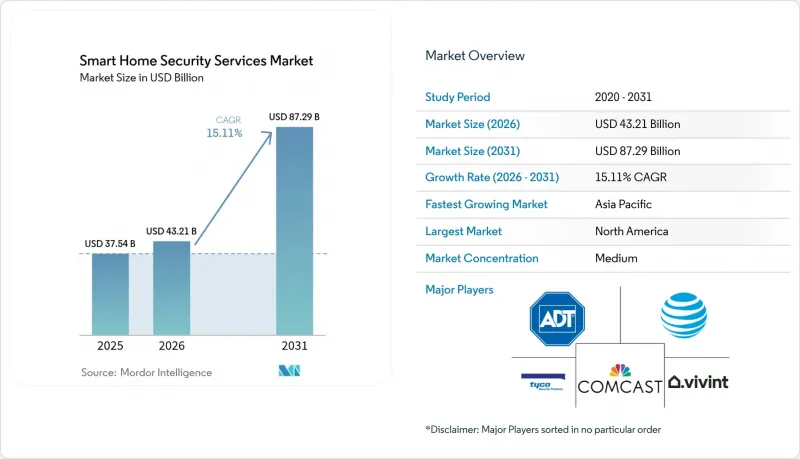
Mordor Intelligence에 의하면, 스마트 홈 보안 서비스 시장 규모는 2025년 375억 4,000만 달러로 평가되었습니다. 2026년에는 432억 1,000만 달러로 확대되어 2026년부터 2031년에 걸쳐 CAGR 15.11%로 성장을 지속하여, 2031년에는 872억 9,000만 달러에 이를 것으로 예측됩니다.
본 보고서는 제품 유형(영상 감시, 출입 통제 등), 구성 요소(하드웨어, 소프트웨어, 서비스), 최종 용도(단독 주택, 아파트·맨션 등), 설치 유형(전문 업체에 의한 설치, 자가 설치) 및 지역별로 분류되어 있습니다. 시장 예측은 금액(달러) 기준으로 제시되어 있습니다.
세계의 스마트 홈 보안 서비스 시장 동향 및 인사이트
AI를 활용한 영상 분석이 선제적인 위협 대응을 가능하게 합니다.
인공지능(AI)을 통해 스마트 홈 보안 서비스 시장은 사건에 반응하는 경보에서 예측형 방어로 진화하고 있습니다. 2025년 6월, 아마존의 Ring은 수백만 건의 동영상 클립을 통해 학습시킨 모델을 활용하여, 일반적인 배달과 수상한 배회 행위를 구별하는 카메라 알림 기능을 도입했습니다. 구글의 제미니 AI는 현재 네스트 카메라의 영상 스트림을 처리하여 표정과 동작 패턴을 평가함으로써, 실제 위협 감지 정확도를 높이는 동시에 오경보를 줄이고 있습니다. 이러한 발전 덕분에 성가신 알림이 67% 감소했으며, 시스템이 가정의 일상적인 습관에 적응하여 개인 맞춤형 보호를 실현할 수 있게 되었습니다. 조기 도입자들은 분석 결과를 생체 인증을 통한 접근 제어와 연동하여, 수동 입력 없이도 원활한 본인 확인을 실현하고 있습니다. 또한, 동일한 알고리즘이 기기 수준의 프로세서에서 실행되는 사례가 늘어나면서 클라우드 대역폭을 줄이는 동시에 사용자의 개인정보 보호를 강화하고 있습니다.
음성 비서 및 IoT 생태계와의 연동
음성 제어는 결정적인 편의성 요소로 자리 잡고 있으며, 조사에 따르면 스마트 홈 사용자의 68%가 일상적인 보안 작업 시 음성 명령을 선호하는 것으로 나타났습니다. ADT는 Google Nest 및 Amazon Alexa와 연동되어 있어, 자연어를 통해 경보 기능을 활성화·비활성화하고 상태를 확인할 수 있습니다. 다국어 가정에서 실시한 현장 테스트 결과, 기기가 이동통신망이 아닌 가정용 Wi-Fi에 연결된 경우 명령어 인식 정확도가 94%에 달하고 응답 속도도 향상되는 것으로 확인되었습니다. 향후 도입될 Matter 표준을 통해 이러한 기능이 브랜드를 초월하여 확장될 것이며, 주택 소유자는 보안 침해가 발생했을 때 조명, 공조, 도어락을 동시에 작동시키는 등의 자동화 시나리오를 자유롭게 설계할 수 있게 될 것입니다. 또한, 각 벤더는 환경 센서를 번들로 제공하여 단일 생태계에서 공기질, 누수, 침입 사건을 모니터링할 수 있게 되었습니다.
초기 기기 및 설치 비용의 부담
단독주택용 기본 패키지는 500-2,000달러이며, 여기에 월간 모니터링 요금이 추가됩니다. 한편, 대규모 공동주택의 개보수에서는 건물 전체를 커버하기 위해 4만 5,000달러를 초과하는 경우도 있습니다. 반도체 부족과 관세 일정 변경으로 인해 하드웨어 공급이 차질을 빚고 있으며, 카메라와 스마트 잠금장치의 단가가 상승하고 있습니다. 각 제조업체는 리스크 분산을 위해 조립을 베트남이나 필리핀으로 이전하고 있지만, 이들 국가에 대한 새로운 무역 관세로 인해 즉각적인 완화 효과는 제한적입니다. 판촉 가격 책정을 통해 구매 성수기의 부담은 경감되지만, 개발도상국에서는 장기적으로 볼 때 합리적인 가격을 유지하는 것이 여전히 과제로 남아 있어, 비용을 장기간에 걸쳐 분산시키는 ‘디바이스 애즈 어 서비스(DaaS)’ 계약에 대한 관심이 높아지고 있습니다.
부문 분석
2025년, 스마트 홈 보안 서비스 시장 중 비디오 감시가 45.70%를 차지하며, 네트워크 카메라, 레코더, 엣지 프로세서를 핵심으로 이 카테고리를 뒷받침했습니다. 4K 센서와 스토리지의 가격이 지속적으로 하락함에 따라, 과거에는 상업시설로 한정되었던 멀티 카메라 구성을 일반 가정에서도 도입할 수 있게 되었습니다. 카메라에 내장된 AI 모듈은 차량, 반려동물, 사람의 얼굴을 로컬에서 필터링하여 대역폭 사용을 억제함과 동시에 프라이버시를 보호합니다. 영상 감시 보안 서비스 시장 규모는 2025년에 약 171억 6,000만 달러에 달했으며, 분석 서비스 구독이 증가함에 따라 두 자릿수 성장률을 기록하며 확대될 것으로 전망됩니다.
출입 통제 분야는 모바일 인증 정보와 원활하게 연동되는 지문, 홍채, 얼굴 인식을 통한 잠금 해제 솔루션 덕분에 2031년까지 연평균 성장률(CAGR) 16.34%로 가장 높은 성장세를 보이고 있습니다. 주요 휴대폰 제조업체와 스마트 잠금 장치 제조업체의 특허 출원은 음성, 얼굴, 터치 인증을 1초 이내에 통합하여 사용자의 편의성 기대에 부응하려는 노력을 뒷받침하고 있습니다. 통합형 도어 스테이션은 고해상도 영상과 생체 인증 리더기를 결합함으로써, 인증 데이터가 감시 영상을 보완하여 사건의 배경 정보를 보다 명확하게 파악할 수 있게 합니다. 주택에서 택배 수령 구역이나 공용 출입구가 보급됨에 따라, 영상과 출입 제어를 결합한 솔루션은 스마트 홈 보안 서비스 시장에서 더 많은 점유율을 확보할 것으로 예측됩니다.
2025년, 카메라, 센서, 제어 허브에 대한 지속적인 수요에 힘입어 하드웨어는 스마트 홈 보안 서비스 시장에서 64.30%의 점유율을 유지했습니다. 그러나 클라우드 스토리지 및 전문 모니터링 정기 계약은 연평균 성장률(CAGR) 16.05%로 확대되고 있어, 서비스 중심의 수익 구조로 점진적으로 전환되고 있음을 시사합니다. 서비스 기반 보안 서비스 시장 규모는 2025년에 129억 달러에 육박할 것으로 예상되며, 예측 기간이 끝날 때까지 2배로 성장할 것으로 전망됩니다. 소비자들은 경보의 우선순위를 정하고 긴급 대응 인력을 파견하는 연중무휴 24시간 체제의 전문가를 높이 평가하고 있으며, 추가 하드웨어 없이도 새로운 분석 기능을 이용할 수 있게 해주는 자동 소프트웨어 업데이트도 환영하고 있습니다.
소프트웨어 계층은 하드웨어와 서비스 사이에 위치하며, AI 추론 엔진과 모든 기기를 통합하는 모바일 대시보드를 통합하고 있습니다. ‘Matter’ 표준에 따른 상호 운용성이 향상됨에 따라, 플랫폼 제공업체들은 에너지 관리 및 노인 돌봄 모니터링 등 산업 전반에 걸친 서비스의 업셀링을 도모할 계획입니다. 단일 구독을 통해 하드웨어, 소프트웨어, 서비스를 원활하게 통합하는 제공업체는 스마트 홈 보안 서비스 시장에서 이익률 확대와 고객 유지율 향상을 도모할 수 있을 것입니다.
지역별 분석
북미는 2025년에 40.60%의 점유율을 차지하며, 스마트 홈 보안 서비스 시장에서 주도적인 위치를 유지했습니다. 미국은 성숙한 유통 채널, 보험과의 번들 판매를 통한 인센티브, 그리고 음성 조작에 대한 소비자의 익숙함 덕분에 지역 내 수요를 주도하고 있습니다. 캐나다에서는 교외 지역으로의 확장에 따라 꾸준한 판매량 증가가 예상되는 반면, 멕시코에서는 범죄 증가가 첫 구매를 촉진하는 중·고소득층 거주 지역에서 급속한 성장이 나타나고 있습니다. ADT와 스테이트 팜이 제휴하여 무료 스타터 키트를 제공하는 등, 보안 업계의 기존 기업과 보험사 간의 지속적인 제휴를 통해 잠재 고객 기반은 계속해서 확대되고 있습니다.
아시아태평양은 도시로의 인구 이동과 디지털 인프라에 대한 공공 투자의 견인 효과로 2031년까지 연평균 성장률(CAGR)이 16.38%를 기록하며 가장 빠른 성장세를 보이고 있습니다. 중국에서는 신축 주택에 스마트 시스템 도입이 의무화되어, 주택용 카메라를 지역 안전 클라우드에 통합하는 대규모 도입이 진행되고 있습니다. 인도의 ‘스마트 시티 미션’에서는 건축 기준과 커넥티드 보안 요건이 연계되어 있어, 현지 제조업체들이 지역의 전력 및 네트워크 환경에 맞춘 비용 효율적인 키트를 공급하고 있습니다. 이 지역의 광범위한 전자기기 공급망이 적극적인 가격 책정을 뒷받침하는 한편, 국내 AI 인재들이 분석 소프트웨어의 현지화를 가속화하고 있습니다.
유럽에서는 GDPR(EU 개인정보보호규정)(일반 데이터 보호 규정) 준수 및 지속가능성에 대한 우선순위에 따라 점진적인 도입이 진행되고 있습니다. 독일, 영국, 프랑스는 초기 비용을 상쇄하고 데이터의 국내 보관을 보장하는 ‘디바이스 애즈 어 서비스(DaaS)’ 모델을 주도하고 있습니다. 남유럽 국가들에서는 건물 개보수 장려책의 일환으로 보안을 에너지 관리 패키지에 통합하고 있습니다. 남미, 중동 및 아프리카는 현재 규모는 작지만, 통신 사업자가 보안 카메라를 광섬유 회선 업그레이드와 세트로 판매하거나, 걸프 지역의 메가 프로젝트가 종합 계획 도시에 주거용 보안 시스템을 통합하는 등 두 자릿수 성장을 기록하고 있습니다. 이러한 신흥 시장은 전 세계 스마트 홈 보안 서비스 시장에 규모와 다양성을 가져다주는 한편, 변동하는 전력 인프라와 기후 변화에 대한 내성을 갖춘 맞춤형 솔루션이 필요합니다.
기타 혜택 :
- 엑셀 형식 시장 예측(ME) 시트
- 3개월간의 애널리스트 지원
자주 묻는 질문
목차
제1장 서론
제2장 조사 방법
제3장 주요 요약
제4장 시장 구도
제5장 시장 규모 및 성장 예측
제6장 경쟁 구도
제7장 시장 기회 및 향후 전망
KTH 26.08.26According to Mordor Intelligence, the smart home security services market size is expected to grow from USD 37.54 billion in 2025 to USD 43.21 billion in 2026 and is forecast to reach USD 87.29 billion by 2031 at 15.11% CAGR over 2026-2031.
This report is Segmented by Product Type (Video Surveillance, Access Control, and More), Component (Hardware, Software, and Services), End-Use (Independent / Detached Homes, Apartments and Condominiums, and More), Installation Type (Professional Installation and Self Installation), and Geography. The Market Forecasts are Provided in Terms of Value (USD).
Global Smart Home Security Services Market Trends and Insights
AI-Powered Video Analytics Enabling Proactive Threat Response
Artificial intelligence elevates the smart home security services market from event-triggered alarms to predictive defence. In June 2025, Amazon's Ring introduced camera alerts that discern routine deliveries from suspicious loitering through models trained on millions of clips. Google's Gemini AI now processes Nest camera streams to evaluate facial expressions and movement patterns, lifting genuine threat detection accuracy while lowering false alarms. These advances cut nuisance notifications by 67% and enable systems to adapt to household routines for personalized protection. Early adopters also link analytics output with biometric access control, creating seamless identification without manual input. The same algorithms are increasingly run on device-level processors, reducing cloud bandwidth and strengthening user privacy.
Integration with Voice Assistants and IoT Ecosystems
Voice control has become a decisive convenience factor, with surveys indicating that 68% of smart home users prefer spoken commands for everyday security tasks. ADT's alignment with Google Nest and Amazon Alexa allows arming, disarming, and status queries through natural language. Field tests in multilingual households confirm 94% command accuracy and faster response when devices stay on home Wi-Fi rather than cellular networks. The forthcoming Matter standard extends these capabilities across brands, letting homeowners craft automation scenes where a security breach cues lights, HVAC, and door locks simultaneously. Vendors also bundle environmental sensors so that a single ecosystem monitors air quality, water leaks, and intrusion events.
High Upfront Device and Installation Costs
Entry packages for single-family homes range from USD 500 to USD 2,000 plus monthly monitoring fees, while large multifamily retrofits can exceed USD 45,000 for full building coverage. Semiconductor shortages and shifting tariff schedules have tightened hardware supply and lifted unit prices for cameras and smart locks. Manufacturers move assembly to Vietnam and the Philippines to diversify risks, yet new trade duties on those countries limit immediate relief. Promotional pricing eases pressure during peak shopping seasons, but sustained affordability remains a hurdle in developing economies, prompting interest in device-as-a-service contracts that spread costs over time.
Other drivers and restraints analyzed in the detailed report include:
- Expansion of Insurer-Backed Premium Discounts for Connected Security
- Government Smart-City Programmes Boosting Residential Surveillance
- Data-Privacy and Cybersecurity Concerns
For complete list of drivers and restraints, kindly check the Table Of Contents.
Segment Analysis
Video surveillance accounted for 45.70% of the smart home security services market in 2025, anchoring the category with networked cameras, recorders, and edge processors. Continuous price declines in 4K sensors and storage enable households to deploy multi-camera layouts once reserved for commercial sites. AI modules embedded in cameras now filter vehicles, pets, and human faces locally, curbing bandwidth use and protecting privacy. The security services market size for video surveillance equated to nearly USD 17.16 billion in 2025 and is projected to scale with double-digit gains as analytics subscriptions multiply.
Access control registers the fastest 16.34% CAGR through 2031 thanks to fingerprint, iris, and facial unlock solutions that link seamlessly with mobile credentials. Patent filings from leading handset and smart lock producers confirm efforts to blend voice, face, and touch proof points in under one second, addressing user expectations for convenience. Integrated door stations combine high-definition video and biometric readers so that authentication data enriches surveillance streams for stronger event context. As homes adopt parcel drop zones and shared entrances, combined video-access stacks should capture further share of the smart home security services market.
Hardware retained 64.30% share of the smart home security services market during 2025, driven by sustained demand for cameras, sensors, and control hubs. However, recurring cloud storage and professional monitoring subscriptions are expanding at a 16.05% CAGR, signalling a gradual pivot toward service-centric revenue. The security services market size tied to services reached close to USD 12.9 billion in 2025 and is set to double by the end of the forecast window. Consumers value 24/7 experts who triage alerts and dispatch first responders, and they appreciate automatic software updates that unlock new analytics without extra hardware.
Software layers sit between hardware and services, integrating AI inference engines and mobile dashboards that unify all devices. As interoperability improves under the Matter standard, platform providers intend to upsell cross-vertical services such as energy management and elder-care monitoring. Providers that seamlessly blend hardware, software, and services under one subscription stand to widen margins and strengthen retention in the smart home security services market.
Complete Report Scope:
- By Product Type
- Video Surveillance
- Security Cameras
- Monitors
- Storage Devices
- Others
- Access Control
- Facial Recognition
- Fingerprint Recognition
- Iris Recognition
- Smart Locks and Others
- Intrusion Detection and Alarms
- Video Surveillance
- By Component
- Hardware
- Software
- Services (Monitoring and Cloud)
- By End-use
- Independent / Detached Homes
- Apartments and Condominiums
- Other Residential (e.g., Assisted-living)
- By Installation Type
- Professional Installation
- Self-installation (DIY)
- By Geography
- North America
- United States
- Canada
- Mexico
- South America
- Brazil
- Rest of South America
- Europe
- Germany
- United Kingdom
- France
- Italy
- Spain
- Rest of Europe
- Asia Pacific
- China
- Japan
- India
- South Korea
- Rest of Asia Pacific
- Middle East and Africa
- Saudi Arabia
- United Arab Emirates
- South Africa
- Rest of Middle East and Africa
- North America
Geography Analysis
North America is expected to maintain its leadership in the smart home security services market, with a 40.60% share in 2025. The United States dominates regional demand thanks to mature distribution channels, bundled insurance incentives, and consumer familiarity with voice-enabled control. Canada contributes steady unit growth through suburban expansion, whereas Mexico sees rapid gains in upper-middle-income neighbourhoods where rising crime prompts first-time purchases. Ongoing partnerships between security incumbents and insurers, such as ADT's alliance with State Farm that offers free starter kits, continue to expand the addressable base.
The Asia Pacific region records the fastest growth, with a 16.38% CAGR through 2031, driven by urban migration and public investments in digital infrastructure. China mandates smart readiness in new dwellings, driving large-scale deployments that integrate residential cameras into district safety clouds. India's Smart Cities Mission links building codes to connected security prerequisites, and local manufacturers supply cost-efficient kits tailored to regional power and network conditions. The region's expansive electronics supply chain underpins aggressive pricing, while homegrown AI talent accelerates the localisation of analytics software.
Europe follows a steady adoption path shaped by GDPR compliance and sustainability priorities. Germany, the United Kingdom, and France spearhead device-as-a-service models that offset upfront costs and guarantee data residency. Southern European nations integrate security with energy-management packages as part of building-retrofit incentives. South America and the Middle East and Africa, although smaller today, experience double-digit growth as telecom operators bundle security cameras with fibre upgrades and as Gulf megaprojects embed residential protection in master-planned cities. These emerging markets add volume and diversity to the global smart home security services market while requiring tailored solutions for variable power infrastructure and climate resilience.
- ADT Inc.
- Amazon (Ring)
- Comcast (Xfinity Home)
- Vivint Smart Home
- SimpliSafe Inc.
- AT&T Digital Life
- Honeywell Home
- Johnson Controls (Tyco/ADT Canada)
- Google Nest
- Arlo Technologies
- Alarm.com
- Axis Communications
- Bosch Security Systems
- Samsung SmartThings
- Hikvision
- Control4 (Snap-One)
- Abode Systems
- Brinks Home Security
- Canary Connect
- August Home
Additional Benefits:
- The market estimate (ME) sheet in Excel format
- 3 months of analyst support
TABLE OF CONTENTS
1 INTRODUCTION
- 1.1 Study Assumptions and Market Definition
- 1.2 Scope of the Study
2 RESEARCH METHODOLOGY
3 EXECUTIVE SUMMARY
4 MARKET LANDSCAPE
- 4.1 Market Overview
- 4.2 Market Drivers
- 4.2.1 Growing safety concerns amid rising burglary rates
- 4.2.2 Falling sensor and connectivity costs
- 4.2.3 Expansion of insurer-backed premium discounts for connected security
- 4.2.4 Integration with voice assistants and IoT ecosystems
- 4.2.5 AI-powered video analytics enabling proactive threat response
- 4.2.6 Government smart-city programmes boosting residential surveillance
- 4.3 Market Restraints
- 4.3.1 High upfront device and installation costs
- 4.3.2 Data-privacy and cybersecurity concerns
- 4.3.3 Patchy battery life of wireless outdoor cameras
- 4.3.4 Emerging data-localisation mandates inflating cloud costs
- 4.4 Value Chain Analysis
- 4.5 Regulatory Landscape
- 4.6 Technological Outlook
- 4.7 Porter's Five Forces Analysis
- 4.7.1 Threat of New Entrants
- 4.7.2 Bargaining Power of Buyers
- 4.7.3 Bargaining Power of Suppliers
- 4.7.4 Threat of Substitutes
- 4.7.5 Intensity of Competitive Rivalry
5 MARKET SIZE AND GROWTH FORECASTS (VALUE)
- 5.1 By Product Type
- 5.1.1 Video Surveillance
- 5.1.1.1 Security Cameras
- 5.1.1.2 Monitors
- 5.1.1.3 Storage Devices
- 5.1.1.4 Others
- 5.1.2 Access Control
- 5.1.2.1 Facial Recognition
- 5.1.2.2 Fingerprint Recognition
- 5.1.2.3 Iris Recognition
- 5.1.2.4 Smart Locks and Others
- 5.1.3 Intrusion Detection and Alarms
- 5.1.1 Video Surveillance
- 5.2 By Component
- 5.2.1 Hardware
- 5.2.2 Software
- 5.2.3 Services (Monitoring and Cloud)
- 5.3 By End-use
- 5.3.1 Independent / Detached Homes
- 5.3.2 Apartments and Condominiums
- 5.3.3 Other Residential (e.g., Assisted-living)
- 5.4 By Installation Type
- 5.4.1 Professional Installation
- 5.4.2 Self-installation (DIY)
- 5.5 By Geography
- 5.5.1 North America
- 5.5.1.1 United States
- 5.5.1.2 Canada
- 5.5.1.3 Mexico
- 5.5.2 South America
- 5.5.2.1 Brazil
- 5.5.2.2 Rest of South America
- 5.5.3 Europe
- 5.5.3.1 Germany
- 5.5.3.2 United Kingdom
- 5.5.3.3 France
- 5.5.3.4 Italy
- 5.5.3.5 Spain
- 5.5.3.6 Rest of Europe
- 5.5.4 Asia Pacific
- 5.5.4.1 China
- 5.5.4.2 Japan
- 5.5.4.3 India
- 5.5.4.4 South Korea
- 5.5.4.5 Rest of Asia Pacific
- 5.5.5 Middle East and Africa
- 5.5.5.1 Saudi Arabia
- 5.5.5.2 United Arab Emirates
- 5.5.5.3 South Africa
- 5.5.5.4 Rest of Middle East and Africa
- 5.5.1 North America
6 COMPETITIVE LANDSCAPE
- 6.1 Market Concentration
- 6.2 Strategic Moves
- 6.3 Market Share Analysis
- 6.4 Company Profiles (includes Global-level Overview, Market-level Overview, Core Segments, Financials as available, Strategic Information, Market Rank/Share for key companies, Products and Services, and Recent Developments)
- 6.4.1 ADT Inc.
- 6.4.2 Amazon (Ring)
- 6.4.3 Comcast (Xfinity Home)
- 6.4.4 Vivint Smart Home
- 6.4.5 SimpliSafe Inc.
- 6.4.6 AT&T Digital Life
- 6.4.7 Honeywell Home
- 6.4.8 Johnson Controls (Tyco/ADT Canada)
- 6.4.9 Google Nest
- 6.4.10 Arlo Technologies
- 6.4.11 Alarm.com
- 6.4.12 Axis Communications
- 6.4.13 Bosch Security Systems
- 6.4.14 Samsung SmartThings
- 6.4.15 Hikvision
- 6.4.16 Control4 (Snap-One)
- 6.4.17 Abode Systems
- 6.4.18 Brinks Home Security
- 6.4.19 Canary Connect
- 6.4.20 August Home
7 MARKET OPPORTUNITIES AND FUTURE OUTLOOK
- 7.1 White-space and Unmet-need Assessment


