

|
시장보고서
상품코드
2115092
스마트홈 보안 시장 : 점유율 분석, 업계 동향과 통계, 성장 예측(2026-2031년)Smart Home Security - Market Share Analysis, Industry Trends & Statistics, Growth Forecasts (2026 - 2031) |
||||||
 Mordor Intelligence
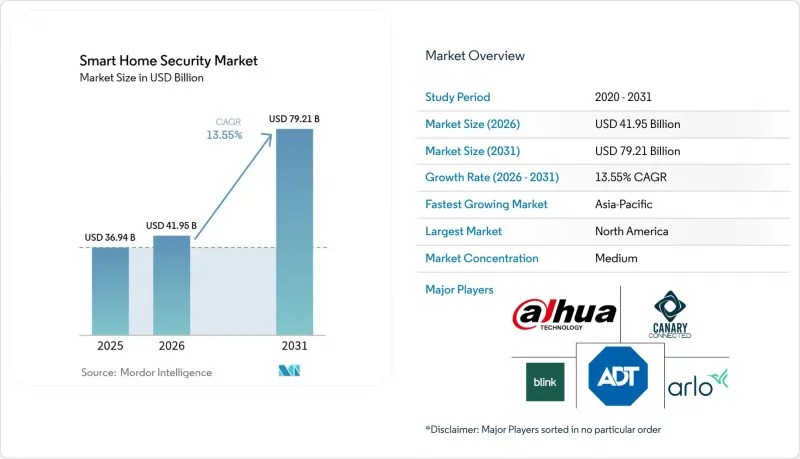
Mordor Intelligence에 의하면, 스마트홈 보안 시장 규모는 2025년에 369억 4,000만 달러로 평가되었고 2026년 419억 5,000만 달러에서 2031년까지 792억 1,000만 달러에 이를 것으로 예측되며, 예측 기간(2026-2031년) CAGR은 13.55%를 나타낼 전망입니다.
본 보고서는 구성 요소(하드웨어, 소프트웨어, 서비스), 기기 유형(스마트 카메라 및 감시 시스템, 스마트 잠금 장치, 스마트 경보 장치,스마트 센서 및 감지기 등), 통신 프로토콜(Wi-Fi, Zigbee 등), 최종 사용자의 주거 유형(단독주택, 아파트, 분양 아파트/공동주택) 및 지역별로 분류되어 있습니다. 시장 전망은 금액(미 달러) 기준으로 제시되어 있습니다.
세계 스마트홈 보안 시장 동향 및 인사이트
AI를 활용한 엣지 분석을 통해 오경보를 줄임
장치에 내장된 신경망 프로세서를 탑재한 스마트 카메라는 현재 반려동물, 차량, 익숙한 얼굴을 인식할 수 있게 되어, 과거 사용자의 신뢰를 떨어뜨리던 성가신 알림을 대폭 줄이고 있습니다. Synaptics사의 2025년형 SoC는 엣지 추론이 어떻게 지연 시간을 단축하고 클라우드로의 데이터 유출을 억제하는지 입증하고 있으며, 응답 시간을 개선하는 동시에 대역폭 비용을 절감하고 있습니다. Arlo사는 이 기능에 가정의 생활 리듬에 적응하는 맞춤형 감지 모드를 결합함으로써 구독 계약 기간의 장기화를 촉진하고 있습니다. 보험사는 오경보 감소 사실을 확인하고 더 큰 폭의 할인을 승인함으로써 도입의 선순환을 뒷받침하고 있습니다. 또한, 이러한 변화로 인해 시장 진입 장벽도 높아지고 있습니다. 경쟁사들은 고도화된 모델을 통합하고 빈번한 펌웨어 업데이트를 유지해야 하므로 연구개발비가 증가하는 반면, 일단 도입되면 정착도가 높은 지속적인 수익을 창출하게 되기 때문입니다.
보험 연계형 기기의 리베이트가 도입을 촉진
주택 소유자는 Nationwide나 Amica와 같은 보험사가 제공하는 프로그램에 따라, 인증된 스마트 센서, 누수 감지기 또는 모니터링이 포함된 경보 시스템을 설치함으로써 보험료를 최대 10%까지 절감할 수 있습니다. 캐나다에서도 Sonnet과 TELUS의 제휴를 통해 유사한 인센티브가 나타나고 있으며, 북미에서의 급속한 확장을 위한 청사진이 제시되고 있습니다. 보험사에게 있어 커넥티드 하드웨어는 위험 요소를 발생 원천에서 감지함으로써 손해 발생 빈도를 줄이고, 손해율의 경제성을 개선합니다. 한편, 벤더는 인수 데이터를 활용하여 잠재 고객을 세분화하고, 서비스 플랜의 업셀링을 도모합니다. 전미보험감독관협회(NAIC)에 의한 번들 판매에 관한 규제 명확화로 인해 규정 준수 관련 우려가 해소되었으며, 기기 출하를 대규모로 촉진하는 다년간의 제휴 계약이 실현되고 있습니다.
보안 대책이 미흡한 기기로 인한 사이버 침해 보험료의 급등
보험 인수사들은 주목을 받은 IoT 봇넷 사건을 계기로 스코어링 모델을 엄격화하여, 벤더에게 상세한 침투 테스트 결과 및 SOC 2 인증서 제출을 요구하고 있습니다. 2024년 베터리(Betterley) 보고서에 따르면, 펌웨어 업데이트 파이프라인에 취약점이 있는 제조업체의 경우 보험료율이 두 자릿수 상승했으며, 이로 인해 제품의 총비용이 증가하여 흑자 전환까지의 기간이 길어지고 있습니다. 시큐어 부트, 하드웨어 루트 오브 트러스트,및 조정된 취약점 공개를 도입한 브랜드는 유리한 조건을 확보하고, 해당 보험 가입 현황을 차별화 요인으로 내세우고 있습니다. 반면, 성숙한 보안 프로그램이 부족한 스타트업은 유통업체가 책임 리스크를 신중하게 검토하는 가운데, 자금적 제약이나 소매업체의 반발에 직면하고 있습니다.
부문 분석
2025년에는 카메라와 센서에 대한 수요에 힘입어 하드웨어가 매출의 47.30%를 차지했으나, 스마트홈 보안 시장에서는 사용자가 부가가치가 높은 AI 알림을 채택함에 따라 클라우드 구독으로의 뚜렷한 전환이 예상됩니다. 서비스 부문은 연평균 성장률(CAGR) 13.66%를 기록할 전망이며, ‘Arlo Secure 6’과 같은 플랫폼에서는 포렌식 동영상 검색, 물체 분류, 긴급 대응 에스컬레이션을 계층형 요금제에 묶어 제공합니다. 이러한 추세로 인해 사용자 1인당 평균 수익이 향상되고 계절적 영향이 완화될 것입니다. 이는 정기적인 이용료로 인해 현금 흐름이 연말연시 기기 판매 주기와 분리되기 때문입니다. 소프트웨어는 멀티 센서 생태계를 총괄하는 펌웨어, API, 모바일 대시보드를 연결하는 가교 역할을 수행하고 있습니다. 크로스셀링 프로세스(기기 판매, 체험판, 유료 요금제로의 전환)를 능숙하게 활용하는 벤더는 평생 가치(LTV)를 최적화하는 동시에, 해지를 방지하는 ‘데이터 기반의 진입 장벽’을 구축할 수 있습니다.
서비스의 성장은 채널의 다양화도 촉진합니다. 통신 사업자는 모니터링 서비스를 광대역 요금제에 묶어 제공하고, 보험사는 설치 쿠폰을 공동으로 제공합니다. 하드웨어 중심의 기존 기업에게는 경쟁력을 유지하기 위해 무선 업그레이드 기능, 견고한 클라우드 파이프라인, 다국어 지원 AI 모델을 통합하는 것이 과제가 됩니다. 그 결과, 로드맵 수립에 있어 실리콘 설계와 ‘서비스로서의 기능(Feature-as-a-Service)’의 마일스톤이 밀접하게 연결되면서, 스마트홈 보안 시장에서 제품 및 서비스의 기존 경계가 모호해지고 있습니다.
스마트 카메라와 감시 장치는 2025년 매출의 51.45%를 차지하며, 시각적 억제 효과와 사건 검증에 대한 소비자의 친숙함을 뒷받침하고 있습니다. 그러나 성장의 중심은 출입 관리와 감시를 단일 설치 지점으로 통합함으로써 연평균 성장률(CAGR) 13.59%를 달성하는 초인종과 자물쇠를 일체화한 카메라로 이동하고 있습니다. ‘Lockly Guard Vision’은 이러한 변화를 상징하는 제품으로, HD 광학 시스템, 지문 인증, RFID 기반 대체 기능을 통합한 폼 팩터를 통해 시공업체의 작업 부담과 모바일 앱의 복잡성을 동시에 경감시키고 있습니다. 기존 주택에 사후 설치하는 경우, 독립형 잠금 장치가 여전히 유용하지만, 인증된 위협에 대해 사이렌, 스트로브 조명, 자동 도어 잠금 장치를 작동시키는 멀티 센서 규칙과 결합함으로써 경보 시스템은 새로운 활로를 모색하고 있습니다.
기능의 집적화에 따라 열 관리, 전력 효율, 안테나 설계와 같은 과제가 발생하고 있지만, 이는 사내에 RF 및 ASIC 팀을 보유한 수직 통합형 기업에게는 강점이 됩니다. 또한, 보험사들은 누수 감지기나 연기 감지기를 보안 패키지의 손해 방지 기능의 연장선으로 취급하는 경향이 강해지고 있어, 카메라를 주력으로 하는 브랜드들에게도 다각화를 촉진하고 있습니다. 따라서 스마트홈 보안 시장에서 차별화를 꾀하려면 개별 하드웨어 사양이 아닌, 통일된 사용자 경험(UX), 배터리 지속 시간, AI 추론의 정확도가 핵심이 됩니다.
지역별 분석
북미는 성숙한 보험 생태계, 견조한 광대역 보급률, 그리고 전문적인 모니터링 서비스가 정착된 문화를 활용하여 2025년에는 매출의 61.40%를 차지했습니다. 아메리칸 패밀리(American Family)와 같은 보험사들은 보험료 할인을 통해 설치를 촉진하고 있는 반면, 5G 고정 무선 액세스는 여러 대의 카메라를 설치하는 가구에 업링크 여유를 확보해 주고 있습니다. 레지디오(Resideo)가 스냅원(Snap One)을 14억 달러에 인수한 사례로 대표되는 전략적 M&A는 유통, 하드웨어, 지속적인 서비스를 단일 스택으로 통합하는 수직 통합형 모델로의 추세를 보여줍니다. 요금 변동과 주별 개인정보 보호법 개정에 따라 비용 및 규정 준수 측면에서 불확실성이 발생하고 있지만, 높은 가처분 소득은 스마트홈 보안 시장이 얼리 어답터층을 넘어 확대되는 가운데 기초적인 수요를 유지하는 데 도움이 되고 있습니다.
아시아태평양은 중국 상무부의 교체 쿠폰과 산업정보화부(MIIT)의 5G 이니셔티브, 그리고 안전 기준을 형성하는 IEC 표준화에서 일본의 주도력에 힘입어 2031년까지 연평균 성장률(CAGR) 14.05%를 기록하며 다른 모든 지역을 능가하는 성장을 이루고 있습니다. 중산층의 주거 침입 및 고령자 돌봄에 대한 인식이 높아지는 데다, 도시의 고밀도화가 진행됨에 따라 아파트에 대한 기기 보급이 확대되고 있습니다. Zigbang이나 SK Shieldus와 같은 제휴 사례는 프로프테크 플랫폼과 AI 탑재 방범 카메라, 긴급 신고 시스템을 통합한 지역 밀착형 서비스 모델을 보여주고 있으며, 고층 아파트 복합 시설에서의 확장성을 가능하게 하고 있습니다. 해외에서 진출한 기업들은 시장 점유율을 확보하기 위해 펌웨어를 현지 언어, 클라우드 주권, 전자상거래 물류에 맞추어 최적화해야 합니다.
유럽에서는 GDPR(EU 개인정보보호규정)에 기반한 데이터 관리에 대한 신뢰와 에너지 절약형 전자 기기를 위한 규제 추진을 배경으로 꾸준한 확장이 이어지고 있습니다. 지속가능성 예산을 통해 보안과 공조(HVAC) 최적화를 통합한 다기능 센서가 지원되고 있습니다. 각 벤더는 ‘프라이버시 바이 디자인(Privacy by Design)’이라는 설계 철학을 통해 차별화를 꾀하고, 얼굴 인식 기술과 관련된 소송을 우려하는 소비자들의 공감을 얻는 인증 마크를 획득하고 있습니다. 라틴아메리카, 중동 및 아프리카는 여전히 발전 단계에 있지만, 광대역 가격 하락과 결제 인프라 개선이 기기의 평균 판매 가격(ASP) 하락을 따라잡는 한, 미래 전망은 밝다고 할 수 있습니다.
기타 혜택:
- 엑셀 형식 시장 예측(ME) 시트
- 3개월간의 애널리스트 지원
자주 묻는 질문
목차
제1장 서론
제2장 조사 방법
제3장 주요 요약
제4장 시장 상황 개요
제5장 시장 규모와 성장 예측
제6장 경쟁 구도
제7장 시장 기회와 향후 전망
JHS 26.08.26According to Mordor Intelligence, the smart home security market size was valued at USD 36.94 billion in 2025 and estimated to grow from USD 41.95 billion in 2026 to reach USD 79.21 billion by 2031, at a CAGR of 13.55% during the forecast period (2026-2031).
This report is Segmented by Component (Hardware, Software, Services), Device Type (Smart Cameras and Monitoring Systems, Smart Locks, Smart Alarms, Smart Sensors and Detectors, and More), Communication Protocol (Wi-Fi, Zigbee, and More), End-User Dwelling Type (Independent Homes, Apartments, Condominiums/MDUs), and Geography. The Market Forecasts are Provided in Terms of Value (USD).
Global Smart Home Security Market Trends and Insights
AI-Enabled Edge Analytics Cut False Alarms
Smart cameras equipped with on-device neural processors now recognize pets, vehicles, and familiar faces, slashing nuisance alerts that once eroded user trust. Synaptics' 2025 SoCs demonstrate how edge inference trims latency and curbs cloud egress, improving response times while lowering bandwidth fees.Arlo layers this capability with custom detection modes that adapt to household routines, encouraging longer subscription tenure. Insurers observe fewer false dispatches and approve deeper discounts, reinforcing a virtuous cycle of adoption. The shift also raises barriers to entry because rivals must integrate sophisticated models and maintain frequent firmware updates, thereby escalating R&D outlays while producing sticky, recurring revenue once deployed.
Insurance-Linked Device Rebates Spur Installs
Homeowners can secure up to 10% premium reductions when they install qualified smart sensors, leak detectors, or monitored alarm packs under programs offered by carriers such as Nationwide and Amica. Similar incentives are also evident in Canada through Sonnet-TELUS tie-ups, signaling a North American blueprint for rapid scale. For insurers, connected hardware mitigates loss frequency by detecting perils at inception, improving loss-ratio economics. Vendors, in turn, leverage underwriting data to segment prospects and upsell service tiers. Regulatory clarity from the National Association of Insurance Commissioners on bundling removes compliance doubts, unlocking multiyear affinity deals that seed device shipments at scale
Surging Cyber-Breach Insurance Premiums on Insecure Devices
Underwriters have tightened their scoring models following high-profile IoT botnet events, requiring vendors to provide detailed penetration test results and SOC 2 attestations. The 2024 Betterley report notes double-digit rate hikes for manufacturers with porous firmware update pipelines, which elevates total product cost and elongates the time to profitability. Brands that embed secure boot, hardware root of trust, and coordinated vulnerability disclosure earn favorable terms and market their coverage status as a differentiator. Conversely, startups lacking mature security programs face capital constraints and retail pushback as distributors weigh liability exposure.
Other drivers and restraints analyzed in the detailed report include:
- Matter-Thread Interoperability Lowers Vendor Lock-in
- Crime-to-Solution Datasets Accelerate Predictive Policing Partnerships
- IPv6 Multicast Instability in Thread-Matter 1.4 Networks
For complete list of drivers and restraints, kindly check the Table Of Contents.
Segment Analysis
Hardware retained 47.30% of the revenue in 2025, anchored by demand for cameras and sensors, but the Smart Home Security market anticipates a pronounced shift to cloud subscriptions as users adopt value-added AI alerts. Services are on track for a 13.66% CAGR, with platforms such as Arlo Secure 6 bundling forensic video search, object classification, and emergency response escalation into tiered plans. This trajectory boosts average revenue per user and mitigates seasonality, as recurring fees decouple cash flow from holiday device cycles. Software occupies a bridging layer, linking firmware, APIs, and mobile dashboards that orchestrate multisensor ecosystems. Vendors that master cross-sell journeys-device sale, trial, paid tier-optimize lifetime value while cultivating data moats that fortify churn barriers.
The growth of services also seeds channel diversification. Telecom operators bundle monitoring into broadband bills, whereas insurers co-sponsor installation vouchers. For hardware-centric incumbents, the task becomes embedding over-the-air upgradability, robust cloud pipelines, and multilingual AI models to sustain competitive positioning. Consequently, roadmap planning now intertwines silicon design with feature-as-a-service milestones, blurring the traditional delineations between product and service within the Smart Home Security market.
Smart cameras and monitoring units delivered 51.45% of 2025 revenue, underscoring consumer familiarity with visual deterrents and event verification. Growth, however, gravitates toward converged doorbell-lock cameras that deliver a 13.59% CAGR by collapsing entry control and surveillance into a single installation point. The Lockly Guard Vision exemplifies this shift, layering HD optics, fingerprint access, and RFID fallback in a form factor that streamlines both contractor labor and mobile app clutter. Standalone locks remain relevant for retrofit scenarios, while alarms gain new life when paired with multi-sensor rules that activate sirens, strobe lights, and automated door locks on authenticated threats.
Feature density brings thermal management, power efficiency, and antenna design challenges that reward vertically integrated players with in-house RF and ASIC teams. Furthermore, insurers are increasingly treating water-leak detectors and smoke sensors as loss-prevention extensions of security bundles, nudging camera-first brands to diversify. In the Smart Home Security market, the path to differentiation thus hinges on unified UX, battery endurance, and AI inference accuracy rather than isolated hardware specs.
Complete Report Scope:
- By Component
- Hardware
- Software
- Services
- By Device Type
- Smart Cameras and Monitoring Systems
- Smart Locks
- Smart Alarms
- Smart Sensors and Detectors
- Combined Doorbell-Lock Cameras
- Other Device Types
- By Communication Protocol
- Wi-Fi
- Zigbee
- Z-Wave / Z-Wave LR
- Thread / Matter
- Bluetooth LE / Mesh
- By End-User Dwelling Type
- Independent Homes
- Apartments
- Condominiums / MDUs
- By Geography
- North America
- United States
- Canada
- Mexico
- South America
- Brazil
- Argentina
- Rest of South America
- Europe
- Germany
- United Kingdom
- France
- Italy
- Spain
- Rest of Europe
- Asia Pacific
- China
- Japan
- India
- Singapore
- South korea
- Australia
- Rest of Asia Pacific
- Middle East and Africa
- Middle East
- Saudi Arabia
- United Arab Emirates
- Turkey
- Rest of Middle East
- Africa
- South Africa
- Nigeria
- Rest of Africa
- Middle East
- North America
Geography Analysis
North America generated 61.40% revenue in 2025 by leveraging a mature insurance ecosystem, robust broadband penetration, and a culture of professional monitoring. Carriers such as American Family incentivize installations through premium discounts, while 5G fixed-wireless access ensures uplink headroom for multi-camera households. Strategic M&A, typified by Resideo's USD 1.4 billion acquisition of Snap One, signals a trend toward vertically integrated models that stitch distribution, hardware, and recurring services into a single stack.Tariff volatility and evolving state privacy statutes create cost and compliance uncertainties; however, high disposable income helps preserve baseline demand as the Smart Home Security market broadens beyond early adopters.
The Asia Pacific outpaces all regions at a 14.05% CAGR through 2031, driven by China's Ministry of Commerce trade-in vouchers, MIIT 5G initiatives, and Japan's leadership in IEC standardization, which shapes safety benchmarks. Rising middle-class awareness around burglary and elder care, alongside urban densification, pushes device penetration into condominiums. Partnerships like Zigbang and SK Shieldus demonstrate localized service models that integrate proptech platforms with AI-powered CCTV and emergency dispatch, unlocking scalability in high-rise complexes. Foreign entrants must tailor their firmware to regional languages, cloud sovereignty, and e-commerce logistics to capture a share.
Europe maintains steady expansion, underpinned by GDPR-driven trust in data stewardship and a regulatory push toward energy-aware electronics. Sustainability budgets support multifunction sensors that integrate security with HVAC optimization. Vendors differentiate through privacy-by-design engineering, earning certification badges that resonate with consumers wary of facial-recognition litigation. Latin America and the Middle East, and Africa remain nascent yet promising, provided improvements in broadband affordability and payment infrastructure keep pace with falling device ASPs.
- ADT Inc.
- Amazon Ring LLC
- Arlo Technologies Inc.
- August Home Inc.
- Aqara (Lumi United Technology Co., Ltd.)
- Blink Home Inc.
- Canary Connect Inc.
- Dahua Technology Co., Ltd.
- Eufy Security (Anker Innovations)
- EZVIZ Inc.
- Frontpoint Security Solutions LLC
- Hangzhou Hikvision Digital Technology Co., Ltd.
- Kwikset Corporation
- Lorex Technology Inc.
- Nuki Home Solutions GmbH
- Reolink Digital Technology Co., Ltd.
- Schlage Lock Company LLC
- SimpliSafe Inc.
- Swann Communications Pty Ltd
- U-tec Group Inc.
Additional Benefits:
- The market estimate (ME) sheet in Excel format
- 3 months of analyst support
TABLE OF CONTENTS
1 INTRODUCTION
- 1.1 Study Assumptions and Market Definition
- 1.2 Scope of the Study
2 RESEARCH METHODOLOGY
3 EXECUTIVE SUMMARY
4 MARKET LANDCSAPE
- 4.1 Market Overview
- 4.2 Market Drivers
- 4.2.1 AI-enabled edge analytics cut false alarms
- 4.2.2 Insurance-linked device rebates spur installs
- 4.2.3 Matter/Thread interoperability lowers vendor lock-in
- 4.2.4 Crime-to-solution datasets accelerate predictive policing partnerships
- 4.2.5 Energy-aware security devices tap rising sustainability budgets
- 4.2.6 5G FWA roll-outs boost bandwidth for cloud-video plans
- 4.3 Market Restraints
- 4.3.1 Surging cyber-breach insurance premiums on insecure devices
- 4.3.2 IPv6 multicast instability in Thread Matter 1.4 networks
- 4.3.3 Rare-earth and Li-Ion price spikes hit battery-camera BOM costs
- 4.3.4 AI-bias litigation limits facial-recognition deployments
- 4.4 Industry Value Chain Analysis
- 4.5 Regulatory Landscape
- 4.6 Technological Outlook
- 4.7 Porter's Five Forces Analysis
- 4.7.1 Bargaining Power of Suppliers
- 4.7.2 Bargaining Power of Buyers
- 4.7.3 Threat of New Entrants
- 4.7.4 Threat of Substitutes
- 4.7.5 Intensity of Competitive Rivalry
- 4.8 Assessment of Macro-economic Trends on the Market
5 MARKET SIZE AND GROWTH FORECASTS (VALUE)
- 5.1 By Component
- 5.1.1 Hardware
- 5.1.2 Software
- 5.1.3 Services
- 5.2 By Device Type
- 5.2.1 Smart Cameras and Monitoring Systems
- 5.2.2 Smart Locks
- 5.2.3 Smart Alarms
- 5.2.4 Smart Sensors and Detectors
- 5.2.5 Combined Doorbell-Lock Cameras
- 5.2.6 Other Device Types
- 5.3 By Communication Protocol
- 5.3.1 Wi-Fi
- 5.3.2 Zigbee
- 5.3.3 Z-Wave / Z-Wave LR
- 5.3.4 Thread / Matter
- 5.3.5 Bluetooth LE / Mesh
- 5.4 By End-User Dwelling Type
- 5.4.1 Independent Homes
- 5.4.2 Apartments
- 5.4.3 Condominiums / MDUs
- 5.5 By Geography
- 5.5.1 North America
- 5.5.1.1 United States
- 5.5.1.2 Canada
- 5.5.1.3 Mexico
- 5.5.2 South America
- 5.5.2.1 Brazil
- 5.5.2.2 Argentina
- 5.5.2.3 Rest of South America
- 5.5.3 Europe
- 5.5.3.1 Germany
- 5.5.3.2 United Kingdom
- 5.5.3.3 France
- 5.5.3.4 Italy
- 5.5.3.5 Spain
- 5.5.3.6 Rest of Europe
- 5.5.4 Asia Pacific
- 5.5.4.1 China
- 5.5.4.2 Japan
- 5.5.4.3 India
- 5.5.4.4 Singapore
- 5.5.4.5 South korea
- 5.5.4.6 Australia
- 5.5.4.7 Rest of Asia Pacific
- 5.5.5 Middle East and Africa
- 5.5.5.1 Middle East
- 5.5.5.1.1 Saudi Arabia
- 5.5.5.1.2 United Arab Emirates
- 5.5.5.1.3 Turkey
- 5.5.5.1.4 Rest of Middle East
- 5.5.5.2 Africa
- 5.5.5.2.1 South Africa
- 5.5.5.2.2 Nigeria
- 5.5.5.2.3 Rest of Africa
- 5.5.5.1 Middle East
- 5.5.1 North America
6 COMPETITIVE LANDSCAPE
- 6.1 Market Concentration
- 6.2 Strategic Moves
- 6.3 Market Share Analysis
- 6.4 Company Profiles (includes Global level Overview, Market level overview, Core Segments, Financials as available, Strategic Information, Market Rank/Share for key companies, Products and Services, and Recent Developments)
- 6.4.1 ADT Inc.
- 6.4.2 Amazon Ring LLC
- 6.4.3 Arlo Technologies Inc.
- 6.4.4 August Home Inc.
- 6.4.5 Aqara (Lumi United Technology Co., Ltd.)
- 6.4.6 Blink Home Inc.
- 6.4.7 Canary Connect Inc.
- 6.4.8 Dahua Technology Co., Ltd.
- 6.4.9 Eufy Security (Anker Innovations)
- 6.4.10 EZVIZ Inc.
- 6.4.11 Frontpoint Security Solutions LLC
- 6.4.12 Hangzhou Hikvision Digital Technology Co., Ltd.
- 6.4.13 Kwikset Corporation
- 6.4.14 Lorex Technology Inc.
- 6.4.15 Nuki Home Solutions GmbH
- 6.4.16 Reolink Digital Technology Co., Ltd.
- 6.4.17 Schlage Lock Company LLC
- 6.4.18 SimpliSafe Inc.
- 6.4.19 Swann Communications Pty Ltd
- 6.4.20 U-tec Group Inc.
7 MARKET OPPORTUNITIES AND FUTURE OUTLOOK
- 7.1 White-space and Unmet-Need Assessment


