|
시장보고서
상품코드
2113977
외과용 이미징 : 시장 점유율 분석, 업계 동향 및 통계, 성장 예측(2026-2031년)Surgical Imaging - Market Share Analysis, Industry Trends & Statistics, Growth Forecasts (2026 - 2031) |
||||||
 Mordor Intelligence
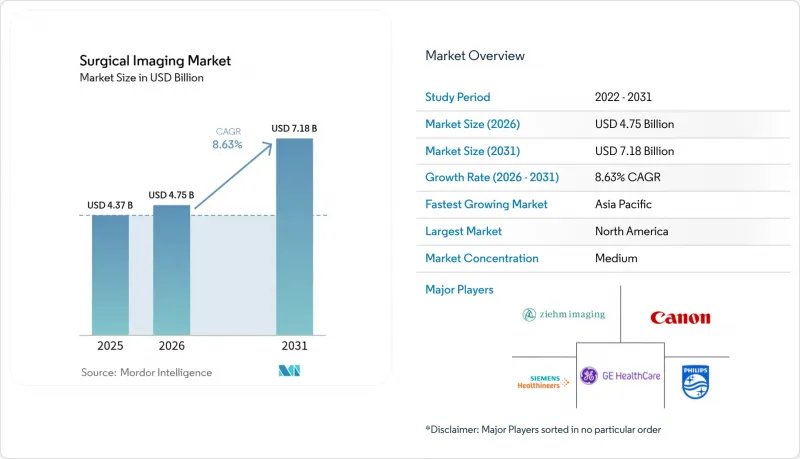
Mordor Intelligence에 의하면, 외과용 이미징 시장 규모는 2025년에 43억 7,000만 달러로 평가되었습니다. 2026년 47억 5,000만 달러에서 2031년까지 71억 8,000만 달러에 이를 것으로 예상되며, 예측 기간(2026-2031년) CAGR은 8.63%를 나타낼 전망입니다.
본 보고서에서는 업계를 ‘영상 진단 기술’(자기공명영상, 컴퓨터 단층촬영, C-암 시스템, 기타 영상 진단 기술), ‘용도’(심장·혈관 외과, 뇌신경외과, 정형외과·외상외과, 기타 용도),‘지역’(북미, 유럽, 아시아태평양, 기타)으로 분류하고 있습니다. 시장 예측은 금액(미 달러)으로 표시되어 있습니다.
세계의 외과용 이미징 시장 동향 및 인사이트
최소 침습 수술에 대한 수요 증가
저침습 수술에서는 촉각에 의한 피드백이 영상 유도 방식의 정밀도로 대체되고 있으며, 수술 중 시각화가 수술 성공에 필수적입니다. 최신 C-암에는 AI를 활용한 노이즈 저감 및 에지 강조 알고리즘이 내장되어 있어, 중요한 해부학적 랜드마크를 선명하게 보여주고 방사선 피폭을 줄여줍니다. 이동식 모델은 슬림한 간트리에 자동 위치 조정 기능과 빠른 기동 시간을 결합하여, 공간이 제한된 외래수술센터(ASC) 환경에도 대응하고 있습니다. 실시간 화질 향상으로 인해 개복 수술로의 전환이 감소하고, 입원 일수가 단축되며, 가치 기반 지불 모델에서 병원의 성과 지표가 강화됩니다. 지불 기관이 보험금 지급을 치료 성과 및 환자 만족도와 연계함에 따라, 첨단 영상 진단 능력이 부족한 의료 기관은 기술력을 갖춘 경쟁사로 환자가 유출될 위험에 직면합니다. 따라서 이러한 급속한 증가는 임상적 요구, 경제적 인센티브 및 환자 선호도를 첨단 영상 진단 시스템으로의 통합적인 전환 경로를 중심으로 조화시키는 것입니다.
만성 질환의 부담 증가
심혈관 질환, 퇴행성 관절염, 암과 같은 비전염성 질환은 평생에 걸친 검사 횟수를 증가시켜 지속적인 영상 진단 수요를 창출하고 있습니다. 수술 전 매핑, 수술 중 유도, 수술 후 경과 관찰과 같은 다단계에 걸친 환자 여정의 각 단계는 각각 전용 시각화 시스템에 의존하고 있으며, 제조업체에게는 예측 가능한 수익원이 되고 있습니다(WHO.INT). 고령화가 진행됨에 따라 상황은 더욱 복잡해지고 있습니다. 80대 환자는 같은 10년 동안 판막 치환술, 척추 고정술, 종양 절제술 등을 받는 경우가 많아 영상 진단 접점이 증가하고 있습니다. 병원 측은 형광 투시 및 CT 융합, 초음파 영상 중첩이 가능한 멀티모달리티 스위트를 표준화함으로써, 환자의 이동 및 직원의 재배치를 최소화하고 검사 건수의 급증에 대응하고 있습니다. 이러한 임상적 및 운영상의 압박이 맞물리면서, 워크플로우를 방해하지 않으면서도 다양한 질환의 경과를 관리할 수 있는 통합형 수술용 영상 진단 플랫폼의 도입이 가속화되고 있습니다.
높은 장비 및 시술 비용
도입, 차폐 공사 및 수년에 걸친 서비스 계약을 고려하면 총 소유 비용은 구매 가격의 2배에 달하는 경우가 많습니다. 고급 중재용 C-암은 최대 25만 달러에 달하며, 구조적 개조가 필요한 경우 하이브리드 수술실 구축 비용은 200만 달러에 이를 수도 있습니다(SIEMENS-HEALTHINEERS.COM). 따라서 중규모 병원은 업그레이드를 미루거나 사용 제한이 있는 리스 계약을 체결하게 되며, 그 결과 진료 건수 증가가 억제될 가능성이 있습니다. 신흥 시장의 의료 기관은 수입 관세 및 환율 변동에 직면해 있어, 이로 인해 도입 예산이 부풀어 오르고 있습니다. 리퍼브 시스템은 비용 절감으로 이어지지만, 일반적으로 AI 지원 프로세서나 공급업체가 지원하는 소프트웨어 업그레이드 경로가 부족하여 미래 대응 능력을 제한하고, 외과용 이미징 시장의 성장을 둔화시키고 있습니다.
부문 분석
C-암 시스템은 다분야에서의 범용성과 외과의들 사이에서 정착된 친숙한 조작성 덕분에 2025년에도 외과용 이미징 시장 점유율의 44.32%를 차지했습니다. 지멘스 헬스인어즈의 ‘CIARTIC Move’와 같은 자율형 모델은 LiDAR 센서와 위상 인식 소프트웨어를 결합하여 암을 자율적으로 위치시키고, 투시 시간을 단축하는 동시에 방사선 피폭량을 저감합니다. 이동식 C-암은 플러그 앤 플레이 방식의 뛰어난 휴대성 덕분에 외래수술센터(ASC)에서 여전히 인기를 끌고 있지만, 고정식 모델은 공간 절약보다 영상의 선명도를 중시하는 하이브리드 수술실에서 주류를 이루고 있습니다. 수술 중 CT(iCT) 및 MRI(iMRI)는 실시간 조직 콘트라스트가 7자리 수의 투자를 정당화할 수 있는 뇌신경외과 및 종양 센터를 대상으로 합니다. 투시 검사 및 초음파 검사는 일상적인 사례에서 합리적인 가격의 대안으로서 안정적인 위치를 유지하고 있지만, 부가가치가 높은 AI가 향후 이러한 가격 대비 성능 비율에 대한 평가를 재정의할 가능성이 있습니다.
수술 중 3D/4D 영상은 2031년까지 연평균 성장률(CAGR) 9.86%를 기록하며 다른 모든 분야를 능가하는 성장세를 보이고 있습니다. 이러한 시스템은 거의 실시간으로 재구성된 체적 데이터 세트를 제공하여, 상처 봉합 전에 척추 정렬을 확인하거나 경카테터 판막의 전개 상태를 확인할 수 있게 해줍니다. 이미지와 기기의 정렬을 통해 임플란트 삽입 경로를 서브mm 단위의 허용 오차 범위 내에서 조정할 수 있기 때문에 정형외과 및 심장외과 팀에서의 도입이 가속화되고 있습니다. GPU 비용과 클라우드 컴퓨팅 요금의 지속적인 하락으로 총 소유 비용의 격차는 줄어들 것으로 예상되며, 이로 인해 해당 기술군의 장기적인 성장이 강화되고 외과용 이미징 시장 전체의 확대가 지속될 것입니다.
지역별 분석
북미는 프리미엄 가격 책정, 정교한 보험 환급 정책, 그리고 AI의 조기 도입을 배경으로 2025년 매출의 38.74%를 차지했습니다. 미국 시장에서는 하이브리드 수술실에 대한 투자가 우선시되고 있으며, FDA의 패스트 트랙 프로그램을 통해 세계적 기준이 되는 제품 출시가 가속화되고 있습니다. 캐나다에서는 장비 이용률 향상을 위해 주 간 자산 공유 네트워크 구축이 진행되고 있는 반면, 멕시코의 민간 병원에서는 최신 세대의 C-암 및 CT-플루오로 하이브리드 장비를 갖추고 의료 관광객 유치에 주력하고 있습니다.
유럽에서는 고령화 및 수술 대기 시간 목표 달성을 위한 노력이 영상 진단 기기의 현대화를 촉진하고 있어 균형 잡힌 성장을 유지하고 있습니다. 독일과 영국은 정부의 영상진단 자금 지원을 받아 수술 중 3D 프로그램 도입을 주도하고 있습니다. 프랑스와 이탈리아는 수명 주기 비용과 측정 가능한 성과를 비교 검토하는 가치 기반 조달 모델을 통해 지출을 억제하고 있으며, 공급업체에게 하드웨어 가격이 아닌 토탈 케어의 경제성을 제시하도록 촉구하고 있습니다. EU 전역에 걸친 CE 마크의 표준화로 인해 규정 준수 관련 마찰이 완화되고, 여러 국가에 걸친 확장이 원활해지면서 수술용 영상 진단 시장의 성장 궤도가 뒷받침되고 있습니다.
아시아태평양은 2031년까지 연평균 성장률(CAGR) 10.04%를 기록하며, 지역별로는 가장 높은 성장이 예상됩니다. 중국에서는 민관 파트너십을 통해 3차 의료기관의 설비 갱신이 진행되고 있는 반면, 인도에서는 급성장하는 민간 부문이 중급 수준이면서도 AI를 지원하는 영상 진단 솔루션을 도입한 ASC(외래수술센터(ASC)) 체인을 구축하고 있습니다. 일본은 국내 전자 기술을 활용하여 AI 의사결정 지원 모듈을 빠르게 도입하고 있으며, 한국도 정부의 혁신 지원금을 통해 비슷한 속도로 뒤따르고 있습니다. 호주는 시장 규모는 작지만, 의무화된 기술 갱신 주기와 정형외과 및 심혈관계 수술 건수가 증가하고 있는 고령화 사회를 통해 수요를 뒷받침하고 있습니다. 이러한 요인들이 맞물리면서 아시아태평양은 세계 외과용 이미징 시장 점유율 확보를 위한 전략적 격전지로서의 입지를 확고히 하고 있습니다.
기타 혜택 :
- 엑셀 형식 시장 예측(ME) 시트
- 3개월간의 애널리스트 지원
자주 묻는 질문
목차
제1장 서론
제2장 조사 방법
제3장 주요 요약
제4장 시장 구도
제5장 시장 규모 및 성장 예측
제6장 경쟁 구도
제7장 시장 기회 및 향후 전망
KTH 26.08.26According to Mordor Intelligence, the surgical imaging market size was valued at USD 4.37 billion in 2025 and estimated to grow from USD 4.75 billion in 2026 to reach USD 7.18 billion by 2031, at a CAGR of 8.63% during the forecast period (2026-2031).
This report Segments the Industry Into Imaging Technology (Magnetic Resonance Imaging, Computed Tomography, C-Arm Systems, and Other Imaging Technologies), Application (Cardiac and Vascular Surgery, Neurosurgery, Orthopedic and Trauma Surgery, and Other Applications), and Geography (North America, Europe, Asia-Pacific, and Others). The Market Forecasts are Provided in Terms of Value (USD).
Global Surgical Imaging Market Trends and Insights
Growing Demand for Minimally Invasive Surgeries
Minimally invasive approaches replace tactile feedback with image-guided precision, making intra-operative visualization core to procedural success. Advanced C-arms now embed AI-based noise reduction and edge-enhancement algorithms that sharpen critical anatomical landmarks and curtail radiation exposure. Mobile variants cater to tight ASC footprints by combining slim gantries with automated positioning and rapid boot-up times. Real-time quality improvements reduce conversion to open surgery, shorten length of stay, and strengthen a hospital's performance metrics under value-based payment models. As payers link reimbursement to outcomes and patient satisfaction, facilities that lack sophisticated imaging capability risk referral leakage to tech-enabled competitors. The surge therefore aligns clinical needs, economic incentives, and patient preferences around a unified migration pathway to high-acuity imaging systems.
Rising Burden of Chronic Diseases
Non-communicable conditions such as cardiovascular disease, osteoarthritis, and cancer escalate lifetime procedural counts and drive recurring imaging demand. Multi-stage patient journeys-pre-operative mapping, intra-operative guidance, and post-operative surveillance-each rely on dedicated visualization systems, creating predictable revenue streams for manufacturers [WHO.INT]. Aging demographics intensify complexity; octogenarian patients often undergo valve replacements, spine fusions, and tumor resections within the same decade, multiplying imaging touchpoints. Hospitals counter volume spikes by standardizing on multimodality suites capable of fluoro-CT fusion or echo overlay, minimizing patient transfers and staff redeployment. This confluence of clinical and operational pressures accelerates procurement of integrated surgical imaging market platforms that can manage diverse disease trajectories without workflow disruption.
High Equipment & Procedure Costs
Total cost of ownership often doubles the sticker price once installation, shielding, and multi-year service contracts are considered. Premium interventional C-arms can cost up to USD 250,000, and hybrid OR build-outs reach USD 2 million when structural retrofits are required [SIEMENS-HEALTHINEERS.COM]. Mid-tier hospitals therefore delay upgrades or enter leasing arrangements that include usage quotas, potentially throttling case growth. Emerging-market providers face import tariffs and currency volatility that inflate acquisition budgets. While refurbished systems offer cost relief, they typically lack AI-ready processors and vendor-supported software pathways, constraining future-proofing and tempering surgical imaging market acceleration.
Other drivers and restraints analyzed in the detailed report include:
- Technological Shift toward 3-D/4-K Intra-operative Imaging
- Expansion of Hybrid Operating Rooms in Tier-1 Hospitals
- Stringent Regulatory & Certification Hurdles
For complete list of drivers and restraints, kindly check the Table Of Contents.
Segment Analysis
C-Arm Systems retained 44.32% of the surgical imaging market share in 2025 owing to multi-specialty versatility and entrenched surgeon familiarity. Self-driving models such as Siemens Healthineers' CIARTIC Move combine lidar sensors with phase-recognition software that positions the arm autonomously, trimming fluoroscopy time and radiation dosage. Mobile C-arms remain ASC favorites for their plug-and-play portability, while fixed versions dominate hybrid suites that prize image clarity over space economy. Intra-operative CT (iCT) and MRI (iMRI) target neurosurgery and oncology centers where real-time tissue contrast justifies seven-digit investments. Fluoroscopy and ultrasound hold steady as budget-friendly options for routine cases, although value-added AI may eventually reset their price-performance calculus.
Intra-operative 3-D/4-D imaging outpaces all peers at a 9.86% CAGR through 2031. These systems deliver volumetric data sets with near-real-time reconstruction, enabling spinal alignment checks or transcatheter valve deployment verification before wound closure. Image-to-device registration aligns implant trajectories within sub-millimeter tolerances, accelerating adoption among orthopedic and cardiac teams. Continued declines in GPU costs and cloud-compute pricing should narrow total ownership gaps, fortifying the long-term ascent of this technology cohort and sustaining overall surgical imaging market expansion.
Complete Report Scope:
- By Imaging Technology
- Magnetic Resonance Imaging (iMRI)
- Computed Tomography (iCT)
- C-Arm Systems
- Fixed C-Arm
- Mobile C-Arm
- Fluoroscopy
- Ultrasound
- Intra-operative 3-D / 4-D Imaging
- Other Technologies
- By Application
- Cardiac & Vascular Surgery
- Neurosurgery
- Orthopedic & Trauma Surgery
- Gastrointestinal Surgery
- Spine Surgery
- Urology & Gynecology Surgery
- Other Applications
- By End User
- Hospitals & Surgical Centers
- Ambulatory Surgical Centers (ASCs)
- Specialty Clinics
- Academic & Research Institutes
- By Geography
- North America
- United States
- Canada
- Mexico
- Europe
- Germany
- United Kingdom
- France
- Italy
- Spain
- Rest of Europe
- Asia-Pacific
- China
- Japan
- India
- South Korea
- Australia
- Rest of Asia-Pacific
- Middle East and Africa
- GCC
- South Africa
- Rest of Middle East and Africa
- South America
- Brazil
- Argentina
- Rest of South America
- North America
Geography Analysis
North America accounted for 38.74% of 2025 revenue on the back of premium pricing, sophisticated reimbursement policies, and early AI adoption. The U.S. market prioritizes hybrid OR investment, and FDA fast-track programs expedite commercial launches that set global benchmarks. Canada pursues provincial asset-sharing networks to lift equipment utilization, while private Mexican hospitals court medical tourists with newest-generation C-arms and CT-fluoro hybrids.
Europe maintains balanced growth as aging demographics and surgical wait-time targets spur modernization of imaging fleets. Germany and the United Kingdom spearhead intra-operative 3-D program adoption, supported by government diagnostic imaging funds. France and Italy temper spending with value-based procurement models that weigh lifetime costs against measurable outcomes, nudging vendors to present total-care economics rather than hardware price tags. Pan-EU CE-mark standardization lowers compliance friction, smoothing multi-country rollouts and underpinning the surgical imaging market trajectory.
Asia-Pacific is poised for the highest regional expansion at a 10.04% CAGR to 2031. China funnels public-private partnerships into tertiary hospital upgrades, while India's burgeoning private sector builds ASC chains that source mid-tier but AI-ready imaging solutions. Japan deploys AI decision-support modules rapidly, leveraging domestic electronics expertise; South Korea replicates pace with government innovation grants. Australia, though smaller in volume, reinforces demand through mandatory technology refresh cycles and an aging population with rising orthopedic and cardiovascular procedure counts. Collectively, these factors cement Asia-Pacific as a strategic battleground for share capture within the global surgical imaging market.
- GE HealthCare Technologies Inc.
- Siemens Healthineers
- Koninklijke Philips
- Canon
- Ziehm Imaging
- Hologic
- Shimadzu
- Medtronic
- Stryker
- Fujifilm Holdings Corp.
- Orthoscan
- Karl Storz
- Carestream Health
- Novadaq (Stryker)
- Geonoray Co. Ltd.
- Nuvox Imaging
- Allengers Medical Systems
- Eurocolumbus S.r.l
- Wuxi Biotec Co.
- Nanjing Perlove Medical
Additional Benefits:
- The market estimate (ME) sheet in Excel format
- 3 months of analyst support
TABLE OF CONTENTS
1 Introduction
- 1.1 Study Assumptions & Market Definition
- 1.2 Scope of the Study
2 Research Methodology
3 Executive Summary
4 Market Landscape
- 4.1 Market Overview
- 4.2 Market Drivers
- 4.2.1 Growing Demand for Minimally-invasive Surgeries
- 4.2.2 Rising Burden of Chronic Diseases
- 4.2.3 Technological Shift toward 3-D/4-K Intra-operative Imaging
- 4.2.4 Expansion of Hybrid Operating Rooms in Tier-1 Hospitals
- 4.2.5 AI-driven Intra-operative Decision Support Requirements
- 4.2.6 Rapid Adoption of Mobile C-arms by Ambulatory Surgery Centers
- 4.3 Market Restraints
- 4.3.1 High Equipment & Procedure Costs
- 4.3.2 Stringent Regulatory & Certification Hurdles
- 4.3.3 Reimbursement Limitations in Emerging Markets
- 4.3.4 Supply-chain Vulnerability of Flat-panel Detectors
- 4.4 Value / Supply-Chain Analysis
- 4.5 Regulatory Landscape
- 4.6 Technological Outlook
- 4.7 Porter's Five Forces
- 4.7.1 Threat of New Entrants
- 4.7.2 Bargaining Power of Buyers
- 4.7.3 Bargaining Power of Suppliers
- 4.7.4 Threat of Substitutes
- 4.7.5 Intensity of Competitive Rivalry
5 Market Size & Growth Forecasts (Value, USD)
- 5.1 By Imaging Technology
- 5.1.1 Magnetic Resonance Imaging (iMRI)
- 5.1.2 Computed Tomography (iCT)
- 5.1.3 C-Arm Systems
- 5.1.3.1 Fixed C-Arm
- 5.1.3.2 Mobile C-Arm
- 5.1.4 Fluoroscopy
- 5.1.5 Ultrasound
- 5.1.6 Intra-operative 3-D / 4-D Imaging
- 5.1.7 Other Technologies
- 5.2 By Application
- 5.2.1 Cardiac & Vascular Surgery
- 5.2.2 Neurosurgery
- 5.2.3 Orthopedic & Trauma Surgery
- 5.2.4 Gastrointestinal Surgery
- 5.2.5 Spine Surgery
- 5.2.6 Urology & Gynecology Surgery
- 5.2.7 Other Applications
- 5.3 By End User
- 5.3.1 Hospitals & Surgical Centers
- 5.3.2 Ambulatory Surgical Centers (ASCs)
- 5.3.3 Specialty Clinics
- 5.3.4 Academic & Research Institutes
- 5.4 By Geography
- 5.4.1 North America
- 5.4.1.1 United States
- 5.4.1.2 Canada
- 5.4.1.3 Mexico
- 5.4.2 Europe
- 5.4.2.1 Germany
- 5.4.2.2 United Kingdom
- 5.4.2.3 France
- 5.4.2.4 Italy
- 5.4.2.5 Spain
- 5.4.2.6 Rest of Europe
- 5.4.3 Asia-Pacific
- 5.4.3.1 China
- 5.4.3.2 Japan
- 5.4.3.3 India
- 5.4.3.4 South Korea
- 5.4.3.5 Australia
- 5.4.3.6 Rest of Asia-Pacific
- 5.4.4 Middle East and Africa
- 5.4.4.1 GCC
- 5.4.4.2 South Africa
- 5.4.4.3 Rest of Middle East and Africa
- 5.4.5 South America
- 5.4.5.1 Brazil
- 5.4.5.2 Argentina
- 5.4.5.3 Rest of South America
- 5.4.1 North America
6 Competitive Landscape
- 6.1 Market Concentration
- 6.2 Strategic Moves
- 6.3 Market Share Analysis
- 6.4 Company Profiles (includes Global level Overview, Market level overview, Core Segments, Financials as available, Strategic Information, Market Rank/Share for key companies, Products & Services, and Recent Developments)
- 6.4.1 GE HealthCare Technologies Inc.
- 6.4.2 Siemens Healthineers AG
- 6.4.3 Koninklijke Philips N.V.
- 6.4.4 Canon Medical Systems Corp.
- 6.4.5 Ziehm Imaging GmbH
- 6.4.6 Hologic Inc.
- 6.4.7 Shimadzu Corp.
- 6.4.8 Medtronic plc
- 6.4.9 Stryker Corp.
- 6.4.10 Fujifilm Holdings Corp.
- 6.4.11 Orthoscan Inc.
- 6.4.12 KARL STORZ SE & Co. KG
- 6.4.13 Carestream Health Inc.
- 6.4.14 Novadaq (Stryker)
- 6.4.15 Geonoray Co. Ltd.
- 6.4.16 Nuvox Imaging
- 6.4.17 Allengers Medical Systems
- 6.4.18 Eurocolumbus S.r.l
- 6.4.19 Wuxi Biotec Co.
- 6.4.20 Nanjing Perlove Medical
7 Market Opportunities & Future Outlook
- 7.1 White-space & Unmet-Need Assessment