
|
시장보고서
상품코드
2114011
헬스케어용 패브릭 : 시장 점유율 분석, 업계 동향과 통계, 성장 예측(2026-2031년)Healthcare Fabrics - Market Share Analysis, Industry Trends & Statistics, Growth Forecasts (2026 - 2031) |
||||||
 Mordor Intelligence
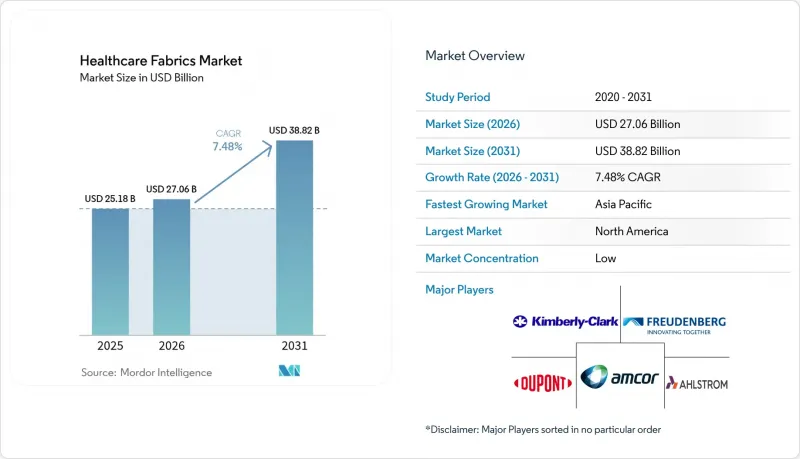
Mordor Intelligence에 따르면 헬스케어용 패브릭 시장 규모는 2025년에 251억 8,000만 달러로 평가되며, 2026년 270억 6,000만 달러에서 2031년까지 388억 2,000만 달러에 달할 것으로 예측되고 있으며, 예측 기간(2026-2031년)에 CAGR은 7.48%에 달할 전망입니다.
이 보고서는 소재(폴리프로필렌, 폴리에스터, 폴리에틸렌, 면, 기타 소재), 원단 유형(직물, 부직포, 니트), 용도(프라이버시 커튼, 벽면 커버,위생용품, 드레싱 제품 등) 및 지역(아시아태평양, 북미, 유럽, 남미, 중동 및 아프리카)별로 분류되어 있습니다. 시장 전망은 금액(달러) 기준으로 제시되어 있습니다.
글로벌 헬스케어용 원단 시장의 동향 및 인사이트
개발도상국에서의 수요 증가
급속히 확대되는 건강보험 제도가 자카르타에서 요하네스버그에 이르기까지 병원 건설을 촉진하고 있으며, 항균 드레이프, 통기성 유니폼 및 일회용 개인 보호 장비(PPE)의 연간 조달 예산을 끌어올리고 있습니다. 190억 달러 규모의 시장을 자랑하는 인도의 기능성 섬유 부문은 100% 외국인 직접 투자(FDI) 한도와 ‘국가 기능성 섬유 미션’을 활용하여 국내 생산 능력을 확대하고, 특수 섬유에 대한 수입 의존도를 대폭 줄였습니다. 팬데믹 기간 중 개인 보호 장비(PPE) 생산 확대는 현지 공급업체들이 급증하는 수요에 대응할 수 있음을 입증했으며, 이러한 교훈은 현재 전략적 비축 정책 수립에 활용되고 있습니다. 생산을 현지화하는 제조업체는 관세 우대 조치나 리드타임 단축과 같은 이점을 얻을 수 있으며, 중산층의 의료 서비스 이용으로 인해 발생하는 수요 증가분을 확실히 확보할 수 있는 입장에 있습니다. 가격에 대한 민감도는 여전히 높지만, 입찰 서류에서는 국제표준화기구(ISO), 미국재료시험협회(ASTM), 유럽연합 의료기기 규정(EU MDR)의 규격이 점점 더 많이 인용되고 있으며, 이는 고수익률의 인증 제품으로의 전환을 나타내는 징후입니다.
의료 분야에서의 셀룰로오스 섬유 활용 확대
리요셀 및 이와 유사한 재생 셀룰로오스 섬유는 저알레르기성, 뛰어난 흡습성, 그리고 친환경적인 폐기 특성을 갖추고 있으며, 상처 피복재, 환자용 의류, 그리고 지속가능한 수술용 드레이프 분야에서 합성 섬유를 대체하고 있습니다. N-메틸모르폴린-N-옥사이드(NMMO) 공정에서 99%를 초과하는 용매 회수율은 환경 부하를 줄이고, 향후 시행될 유럽연합(EU) 전역의 섬유 제품 에코디자인 규정을 충족합니다. 키토산 유도체, 4급 암모늄염 또는 은 나노입자를 이용한 항균 후처리는 인장 강도를 저하시키지 않으면서 셀룰로오스 매트릭스에 효과적으로 결합하게 되었습니다. 렌징 그룹의 룩셈부르크 및 리치몬드에 위치한 국제 지속가능성 탄소 인증(ISCC) PLUS를 획득한 생산 거점에서는 100% 재생 가능 전력을 사용하여 리요셀을 생산하고 있으며, 이는 병원 조달 스코어카드에서 스코프 3 배출량 감축에 기여하고 있습니다. 퍼플루오로알킬 및 폴리플루오로알킬 물질(PFAS)에 대한 규제가 강화되는 가운데, 셀룰로오스 섬유는 안전한 화학 물질 기준 준수 및 조달 프로세스의 추적 가능성 측면에서 두각을 나타내며, 장기적인 성장 모멘텀을 더욱 강화하고 있습니다.
소비자의 낮은 인지도
저소득 지역의 조달 담당자들은 항균성의 지속성이나 센서의 정확도가 아닌, 실 밀도를 섬유 제품의 품질 지표로 간주하는 경우가 많아, 이로 인해 업그레이드 주기가 지연되고 있습니다. 스마트 텍스타일에 대한 통일된 기준이 없어 가치 평가가 복잡해지고 있으며, 또한 사례 연구의 보급이 제한적이어서 총 소유 비용(TCO) 측면에서의 이점이 충분히 인식되지 못하고 있습니다. 업계 단체들은 교육 프로그램을 확충하고 있지만, 그 도입 현황에는 큰 편차가 나타나고 있습니다. 통일된 표시 기준이나 성능 계층 체계가 확립되기 전까지는 대량 구매자들이 초기 투자 비용(CAPEX)이 가장 낮은 대안을 우선시하는 경향이 있으며, 그 결과 프리미엄 원단의 단기적인 시장 침투가 저해될 가능성이 있습니다.
부문 분석
폴리프로필렌은 수지 비용이 저렴하고, 멜트블로우 공법의 범용성이 높으며, 일회용 배리어 제품에 적합한 소수성 덕분에 2025년에도 매출 기준 39.62%의 선두를 유지했습니다. 그러나 의료용 섬유 시장에서는 생체 적합성 및 PFAS 무함유라는 특징을 바탕으로 셀룰로오스계 소재 등의 경쟁 제품이 연평균 9.26%의 성장률을 기록하고 있으며, 전환기를 맞이하고 있습니다. 2025년 1월부터 시행되는 유럽의 PFAS 금지 조치로 인해 기존의 불소계 화학 약품을 이용한 마감 가공의 규정 준수 장벽이 높아지면서 구매자들은 리요셀이나 키토산 처리된 원단으로 전환하고 있습니다. 미국의 여러 병원 그룹은 2030년까지 조달 구성의 30%를 바이오 기반 원료로 전환한다는 목표를 담은 조달 로드맵을 발표했으며, 이에 따라 셀룰로오스 채택에 큰 여지가 생기고 있습니다. 폴리에스터는 재사용 가능한 프라이버시 커튼이나 빈번한 세탁이 필요한 스크럽 의류에 계속 사용되고 있지만, 염색 공장의 에너지 회수 시스템 개선을 통해 탄소 강도가 점차 낮아지고 있습니다. 폴리에틸렌은 중환자실용 드레이프에서 높은 수증기 투과율을 제공하는 미세 다공성 라미네이트 소재로서 틈새 수요가 유지되고 있습니다. 면은 흡습성이 높아짐에 따라 병원체의 부착량이 증가하므로 그 사용이 감소하고 있으며, 항균 성분이 포함된 혼방 소재로의 대체가 진행되고 있습니다. 효소 표백이나 저온 반응성 염료 처방과 같은 신생 기업의 혁신은 기존 섬유의 단계적인 친환경화를 시사하고 있지만, 셀룰로오스의 폐쇄형 공정(closed-loop process)에 대한 이러한 혁신의 확장 가능성에 대해서는 여전히 불투명한 상황입니다.
지역별 분석
2025년, 북미는 매출의 37.68%를 차지했습니다. 이는 항균 드레이프 및 스마트 텍스타일을 포함한 피부 접촉용 의료기기에 대해 ISO-10993-1 시험을 의무화하는 미국 식품의약국(FDA)의 엄격한 감독에 힘입은 결과입니다. 미국의 의료 서비스 제공자들은 감염 관리의 효과성을 최우선으로 여기기 때문에 단가가 높음에도 불구하고 고품질의 셀룰로오스계 또는 불소 무함유 배리어 원단을 채택하고 있습니다. 공급망의 회복탄력성은 여전히 경영진 수준의 우려 사항이며, 프리미어(Premier)사의 2023년 조사에 따르면 경영진의 75%가 공급 차질이 적어도 향후 2년 동안 지속될 것으로 예상하고 있으며, 이는 다중 조달 전략 및 니어쇼어링(nearshoring) 노력을 촉진하고 있습니다. 카디널 헬스(Cardinal Health)가 AI를 도입한 포트워스에 위치한 34만 제곱피트 규모의 물류 허브는 리드 타임을 단축하고 납품률 보장을 향상시키는 물류 자동화에 대한 투자의 한 예입니다.
아시아태평양에서는 각국 정부가 병원 인프라에 자금을 투입하고 국내 기술 섬유 생산을 장려하고 있으며, 2031년까지 연평균 성장률(CAGR) 9.13%로 시장이 확대되고 있습니다. 190억 달러 규모의 인도 기술 섬유 산업은 관세 감면 및 100% 외국인 직접 투자(FDI) 허용 한도의 혜택을 받아 수출 주문을 확보하는 동시에 수입 대체를 추진하고 있습니다. 중국은 붕대 및 거즈의 수출 점유율을 확대하는 한편, ‘제14차 5개년 계획’에 따라 항균 및 스마트 패브릭 연구개발 보조금을 투입하고 있으며, 이를 통해 의료용 섬유 분야의 세계적 제조 거점으로서의 위상을 강화하고 있습니다. 인도네시아의 국민건강보험제도(Jaminan Kesehatan Nasional: JKN)는 병원의 병상 증설을 가속화하고 있으며, 프라이버시 커튼 및 재사용 가능한 침구류 조달 증가를 지원하고 있습니다. 태국이나 말레이시아 등 의료 관광의 주요 지역에서는 해외 환자를 유치하기 위해 첨단 수술 가운이나 스마트 압박복을 지정하고 있으며, 높은 이익률을 자랑하는 기술적으로 첨단 섬유 제품에 대한 수요를 촉진하고 있습니다. 유럽에서는 유럽환경청(EEA)의 2024년 PFAS 위험 평가를 계기로 섬유 제품에 대한 화학 물질 규제가 강화되는 방향으로 나아가고 있으며, 견고한 한 자릿수 중반대의 성장이 예상됩니다. 의료 시스템에서는 불소계 배리어 소재를 바이오 기반 코팅으로 적극적으로 대체하고 있으며, 이러한 전환은 친환경 인증을 받은 화학 약품으로 처리된 셀룰로오스 및 폴리에틸렌 테레프탈레이트(PET) 기반 원단에 혜택을 주고 있습니다. 유럽 그린딜의 친환경 설계 요건에 따라 재활용 가능한 단일 소재 부직포 및 회수 물류에 대한 투자가 촉진되고 있습니다. 남미 및 중동 및 아프리카에서는 시장 침투율은 낮지만, 급속한 도입이 진행되고 있는 지역도 있습니다. 브라질의 민간 병원에서는 병원내 감염을 억제하기 위해 항균성 프라이버시 커튼을 시범 도입하고 있으며, 사우디아라비아의 ‘비전 2030’ 병원 프로젝트에서는 환자의 생체 신호를 모니터링하는 스마트 침구 사양이 포함되어 있습니다.
기타 혜택:
- 엑셀 형식의 시장 예측(ME) 시트
- 3개월간의 애널리스트 지원
자주 묻는 질문
목차
제1장 서론
제2장 조사 방법
제3장 개요
제4장 시장 구도
제5장 시장 규모와 성장 예측
제6장 경쟁 구도
제7장 시장 기회와 향후 전망
KSA 26.08.26According to Mordor Intelligence, the healthcare fabrics market size was valued at USD 25.18 billion in 2025 and estimated to grow from USD 27.06 billion in 2026 to reach USD 38.82 billion by 2031, at a CAGR of 7.48% during the forecast period (2026-2031).
This report is Segmented by Material (Polypropylene, Polyester, Polyethylene, Cotton, and Other Material Types), Fabric Type (Woven, Non-Woven, and Knitted), Application (Privacy Curtains, Wall Coverings, Hygiene Products, Dressing Products, and More), and Geography (Asia-Pacific, North America, Europe, South America, and Middle East and Africa). The Market Forecasts are Provided in Terms of Value (USD).
Global Healthcare Fabrics Market Trends and Insights
Rising Demand in Developing Nations
Fast-growing health-insurance programs are stimulating hospital construction from Jakarta to Johannesburg, lifting annual procurement budgets for antimicrobial drapes, breathable uniforms, and disposable Personal Protective Equipment (PPE). India's technical-textiles sector, valued at USD 19 billion, has used 100% Foreign Direct Investment (FDI) allowances and the National Technical Textiles Mission to boost domestic capacity, slashing import dependence for specialized fibers . Personal Protective Equipment (PPE) scaling during the pandemic proved local suppliers can meet surge requirements, a lesson now informing strategic stockpiling policies. Manufacturers that localize production gain duty benefits and shorter lead times, positioning them to capture the incremental volumes generated by middle-class healthcare utilization. While price sensitivity remains high, tender documents increasingly reference International Organization for Standardization (ISO), American Society for Testing and Materials (ASTM), and European Union Medical Device Regulation (EU MDR) standards, signalling an upgrade path toward higher-margin, certified products.
Increasing Use of Cellulose Fibres in Healthcare
Lyocell and similar regenerated-cellulose fibers are displacing synthetics in wound dressings, patient clothing, and sustainable drapes because they provide hypoallergenic performance, superior moisture management, and a benign end-of-life profile. Solvent recovery rates above 99% in the N-Methylmorpholine N-oxide (NMMO) process lower environmental footprints, satisfying forthcoming European Union (EU)-wide textile eco-design rules. Antimicrobial post-treatments using chitosan derivatives, quaternary ammonium salts, or silver nanoparticles now bond effectively to cellulose matrices without degrading tensile strength. The Lenzing Group's International Sustainability & Carbon Certification (ISCC) PLUS-certified sites in Luxembourg and Richmond generate Lyocell under 100% renewable electricity, offering hospitals Scope 3 emission reductions for procurement scorecards. As Perfluoroalkyl and Polyfluoroalkyl Substances (PFAS) bans tighten, cellulose fibers stand out for safe-chemistry compliance and traceable sourcing, reinforcing their long-run growth momentum.
Lack of Consumer Awareness
Procurement managers in lower-income regions often equate textile quality with thread-count rather than antimicrobial durability or sensor accuracy, slowing upgrade cycles. The absence of harmonized smart-textile standards complicates value assessments, while limited case-study dissemination keeps total-cost-of-ownership benefits under-recognized. Industry associations are expanding training modules, but uptake varies widely. Until consistent labelling and performance-tier frameworks emerge, bulk buyers may default to lowest-capex options, curbing near-term penetration of premium fabrics.
Other drivers and restraints analyzed in the detailed report include:
- Hospital-Acquired-Infection Reduction Mandates
- Surge in Smart-Textile Integration for Patient Monitoring
- Volatile Petro-Polymer Raw-Material Prices
For complete list of drivers and restraints, kindly check the Table Of Contents.
Segment Analysis
Polypropylene sustained a 39.62% revenue lead in 2025 thanks to low resin cost, melt-blown versatility, and hydrophobicity suited for disposable barrier products. Yet the healthcare textiles market is witnessing a pivot as other material types, such as cellulose-based competitors, grow 9.26% annually on the back of bio-compatibility and PFAS-free credentials. Europe's forthcoming PFAS ban effective January 2025 raises compliance hurdles for legacy fluorochemical finishes, nudging buyers toward lyocell and chitosan-treated fabrics. Several United States hospital groups have published sourcing roadmaps that target a 30% procurement mix shift toward bio-based inputs by 2030, creating sizeable headroom for cellulose adoption. Polyester continues to service reusable privacy curtains and high-wash-count scrubs, but energy-recovery upgrades in dyeing plants are helping mitigate its carbon intensity. Niche volumes of polyethylene are preserved for micro-porous laminates offering high moisture-vapour transmission rates in critical-care drapes. Cotton's presence recedes because moisture retention increases pathogen load, prompting its substitution with blends that embed antimicrobial chemistries. Start-up innovations such as enzymatic bleaching and low-temperature reactive dye formulas point to an incremental greening of legacy fibers, but their scalability against cellulose's closed-loop process remains uncertain.
Complete Report Scope:
- By Material
- Polypropylene
- Polyester
- Polyethylene
- Cotton
- Other Material Types (Cellulose-based Lyocell, etc.)
- By Fabric Type
- Woven
- Non-Woven
- Knitted
- By Application
- Privacy Curtains
- Wall Coverings
- Hygiene Products
- Dressing Products
- Bedding
- Other Applications (Surgical Gowns & Drapes, etc.)
- By Geography
- Asia-Pacific
- China
- Japan
- India
- South Korea
- ASEAN Countries
- Rest of Asia-Pacific
- North America
- United States
- Canada
- Mexico
- Europe
- Germany
- United Kingdom
- France
- Italy
- Spain
- Russia
- NORDIC Countries
- Rest of Europe
- South America
- Brazil
- Argentina
- Rest of South America
- Middle East and Africa
- Saudi Arabia
- South Africa
- Rest of Middle East and Africa
- Asia-Pacific
Geography Analysis
North America took 37.68% revenue in 2025, underpinned by rigorous Food and Drug Administration (FDA) oversight that mandates ISO-10993-1 testing for skin-contact devices, including antimicrobial drapes and smart textiles. Providers in the United States prioritize infection-control efficacy and therefore adopt premium cellulosic or fluorine-free barrier fabrics despite higher unit prices. Supply-chain resiliency remains a board-level concern; Premier's 2023 survey showed 75% of executives expect disruptions to persist for at least two more years, prompting multi-sourcing strategies and near-shoring initiatives. Cardinal Health's AI-enabled 340,000 sq ft Fort Worth distribution hub exemplifies investment in logistics automation that shortens lead times and increases fill-rate guarantees.
Asia-Pacific is advancing at a 9.13% CAGR through 2031 as governments pour capital into hospital infrastructure and incentivize domestic technical-textile production. India's USD 19 billion technical-textiles base enjoys duty credits and 100% FDI allowances, capturing export orders and substituting imports. China is expanding its share of bandage and gauze exports and directing R&D grants toward antimicrobial and smart fabrics under the 14th Five-Year Plan, thereby reinforcing its position as a global manufacturing hub for healthcare textiles. Indonesia's Jaminan Kesehatan Nasional (JKN) national insurance scheme is accelerating hospital bed additions, driving higher procurement of privacy curtains and reusable bedding. Medical-tourism hotspots such as Thailand and Malaysia are specifying advanced gowns and smart compression garments to attract international patients, fostering demand for higher-margin technologically advanced textiles. Europe posts steady mid-single-digit growth, propelled by the European Environment Agency's 2024 PFAS risk assessment that places textiles on a path toward stricter chemical controls. Healthcare systems are actively replacing fluorinated barriers with bio-based coatings, a switch that benefits cellulose and polyethylene terephthalate-based fabrics treated with eco-certified chemistries. The European Green Deal's eco-design requirements are spurring investment in recyclable mono-material non-wovens and take-back logistics. South America and Middle East & Africa trail in market penetration but display pockets of rapid adoption: Brazil's private hospitals now pilot antimicrobial privacy curtains to curb nosocomial infections, while Saudi Arabia's Vision 2030 hospital projects include specifications for smart bedding that monitors patient vitals.
- Ahlstrom
- Amcor plc
- Asahi Kasei Corporation
- Avgol Industries 1953 Ltd,
- Brentano Fabrics
- Cardinal Health
- Carnegie Fabrics, LLC
- Designtex
- DuPont
- Eximius Innovative Pvt. Ltd.
- Freudenberg SE
- Herculite
- Johnson & Johnson
- KCWW (Kimberly-Clark Worldwide)
- Medline Industries, LP.
- MillerKnoll, Inc.
- Mitsui Chemicals, Inc.
- Toray Industries Inc.
- Trelleborg AB
- TWE GmbH & Co. KG,
Additional Benefits:
- The market estimate (ME) sheet in Excel format
- 3 months of analyst support
TABLE OF CONTENTS
1 Introduction
- 1.1 Study Assumptions & Market Definition
- 1.2 Scope of the Study
2 Research Methodology
3 Executive Summary
4 Market Landscape
- 4.1 Market Overview
- 4.2 Market Drivers
- 4.2.1 Rising Demand in Developing Nations
- 4.2.2 Increasing Use of Cellulose Fibres in Healthcare
- 4.2.3 Hospital-acquired-infection (HAI) Reduction Mandates
- 4.2.4 Growing Adoption of Antimicrobial & Antiviral Finishes
- 4.2.5 Surge in Smart-textile Integration for Patient Monitoring
- 4.3 Market Restraints
- 4.3.1 Lack of Consumer Awareness
- 4.3.2 Volatile Petro-polymer Raw-material Prices
- 4.3.3 Inadequate Disposal Infrastructure for Single-use Fabrics
- 4.4 Value Chain Analysis
- 4.5 Porter's Five Forces
- 4.5.1 Bargaining Power of Suppliers
- 4.5.2 Bargaining Power of Buyers
- 4.5.3 Threat of New Entrants
- 4.5.4 Threat of Substitutes
- 4.5.5 Competitive Rivalry
5 Market Size & Growth Forecasts (Value)
- 5.1 By Material
- 5.1.1 Polypropylene
- 5.1.2 Polyester
- 5.1.3 Polyethylene
- 5.1.4 Cotton
- 5.1.5 Other Material Types (Cellulose-based Lyocell, etc.)
- 5.2 By Fabric Type
- 5.2.1 Woven
- 5.2.2 Non-Woven
- 5.2.3 Knitted
- 5.3 By Application
- 5.3.1 Privacy Curtains
- 5.3.2 Wall Coverings
- 5.3.3 Hygiene Products
- 5.3.4 Dressing Products
- 5.3.5 Bedding
- 5.3.6 Other Applications (Surgical Gowns & Drapes, etc.)
- 5.4 By Geography
- 5.4.1 Asia-Pacific
- 5.4.1.1 China
- 5.4.1.2 Japan
- 5.4.1.3 India
- 5.4.1.4 South Korea
- 5.4.1.5 ASEAN Countries
- 5.4.1.6 Rest of Asia-Pacific
- 5.4.2 North America
- 5.4.2.1 United States
- 5.4.2.2 Canada
- 5.4.2.3 Mexico
- 5.4.3 Europe
- 5.4.3.1 Germany
- 5.4.3.2 United Kingdom
- 5.4.3.3 France
- 5.4.3.4 Italy
- 5.4.3.5 Spain
- 5.4.3.6 Russia
- 5.4.3.7 NORDIC Countries
- 5.4.3.8 Rest of Europe
- 5.4.4 South America
- 5.4.4.1 Brazil
- 5.4.4.2 Argentina
- 5.4.4.3 Rest of South America
- 5.4.5 Middle East and Africa
- 5.4.5.1 Saudi Arabia
- 5.4.5.2 South Africa
- 5.4.5.3 Rest of Middle East and Africa
- 5.4.1 Asia-Pacific
6 Competitive Landscape
- 6.1 Market Concentration
- 6.2 Strategic Moves
- 6.3 Market Share(%)/Ranking Analysis
- 6.4 Company Profiles (includes Global level Overview, Market level overview, Core Segments, Financials as available, Strategic Information, Market Rank/Share for key companies, Products & Services, and Recent Developments)
- 6.4.1 Ahlstrom
- 6.4.2 Amcor plc
- 6.4.3 Asahi Kasei Corporation
- 6.4.4 Avgol Industries 1953 Ltd,
- 6.4.5 Brentano Fabrics
- 6.4.6 Cardinal Health
- 6.4.7 Carnegie Fabrics, LLC
- 6.4.8 Designtex
- 6.4.9 DuPont
- 6.4.10 Eximius Innovative Pvt. Ltd.
- 6.4.11 Freudenberg SE
- 6.4.12 Herculite
- 6.4.13 Johnson & Johnson
- 6.4.14 KCWW (Kimberly-Clark Worldwide)
- 6.4.15 Medline Industries, LP.
- 6.4.16 MillerKnoll, Inc.
- 6.4.17 Mitsui Chemicals, Inc.
- 6.4.18 Toray Industries Inc.
- 6.4.19 Trelleborg AB
- 6.4.20 TWE GmbH & Co. KG,
7 Market Opportunities & Future Outlook
- 7.1 White-space & Unmet-Need Assessment
- 7.2 Textiles for Remote Monitoring and Telemedicine