

|
시장보고서
상품코드
2114018
전기 모터 : 시장 점유율 분석, 업계 동향과 통계, 성장 예측(2026-2031년)Electric Motor - Market Share Analysis, Industry Trends & Statistics, Growth Forecasts (2026 - 2031) |
||||||
 Mordor Intelligence
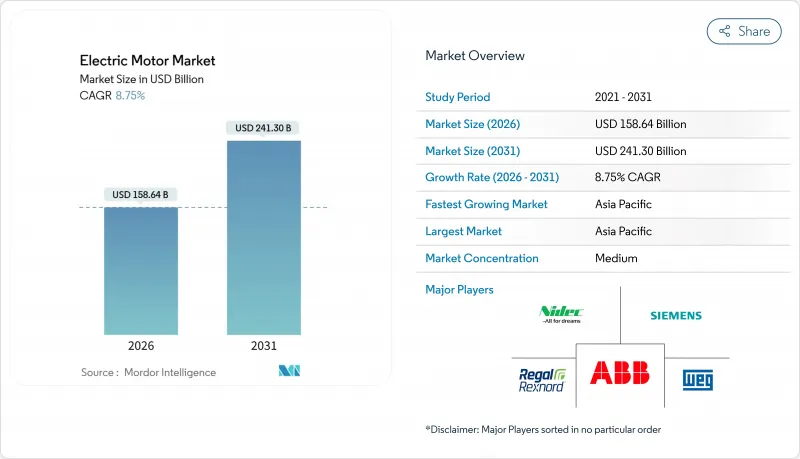
Mordor Intelligence에 따르면 전기 모터 시장 규모는 2026년에 1,586억 4,000만 달러로 추정되고 있으며, 예측 기간(2026-2031년)에 CAGR 8.75%로 추이하며, 2031년까지 2,413억 달러에 달할 것으로 전망되고 있습니다.
이 보고서는 전기 모터(DC 모터, AC 모터, 기타), 정격 출력(분수 마력 등), 전압(저전압, 중전압, 고전압), 용도(산업용 기계, HVAC 및 냉동, 기타),최종 용도 산업(주택, 상업, 산업) 및 지역(북미, 유럽, 아시아태평양, 남미, 중동 및 아프리카)별로 분류되어 있습니다.
세계 전기 모터 시장의 동향 및 인사이트
아시아 이산형 산업 분야의 제조 자동화 급속한 전기화
중국, 일본, 한국 및 아세안(ASEAN) 지역의 로봇이 밀집된 조립 라인에서는 새로운 유닛 1대당 4-7축의 서보 축이 탑재되어 있습니다. 국제로봇연맹(IFR)의 집계에 따르면 2024년 전 세계 도입 대수는 54만 2,000대에 달했으며, 그 중 70% 이상이 아시아태평양에 도입되었습니다. 각 관절에는 소형이며 고정밀도의 모터가 필요하며, 이로 인해 로봇 1대당 모터의 평균 단가가 상승함에 따라 피드백 기능을 내장한 브러시리스 DC 모터 및 영구자석 동기 모터에 대한 수요가 증가하고 있습니다. 인도의 전자기기 생산 연계형 장려 제도(PLI)에서는 15억 달러의 보조금이 배정되어 있으며, 관세 감면 혜택을 받기 위해 모터의 현지 조달이 진행되고 있습니다. OEM 각사는 현재 듀티 사이클에 내성이 있는 권선 및 내열성 절연재를 사양으로 지정하고 있으며, 조달 기준이 단가에서 수명 주기 처리량으로 전환되고 있습니다.
연방 에너지 기준에 힘입어 미국 주택 개조시 HVAC 도입이 가속화되고 있습니다.
미국 에너지부가 2024년에 최종 결정한 SEER2 규정 개정에 따라 송풍기 어셈블리에 전자 정류 모터(ECM)의 채택이 사실상 의무화되어, 수백만 가구의 주택에서 교체 수요가 급증하고 있습니다. 가변 속도 ECM은 영구 분할 콘덴서 모터에 비해 전력 사용량을 최대 30%까지 절감할 수 있으며, 캘리포니아주와 텍사스주의 전력 회사는 이러한 이점을 수요 반응(Demand Response) 인센티브를 통해 수익화하고 있습니다. 각 모터 공급업체들은 진단 기능과 클라우드 기반 보증을 세트로 판매하며, 모터를 단순한 일회성 부품 판매가 아닌 서비스 수익의 진입점으로 자리매김하고 있습니다. 당초 40-60%의 가격 프리미엄에 회의적이었던 설치 업체들도 연방 세액 공제로 인해 투자 회수 기간이 2개의 난방 시즌으로 단축됨에 따라 입장을 바꾸고 있습니다.
네오디뮴 가격 변동이 영구자석 모터의 수익성을 압박
2024년, 중국의 공급량 할당 조정의 영향으로 산화네오디뮴 가격이 15% 급등하여, 자동차용 고정 가격 계약을 체결한 제조사들을 압박하고 있습니다. 자석은 트랙션 모터의 부품 원가의 최대 30%를 차지하므로 가격 변동은 이미 낮은 이익률을 더욱 압박하고 있습니다. 재고를 늘리면 운전 자금이 묶이고 가치 하락 위험도 발생하므로 일부 공급업체는 효율을 약간 희생하더라도 희토류에 대한 의존을 피할 수 있는 유도 모터나 스위치드 릴랙턴스 모터와 같은 대안을 검토하기 시작했습니다.
부문 분석
2025년, 전기 모터 시장 매출의 74%를 교류(AC) 모터가 차지하고 있으며, 펌프, 압축기, HVAC용 송풍기 등에서의 확고한 사용에 힘입어 연평균 9.45%의 성장이 예상됩니다. 고정 속도 용도에서는 유도형이 주류를 이루고 있지만, 가변 주파수 구동(VFD)을 통해 정밀도와 에너지 효율을 높일 수 있는 분야에서는 동기형이 점유율을 확대하고 있습니다. 유럽에서 IE4 및 IE5 등급의 도입이, 특히 0.75킬로와트 이상의 프레임 크기에서 동기 모터의 보급을 가속화하고 있습니다. 직류(DC) 모터는 토크 밀도와 배터리와의 호환성이 높은 초기 비용을 상쇄하는 자동차, 전동 공구, 소형 가전 분야에서 확고한 입지를 다지고 있습니다. 현재 거의 모든 고급 청소기에는 브러시리스 DC 모터가 탑재되어 있으며, 1회 충전당 작동 시간을 최대 40%까지 연장하고 있습니다.
부상하고 있는 하이브리드 등급은 유도 모터의 견고성과 영구자석 로터를 융합하여 IE4 수준의 효율을 실현하면서도 직접 시동이 가능합니다. 이 기능은 인버터 인프라가 보급되지 않은 신흥 시장에서 높이 평가받고 있습니다. 특수한 형태인 헤르메틱형, 스테핑형, 축류형은 여전히 규모는 작지만, 냉동, 3D 프린팅, 모빌리티 분야의 스타트업과 연계된 수익성이 높은 틈새 시장을 유지하고 있습니다. 성능 범위가 겹치면서 구매 결정은 분류에 따른 것이 아니라 소음 특성, 열적 여유, 혹은 1kg당 토크와 같은 용도별 지표에 중점을 두게 되었습니다.
1마력 미만의 모터는 2025년 출하 대수의 51.4%를 차지하고 있으며, 이는 냉장고, 세탁기, 결제 단말기 등에서 널리 보급된 현상을 반영하고 있습니다. 이 부문에서는 가격 탄력성이 지배적입니다. 3달러의 비용 차이만으로도 조달처가 변경되는 경우도 있지만, ENERGY STAR 기준치에 따라 해마다 단계적인 효율 향상이 요구되고 있습니다. 1-500마력의 적분마력(IP) 모터는 컨베이어, 압축기, 공작 기계 등에 사용되며, 이러한 분야에서는 가동 중단으로 인한 비용이 기기 가격을 훨씬 초과합니다. 공장이 IE4 모델로 업데이트하여 최대 5%의 에너지 절약 효과를 얻기 위해, 이 중위권 전기 모터 시장 규모는 계속해서 확대되고 있습니다.
500마력을 초과하는 고출력 유닛은 생산량이 적지만, 광업 및 석유화학 업계의 노후 설비 교체로 인해 2031년까지 연평균 7.8%의 성장이 예상됩니다. 사업자들은 현재의 에너지 요금 수준에서 3-4년의 회수 기간이 예상되는 신규 제조 IE4 모델과, 원래의 IE1 또는 IE2 효율만 회복할 수 있는 재권선 서비스를 비교 검토하고 있습니다. 일부 OEM(Original Equipment Manufacturer)는 현재 기존 프레임을 현장에서 바로 업그레이드할 수 있는 모듈식 고정자·회전자 카트리지를 제공하고 있으며, 이는 완전한 교체와 개보수 사이의 중간적인 대안이 되고 있습니다.
지역별 분석
아시아태평양은 2025년 전기 모터 시장에서 43.8%의 점유율을 유지할 것으로 보이며, 2031년까지 연평균 성장률(CAGR) 10.7%를 기록할 전망입니다. 중국 자동차 제조업체들은 2025년 11월까지 1,478만 대의 신에너지차를 납품했으며, 세단이 듀얼 모터 레이아웃으로 전환됨에 따라 트랙션 모터 수요가 두 배로 증가하는 요인이 되고 있습니다. 2024년, 이 지역의 로봇 도입 대수는 전 세계 54만 2,000대의 70%를 넘어섰습니다. 각 셀에는 최대 7개의 정밀 모터가 필요합니다. 인도의 ‘생산 연계형 인센티브(PLI)’ 제도에 따라 전자기기 및 모터 생산에 15억 달러가 투입되고 있습니다. 한편, 베트남과 태국에서는 조달을 현지화하고 리드타임을 단축하는 가전제품 조립 라인이 유치되고 있습니다.
북미 지역의 성장세는 미국 에너지부(DOE)의 SEER2 기준에 따른 HVAC(냉난방 공조) 개조 의무화 및 산업 분야의 예측 유지보수 도입에서 기인합니다. 2024년 조사에 따르면 교체 사례의 38%가 시간 기반 일정이 아닌 센서 경보에 의해 촉발된 것으로 나타나, 자산 관리 분야에서 데이터베이스 패러다임이 정착되고 있음을 보여줍니다. 캐나다 광업 부문에서는 외딴 지역의 킬로와트시당 0.12달러를 초과하는 전력 비용을 억제하기 위해 IE4 규격을 준수하는 고출력 모터로의 교체가 진행되고 있습니다. 멕시코에서는 자동차 및 백색 가전 제조 분야의 니어쇼어링 유입으로 인해 지역 공급망이 긴밀해지면서, 새로운 생산 시설에 중전압 모터의 도입이 촉진되고 있습니다.
유럽의 상황은 정책 주도형입니다. 에코디자인 규제에 따라 현재 IE4 준수가 의무화되어 있으며, 2027년까지 IE5 기준이 도입될 전망입니다. 2024년에 16.4기가와트의 해상 풍력발전이 추가됨에 따라 수 메가와트급 발전기에 대한 수요가 지원되고 있습니다. 한편, 독일의 공정 산업에서는 에너지 사용량을 20-40% 절감하는 가변 주파수 드라이브가 채택되고 있습니다. 영국에서의 히트펌프 보급 확대와 북유럽 국가들의 수력 발전 의존도는 변동 부하 하에서도 효율적으로 작동하는 모터에 대한 수요를 지원하고 있습니다. 동유럽의 공장에서는 설비 현대화를 위한 EU 연대 기금의 보조금 혜택을 받고 있으며, 이를 통해 고효율 규격의 도입이 촉진되고 있습니다.
남미의 상황은 상품 주도형입니다. 브라질의 농업 관련 사업에서는 고온과 분진을 견딜 수 있는 관개용 및 곡물 처리용 모터가 필수적인 반면, 아르헨티나의 리튬 광산에서는 투자자의 지속가능성 조항을 충족하기 위해 IE4 규격을 준수하는 고출력 분쇄기가 도입되고 있습니다. 중동에서는 석유 및 가스 사업자들이 ATEX 및 IECEx 인증을 취득한 방폭형 유닛을 요구하고 있으며, 이 인증 취득의 난관으로 인해 납기 기간은 길어지지만, 프리미엄 가격으로의 판매가 보장되고 있습니다. 걸프 연안 국가들은 지역 냉방 시스템 및 해수 담수화 시스템에 투자하고 있으며, 이는 중전압 펌프 조달을 촉진하고 있습니다.
기타 혜택:
- 엑셀 형식의 시장 예측(ME) 시트
- 3개월간의 애널리스트 지원
자주 묻는 질문
목차
제1장 서론
제2장 조사 방법
제3장 개요
제4장 시장 구도
제5장 시장 규모와 성장 예측
제6장 경쟁 구도
제7장 시장 기회와 향후 전망
KSA 26.08.26According to Mordor Intelligence, the electric motor market size is estimated at USD 158.64 billion in 2026, and is expected to reach USD 241.30 billion by 2031, at a CAGR of 8.75% during the forecast period (2026-2031).
This report is Segmented by Motor Type (DC Motor, AC Motor, and Others), Output Power Rating (Fractional Horsepower, and More), Voltage (Low Voltage, Medium Voltage, and High Voltage), Application (Industrial Machinery, HVAC and Refrigeration, and More), End-Use Industry (Residential, Commercial, and Industrial), and Geography (North America, Europe, Asia-Pacific, South America, and Middle East and Africa).
Global Electric Motor Market Trends and Insights
Rapid Electrification of Manufacturing Automation in Asia's Discrete Industries
Robot-dense assembly lines across China, Japan, South Korea, and the ASEAN region are embedding four to seven servo axes in each new unit. The International Federation of Robotics counted 542,000 installations worldwide in 2024, more than 70% of which landed in Asia-Pacific. Every joint needs a compact, high-precision motor, raising average motor value per robot and pulling demand toward brushless DC and permanent-magnet synchronous designs with integrated feedback. India's electronics Production-Linked Incentive scheme has allocated USD 1.5 billion in subsidies, spurring local sourcing of motors to qualify for tariff relief. Original-equipment manufacturers now specify duty-cycle-resilient windings and temperature-resistant insulation, shifting procurement criteria from unit price to lifetime throughput.
Accelerating HVAC Adoption in US Residential Retrofits Driven by Federal Energy Standards
The U.S. Department of Energy's updated SEER2 rules, finalized in 2024, effectively require electronically commutated motors in blower assemblies, setting off a replacement surge across millions of homes. Variable-speed ECMs cut electricity use by up to 30% relative to permanent split-capacitor motors, a benefit that utilities in California and Texas monetize through demand-response incentives. Motor vendors are bundling diagnostics and cloud-based warranties, framing the motor as a gateway to service revenue rather than a one-time component sale. Installers initially wary of 40-60% price premiums have shifted stance as federal tax credits shorten payback periods to two heating seasons.
Volatile Neodymium Prices Pressuring Permanent-Magnet Motor Economics
Neodymium oxide prices spiked 15% during 2024 as Chinese supply faced quota adjustments, squeezing manufacturers that commit to fixed-price automotive contracts. Magnets represent up to 30% of a traction motor's bill of materials, so pricing swings erode already-thin margins. Stockpiling inventory locks working capital and risks devaluation, pushing some vendors to investigate induction or switched-reluctance alternatives that sidestep rare-earth dependence at modest efficiency penalties.
Other drivers and restraints analyzed in the detailed report include:
- Surging Offshore Wind Turbine Installations Requiring High-Power Permanent-Magnet Motors in Europe
- Battery Electric Vehicle Powertrain Ramp-Up in China Catalyzing High-Efficiency Traction Motors Demand
- Supply Constraints of IGBT Modules Limiting High-Voltage Motor Production
For complete list of drivers and restraints, kindly check the Table Of Contents.
Segment Analysis
AC machines accounted for 74% of the Electric Motors market revenue in 2025 and are set to grow 9.45% yearly, underpinned by entrenched use in pumps, compressors, and HVAC blowers. Induction models dominate fixed-speed duties, but synchronous variants are picking up share wherever variable-frequency drives unlock precision and energy gains. Adoption of IE4 and IE5 classes in Europe has accelerated synchronous uptake, particularly in frame sizes above 0.75 kilowatts. DC architectures hold ground in automotive, power tools, and small appliances, where torque density and battery compatibility outweigh higher upfront cost. Brushless DC motors now ship inside nearly every premium vacuum cleaner, extending run time per charge by up to 40%.
A rising hybrid class blends induction robustness with permanent-magnet rotors, delivering IE4 efficiency while starting direct-on-line, a feature valued in developing markets that lack ubiquitous inverter infrastructure. Specialty formats, hermetic, stepper, and axial-flux, remain small yet profitable niches tied to refrigeration, 3-D printing, and mobility startups. As performance envelopes overlap, purchasing decisions hinge less on taxonomy and more on application-specific metrics such as acoustic signature, thermal headroom, or torque-per-kilogram.
Motors below 1 horsepower held 51.4% of 2025 shipments, reflecting ubiquity across refrigerators, washing machines, and payment terminals. Price elasticity rules this tranche: a USD 3 cost delta can flip sourcing decisions, yet ENERGY STAR thresholds force incremental efficiency gains year after year. Integral-horsepower machines between 1 and 500 horsepower serve conveyors, compressors, and machine tools where downtime costs dwarf equipment prices. The Electric Motors market size for this middle band continues to expand as factories retrofit IE4 models to capture up to 5% energy savings.
High-power units above 500 horsepower, though smaller in volume, are forecast to grow 7.8% annually to 2031 on the replacement of aging assets in mining and petrochemicals. Operators weigh rewind services that recover only original IE1 or IE2 efficiency against new-build IE4 alternatives with 3- to 4-year paybacks at current energy tariffs. Some OEMs now offer modular stator-rotor cartridges that upgrade legacy frames in situ, bridging the gap between full replacement and refurbishment.
Complete Report Scope:
- By Motor Type
- AC Motor (Induction (Asynchronous), Synchronous)
- DC Motor (Brushed, Brushless (BLDC))
- Others (Hermetic Motor, Stepper Motor)
- By Output Power Rating
- Fractional Horsepower (Below 1 HP)
- Integral Horsepower (1 to 500 HP)
- High-Power (Above 500 HP)
- By Voltage
- Low Voltage (Below 1 kV)
- Medium Voltage (1 to 6 kV)
- High Voltage (Above 6 kV)
- By Application
- Industrial Machinery
- HVAC and Refrigeration
- Automotive and Transportation
- Residential Appliances
- Utilities and Energy
- Others (Agriculture, Oil and Gas, Mining)
- By End-Use Industry
- Residential
- Commercial
- Industrial
- By Geography
- North America
- United States
- Canada
- Mexico
- Europe
- United Kingdom
- Germany
- France
- Spain
- NORDIC Countries
- Russia
- Rest of Europe
- Asia-Pacific
- China
- India
- Japan
- South Korea
- Malaysia
- Thailand
- Indonesia
- Vietnam
- Australia
- Rest of Asia-Pacific
- South America
- Brazil
- Argentina
- Colombia
- Rest of South America
- Middle East and Africa
- United Arab Emirates
- Saudi Arabia
- South Africa
- Egypt
- Rest of Middle East and Africa
- North America
Geography Analysis
Asia-Pacific retained a 43.8% Electric Motors market share in 2025 and is tracking a 10.7% CAGR to 2031. Chinese automakers delivered 14.78 million new-energy vehicles through November 2025, a vector that multiplies traction-motor demand as sedans transition to dual-motor layouts. Robotics installations across the region surpassed 70% of the global 542,000 units in 2024, each cell requiring up to seven precision motors. India's Production-Linked Incentive subsidies channel USD 1.5 billion into electronics and motor production, while Vietnam and Thailand attract appliance assembly lines that localize sourcing and compress lead times.
North American momentum stems from HVAC retrofits mandated by DOE SEER2 standards and industrial predictive-maintenance rollouts. A 2024 survey recorded 38% of replacements triggered by sensor alerts rather than time-based schedules, indicating a data-driven paradigm in asset management. Canada's mining sector is moving to IE4 high-horsepower upgrades to mitigate electricity costs above USD 0.12 per kilowatt-hour in remote zones. Mexico's near-shoring influx for automotive and white goods manufacturing tightens regional supply chains and boosts medium-voltage motor uptake in new production halls.
Europe's landscape is policy-led. Ecodesign regulations require IE4 compliance today and foreshadow IE5 thresholds by 2027. Offshore wind additions of 16.4 gigawatts in 2024 underpin multi-megawatt generator demand, while Germany's process industries adopt variable-frequency drives that shave 20-40% energy use. The United Kingdom's heat-pump push and Nordic reliance on hydropower converge on motors that operate efficiently under variable loads. Eastern European factories benefit from EU cohesion-fund grants to modernize equipment, nudging adoption of premium-efficiency ratings.
South America's mix is commodity-driven: Brazil's agribusiness relies on irrigation and grain-handling motors that survive high heat and dust, whereas Argentina's lithium mines deploy high-horsepower crushers under IE4 specifications to meet investor sustainability covenants. In the Middle East, oil and gas operators demand explosion-proof units with ATEX and IECEx tags, a certification hurdle that stretches supply timelines but locks in premium pricing. Gulf states invest in district-cooling and desalination systems, fueling medium-voltage pump procurement.
- ABB Ltd.
- Siemens AG
- Nidec Corporation
- Regal Rexnord Corporation
- WEG S.A.
- Toshiba Corporation
- Hitachi Ltd.
- Rockwell Automation, Inc.
- AMETEK, Inc.
- Johnson Electric Holdings Ltd.
- TECO Electric & Machinery Co., Ltd.
- Mitsubishi Electric Corporation
- Baldor Electric Company
- Brook Crompton Holdings Ltd.
- Anhui Wannan Electric Machine Co., Ltd.
- Kirloskar Electric Company Ltd.
- Hyosung Heavy Industries
- Danaher Motion (Kollmorgen)
- Yaskawa Electric Corporation
- Fuji Electric Co., Ltd.
- Robert Bosch GmbH
- Schneider Electric SE
- SEW-Eurodrive GmbH & Co. KG
- Emerson Electric Co.
Additional Benefits:
- The market estimate (ME) sheet in Excel format
- 3 months of analyst support
TABLE OF CONTENTS
1 Introduction
- 1.1 Study Assumptions & Market Definition
- 1.2 Scope of the Study
2 Research Methodology
3 Executive Summary
4 Market Landscape
- 4.1 Market Overview
- 4.2 Recent Trends & Developments
- 4.3 Market Drivers
- 4.3.1 Rapid Electrification of Manufacturing Automation in Asia's Discrete Industries
- 4.3.2 Accelerating HVAC Adoption in US Residential Retrofits Driven by Federal Energy Standards
- 4.3.3 Surging Offshore Wind Turbine Installations Requiring High-Power Permanent-Magnet Motors in Europe
- 4.3.4 Battery Electric Vehicle Powertrain Ramp-Up in China Catalyzing High-Efficiency Traction Motors Demand
- 4.3.5 Industrial IoT-Enabled Predictive Maintenance Boosting Replacement of Aging Motors in North America
- 4.3.6 Government Mandates on MEPS Propelling IE4 & IE5 Motor Sales Globally
- 4.4 Market Restraints
- 4.4.1 Volatile Neodymium Prices Pressuring Permanent-Magnet Motor Economics
- 4.4.2 Supply Constraints of IGBT Modules Limiting High-Voltage Motor Production
- 4.4.3 Lengthy Certification Cycles for Explosion-Proof Motors in Middle-East Oil & Gas
- 4.4.4 Growing Adoption of Integrated Servo Drives Reducing Stand-Alone Motor Revenue Opportunities
- 4.5 Supply-Chain Analysis
- 4.6 Regulatory Outlook
- 4.7 Technological Outlook
- 4.8 Porter's Five Forces
- 4.8.1 Bargaining Power of Suppliers
- 4.8.2 Bargaining Power of Buyers
- 4.8.3 Threat of New Entrants
- 4.8.4 Threat of Substitute Products
- 4.8.5 Intensity of Competitive Rivalry
5 Market Size & Growth Forecasts
- 5.1 By Motor Type
- 5.1.1 AC Motor (Induction (Asynchronous), Synchronous)
- 5.1.2 DC Motor (Brushed, Brushless (BLDC))
- 5.1.3 Others (Hermetic Motor, Stepper Motor)
- 5.2 By Output Power Rating
- 5.2.1 Fractional Horsepower (Below 1 HP)
- 5.2.2 Integral Horsepower (1 to 500 HP)
- 5.2.3 High-Power (Above 500 HP)
- 5.3 By Voltage
- 5.3.1 Low Voltage (Below 1 kV)
- 5.3.2 Medium Voltage (1 to 6 kV)
- 5.3.3 High Voltage (Above 6 kV)
- 5.4 By Application
- 5.4.1 Industrial Machinery
- 5.4.2 HVAC and Refrigeration
- 5.4.3 Automotive and Transportation
- 5.4.4 Residential Appliances
- 5.4.5 Utilities and Energy
- 5.4.6 Others (Agriculture, Oil and Gas, Mining)
- 5.5 By End-Use Industry
- 5.5.1 Residential
- 5.5.2 Commercial
- 5.5.3 Industrial
- 5.6 By Geography
- 5.6.1 North America
- 5.6.1.1 United States
- 5.6.1.2 Canada
- 5.6.1.3 Mexico
- 5.6.2 Europe
- 5.6.2.1 United Kingdom
- 5.6.2.2 Germany
- 5.6.2.3 France
- 5.6.2.4 Spain
- 5.6.2.5 NORDIC Countries
- 5.6.2.6 Russia
- 5.6.2.7 Rest of Europe
- 5.6.3 Asia-Pacific
- 5.6.3.1 China
- 5.6.3.2 India
- 5.6.3.3 Japan
- 5.6.3.4 South Korea
- 5.6.3.5 Malaysia
- 5.6.3.6 Thailand
- 5.6.3.7 Indonesia
- 5.6.3.8 Vietnam
- 5.6.3.9 Australia
- 5.6.3.10 Rest of Asia-Pacific
- 5.6.4 South America
- 5.6.4.1 Brazil
- 5.6.4.2 Argentina
- 5.6.4.3 Colombia
- 5.6.4.4 Rest of South America
- 5.6.5 Middle East and Africa
- 5.6.5.1 United Arab Emirates
- 5.6.5.2 Saudi Arabia
- 5.6.5.3 South Africa
- 5.6.5.4 Egypt
- 5.6.5.5 Rest of Middle East and Africa
- 5.6.1 North America
6 Competitive Landscape
- 6.1 Market Concentration
- 6.2 Strategic Moves (M&A, Partnerships, PPAs)
- 6.3 Market Share Analysis (Market Rank/Share for key companies)
- 6.4 Company Profiles (includes Global level Overview, Market level overview, Core Segments, Financials as available, Strategic Information, Products & Services, and Recent Developments)
- 6.4.1 ABB Ltd.
- 6.4.2 Siemens AG
- 6.4.3 Nidec Corporation
- 6.4.4 Regal Rexnord Corporation
- 6.4.5 WEG S.A.
- 6.4.6 Toshiba Corporation
- 6.4.7 Hitachi Ltd.
- 6.4.8 Rockwell Automation, Inc.
- 6.4.9 AMETEK, Inc.
- 6.4.10 Johnson Electric Holdings Ltd.
- 6.4.11 TECO Electric & Machinery Co., Ltd.
- 6.4.12 Mitsubishi Electric Corporation
- 6.4.13 Baldor Electric Company
- 6.4.14 Brook Crompton Holdings Ltd.
- 6.4.15 Anhui Wannan Electric Machine Co., Ltd.
- 6.4.16 Kirloskar Electric Company Ltd.
- 6.4.17 Hyosung Heavy Industries
- 6.4.18 Danaher Motion (Kollmorgen)
- 6.4.19 Yaskawa Electric Corporation
- 6.4.20 Fuji Electric Co., Ltd.
- 6.4.21 Robert Bosch GmbH
- 6.4.22 Schneider Electric SE
- 6.4.23 SEW-Eurodrive GmbH & Co. KG
- 6.4.24 Emerson Electric Co.
7 Market Opportunities & Future Outlook
- 7.1 White-Space & Unmet-Need Assessment


