

|
시장보고서
상품코드
2115064
유럽의 전기자동차용 전기 모터 시장 : 시장 점유율 분석, 업계 동향 및 통계, 성장 예측(2026-2031년)Europe Electric Motors For Electric Vehicle - Market Share Analysis, Industry Trends & Statistics, Growth Forecasts (2026 - 2031) |
||||||
 Mordor Intelligence
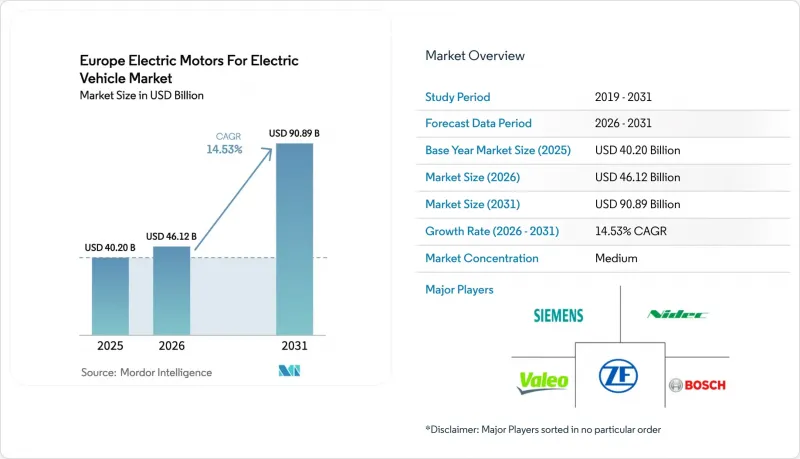
Mordor Intelligence에 의하면, 유럽의 전기자동차(EV)용 전기 모터 시장은 2025년 402억 달러로 평가되었고, 2026년에는 461억 2,000만 달러로 추정되고, 2031년까지 908억 9,000만 달러에 이를 것으로 예측되며, 예측 기간(2026-2031년) CAGR 14.53%로 성장할 전망입니다.
본 보고서는 모터 유형별(DC 브러시형, DC 브러쉬리스 등), 차량 유형별(BEV, HEV 등), 용도별(이륜차 등), 출력별(50 kW 미만 등), 냉각 방식별(공랭식, 수랭식), 국가별(독일, 영국, 프랑스 등)로 분류되어 있습니다. 시장 전망은 금액(달러) 및 수량(대수) 두 가지 측면에서 제시되어 있습니다.
유럽의 전기자동차용 전기 모터 시장 동향 및 인사이트
2025년 및 2030년을 향한 EU의 더욱 엄격한 CO2 차량 평균 배출량 목표
유럽연합(EU) 규정 2025/1214에 따라, 2025년 차량 평균 배출량 상한은 2029년까지 93.6 g CO2/km로 하향 조정되었으며, 2034년에는 49.5 g CO2/km의 상한이 설정되었습니다. 이에 따라 2025년 말에 슈퍼크레딧 제도가 종료됨과 동시에, 기준을 달성하지 못할 경우 고액의 벌금이 부과될 예정입니다. 각 자동차 제조업체들은 현재 단기적인 수익성을 고려하지 않고 BEV(배터리식 전기차) 출시를 가속화하고 있습니다. 이는 전기차의 구성 비율에 1퍼센트 포인트의 편차가 발생하는 것만으로도 수억 유로 규모의 벌금이 부과될 가능성이 있기 때문입니다. 그 결과, 츠비카우, 에멘, 티히 공장에서 플랫폼 생산이 앞당겨지고 있으며, 각 공급업체들도 이에 발맞추어 헤어핀형 스테이터 및 로터 생산 라인을 확대되고 있습니다. 이 규제로 인해 모터 수요는 소비자의 선호도가 아닌 법정 상한선에 사실상 묶이게 되었으며, 전기차 시장을 겨냥한 유럽산 전기 모터는 정책 주도형 성장 궤도로 밀려나고 있습니다.
배터리 단가(USD/kWh)의 급락이 합리적인 가격의 BEV를 실현
배터리 팩의 평균 가격은 2022년 153달러/kWh에서 2024년에는 111달러/kWh로 하락했으며, 2026년까지 80달러/kWh 아래로 떨어질 전망입니다. 이 기준치를 밑돌게 됨에 따라 B부문 및 C부문 BEV는 보조금 없이도 내연기관 차량과 동등한 구매 가격을 실현할 수 있게 되어, 그 결과 모터의 잠재적 고객 기반이 수천만 대 규모로 확대될 것입니다. 르노가 2025년에 2만 5,000유로에 출시할 ‘R5 E-Tech’는 배터리 비용 하락으로 가격 책정 여지가 생겨, 고효율 110kW 영구자석 모터를 채택할 수 있게 되었음을 보여줍니다. 한편, 각 부품 공급업체들은 구리제 헤어핀 권선과 일체형 인버터를 채택함으로써 모터 1기당 조립 공수를 3분의 1 가까이 줄였습니다. 그러나 에너지 밀도가 낮은 인산철 리튬 배터리로의 전환에 따라 모터에는 더 넓은 토크 대역에서 높은 효율을 발휘할 것이 요구되고 있으며, 비용, 주행 거리, 희토류 수요 간의 미묘한 균형이 부각되고 있습니다.
희토류 자석의 가격 변동과 공급망 리스크
네오디뮴·프라세오디뮴 산화물은 2025년 초 1메트르톤당 6만 8,000달러 가까이에서 정점을 찍은 후, 연말까지 5만 4,000달러까지 하락했습니다. 이 26%의 변동으로 인해 많은 1차 공급업체의 분기 매출 총이익률이 불안정해졌습니다. 선물 계약은 변동성의 일부를 완화할 수 있지만, 막대한 프리미엄이 수반되기 때문에 이익을 더욱 압박하게 됩니다. 페라이트 자석으로의 대체는 출력 밀도를 최대 20%까지 떨어뜨리기 때문에 설계 변경이 필요하지만, 주류 승용차에서 이를 수용하는 OEM 제조업체는 거의 없습니다. 작센주의 재활용 노력은 2028년까지 연간 2,000메트르톤의 회수를 목표로 하고 있지만, 이는 유럽의 예상 수요의 5% 미만에 불과합니다. 국내 채굴이나 대규모 재활용이 현실적인 대안이 될 때까지는 자석 가격 동향이 구조적인 역풍으로 남아 있을 것입니다.
부문 분석
2025년, 유럽 전기자동차용 전기 모터 시장 점유율 중 영구자석 동기 모터(PMSM)는 58.71%를 차지했습니다. 높은 출력 밀도 덕분에 자동차 제조업체는 차량 서브프레임의 크기를 변경하지 않고도 실내 공간 목표를 달성할 수 있기 때문입니다. 유도 모터는 듀얼 모터 방식의 사륜구동(AWD) 구성에서 자주 사용되며, 그 저비용이 부분 부하 시 효율 저하에 따른 단점을 상쇄하고 있습니다. BLDC 모터는 구조가 단순하고 공랭식과의 호환성이 뛰어나 이륜차 및 삼륜차 시장에서 일정한 입지를 유지하고 있습니다. 반면, 일반적인 자동차 용도에서는 브러시가 있는 직류 모터가 BLDC 모터로 거의 대체되었습니다. SRM의 출하 대수는 급속히 증가하고 있으며, 희토류 가격 변동 위험을 피할 수 있는 자석이 필요 없는 설계 덕분에 2031년까지 연평균 성장률(CAGR) 16.97%로 증가할 것으로 예측됩니다.
SRM의 보급에는 기술적인 상충 관계가 따릅니다. 토크 리플과 소음 수준이 높기 때문에 고도의 제어 알고리즘이 필요하며, 그 결과 더 고가의 실리콘 카바이드 인버터가 요구됩니다. 그럼에도 불구하고, 각 공급업체들은 정격 부하 효율 90% 이상을 달성하는 150kW SRM 프로토타입을 발표하며 PMSM과의 격차를 크게 좁히고 있습니다. 배터리 팩 용량이 75 kWh를 초과하는 경우, 주행 거리에 미치는 영향이 비교적 미미하기 때문에 유도 전동기의 채택은 견조한 추세를 보이고 있습니다. 전반적으로 기술 구성의 변화는 지속되겠지만, 2031년까지는 PMSM이 유럽 전기차 시장을 위한 전기 모터의 주력 제품으로 남을 것입니다.
2025년에는 폭스바겐의 ID 시리즈, 스텔란티스의 플랫폼, 그리고 테슬라의 ‘모델 Y’의 견조한 판매에 힘입어 BEV가 시장 점유율의 72.88%를 차지했습니다. FCEV는 독일, 프랑스, 네덜란드에 걸쳐 현재 250곳의 충전소를 아우르는 수소 충전 네트워크에 힘입어 2031년까지 연평균 성장률(CAGR) 19.81%로 확대되고 있습니다. PHEV의 점유율은 실제 주행 조건에서의 CO2 배출량 시험 기준이 강화됨에 따라 축소되고 있으며, 이에 따라 각 OEM 업체들은 연구개발 예산을 완전 전기 아키텍처로 재분배하고 있습니다. HEV는 충전 네트워크가 미비한 지역에서 여전히 이용되고 있지만, 정격 출력이 50 kW 미만에 그치는 경우가 많아 모터 관련 수익은 낮은 임베디드니다.
대형 트럭 분야에서는 FCEV에 탑재되는 2기의 180 kW 수냉식 PMSM이 연료전지의 응답 지연을 보완하도록 설계되어 있으며, 이는 BEV의 표준 사양과는 확연히 다릅니다. 판매 대수 측면에서는 BEV가 주류를 이루고 있지만, FCEV의 성장은 전기차 시장에서 유럽산 전기 모터 수요 구조를 다각화할 뿐만 아니라, 추가적인 성장을 이끄는 원동력이 되고 있습니다.
기타 혜택 :
- 엑셀 형식 시장 예측(ME) 시트
- 3개월간의 애널리스트 지원
자주 묻는 질문
목차
제1장 서론
제2장 조사 방법
제3장 주요 요약
제4장 시장 구도
제5장 시장 규모 및 성장 예측
제6장 경쟁 구도
제7장 시장 기회 및 향후 전망
AJY 26.08.28According to Mordor Intelligence, the European electric motors for the electric vehicle market are expected to grow from USD 40.20 billion in 2025 to USD 46.12 billion in 2026 and are forecast to reach USD 90.89 billion by 2031, advancing at a 14.53% CAGR during the forecast period (2026-2031).
This report is Segmented by Motor Type (DC Brushed, DC Brushless, and More), Vehicle Type (BEV, HEV, and More), Application (Two-Wheeler and More), Power Output (Less Than 50 KW and More), Cooling Method (Air-Cooled and Liquid-Cooled), and Country (Germany, United Kingdom, France, and More). Market Forecasts are Provided in Terms of Both Value (USD) and Volume (Units).
Europe Electric Motors For Electric Vehicle Market Trends and Insights
Stricter EU CO2 Fleet-Average Targets for 2025 and 2030
The European Union's Regulation 2025/1214 lowered the 2025 fleet-average limit to 93.6 g CO2/km till 2029 and set a 49.5 g CO2/km ceiling for 2034, pairing steep non-compliance fines with the expiration of the super-credit mechanism at the end of 2025. Automakers now accelerate BEV launches, irrespective of short-term profitability, because every percentage-point gap in the electric-vehicle mix can trigger hundreds of millions of euros in penalties. Platform production is therefore being front-loaded at factories in Zwickau, Emden, and Tychy, with suppliers scaling hairpin stator and rotor lines accordingly. The regulation effectively ties motor demand to statutory ceilings rather than consumer preference, pushing European electric motors for the electric vehicle market onto a policy-driven growth path.
Rapid Decline in Battery USD/kWh Enabling Affordable BEVs
Average pack prices slid from USD 153/kWh in 2022 to USD 111/kWh in 2024 and are on track to fall below USD 80/kWh by 2026. Crossing this threshold enables B- and C-segment BEVs to reach purchase-price parity with internal-combustion cars without subsidies, thereby expanding the potential motor customer base by tens of millions of vehicles. Renault's 2025 R5 E-Tech launch at EUR 25,000 illustrates how lower battery costs free pricing headroom to specify higher-efficiency, 110 kW permanent-magnet motors. Component suppliers, meanwhile, have trimmed assembly labor per motor by nearly one-third, thanks to copper hairpin winding and integrated inverters. Yet the shift toward lithium-iron-phosphate batteries-with their lower energy density-requires motors to deliver better efficiency across a broader torque band, highlighting the delicate balance between cost, range, and rare-earth demand.
Rare-Earth Magnet Price Volatility and Supply-Chain Risk
Neodymium-praseodymium oxide peaked near USD 68,000 per metric ton in early 2025 before sliding to USD 54,000 by year-end, a 26% swing that destabilized quarterly gross margins for many Tier 1 suppliers. Forward contracts can cushion some volatility but carry hefty premiums, further squeezing profit. Substituting ferrite magnets reduces power density by up to 20%, necessitating design changes that few OEMs are willing to accept for mainstream passenger cars. Recycling initiatives in Saxony aim to recover 2,000 metric tons annually by 2028; however, this covers less than 5% of the projected European demand. Until domestic extraction or large-scale recycling becomes a viable option, magnet pricing remains a structural headwind.
Other drivers and restraints analyzed in the detailed report include:
- OEM Electrification Road-Maps and Platform Shifts
- Spain's 2024 PERTE VEC 2 Program Anchoring New E-Drive Supply Chains
- High CAPEX for Advanced Hair-Pin Winding and Liquid-Cooling Lines
For complete list of drivers and restraints, kindly check the Table Of Contents.
Segment Analysis
Permanent Magnet Synchronous Motors (PMSMs) commanded 58.71% of the European electric motors for the electric vehicle market share in 2025, as their power density allows automakers to meet interior-space targets without resizing vehicle subframes. Induction motors are often used in dual-motor all-wheel-drive configurations, where their lower cost offsets the penalties associated with partial-load efficiency. BLDC units maintained a foothold in two- and three-wheelers due to their simplicity and compatibility with air cooling. At the same time, brushed DC motors have largely been replaced by BLDC units in mainstream automotive use. SRM volume is rising quickly-forecasted to increase at a 16.97% CAGR through 2031, because magnet-free designs hedge against rare-earth volatility.
SRM gains come with engineering trade-offs: higher torque ripple and acoustic noise demand sophisticated control algorithms that in turn require costlier silicon-carbide inverters. Nevertheless, suppliers unveiled 150 kW SRM prototypes that achieve over 90% rated-load efficiency, significantly narrowing the gap with PMSM. Induction motor adoption remains steady where battery packs exceed 75 kWh, as the impact on range is less severe. Overall, technology mix shifts will continue, yet PMSM remains the anchor of the European electric motors for the electric vehicle market through 2031.
BEVs absorbed 72.88% of the market share in 2025 on the strength of Volkswagen ID models, Stellantis platforms, and Tesla's sustained Model Y sales. FCEVs are expanding at a 19.81% CAGR through 2031, driven by hydrogen-refueling corridors that now span 250 stations across Germany, France, and the Netherlands. The PHEV share is eroding under stricter real-world CO2 testing, prompting OEMs to reallocate their R&D budgets toward full-electric architectures. HEVs still serve regions with patchy charging networks but generate lower motor revenue because power ratings often stay below 50 kW.
In heavy-duty trucks, dual 180 kW liquid-cooled PMSMs in FCEVs are designed to offset the fuel-cell response lag, marking a departure from BEV standards. While BEVs dominate in volume, the growth of FCEVs not only offers an incremental boost but also diversifies the demand landscape for European electric motors for the electric vehicle market.
Complete Report Scope:
- By Motor Type
- DC Brushed Motors
- DC Brushless Motors (BLDC)
- Induction Motors (AC)
- Permanent Magnet Synchronous Motors (PMSM)
- Switched Reluctance Motors (SRM)
- By Vehicle Type
- Battery Electric Vehicles (BEVs)
- Hybrid Electric Vehicles (HEVs)
- Plug-in Hybrid Electric Vehicles (PHEVs)
- Fuel Cell Electric Vehicles (FCEVs)
- By Application
- Two-Wheelers
- Three-Wheelers
- Passenger Cars
- Commercial Vehicles
- Off-Road / Industrial EVs
- By Power Output
- Less than 50 kW
- 51 to 100 kW
- 101 to 200 kW
- 201 to 400 kW
- Above 400 kW
- By Cooling Method
- Air-Cooled Motors
- Liquid-Cooled Motors
- By Country
- Germany
- United Kingdom
- France
- Italy
- Spain
- Rest of Europe
List of Companies Covered in this Report:
- Robert Bosch GmbH
- Siemens AG
- ZF Friedrichshafen AG
- Valeo SA
- Continental AG
- Schaeffler AG
- Nidec Corporation
- BorgWarner Inc.
- MAHLE GmbH
- ABB Ltd.
- NSK Ltd.
- NTN Corporation
- YASA Limited
- GKN Automotive
- Inovance Automotive
- Parker Hannifin
- Dana Inc.
- Hitachi Astemo
- Vitesco Technologies
- Rheinmetall AG
- Traktionssysteme Austria GmbH
- Skoda Electric
- Elaphe Propulsion Technologies
- Protean Electric
- Johnson Electric Holdings
- Tesla Inc.
Additional Benefits:
- The market estimate (ME) sheet in Excel format
- 3 months of analyst support
TABLE OF CONTENTS
1 Introduction
- 1.1 Study Assumptions and Market Definition
- 1.2 Scope of the Study
2 Research Methodology
3 Executive Summary
4 Market Landscape
- 4.1 Market Overview
- 4.2 Market Drivers
- 4.2.1 Stricter EU CO2 Fleet-Average Targets for 2026 and 2030
- 4.2.2 Rapid Decline in Battery USD/kWh Enabling Affordable BEVs
- 4.2.3 OEM Electrification Road-Maps and Platform Shifts (MEB, STLA-Medium, etc.)
- 4.2.4 Spain's 2024 PERTE VEC 2 Program Anchoring New E-Drive Supply Chains
- 4.2.5 Surging Demand from Retrofit E-Powertrains for Urban Delivery Vans
- 4.2.6 AI-Driven Motor-Inverter Co-Design Cutting Motor Rare-Earth Content
- 4.3 Market Restraints
- 4.3.1 Rare-Earth Magnet Price Volatility and Supply-Chain Risk
- 4.3.2 High CAPEX for Advanced Hair-Pin Winding and Liquid-Cooling Lines
- 4.3.3 Grid Connection Queues Delaying E-Bus Depot Roll-Outs
- 4.3.4 Talent Shortage in SiC/GaN Power-Electronics Packaging
- 4.4 Value / Supply-Chain Analysis
- 4.5 Regulatory Landscape
- 4.6 Technological Outlook
- 4.7 Porter's Five Forces
- 4.7.1 Threat of New Entrants
- 4.7.2 Bargaining Power of Suppliers
- 4.7.3 Bargaining Power of Buyers
- 4.7.4 Threat of Substitutes
- 4.7.5 Competitive Rivalry
5 Market Size and Growth Forecasts (Value (USD) and Volume (Units))
- 5.1 By Motor Type
- 5.1.1 DC Brushed Motors
- 5.1.2 DC Brushless Motors (BLDC)
- 5.1.3 Induction Motors (AC)
- 5.1.4 Permanent Magnet Synchronous Motors (PMSM)
- 5.1.5 Switched Reluctance Motors (SRM)
- 5.2 By Vehicle Type
- 5.2.1 Battery Electric Vehicles (BEVs)
- 5.2.2 Hybrid Electric Vehicles (HEVs)
- 5.2.3 Plug-in Hybrid Electric Vehicles (PHEVs)
- 5.2.4 Fuel Cell Electric Vehicles (FCEVs)
- 5.3 By Application
- 5.3.1 Two-Wheelers
- 5.3.2 Three-Wheelers
- 5.3.3 Passenger Cars
- 5.3.4 Commercial Vehicles
- 5.3.5 Off-Road / Industrial EVs
- 5.4 By Power Output
- 5.4.1 Less than 50 kW
- 5.4.2 51 to 100 kW
- 5.4.3 101 to 200 kW
- 5.4.4 201 to 400 kW
- 5.4.5 Above 400 kW
- 5.5 By Cooling Method
- 5.5.1 Air-Cooled Motors
- 5.5.2 Liquid-Cooled Motors
- 5.6 By Country
- 5.6.1 Germany
- 5.6.2 United Kingdom
- 5.6.3 France
- 5.6.4 Italy
- 5.6.5 Spain
- 5.6.6 Rest of Europe
6 Competitive Landscape
- 6.1 Market Concentration
- 6.2 Strategic Moves
- 6.3 Market Share Analysis
- 6.4 Company Profiles (Includes Global level Overview, Market level overview, Core Segments, Financials as available, Strategic Information, Market Rank/Share for key companies, Products and Services, and Recent Developments)
- 6.4.1 Robert Bosch GmbH
- 6.4.2 Siemens AG
- 6.4.3 ZF Friedrichshafen AG
- 6.4.4 Valeo SA
- 6.4.5 Continental AG
- 6.4.6 Schaeffler AG
- 6.4.7 Nidec Corporation
- 6.4.8 BorgWarner Inc.
- 6.4.9 MAHLE GmbH
- 6.4.10 ABB Ltd.
- 6.4.11 NSK Ltd.
- 6.4.12 NTN Corporation
- 6.4.13 YASA Limited
- 6.4.14 GKN Automotive
- 6.4.15 Inovance Automotive
- 6.4.16 Parker Hannifin
- 6.4.17 Dana Inc.
- 6.4.18 Hitachi Astemo
- 6.4.19 Vitesco Technologies
- 6.4.20 Rheinmetall AG
- 6.4.21 Traktionssysteme Austria GmbH
- 6.4.22 Skoda Electric
- 6.4.23 Elaphe Propulsion Technologies
- 6.4.24 Protean Electric
- 6.4.25 Johnson Electric Holdings
- 6.4.26 Tesla Inc.
7 Market Opportunities and Future Outlook
- 7.1 White-space and Unmet-Need Assessment


