|
시장보고서
상품코드
2114025
사탕수수 수확기 : 시장 점유율 분석, 업계 동향 및 통계, 성장 예측(2026-2031년)Sugarcane Harvesters - Market Share Analysis, Industry Trends & Statistics, Growth Forecasts (2026 - 2031) |
||||||
 Mordor Intelligence
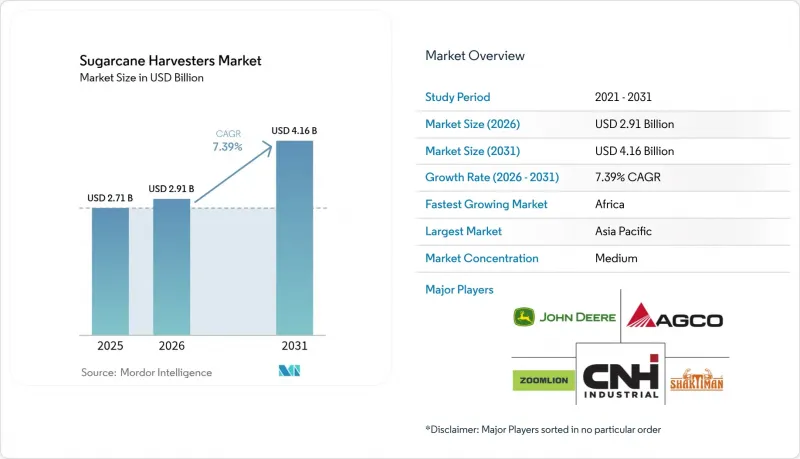
Mordor Intelligence에 의하면, 2026년 사탕수수 수확기 시장 규모는 29억 1,000만 달러로 추정되고 2025년 27억 1,000만 달러에서 확대해, 2031년에는 41억 6,000만 달러에 이를 것으로 예측됩니다.
2026년부터 2031년까지 연평균 성장률(CAGR) 7.39%로 성장할 것으로 전망됩니다.
본 보고서는 유형별(전줄기 수확기 및 초퍼/빌렛 수확기), 구동 방식별(자주식 및 트랙터 탑재/견인식), 열 처리 능력별(단열 및 다열), 지역별(북미, 유럽, 아시아태평양, 남미, 중동 및 아프리카)로 분류되어 있습니다. 시장 전망은 금액(달러) 기준으로 제시되어 있습니다.
세계의 사탕수수 수확기 시장 동향 및 인사이트
주요 생산국에서의 기계 수확 의무화
수확 전 소각을 금지하고 기계 수확을 의무화하는 정부 규제로 인해 사탕수수 생산 관행은 변화를 겪고 있습니다. 태국의 사탕수수·설탕 위원회 사무국(OCSB)은 유해한 PM2.5 미세 입자 배출량을 대폭 줄이는 것을 목표로, 2024-25년 수확 시즌 동안 수확 전 사탕수수 농장에서의 소각을 최대 90%까지 줄이겠다는 야심찬 목표를 설정했습니다. 브라질에서는 이러한 규제 도입으로 인해 노동력 수요가 64% 감소했으며, 기계 수확이 주된 방법으로 자리 잡았습니다. 이러한 규제 조치는 기계화되고 효율성을 중시하는 사탕수수 생산으로의 근본적인 전환을 보여줍니다.
지속적인 농업 인력 부족이 소형 자가주행 기계의 도입을 촉진하고 있습니다.
인구 동향의 변화와 도시로의 인구 유출로 인해 농업 인력이 감소하고 있어, 기계화 추진과 임금 인상이 요구되고 있습니다. 중국의 경우, 국가통계국(NBS) 보고서에 따르면 젊은 층이 농촌에서 도시로 이동한 결과, 2023년 도시화율은 66.16%에 달했습니다. 휴대용 수확기의 도입으로 작업 효율이 향상되었고, 수작업의 필요성이 감소했습니다. 유로스타트에 따르면, 유럽연합(EU)에서는 주로 계절 근로자로서의 이주 노동력 확보가 어려워진 것을 이유로 농업 임금이 12% 상승하여 시간당 34.4달러에 달했습니다. 이는 소형 자가주행 사탕수수 수확기의 필요성을 부각시키고 있습니다.
개발도상 지역에서의 대용량 기계의 고가
대용량 수확 장비에는 막대한 설비 투자가 필요하기 때문에 많은 소규모 농가에서는 작업의 기계화가 진행되지 않고 있습니다. 이러한 현대식 기계에 대한 접근이 제한되어 있는 것이 일부 지역에서 생산성 저하를 초래하고 있습니다. 기계 수확은 장기적으로 1톤당 비용을 절감하지만, 막대한 초기 투자가 여전히 장벽으로 작용하고 있습니다. 업계에서는 잠재적인 해결책으로 자금 조달 방안이나 협동조합 소유 모델이 검토되고 있습니다. 그러나 기술 접근성이 확대되지 않는 한, 기계화는 사탕수수 부문 내의 기존 불평등을 더욱 심화시킬 가능성이 있습니다.
부문 분석
초퍼식 수확기는 사탕수수 수확기 시장을 독점하고 있으며, 2025년 매출의 71.35%를 차지했습니다. 이러한 기계는 처리 능력이 높은 제당 공장과 호환되고, 잎이 많은 사탕수수 수확 조건에서도 뛰어난 성능을 발휘하기 때문에 대규모 농장에서 주요 선택지로 자리 잡고 있습니다. 이 기계들은 처리 능력을 높이고 가동 중지 시간을 최소화하는 개선된 블레이드와 추출 장치를 갖추고 있습니다. 스마트 시스템과의 연동을 통해 칼날의 압력이나 잔여물의 분리를 자동으로 조정할 수 있어, 다양한 밭 조건에서 작업 효율이 향상됩니다. 전줄기 수확기는 특히 고급 설탕 생산과 같이 과즙 손실을 최소화해야 하는 필수적인 전문 분야에서 시장 입지를 공고히 하고 있습니다.
전줄기 수확기는 2031년까지 프리미엄 설탕 생산자 및 과즙 보존을 중시하는 지역 수요에 힘입어 연평균 성장률(CAGR) 6.89%를 유지하고 있습니다. 밭에서의 소각 규제가 강화되는 가운데, 초퍼형 설계는 잔여물 관리 능력 향상과 막힘 현상을 줄여줍니다. 각 제조업체는 환경 규제 및 운영 요건에 대응하기 위해, 기계적 신뢰성과 정밀한 수확 능력을 겸비하고 지역별 농업적 요건에 특화된 초퍼형 구성 개발을 추진하고 있습니다.
지역별 분석
아시아태평양은 광대한 재배 면적과 정부 정책에 힘입어 사탕수수 수확기 시장 점유율의 54.65%를 차지하고 있습니다. 중국과 인도에서는 노동력 부족과 운영 비용 문제에 대응하기 위해 기계화에 대한 투자를 확대되고 있습니다. 인도에서는 마하라슈트라 주의 협동조합 제당 공장이 효율적인 수확을 보장하고 계절 근로자에 대한 의존도를 낮추기 위해 기계식 수확기에 대한 공동 융자를 실시했습니다. 태국 정부는 중규모 농가에서의 도입을 촉진하기 위해 보조금을 지급하고 있습니다. 이 지역에서는 현지 여건에 적합한 수확 기술을 개발하기 위해 현지 제조업체와 세계 장비 제조업체 간의 협력이 강화되고 있습니다.
아프리카는 현재 시장 점유율은 작지만 연평균 성장률(CAGR) 7.49%로 성장하고 있습니다. 조사에 따르면, 특히 수단에서는 수작업 수확에 비해 기계화를 통해 상당한 비용 절감이 가능함이 밝혀졌습니다. 남아프리카는 작물 관리를 위한 살포용 드론 등의 혁신 기술을 도입함으로써 기술적 진보를 이루고 있습니다. 아프리카 각국 정부는 국제 금융 기관과 협력하여 농업 기계 자금 조달 수단을 마련하고 있으며, 이는 업계 전반에서 기계화 및 데이터 기반 농업 관행으로의 전환이 진행되고 있음을 보여줍니다.
남미는 시장 내 입지를 유지하고 있으며, 브라질은 2023/24년에 7억 500만 메트르톤을 생산했습니다. 콜롬비아와 페루는 중형 수확기 모델 도입에서 브라질을 뒤따르고 있습니다. 환경 규제로 인해 농가들은 그린케인(정제되지 않은 사탕수수) 수확 및 에탄올 생산으로 방향을 전환하고 있으며, 한편 디지털 솔루션이 업무 효율 향상에 기여하고 있습니다. 북미에서는 루이지애나주의 설탕 산업이 인건비 관리 및 무역 요건 준수를 목적으로 자동화를 도입하고 있습니다. 시장 점유율은 작지만, 유럽 및 중동에서는 지속 가능한 설탕 생산과 특산 설탕 생산을 우선시하고 있어, 효율적이고 친환경적인 수확 장비에 대한 수요가 증가하고 있습니다.
기타 혜택 :
- 엑셀 형식 시장 예측(ME) 시트
- 3개월간의 애널리스트 지원
자주 묻는 질문
목차
제1장 서론
제2장 조사 방법
제3장 주요 요약
제4장 시장 구도
제5장 시장 규모 및 성장 예측
제6장 경쟁 구도
제7장 시장 기회 및 향후 전망
KTH 26.08.26According to Mordor Intelligence, the sugarcane harvesters market size in 2026 is estimated at USD 2.91 billion, growing from 2025 value of USD 2.71 billion with 2031 projections showing USD 4.16 billion, growing at 7.39% CAGR over 2026-2031.
This report is Segmented by Type (Whole-Stalk Harvesters and Chopper/Billet Harvesters), by Drive Mode (Self-Propelled and Tractor-Mounted/Towed), by Row-Capacity (Single-Row and Multi-Row), and by Geography (North America, Europe, Asia-Pacific, South America, Middle East, and Africa). The Market Forecasts are Provided in Terms of Value (USD).
Global Sugarcane Harvesters Market Trends and Insights
Mechanized-harvesting Mandates in Major Producing Countries
Government regulations prohibiting pre-harvest burning and mandating mechanical harvesting are transforming sugarcane production practices. The Office of the Cane and Sugar Board (OCSB), Thailand, has set an ambitious target to reduce the burning of sugar cane plantations prior to harvest by up to 90% during the 2024-25 harvest season, with the aim of significantly lowering harmful PM2.5 fine particle emissions. Brazil's implementation of these regulations reduced labor requirements by 64%, establishing mechanical harvesting as the primary method. These regulatory measures indicate a fundamental shift toward mechanized, efficiency-focused sugarcane production.
Permanent Farm-labor Shortages Pushing Adoption of Compact Self-propelled Units
Demographic changes and urban migration are reducing the agricultural workforce, necessitating increased mechanization and higher wages. In China, the National Bureau of Statistics (NBS) reported urbanization reached 66.16% in 2023, as younger populations moved from rural areas. The adoption of portable harvesters has enhanced operational efficiency and reduced manual labor requirements. According to Eurostat, in the European Union, agricultural wages increased by 12% to USD 34.4 per hour, primarily due to reduced seasonal immigrant labor availability, highlighting the necessity of compact self-propelled sugarcane harvester units.
High-price for High-capacity Machines in Developing Regions
The significant capital requirements for high-capacity harvesting equipment prevent many small-scale growers from mechanizing their operations. This limited access to modern machinery has led to productivity declines in several regions. While mechanical harvesting reduces per-ton costs over time, the substantial initial investment remains prohibitive. The industry is exploring financing options and cooperative ownership models as potential solutions. However, without broader access to technology, mechanization may increase existing inequalities within the sugarcane sector.
Other drivers and restraints analyzed in the detailed report include:
- Sugar-ethanol Flex-mill Expansion Demanding Higher Field-throughput Machinery
- OEM Telematics / AI Modules that Cut Billet Losses
- Limited After-sales Service Network in Rural Areas
For complete list of drivers and restraints, kindly check the Table Of Contents.
Segment Analysis
Chopper-style harvesters dominate the sugarcane harvesters market size, accounting for 71.35% of the 2025 revenue. These machines are the primary choice for large-scale operations due to their compatibility with high-tonnage mills and performance in leafy cane conditions. The machines feature upgraded blades and extractors that increase throughput and minimize downtime. Integration with smart systems enables automatic adjustment of knife pressure and trash separation, improving operational efficiency across varying field conditions. Whole-stalk harvesters retain their market presence in specialized segments where minimal juice loss is essential, particularly in premium sugar production.
Whole-stalk harvesters maintain a CAGR of 6.89%, supported by demand from premium sugar producers and regions focusing on juice retention through 2031. With increasing field burn restrictions, chopper designs provide enhanced residue management capabilities and reduced clogging. Manufacturers are developing chopper configurations specific to regional agronomic requirements, combining mechanical reliability with precise harvesting capabilities to address environmental regulations and operational requirements.
Complete Report Scope:
- By Type
- Whole-Stalk Harvesters
- Chopper / Billet Harvesters
- By Drive Mode
- Self-Propelled
- Tractor-Mounted / Towed
- By Row-Capacity
- Single-Row
- Multi-Row
- By Geography
- North America
- United States
- Canada
- Mexico
- Rest of North America
- Europe
- France
- Spain
- Portugal
- Russia
- Rest of Europe
- Asia-Pacific
- China
- India
- Thailand
- Indonesia
- Australia
- Rest of Asia-Pacific
- South America
- Brazil
- Argentina
- Colombia
- Rest of South America
- Middle East
- United Arab Emirates
- Saudi Arabia
- Turkey
- Rest of Middle East
- Africa
- South Africa
- Egypt
- Sudan
- Rest of Africa
- North America
Geography Analysis
Asia-Pacific holds a 54.65% of the Sugarcane Harvester market share, supported by extensive cultivation areas and government policies. China and India are increasing their mechanization investments to address labor shortages and operational costs. In India, Maharashtra's cooperative mills are providing joint financing for mechanical harvesters to ensure efficient harvesting and reduce reliance on seasonal workers. Thailand's government is offering subsidies to increase adoption among mid-sized farmers. The region is seeing increased collaboration between local manufacturers and global equipment makers to develop harvesting technologies suited to local conditions.
Africa, despite its current smaller market share, is growing at a 7.49% CAGR. Research indicates substantial cost reductions through mechanization compared to manual harvesting, particularly in Sudan. South Africa is advancing technologically by incorporating innovations like spray drones for crop management. African governments are working with international financial institutions to create equipment financing options, indicating an industry-wide transition to mechanized and data-based farming practices.
South America maintains its market position, with Brazil producing 705 million metric tons in 2023/24. Colombia and Peru follow Brazil in the adoption of mid-capacity harvester models. Environmental regulations are directing farmers toward green-cane harvesting and ethanol production, while digital solutions enhance operations. In North America, Louisiana's sugar industry is implementing automation to manage labor costs and comply with trade requirements. Europe and the Middle East, with smaller market shares, are prioritizing sustainable and specialty sugar production, increasing demand for efficient, environmentally conscious harvesting equipment.
- Deere & Company
- CNH Industrial N.V.
- AGCO Corporation
- Samart Kasetyon Co., Ltd.
- Zoomlion Heavy Industry Science and Technology Co., Ltd.
- Tirth Agro Technology Private Limited (Shaktiman Agro)
- TAGRM Co. Ltd.
- Grupo Jacto
- Jiangsu World Agriculture Machinery Co., Ltd (World Group)
- Kartar Agro Industries Private Limited
- Yanmar Holdings Co., Ltd.
- Guangxi LiuGong Group
- CANETEC Pty Ltd
- Wuhan Wubota Machinery Co., Ltd.
Additional Benefits:
- The market estimate (ME) sheet in Excel format
- 3 months of analyst support
TABLE OF CONTENTS
1 Introduction
- 1.1 Study Assumptions and Market Definition
- 1.2 Scope of the Study
2 Research Methodology
3 Executive Summary
4 Market Landscape
- 4.1 Market Overview
- 4.2 Market Drivers
- 4.2.1 Mechanized-harvesting Mandates in Major Producing Countries
- 4.2.2 Permanent Farm-labor Shortages Pushing Adoption of Compact Self-propelled Units
- 4.2.3 Sugar-ethanol Flex-mill Expansion Demanding Higher Field-throughput Machinery
- 4.2.4 Carbon-credit Premiums for Green-cane Harvesting (No Field-burn) Driving Equipment Spend
- 4.2.5 OEM Telematics / AI Modules that Cut Billet Losses
- 4.2.6 Multi-row Harvester Introductions Lowering Operating Cost
- 4.3 Market Restraints
- 4.3.1 High-price for High-capacity Machines in Developing Regions
- 4.3.2 Limited After-sales Service Network in Rural Areas
- 4.3.3 Cane-variety Mismatch with Existing Cutter-base Designs Raising Stool Damage
- 4.3.4 Financing Barriers as Harvesters Seldom Qualify for Green-asset Tax Credits
- 4.4 Regulatory Landscape
- 4.5 Technological Outlook
- 4.6 Porter's Five Forces Analysis
- 4.6.1 Bargaining Power of Suppliers
- 4.6.2 Bargaining Power of Buyers
- 4.6.3 Threat of New Entrants
- 4.6.4 Threat of Substitutes
- 4.6.5 Intensity of Competitive Rivalry
5 Market Size and Growth Forecasts (Value)
- 5.1 By Type
- 5.1.1 Whole-Stalk Harvesters
- 5.1.2 Chopper / Billet Harvesters
- 5.2 By Drive Mode
- 5.2.1 Self-Propelled
- 5.2.2 Tractor-Mounted / Towed
- 5.3 By Row-Capacity
- 5.3.1 Single-Row
- 5.3.2 Multi-Row
- 5.4 By Geography
- 5.4.1 North America
- 5.4.1.1 United States
- 5.4.1.2 Canada
- 5.4.1.3 Mexico
- 5.4.1.4 Rest of North America
- 5.4.2 Europe
- 5.4.2.1 France
- 5.4.2.2 Spain
- 5.4.2.3 Portugal
- 5.4.2.4 Russia
- 5.4.2.5 Rest of Europe
- 5.4.3 Asia-Pacific
- 5.4.3.1 China
- 5.4.3.2 India
- 5.4.3.3 Thailand
- 5.4.3.4 Indonesia
- 5.4.3.5 Australia
- 5.4.3.6 Rest of Asia-Pacific
- 5.4.4 South America
- 5.4.4.1 Brazil
- 5.4.4.2 Argentina
- 5.4.4.3 Colombia
- 5.4.4.4 Rest of South America
- 5.4.5 Middle East
- 5.4.5.1 United Arab Emirates
- 5.4.5.2 Saudi Arabia
- 5.4.5.3 Turkey
- 5.4.5.4 Rest of Middle East
- 5.4.6 Africa
- 5.4.6.1 South Africa
- 5.4.6.2 Egypt
- 5.4.6.3 Sudan
- 5.4.6.4 Rest of Africa
- 5.4.1 North America
6 Competitive Landscape
- 6.1 Market Concentration
- 6.2 Strategic Moves
- 6.3 Market Share Analysis
- 6.4 Company Profiles (Includes Global Level Overview, Market Level Overview, Core Segments, Financials as Available, Strategic Information, Market Rank/Share for Key Companies, Products and Services, and Recent Developments)
- 6.4.1 Deere & Company
- 6.4.2 CNH Industrial N.V.
- 6.4.3 AGCO Corporation
- 6.4.4 Samart Kasetyon Co., Ltd.
- 6.4.5 Zoomlion Heavy Industry Science and Technology Co., Ltd.
- 6.4.6 Tirth Agro Technology Private Limited (Shaktiman Agro)
- 6.4.7 TAGRM Co. Ltd.
- 6.4.8 Grupo Jacto
- 6.4.9 Jiangsu World Agriculture Machinery Co., Ltd (World Group)
- 6.4.10 Kartar Agro Industries Private Limited
- 6.4.11 Yanmar Holdings Co., Ltd.
- 6.4.12 Guangxi LiuGong Group
- 6.4.13 CANETEC Pty Ltd
- 6.4.14 Wuhan Wubota Machinery Co., Ltd.