

|
시장보고서
상품코드
2114028
에스테틱 스레드 : 시장 점유율 분석, 업계 동향 및 통계, 성장 예측(2026-2031년)Aesthetic Threads - Market Share Analysis, Industry Trends & Statistics, Growth Forecasts (2026 - 2031) |
||||||
 Mordor Intelligence
Mordor Intelligence에 의하면, 2026년 에스테틱 스레드 시장 규모는 1억 5,363만 달러로 추정되고 2025년 1억 3,901만 달러에서 확대해, 2031년에는 2억 5,314만 달러에 이를 것으로 예측됩니다.
2026년부터 2031년에 걸쳐 연평균 성장률(CAGR)은 10.49%를 나타낼 것으로 전망됩니다.
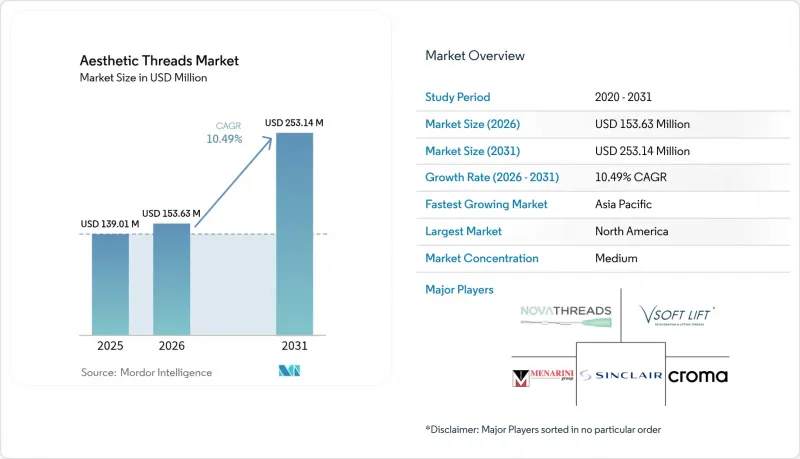
본 보고서는 실 소재(폴리디옥사논(PDO) 등), 실의 설계(바브 실 등), 적용 분야(안면 리프팅 및 회춘 치료 등), 최종 사용자(병원 및 클리닉 등), 지역(북미 등)별로 세분화되어 있습니다. 시장 전망은 금액(달러) 기준으로 제시되어 있습니다.
세계의 에스테틱 스레드 시장 동향 및 인사이트
저침습적 안면 회춘 시술에 대한 수요 급증
환자들은 긴 회복 기간이 필요하지 않고 자연스러운 결과를 가져다주는 시술을 선호하며, 실 리프팅의 만족도는 6개월 시점에서 95%, 1년 시점에서 62%에 달할 전망입니다. 젊은 소비자층은 ‘프리주베네이션(조기 회춘)’을 받아들이고 있으며, 소셜 미디어에서는 조기 시술을 당연시하는 동세대들의 경험담이 널리 퍼지고 있습니다. 스레드와 에너지 기기를 결합한 병용 요법은 침습성을 낮게 유지하면서 적응 범위를 넓히고 있습니다. 표준화된 교육을 통해 학습 곡선이 단축되고, 유해 사건이 감소함에 따라 입소문을 통한 보급이 촉진되고 있습니다. 임상 데이터를 통해 미니 리프트 수술에 필적하는 지속성이 확인됨에 따라, 미국의 특정 주에서는 보험사에 의한 일부 비용 환급이 시범적으로 도입되고 있습니다.
진피 필러를 대체하는 PDO 실의 적용 확대
PDO 실은 즉각적인 리프팅 효과에 더해, 최장 12개월간 지속되는 콜라겐 생성이라는 이중의 이점이 있습니다. 그 효과가 더 오래 지속되기 때문에 6-12개월밖에 지속되지 않는 필러에 비해 비용 대비 효과가 뛰어납니다. 또한, 실은 볼륨을 보충하는 주사제보다 직접적으로 처짐을 개선하기 때문에 볼이 지나치게 부풀어 오르는 것을 우려하는 환자들에게도 지지를 받고 있습니다. 기기 제조업체들은 바브의 배치를 개선하여 삽입을 용이하게 하고 시술 시간을 단축하고 있습니다. 영구 필러에 비해 합병증 위험이 낮기 때문에 위험을 꺼리는 고객이나 신중한 시술자들도 이 시술법으로 전환하고 있습니다.
실의 내구성에 관한 장기적인 임상 데이터는 제한적입니다.
대부분의 연구가 24개월 만에 종료되기 때문에 5년 후의 성능이나 콜라겐의 지속성에 대한 지식의 공백이 남아 있습니다. 브랜드별 흡수율의 편차는 표준화된 결과 예측을 복잡하게 만들고, 규제 당국의 감시를 더욱 엄격하게 하고 있습니다. 현재 규제 당국은 장기간에 걸친 생체 적합성 데이터 제출을 요구하고 있으며, 이로 인해 연구 개발 주기가 길어지고 신소재 시장 출시가 지연되고 있습니다. 실제 임상 증거가 축적될 때까지, 특히 PCL과 같은 새로운 고분자의 경우 시술자들은 여전히 신중한 태도를 유지하고 있습니다. 이러한 신중함으로 인해 단기적인 도입이 억제되고 있으며, 특히 공공 자금을 기반으로 하는 의료 제도에서는 보험 적용 승인 전에 확고한 종단적 데이터가 요구되기 때문에 이러한 경향이 두드러집니다.
부문 분석
폴리디옥사논은 2025년 매출의 64.98%를 차지했으며, 클리닉들이 6-8개월이라는 흡수 기간을 신뢰하고 있기 때문에 이 폴리머의 에스테틱 스레드 시장 점유율은 여전히 압도적입니다. 폴리카프로락톤은 현재 규모는 작지만, 2031년까지 연평균 성장률(CAGR) 10.72%를 나타낼 것으로 예측되며, 최대 24개월 동안 콜라겐 대사를 유지하는 장기 지속형 리프팅에 할당되는 에스테틱 스레드 시장 규모를 확대될 전망입니다. 폴리-L-젖산 실은 단계적인 리모델링을 통해 고가의 가격 책정이 정당화되는 바디 컨투어링이라는 틈새 시장을 점유하고 있으며, 폴리젖산-코-글리콜산은 단계적인 분해 일정이 요구되는 특수한 적응증에 대응하고 있습니다. 현재, 재료 선정은 폴리머의 수명 주기를 해부학적 가동성에 맞추는 데 중점을 두고 있으며, 이를 통해 의료 제공업체는 임상적 예측 가능성을 저해하지 않으면서 서비스 메뉴를 단계적으로 설정할 수 있게 되었습니다.
PDO, PCL, PLLA 실을 세트로 구성한 스타터 키트는 신규 개원한 클리닉이 리프팅 효과의 지속 기간을 환자의 회복 기간 허용 범위에 맞추어 조정하는 데 도움이 됩니다. 한편, 유럽의 바이어들 사이에서는 바이오 원료임을 증명하는 ISO-13432 인증에 대한 수요가 점점 더 높아지고 있습니다. 이에 대응하여 각 제조업체는 매립지 점유 면적을 줄이고 Z세대 소비자에게 매력적인 ‘에코 프리미엄’ 계층을 창출하는 PLA 블렌드 제품 라인을 전개하고 있습니다. 관세로 인해 아시아산 PDO 가격이 최대 54% 상승하는 가운데, 미국의 유통업체은 국내에서 압출 성형된 실을 추가함으로써 리스크를 헤지하고 공급 회복력을 높이고 있습니다. 조달처를 다각화함으로써 특정 수지의 원자재 부족 발생 시 대체 비용을 절감할 수 있으며, 무역 혼란 시에도 시술 건수를 안정적으로 유지할 수 있습니다.
2025년 지출 중 바브가 있는 제품이 42.72%를 차지했으며, 즉각적인 기계적 리프팅 효과와 시술자들 사이에서 널리 알려진 인지도 덕분에 에스테틱 스레드 시장에서 바브가 있는 제품의 점유율은 다른 형태의 제품을 계속해서 앞지르고 있습니다. 한편, 콘형 실은 다방향 그립이 실의 이동을 억제하고 시술 시간을 단축시켜 2031년까지 연평균 성장률(CAGR) 11.02%가 예상되며, 해부학적으로 시술이 어려운 부위에 클리닉에서 채택함에 따라 에스테틱 스레드 시장 내 점유율을 확대되고 있습니다. 매끄러운 모노필라멘트 실은 여전히 진피 콜라겐 유도에 있어 주류이며, 반면 나사형이나 토네이도형은 코나 눈썹 리프팅 시 필요한 회전 고정 요구를 충족시키고 있습니다.
현재 파일럿 연구 단계에 있는 하이브리드형(바브·콘 복합 구조)은 2단계 지원-초기 물리적 리프팅에 이어 장기적인 새로운 콜라겐 생성-을 약속하며, 폴리머가 체내에 머무는 기간을 연장하지 않으면서도 눈에 띄는 효과를 지속시킬 것으로 기대됩니다. 충분히 입증된 콘형 디자인의 경우, FDA 승인까지의 기간이 18개월로 단축되어 시장 출시가 가속화되고 있으며, 벤처 캐피탈의 투자도 유치하고 있습니다. 각 디자인에 맞추어 색상으로 구분된 캐뉼라는 경험이 부족한 시술자가 삽입 깊이를 판단하기 쉽게 해주며, 초기 임상시험에서는 삽입 위치 오류를 17% 감소시켰습니다. 클리닉에서는 턱선을 따라 강력한 바브가 달린 실을 사용하고, 중안면에는 더 가느다란 모노실을 조합하는 사례가 늘어나고 있어, 소모품 비용을 안정화시키면서 장력 분포를 개별적으로 조정할 수 있게 되었습니다.
지역별 분석
북미는 2025년 지출의 30.80%를 차지하며, 에스테틱 스레드 시장 규모에서 가장 규모가 큰 지역 점유율을 기록했습니다. 이는 FDA 규제가 명확하게 정립되어 있고, 1만 488곳의 메디컬 스파가 운영되고 있어 견조한 소비자 수요를 뒷받침하고 있기 때문입니다. 10%의 기본 관세에 더해 중국산 제품에 부과되는 최대 54%의 추가 관세가 공급 비용을 상승시키고 있어, 고급 클리닉은 비용을 부유층 환자에게 전가하고 있는 반면, 가격에 민감한 부문에서는 이익률을 지키기 위해 국산 PDO 제품 라인을 시험적으로 도입하고 있습니다. 따라서 성장은 폭발적이기보다는 안정적이며, 그 원동력은 첫 번째 물결의 참신함이 아니라 인구 증가와 시술 기술의 정교화에 있습니다.
아시아태평양은 2031년까지 연평균 성장률(CAGR) 12.05%로 가장 높은 성장률을 기록하고 있으며, 가처분 소득 증가와 피부 미용을 중시하는 문화적 경향이 중국의 의료 및 미용 부문을 연평균 10% 성장으로 이끌고 있습니다. 한국과 중국의 지역 제조업체들은 경쟁력 있는 가격의 콘형 및 바브형 제품을 공급하고 있으며, 무역상의 역풍에도 불구하고 합리적인 가격을 유지함으로써 현지 브랜드의 에스테틱 스레드 시장 점유율을 확대되고 있습니다. 태국과 싱가포르의 의료 관광 거점에서는 실 리프트를 다른 미용 서비스와 세트로 제공함으로써, 국경을 넘는 시술 유입을 뒷받침하고 지역 수익을 끌어올리고 있습니다.
유럽에서는 MDR에 기반한 규제 조화와 지속가능성을 중시하는 소비자 선호에 따라 클리닉들이 바이오 인증 폴리머로 전환을 추진하고 있어, 중등도의 한 자릿수 성장을 보일 것으로 전망됩니다. 남미, 중동 및 아프리카는 여전히 발전 단계에 있지만 유망한 시장이며, 중산층 인구 증가와 정부가 지원하는 의료 관광 회랑 덕분에 낮은 수준에서 두 자릿수 대의 보급률 상승이 예상됩니다. 이 지역에서는 기술 격차와 규제 감독의 불균일성이 단기적인 성장 가속화를 저해하고 있지만, 다국적 유통업체들이 시장 침투를 가속화하기 위해 턴키 방식의 교육 키트를 제공합니다.
기타 혜택 :
- 엑셀 형식 시장 예측(ME) 시트
- 3개월간의 애널리스트 지원
자주 묻는 질문
목차
제1장 서론
제2장 조사 방법
제3장 주요 요약
제4장 시장 구도
제5장 시장 규모 및 성장 예측
제6장 경쟁 구도
제7장 시장 기회 및 향후 전망
KTH 26.08.26According to Mordor Intelligence, aesthetic thread market size in 2026 is estimated at USD 153.63 million, growing from 2025 value of USD 139.01 million with 2031 projections showing USD 253.14 million, growing at 10.49% CAGR over 2026-2031.
This report is Segmented by Thread Material (Polydioxanone (PDO), and More), Thread Design (Barb Threads, and More), Application Area (Face Lift & Rejuvenation, and More), End User (Hospitals & Clinics, and More), and Geography (North America, and More). The Market Forecasts are Provided in Terms of Value (USD).
Global Aesthetic Threads Market Trends and Insights
Surge in demand for minimally invasive facial rejuvenation
Patients favor procedures that deliver natural-looking lift without long recovery, raising thread-lift satisfaction to 95% at six months and 62% at one year. Younger consumers embrace "pre-juvenation," and social platforms amplify peer testimonials that normalize early intervention. Combination therapies pairing threads with energy devices widen indications while keeping invasiveness low. Standardized training now shortens learning curves, reducing adverse events and enhancing word-of-mouth growth. As clinical data confirms durability comparable to mini-lift surgery, insurers are piloting partial reimbursements in select U.S. states.
Rising adoption of PDO threads over dermal fillers
PDO threads create a dual benefit of immediate lift plus collagen genesis that persists for up to 12 months. Their longer effect window makes procedures cost-effective relative to fillers that last 6-12 months. Threads also treat laxity more directly than volume-based injectables, appealing to patients wary of overfilled cheeks. Device makers have refined barb distribution, easing insertion and cutting chair time. Lower complication risk compared with permanent fillers persuades risk-averse clients and cautious practitioners to switch modalities.
Limited long-term clinical data on thread durability
Most studies stop at 24 months, leaving a knowledge gap on five-year performance and collagen persistence. Absorption variability among brands complicates standardized outcome forecasts and heightens regulatory scrutiny. Agencies now request extended biocompatibility data, which lengthens R&D cycles and slows novel material roll-outs. Practitioners remain cautious, especially for newer polymers like PCL, until real-world evidence accumulates. This restraint tempers near-term adoption, particularly in publicly funded healthcare systems that demand robust longitudinal data before reimbursement approval.
Other drivers and restraints analyzed in the detailed report include:
- Expansion of medical-spa chains offering thread lifts
- Regulatory approvals for barbed and cone thread designs
- Risk of post-procedure complications in un-skilled settings
For complete list of drivers and restraints, kindly check the Table Of Contents.
Segment Analysis
Polydioxanone retained 64.98% of 2025 revenue, meaning the aesthetic thread market share for this polymer remains dominant as clinics trust its six- to eight-month absorption window. Polycaprolactone, though smaller today, is forecast to post a 10.72% CAGR through 2031, expanding the aesthetic thread market size allocated to long-duration lifts that sustain collagen turnover for up to 24 months. Poly-L-lactic acid threads occupy a body-contouring niche where gradual remodeling justifies higher ticket prices, and poly-lactic-co-glycolic acid fills specialty indications demanding staged degradation timelines. Material selection now hinges on matching polymer life cycles to anatomical mobility so providers can tier service menus without lowering clinical predictability.
Starter kits that bundle PDO, PCL, and PLLA threads help new practices calibrate lift duration to patient downtime tolerance, while European buyers increasingly demand ISO-13432 certificates that verify bio-based feedstocks. Manufacturers have answered with PLA-blend lines that shrink landfill footprints and create an eco-premium tier attractive to Gen-Z consumers. As tariffs inflate Asian PDO prices by up to 54%, U.S. distributors hedge risk by adding domestically extruded threads, increasing supply resilience. Diversified sourcing lowers substitution costs if raw-material shortages hit a single resin, maintaining steady procedural volumes even during trade disruptions.
Barbed products captured 42.72% of 2025 spending, so the aesthetic thread market share of barbs continues to eclipse other geometries thanks to immediate mechanical lift and broad practitioner familiarity. Cone threads, however, are slated for an 11.02% CAGR to 2031 as their multidirectional grip curbs migration and shortens chair time, expanding their slice of the aesthetic thread market size as clinics adopt them for challenging anatomic sites. Smooth mono threads remain staples for dermal collagen induction, while screw or tornado formats serve rotational anchoring needs in nasal or brow lifts.
Hybrid barb-cone constructs now in pilot studies promise dual-stage support-early physical lift followed by prolonged neocollagenesis-which could stretch visible results without extending polymer residency. FDA clearance timelines have dropped to 18 months for well-documented cone designs, accelerating commercial roll-outs and enticing venture backing. Color-coded cannulas paired to each design simplify insertion depth for new injectors and cut placement errors by 17% in early trials. Clinics increasingly combine strong barbed vectors along the jawline with finer mono threads across the mid-face, tailoring tensile maps while keeping consumable costs stable.
Complete Report Scope:
- By Thread Material
- Polydioxanone (PDO)
- Poly-L-Lactic Acid (PLLA)
- Polycaprolactone (PCL)
- Poly-Lactic-co-Glycolic Acid (PLGA)
- By Thread Design
- Barb Threads
- Cone Threads
- Smooth / Mono Threads
- Screw / Tornado Threads
- By Application Area
- Face Lift & Rejuvenation
- Neck & Jawline Contouring
- Body Lifting (Arms, Abdomen, Buttocks, Thighs)
- Other Applications (Eyebrow, Nose Lift)
- By End User
- Hospitals & Clinics
- Ambulatory Surgical Centers
- Medical Spas & Aesthetic Centers
- Dermatology & Cosmetic Surgery Centers
- By Geography
- North America
- United States
- Canada
- Mexico
- Europe
- Germany
- United Kingdom
- France
- Italy
- Spain
- Rest of Europe
- Asia-Pacific
- China
- India
- Japan
- South Korea
- Australia
- Rest of Asia-Pacific
- South America
- Brazil
- Argentina
- Rest of South America
- Middle East and Africa
- GCC
- South Africa
- Rest of Middle East and Africa
- North America
Geography Analysis
North America commanded 30.80% of 2025 spending, making it the largest regional slice of the aesthetic thread market size as FDA clarity and 10,488 operating medical spas underpin robust consumer uptake. Baseline tariffs of 10% plus China-specific surcharges up to 54% inflate supply costs, so premium clinics pass expenses to affluent patients, while price-sensitive segments test domestic PDO lines to protect margins. Growth is therefore stable rather than explosive, anchored by demographic expansion and procedural refinements rather than first-wave novelty.
Asia-Pacific records the fastest 12.05% CAGR to 2031, fueled by rising disposable income and a cultural emphasis on skin aesthetics that propels China's medical-beauty sector toward 10% annual growth. Regional manufacturers in Korea and China supply competitively priced cone and barb designs, maintaining affordability despite trade headwinds and thus expanding the aesthetic thread market share for local brands. Medical-tourism hubs in Thailand and Singapore bundle thread lifts with other cosmetic services, supporting cross-border procedure flows that lift regional revenues.
Europe delivers steady mid-single-digit growth as regulatory harmonization under the MDR and consumer preference for sustainability shift clinics toward bio-certified polymers. South America and the Middle East & Africa remain nascent but promising, with rising middle-class populations and government-backed medical-tourism corridors fostering double-digit uptake from a low base. Skill gaps and uneven regulatory oversight in these regions temper near-term acceleration, though multinational distributors offer turnkey training kits to speed market penetration.
- Sinclair Pharma plc
- N-Finders Co., Ltd.
- HansBiomed Co., Ltd
- Croma Pharma GmbH
- Aptos
- Intraline Canada Inc.
- BENEV Company Inc.
- Sewon Cellontech Co., Ltd.
- Arch Glow Global Ltd.
- Estar Medical Ltd.
- Healux Corporation
- PDO Max Inc.
- Les Encres LLC
- Aptos International
- Invictus Surgical
- Adoderm GmbH
- SteriGraft Medical
- V Soft Lift AB
Additional Benefits:
- The market estimate (ME) sheet in Excel format
- 3 months of analyst support
TABLE OF CONTENTS
1 Introduction
- 1.1 Study Assumptions & Market Definition
- 1.2 Scope of the Study
2 Research Methodology
3 Executive Summary
4 Market Landscape
- 4.1 Market Overview
- 4.2 Market Drivers
- 4.2.1 Surge in demand for minimally-invasive facial rejuvenation
- 4.2.2 Rising adoption of PDO threads over dermal fillers
- 4.2.3 Expansion of medical-spa chains offering thread lifts
- 4.2.4 Regulatory approvals for barbed & cone thread designs
- 4.2.5 AI-assisted patient-selection tools improving outcomes
- 4.2.6 Growing preference for sustainability-certified polymers
- 4.3 Market Restraints
- 4.3.1 Limited long-term clinical data on thread durability
- 4.3.2 Risk of post-procedure complications in un-skilled settings
- 4.3.3 Intense pricing pressure from generic Asian manufacturers
- 4.3.4 Rising litigation linked to counterfeit products online
- 4.4 Value / Supply-Chain Analysis
- 4.5 Regulatory Landscape
- 4.6 Technological Outlook
- 4.7 Porter's Five Forces
- 4.7.1 Competitive Rivalry
- 4.7.2 Threat of New Entrants
- 4.7.3 Bargaining Power of Suppliers
- 4.7.4 Bargaining Power of Buyers
- 4.7.5 Threat of Substitutes
5 Market Size & Growth Forecasts (Value)
- 5.1 By Thread Material
- 5.1.1 Polydioxanone (PDO)
- 5.1.2 Poly-L-Lactic Acid (PLLA)
- 5.1.3 Polycaprolactone (PCL)
- 5.1.4 Poly-Lactic-co-Glycolic Acid (PLGA)
- 5.2 By Thread Design
- 5.2.1 Barb Threads
- 5.2.2 Cone Threads
- 5.2.3 Smooth / Mono Threads
- 5.2.4 Screw / Tornado Threads
- 5.3 By Application Area
- 5.3.1 Face Lift & Rejuvenation
- 5.3.2 Neck & Jawline Contouring
- 5.3.3 Body Lifting (Arms, Abdomen, Buttocks, Thighs)
- 5.3.4 Other Applications (Eyebrow, Nose Lift)
- 5.4 By End User
- 5.4.1 Hospitals & Clinics
- 5.4.2 Ambulatory Surgical Centers
- 5.4.3 Medical Spas & Aesthetic Centers
- 5.4.4 Dermatology & Cosmetic Surgery Centers
- 5.5 By Geography
- 5.5.1 North America
- 5.5.1.1 United States
- 5.5.1.2 Canada
- 5.5.1.3 Mexico
- 5.5.2 Europe
- 5.5.2.1 Germany
- 5.5.2.2 United Kingdom
- 5.5.2.3 France
- 5.5.2.4 Italy
- 5.5.2.5 Spain
- 5.5.2.6 Rest of Europe
- 5.5.3 Asia-Pacific
- 5.5.3.1 China
- 5.5.3.2 India
- 5.5.3.3 Japan
- 5.5.3.4 South Korea
- 5.5.3.5 Australia
- 5.5.3.6 Rest of Asia-Pacific
- 5.5.4 South America
- 5.5.4.1 Brazil
- 5.5.4.2 Argentina
- 5.5.4.3 Rest of South America
- 5.5.5 Middle East and Africa
- 5.5.5.1 GCC
- 5.5.5.2 South Africa
- 5.5.5.3 Rest of Middle East and Africa
- 5.5.1 North America
6 Competitive Landscape
- 6.1 Market Concentration
- 6.2 Market Share Analysis
- 6.3 Company Profiles {(includes Global level Overview, Market level overview, Core Segments, Financials as available, Strategic Information, Market Rank/Share for key companies, Products & Services, and Recent Developments)}
- 6.3.1 Sinclair Pharma plc
- 6.3.2 N-Finders Co., Ltd.
- 6.3.3 HansBiomed Co., Ltd
- 6.3.4 Croma Pharma GmbH
- 6.3.5 Aptos LLC
- 6.3.6 Intraline Canada Inc.
- 6.3.7 BENEV Company Inc.
- 6.3.8 Sewon Cellontech Co., Ltd.
- 6.3.9 Arch Glow Global Ltd.
- 6.3.10 Estar Medical Ltd.
- 6.3.11 Healux Corporation
- 6.3.12 PDO Max Inc.
- 6.3.13 Les Encres LLC
- 6.3.14 Aptos International
- 6.3.15 Invictus Surgical
- 6.3.16 Adoderm GmbH
- 6.3.17 SteriGraft Medical
- 6.3.18 V Soft Lift AB
7 Market Opportunities & Future Outlook
- 7.1 White-space & Unmet-Need Assessment


