

|
시장보고서
상품코드
2116133
비침습적 미용 시술 시장 : 점유율 분석, 업계 동향과 통계, 성장 예측(2025-2031년)Non-invasive Aesthetic Treatment - Market Share Analysis, Industry Trends & Statistics, Growth Forecasts (2025 - 2031) |
||||||
 Mordor Intelligence
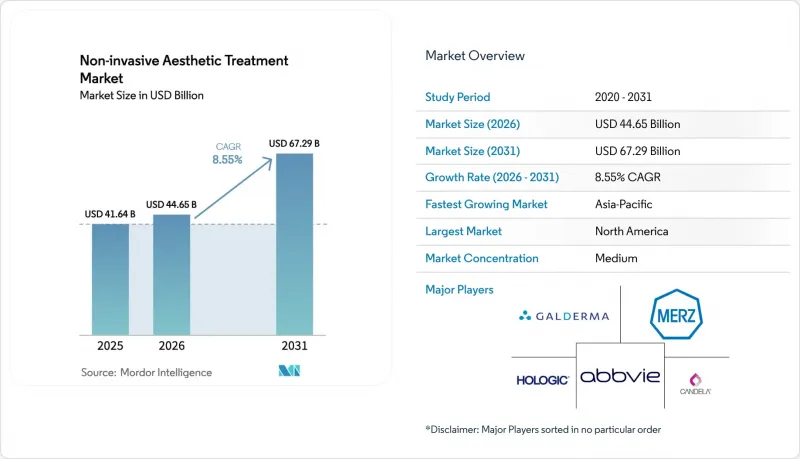
Mordor Intelligence에 의하면, 비침습적 미용 시술 시장 규모는 2025년에 416억 4,000만 달러로 평가되었고 2026년 446억 5,000만 달러에서 2031년까지 672억 9,000만 달러에 이를 것으로 예측되며, 예측 기간(2026-2031년) CAGR은 8.55%를 나타낼 전망입니다.
본 보고서는 제품 유형(주사용 신경독소(보툴리눔툭신(보톡스) A형 등), 주사용 피부 필러 등), 최종 사용자(피부과·성형외과 클리닉 등), 성별(여성, 남성),연령대(13-39세 등), 용도(안면 미용 등), 지역(북미 등)별로 분류되어 있습니다. 시장 예측은 금액(미 달러) 기준으로 제시되어 있습니다.
전 세계 비침습적 미용 시술 시장 동향 및 인사이트
팬데믹 이후 뉴로모듈레이터 및 히알루론산(HA) 필러 시술 건수의 급증
팬데믹으로 인한 활동 제한 이후 미용 시술이 회복됨에 따라, 뉴로모듈레이터 및 히알루론산(HA) 필러 시술 건수는 사상 최고 수준에 도달했습니다. 그 증거로, 애브비(AbbVie) 산하인 알러간 에스테틱스(Allergan Aesthetics) 부문은 2024년 3분기에 전년 동기 대비 8.6% 증가한 11억 달러의 매출을 기록했습니다. 이러한 상승 추세는 단순히 억눌렸던 수요가 풀린 것에 그치지 않습니다. 재택근무로 인해 카메라에 비치는 얼굴이 늘어나면서, 환자들은 더 이른 단계부터 주름 예방을 원하게 되었습니다. 국제미용성형외과학회(ISAPS)의 2024년 세계 조사에 따르면, 히알루론산 시술 건수는 633만 8,184건에 달하고, 전 세계적으로 2023년 수치 대비 5.2% 증가했습니다. 동시에, 히알루론산 필러에 도입된 새로운 가교 기술로 인해 지속성이 향상되고 주사 후 염증이 완화되고 있습니다. 또한, 동적 주름에는 보톡스를, 볼륨 감소에는 필러를 사용하는 ‘2제 병용 요법’은 시술 건수가 많은 클리닉에서 현재 표준 시술로 자리 잡고 있습니다. 미국 식품의약국(FDA)은 위조 주사제에 대한 감시를 강화하고 있으며, 2024년에는 무허가 유통업체에게 여러 차례 경고장을 발부했습니다. 이 조치는 환자의 안전을 지키고 의료진의 신뢰를 유지하기 위한 것입니다.
다중 모드 에너지 플랫폼에서의 지속적인 기기 혁신
각 제조업체는 단일 용도의 레이저에서 고주파(RF), 초음파, 전자기 근육 자극을 하나의 핸드피스에 통합한 시스템으로 전환하고 있습니다. InMode사의 ‘Morpheus8’은 2024년에 고주파 마이크로니들링 및 바디 컨투어링 모듈에 대한 승인을 획득하여, 시술자는 한 번의 시술로 피부 탄력 개선과 지방 제거를 동시에 수행할 수 있게 되었습니다. BTL사의 ‘EmSculpt Neo’는 RF 가열과 고강도 집속 전자기 펄스를 융합하여 지방을 감소시키는 동시에 근육을 형성할 수 있으며, 승인된 적응증을 복부, 엉덩이, 허벅지로 확대했습니다. 이러한 플랫폼은 고가임에도 시술 시간을 단축하여 클리닉의 처리 능력과 시간당 수익을 향상시킵니다. 단일 모달리티 레이저 기기는 공급업체가 소프트웨어 기반 계획 도구를 추가하거나 소규모 시설을 위한 유연한 자금 조달 수단을 제공하지 않는 한, 상품화 위험에 직면해 있습니다.
높은 장비 및 시술 비용이 이용 장벽으로 작용
프리미엄 에너지 치료 플랫폼의 가격은 10만-30만 달러로, 신흥 경제국의 많은 독립 클리닉에게는 감당하기 어려운 가격입니다. 1회 시술 비용이 500-1,500달러이므로, 수요는 가구 소득이 2만 달러를 초과하는 고소득층으로 한정되어 있습니다. 리스 모델은 부담을 어느 정도 덜어주지만, 신용 측면의 제약으로 인해 여전히 도입이 저해되고 있습니다. 제조업체들은 이익률은 낮아지더라도 판매 대수를 늘리기 위해, 모드 수를 줄인 엔트리 레벨 장비를 출시하고 있습니다. 주사제의 가격 책정은 비교적 관리하기 쉬운 편이지만, 그레이 마켓에서공급이 이익률을 압박하여 연구 개발(R&D) 투자를 위협하고 있습니다.
부문 분석
2025년, 주사용 신경독소는 비침습적 미용 시술 시장에서 41.35%의 점유율을 차지하며, 보톡스나 제오민과 같은 제제의 확고한 브랜드 가치를 입증하고 있습니다. 한편, 에너지 기반 플랫폼은 2031년까지 연평균 성장률(CAGR) 12.56%를 기록하며, 전체 카테고리 중 가장 높은 성장률을 보일 전망입니다. 이는 고주파와 초음파 헤드를 결합함으로써, 의료진이 한 번의 시술로 피부 처짐 개선과 지방 감소 두 가지를 모두 해결할 수 있게 되기 때문입니다. 히알루론산 필러는 가역성과 안전성으로 인해 여전히 매출의 주축을 이루고 있지만, 폴리카프로락톤 및 폴리-L-젖산 제품은 최장 24개월의 지속성을 제공하며 히알루론산(HA) 시장 점유율을 잠식하고 있습니다. 갈데르마사의 ‘스컬프트라’와 메르츠사의 ‘라디에세’는 체중 감량 후 피부 질 개선을 위한 콜라겐 자극제로 판매되고 있으며, GLP-1 치료를 받고 있는 환자층에게도 지지를 받고 있습니다. 레이저 및 IPL(고강도 펄스 광) 장치는 도입 대수 기준으로는 여전히 에너지 계열 기기의 판매를 주도하고 있지만, 색소 침착의 위험이 없는 비절제식 탄력 개선을 원하는 소비자가 늘어나면서 고주파(RF) 기기가 빠르게 추격하고 있습니다. EmSculpt로 대표되는 전자기 근육 자극 장치는 근육량을 늘리고 그 위의 지방을 감소시킴으로써 새로운 적응증을 확립했습니다. 의약품을 통한 체중 감량으로 치료 가능한 지방 덩어리가 감소함에 따라, 크라이오리포라이시스의 성장은 둔화되고 있으며, 각 벤더들은 피부 탄력 개선 기능을 추가하는 방향으로 나아가고 있습니다.
에너지 기기 공급업체들은 현재 Wi-Fi를 통해 새로운 프로토콜을 제공하는 소프트웨어 구독 서비스를 번들로 제공하며, 하드웨어 판매를 지속적인 수익원으로 전환하고 있습니다. 소모품인 마이크로니들 팁과 일회용 RF 카트리지는 ‘면도기와 면도날’과 같은 비즈니스 모델을 창출하여, 하드웨어 가격 하락이 이익률에 미치는 영향을 완화하고 있습니다. 아시아의 클리닉들이 면적과 시술 범위를 극대화하기 위해 멀티모달 타워를 도입함에 따라, 에너지 플랫폼을 활용한 비침습적 미용 시술 시장 규모는 꾸준히 확대될 것으로 예측됩니다. 중국 장비 제조업체들이 미국 및 EU의 심사를 통과한 후 수출을 확대하면 경쟁은 더욱 치열해질 것입니다. 특히, 뛰어난 조직 선택성을 내세우는 독자적인 펄스 알고리즘을 둘러싸고 지적재산권 관련 소송이 증가할 것으로 예측됩니다.
2025년 시점에서 인증된 피부과 및 성형외과 클리닉은 병원과의 제휴 관계와 복잡한 증례에 대한 대응 능력을 활용하여 비침습적 미용 시술 시장 규모의 44.23%를 차지했습니다. 한편, 메디컬 스파는 라운지 같은 쾌적한 환경과 12개월에 걸쳐 비용을 분산시키는 구독 요금제를 제공함으로써 2031년까지 연평균 성장률(CAGR) 11.57%로 성장하고 있습니다. 미국에서 주 정부 차원의 규제가 완화됨에 따라 간호사가 의사의 감독 하에 주사를 놓을 수 있게 되어 인력 공급이 확대되고 인건비가 절감되고 있습니다. 병원과 외래 진료 센터는 높은 시설 이용료로 인해 가격에 민감한 고객을 멀어지게 하여 시장 점유율이 낮은 수준에 머물고 있지만, 마취나 다직종에 의한 관리가 필요한 체중 감량 수술 후 바디 컨투어링 사례를 유치하고 있습니다.
기존 클리닉들은 스파로 이탈하기 쉬운 환자를 유지하기 위해 호화로운 인테리어, 온라인 예약, 회원제를 도입하여 대응하고 있습니다. 한편, 일부 메디컬 스파는 신뢰도를 높이고 고도의 시술에 대한 보험 적용 요건을 충족하기 위해 전문의 자격을 갖춘 피부과 전문의를 채용하고 있습니다. 각 모델이 서로의 요소를 도입함에 따라 그 경계는 모호해지고 있지만, 가격 차이는 여전히 존재합니다. 보톡스의 평균 단가는 스파에서는 1병당 10-12달러인 반면, 의사가 소유한 클리닉에서는 14-16달러입니다. 비침습적 미용 시술 시장은 핵심 의료 행위는 의사가 주도하고, 대량으로 이루어지는 유지 관리 치료는 스파 환경에서 진행하는 하이브리드 모델을 통해 안정화될 것으로 보입니다.
지역별 분석
북미는 2025년에 전 세계 매출의 36.38%를 차지하며, 미용 서비스에 대한 1인당 지출액이 여전히 가장 높은 지역입니다. 훈련을 받은 시술자의 밀집된 네트워크와 환자를 위한 유연한 자금 조달 수단에 대한 접근성 덕분에 신기술의 급속한 보급이 가능해지고 있습니다. GLP-1 제제의 처방이 체중 감량 후 바디 컨투어링으로의 의뢰 급증을 뒷받침하고 있으며, 내분비과 전문의와 1차 진료 의사를 미용 의료의 고객 확보 과정에 참여시키고 있습니다. 뉴욕이나 로스앤젤레스와 같은 도시에서는 환자 유치 비용이 높고, 소비자들이 회원제 과금 체계를 수용하고 있어 메드스파의 구독 모델이 활발하게 전개되고 있습니다. 규제 당국의 감독은 우호적이지만, 위조 주사제를 판매하는 무면허 사업자에 대한 단속이 강화되고 있습니다.
유럽에서는 레이저 및 RF 기기 도입 기반이 성숙해 있지만, 의료기기 규정(MDR)으로 인해 승인 절차가 장기화되면서 기존 사업자들에게는 규정 준수 측면에서 우위가 발생하고 있습니다. 시술 건수 면에서는 독일, 프랑스, 영국이 선두를 차지하고 있지만, 이탈리아와 스페인에서는 얼굴의 미관을 중시하는 문화적 배경으로 인해 필러에 대한 수요가 견조합니다. 동유럽은 가구 소득 증가와 국경을 초월한 의료 종사자 연수에 힘입어 부상하고 있지만, 가격에 대한 민감도는 여전히 높은 상태입니다. 전략적 과제는 환자의 안전성을 엄격히 확보하면서도 혁신의 속도를 동시에 유지하여, 유럽이 아시아나 미국에 기술적 리더십을 내주지 않도록 하는 것입니다.
아시아태평양은 중국, 인도, 동남아시아의 중산층 확대에 더해, 의료기기 승인을 신속화하는 규제 조화에 힘입어 2031년까지 연평균 성장률(CAGR) 10.45%라는 지역 내 최고 성장률을 달성할 전망입니다. 한국은 정부가 지원하는 의료 관광 프로그램의 뒷받침을 받아 계속해서 세계 최고의 시술 밀도를 유지하고 있습니다. 중국 국가의약품감독관리국은 2024년에 RF(고주파) 및 초음파 기기에 대한 승인을 여러 건 내주며, 해외 브랜드 시장 진입 기간을 단축할 것으로 보이는 개방적인 자세를 보였습니다. 인도에서는 2선 도시가 차세대 성장 분야로 부상하고 있으나, 의료 인력 부족과 가격에 대한 민감성으로 인해 고가 장비 도입이 억제되고 있습니다. 일본에서는 절제 없는 회춘을 원하는 고령층 사이에서 비절개형 레이저에 대한 수요가 견조하게 유지되고 있습니다. 호주는 엄격한 규제 기준과 바디 컨투어링 기술의 높은 보급률로 인해 선진국 그룹을 마무리했습니다. 중동 및 아프리카는 시장이 아직 발전 단계에 있지만, 두바이가 ‘걸프 지역의 베벌리힐스’가 되기 위해 추진하는 노력의 혜택을 받고 있어 국제적인 외과 의사와 투자를 유치하고 있습니다. 브라질과 아르헨티나를 필두로 한 남미는 성형 수술에 대한 문화적 수용도가 높은 것을 배경으로 성장하고 있지만, 환율 변동의 영향을 받기 쉬운 상황이 지속되고 있습니다.
기타 혜택:
- 엑셀 형식 시장 예측(ME) 시트
- 3개월간의 애널리스트 지원
자주 묻는 질문
목차
제1장 서론
제2장 조사 방법
제3장 주요 요약
제4장 시장 구도
제5장 시장 규모와 성장 예측
제6장 경쟁 구도
제7장 시장 기회와 향후 전망
JHS 26.08.28According to Mordor Intelligence, the non-invasive aesthetic treatment market size was valued at USD 41.64 billion in 2025 and is estimated to grow from USD 44.65 billion in 2026 to reach USD 67.29 billion by 2031, at a CAGR of 8.55% during the forecast period (2026-2031).
This report is Segmented by Product Type (Injectable Neurotoxins [Botulinum Toxin Type A and More], Injectable Dermal Fillers, and More), End User (Dermatology & Plastic-Surgery Clinics, and More), Gender (Female, Male), Age Group (13-39, and More), Application (Facial Aesthetics, and More), and Geography (North America, and More). Market Forecasts are Provided in Terms of Value (USD).
Global Non-invasive Aesthetic Treatment Market Trends and Insights
Surging Procedure Volumes of Neuromodulators & HA Fillers Post-Pandemic
The rebound of elective aesthetics after pandemic shutdowns has driven neuromodulator and hyaluronic acid (HA) filler sessions to record levels, evidenced by AbbVie's Allergan Aesthetics unit booking USD 1.1 billion in Q3 2024 revenue, an 8.6% year-over-year increase. This upswing is more than pent-up demand; remote work keeps faces on camera, prompting patients to pursue wrinkle prevention earlier in life. According to the International Society of Aesthetic Plastic Surgery (ISAPS) 2024 global survey, the number of hyaluronic acid procedures reached 6,338,184, marking a 5.2% rise from 2023 figures worldwide. Concurrently, new cross-linking chemistries in HA fillers increase persistence and reduce post-injection inflammation, and dual-product protocols-utilizing neurotoxin for dynamic lines and filler for volume loss-are now routine in high-volume practices. The U.S. Food and Drug Administration has heightened surveillance of counterfeit injectables, issuing multiple warning letters in 2024 to unlicensed distributors, a move that safeguards patient safety and maintains clinician confidence.
Continuous Device Innovation In Multi-Modal Energy Platforms
Manufacturers are migrating from single-purpose lasers to systems that blend radiofrequency, ultrasound, and electromagnetic muscle stimulation in one handpiece. InMode's Morpheus8 gained 2024 clearance for RF microneedling plus body-contouring modules, letting practitioners tighten skin and debulk fat in the same appointment. BTL's EmSculpt Neo fuses RF heating with high-intensity focused electromagnetic pulses to cut fat and build muscle simultaneously, expanding cleared indications to abdomen, buttocks, and thighs. These platforms command premium pricing yet shorten chair time, improving clinic throughput and revenue per hour. Single-modality lasers now face commoditization risk unless vendors add software planning tools or flexible financing for smaller sites.
High Device And Treatment Costs Limit Access
Premium energy platforms cost USD 100,000-300,000, putting them beyond reach for many independent clinics in emerging economies. Session fees of USD 500-1,500 restrict demand to high-income groups where household income exceeds USD 20,000. Leasing models ease some burden yet remain hindered by credit constraints. Manufacturers are releasing entry-level devices with fewer modes to gain volume, even at lower margins. Injectable pricing is comparatively manageable, but gray-market supply cuts margins and threatens R&D investment.
Other drivers and restraints analyzed in the detailed report include:
- Rising Disposable Income And Beauty Consciousness In Emerging Asia-Pacific
- AI-Driven Facial Mapping Enabling Personalized Protocols
- Stringent, Patch-Work Regulations Delay Launches
For complete list of drivers and restraints, kindly check the Table Of Contents.
Segment Analysis
Injectable neurotoxins commanded 41.35% of the non-invasive aesthetic treatment market share in 2025, underscoring entrenched brand equity for formulations such as Botox and Xeomin. Energy-based platforms, however, will post a 12.56% CAGR through 2031, the fastest among all categories, as bundled radiofrequency and ultrasound heads help clinicians address skin laxity and adipose reduction in a single visit. Hyaluronic acid fillers remain the revenue anchor because of reversibility and safety, yet polycaprolactone and poly-L-lactic acid products offer up to 24-month persistence, drawing share from HA. Galderma's Sculptra and Merz's Radiesse are marketed as collagen stimulators for post-weight-loss skin quality, resonating with GLP-1 patients. Laser and intense pulsed light units still dominate energy sales by installed base, but radiofrequency devices are closing fast as consumers seek non-ablative tightening without pigment risk. Electromagnetic muscle stimulators, epitomized by EmSculpt, created a fresh indication by building muscle mass and trimming overlying fat. Cryolipolysis growth is moderating as pharmaceutical weight loss shrinks treatable fat pockets, pushing vendors toward adjunctive skin-tightening features.
Energy vendors now bundle software subscriptions that unlock new protocols over Wi-Fi, turning hardware sales into recurring revenue streams. Consumable microneedle tips and single-use RF cartridges create razor-razor-blade economics, cushioning the margin impact of hardware price erosion. The non-invasive aesthetic treatment market size for energy platforms is projected to climb steadily as Asian clinics adopt multimodal towers to maximize floor space and procedure range. Competition will heighten when Chinese device makers scale exports after clearing U.S. and EU audits. Intellectual-property litigation is expected to rise, especially around proprietary pulse algorithms that claim superior tissue selectivity.
Board-certified dermatology and plastic-surgery clinics held 44.23% of the non-invasive aesthetic treatment market size in 2025, leveraging hospital affiliations and complex case-handling capability. Yet medical spas are expanding at an 11.57% CAGR to 2031 by offering lounge-style environments and subscription pricing that spreads costs over twelve months. Relaxed U.S. state supervision rules permit nurse practitioners to inject under physician oversight, widening labor supply and lowering wage expenses. Hospitals and ambulatory centers sit at the low end of share because higher facility fees deter price-sensitive clients, although they attract post-bariatric body-contouring cases requiring anesthesia and multidisciplinary care.
Traditional clinics are fighting back by adopting luxury interiors, online scheduling, and membership programs to retain patients who might defect to spas. Some med-spas, in turn, recruit board-certified dermatologists to boost credibility and qualify for advanced procedure insurance. The competitive line is blurring as each model borrows elements from the other, yet pricing gaps persist: average neurotoxin vial costs USD 10-12 per unit in spas versus USD 14-16 in physician-owned clinics. The non-invasive aesthetic treatment market will likely stabilize with a hybrid model where core medical acts remain physician-led while high-volume maintenance treatments sit in spa settings.
Complete Report Scope:
- By Product Type
- Injectables - Neurotoxins
- Botulinum Toxin Type A
- Botulinum Toxin Type B
- Injectables - Dermal Fillers
- Hyaluronic Acid
- Calcium Hydroxylapatite
- Poly-L-Lactic Acid
- Collagen & PMMA Microspheres
- Polycaprolactone / Other Biostimulators
- Energy-Based Systems
- Laser / IPL Platforms
- Radiofrequency Devices
- Ultrasound / HIFU Platforms
- Cryolipolysis Systems
- Electro-Magnetic Muscle Stimulators
- Topical & Skin Booster Products
- Injectables - Neurotoxins
- By End User
- Dermatology & Plastic-Surgery Clinics
- Medical Spas
- Hospitals & Ambulatory Centers
- By Gender
- Female
- Male
- By Age Group
- 13 - 39 Years
- 40 - 54 Years
- 55 - 69 Years
- 70+ Years
- By Application / Treatment Area
- Facial Aesthetics
- Body Contouring & Fat Reduction
- Skin Rejuvenation / Pigment & Texture
- Hair & Scalp Treatments
- Intimate Wellness (Vaginal / Penile)
- By Geography
- North America
- United States
- Canada
- Mexico
- Europe
- Germany
- France
- United Kingdom
- Italy
- Spain
- Rest of Europe
- Asia-Pacific
- China
- Japan
- India
- South Korea
- Australia
- Rest of Asia-Pacific
- Middle East & Africa
- GCC
- South Africa
- Rest of Middle East & Africa
- South America
- Brazil
- Argentina
- Rest of South America
- North America
Geography Analysis
North America generated 36.38% of global revenue in 2025 and remains the highest per-capita spender on aesthetic services. A dense network of trained practitioners and access to flexible patient financing enable rapid uptake of new technologies. GLP-1 prescriptions are fueling a surge in post-weight-loss body-contouring referrals, bringing endocrinology and primary-care physicians into the aesthetic funnel. Med-spa subscription models thrive in cities such as New York and Los Angeles, where patient acquisition costs are steep and consumers accept membership billing. Regulatory oversight is favorable but increasingly targets unlicensed operators selling counterfeit injectables.
Europe maintains a mature installed base of laser and RF devices, yet the Medical Device Regulation has lengthened approval pathways, giving incumbents a compliance advantage. Germany, France, and the United Kingdom lead procedure volumes, while Italy and Spain post robust filler demand due to cultural emphasis on facial aesthetics. Eastern Europe is emerging, aided by rising household incomes and cross-border practitioner training, although price sensitivity remains high. The strategic challenge is balancing patient-safety rigor with innovation speed so that Europe does not cede technology leadership to Asia or the United States.
Asia-Pacific will deliver the fastest regional CAGR of 10.45% through 2031, propelled by expanding middle classes in China, India, and Southeast Asia alongside regulatory harmonization that speeds device clearance. South Korea continues to top global procedure density, bolstered by government-supported medical-tourism programs. China's National Medical Products Administration issued multiple RF and ultrasound approvals in 2024, signaling an openness that should shorten market entry for foreign brands. India's tier-2 cities form the next frontier, though practitioner shortages and price sensitivity temper high-end device adoption. Japan sees steady demand for non-ablative lasers among an aging population seeking subtle rejuvenation. Australia rounds out the developed cohort with strict regulatory standards and high uptake of body-contouring technologies. The Middle East and Africa are nascent but benefit from Dubai's push to become the Beverly Hills of the Gulf, attracting international surgeons and investment. South America, led by Brazil and Argentina, rides cultural acceptance of cosmetic enhancement yet remains vulnerable to currency swings.
- Abbvie
- Alma Lasers
- Bausch Health (Solta Medical)
- BTL
- Candela Medical
- Cutera
- Daewoong Pharma
- Galderma
- Hologic (Cynosure)
- Hugel Inc.
- InMode Ltd.
- Ipsen
- Lumenis
- Merz Pharma
- Revance Therapeutics
- Sciton
- Sinclair Pharma
- Teoxane SA
- Venus Concept
Additional Benefits:
- The market estimate (ME) sheet in Excel format
- 3 months of analyst support
TABLE OF CONTENTS
1 Introduction
- 1.1 Study Assumptions & Market Definition
- 1.2 Scope of the Study
2 Research Methodology
3 Executive Summary
4 Market Landscape
- 4.1 Market Overview
- 4.2 Market Drivers
- 4.2.1 Surging Procedure Volumes of Neuromodulators & HA Fillers Post-Pandemic
- 4.2.2 Continuous Device Innovation in Multi-Modal Energy Platforms
- 4.2.3 Rising Disposable Income & Beauty Consciousness in Emerging APAC
- 4.2.4 AI-Driven Facial Mapping Enabling Hyper-Personalized Protocols
- 4.2.5 Subscription-Based Med-Spa Programmes Boosting Repeat Utilization
- 4.2.6 Post-Semaglutide Body-Contouring Demand Spike
- 4.3 Market Restraints
- 4.3.1 High Device & Treatment Costs Limit Access
- 4.3.2 Stringent, Patch-Work Regulations Delay Launches
- 4.3.3 Counterfeit Injectables Eroding Clinician & Patient Trust
- 4.3.4 Shortage of Trained Practitioners Outside Tier-1 Cities
- 4.4 Value / Supply-Chain Analysis
- 4.5 Regulatory Landscape
- 4.6 Technological Outlook
- 4.7 Porter's Five Forces
- 4.7.1 Threat of New Entrants
- 4.7.2 Bargaining Power of Suppliers
- 4.7.3 Bargaining Power of Buyers
- 4.7.4 Threat of Substitutes
- 4.7.5 Intensity of Competitive Rivalry
5 Market Size & Growth Forecasts (Value in USD)
- 5.1 By Product Type
- 5.1.1 Injectables - Neurotoxins
- 5.1.1.1 Botulinum Toxin Type A
- 5.1.1.2 Botulinum Toxin Type B
- 5.1.2 Injectables - Dermal Fillers
- 5.1.2.1 Hyaluronic Acid
- 5.1.2.2 Calcium Hydroxylapatite
- 5.1.2.3 Poly-L-Lactic Acid
- 5.1.2.4 Collagen & PMMA Microspheres
- 5.1.2.5 Polycaprolactone / Other Biostimulators
- 5.1.3 Energy-Based Systems
- 5.1.3.1 Laser / IPL Platforms
- 5.1.3.2 Radiofrequency Devices
- 5.1.3.3 Ultrasound / HIFU Platforms
- 5.1.3.4 Cryolipolysis Systems
- 5.1.3.5 Electro-Magnetic Muscle Stimulators
- 5.1.4 Topical & Skin Booster Products
- 5.1.1 Injectables - Neurotoxins
- 5.2 By End User
- 5.2.1 Dermatology & Plastic-Surgery Clinics
- 5.2.2 Medical Spas
- 5.2.3 Hospitals & Ambulatory Centers
- 5.3 By Gender
- 5.3.1 Female
- 5.3.2 Male
- 5.4 By Age Group
- 5.4.1 13 - 39 Years
- 5.4.2 40 - 54 Years
- 5.4.3 55 - 69 Years
- 5.4.4 70+ Years
- 5.5 By Application / Treatment Area
- 5.5.1 Facial Aesthetics
- 5.5.2 Body Contouring & Fat Reduction
- 5.5.3 Skin Rejuvenation / Pigment & Texture
- 5.5.4 Hair & Scalp Treatments
- 5.5.5 Intimate Wellness (Vaginal / Penile)
- 5.6 By Geography
- 5.6.1 North America
- 5.6.1.1 United States
- 5.6.1.2 Canada
- 5.6.1.3 Mexico
- 5.6.2 Europe
- 5.6.2.1 Germany
- 5.6.2.2 France
- 5.6.2.3 United Kingdom
- 5.6.2.4 Italy
- 5.6.2.5 Spain
- 5.6.2.6 Rest of Europe
- 5.6.3 Asia-Pacific
- 5.6.3.1 China
- 5.6.3.2 Japan
- 5.6.3.3 India
- 5.6.3.4 South Korea
- 5.6.3.5 Australia
- 5.6.3.6 Rest of Asia-Pacific
- 5.6.4 Middle East & Africa
- 5.6.4.1 GCC
- 5.6.4.2 South Africa
- 5.6.4.3 Rest of Middle East & Africa
- 5.6.5 South America
- 5.6.5.1 Brazil
- 5.6.5.2 Argentina
- 5.6.5.3 Rest of South America
- 5.6.1 North America
6 Competitive Landscape
- 6.1 Market Concentration
- 6.2 Market Share Analysis
- 6.3 Company Profiles (includes Global level Overview, Market level overview, Core Segments, Financials as available, Strategic Information, Market Rank/Share for key companies, Products and Services, and Recent Developments)
- 6.3.1 AbbVie
- 6.3.2 Alma Lasers
- 6.3.3 Bausch Health (Solta Medical)
- 6.3.4 BTL Industries
- 6.3.5 Candela Medical
- 6.3.6 Cutera Inc.
- 6.3.7 Daewoong Pharma
- 6.3.8 Galderma SA
- 6.3.9 Hologic (Cynosure)
- 6.3.10 Hugel Inc.
- 6.3.11 InMode Ltd.
- 6.3.12 Ipsen Pharma
- 6.3.13 Lumenis
- 6.3.14 Merz Aesthetics
- 6.3.15 Revance Therapeutics
- 6.3.16 Sciton
- 6.3.17 Sinclair Pharma
- 6.3.18 Teoxane SA
- 6.3.19 Venus Concept
7 Market Opportunities & Future Outlook
- 7.1 White-Space & Unmet-Need Assessment


